Advanced Financial Analysis
From corporate governance to currency crises, from DCF valuation to the political economy of austerity — build the analytical tools of Aswath Damodaran and understand whose interests they serve through the lens of Mark Blyth. CFA Level 2 rigor meets political economy.
What You Will Learn
Valuation Mastery
DCF, relative valuation, and real options — the complete analytical toolkit for valuing any business, from startups to distressed firms.
Political Economy Lens
Every financial model encodes assumptions about power. Mark Blyth's framework reveals who benefits, who pays, and whose society bears the cost.
International Finance
Currency crises, cross-border valuation, and the impossible trinity — finance as it actually operates across borders, not just in textbooks.
Curated Video Library
6 curated videos to explore — plus 18 more matched to individual units inside the course

Barry Eichengreen presents the full Exorbitant Privilege thesis in this 59-minute Boston GBH Forum lecture: how the dollar's role as the global reserve currency emerged from Bretton Woods, why the system survived the 1971 Nixon Shock that should have killed it, and what the structural conditions are that would either entrench or unwind dollar hegemony. Eichengreen is the Berkeley monetary historian who wrote the book on this question, and his lecture format is exactly what the course's Units 13 and 14 require: not a market-news take on dollar dominance but the historical institutional analysis that explains why the question even exists. The Q&A is particularly valuable -- audience members push back on de-dollarization scenarios, BRICS settlement systems, and CBDC competition, and Eichengreen's answers model how a serious scholar engages contested predictions without retreating to either certainty or agnosticism. For students arriving from the Financial Markets prerequisite (which used the Heinrich-Böll central banking talk and the Mark Blyth Trumpism lecture as its monetary anchors), Eichengreen gives them the technical historical apparatus to push the analysis to graduate level.

Amartya Sen presents the capabilities framework -- his Nobel-winning alternative to utility-maximization as the foundation of welfare economics -- in this 77-minute Chicago Law School lecture. The capabilities approach reframes economic analysis around what people are actually able to do and be, rather than around their preferences or income, and Sen's lecture is the most rigorous primary-source presentation of the framework available on the open internet. For Unit 17 (Choosing Your Philosophy) this is essential: Sen offers students an alternative to the utility-and-revealed-preference epistemology that quietly underwrites most of modern finance, and watching him argue with Chicago Law faculty about how the framework operationalizes is more valuable than any textbook summary. Sen is also the most gracious of the great heterodox economists -- his rhetorical posture (never dismissive of the orthodox apparatus, always asking what it leaves out) is the model students need for their own philosophy work in this unit.

Thomas Piketty delivers the core Capital in the Twenty-First Century argument in this 74-minute Institute for Advanced Study lecture. The pedagogical value of the IAS venue is exactly what this course needs: Piketty is presenting to peer economists, not to a general audience, so the lecture preserves the technical density that mass-market summaries strip out. He builds the r > g argument from the long-run capital share data, walks through the historical taxation regimes that compressed and then unleashed wealth inequality, and engages directly with the methodological criticisms that have circulated since the book's publication. For Units 16 and 17 of this course -- which integrate political economy analysis into investment philosophy -- Piketty is one of the three or four scholars who has shifted the entire frame of how serious finance professionals think about long-run wealth distribution. Students who absorb this lecture will arrive at the philosophy unit with the empirical apparatus they need to evaluate whether their investment philosophy reproduces or contests the dynamics Piketty documents.

Mariana Mazzucato delivers the full Value of Everything argument in this 87-minute UCL Institute for Innovation and Public Purpose lecture. The argument cuts to the foundation of valuation theory: the distinction between value creation and value extraction has been quietly erased in modern economics, with the consequence that finance and rentier sectors are recorded in GDP as 'producing value' even when they are extracting it from the productive economy. For Unit 1 (What Is a Corporation For?) and Unit 17 (Choosing Your Philosophy), Mazzucato gives students a theoretical apparatus the prerequisite course did not provide: the value-creation framework that lets them evaluate not just whether their investments will be profitable but whether they create or extract value. The lecture's UCL setting matters -- this is the same institute where Mazzucato leads the Mission Economy research program, and the Q&A surfaces how the framework is being operationalized in EU industrial policy, NHS procurement, and public-sector innovation strategy. For students who arrive at this course thinking value-extraction critique is the province of activists rather than economists, Mazzucato's institutional credibility is part of the pedagogy.
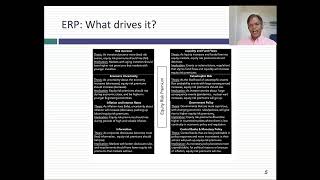
Aswath Damodaran is the central figure of this course -- his NYU Stern lectures form the spine of seven unit companions -- and this 42-minute talk is the ideal entry point. Damodaran walks through what equity risk premiums actually represent, why the standard estimation methods (historical, implied, country-risk-adjusted) produce wildly different numbers, and why every analyst who quotes a single 'right' number is hiding the political and methodological choices baked into their estimate. For a course whose Unit 2 is titled 'The Price of Risk' and whose framing essential question is 'whose risks get priced into markets and whose get externalized,' this is the canonical primary source. Watching Damodaran think through the equity risk premium -- where he commits to a number, where he explicitly refuses to, where he flags uncertainty -- is the most valuable demonstration of valuation epistemology available on the open internet. Students who watch this once will internalize the Damodaran method as a working practice, not a textbook abstraction.
Ludovic Phalippou is the Oxford Säid finance professor who has spent his career documenting the systematic gap between private equity's marketed returns and its actual investor outcomes after fees. This 65-minute Rational Reminder interview is the most accessible long-form primary source on his research available, and it covers the technical apparatus -- IRR manipulation through subscription line financing, the J-curve, the asymmetry of carry economics, the ways performance is benchmarked against listed equivalents -- with the rigor a graduate-level finance course requires. For Unit 12 (Alternative Investments and the Shadow Banking System) this is the canonical primary source. Phalippou is also the most rhetorically careful of the PE critics: he is not arguing the asset class is fraudulent but that the institutional incentive structure systematically misleads sophisticated allocators (university endowments, public pensions) about realized returns. Students who absorb this interview will be able to read PE marketing materials with the technical literacy to identify exactly where the headline numbers depart from the investor experience -- a skill the prerequisite course did not develop.
Explore These Channels
Aswath Damodaran's NYU Stern channel is the single most valuable resource in finance education on the open internet. He posts every session of his MBA Corporate Finance, Valuation, and Investment Philosophies courses in their entirety, free, with the same materials NYU students pay tuition to access. For Advanced Financial Markets, his channel is the primary source for seven units (2, 4, 5, 6, 7, 8, 17) -- the technical valuation core of the course. His pedagogical method is exactly what the course requires: he commits to numbers, shows his work, flags where his judgment differs from the textbook consensus, and updates his estimates publicly each January in his 'data update' series. Students who follow Damodaran across the course will, by the end, have access to a complete graduate-level valuation curriculum they can revisit any time. His channel is the antidote to finance pedagogy that hides behind formulas: Damodaran teaches valuation as a structured confrontation with uncertainty, which is the course's central thesis.
Chicago Booth Review is the editorial channel of the University of Chicago Booth School of Business, and it is where the most consequential debates in financial economics get aired in their original form. The signature 'Are markets efficient?' debate between Eugene Fama (efficient markets) and Richard Thaler (behavioral finance) -- both Chicago Booth faculty, both Nobel laureates, in fundamental disagreement -- is the primary source for Unit 9. The channel also features short-form pieces from Raghuram Rajan, John Cochrane, Luigi Zingales, Anil Kashyap, and the broader Chicago monetary and finance faculty. For Advanced Financial Markets, Chicago Booth Review is the indispensable counterweight to the political-economy framings that dominate other unit companions: students need to hear the orthodox case in its strongest form before they can evaluate the heterodox alternatives, and Chicago Booth is where the orthodox case is made by the people who built it.
The Peterson Institute for International Economics is Washington's premier think tank for international monetary economics, and its YouTube channel hosts the long-form lectures and policy seminars that working international finance practitioners actually watch. For Units 10, 13, and 14 -- bond markets, currency markets, and cross-border valuation -- Peterson is the primary source for analysts of sovereign debt (Carmen Reinhart's 'Decade of Debt' lecture is the canonical example), exchange rate regimes (Maurice Obstfeld, Olivier Blanchard, Adam Posen), and capital flow dynamics. The channel's editorial discipline matches the course's needs: full-length speaker series talks with extensive Q&A, no editorial spin overlay, transcripts of policy panels. Peterson is also where the Council on Foreign Relations / IMF / Treasury crowd presents their working papers in real time, so students who follow the channel will encounter the policy debate as it is being made by the people making policy.
MIT OpenCourseWare's finance and applied mathematics offerings are the gold standard for free, complete, university-grade course content. The 18.S096 'Topics in Mathematics with Applications in Finance' course is the most direct match for Unit 18's quantitative methods review, and the broader OCW catalog includes complete sequences in probability (6.041), linear algebra (18.06), and computational finance (15.401) that students can use as reference material throughout the course. For students who come to Advanced Financial Markets with weak quantitative foundations, OCW is the bridge that lets them work asynchronously to fill the gaps without slowing down the cohort. The MIT pedagogical signature -- explicit problem sets, full lecture transcripts, no skipped derivations -- is exactly what graduate-level finance instruction requires when the course itself focuses on judgment rather than mathematical mechanics.