Comparative Religions
What is wrong with the human condition, and what would fix it? Each great tradition asks a version of this question and gives a genuinely different answer. Ten units of religious literacy — taught about, never devotionally: the full range of positions declared before any tradition makes its case, the traditions in their own terms, and the civic skill of understanding neighbors you may disagree with.
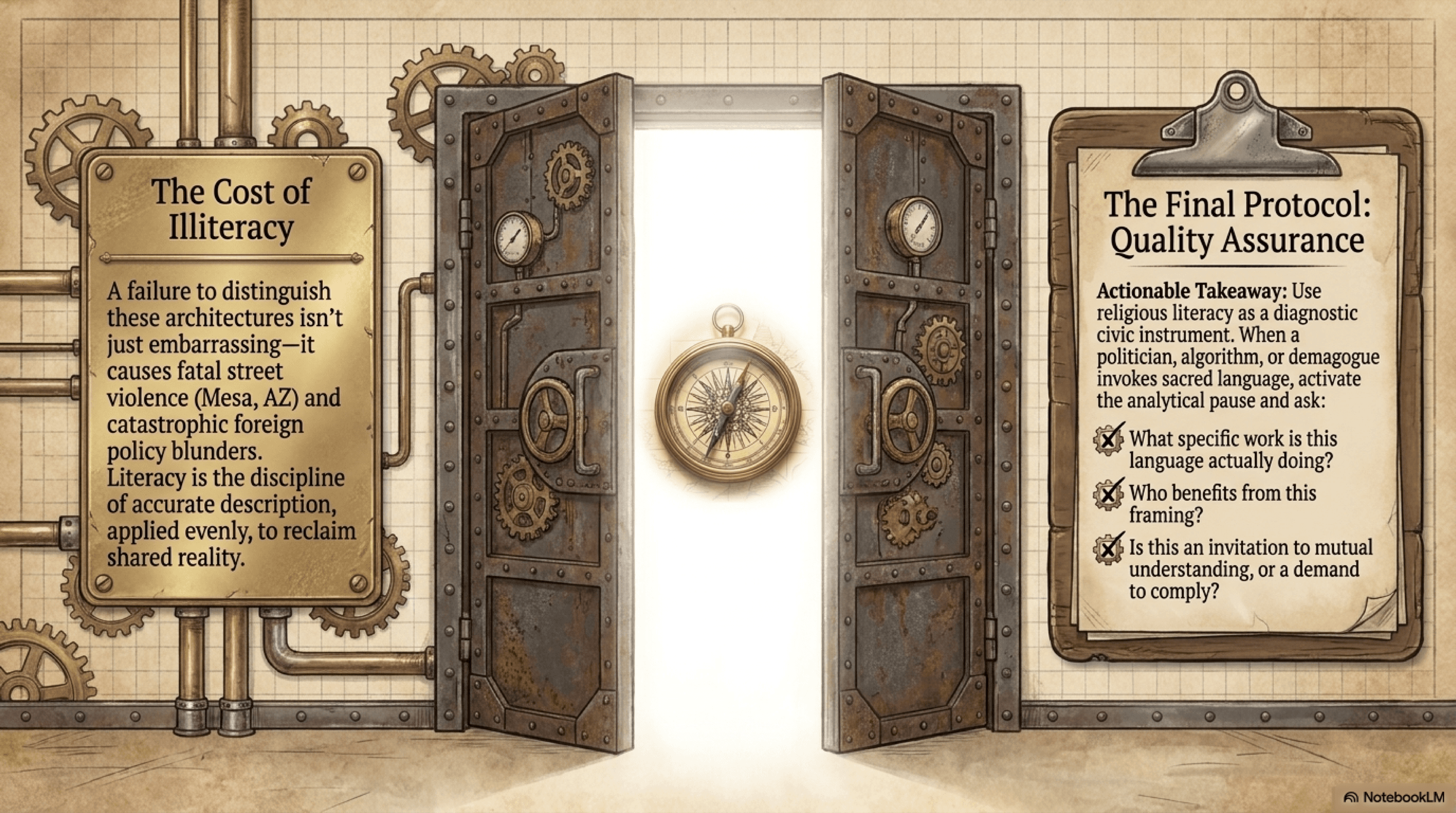
A failure to tell traditions apart has a body count and a policy cost — the Sodhi murder in Mesa, Arizona and the Sunni-Shia gap in post-invasion Iraq planning, both covered in Unit 1.
The Synthesis Matrix: One Instrument, Three Architectures
The comparative grid this course keeps as a running instrument, built one tradition at a time and carried forward to every architecture that follows.
Units 4 through 6 build the same three-row grid for Judaism, Christianity, and Islam — the primary human problem each tradition diagnoses, the mechanism of cure each engineers, and where each locates operational authority. The point is not a chart that makes the traditions interchangeable. Judaism's exile and covenant, Christianity's sin and grace, and Islam's pride and submission are three distinct architectures sharing a historical foundation, not three dialects of one machine — Prothero's difference thesis from Unit 1, made operational.
Once built, the same instrument travels: Hinduism's cycle and release, Buddhism's suffering and awakening, and the traditions later units show straining the category of "religion" altogether all get read through the identical three questions. Students keep the matrix, not a pile of disconnected facts about each tradition in turn.
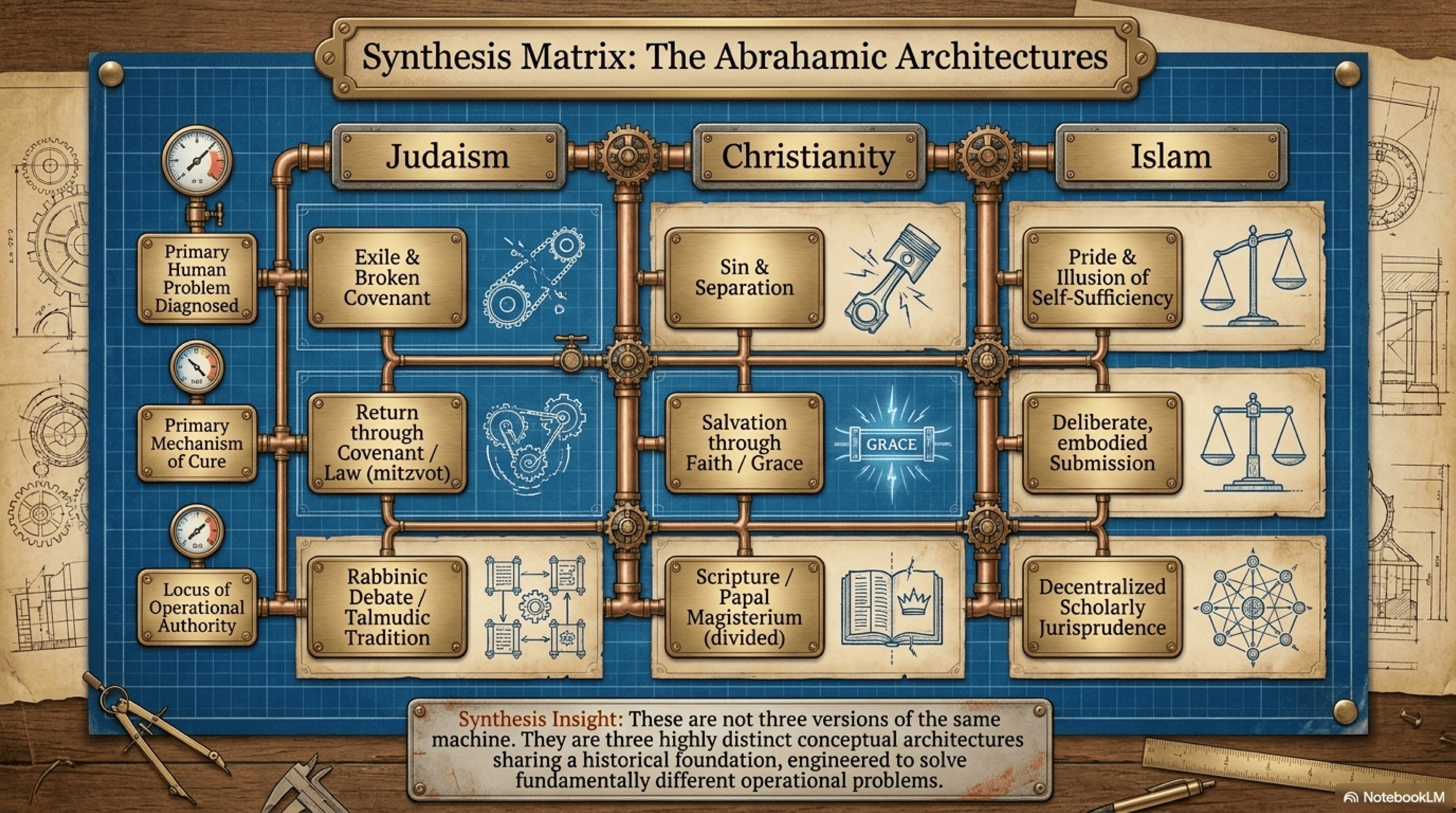
The grid built across Units 4-6 and carried forward to every tradition that follows.
Sacred Language in Civic Life: A Preview
Sociologist Robert Bellah's concept of civil religion names something every functioning nation-state does: deploy religious-adjacent language, symbols, and ritual to bind citizens into a shared moral identity that does not depend on any one sectarian belief. It works by generalizing — "God," "Providence" — precisely so citizens of genuinely different faiths and no faith can participate in the same civic ritual without affirming a specific doctrine. Lincoln's Second Inaugural is the tradition's gold standard: profound sacred language in service of a shared reckoning, deployed with enough humility that it never claims exclusive divine favor for one side.
This is a preview of the course's capstone literacy, built in full in Unit 10: collective action at the scale of a nation runs on shared moral vocabulary, and the traditions this course studies are the deepest reservoir that vocabulary draws from — in America and everywhere else a government asks citizens to act together. The same instrument that reads a Lincoln address also reads a demagogue's. By Unit 10, when a politician, an algorithm, or a crowd invokes sacred language, the question is automatic: what specific work is this language doing, who benefits from the framing, and is it an invitation to mutual understanding or a demand to comply?
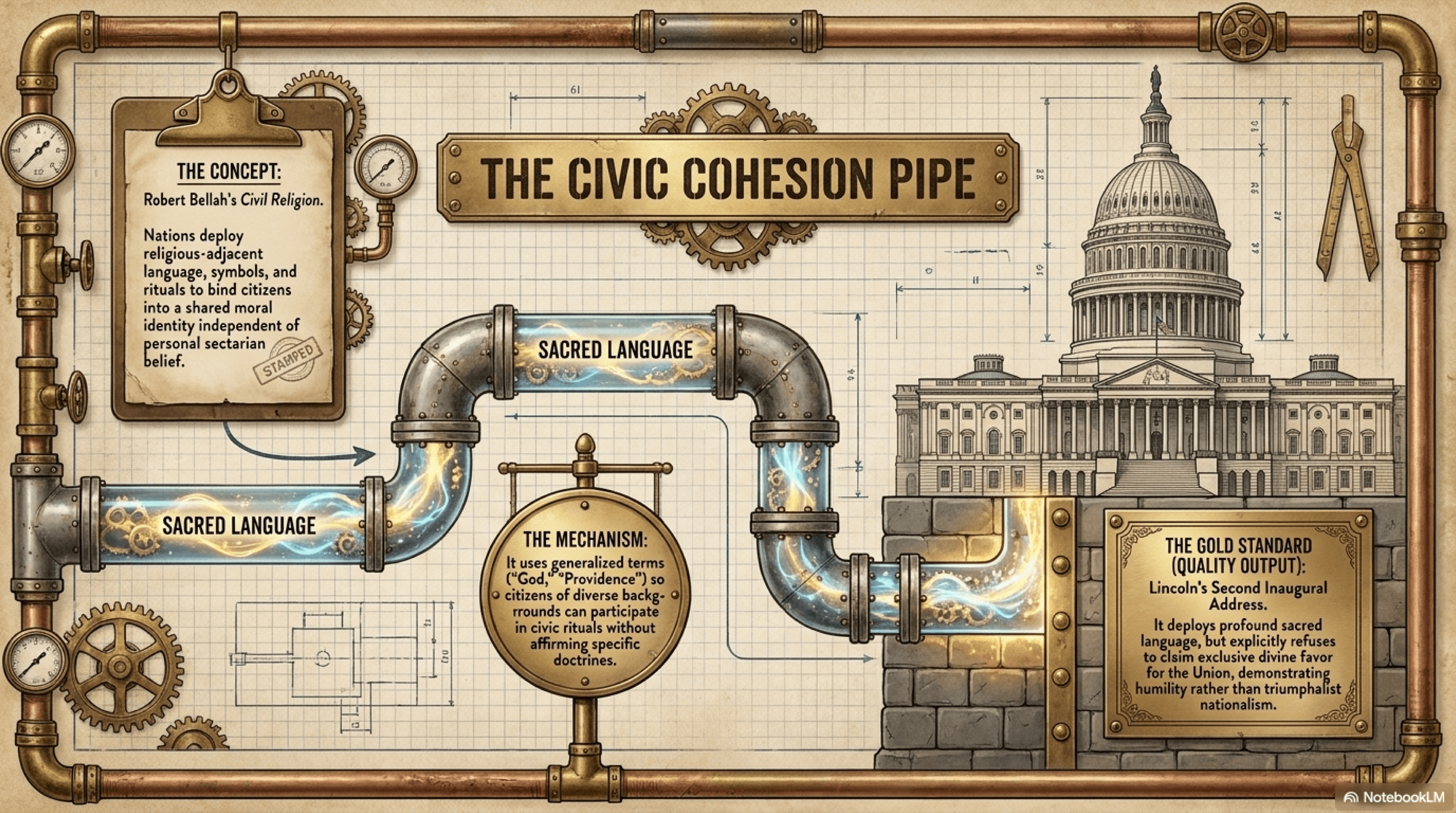
Civil religion, previewed here and built in full in Unit 10 — the course's capstone literacy for detecting sacred-language framing in real time.
What You Will Learn
Differences Are the Curriculum
Against the food-festival survey: each tradition diagnoses a different problem — exile, sin, pride, the cycle, suffering — and prescribes a different cure. The comparative grid is an instrument students keep, not a heap of facts.
Units 4-9
Doubt Has a History Too
Antiquity's own skeptics were born in the same neighborhoods as the scriptures, and disbelief gets the same scholarly treatment as belief — stated up front, before any tradition's own unit begins: its lineage, its internal debates, its own ethics.
Units 2-3
Sacred Language, Secular Power
The capstone literacy: detecting religious framing in political speech — just-war traditions compared across religions, civil religion, and the case study of post-9/11 rhetoric.
Unit 10