Environmental Science & Sustainability
What is happening to the only planet we will ever have? From Sagan's Pale Blue Dot to Attenborough's witness testimony of collapse — the evidence, the math, the politics, and the question of what we do now.
NOT a Textbook About Biomes
This course uses specific data with sources, not vague claims. Every unit includes at least one 'the math doesn't work' moment where you do the actual arithmetic. The obstacle to action is not knowledge — it's politics, economics, and human psychology.
What You Will Learn
The Pale Blue Dot
Earth as a single pixel, 3.7 billion miles away. Nine planetary boundaries define the safe operating space for human civilization. We have already crossed four of them.
Unit 1
What We've Done
The Aral Sea is a desert. Cancer Alley has 50x the national cancer rate. The ocean absorbed 30% of our CO₂ and 90% of our excess heat. Attenborough watched it happen over 70 years.
Unit 8
What We Do Now
Direct air capture: 4,000 tons/year. Humans emit 37 billion tons/year. Do the math. But solar costs dropped 99% since 1976. The technology exists. The physics works. The politics don't.
Unit 12
Curated Video Library
6 curated videos to explore — plus 16 more matched to individual units inside the course

Three and a half minutes. That is all it takes for Carl Sagan to reframe every unit in this course. The Pale Blue Dot passage -- written after Sagan persuaded NASA to turn Voyager 1's camera back toward Earth from 3.7 billion miles away -- is the philosophical foundation of Unit 1 and the emotional throughline of the entire curriculum. 'Look again at that dot. That's here. That's home. That's us.' When Sagan says 'there is perhaps no better demonstration of the folly of human conceits than this distant image of our tiny world,' he is making the argument that planetary boundaries (Rockstrom's framework in Unit 1) are not arbitrary limits imposed on human ambition but the physical parameters of the only home our species has ever known. This video should be the first thing students see when they open the course. Not because it contains data -- it contains none -- but because it establishes the perspective from which all the data that follows becomes meaningful.
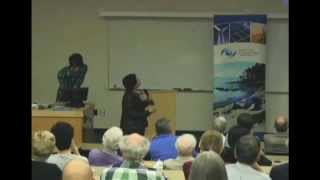
Naomi Oreskes delivers the full Merchants of Doubt argument in this seventy-seven-minute lecture -- longer and more detailed than any YouTube clip or TED talk can provide. She traces the direct lineage from tobacco industry disinformation to climate denial, naming the specific scientists (Fred Singer, Fred Seitz, Bill Nierenberg) who moved from defending tobacco to attacking climate science, and the specific strategy they deployed: 'doubt is our product.' This is the intellectual backbone of Unit 14, which asks students to identify the six moves of the denial playbook and apply them to Exxon's internal research versus public communications. Oreskes does not merely describe the strategy -- she shows the primary documents, the internal memos, the funding flows. For students who think 'both sides' of the climate debate deserve equal weight, this lecture provides the forensic evidence that one side was manufactured. The Q&A section is particularly valuable: audience members push back, and Oreskes's responses model how to defend scientific consensus against bad-faith challenge.
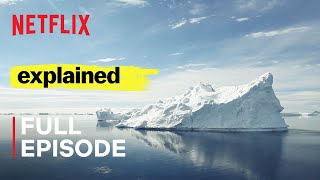
In nineteen minutes, this Netflix Explained episode covers the global freshwater crisis with the clarity and production quality that educational YouTube rarely achieves. It opens with the counter-intuitive fact that drives Unit 4: Earth has the same amount of water it has always had, yet billions of people face water scarcity. The episode traces the Ogallala Aquifer depletion, Cape Town's Day Zero crisis, and the politics of water privatization -- three case studies the curriculum uses to demonstrate how a renewable resource becomes functionally non-renewable when extraction outpaces recharge. The visual treatment of aquifer cross-sections and groundwater mining makes the invisible visible in exactly the way the unit's prose attempts but cannot fully achieve. For students who think water scarcity is a problem for other countries, the Ogallala segment -- showing the breadbasket of America drawing down a resource that took millions of years to accumulate -- lands with genuine surprise.

This Netflix documentary does something no textbook can: it makes you watch a coral reef die. The filmmakers spent three years developing time-lapse technology to capture coral bleaching as it happens -- the moment when heat-stressed coral expels its symbiotic algae and turns bone white. The footage from Lizard Island on the Great Barrier Reef is devastating and scientifically precise. Students will see the zooxanthellae expulsion mechanism described in Unit 8 unfold in real time, but the documentary's power extends far beyond one unit. It connects ocean acidification chemistry (Unit 2's carbon cycle), biodiversity loss (Unit 3's extinction rates), the gap between scientific knowledge and political action (Unit 10's climate policy), and the psychological burden of witnessing ecological collapse (Unit 13's solastalgia). The marine biologist Zack Rago breaks down on camera after documenting the death of a reef he has studied for years -- that moment teaches students something about environmental science that no data set can: what it costs to pay attention.

Kurzgesagt's most important climate video is not the optimistic one -- it is this one. The video systematically dismantles the idea that individual consumer choices (shorter showers, reusable bags, meatless Mondays) can meaningfully address a crisis driven by industrial systems and political structures. It traces the origin of the 'carbon footprint' concept to a BP advertising campaign -- the exact corporate deflection strategy Unit 14 dissects in detail. Then it pivots: if individual action cannot fix the problem, what can? The answer -- systemic change through collective political action -- connects directly to Unit 10's treatment of the free rider problem and Unit 11's GND vs. degrowth vs. ecomodernism debate. At sixteen minutes, it is the single best animated explainer of the gap between individual responsibility rhetoric and structural reality. Students who watch this before engaging the policy units will arrive with the right question already formed: whose job is this, actually?

60 Minutes sends a correspondent into the field with conservation biologists who are documenting species disappearing faster than they can be catalogued. The segment opens with the statistic that drives Unit 3: current extinction rates are 1,000 times the background rate. But what makes this piece exceptional is the footage of researchers discovering new species in the act of losing them -- finding a frog that has never been named in a habitat that will be gone within a decade. This is shifting baseline syndrome (Unit 3's key concept from Daniel Pauly) captured on camera. The interview with E.O. Wilson's intellectual successors grounds the abstraction in field biology: these are not models or projections but real scientists watching the sixth extinction happen in real time. For a course that asks students to calculate extinction rates, this video provides the emotional weight that makes those calculations matter.
Explore These Channels
Kurzgesagt's animated explainers are the gold standard for making complex environmental science accessible without dumbing it down. Their climate change playlist alone covers planetary boundaries, carbon budgets, nuclear energy tradeoffs, geoengineering ethics, and the structural gap between individual action and systemic change. The animation style transforms abstract data -- parts per million of CO2, gigatons of ice loss, extinction rates -- into visual narratives that students remember. Crucially, Kurzgesagt has evolved: their earlier optimistic framing has been challenged by critics (notably the 'art of climate greenwashing' video by Think That Through), and the channel's response -- making 'Can YOU Fix Climate Change?' which explicitly addresses structural vs. individual responsibility -- models the kind of intellectual honesty the course demands.
Climate Town combines investigative journalism with comedy in a way that makes corporate climate disinformation entertaining to dissect. Rollie Williams's video essays trace the money -- from BP's carbon footprint campaign to fossil fuel lobbying to greenwashing in fast fashion -- with primary sources and receipts. For Unit 14 (greenwashing and denial), Climate Town is the most pedagogically effective channel available: students who would zone out during a lecture on corporate communications strategy will watch a twenty-minute video essay that makes them angry about the same material. The channel's treatment of carbon offsets is particularly strong and connects directly to Unit 10's analysis of market-based climate policy instruments.
PBS Terra occupies the sweet spot between accessible and rigorous that this course needs. Their water crisis series is the best available video companion for Unit 4, covering the Ogallala Aquifer, Colorado River over-allocation, and global freshwater distribution with real data and field reporting. The energy transition coverage is balanced without false equivalence -- they acknowledge renewable energy's supply chain problems (Xinjiang polysilicon, Congo cobalt) while showing the learning curves that make the transition inevitable. For a course that demands students hold complexity without retreating to easy answers, PBS Terra models that discipline consistently.
Our Changing Climate produces the most intellectually ambitious environmental video essays on YouTube. Where other channels explain the science, this channel engages the political economy: why does the carbon footprint concept serve corporate interests? What would degrowth actually require? Is ecomodernism compatible with justice? These are Unit 11 questions, and Our Changing Climate treats them with the seriousness they deserve. The channel's collaboration with Climate Town on the carbon footprint video is a model of how structural analysis and accessible communication can work together.