Skip to content
Interdisciplinary CurriculumCurriculum

Your learning stays with you.

Support Independent Learning
Purchase Terms

© 2026 Commensurate Ventures. All rights reserved.

Interdisciplinary CurriculumCurriculum
All Courses

History of Technology

From fire to AI, every technology is a political act. This course traces how tools reshaped societies, who benefited, who paid the cost, and why the stories we tell about innovation are almost always wrong.

20 Units
2-3 weeks per unit
Curriculum Map

What You Will Learn

Historical Contingency

Every technology was invented at a specific time by specific people facing specific problems. Nothing about our technological world was inevitable.

Power Analysis

Who benefits from each technology? Who explains it? Who pays the cost? These questions recur from ancient irrigation to artificial intelligence.

Epistemic Humility

The history of technology is littered with confident predictions that proved wrong. We study what we can know, what we cannot, and how to tell the difference.

Curated Video Library

8 curated videos to explore — plus 15 more matched to individual units inside the course

Who Controls All of Our Money?
22m
explainer
Who Controls All of Our Money?YouTube
ColdFusion·Jun 2017(9 years ago)·7.3M views

ColdFusion opens with Henry Ford's warning that if people understood the banking system 'there would be a revolution before tomorrow morning' and then delivers a tightly edited history that connects directly to the course's recurring theme: technology is never neutral, and the systems we build encode the interests of their builders. The video traces how a secret 1910 meeting at Jekyll Island led to the creation of the Federal Reserve, how the six men in attendance represented a quarter of the world's wealth, and how they used disinformation in newspapers to trick both Congress and the public into supporting a system designed to benefit its architects. While this is ostensibly about banking, it is really about the politics of infrastructure -- the same question Unit 7 asks about electrification and Unit 13 asks about the internet. Who designs the system? Who benefits? Who is excluded? ColdFusion's visual storytelling makes these questions accessible in 21 minutes, and Alan Greenspan's on-camera admission that 'there is no other agency of government which can overrule actions that we take' is the kind of primary-source moment that sticks with students.

infrastructureplatformregulatory capturenetwork effects
In the Age of AI (full documentary) | FRONTLINE
1h 54m
documentary
In the Age of AI (full documentary) | FRONTLINEYouTube
FRONTLINE PBS | Official·Dec 2019(6 years ago)·26.0M views

This is the centerpiece documentary for this course. FRONTLINE traces the global AI revolution across two hours, moving from China's mass deployment of facial recognition and social credit scoring to Silicon Valley's automation of white-collar work to the Uighur surveillance apparatus in Xinjiang. The documentary interviews Kai-Fu Lee, who describes the moment he realized that AI would displace 40 percent of the world's jobs within fifteen years, and visits a factory in Guangdong where robots have replaced 90 percent of the workforce. It profiles Shoshana Zuboff explaining surveillance capitalism, follows truck drivers confronting autonomous vehicle technology, and examines how algorithmic hiring systems reproduce racial bias at industrial scale. For a course that asks 'who decides what technology gets built and for whom,' this documentary provides two hours of case studies spanning Units 8 through 18 -- from assembly line automation to AI governance. When your student reads about existential risk in Unit 9 and surveillance capitalism in Unit 15 and the attention economy in Unit 17, they will already have FRONTLINE's reporting in their heads: real people, real consequences, real choices still being made.

artificial intelligencesurveillance capitalismautomationexistential risk+3 more
Shoshana Zuboff on surveillance capitalism | VPRO Documentary
1h 17m
documentary
Shoshana Zuboff on surveillance capitalism | VPRO DocumentaryYouTube
vpro documentary·Dec 2019(6 years ago)·4.6M views

This VPRO documentary follows Shoshana Zuboff as she explains surveillance capitalism with the precision of a scholar and the urgency of a whistleblower. She opens by insisting that the term 'surveillance capitalism' is not arbitrary -- the surveillance must be 'engineered as undetectable, indecipherable, cloaked in rhetoric that aims to misdirect.' The documentary then traces how Google discovered that the 'behavioral surplus' -- data beyond what was needed to improve search -- could predict human behavior with extraordinary accuracy, and how that discovery created a new economic logic. Zuboff explains how a supermarket's algorithm detected a teenager's pregnancy before her father knew, simply by tracking her switch from fragrant to neutral shampoos. She describes how facial recognition software trained on family photos uploaded to Facebook is deployed for purposes users never consented to. This is the definitive companion for Unit 15 because Zuboff's framework -- that surveillance capitalism 'unilaterally claims human experience as free raw material' -- is the unit's central concept, and hearing her explain it with specific examples gives students a visceral understanding that reading alone cannot provide.
surveillance capitalismalgorithmplatformbehavioral surplus+1 more
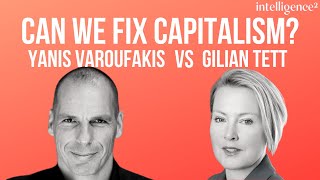
Can we Fix Capitalism? Yanis Varoufakis vs Gillian Tett
1h 27m
debate
Can we Fix Capitalism? Yanis Varoufakis vs Gillian TettYouTube
Intelligence Squared·Oct 2021(4 years ago)·508K views

This Intelligence Squared debate at Union Chapel pits a former Greek finance minister against the Financial Times' chair in a structured argument about whether capitalism is reformable or already dying -- and the answer hinges on technology. Varoufakis opens with a genuinely original thesis: we are living through a moment analogous to the 1790s, when feudalism was still dominant but pockets of capitalism were emerging beneath it. He argues that capitalism is 'overthrowing itself' as profit ceases to be the primary engine of accumulation, replaced by what he calls 'technofeudalism' -- a system where platform owners extract rent from everyone who must use their infrastructure, much as feudal lords extracted rent from everyone who worked their land. Gillian Tett counters with a pragmatic defense of market reform. For a course that traces technology from the printing press through platform capitalism, Varoufakis provides the most provocative end-state argument: that the platforms examined in Units 14 and 15 have created not merely a new form of capitalism but a new mode of production entirely. The debate format, with audience votes before and after, models the kind of structured argumentation the course demands.

platformenshittificationsurveillance capitalismnetwork effects+1 more
How Elon Musk Turned Twitter Into X (full documentary) | FRONTLINE
1h 54m
documentary
How Elon Musk Turned Twitter Into X (full documentary) | FRONTLINEYouTube
FRONTLINE PBS | Official·Oct 2023(2 years ago)·3.0M views

FRONTLINE's investigation of Elon Musk's Twitter acquisition is a real-time case study in everything this course teaches about the politics of technology. The documentary traces how one man's purchase of a global communications platform -- justified by free speech rhetoric -- produced measurable increases in harassment, foreign disinformation, and the erosion of content moderation infrastructure that took years to build. It interviews former Twitter employees who describe being fired by email at midnight, researchers who document the platform's shift toward amplifying outrage, and First Amendment scholars who distinguish between free speech as a constitutional protection and free speech as a billionaire's personal brand. For Units 14 and 18, this documentary is essential because it shows enshittification happening in real time: a platform that once functioned as a 'global town square' being reshaped to serve the interests of a single owner. Langdon Winner's question from Unit 18 -- 'do artifacts have politics?' -- is answered here with devastating specificity: when one person controls the architecture of public discourse, that architecture reflects his politics.

platformenshittificationregulatory captureinformation revolution+1 more
Transformers, the tech behind LLMs | Deep Learning Chapter 5
27m
explainer
Transformers, the tech behind LLMs | Deep Learning Chapter 5YouTube
3Blue1Brown·Apr 2024(2 years ago)·9.6M views

Grant Sanderson's visualization of transformer architecture is the single best explanation of the technology behind ChatGPT, Claude, and every other large language model reshaping the world this course examines. He traces how transformers differ from earlier approaches: instead of processing text one word at a time, they 'soak it all in at once in parallel,' which is why they can be trained on the enormous datasets that made modern AI possible. His animation of the attention mechanism -- showing how the numbers encoding the word 'bank' are refined based on surrounding context to encode 'river bank' rather than 'financial bank' -- makes visible the process that Unit 16 describes abstractly when it says AI 'pattern-matches on data that humans collected, labeled, and curated.' Sanderson's observation that 'researchers design the framework for how each of these steps work' but 'the specific behavior is an emergent phenomenon based on how hundreds of billions of parameters are tuned during training' captures the central epistemic problem of AI governance: we built these systems, but we do not fully understand why they work. For a course that asks 'who teaches the machines,' this video provides the honest answer: we designed the architecture, but what emerged from training surprises even us.

artificial intelligencelarge language modelalgorithm
A.I. - Humanity's Final Invention?
17m
explainer
A.I. - Humanity's Final Invention?YouTube
Kurzgesagt - In a Nutshell·Aug 2024(1 year ago)·11.0M views

Kurzgesagt traces intelligence from flatworm brains 500 million years ago through hominins, the agricultural revolution, and the information age to arrive at the question Unit 16 poses: what happens when we build machines better at the thing that gave us dominion over the planet? The video's evolutionary framing is essential because it places AI in the deepest possible historical context -- not as a product of Silicon Valley but as the latest chapter in a story that began when neural structures first proved worth their metabolic cost. The animation showing how chess AI progressed from narrow specialized systems to self-learning models that mastered the game in four hours by playing against themselves visualizes the leap from narrow to general intelligence that the unit describes. Kurzgesagt does not shy from the existential dimension: the video's final section asks what happens when AI systems become 'better than humans at the very thing that gave us power over the planet,' directly connecting to Unit 9's treatment of existential technological risk. At 16 minutes and with Kurzgesagt's signature animation quality, this is the ideal low-commitment entry point for students encountering AI for the first time.

artificial intelligenceexistential riskalgorithmlarge language model+1 more
This is Going to be Very Messy
44m
explainer
This is Going to be Very MessyYouTube
Hank Green·Feb 2026(This year)·1.4M views

Hank Green sits down and works through his entire catalogue of AI concerns in real time, and the result is the most honest, least performative assessment of artificial intelligence available on YouTube. He opens by acknowledging the epistemic problem that haunts this course: every potential AI impact has both a severity and a likelihood, and reasonable people disagree about both dimensions. He then catalogues specific harms already happening -- algorithmic cruelty in sentencing and credit decisions, the 'creative vampirism' of training models on unconsented intellectual property, AI-induced psychosis from chatbot relationships, deepfake pornography, the energy costs of data centers, and the concentration of power in a handful of companies. What makes this essential for Unit 16 is Green's refusal to rank these concerns into a neat hierarchy. He models exactly the kind of thinking the course demands: holding multiple concerns simultaneously, resisting the urge to collapse complexity into a single narrative, and being honest about what you do not know. His disclosure that he is receiving settlement money from Anthropic for training on his books while knowing YouTube creators will never see equivalent compensation is the kind of specific, personal detail that makes abstract policy debates real.

artificial intelligencealgorithmexistential riskplatform+2 more

Explore These Channels

FRONTLINE PBS | Official
~6h

FRONTLINE has produced the definitive documentary investigations of technology's impact on society, from 'In the Age of AI' to 'The Facebook Dilemma' to their Twitter/X investigation. Their documentaries feature extensive interviews with the engineers, executives, regulators, and ordinary people affected by technological change, providing the kind of primary-source testimony that textbooks cannot replicate. For a course that insists technology is never neutral, FRONTLINE's investigative journalism provides the evidence: real decisions by real people with real consequences.

Covers 4 units in this course
ColdFusion
~4h

ColdFusion produces tightly edited documentary explainers on the history and business of technology, covering everything from the creation of the Federal Reserve to the rise of Google to the story of how specific companies built and lost their monopolies. The channel's visual style -- clean graphics, archival footage, primary-source quotations -- makes complex institutional histories accessible without dumbing them down. For students who need scaffolding before tackling the curriculum's more academic sources, ColdFusion provides ideal preparation: it names the concepts, identifies the players, and traces the money.

Covers 3 units in this course
3Blue1Brown
~3h

3Blue1Brown's deep learning series is the gold standard for visual explanations of neural networks, transformers, and large language models. Grant Sanderson's animations make the mathematics of AI legible to students with no calculus background, showing how neurons fire, how gradient descent works, and how attention mechanisms allow transformers to process language. For Unit 16, which asks 'whose intelligence do machines encode,' understanding the technical architecture is essential -- not because students need to build neural networks, but because understanding how these systems learn from data illuminates why they reproduce the biases embedded in that data. The channel also provides the technical vocabulary (parameters, training, backpropagation) that students need to evaluate AI claims critically rather than accepting or rejecting them on faith.

Covers 2 units in this course

All Units

1
2-3 weeks
The Invention of Invention
Everything you think you know about invention is shaped by stories told much later, by people with reasons to tell them that way.
  • •Analyze what counts as 'technology' and why the definition matters politically
  • •Understand that most technological development was incremental and anonymous, not heroic
  • •Evaluate the ideological function of the 'lone inventor' narrative
  • +1 more objectives
Start learning
2
2-3 weeks
Printing, Propaganda, and the Democratization of Error
Gutenberg didn't just democratize knowledge—he democratized error. The printing press enabled both the Reformation and the witch-hunting craze.
  • •Analyze how the printing press simultaneously enabled the spread of knowledge and misinformation
  • •Understand the concept of information revolutions and their structural effects on power
  • •Evaluate claims about technology's 'democratizing' effects using historical evidence
  • +1 more objectives
Start learning
3
2-3 weeks
Navigation, Empire, and the Technology of Conquest
European colonial expansion was not inevitable—it was enabled by specific technologies that other civilizations chose not to deploy for conquest.
  • •Analyze how navigation technology enabled European colonial expansion
  • •Understand the concept of technological determinism and its limitations
  • •Evaluate the claim that technology is morally neutral
  • +1 more objectives
Start learning
4
2-3 weeks
The Scientific Revolution and Who Gets to Explain the World
The Scientific Revolution was as much a social technology as an intellectual one. New institutions created new rules for who could claim to know things—and those rules excluded most of humanity.
  • •Analyze the Scientific Revolution as a social and institutional transformation, not just an intellectual one
  • •Understand how new institutions (academies, journals, peer review) created new rules for knowledge claims
  • •Evaluate who was included and excluded from the emerging scientific community and why
  • +1 more objectives
Start learning
5
2-3 weeks
The Industrial Revolution — Machines, Markets, and the Making of the Working Class
The Industrial Revolution wasn't just about machines—it was about remaking human beings into machine-tenders and remaking the planet into a resource to be extracted.
  • •Analyze the Industrial Revolution as a transformation of social relations, not just technology
  • •Understand the Luddite movement as rational economic resistance, not anti-technology sentiment
  • •Evaluate the human costs of industrialization alongside its material benefits
  • +1 more objectives
Start learning
6
2-3 weeks
Telegraph to Telephone — When Distance Died the First Time
Every claim made about the internet in the 1990s—that it would unite humanity, abolish distance, democratize information—was made about the telegraph in the 1850s.
  • •Analyze how the telegraph transformed commerce, warfare, journalism, and daily life
  • •Understand the concept of 'network effects' and natural monopoly using historical examples
  • •Evaluate the recurring pattern of utopian claims about new communication technologies
  • +1 more objectives
Start learning
7
2-3 weeks
Electrification and the Grid — Whose Light, Whose Darkness
Electrification was not a gift bestowed uniformly. It came first to wealthy neighborhoods, then to profitable ones, then—decades later and only with government intervention—to rural America.
  • •Analyze how electrification transformed daily life and economic organization
  • •Understand why private markets failed to electrify rural America
  • •Evaluate the concept of infrastructure as a public good using historical evidence
  • +1 more objectives
Start learning
8
2-3 weeks
Assembly Lines, Automation, and the Promise of Leisure
Henry Ford doubled wages and people called it revolutionary. But the assembly line also deskilled workers, made them interchangeable, and created the conditions for their eventual replacement.
  • •Analyze how the assembly line transformed the nature of work and the worker
  • •Understand Taylorism and Fordism as systems of social control, not just efficiency
  • •Evaluate the recurring promise that automation will create leisure
  • +1 more objectives
Start learning
9
2-3 weeks
The Bomb — When Technology Became Existential
Before 1945, technology could destroy cities. After 1945, it could destroy civilization. The atomic bomb was the first technology whose intended use would be catastrophic.
  • •Analyze how nuclear weapons fundamentally changed the relationship between humanity and technology
  • •Understand the ethical debates among Manhattan Project scientists
  • •Evaluate the deterrence theory and its assumptions about rationality
  • +1 more objectives
Start learning
10
2-3 weeks
Television, Advertising, and the Manufacture of Desire
Television didn't just transmit culture—it restructured it. It rewarded simplicity over complexity, image over argument, emotion over reason.
  • •Analyze how television restructured public discourse and political communication
  • •Understand advertising as a technology of persuasion and desire-creation
  • •Evaluate Postman's thesis about entertainment and public discourse
  • +1 more objectives
Start learning
11
2-3 weeks
The Space Race, the Cold War, and Government as Inventor
Every Silicon Valley founder who claims the government should 'get out of the way' of innovation is using technologies the government invented: the internet, GPS, touchscreens, voice recognition.
  • •Analyze the role of government funding in technological innovation
  • •Understand the military-industrial complex and its effects on technology development
  • •Evaluate the 'entrepreneurial state' thesis using historical evidence
  • +1 more objectives
Start learning
12
2-3 weeks
The Personal Computer — Liberation Technology or Neoliberal Tool?
The personal computer emerged from Bay Area counterculture—hippies who believed technology could liberate individuals from institutional control. This ideology became Silicon Valley's founding myth and neoliberalism's most effective delivery mechanism.
  • •Analyze how counterculture values shaped the ideology of Silicon Valley
  • •Understand the transition from institutional to personal computing and its political implications
  • •Evaluate the claim that personal technology empowers individuals
  • +1 more objectives
Start learning
13
2-3 weeks
The Internet's Broken Promise
The internet was supposed to democratize everything. In some ways it did. In other ways, it created new monopolies more powerful than any that came before.
  • •Analyze the gap between early internet idealism and current internet reality
  • •Understand the structural features that enabled platform monopolization
  • •Evaluate the role of Section 230 and other policy decisions in shaping the internet
  • +1 more objectives
Start learning
14
2-3 weeks
Platform Capitalism and Enshittification
Cory Doctorow coined 'enshittification' to describe the lifecycle of platforms: first good to users, then abusive to serve business customers, finally abusive to everyone to serve shareholders.
  • •Analyze the business model of digital platforms and their lifecycle dynamics
  • •Understand Doctorow's 'enshittification' framework as a structural analysis
  • •Evaluate the concept of 'platform capitalism' as distinct from earlier forms of capitalism
  • +1 more objectives
Start learning
15
2-3 weeks
Surveillance Capitalism — When You Are the Product
Google discovered that the behavioral data users generate while searching is more valuable than the search results themselves. This discovery created a new form of capitalism.
  • •Analyze Zuboff's concept of surveillance capitalism as a new economic logic
  • •Understand how behavioral data extraction differs from earlier forms of data collection
  • •Evaluate the relationship between private surveillance and state surveillance
  • +1 more objectives
Start learning
16
2-3 weeks
Artificial Intelligence — Who Teaches the Machines?
AI does not think. It pattern-matches on data that humans collected, labeled, and curated. The question is not whether machines are intelligent but whose intelligence they encode.
  • •Analyze AI as a technology that encodes human decisions and biases at scale
  • •Understand the difference between narrow AI, general AI, and the marketing of AI
  • •Evaluate claims about AI risk using historical patterns of technological anxiety
  • +1 more objectives
Start learning
17
2-3 weeks
The Attention Economy and the Crisis of Knowledge
Herbert Simon warned in 1971 that 'a wealth of information creates a poverty of attention.' Fifty years later, an entire industry is devoted to capturing, manipulating, and monetizing human attention.
  • •Analyze how attention became the scarcest resource in the information economy
  • •Understand the design techniques used to capture and hold attention
  • •Evaluate the effects of the attention economy on democratic discourse and knowledge
  • +1 more objectives
Start learning
18
2-3 weeks
Who Decides What Comes Next?
Technology is not destiny. Every artifact embodies choices, and those choices can be made differently. This final unit asks the political question that technical discourse avoids.
  • •Synthesize the course's recurring themes into a framework for evaluating technological choices
  • •Analyze existing movements for democratic technology governance
  • •Evaluate competing visions of technological futures
  • +1 more objectives
Start learning
19
Free5-7 days
Case Study: Text READY — An Investigation Into the Government's Theory of AI Displacement
We enrolled in the Department of Labor's AI literacy course, completed all seven lessons, boundary-tested every interaction, and extracted the complete transcript. What follows is the investigation: what we assumed before the data, what the data showed, and what changed.
  • •Apply Simon's bounded rationality to evaluate how governments design workforce policy under radical uncertainty
  • •Use Meadows' feedback delay analysis to assess whether retraining programs can match the pace of technological displacement
  • •Apply the IPC framework to distinguish between a policy's stated intent, stakeholder perceptions, and measurable consequences
  • +2 more objectives
Start learning
20
Free3-4 days
Case Study: The Voluntary Panopticon — How Consumers Built the Surveillance State the Government Couldn't
From the PATRIOT Act to Ring's 'war on crime,' how the privatization of surveillance inverted the Fourth Amendment — and why a musician's YouTube documentary succeeded where policy advocacy failed.
  • •Trace the post-9/11 arc from government surveillance expansion to corporate surveillance outsourcing to consumer self-surveillance
  • •Apply Schneier's surveillance-industrial complex framework to Ring's corporate evolution
  • •Evaluate the efficacy gap between surveillance camera adoption rates and independent evidence of crime deterrence
  • +1 more objectives
Start learning

An open educational resource. Draws on history of science, science and technology studies (STS), and critical theory to understand technology as a social and political phenomenon.