Introduction to Sociology: The Great Defection
Why did sociology repeatedly defect from its own pretensions? From phrenology's scientific trappings through Durkheim, Weber, and Marx to Parsons' grand theory and its spectacular collapse — then Luhmann's radical reimagination of society as communication, not people. The arc ends where trust itself is replaced by code: Bitcoin as sociology's ultimate defection.
NOT Intro to Soc 101
This course does not survey sociology — it tells a story. Every unit is a defection: from pseudoscience, from ideology, from consensus, from people, from trust itself. Luhmann's systems theory is the pivot, and the last defection comes from outside the discipline entirely.
What You Will Learn
The Pretension
Phrenology measured skulls. Spencer hijacked Darwin. Durkheim invented social facts. Weber saw the iron cage. Marx saw the specter. Every founding gesture claimed scientific authority — and every one smuggled in ideology.
Unit 1
The Luhmannian Turn
Society is not people — it is communication. Luhmann imports autopoiesis from biology, shatters the subject/object distinction, and rebuilds sociology on self-referential systems. The most important social theorist you have never heard of.
Unit 8
The Engineering Defection
If trust is a social mechanism for reducing complexity, what happens when engineers build a substitute? Ratings, credit scores, provenance signatures, and cryptographic consensus are the same move made four times — only one of them wrote a manifesto.
Unit 14
Curated Video Library
7 curated videos to explore — plus 11 more matched to individual units inside the course
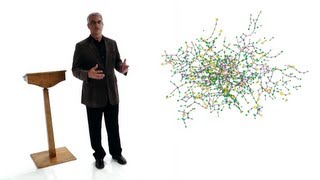
This is the ideal orientation video for the entire course. Nicholas Christakis, a physician-turned-sociologist at Yale, opens by describing how he abandoned reconstructive surgery because he realized he was 'running around putting my fingers in the dyke' -- treating individuals one at a time when the real question was why groups of people become sick. He then introduces the two foundational ideas of sociology in language students can absorb before encountering Durkheim or Luhmann: first, that individuals are embedded in structures that constrain and enable them (the structure-versus-agency problem), and second, that collective phenomena are 'not mere aggregations of individual phenomena' -- that groups have properties invisible at the individual level. His use of Charlotte Perkins Gilman's suicide note and Ron Burst's Golden Gate Bridge jump to demonstrate that even suicide, the most seemingly private act, is saturated with social connection lands exactly where Unit 3 begins with Durkheim's discovery that suicide rates are more stable than death rates.

Rushkoff opens at the 92nd Street Y by describing how he used to go to San Francisco 'to find out what's happening next' and come back to New York to argue for human potential -- and now the roles have reversed. His talk traces how digital platforms extracted the peer-to-peer promise of the early internet and turned it into a venture-capital-funded extraction machine. The connection to Luhmann's systems theory is structural: Rushkoff is describing how the economic function system colonized the communication possibilities of the internet, rewriting a peer-to-peer medium as a profit-extraction device. His account of Google bus protests in San Francisco -- where tech workers' presence raised rents 30% near bus stops, pricing out the communities that made the city worth living in -- is a contemporary parable of what Luhmann calls structural coupling gone pathological: the economic system's operations producing dangers for those who did not make the decisions. For Units 9 and 14, this video makes the abstract question of how function systems interact into a story students can feel.

This tightly edited 26-minute explainer opens by confronting the American conflation of socialism with evil -- playing clips of politicians using 'Marxist' as an epithet -- and then systematically walks through the history of capitalism from feudalism through the industrial revolution to the present. Its treatment of the employer-employee relationship as a power relation rather than a voluntary exchange maps directly onto Marx's concept of exploitation in Unit 5. The video's key pedagogical move is making Marx's abstract categories concrete: it explains surplus value through the specific mechanics of how a boss's paycheck is determined by 'your minimum needs and your boss's requirements for labor power,' and how unemployment functions as a disciplinary mechanism that keeps wages low. At 26 minutes, this is the shortest showcase video, making it a low-commitment entry point for students who are encountering Marxist analysis for the first time and need the concepts grounded in everyday experience before the unit demands deeper theoretical engagement.
This debate at Union Chapel stages the exact conflict the course traces between Units 5 and 15: is capitalism a reformable system or one that is overthrowing itself? Varoufakis opens with a genuinely original sociological argument: we are living in a moment analogous to the 1790s, when feudalism was still dominant but pockets of capitalism were emerging beneath it. He argues that capitalism retained two defining characteristics throughout all its transformations -- profit as the fuel and markets as the mechanism -- and that both are now being displaced by what he calls 'technofeudalism.' Gillian Tett, chair of the Financial Times, counters with a pragmatist defense of reform. The debate format models exactly the kind of structured argumentation the course demands, and the audience vote before and after the speeches makes persuasion visible. For a course that culminates in the Habermas-Luhmann debate over whether sociology should describe or transform, watching two public intellectuals model that disagreement in real time is invaluable preparation.
Michael Sandel's Geneva lecture is introduced by a host who frames it through Durkheim, Tonnies, and Polanyi -- the exact intellectual tradition this course traces. The introduction alone is a masterclass in sociological thinking: the host explains how differentiation and individualism have weakened integration and community bonds, cites Durkheim's argument that anomie leads to rising suicide rates, and invokes Hannah Arendt's warning that structural loneliness 'makes us ideal subjects of totalitarian rule.' Sandel then argues that meritocracy, rather than being a solution to inequality, has become a new form of social hierarchy that corrodes solidarity by telling the losers that their failure is deserved. His concept of 'the tyranny of merit' maps directly onto Weber's iron cage from Unit 4: an institution built to rationalize opportunity has escaped its creators' intentions and become a mechanism of social stratification. The discussion of Andrew Carnegie's 'Gospel of Wealth' connects to Unit 2's treatment of how Social Darwinism justified inequality as natural law, showing students that the legitimation strategies change but the underlying structure persists.
Robert Reich traces American history through six episodes that read like a syllabus for applied sociology: the Gilded Age robber barons, the rise of fascism, the construction and dismantling of the middle class, and the return of concentrated wealth in a second Gilded Age. His treatment of Social Darwinism is direct and accessible -- he shows how the ideology that inequality is natural law legitimized the first Gilded Age and is being recycled today under different language. This maps precisely onto Unit 2's argument that Spencer's 'survival of the fittest' transformed a biological metaphor into a political weapon. Reich's account of how Teddy Roosevelt used antitrust law, progressive taxation, and labor protections to dismantle robber-baron power, and how those guardrails were subsequently eroded, gives students a concrete historical arc for the abstract concepts of social structure and institutional change that run through the entire course. At 33 minutes with fast visual editing, this is ideal scaffolding for students who need the historical context before engaging with the theoretical frameworks.

This lecture opens with a thought experiment students will not forget: you can be a wealthy lawyer with a BMW, or you can be stranded on an island with strangers where every day is a struggle for survival -- and the question is which life makes you happier. The lecturer uses this to introduce Marx's central insight that human beings need purpose and collective mission, not just material comfort. What makes this video essential for Unit 5 is that it traces Marx through his intellectual lineage from Kant and Hegel with genuine pedagogical care, explaining how Marx 'turned Hegel upside down' by replacing the Geist with material conditions, and how the master-slave dialectic became the template for class struggle. The six mentions of alienation in the transcript map directly onto the unit's treatment of Marx's Economic and Philosophic Manuscripts. But the video's title -- 'What Marx Got Wrong' -- signals that it is not hagiography. Students get both the power of Marx's analysis and its limitations, which is exactly the balanced treatment the unit demands when it asks students to 'distinguish between Marx as political revolutionary and Marx as social theorist.'
Explore These Channels
Big Think hosts short-form lectures by leading social scientists, philosophers, and public intellectuals on exactly the questions this course poses: What holds societies together? How do institutions shape individual behavior? Why do people accept systems that work against their interests? Their sociology-adjacent content features Nicholas Christakis on social networks, Steven Pinker on human nature, Cornel West on race and democracy, and Noam Chomsky on power structures -- each delivering a single concept in under fifteen minutes. For students who need a conceptual bridge before tackling full-length unit content, Big Think provides the most efficient on-ramp available.
Crash Course Sociology, hosted by Nicole Sweeney, covers Durkheim, Weber, Marx, structural functionalism, symbolic interactionism, and conflict theory in animated 10-12 minute episodes that map almost one-to-one onto Units 3 through 7 of this course. The production quality is high, the tone is accessible without being condescending, and the episodes explicitly name the glossary terms students will encounter in the curriculum. For foundational units where students need a second pass at core concepts -- social facts, ideal types, the sociological imagination, manifest and latent functions -- Crash Course provides the most reliable supplementary resource available on YouTube.
Intelligence Squared hosts structured Oxford-style debates between leading economists, sociologists, and public intellectuals on the structural questions this course poses: Can capitalism be fixed? Is meritocracy just? Should institutions be trusted? The debate format models the kind of rigorous argumentation the Habermas-Luhmann unit demands, and the audience vote before and after each debate makes the persuasion process visible. Their debates on inequality, democracy, and technology feature regular appearances by Yanis Varoufakis, Slavoj Zizek, and other voices students encounter in the curriculum's later units.