Philosophy of History
Time, truth, and the stories we tell. An advanced course exploring how history is constructed, remembered, and interpreted—with practical applications in business analysis and decision-making.
The Archive Versus the Ledger
Audio Overview — Philosophy of History
What You Will Learn
Historiography
How is history written? What assumptions shape historical narratives? Examine the methods and biases of historical practice.
Truth & Evidence
What can we know about the past? How do we evaluate evidence? Explore epistemological questions about historical knowledge.
Applied Analysis
Apply historical thinking to business cases. Read financial statements, analyze corporate decisions, and understand institutional memory.
Curated Video Library
8 curated videos to explore — plus 9 more matched to individual units inside the course

Niall Ferguson arrives at this Intelligence Squared talk with a provocation: when he moved to Stanford and tried to talk to Silicon Valley about history, 'the guys in the t-shirts were looking at their phones' because for them 'history began with the Google IPO.' His book The Square and the Tower argues that historians have systematically overemphasized hierarchical structures -- states, armies, corporations -- because those are the institutions that keep archives, while neglecting the distributed networks that actually drive historical change. This is a direct challenge to conventional historiography and maps beautifully onto Unit 1's exploration of how historians construct knowledge. Ferguson's key insight -- that the bias toward state archives has 'left the field of network history to the conspiracy theorists' -- gives students a concrete example of how the methods of historical inquiry shape the history that gets written. His anecdote about the Illuminati becoming a conspiracy theory because serious scholars ignored network analysis is a perfect illustration of the course's argument that historiography is never neutral.
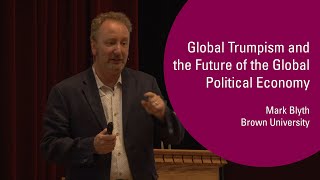
Mark Blyth is the intellectual spine connecting this course's philosophical questions to contemporary politics. In this McMaster lecture, he explains the rise of global populism through a computer metaphor: every country has the same 'hardware' (capital, labor, institutions) but runs different 'software' (policy regimes), and the neoliberal operating system has been crashing everywhere simultaneously. What makes Blyth essential for philosophy of history is his method -- he treats ideas as causal forces in history, not mere reflections of material conditions. His concept of 'macroeconomic regimes' that 'endogenously undermine themselves over time' is a theory of historical causation that Unit 5 students can test against the competing frameworks of structure versus agency. Blyth is also genuinely funny, which matters: he opens by noting that three parts of Europe are now run by comedians, and his description of infiltrating bond market conferences makes students laugh while absorbing dense arguments about how economic ideas shape historical outcomes.
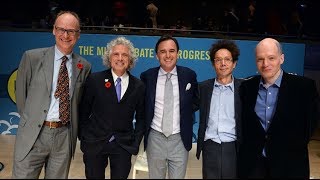
This is the definitive debate on whether history has a direction -- the exact question Unit 6 poses. Steven Pinker and Matt Ridley argue for the motion that 'humankind's best days lie ahead,' armed with graphs showing declining violence, poverty, and disease. Malcolm Gladwell and Alain de Botton argue against, questioning whether statistical improvement constitutes genuine human progress. The debate format models the kind of structured argumentation the course demands: Pinker opens by insisting 'there's nothing faith-based about' progress and deploying 250 years of data, while Gladwell counters that progress is unevenly distributed and the metrics themselves encode assumptions. The audience votes before and after -- 73% pro-progress at the start -- and students see minds changing in real time. This is the ideal companion for Unit 6 because the four debaters embody the competing frameworks the unit examines: Enlightenment progress, cyclical decline, and the question of whether 'progress' is itself a narrative we impose on the chaos of the past.
Ray Dalio condenses 500 years of imperial rise and decline into 43 minutes, and does it through a framework that embodies this course's central debates. His 'big cycle' of empire -- education leads to innovation, innovation leads to military power, military power leads to reserve currency status, reserve currency status leads to overborrowing, overborrowing leads to decline -- is precisely the kind of grand historical narrative that Unit 4 teaches students to interrogate. Is Dalio discovering a pattern in history or imposing one? His opening story is unforgettable: in 1971, he watched Nixon break the dollar's link to gold, expected the stock market to crash, and instead saw it surge 25%. He then discovered the same thing happened in 1933. This recurring shock -- that history rhymes in ways that surprise even informed observers -- is the experiential hook for the course's treatment of causation and contingency in Unit 5. Students should watch this and then ask: is the big cycle a structural cause in Braudel's sense, or a narrative superimposed on contingent events?
Steven Pinker lays out the argument for rational progress more concisely here than in any of his books, and in doing so provides the strongest possible version of the thesis this course teaches students to interrogate. His opening is philosophically precise: 'I don't believe in progress -- at least not as a force in the universe,' quoting the humorous dictum 'I don't believe in anything you have to believe in.' He insists there is no 'arc bending toward justice' -- the universe is indifferent, pathogens evolve faster than we can, entropy guarantees disorder. Progress happens not because of any historical telos but because human rationality occasionally stumbles on improvements and remembers them. This is a sophisticated position that students in Unit 6 need to grapple with: is Pinker's rationality-driven account of progress fundamentally different from Hegel's teleology, or is it the same structure dressed in scientific language? His use of Bayesian reasoning -- updating beliefs based on evidence rather than narrative -- connects directly to Unit 5's treatment of probabilistic causation.
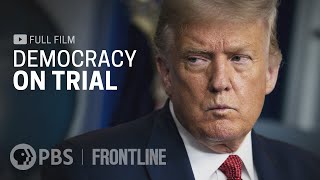
This FRONTLINE documentary traces the January 6th investigation from the attack through the House Select Committee hearings to the federal indictment of Donald Trump. Its relevance to philosophy of history is not the politics but the epistemology: the documentary is fundamentally about how evidence is gathered, evaluated, and contested in real time. The committee conducted more than 1,000 interviews, reviewed millions of documents, and thousands of hours of video -- and the question of what constitutes proof, what counts as testimony, and who gets to decide what happened is exactly the terrain Unit 3 covers. When Trump denounces the committee as illegitimate while the investigators describe their forensic methodology, students see the epistemological questions of historical knowledge playing out in the present. Chief investigator Tim Heaphy describes hiring 14 former prosecutors specifically for their skill at 'discerning what's relevant and separating that from what's not' -- a perfect contemporary illustration of the historian's craft that E.H. Carr and R.G. Collingwood theorized decades ago.

This is the single most important lecture for this course. Timothy Snyder, Yale historian and permanent fellow at the Institute for Human Sciences in Vienna, asks the question that animates every unit in the curriculum: what happens when societies lose their capacity for historical thinking? His lecture traces what he calls 'neopaganism' -- the emergence of political movements that abandon rational self-interest in favor of cult-like sacrifice, dark fantasies of decline, and leaders treated as gods. Snyder explicitly abandons the conventional social-science framework of explaining movements through rational self-interest, arguing instead that we need a fundamentally different hermeneutic. His analysis of how both Trump and Putin represent the collapse of historical consciousness -- the inability to imagine a future grounded in evidence about the past -- maps directly onto the course's central tension between history as disciplined inquiry and history as myth. When your student reads E.H. Carr on the construction of historical knowledge in Unit 1, Snyder's warning about what happens when that construction fails will be ringing in their ears.

This three-and-a-half-hour documentary traces the rise of Amsterdam, London, and New York as successive centers of global power, and in doing so provides the richest possible case study for the course's treatment of narrative structure and historical causation. The film opens in 1594 Amsterdam, where ten men meeting near Dam Square plot to break the Portuguese monopoly on the spice trade -- and then traces how that single decision set in motion the invention of capitalism, the stock market, and the modern corporation. For Unit 4 students, the documentary is an object lesson in how narrative choices shape meaning: the filmmakers chose to begin in Amsterdam rather than Lisbon, chose commerce rather than conquest as the through-line, and chose three cities rather than three empires. The result is a history of power that foregrounds trade networks and financial innovation over military conquest -- exactly the kind of interpretive choice that Hayden White argues all historians make, whether they acknowledge it or not. At over three hours, this is a commitment, but it rewards patient viewing with the most complete narrative arc available.
Explore These Channels
The Institute for Human Sciences in Vienna hosts lectures by leading historians and political theorists grappling with the relationship between historical thinking and contemporary politics. Timothy Snyder, a permanent fellow, delivers regular lectures that bridge academic historiography and public engagement -- exactly the combination this course demands. Their archive includes lectures on freedom, historical consciousness, and the collapse of democratic norms that map directly onto the course's treatment of how historical interpretation shapes political possibility.
Intelligence Squared hosts structured Oxford-style debates between leading historians, philosophers, and public intellectuals on exactly the questions this course poses: Does history have a direction? Can we learn from the past? Is progress real? The debate format models the kind of rigorous argumentation the course demands, and the audience vote before and after each debate makes persuasion visible. Their history and philosophy debates feature regular appearances by Niall Ferguson, Steven Pinker, and other voices students will encounter in the curriculum.
Crash Course's World History and European History series, hosted by John Green, provide accessible introductions to the historical events and periods that this course analyzes philosophically. When Unit 5 discusses causation using the example of World War I, or Unit 6 examines the idea of progress through the Enlightenment, students benefit from having the factual narrative already in place. Green's signature style -- fast-paced, self-aware about the narratives he's constructing, and explicit about historiographical choices -- makes Crash Course an unusually good complement to a course that teaches students to interrogate how history is written rather than just what happened.