
In the spring of 2026, an engineering firm called Jacobs won the mandate to build one of the largest AI data-center campuses in Louisiana. Every headline attached the same number to the deal: seven billion dollars. That number is real, and it is not Jacobs'. It is the value of a fifteen-year lease between two other companies. What Jacobs actually earns for building the thing is disclosed nowhere I could find. Sit in that gap for a minute, the distance between the number in the headline and the number in Jacobs' pocket, because it is the shape of the entire ground floor of the AI economy. The people who do the work are paid a fee. The people who own the building hold the risk. And the building is going obsolete faster than they can pour the concrete.
This is Part 1 of The Stack, a layer-by-layer teardown of the AI compute economy in the spirit of the Computedollar series and Michael Cembalest's 2026 reports for J.P. Morgan. Each part asks the same two questions of one rung of the ladder: who books the equity, and who eats the subsidized loss? We start at the bottom, the shell: the building, the power, and the people who pour it.
/ 01The Seven Billion Dollars That Isn't Jacobs'
Jacobs Solutions, ticker J, one of the large publicly traded engineering-and-construction-management houses, is having the best year in its history, and AI is a big part of the reason. Fiscal second-quarter backlog hit a record $27.0 billion, up 22% year over year; revenue was up 27%; management raised full-year guidance for the second straight quarter and put “AI infrastructure” at the top of the list of reasons.1 The CEO called the data-center investment cycle “still in early stages.”2 This is not a company on the outside of the boom looking in. It is building it, in Louisiana and Texas, right now.3
So here is the tape-reader's question, the one the sell-side note won't quite ask: when Jacobs builds a $7 billion AI campus, how much of the AI does Jacobs own?
The answer, as far as the public record goes, is none. The “$7.0 billion” that trailed the River Bend deal through every trade publication is the total contract value of a fifteen-year, 245-megawatt lease between Hut 8, which owns the campus, and Fluidstack, which rents it.4 It is Hut 8's revenue line, not Jacobs'. Jacobs' role is EPCM, engineering, procurement, and construction management: it designs the thing and oversees the building of it, for a fee, and then it leaves. Jacobs' actual fee on that contract is not broken out in any source I could locate, and neither is the fee-versus-reimbursable split of its data-center backlog.5 What is visible in the record is what's absent from it: nowhere does Jacobs take an equity stake, a co-investment, or a share of the campus's fifteen-year lease stream. It is a services business, and a good one.
And it is not alone in the pattern. Turner, DPR, and Mortenson are building Meta's $10 billion Richland Parish campus as a joint venture; Turner's own backlog hit a record $48.9 billion, roughly 40% of it data-center work, and Turner signed a separate $6 billion CoreWeave build in Pennsylvania.6 Quanta Services carries a ~$48.5 billion backlog and frames data centers mostly through the power side: substations, transmission, interconnection.7 Every one of these firms shows real, dated, quantifiable growth off the AI build. Not one of the sources I pulled shows any of them holding equity in the asset they build. They pour it, they manage it, they hand over the keys, and someone else carries the depreciation.
A fee business is not a bad business; Warren Buffett would happily own a toll bridge that never takes inventory risk. Jacobs converts engineering talent into a record backlog with no obligation to guess right about which cooling architecture wins or which chip generation strands. If the campus it builds is obsolete in four years, that is the owner's problem, not Jacobs'. The capped fee is a feature. The point of this series is not that the fee is bad: it is that the fee is not equity in the boom, and the two get conflated every time a $7 billion headline lands on a firm collecting a rounding error of it.
One honest caveat, and it matters for how hard I lean on this. “Jacobs holds no equity” is an absence of evidence, not a signed confirmation that zero exists: no source shows a stake. The load-bearing number, Jacobs' actual fee and its fee-versus-reimbursable mix, sits inside a 10-Q that this research pass could not pull directly.5 I flag it because the whole series lives or dies on the estimate-versus-reported discipline: when a number is inferred rather than filed, you should be told which.
/ 02The Building Is Obsolete Before It Opens
Now to the risk the builder handed off. It has a physics to it, and the physics is unusually cruel to whoever holds the deed.
Three years ago, a well-appointed enterprise server rack drew about ten kilowatts. The H100 boom pushed the AI rack to forty. Nvidia's current Blackwell GB200 NVL72 draws somewhere between 120 and 132 kilowatts in a single rack, and the projection for 2030 is 250.8 You cannot cool 132 kilowatts with moving air. Direct-to-chip liquid cooling, plumbing coolant onto the silicon, is now mandatory for current chips, and its share of new deployments has gone from a rounding error in 2021 to something like a third of the market in 2026.9 A data center is no longer a warehouse with air conditioning. It is a precisely engineered thermal machine built to one generation's spec.
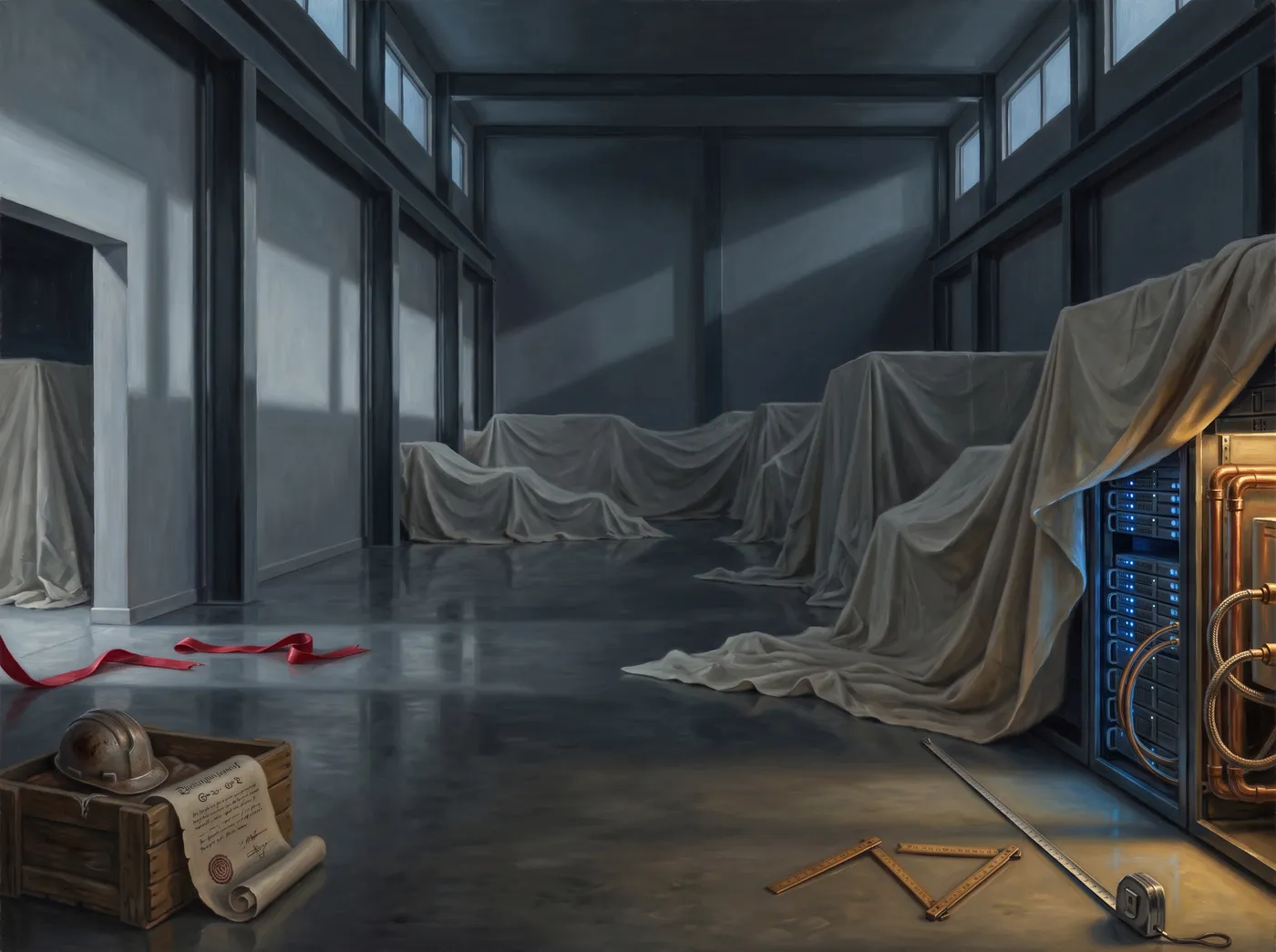
Here is where the deed-holder gets hurt. A data center's hard ceiling is not its floor space; it is the fixed number of megawatts it is allowed to pull off the grid, negotiated years in advance. When you retrofit an older building for today's dense, liquid-cooled racks, you hit that megawatt ceiling long before you fill the floor. One case study models a 50-megawatt facility built in 2024, two years ago, that, retrofitted for Blackwell-class racks, loses roughly 70% of its usable white space: 50,000 square feet of engineered building collapses to about 15,000 usable, because the power runs out first.8 The retrofit itself runs into nine figures, and against the available lease terms it frequently doesn't pencil for a building barely old enough to have a mortgage.
And the timing is the trap. AI tenants now sign fifteen-year leases and pre-lease capacity two to three years before a building opens.10 The developer locks in a cooling-and-density assumption at signing that has to survive a competitive-density cycle that turns over about every three years. You are underwriting a building to a 2026 spec and financing it against a 2041 lease, in an industry that reinvented the rack twice since 2023. That is the stranded-shell risk, and it does not sit with Jacobs. It sits with NTT, with Blackstone's QTS, with Vantage, with CoreWeave, the owners, and, increasingly, with whoever bought their bonds.
The same source that models the 70% white-space loss puts total at-risk, CMBS-financed data-center exposure at $40 billion, and notes data centers are now more than 10% of new single-asset/single-borrower CMBS issuance.8 The securitization trend is corroborated; the physical density logic is corroborated across trade press.9 But that specific $40 billion aggregate comes from one markets-commentary site, not a rating agency or a filing. Treat it as a flare, not a fact: the mechanism is real, the precise dollar total is unverified.
/ 03Et Voila! Off Balance Sheet
If the owner holds the obsolescence risk, the next question is how the owner pays for the building without that risk showing up where an investor would see it. The answer is the most elegant piece of financial engineering in the whole layer, and we know its shape because Cembalest walked into it in his own footnotes.
Meta is building a data-center campus called Hyperion in Louisiana. To fund it, a special-purpose vehicle anchored by the private-credit firm Blue Owl, 80% Blue Owl and 20% Meta, borrowed $27 billion of investment-grade debt.11 Meta signs renewable four-year operating leases that begin when the campus is finished, plus a residual-value guarantee that stays above the outstanding debt and reaches zero after twenty years. S&P will not put that $27 billion on Meta's balance sheet today; applied today, it says, the obligation would lift Meta's leverage by all of 0.2 turns, comfortably under its downgrade threshold. Meta keeps its AA– rating. The debt exists, the building gets built, and Meta's credit looks untouched.

Cembalest does the arithmetic S&P declines to. Meta's net-debt-to-EBITDA started 2025 negative: more cash than debt. Add the year's bond issuance and consolidate the Hyperion obligation the way a suspicious person would, and it climbs to 63%.11 Still below the market median; still, in his words, “a very different picture than when the year began.” His verdict on the accounting fits in three words, and I am going to let him keep them:
“Et Voila! Off balance sheet…” — Cembalest, “Smothering Heights,” Outlook 2026
He notes the same triple-net-lease-in-an-SPV technique showing up at Intel, EQT, Rogers, Sempra, and Keurig Dr Pepper, and that whether these structures survive a substantive-consolidation test in a bankruptcy is, in his phrase, “unknown at this time.”11 The bondholders don't hold a first mortgage. The SPV can pile on more senior debt as long as it doesn't trip a downgrade. This is the subsidy entering the shell: cheap capital, structured to build a possibly-stranding asset without denting the sponsor's credit rating.
The $27 billion of debt is solid. Every source agrees. The equity side does not reconcile. CNBC and Bisnow describe roughly $7 billion of Blue Owl cash against Pimco-anchored bonds; other reporting describes an SPV (named, wonderfully, “Beignet Investor”) raising $27 billion from Pimco, BlackRock and Apollo plus $2.5–3 billion of equity, with Meta contributing land rather than cash.12 I can't tell you from the public record who wrote the equity check or how big it was. When someone does, it should come out of Meta's own 10-K footnote, not a press release.
Meta is not the aggressive case. Oracle is. OpenAI has committed to pay Oracle roughly $60 billion a year for computing capacity Oracle hasn't built yet, requiring 4.5 gigawatts of power, or in his units “2.25 Hoover Dams or four nuclear plants.” Cembalest's dry aside: it's “an amount OpenAI doesn't earn yet.”13 Oracle's free cash flow doesn't support that on its own, so it started borrowing: $18 billion of bonds sold in a single day in September 2025, and, by 2026 reporting, on the order of $72 billion of data-center partner debt across three packages, one of which reportedly needed Pimco to anchor $10 billion after U.S. banks pulled back.14 Oracle's own November filing is characterized as disclosing $248 billion of additional lease commitments and $553 billion of remaining performance obligations.14 Those last figures are secondary characterizations of Oracle's filing, not the filing itself: a gap Part 3 will have to close directly.
Zoom out and the pattern has a name: private credit. Blackstone, Blue Owl, Apollo, Pimco, and BlackRock now originate most data-center debt. Outstanding private-credit loans to AI-related companies went from near zero to more than $200 billion in a few years, with Morgan Stanley projecting another $800 billion over the next two.15 The single largest such deal reported: Apollo and Blackstone assembling roughly $35–36 billion to fund Anthropic's compute buildout, including its purchase of Google-designed chips, a frontier lab financing its hardware through an off-balance-sheet SPV because, in the reporting's own words, the banks are “choking on the amount of AI debt they have to issue.”16 Hold that thread; it reappears in Part 4 wearing a different hat.
The SPV borrows
A private-credit-anchored vehicle raises investment-grade debt to build the campus. The hyperscaler takes a minority stake and signs long leases plus a residual-value guarantee.
The rating agency looks away
Because the debt sits in the SPV, not the parent, it doesn't consolidate onto the sponsor's balance sheet today. The credit rating holds. The leverage is real but invisible where equity investors look.
The bondholder holds the shell
The debt is secured against a building underwritten to a spec with a ~36-month shelf life. If the shell strands, the sponsor's rating is protected; the private-credit fund, and, via CMBS, the pension behind it, is holding the asset.
/ 04Sixty-Three Percent
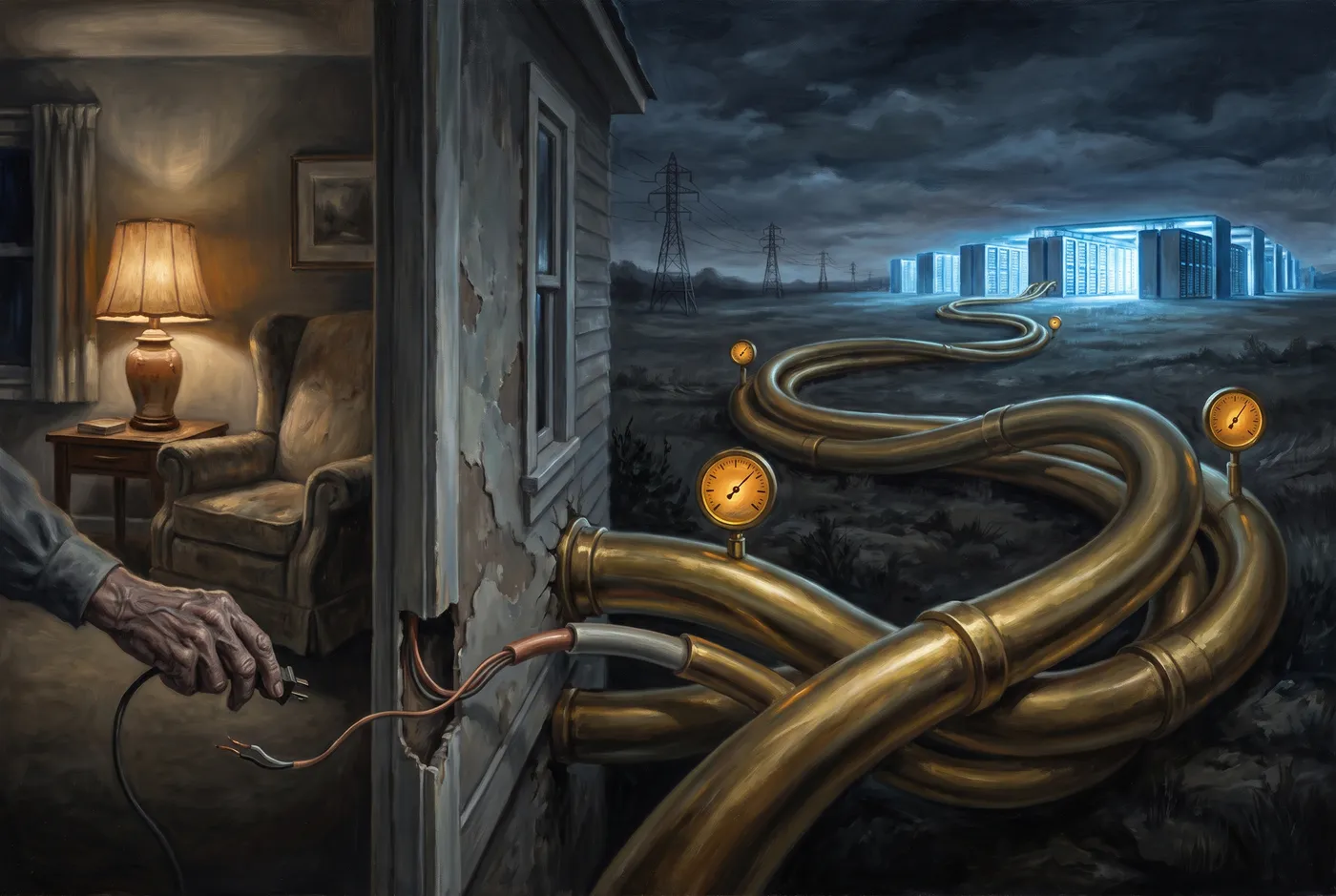
There is a second party absorbing the shell's cost who never signed anything, never bought a bond, and cannot opt out: the person who plugs a lamp into the wall in the mid-Atlantic United States.
PJM is the grid operator for thirteen states from New Jersey to Illinois. Every year it runs a capacity auction: a payment to power plants for promising to be available. That price went from $28.92 per megawatt-day in the 2024/25 auction to $329.17 for 2026/27, hitting the $333.44 price cap in the most recent round.17 More than a tenfold increase, and it lands on every ratepayer's bill. PJM's own twenty-year forecast has summer peak demand rising 58% by 2046, driven primarily by data centers.17
Who caused the price spike? PJM's independent market monitor, a firm called Monitoring Analytics, put a number on it: data-center load was responsible for 63% of the price increase in the 2025/2026 auction, about $9.3 billion in a single year, and $23.1 billion across three consecutive auctions.18 The monitor's own characterization is that current conditions are “almost entirely” a function of data-center load, which it calls “unique and unprecedented and uncertain.” Its recommended fix is blunt: make new data centers bring their own generation instead of drawing on the shared grid.18 The Union of Concerned Scientists separately estimated ratepayers will pay about $4.4 billion for data-center-related transmission approved in 2024 alone.19
“The builder took a fee. The ratepayer took a rate hike. Nobody asked the ratepayer.”
A discipline note, because I want you to trust the next five parts. You will see a second figure in circulation: that data centers drove 82% of the increase, $7.3 billion of a $16.1 billion auction. That is not the same statistic as the 63% above; one is a share of the price increase under the monitor's attribution method, the other a share of total-revenue increase in a single auction.18 Both trace to the monitor, reported at different moments. They should never be blended into one sentence, and a lot of coverage blends them. This series won't.
/ 05The Chips Get a Tariff Break. The Transformers Don't.
One more asymmetry, and it tells you exactly which part of the stack the state has decided to protect. In January 2026 the U.S. imposed a 25% Section 232 tariff on advanced semiconductors, and explicitly exempted chips headed for data centers of 100 megawatts or more.20 The silicon, which is Part 2's layer, gets carved out of the harshest new tariff precisely because it is the strategically precious asset.
The physical hardware that connects the shell to the grid gets no such mercy. Electrical grid equipment, transformers, switchgear, is reported to sit under a separate 15% Section 232 track running through the end of 2027.20 The United States imports roughly 90% of its large power transformers, and lead times have stretched toward four years for the biggest units, worsened by copper tariffs reported as high as 50% and rules forcing Chinese-linked materials out of federally funded grid projects.21 Gas turbines are sold out through 2030–2031; GE Vernova's backlog hit 100 gigawatts, with new-order prices up 10–20 points per kilowatt in the first half of 2026 alone, and plant-level costs pushing from under $1,500 per kilowatt in 2023 toward or past $3,000 on some measures.22
The 15% grid-equipment tariff rate and its December-2027 sunset come from trade-press synthesis of the January proclamation, not the proclamation text: verify against the Federal Register before you print it.20 And the gas-turbine cost figure is a genuinely contested, moving target: at least four methodologies are in circulation (plant-level all-in, turbine-unit price, EPRI's narrow recent window, Wood Mackenzie's 195% cumulative). Cite a dated range, not a single hero number.22
The asymmetry is the point. The chip is protected; the grid gear that carries power to the chip is taxed and back-ordered for years. Which is why a live escape hatch has appeared: Oracle's “Project Jupiter” campus in New Mexico switched its power design from gas turbines and diesel to up to 2.45 gigawatts of Bloom Energy fuel cells on a single microgrid, substituting distributed generation for grid draw specifically to skip both the turbine queue and the ratepayer fight.23 Bloom booked $7.65 billion of data-center contracts in a ninety-day window. When the owners route around the grid, the stranded-shell risk doesn't vanish. It just moves onto a fuel-cell stack with its own depreciation curve.
/ 06Who Holds the Shell
Stack up the ledger for this one layer. The builder, Jacobs, Turner, Quanta, did the work and took a fee, with no equity in the boom it poured. The owner, Meta, Oracle, the neoclouds, holds a building underwritten to a spec with a three-year shelf life, financed through a vehicle designed so the leverage doesn't show. The ratepayer holds a tenfold capacity-price increase nobody asked them to approve. And the bondholder, increasingly a private-credit fund, and behind it, through CMBS and pension allocations, you, holds the debt secured against the thing most likely to strand.
Every party in that sentence is doing something rational. Jacobs is right to prefer a fee to inventory risk. Meta is right to protect its rating. The auction cleared at a real price. The private-credit fund earns a real spread. None of it is fraud, and pretending otherwise is the failure mode this series is built to avoid. But rationality distributed this way has a shape, and the shape is: the upside concentrates with whoever owns the equity and the silicon, and the downside, obsolescence, leverage, the electric bill, is spread out over builders who don't own it, ratepayers who didn't choose it, and pensions who can't see it.
Buffett's line is that you only find out who's swimming naked when the tide goes out. The shell layer's tide is the density cycle: a new rack spec every three years against a fifteen-year lease. It is going to go out on schedule, on a specific building, holding a specific chip, that someone financed at a specific price. The question the rest of the stack answers is who is standing under it. We just met the first four of them, and none of them are the chip vendor. That's the next layer up.
Go up one rung, to the silicon, the one thing in this whole economy that got a tariff exemption because the state decided it was too precious to tax, and you find that even there, at the richest node in the stack, a quarter of the richest company's profit turns out to be a number it wrote about something it owns, not cash a customer paid it. Part 2 follows the token into the chip.