Why This Series Exists
This is the fifth investigative series. The “why” hasn’t changed since No Kings: The Chalice Overflows. The calendar advanced; another series came due. The original explanation, unchanged:
I used to explain things for a living. Not formally. Nobody hires you to explain. But when Lehman fell in 2008 and the CDOs unwound and the people around me asked what just happened?, I was the person who could answer, because I’d crossed enough disciplines, engineering, the Navy, finance, to see the machine from outside any single code-cage. Explaining the machine was a calling I didn’t choose. It chose me when the machine broke.
The machine is breaking again. Different variables, same architecture. And the corpus I’ve been building, 121 courses, 1,459 units, 10 case studies, 7 interactive games (more on the way), is busting its pressure vessel. The curriculum can explain how systems work. It can’t say I can’t believe I have to explain this. It can’t present the institutional absurdity straight-faced and let you realize it’s comedy. It can’t tell you that the Attorney General got fired for not being mean enough, and that her replacement is the president’s personal defense lawyer, and that you couldn’t write this in Idiocracy because the test audience would say it’s too on the nose.
This series can. Same rigor. Same sourcing. Wider scholar palette. Because the situation demands it.
Reading the Receipt
How to Read a Structural Admission
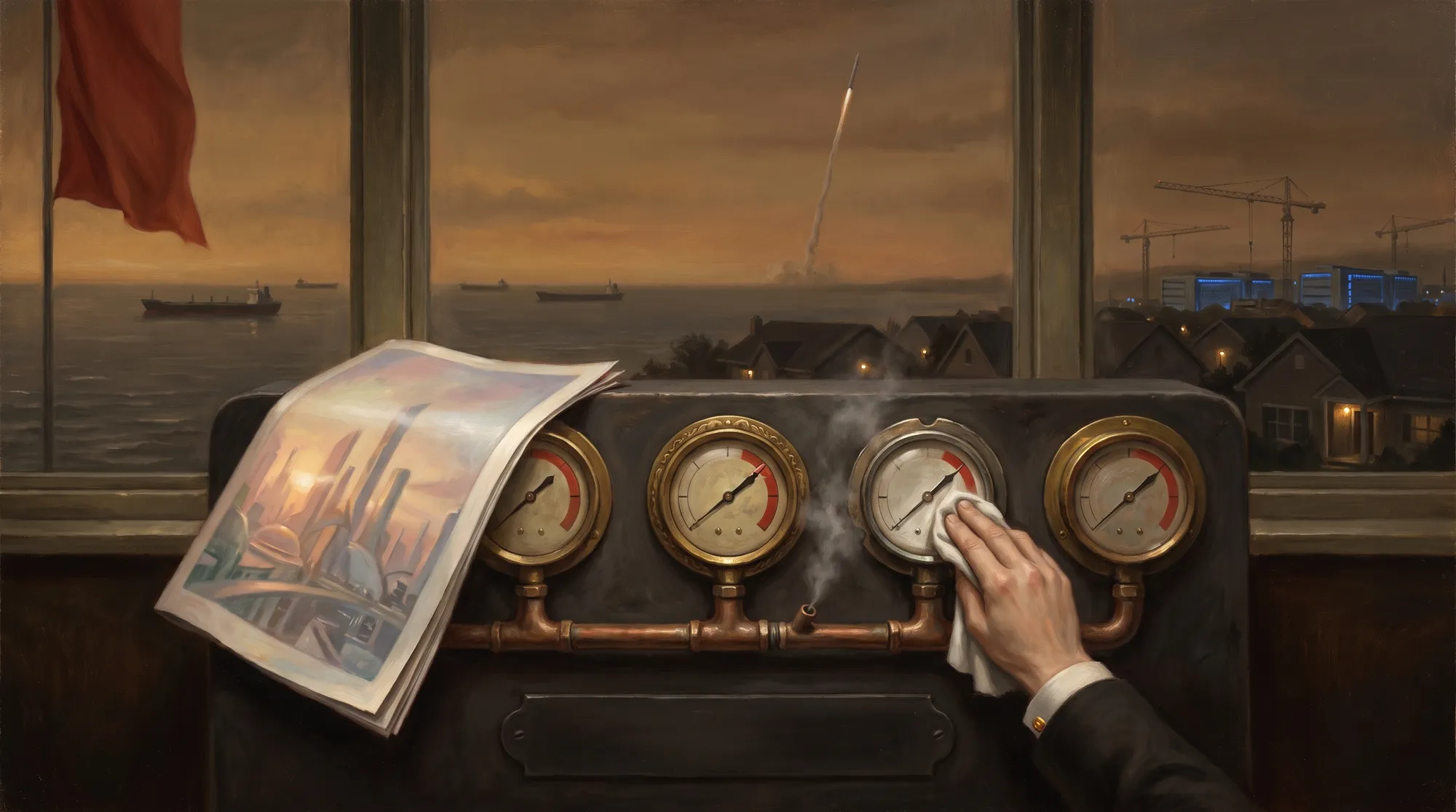
In a thirty-day window in May 2026, five independent subsystems each produced a documented receipt of the same fact: the post-1945 American architecture of capital, energy, and security can no longer be defended on the original spreadsheet. Each one named the admission in its own code. This series reads them together.
The Analytical Frameworks
This series uses roughly a dozen scholars across six articles, reaching for whichever lens the evidence earns, never reaching for one because the others have been used. The load-bearing framework names include:
- Susan Strange. Structural power across security, production, finance, and knowledge. The Gulf is trying to buy the knowledge structure with hydrocarbon receipts; the question is what it gets in return.
- Hyman Minsky. Hedge / Speculative / Ponzi finance phases. The QE-era Fed normalized speculative-finance balance sheets for households, hyperscalers, and the sovereign. Warsh proposes to reverse the regime; the existing stock of liabilities does not get to vote.
- Mariana Mazzucato. The entrepreneurial state. Public R&D underwrites the technology. Private capital captures the upside. Public balance sheets absorb the downside. The third leg is no longer hypothetical.
- J.K. Galbraith. The bezel. The inventory of undiscovered loss that fattens in easy money and is revealed when liquidity ebbs. The AI capex cycle is a candidate.
- Naomi Klein. Shock doctrine. The "pre-bailout" framing in plain English: the architecture is engineered to channel retail-borne demand into a structure that disables retail recourse, on a compressed timeline, with the cash going somewhere else.
- Samuel Spitale. The five trademarks of successful propaganda. The connective tissue that lets each subsystem look at the others and see "scaling laws hold" instead of seeing the admission.
- Blyth · Luhmann · Habermas · Lessig. The four scholars whose lenses have carried the prior series. Still load-bearing, now four of about a dozen.
Tooze, Polanyi, Slobodian, Smil, Varoufakis, Yergin, Sassen, Davis, Kirshner, Kindleberger, Setser, and Zuboff also earn seats where the evidence calls them. The full palette is documented in the series planning notes.
Article 1
The Spreadsheet That Didn't Hold
Stargate UAE broke ground on March 20, 2026, six days before war-risk insurance was withdrawn for the country's own coastline. The MGX fund did not exist in 2023. Aramco cut its dividend by $38.5 billion and announced its first-ever buyback. Sheikh Tahnoon bin Zayed is on the cover because the bridge between hydrocarbon receipts and US compute is not Washington's policy choice. It is Abu Dhabi's portfolio choice.
Draft MonetaryArticle 2
The Rupture
Kevin Warsh was confirmed by the Senate 54–45, the narrowest Fed-chair vote in the post-1977 era. The 30-year Treasury yield broke 5% the day after. The 10-year hit 4.7% on May 20, the same day SpaceX filed its public S-1. Powell stayed on as a governor through 2028, citing a DOJ probe. The "QT-for-Cuts" doctrine steepens the curve mechanically. The duration mismatch stopped being theoretical.
Draft CapitalArticle 3
The Architecture
Nasdaq rewrote its fast-entry rules on March 30, three weeks before SpaceX filed its confidential S-1. Seventy-eight percent of the $80 billion raise leaves the corporate perimeter on day one. CalPERS, New York City, and New York State comptrollers called the structure "the most management-favorable governance structure ever brought to the U.S. public markets at this scale." It was effectively ignored. When law, norms, and markets cannot discipline an issuer mechanically required to buy, the index-fund plumbing is what binds.
Draft PropagandaArticle 4
The Canon
No single document carries the weight of the Powell Memo. But three texts, Amodei's Machines of Loving Grace, Andreessen's Why AI Will Save the World, and Altman's Moore's Law for Everything, together do the same work: give capital a moral permission structure. Read alongside the Spitale framework, the dog-whistles of AI capital become legible. "Compute moat." "Scaling laws." "Responsible scaling." "National champion." Each does load-bearing work for someone.
Draft StrategicArticle 5
The Kowtow
Trump arrived in Beijing May 13 with eighteen CEOs and four Cabinet secretaries, including the first sitting US Secretary of Defense ever to accompany a president to the People's Republic. He left with no joint statement, zero chip deliveries, and a Chinese-drafted framework label ("four stabilities") in the bilateral vocabulary. The bond market priced the trip and the Warsh transition as one signal. Brookings: "up until this trip it was typically the United States that had the initiative. That's not the case anymore."
Draft SynthesisArticle 6
The Forced Absorber
Five subsystems, five admissions, one residual holder. The pension trustee. The 401(k) recordkeeper. The index methodologist. The sovereign-wealth manager. The Mazzucato cycle, closed. The Klein pre-bailout frame, defended in plain English. The honest reckoning the platform's own prior reporting owes, including the case study from ten weeks ago that named the duration mismatch but did not name the actor upstream of it. And what the curriculum is for, in a system designed to keep the fact from being said.
Primary Companion Series
No Kings: The Chalice Overflows traced what happens when every institution's binary code collapses into loyal/disloyal. The Computedollar is the direct follow-on: it traces what happens to the asset prices that were being marked against the code that just collapsed. Same palette. Same methodology. Wider scholar palette. The five admissions documented here include the monetary, energy, capital-structure, propaganda, and strategic dimensions that Chalice Overflows pointed toward but did not yet trace.
Other Companion Series
Social Physics of the New Disorder. The economic machine, five gauges connected by one feedback loop. Article 5 of that series explicitly anticipated the bond-market repricing that Article 2 here documents landing. · The Domestic Machine. Enforcement architecture; introduced the honest-reckoning self-audit pattern this series inherits. · The Education Machine. Register variation; mythology rather than collapse.
Honest Reckoning Anchor
This series is a follow-on to The Century Bond and the Three-Year GPU, the curriculum case study published 2026-03-12. That piece named the petrodollar-to-computedollar transition in its closing paragraph but did not name Sheikh Tahnoon as the upstream actor. It treated the duration mismatch as a theoretical risk; Warsh has now made it a priced event. The honest reckoning is throughout this series, comprehensive in Article 6.
How to Read This Series
- The Receipt. Each article opens with verifiable evidence. Dates. Prices. Quotes. Vote counts. Filing receipts. SEC line items. Start here.
- The Pipes. Connections between events traced through evidence, not assertion. The mechanism is documented; follow the structural links.
- The Framework. After the evidence speaks, the analytical tools are named with full attribution. Multiple lenses; no single one authoritative.
- The Sources. Every claim traceable. Primary documents where available. Inline citations throughout. We do not ask you to trust us. We ask you to check.
- The Honest Reckoning. Self-audit asides naming what the platform's prior reporting got wrong or structurally missed. Same standard applied to ourselves as to the subjects.
The Investigation in Order
One argument, in the order the year forced it
Written as the events arrived. Read top to bottom and you watch the argument grow, and watch what each dispatch couldn’t yet see become the subject of the next.
- 01
Read the economy as five gauges on one feedback loop, and called the bond-market repricing before it landed — but not yet the hand on the valve.
- 02The Domestic MachineMar 2026
Mapped the enforcement architecture and set the honest-reckoning self-audit this family now inherits as a rule — still reading enforcement as a domestic story, not a capital one.
- 03No Kings: The Chalice OverflowsApr 2026
Traced what happens when every institution collapses its judgment into one question, loyal or disloyal — without yet pricing the assets marked against the code that broke.
- 04The ComputedollarMay 2026you are here
Named the forced absorber: the pension as buyer of last resort in the AI capital cycle — reading compute as finance, before it was clear how much was physics.
- 05The StackJul 2026
Took the compute economy apart floor by floor, down to the power bill and the eleven days of gas under the whole supply — and left the questions open, on purpose.
- 06Hormuz and the Weighting GameAug 2026
Tallied six flows, talent, open weights, inference routing, data, allied standards, and capital, and argued the transfer to China's AI buildout runs one way, closing on the marginal cost of a watt as the deciding metric — the strait it's named for closes and reopens through all of it; the transfer doesn't stop either way.
- →The open questionunresolved
The Computedollar’s final article left four gaps open on purpose, labor displacement, stranded-asset risk under carbon pricing, the cognitive basis of deliberation, and cross-asset contagion, each named with its framework hooks and none of them traced. What has happened since sits inside those gaps rather than closing them: an index architecture that split rather than held, an absorption capacity that turned out to have a limit, a strait that for five months neither closed nor reopened. — The list ends here because the argument has not, not because the argument arrived.
The Education Machine (Apr 2026): the same rigor turned on mythology and merit rather than collapse. It sits beside the arc, not inside it, and reads on its own.