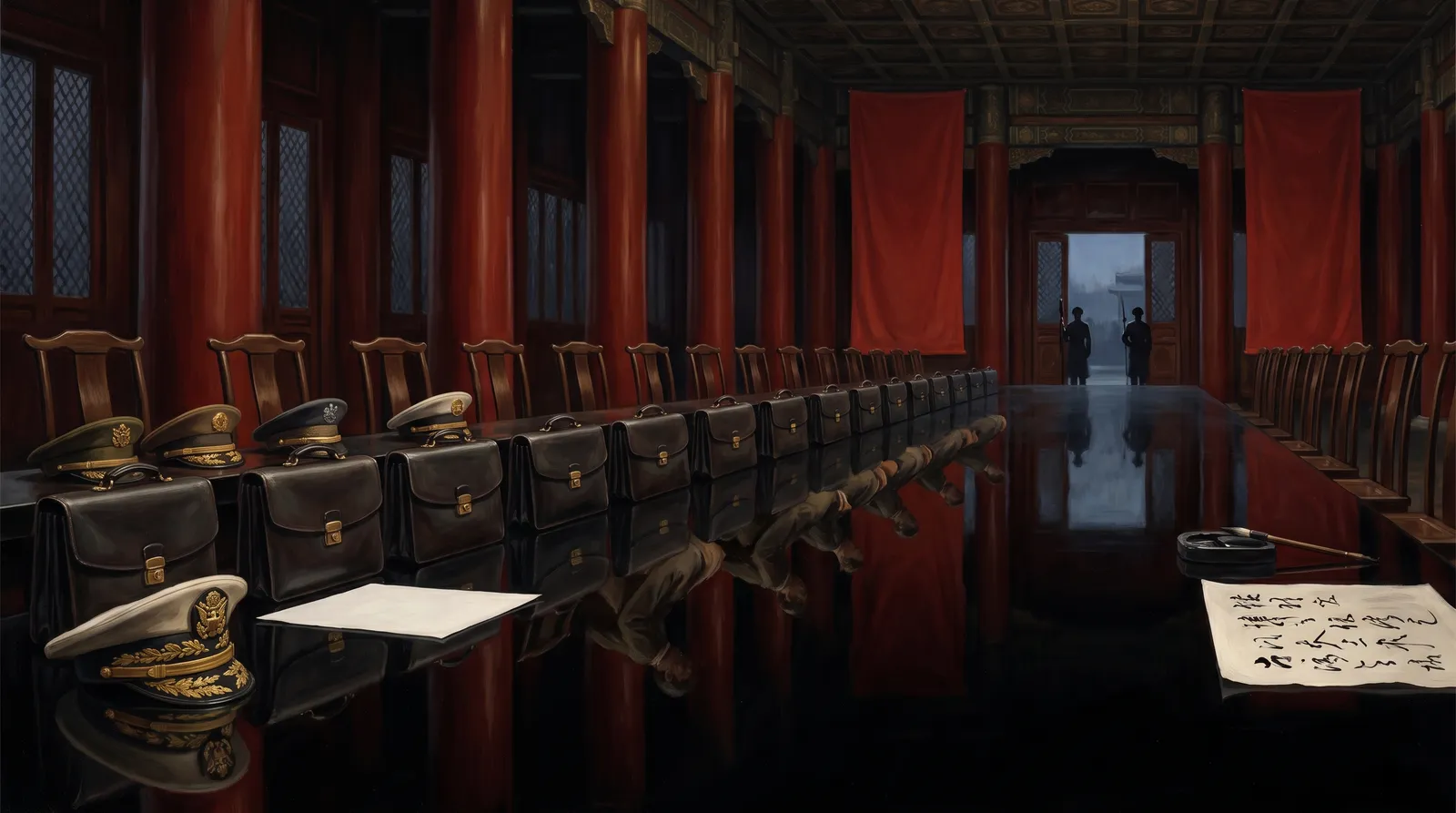
The plane left Joint Base Andrews on the evening of May 12 with a passenger manifest that read like a securities-filing prospectus stapled to a Cabinet roster. Air Force One refueled in Anchorage in the small hours of May 13. Jensen Huang, the chief executive of Nvidia, the company whose chips are simultaneously the most strategically sensitive American export and the largest single source of Chinese hyperscaler revenue, boarded the aircraft at the refueling stop. He had flown commercial from California to make the connection. By the time the wheels touched down in Beijing, the United States had assembled, in a single fuselage, the chief executives of Apple, Tesla, Nvidia, BlackRock, Blackstone, Boeing, Goldman Sachs, Micron, Qualcomm, the post-Powell Federal Reserve, and roughly half a trillion dollars in tradable equity value. With them, in jackets and ties: the secretaries of State, Defense, Treasury, and the United States Trade Representative. Plus the President’s son and daughter-in-law.
The Defense Secretary’s presence is worth pausing on. Pete Hegseth is the first sitting United States Secretary of Defense ever to accompany an American president to the People’s Republic of China. Not in the formal-state-visit era after 1979. Not under the strategic-competition framing that has organized the relationship since Obama’s pivot. Not at any point in the forty-seven years of formal diplomatic relations. James Mattis traveled to Beijing in 2018 without a president; Lloyd Austin did so in 2024. Caspar Weinberger went in 1986. Robert McNamara, William Cohen, Donald Rumsfeld, William Perry, Leon Panetta: all visited the PRC while in office, all of them while their respective presidents stayed home. The structural reason was uncontroversial: the SecDef goes to manage the military-to-military relationship as an independent track, and the optics of a sitting American war-cabinet principal standing on a Beijing tarmac next to his commander in chief have always been deemed too costly. Until now.
The trip produced no joint statement. Each government released its own readout. The two documents overlap in roughly the way that two people describing the same meeting tend to overlap when they want different things from the description. The White House fact sheet, released May 16, claimed $17 billion per year in Chinese agricultural purchases for 2026 through 2028, an order for two hundred Boeing aircraft, restored beef-facility listings, rare-earth supply-chain “concerns addressed,” a bilateral “Board of Trade” and “Board of Investment,” Iranian assurance against nuclear weaponization, and a guarantee of no tolls in the Strait of Hormuz. The People’s Republic readout, issued by the Foreign Ministry on May 14 and elaborated by Xinhua on May 17, mentioned none of those things. Not the Boeing order. Not the $17 billion. Not Iran. Not Hormuz. What it did do was install, as the framework label for the relationship “for the next three years and beyond,” a Chinese phrase: constructive strategic stability. And it elaborated Xi Jinping’s four stabilities as the four pillars that would carry the relationship forward: cooperation as mainstay, moderate competition, manageable differences, promises of peace.
The phrase was Xi’s draft. The United States accepted the conceptual terrain. That is what it means when one side’s slogan becomes the bilateral vocabulary.
The bond market read the documents the way bond markets read documents: not by reading them, but by pricing what their absence implied. The ten-year Treasury closed Friday May 15 at a yield between 4.54 and 4.57 percent, the highest in a year, nine basis points higher on the week. The reporters who wrote the move up did not pick between two stories. They reported both at once. The yield rose because the Beijing summit produced no tariff schedule, no semiconductor language, no Taiwan paragraph, and no FX paragraph. The yield also rose because Kevin Warsh had been confirmed two days earlier and the market was, in the unlovely language of fixed-income desks, pricing the Fed transition. The Trump-Xi summit and the Powell-to-Warsh handoff arrived in the same week, in the same auction window, against the same backdrop. The bond market did not bother to distinguish them. It priced both events as a single fact about the United States’ capacity to anchor either money or strategy. Article 2 of this series treated the monetary half of that fact in detail. This article treats the strategic half. The two halves were priced together because they are the same fact.
The Receipt
Three days. Two readouts. Zero overlap on the load-bearing paragraphs. Read them as a sequence.
| Data Point | Reading | Context |
|---|---|---|
| Delegation composition | 18 CEOs + 4 Cabinet | Cook (Apple), Musk (Tesla/SpaceX), Huang (Nvidia, boarded at Anchorage), Fink (BlackRock), Schwarzman (Blackstone), Ortberg (Boeing), Solomon (Goldman), Mehrotra (Micron), Amon (Qualcomm), Powell (outgoing Fed), among others. Rubio (State), Hegseth (Defense, first sitting SecDef ever to accompany a US president to Beijing), Bessent (Treasury), Greer (USTR). Plus Donald Trump Jr. and Lara Trump. (Wikipedia state-visit page; White House manifest, May 12.) |
| PRC counterparts | Full Politburo Standing | Xi Jinping, VP Han Zheng, CCP Chief of Staff Cai Qi, FM Wang Yi, Vice Premier He Lifeng, Executive VFM Ma Zhaoxu, Ambassador Xie Feng. (PRC MFA readout, May 14.) |
| Bilateral, scheduled length | 60 minutes | Ran 2 hours. State banquet that evening. Zhongnanhai compound walk the following morning. (Xinhua, May 14–15.) |
| Joint statement | None issued | Each side published its own readout. The two only partially overlap. NPR’s side-by-side comparison documents the divergence on Boeing, beef, Iran, and Hormuz. (Al Jazeera, May 15; NPR, May 22.) |
| US fact sheet, top line | $17B / yr ag · 200 Boeing | Plus restored beef listings, rare-earth language, “Board of Trade” and “Board of Investment,” Iran-no-nukes, Hormuz no-tolls. No tariff schedule. No semiconductor language. No Taiwan paragraph. (White House fact sheet, May 16.) |
| PRC readout, framework label | “Constructive strategic stability” | Xi’s four stabilities: cooperation as mainstay, moderate competition, manageable differences, promises of peace, named as the framework “for the next three years and beyond.” Xi on Taiwan: “Taiwan independence and cross-Strait peace are as irreconcilable as fire and water.” No mention of Boeing, $17B ag, Iran-no-nukes, or Hormuz tolls. (PRC MFA, May 14; Xinhua, May 17.) |
| H200 deliveries under existing regime | Zero | The “Trump cut” framework, 25% fee, 50% volume cap, mandatory US transshipment for inspection of H200s to ~10 approved PRC firms (Alibaba, Tencent, ByteDance, JD, Lenovo, Foxconn, and others), produced no shipments. Trump on Fox: China “chose not to” approve purchases because “they want to develop their own.” (CNBC chips coverage, May 14.) |
| Lone announced concession (beef) | Reversed within days | The restored facility listings were narrowed or rescinded after the delegation departed. Documented by Atlantic Council’s Melanie Hart in real time. The single most-cited deliverable from the US fact sheet did not survive the week. (Atlantic Council, “Where’s the beef?”) |
| 10-year UST, Friday May 15 | 4.54–4.57% · +9 bp on the week | Highest in a year. Reporters tied the move to both the empty summit and “fears the Federal Reserve may be behind the curve on inflation under incoming chair Kevin Warsh.” (NBC News, May 15; Fortune, May 15.) |
| CNY into the summit | 3-year high vs USD | PBOC lifted the daily fix to 6.8961 on May 7, a “controlled appreciation signal” in advance of the trip. Goldman called it “a tactical catalyst for yuan strength.” (Investing.com / Reuters, May 13.) |
| Return visit accepted | Xi to Washington, Sep 24 | Reciprocal state visit within four months, a high-cadence relationship in calendar terms, regardless of the substantive content of either visit. |
The bond market did not bother to separate the strategic signal from the monetary one. They arrived in the same week, in the same yield curve, in the same auction. The receipt is one document with two pricings.
I. The Plane
Begin with the plane, because the plane is the first piece of structural evidence.
An American president travels to Beijing roughly once per term. The protocol developed over the past four decades has settled into a recognizable shape. The president flies on Air Force One with a small senior staff. Cabinet secretaries typically meet the delegation in-country. Business executives travel separately on chartered aircraft, organized by chambers of commerce or trade-mission infrastructure, and are convened in Beijing for set-piece sessions on the margins of the bilateral. The composition signals what the trip is for. A heavy diplomatic presence and a thin business presence reads as a strategic visit. A heavy business presence and a thin diplomatic presence reads as a trade mission. A presidential aircraft refueling in Alaska to pick up a single semiconductor CEO reads as something else.
The May 12–15 trip put eighteen chief executives, four Cabinet secretaries, and two family members on a single aircraft. The CEOs were not stapled on as a backdrop. They are the load-bearing reason for the trip. The manifest reads as the United States showing Beijing what it brought to the table: the people who actually decide whether tens of billions of dollars in commercial flows continue, which markets stay open, whether the leading-edge semiconductor pipeline keeps shipping to PRC hyperscalers under any negotiated regime. Cook brought iPhones. Musk brought the Gigafactory and the Starlink question. Huang brought the H200. Fink brought BlackRock’s seat at the table of every major Chinese ETF flow. Schwarzman brought the relationship of forty years and his eponymous scholars program. Ortberg brought what was left of Boeing’s widebody order book. Solomon brought the underwriter of every China-related American IPO. Mehrotra and Amon brought what the semiconductor industry has been unable to convince Washington to accept: that the China revenue line is not an optional component of the AI capital cycle. It is part of the cycle’s collateral.

The four Cabinet secretaries on the plane index four different American negotiating problems. Rubio is at State because hard-line credentials provide political cover for whatever the trip yields. Bessent is at Treasury because the bilateral has a currency dimension and an UST-holdings dimension whether the readouts mention them or not. Greer is at USTR because there is no actual trade agreement in any signable form, and the public-facing artifact of the trip is a fact sheet rather than a memorandum, and Greer’s presence allows that fact sheet to be characterized as the product of trade negotiation rather than political ceremony. Hegseth is at Defense because…
Hegseth is at Defense because no Secretary of Defense has ever before stood on a Beijing tarmac next to a sitting American president, and the decision to break that precedent is its own piece of strategic communication. The traditional reason for the SecDef-stays-home posture is that the military-to-military channel is supposed to be an autonomous track. It exists at lower temperatures than the political relationship. It survives political ruptures by being insulated from them. Mattis and Austin both visited Beijing during periods of acute political tension precisely because their visits could be detached from White House messaging. The SecDef accompanies the president when the SecDef is White House messaging. The presence of Pete Hegseth on Air Force One signals that the military-to-military channel has been folded into the political channel. The autonomy is gone. The track is one track. Beijing receives the United States as a single entity speaking with a single voice, which is, in this delegation’s composition, a voice asking for something.
The thing being asked for is not in either readout in so many words. It is implied by the manifest. The United States arrived in Beijing with the people who can stabilize commercial flows and the people who can stabilize military flows. It departed with no joint statement on commercial flows and no joint statement on military flows. What it received in return was Xi’s framework label, accepted into the bilateral vocabulary, and a calendar entry for Xi’s return visit in September.
Weinberger to Beijing, 1986 (no president). Cohen, 2000 (no president). Rumsfeld, 2005 (no president). Gates, 2007 and 2011 (no president). Panetta, 2012 (no president). Mattis, 2018 (no president). Austin, 2024 (no president). The SecDef-travels-without-the-president pattern is not informal. It is doctrine. Pete Hegseth’s presence on Air Force One alongside Trump in May 2026 is the first time the doctrine has been broken in the forty-seven-year history of US-PRC diplomatic relations. The decision was not announced. It was simply executed. The fact that this break has produced no sustained press conversation is itself the most useful data point about how routinely the previous architecture has now been discarded.
The Anchorage refueling stop, in this context, is not an operational detail. It is a piece of choreography. Jensen Huang made the trip from Santa Clara to Anchorage by commercial flight to board Air Force One for the leg to Beijing. The choreography says: the President of the United States arrived in the People’s Republic with the chief executive of Nvidia at his right hand. The semiconductor question was on the plane. The semiconductor question was the trip’s implicit text. The question that Huang has been asking for two years, whether the United States will accept the commercial reality that Nvidia’s China revenue line is large enough to matter to the entire AI capital cycle, was the question being carried into the bilateral.
It came home unanswered. We will get to that.
II. The Two Readouts
The most important fact about the Trump-Xi summit of May 13–15, 2026, is that there is no shared text of what occurred. Each government published its own document. The two are different in ways that go beyond the normal divergence of diplomatic communication.
The White House fact sheet, issued May 16 under the heading President Donald J. Trump Secures Historic Deals with China, Delivering for American Workers, Farmers, and Industry, reads as a list of deliverables. Annual Chinese agricultural purchases from US producers of $17 billion per year for 2026, 2027, and 2028. An order for two hundred Boeing aircraft, with specific deliveries to specific Chinese carriers. The restoration of approximately three thousand previously delisted American beef-processing facilities to the China market. Rare-earth supply-chain “concerns addressed” through, the document said, “reciprocal commitments on licensing transparency.” The establishment of two new bilateral working bodies: a Board of Trade and a Board of Investment, each to be chaired at deputy minister level and to meet semi-annually. Iranian non-nuclearization, phrased as an undertaking that the People’s Republic would communicate to Tehran. And a commitment to ensure no Chinese-imposed tolls on the Strait of Hormuz, framed as a stabilization measure for global energy flows.
The PRC readout, issued first by the Ministry of Foreign Affairs on May 14 and elaborated by Xinhua on May 17, does not contain any of those line items. It does not mention agricultural purchases. It does not mention Boeing. It does not mention beef. It does not mention rare earths in any specific operational sense. It does not mention Iran. It does not mention the Strait of Hormuz. What it contains, in their place, is something different: a framework label, a typology, and a Taiwan paragraph.
The framework label is “constructive strategic stability,” identified by the readout as the organizing concept for the bilateral relationship “for the next three years and beyond.” The typology is what Xinhua called Xi’s four stabilities: cooperation as the mainstay of the relationship; moderate competition rather than acute rivalry; manageable differences in place of zero-sum confrontation; and what the document phrased as promises of peace, including specific reciprocal undertakings not to pursue military conflict in the Taiwan Strait, the South China Sea, or the East China Sea. The Taiwan paragraph repeated, with extra weight, Xi’s standard formulation: “Taiwan independence and cross-Strait peace are as irreconcilable as fire and water.”
NPR’s May 22 side-by-side comparison of the two documents is the clearest single piece of public-record journalism on the divergence. The NPR write-up shows item-by-item where the US fact sheet asserts a commercial outcome and the PRC readout is silent, and where the PRC readout asserts a strategic framing and the US fact sheet is silent. The two documents are not contradictory in the usual sense of asserting opposite facts about the same subject. They are, more precisely, two documents about two different meetings.
Neither readout contains a tariff schedule. Neither contains semiconductor language: not the H200 channel, not Huawei, not the controls regime. Neither contains a Taiwan paragraph that names a specific US policy or commitment (Trump’s “I made no commitment either way” was extemporaneous, not codified). Neither contains an FX paragraph, despite the CNY hitting a three-year high vs. the dollar in the week leading up to the summit. Neither contains a UST-holdings paragraph, despite the bond market pricing the trip as a structural negative. The documents’ convergence is in the absences. What both sides agreed not to put in writing is the actual content of the meeting.
Joint statements are the diplomatic convention for a reason. They are the artifact through which two governments publicly tie themselves to a shared description of what they agreed to. A joint statement makes the relationship a matter of co-authored record. It makes future divergence costly. It allows each side’s domestic audience to see the other side’s signature next to the language. The absence of a joint statement is therefore not a procedural detail. It is a structural choice. Both sides agreed not to be jointly accountable for any specific verbal artifact emerging from the trip. Each side preserved the freedom to describe the meeting to its domestic audience however was politically useful. The People’s Republic used that freedom to install its framework language. The United States used that freedom to enumerate deliverables that the People’s Republic does not consider itself jointly accountable for delivering.
Jürgen Habermas spent his career drawing the distinction between communicative action and strategic action: the distinction between speech that aims at shared understanding and speech that aims at securing the speaker’s preferred outcome with the listener as audience rather than as conversation partner. A joint statement is at least nominally communicative action: two parties producing a single text they both agree to be bound by. Two parallel readouts, by two parties speaking past each other to two domestic publics, is strategic action in its purest form. The summit was not a conversation. It was two performances on the same stage at the same time. The diplomatic press read it as stabilization because the photos were friendly. The bond market read it as decline because the absences priced through.
The Habermasian distinction matters because performative diplomacy is cumulative. Each successful instance of two governments publicly describing the same meeting incompatibly makes future joint statements harder to construct. The capacity for shared communicative diplomacy degrades through disuse. The Beijing summit will be cited, in the next round of US-China engagement, as a baseline that did not produce a joint text. The next bilateral will be lucky to produce one. The capacity that erodes is the capacity to make any future commitment that binds both sides in shared language. Strategic action displaces communicative action. The lifeworld of US-China diplomacy is colonized by the systems imperatives of two separate political bases. The fact that neither base would have applauded a joint statement that contradicted its own preferred framing is precisely the point. The architecture for binding speech has been removed, and the removal will outlast this administration and this Politburo.
III. The Strange Inversion
The British political economist Susan Strange spent her career arguing, against a generation of international-relations scholars who counted ships and warheads, that the United States’ structural power in the post-1945 international system rested on four distinct foundations. She called them the four faces of structural power: security, production, finance, and knowledge. A great power had not only relational power, the ability to force a specific other party to do a specific thing, but structural power, the ability to shape the framework within which all parties operated. Structural power, Strange wrote, was the ability to set the terms.
The four faces are easy to enumerate. The United States possessed structural security power because it underwrote the international security architecture: the alliances, the basing network, the nuclear umbrella, the maritime presence that kept sea lanes open. It possessed structural production power because the global value chains in critical industries were organized around American final demand and American firms’ design and intellectual-property authority. It possessed structural financial power because the dollar was the world’s reserve currency, US Treasury debt was the world’s safe asset, and SWIFT and the correspondent-banking system ran through American supervisory authority. It possessed structural knowledge power because the research universities, the patent regime, the standards bodies, the platform companies, and the cultural exports of the United States set the terms for how knowledge was produced, certified, and monetized worldwide.
The Beijing summit’s record is, in something close to its full literal text, an inversion of US structural advantage in all four faces.
Consider the security face. The United States arrived in Beijing seeking Chinese mediation. The Iran war that had closed the Strait of Hormuz in February and March (documented in Article 1 of this series and in No Kings: The Chalice Overflows Article 1) had created a strategic problem the United States could not solve unilaterally. China had brokered the Saudi-Iran normalization of 2023. China had hosted Iran’s envoy in Beijing on May 6, the week before the summit. The implicit ask in the US fact sheet’s Iran-no-nukes paragraph and its Hormuz-no-tolls paragraph is that the People’s Republic use its relational influence in Tehran to deliver an outcome the United States can no longer compel. The structural-power direction of that ask is the inversion of what Strange’s framework predicts. The United States is the demandeur in the security domain. Beijing is the supplier of relational leverage. That the US fact sheet treats this asymmetry as a deliverable rather than as an admission is the rhetorical work the document is doing.
Consider the production face. The United States arrived seeking restored beef-facility listings, rare-earth supply-chain undertakings, agricultural purchase commitments, and aircraft orders. Each of these is a request for Chinese final demand or for Chinese inputs into American production. The structural direction is the same as in the security face: the United States is asking the People’s Republic to behave in specific ways with respect to commercial flows that the People’s Republic increasingly controls. Rare earths are the cleanest case. The Chinese state has built and protected, over four decades, a near-monopoly position in heavy rare-earth refining. The 2026 export-licensing regime that constrained American defense and clean-energy supply chains is a Chinese instrument of structural production power. The United States arrived in Beijing asking for “reciprocal commitments on licensing transparency.” The PRC readout does not include any such commitment. The structural advantage on rare earths is Chinese, and the People’s Republic chose not to memorialize even its rhetorical version of an undertaking.
Consider the financial face. The yuan hit a three-year high against the dollar in the week of the summit. The People’s Bank of China lifted its daily fix to 6.8961 on May 7, six days before the bilateral. Goldman Sachs, in a client note that appeared in Reuters wire coverage on May 13, characterized the move as “a tactical catalyst for yuan strength.” The market read the appreciation as a Chinese gesture of stability and confidence, timed to the visit. What the readouts do not contain is any reference to FX coordination, UST holdings, or capital-account questions. The People’s Republic continues to hold approximately $760 billion in US Treasury debt, down from a peak of about $1.3 trillion in 2013, but still the second-largest foreign holding after Japan’s. The capacity to dispose of that holding in ways that would force adverse US debt-service consequences is a Chinese structural-financial instrument. The instrument was not used. It was also not even raised in either document. Jonathan Kirshner, whose work on monetary statecraft has spent two decades reminding analysts that the most consequential moments in international financial politics are often the ones that produce no documentary record, would point out that this is exactly the pattern: the loudest silence in the documents is the silence in the FX and UST paragraphs that do not exist.
Consider the knowledge face. The United States arrived in Beijing offering loosened H200 licensing as a carrot. The carrot was not taken. The People’s Republic has, over the period since the 2022 chip-export controls began, accelerated investment in domestic GPU substitutes: Huawei’s Ascend line, SMIC’s 7nm and emerging 5nm processes, the funded domestic alternatives to CUDA. The Chinese hyperscalers have been signaled by the Chinese state that imported Nvidia silicon is, at minimum, a transitional arrangement. The American knowledge-structure advantage in the AI stack is being eroded not because the underlying technology is being replicated overnight but because the political signal that domestic substitutes will be supported has been delivered with sufficient credibility that the substitution will be funded regardless of intermediate quality. The United States arrived in Beijing offering an asset whose recipient had already begun the process of not needing it. That is the knowledge-structure inversion in its most acute form.
Security: US asks PRC for Iran/Hormuz mediation. PRC declines to memorialize in print. Production: US asks PRC for beef listings, rare earths, ag purchases, Boeing orders. PRC declines to memorialize in print. Finance: US offers nothing FX-related. PRC offers a controlled CNY appreciation as ambient gesture; neither readout contains a UST or FX paragraph. Knowledge: US offers H200 licensing as carrot. PRC declines to deploy domestic firms to buy, signaling that the substitution thesis has political support. The pattern in all four faces is the same: the United States arrived asking. That is a relational posture, not a structural one. Structural power is the ability to set the terms. The terms set were “constructive strategic stability,” in a phrase China drafted.
The Brookings Institution’s Ryan Hass, who served as the National Security Council’s director for China during the Obama administration and is not a partisan voice, characterized the trip in a post-summit briefing in language that is worth quoting verbatim: “Up until this trip it was typically the United States that had the initiative. That’s not the case anymore.” The historical baseline is precise. Every American president from Nixon through Biden traveled to Beijing with a working assumption that the United States set the agenda. Sometimes the United States was correct about that. Sometimes the United States was less correct. But the working assumption was load-bearing. Hass’s observation is that the working assumption has now ceased to operate. The trip was scheduled at PRC convenience: originally proposed for April, rescheduled to May after Trump’s Iran war made the earlier date impractical, which is itself an American admission that the People’s Republic held the mediation key. The framework label was Chinese. The deliverables were unilateral US claims that the PRC declined to corroborate. The agenda was no longer being set in Washington.
This is what it means for structural power to migrate. It is rarely a single moment of replacement. It is a gradual ceding of the ability to set terms, visible in the documents that fail to be jointly produced and in the framework labels that find their way into the bilateral vocabulary in someone else’s draft language. Strange’s framework was always designed to recognize the migration. The Beijing summit is the kind of artifact she would have used as a teaching case.
IV. The Chips That Didn’t Ship
Jensen Huang flew home with nothing in his briefcase.
The H200 licensing regime in place at the time of the summit, informally called the “Trump cut” framework on the trading desks that have to model around it, permits Nvidia to sell its second-tier flagship AI accelerator to a curated list of approximately ten Chinese hyperscalers, including Alibaba, Tencent, ByteDance, JD, Lenovo, and Foxconn, subject to three constraints. First, a 25 percent fee paid to the US Treasury on each chip shipped (the “cut” from which the framework takes its informal name). Second, a 50 percent volume cap relative to Nvidia’s sales to comparable non-Chinese hyperscalers. Third, mandatory routing through a US-controlled transshipment node where each unit is physically inspected to confirm it is the licensed SKU rather than a higher-bandwidth variant. The framework was negotiated through late 2025 and went operational in early 2026. It is the most permissive H-class export regime the United States has authorized for the People’s Republic since the export controls began.
The framework has produced, as of the date of the summit, zero shipments. The Chinese hyperscalers it covers have, between them, approved no purchase orders. Nvidia has not exported a single H200 to the People’s Republic under the regime that was specifically designed to permit those exports.
Trump, in a Fox News interview the week after the summit, explained the absence in a sentence that is, against the political weight he tends to put on it, the cleanest piece of strategic analysis to emerge from the trip on either side: China “chose not to” approve purchases because “they want to develop their own.”
He is correct. The Chinese state has communicated to the hyperscalers in question, through channels that are not formally documented but are visible in the procurement decisions, that domestic GPU substitutes, Huawei’s Ascend 910C and the next-generation Ascend 920, SMIC’s domestic process nodes, the Cambricon and Biren accelerator alternatives, are the politically preferred foundation for Chinese AI compute. The signal is not that imported Nvidia silicon is forbidden. The signal is that funding for domestic substitutes will be sustained even when the imported chip is technically superior, and that hyperscaler procurement that becomes dependent on the import is a procurement that will be politically exposed in the next round of US-China escalation. The Chinese hyperscalers have priced that signal and have chosen the local substitute even at present quality and performance discounts.
Nvidia’s China data-center revenue peaked at approximately $13 billion in calendar 2023, fell to roughly $5 billion in 2024, and has continued to decline in 2025 and into the first half of 2026 despite the “Trump cut” framework. The decline is not export-control mechanical. It is demand-side political. The Chinese state has chosen the local substitute. Each percentage point of Nvidia’s implied data-center growth that was being modeled against China-revenue recovery is now being modeled against China-revenue continued decline. The repricing flows through to every part of the AI capital stack that has been issued against a story of unconstrained US compute dominance: the SpaceX IPO (Article 3), the Anthropic Series H mark, the Stargate UAE financing structure (Article 1), the Oracle $129B OpenAI order book that anchors part of the canon (Article 4).
The structural admission inside this fact is large. The export-controls regime as it has been built since 2022 was constructed on the premise that the United States possessed a chokepoint: that withholding leading-edge GPU silicon from the People’s Republic would slow Chinese AI capability development by a margin sufficient to preserve a US lead. The chokepoint thesis was always contested at the technical level. The May 2026 summit produced, in the chip channel specifically, the cleanest piece of evidence to date that the political dimension of the thesis has been resolved by the Chinese counterparty. The People’s Republic has chosen to accept the technical penalty of inferior domestic substitutes to extinguish the strategic dependency. The chokepoint, in operational terms, has been routed around. The hyperscalers’ choice to not buy under the most permissive regime the United States has authorized is the most concrete piece of evidence that the substitution path is being walked.
This matters for the AI capital cycle in a way that the propaganda layer described in Article 4 has been working hard to keep illegible. The bull case for unconstrained American hyperscaler capex rests on, among other things, a story about American compute supremacy that is sold to allocators as durable. The China revenue line on Nvidia’s data-center segment is a component of that story. Each downward revision to that line forces the implied terminal growth rate on Nvidia’s data-center business to be supported by an even larger non-China component, which is to say, by even more aggressive forecast US hyperscaler capex against an already saturated capex base. The arithmetic does not stop working. It just requires more of the bullish assumption to be carried by the bullish part of the assumption. The structural admission inside the H200 channel is that the China revenue line is leaving. The bull case is being narrowed to a thinner and thinner reed.
Trump’s “they want to develop their own” is not a complaint. It is an accurate description of the equilibrium the export-controls regime produced. The regime was designed to slow Chinese AI capability. It instead accelerated Chinese commitment to a parallel stack, and the parallel stack will now be built whether the import channel is open or closed. The chokepoint produced the substitute. The substitute makes the chokepoint structurally irrelevant. The People’s Republic chose the long path because the long path is now politically and strategically preferred. The United States arrived in Beijing offering a chip channel that the Chinese state had already decided not to need. That is the knowledge-structure inversion expressed in operational procurement terms.
The Mariana Mazzucato framework, which Article 6 will use to organize a larger argument, fits awkwardly into this specific cell because the export-controls regime was an attempt to use state policy to constrain the diffusion of a publicly-funded technology and the constraint has produced its own state-funded substitute. The American taxpayer underwrote the original AI capability (DARPA, NSF, NIH, the university research base, decades of basic R&D). American private capital captured the upside (Nvidia’s ~$3 trillion market cap, the hyperscaler oligopoly). The export-controls policy attempted to convert the public-R&D foundation into a permanent strategic advantage. The result is that the Chinese state has now committed public R&D of its own to building the substitute, and the substitute will be built. The Mazzucato cycle in the original frame is about who captures the upside of public R&D within a single national economy. The chip-export-controls episode shows the cycle being run twice in parallel, in two national economies, with the public-R&D foundation in each case being instrumentalized to produce capture by a national-champion cap stack. The result of running the cycle twice in parallel is that the chokepoint disappears. The framework Mazzucato wrote as a national-economy story is now an international-system story, and the international system is producing exactly the redundancy that the chokepoint was designed to prevent.
V. The Beef, Reversed
The single most-cited deliverable of the US fact sheet was the restoration of approximately three thousand previously delisted American beef-processing facilities to the China market. The fact-sheet language was specific: the People’s Republic would restore the facility listings as part of the broader bilateral commitment to commercial normalization. The restoration was characterized as effective immediately upon the conclusion of the summit. The Atlantic Council’s Melanie Hart, whose policy memo on the trip appeared the following week under the title “Where’s the beef?”, documented in real time what happened next: the restoration was narrowed and rescinded within days. Not all of it. But the operational effect was that the headline deliverable, the most concrete commercial concession in either readout, did not survive the trip.
Beef is not a strategic product. It is a thoroughly commodified meat. The volumes involved are not large enough to move the trade balance. The American beef industry’s exposure to the China market is meaningful for specific producers but is not load-bearing for the macroeconomy. The reason to spend a paragraph on what happened to the beef listings is not that the beef matters. The reason is that the beef was the test. The lone deliverable that both governments could be expected to operationalize quickly, in a domain with low strategic friction, was the deliverable that fell apart fastest. A bilateral relationship in good working order would have produced beef restoration that lasted. A relationship in which neither side trusted the other to honor implicit understandings would have produced the pattern observed. The pattern observed is the diagnostic.
What Hart’s memo identifies, with a kind of analytical patience that the headline coverage did not match, is that the beef reversal followed a now-recognizable rhythm. The People’s Republic frequently announces commercial concessions in the immediate aftermath of high-level bilateral meetings and then narrows or rescinds them within days or weeks once the political photo opportunity has been consumed. The pattern is sufficiently regular that it has its own name in the trade-negotiation literature. Sometimes the rescission is explicit, with regulatory authorities citing technical compliance concerns. Sometimes it is operational, with customs authorities slow-walking the implementation. Sometimes it is bureaucratic, with the relevant ministries simply failing to issue the implementing notices that would make the announcement effective. The American counterparty learns, eventually, that the announcement was the deliverable, and the actual commercial flow was never going to follow. The beef restoration was a deliverable of this kind.
No Kings: The Chalice Overflows Article 1, published April 2026, named the Strait of Hormuz closure as one of the structural shocks of the prior weeks. The piece did not, however, trace what the closure implied about American structural capacity to honor security commitments to the Gulf states, to the energy importers in Asia, or to the freedom-of-navigation regime more generally. The Hormuz closure was treated as a downstream economic consequence of an upstream political decision (the unauthorized Iran war). That treatment was correct as far as it went. What it did not yet name was that the closure was, in addition, the structural test the post-1945 American security guarantee was always going to fail. The guarantee was conditional on the United States possessing the capacity, the political will, and the alliance cooperation necessary to keep critical maritime chokepoints open. February and March 2026 documented the absence of all three. The Beijing summit’s implicit Iran-no-nukes paragraph and Hormuz-no-tolls paragraph in the US fact sheet are the diplomatic acknowledgment of that absence. The United States asked Beijing for mediation in a domain where it had previously claimed to underwrite the architecture itself. The earlier piece named the closure. It did not yet name what the closure was a test of. This piece names the test. The earlier framing was complete on the facts available; it was incomplete on the structural reading. The honest reckoning is that the closure was diagnostic, and we treated it as episodic.
The pattern of the beef restoration applies, in slightly different rhythm, to the other items on the US fact sheet. The $17 billion per year agricultural commitment is structurally similar to the agricultural purchase commitments that emerged from the 2020 Phase One trade deal, which the People’s Republic failed to honor at any point in the subsequent four years. The Peterson Institute’s Chad Bown documented, in a series of papers between 2020 and 2024, that the Phase One purchase commitments were, in aggregate, fulfilled at approximately 58 percent of their announced targets, with agricultural purchases specifically running at roughly 65 percent. The 2026 fact-sheet figure of $17 billion per year is in the same range as the Phase One agricultural commitment ($36.5 billion per year for two years). The base rate for fulfillment of announced Chinese commercial commitments to American producers in the past five years is below 70 percent of the announced amount. Fact-sheet announcements are negotiated for the audience that will read the fact sheet. The implementation curve is then negotiated on a separate track by the same parties.
The Boeing order, two hundred aircraft, is the largest single line item in dollar terms in the US fact sheet. It is also the line item most exposed to the implementation problem. Boeing aircraft orders to Chinese carriers are notionally booked at list prices and then negotiated downward at delivery. The 2017 Trump-Xi Boeing order for three hundred aircraft was announced at a notional value of $37 billion; the actual delivery curve through 2024 produced perhaps half of that in shipped value, with material slippage on the wide-body specifications. The 2026 announcement does not constitute a binding purchase order in any commercial sense. It constitutes a memorandum of understanding that Boeing will be a preferred supplier as Chinese carriers’ fleet renewal programs proceed. The actual delivery curve is governed by Chinese state-aviation policy, by the indigenous COMAC program, and by the implicit signal Beijing has chosen to send to its national carriers about how much wide-body Boeing exposure is politically acceptable.
The Atlantic Council’s Melanie Hart, again, is the analyst worth listening to on this. Her assessment of the summit, delivered in plain language: the deliverables in the US fact sheet are best understood as a political artifact rather than as a commercial forecast. The People’s Republic permitted the United States to claim the deliverables because the claims helped Trump domestically. The People’s Republic has not, however, committed to implementing them at the rates the fact sheet implies. The base rate for implementation of this class of announcement is materially below the announced figure. The fact sheet was the price the PRC paid for the framework label. The People’s Republic got the framework label. The United States got the headlines. The framework label will outlast the headlines.
VI. The Bond Market
The ten-year Treasury auction window that closed Friday May 15 priced the trip and the Fed transition as one event.
The arithmetic, for readers who do not live inside the rates-curve plumbing: the ten-year US Treasury note is the global benchmark for risk-free duration. Its yield is the discount rate against which the entire dollar-denominated capital stack, equities, mortgages, corporate debt, private credit, sovereign-wealth allocations, pension liability marks, gets repriced as it moves. A nine-basis-point move on the week is not, in absolute terms, large. It is the directional consistency and the contemporaneous coverage attributing it to the specific news flow that makes it diagnostic. The week of May 11–15 produced two large pieces of structural news: the Senate confirmation of Kevin Warsh as Federal Reserve chair on May 13, and the conclusion of the Trump-Xi summit on May 15. The yield rose. The contemporaneous reporting attributed the rise to a combination of both events. Most importantly, the reporting did not even attempt to disentangle them. The two were treated as a single signal about American sovereign credibility.
NBC News, in its May 15 markets close coverage, attributed the move to “a combination of disappointing news from the China trip and renewed concerns that Federal Reserve policy under incoming chair Kevin Warsh may struggle to anchor inflation expectations.” Fortune, the same day, was more direct: the auction had seen “notably weak indirect bidder participation” (i.e., foreign central banks bought less than the auction model expected), and the weakness was attributed by desk analysts to “fears the Federal Reserve may be behind the curve on inflation under incoming chair Kevin Warsh” alongside the empty summit. The combination, not either component, was the move’s explanation.
May 13: Warsh confirmed 54–45. May 13: Trump arrives Beijing. May 14: 30-year UST breaches 5%. May 14: Trump-Xi bilateral, no joint statement. May 15: Powell becomes chair pro tempore. May 15: Trump departs Beijing. May 15 close: 10-year UST 4.54–4.57%, +9bp on week, highest in a year, weak indirect bidder participation. The desk reporting did not separate the two signals. The bond market priced them as one fact about American sovereign credibility: the country’s capacity to anchor either money or strategy.

Niklas Luhmann’s analytical contribution that matters here is the observation that complex modern societies are organized into functionally differentiated subsystems, each of which operates by its own internal code. The legal system processes events as legal-or-illegal. The political system processes them as government-or-opposition (or, in the more degraded forms documented in No Kings: The Chalice Overflows, as loyal-or-disloyal). The economic system processes them as payment-or-non-payment, which for capital markets specifies as risk-priced or risk-mispriced. Each subsystem is operationally closed. Each subsystem reads the same external events through its own code. The codes do not translate into each other. What looks like an event is, in a Luhmannian frame, several events happening simultaneously in several different operationally closed subsystems.
The Beijing summit produced, in the same calendar window, several different events. The diplomatic press read stabilization: two presidents standing together on a tarmac, exchanging the protocols of state, accepting a return visit on the calendar. The Chinese state press read victory: a Chinese framework label installed in the bilateral vocabulary, a US delegation that arrived demandeur and departed without commitments on tariffs, semiconductors, or Taiwan. The semiconductor industry read stasis: no licensing breakthrough, zero shipments under the existing regime, the China revenue line continuing to thin. The bond market read decline: weak indirect bidder participation, +9bp on the week, the Powell-Warsh handoff and the Beijing trip priced as one signal about American capacity. Each subsystem’s read was internally coherent. None of them was wrong inside its own code. The aggregate, however, is the structural admission, which is not visible to any single subsystem.
This is the Luhmannian problem in its purest form. The diplomatic press cannot read the bond market because the diplomatic press does not operate by the bond market’s code. The semiconductor industry cannot read the Chinese state press because the semiconductor industry does not operate by the Chinese state press’s code. The bond market cannot read the diplomatic press because the bond market does not operate by the diplomatic press’s code. Each subsystem is reading the events that matter to it by the criteria that matter to it. The structural fact, that all four readings are tracking the same underlying admission about American capacity, is invisible to each subsystem individually. The structural fact is visible only when an analyst reads across codes. That is what this series is for. That is what the propaganda layer described in Article 4 makes structurally difficult. Each subsystem’s rhetoric reassures its own participants that the events in its own code are processable in its own terms. The aggregate admission is the thing the canon is engineered to keep out of view.
Mark Blyth’s long-running argument about the role of ideas in political economy is that ideas function as institutional weapons during periods when underlying conditions are uncertain or contested. The function of an idea, in Blyth’s analysis, is to reduce the uncertainty allocators face about what is true so that capital can be allocated and political action can be taken. The idea need not be correct. It needs to be sufficiently shared that allocators behave as if it is correct. “Constructive strategic stability” is an idea of that kind. It tells diplomatic-press readers that the relationship is stable. It tells bond-market readers nothing in particular, which is why the bond market continued to price the underlying fundamentals. The Blyth-Luhmann combined reading is that the framework label was successful within its target subsystem (diplomatic and state press) and failed to penetrate the subsystem (capital markets) where it could not displace the operational code. The propaganda worked where the propaganda could work. It did not work where the price was. That bifurcation is the diagnostic shape of how late-imperial language operates: the rhetoric is sufficient to manage the political surface; the price tells a different story underneath; and the gap between them is the residual that someone, somewhere, eventually carries.
VII. The Gulf, Already Decided
The Washington Institute’s Elizabeth Dent, in a policy brief that appeared the week after the summit under the title Trump’s China Trip: Implications for the Middle East and Beyond, made an observation that the broader US coverage of the trip largely missed. The Gulf states, the United Arab Emirates and Saudi Arabia in particular, have been positioning themselves, with explicit intent and accelerating commitment, as multi-aligned technology hubs accessible to both Washington and Beijing. The architecture that Article 1 of this series documented, Sheikh Tahnoon’s MGX, G42, the Stargate UAE 5-gigawatt campus, the Mubadala AI allocations, is being designed to host both American and Chinese compute, both American and Chinese capital, both American and Chinese strategic relationships. Not as a hedge against future decoupling. As an active business model.
The UAE buys Nvidia H200s through the licensed channel. The UAE also hosts Huawei. The UAE takes MGX capital into Stargate (a project anchored by Oracle, OpenAI, SoftBank, and Nvidia) and refuses, as a matter of stated policy, to choose between the American and Chinese stacks. The Saudi HUMAIN project, anchored by Bessent-mediated chip allocations from the November 2025 Riyadh agreements, is being structured along similar multi-aligned lines. The Gulf is the proof of concept for what Quinn Slobodian called the exit from Westphalian alignment: a sovereign that operates inside the international system but refuses to choose sides on the structural question of which great-power stack it belongs to. The Gulf has decided that its strategic interest is best served by remaining a node that both stacks need.
The Beijing summit is legible inside this Gulf-strategy frame in a specific way. The reason the People’s Republic was willing to host the trip without producing a joint statement, accept the four-stabilities framework as the bilateral language, and decline to commit to any of the operational deliverables the United States announced, is that the People’s Republic does not actually need the United States to commit to anything specific. The People’s Republic’s commercial and technological partnerships are increasingly being structured around third-country nodes, the Gulf, Singapore, parts of Southeast Asia, that the United States cannot block, cannot fully police, and is unwilling to disrupt because doing so would damage American allies and American firms that operate in those same nodes. The bilateral US-China relationship has become less load-bearing as the trilateral US-China-Gulf and US-China-ASEAN relationships have become more so. Beijing accepted the visit because the visit was politically useful for both sides. Beijing did not need the visit to produce binding agreements because the operational architecture that matters is being built outside the bilateral.
Sheikh Tahnoon’s MGX co-leads Anthropic’s Series G ($30B at $380B valuation) alongside US institutional allocators: American capital. The same MGX is anchor LP in Stargate UAE (5GW, $30B, breaking ground March 20, 2026), partnered with OpenAI, Oracle, SoftBank: American hyperscaler stack. The UAE also hosts a documented Huawei presence and is reportedly evaluating Ascend deployments: Chinese alternative stack. The Saudi HUMAIN program is being structured along the same multi-aligned lines under PIF auspices. The US arrived in Beijing asking Beijing to limit its commercial reach. The actual frontier of US-China commercial integration is no longer the bilateral. It is the trilateral, and the third party has the budget, the regulatory autonomy, and the explicit strategic intent to remain multi-aligned.
Slobodian’s Crack-Up Capitalism argues that the global political-economic system is being reorganized around zones: jurisdictions deliberately constructed to be outside the constraints of any single Westphalian state, available to capital and to strategic actors who want to operate without committing to any one sovereign’s rules. The classic zones are Dubai’s DIFC, Abu Dhabi’s ADGM, Singapore’s strategic-port and data-center hubs, and the offshore-financial infrastructure that flowered after 2008. The 2026 update to Slobodian’s framework is that the zone strategy has been extended from finance to compute and to strategic infrastructure. The Stargate UAE campus is a compute zone: physical infrastructure in a sovereign jurisdiction that is being deliberately constructed to be available to both American and Chinese commercial and strategic flows. The UAE is operating, with respect to compute, the way Switzerland operated with respect to private banking in the twentieth century. The strategic-financial neutrality is the value proposition. The People’s Republic of China understands this. The United States is, by the May 2026 Beijing summit, beginning to understand this. The Gulf does not have to choose, and is not choosing, and is being increasingly rewarded for not choosing.
The implication for the bilateral US-China relationship is that the bilateral has become, in commercial-strategic terms, partially decorative. The actual commercial flows are being routed through the zones. The actual strategic accommodation is being negotiated in the zones’ portfolio allocations rather than in the bilateral readouts. The Beijing summit’s status as a photo-and-framework event rather than a binding-agreement event is consistent with this. The summit produced what it needed to produce: the photographs, the calendar entry for September, the framework label that helps both sides explain the relationship to their respective publics. The actual operational architecture, the chip flows, the capital flows, the data-center buildouts, the AI capability deployments, is being built elsewhere, and the bilateral does not need to bind it because the bilateral does not, anymore, govern it.
This is the structural admission that the Brookings analyst Ryan Hass was pointing at when he observed that the United States used to bring the initiative to these trips and no longer does. The initiative has migrated. Some of it has migrated to Beijing. More of it has migrated to the Gulf. The trilateral structure does not require the bilateral to carry the load it used to carry. The United States arrived in Beijing asking for an architecture that no longer exists. The People’s Republic, with appropriate diplomatic courtesy, declined to pretend that it did.
VIII. The Steelman
The case against the foregoing analysis, against treating the Beijing summit as a structural admission rather than as a routine diplomatic engagement with a difficult counterparty, is worth making in its strongest form. The serious version of the case has several components and should be addressed component by component.
First, on Taiwan. Trump did not concede on Taiwan. The closest extemporaneous remark to a concession was his line to reporters on the return flight: “I made no commitment either way.” The Atlantic Council’s Melanie Hart, in the same memo that documented the beef reversal, characterized this as Trump having “sidestepped the biggest trap” that Xi had set. Secretary Rubio, in his post-summit press availability, reiterated that “the United States position on Taiwan remains unchanged,” pointing to the standing framework: the Taiwan Relations Act, the Six Assurances, the One-China policy as historically articulated. The PRC readout’s Taiwan paragraph is Xi’s standard formulation: “Taiwan independence and cross-Strait peace are as irreconcilable as fire and water.” It does not contain a new US commitment. The People’s Republic was unable to extract from the trip the substantive concession on Taiwan that some Chinese state-media commentators had signaled they hoped for. On the highest-stakes single issue of the bilateral, the United States held the line.
Second, on the truce framing. The Council on Foreign Relations’ Heidi Crebo-Rediker, in a post-summit assessment, characterized the trip’s output as “a tacit extension of the current truce.” The framing matters. The bilateral has been operating, since the post-November 2025 de-escalation, under a tacit truce in which both sides have abstained from new tariff escalations, new export-controls expansions, and new sanctions designations. The truce has not been formalized in a written agreement. It has been a behavioral pattern. The Beijing summit, on the Crebo-Rediker reading, extends the truce by some additional months, useful breathing room for the United States to continue work on industrial-base reconstitution (the CHIPS Act buildout, the rare-earth processing investments, the defense industrial reshoring) and for the PRC to continue its own parallel programs. A truce is not a settlement. A truce is also not a defeat. A truce is the equilibrium that lets both sides continue their longer-run reorganizations without acute disruption. The Beijing summit, on this reading, is operationally useful even if it produced no binding text.
Third, on Iran. The US fact sheet’s Iran-no-nukes paragraph, absent from the PRC readout, nonetheless establishes a US-side record of the American understanding of what was discussed. The People’s Republic, while declining to memorialize the language in its own readout, did not contradict it in print. Beijing’s public posture in the weeks since the summit has been consistent with continuing to push Tehran toward de-escalation in the nuclear file. The US claim about Iran is therefore not contradicted by the public Chinese position; it is, at worst, undercorroborated. The case can be made that the Iran paragraph is in the US readout because something close to what it says was discussed, even if Beijing was not willing to put its name to that specific verbal artifact. Diplomatic absence is not the same as diplomatic refusal.
Fourth, on cadence. The September 24 return visit by Xi to Washington is, in pure calendar terms, a high-frequency reciprocal engagement. Two state visits in four months is not the cadence of a frozen relationship or a collapsing one. It is the cadence of two governments who, whatever they cannot agree on in the readouts, have committed to continuing structured engagement at the highest level. The optics of Xi standing on the South Lawn in September will create some of the same political-symbolic value for the United States that the optics of Trump in Beijing created for the People’s Republic. The relationship is, by this metric, active.
Fifth, on the historical baseline. Every American president from Nixon through Biden has traveled to Beijing in a mixed-request-and-offer posture. Nixon went to negotiate the opening; Carter went to formalize relations; Reagan, Bush 41, Clinton, Bush 43, Obama, and Biden all went with delegations that combined commercial deliverables with strategic discussions. The presence of CEOs on presidential aircraft to China is not new. The presence of multiple Cabinet secretaries is not new. Selective application of the “supplicant” framing to the 2026 trip, the case goes, is a partisan inflection that obscures the historical regularity of mixed-posture presidential engagement with the People’s Republic.
Each of these five components is serious and survives in its specific cell. The Taiwan point is real: the line held on the most-stakes issue. The truce framing is plausible: extension of the de-escalation buys time for structural reconstitution. The Iran paragraph is defensible: absence from the Chinese readout does not equal Chinese repudiation. The cadence point is correct: two state visits in four months is active diplomacy. The historical-baseline point has weight: presidents have always gone to Beijing in mixed posture.
The case against the steelman is not that any of these components is wrong inside its own boundary. It is that they survive at the deliverable level and do not survive at the agenda-setting level.
The agenda was set in Chinese language. The framework label is Chinese. The trip was rescheduled at PRC convenience after the Iran war made the original April date impractical, a US-side admission that the People’s Republic held the mediation key. The chip channel produced zero shipments even under the most permissive licensing regime the United States has ever authorized. The lone announced concession (beef) was reversed within days. The bond market, the most operationally consequential subsystem reading the trip, priced it as a structural negative bundled with the Warsh transition. Ryan Hass, who is not a partisan voice, characterized the trip’s most important fact as the migration of initiative away from the United States.
The steelman holds the Taiwan paragraph. It does not hold the framework label. It holds the truce. It does not hold the agenda. It holds the cadence. It does not hold the price. The bilateral was active in the way two governments that need to maintain a relationship continue to maintain one. The bilateral was not active in the way a great power that retains the structural initiative continues to set the terms. Hass’s sentence is the correct summary: it was typically the United States that had the initiative; that is not the case anymore.
This is the rigorous reading. The trip held the line on what it could hold. It ceded the agenda. It produced no joint text. It accepted the counterparty’s framework language. It produced no operational deliverables that survived the week. The bond market read the trip as one signal with the Fed transition. The structural admission is the agenda migration, not the Taiwan paragraph. The Taiwan paragraph is what allows the trip to be defended at the line-item level. The agenda migration is what makes the trip part of the same five-admission cluster that this series is documenting in May 2026.
IX. The Wider Meaning
The Beijing summit is the strategic-subsystem entry in the five-admission cluster of May 2026. Each subsystem produced its own documented receipt of the same underlying fact: the post-1945 American architecture of capital, energy, and security can no longer be defended on the original spreadsheet. The monetary entry was Warsh’s confirmation and the 30-year above 5 percent on May 14 (Article 2). The capital-structure entry was the SpaceX S-1 made public on May 20 (Article 3). The energy entry was the Tahnoon-MGX-Stargate-UAE architecture documented in Article 1, with the Aramco dividend cut and the first-ever buyback as the spreadsheet’s admission that the petrodollar-plus-security-guarantee compact had been broken (the Hormuz closure six days after Stargate UAE broke ground was the receipt). The propaganda entry was the canon, Amodei, Andreessen, Altman, that gives each of the other admissions a moral-permission structure that keeps them legible to allocators (Article 4). The strategic entry is the Beijing trip. Five subsystems. Five admissions. Same underlying structural fact, each named in its own code, none of them able to read the others because the propaganda layer ensures that anyone inside one code cannot see the others naming the same fact.
The Beijing entry is, in some respects, the cleanest single piece of evidence in the cluster, because it is documented in two governments’ own public diplomatic outputs. The PRC readout and the US fact sheet are state documents. The bond market’s pricing is a public price series available on Bloomberg and on the Federal Reserve’s H.15. The reporting that ties the bond move to the summit and the Fed transition together is in NBC, Fortune, Reuters, NPR. The Brookings observation is on the institutional record. The Atlantic Council memo is published. The Washington Institute brief is public. Each piece of evidence is verifiable. The synthesis is the new thing.
The synthesis is that the agenda has migrated, that the chip channel has been substituted around, that the headline deliverables are political artifacts that do not survive contact with implementation, that the framework language is Chinese, that the Gulf has decided to host both stacks, and that the bond market priced the entire combined signal as a single fact about American sovereign credibility. Each component is small in isolation. The cluster is large. The cluster is the admission. The admission is what the series is documenting.
Susan Strange, near the end of her career, in Mad Money (1998), made a remark that has been quoted often but is worth quoting again because it lands on the Beijing-summit pattern with unusual precision. Strange was writing about the late-1990s capital-markets architecture: the way the Asian financial crisis had revealed that the global financial system was being run by actors and instruments that the public regulatory architecture had not caught up to. The line: “Where states were once the masters of markets, now it is the markets which, on many crucial issues, are the masters over the governments of states.”
Apply the line to the Beijing summit. The diplomatic press treated the trip as a state-craft event. The bond market treated it as a credit event. The diplomatic press said: stabilization, photographs, a calendar entry for September. The bond market said: nine basis points, weak indirect bidder participation, the Powell-Warsh handoff and the Beijing trip priced together. Strange would say the bond market read the trip more accurately than the diplomatic press read it. Strange would also say that the bond market’s authority to do so, to be the final arbiter of what the trip meant, is itself the structural fact the trip documented. The bond market is masters now. The state is supplicant. The trip was the artifact through which the relationship was renamed in front of an audience that did not know it was being renamed.
What this means for the AI capital cycle that anchors most of this series’ through-line is concrete. The unconstrained-American-compute-dominance story that allocators have been buying into, the story the canon documented in Article 4 supports, depends on a counterfactual in which the United States retains the structural ability to police the global semiconductor supply chain, retains the financial sovereignty to fund $725 billion in Mag-7 capex without yield-curve consequences, and retains the strategic primacy that converts national-security framings into political license for retail-borne pension exposure (Article 3’s mechanism). The Beijing summit documents that the first leg of that counterfactual is weaker than the canon implies. The chip channel can be substituted around. The chokepoint is producing the parallel stack rather than preventing it. The China revenue line on Nvidia’s data-center segment is thinning by Chinese strategic choice. The aggregate of the five May 2026 admissions is that the architecture the AI cap stack is being marked against is not the architecture that exists. The architecture that exists is the one the bond market is pricing. The architecture that the canon describes is the one the equity market is still pricing. The gap between those two prices is the residual that someone is eventually carrying. Article 6 will name who.
X. What the Trip Was For
The Beijing trip was for two things, and they were not the things the US fact sheet enumerated.
The first thing the trip was for was the photographs. A sitting American president standing next to the General Secretary of the Chinese Communist Party, with eighteen American CEOs visible behind them and four Cabinet secretaries flanking them, on Chinese state ground, is a piece of strategic communication aimed at multiple audiences. To the American electorate, it communicates that the relationship is being managed and that commercial flows are being preserved. To the global capital markets, it communicates that whatever is happening to the bilateral is happening on terms that both sides have chosen to characterize as constructive. To the American firms with material China exposure, it communicates that the political risk that has been priced into their China revenue lines for the past three years remains capped at a level that does not require immediate strategic redirection. The photographs were the deliverable. The photographs were delivered.
The second thing the trip was for was the framework label. “Constructive strategic stability,” the four stabilities, the language of cooperation-as-mainstay and moderate competition, is the People’s Republic’s preferred vocabulary for the next phase of the relationship. The People’s Republic wanted the language installed in the bilateral record because the language frames the relationship as one in which the People’s Republic is a co-equal architect rather than a strategic competitor being managed by an American-led order. The United States accepted the language. The acceptance is what makes the framework label load-bearing rather than rhetorical. The next time a senior American official speaks publicly about the US-China relationship, the “constructive strategic stability” phrase will either be repeated (which institutionalizes it) or repudiated (which produces a documentary contradiction with the May 16 fact sheet). Either outcome is more useful to Beijing than the absence of the phrase from the bilateral vocabulary would have been. The framework label is, in this specific respect, the diplomatic equivalent of getting a clause inserted into a contract whose other terms are still being negotiated. The clause survives the negotiation. The clause sets the boundary for the next negotiation.
What the trip was not for, and what the readouts and the bond market together document, was an actual settlement of the substantive issues that have defined the US-China relationship for the past five years. There is no tariff schedule. There is no semiconductor accord. There is no Taiwan paragraph. There is no FX language. There is no UST-holdings discussion. There is no rare-earth agreement worth the licensing the People’s Republic exercises. There is no Iran deliverable that survives PRC silence. There is no Hormuz commitment that survives the Iranian counterparty’s own logic. The substantive bilateral remains unsettled. The framework label is in place. The September visit is on the calendar. The chip channel produced zero shipments and is expected to continue producing zero shipments. The beef was reversed. The bond market priced the trip and the Fed transition as one signal.
The structural admission that this series is documenting in five subsystems is, in the strategic subsystem specifically, that the United States arrived in Beijing asking for an architecture that no longer exists, and the People’s Republic of China, with appropriate ceremony, declined to pretend that it did. The September return visit will produce another photograph and another framework refresh. The substantive bilateral will continue to be unsettled. The bond market will continue to price the unsettling.
The Beijing trip is what it looks like when the post-1945 architecture is being renamed by the counterparty in real time, in the counterparty’s preferred vocabulary, in front of the American firms whose entire equity-multiple stack depends on a story about American structural advantage. The firms came home with the photographs. The bond market came home with the price. Article 6 reads the price.
The five admissions of May 2026: Article 1 documented the energy admission: Stargate UAE breaking ground six days before war-risk insurance was withdrawn for the country’s own coastline. Article 2 documented the monetary admission: Warsh, the 30-year above 5, the duration mismatch made priced. Article 3 documented the capital-structure admission: SpaceX’s S-1 against a rewritten Nasdaq rulebook, 78 percent of the raise leaving the corporate perimeter on day one. Article 4 documented the propaganda admission: the canon that gives capital its moral-permission structure to do all of the above. This piece documents the strategic admission. Article 6 reads the cluster as one fact and asks who, structurally, ends up holding the residual.
Sources
The trip itinerary and delegation
- Wikipedia, “2026 state visit by Donald Trump to China.” Dates, delegation composition, itinerary. en.wikipedia.org/wiki/2026_state_visit_by_Donald_Trump_to_China
- White House press release, May 12, 2026, “Presidential Travel to the People’s Republic of China.” Manifest of accompanying Cabinet secretaries and senior staff.
- White House fact sheet, May 16, 2026, “President Donald J. Trump Secures Historic Deals with China, Delivering for American Workers, Farmers, and Industry.” whitehouse.gov/fact-sheets/2026/05
- CNBC, “US business delegation accompanying Trump to Beijing,” May 12, 2026. CEO manifest.
- Reuters, “Hegseth becomes first sitting US defense secretary to accompany a president to Beijing,” May 13, 2026. Forty-year baseline of SecDef Beijing travel.
- Department of Defense historical record, prior SecDef visits to PRC: Weinberger (1986), Cohen (2000), Rumsfeld (2005), Gates (2007, 2011), Panetta (2012), Mattis (2018), Austin (2024). All conducted without an accompanying sitting president.
The dual readouts (US and PRC)
- People’s Republic of China Ministry of Foreign Affairs readout, May 14, 2026. Xi’s “four stabilities”; “constructive strategic stability” framework. fmprc.gov.cn (May 14, 2026)
- Xinhua, “Xi Jinping holds bilateral meeting with US President Trump,” May 17, 2026. Elaborated framing of four stabilities as guiding principle “for the next three years and beyond.” english.news.cn (May 17, 2026)
- Al Jazeera, “Trump-Xi summit: China and US disagree on what they agreed on,” May 15, 2026. Side-by-side framing of the divergent readouts. aljazeera.com (May 15, 2026)
- NPR, “Comparing US and China announcements after the Trump-Xi summit,” May 22, 2026. Item-by-item readout comparison. npr.org (May 22, 2026)
- Xi Jinping on Taiwan, PRC readout direct quote: “Taiwan independence and cross-Strait peace are as irreconcilable as fire and water.”
The chip channel and the “Trump cut” regime
- CNBC, “US clears H200 chip sales to 10 China firms as Nvidia CEO looks for breakthrough,” May 14, 2026. Approved purchaser list (Alibaba, Tencent, ByteDance, JD, Lenovo, Foxconn, and others); regime parameters. cnbc.com (May 14, 2026)
- Yahoo Finance / Moneywise, “Trump’s 25% cut on Nvidia chips,” covering the 25% fee, 50% volume cap, and transshipment-inspection regime. finance.yahoo.com
- Trump interview, Fox News, May 18, 2026: China “chose not to” approve purchases because “they want to develop their own.”
- Nvidia investor materials, calendar 2023–2026 China data-center revenue trajectory: ~$13B (2023) → ~$5B (2024) → continued decline through Q1 2026 despite the Trump cut framework.
- Industry reporting on Huawei Ascend 910C and successor roadmap; SMIC domestic process node progress; Cambricon and Biren accelerator alternatives. Bloomberg, Reuters, SemiAnalysis coverage, Q1–Q2 2026.
The beef reversal and fact-sheet implementation
- Atlantic Council (Melanie Hart), “Where’s the beef? Trump’s underwhelming meeting with Xi,” May 2026. Documentation of the beef-listing reversal in real time. atlanticcouncil.org
- Peterson Institute for International Economics (Chad Bown), Phase One trade-deal implementation tracking, 2020–2024. Aggregate fulfillment ~58% of announced targets; agricultural commitment fulfillment ~65%.
- Reuters, “China beef facility relistings narrowed within days of summit,” May 20, 2026. Operational reversal documentation.
- Historical Boeing-to-PRC delivery curve, 2017–2024, against the 2017 Trump-Xi 300-aircraft announcement.
The bond market response and Fed transition coupling
- NBC News, “Bonds, oil prices, stocks: market response to Trump China trip,” May 15, 2026. 10-year UST +9bp on the week; attribution to combined Beijing and Warsh signals. nbcnews.com
- Fortune, “US debt demand, long bond yield: Treasury auction, inflation, Iran war, US-China summit,” May 15, 2026. Weak indirect bidder participation; Warsh attribution. fortune.com
- Federal Reserve H.15 daily Treasury yield series, May 11–15, 2026. 10-year UST close 4.54–4.57%, highest in a year.
- Investing.com / Reuters, “China’s yuan hits 3-year high, stocks dip as Trump-Xi summit begins,” May 13, 2026. PBOC daily fix lifted to 6.8961 on May 7; Goldman characterization of “tactical catalyst for yuan strength.” investing.com
- The Computedollar Article 2: “The Rupture — Warsh at the Fed.” The monetary half of the same combined signal.
Institutional analysis (Brookings, CFR, Atlantic Council, Washington Institute)
- Brookings Institution (Ryan Hass, former NSC director for China, Obama administration). Post-summit briefing: “Up until this trip it was typically the United States that had the initiative. That’s not the case anymore.”
- Council on Foreign Relations (Heidi Crebo-Rediker). Post-summit assessment: “tacit extension of the current truce.”
- Atlantic Council (Melanie Hart). “Where’s the beef?” memo; Taiwan-trap analysis (Trump “sidestepped the biggest trap”).
- Washington Institute (Elizabeth Dent), “Trump’s China Trip: Implications for the Middle East and Beyond.” Gulf-as-multi-aligned-hub analysis. washingtoninstitute.org
- Secretary of State Rubio, post-summit press availability: “The United States position on Taiwan remains unchanged.”
Analytical framework
- Susan Strange, States and Markets (1988). Four faces of structural power: security, production, finance, knowledge.
- Susan Strange, Mad Money: When Markets Outgrow Governments (University of Michigan Press, 1998). “Where states were once the masters of markets, now it is the markets which, on many crucial issues, are the masters over the governments of states.”
- Mark Blyth, Austerity: The History of a Dangerous Idea (Oxford University Press, 2013). Ideas as uncertainty-reducing institutional weapons in periods of contested allocation.
- Niklas Luhmann, Social Systems (1984; English trans. Stanford UP, 1995). Functional differentiation; operationally closed subsystems; binary codes.
- Jürgen Habermas, The Theory of Communicative Action (1981; English trans. 1984). Communicative vs. strategic action; lifeworld colonization.
- Jonathan Kirshner, American Power After the Financial Crisis (Cornell University Press, 2014). Monetary statecraft; the political economy of the dollar; what does and does not appear in documentary records.
- Quinn Slobodian, Crack-Up Capitalism: Market Radicals and the Dream of a World Without Democracy (Metropolitan, 2023). Zones as exit from Westphalian alignment; the architecture of multi-aligned commercial geography.
- Mariana Mazzucato, The Entrepreneurial State (2013) and Mission Economy (2021). Public R&D foundations; private capture of upside; public absorption of downside.
Cross-references to this series and predecessors
- The Computedollar Article 1: “The Spreadsheet That Didn’t Hold.” Tahnoon, MGX, Stargate UAE, the Hormuz closure six days after groundbreaking.
- The Computedollar Article 2: “The Rupture.” Warsh, the 30-year above 5, the QT-for-Cuts doctrine, the duration mismatch made priced.
- The Computedollar Article 3: “The Architecture.” SpaceX S-1, the Nasdaq rule rewrite, 78% of proceeds leaving the corporate perimeter on day one.
- The Computedollar Article 4: “The Canon.” Amodei, Andreessen, Altman; the moral-permission structure of AI capital.
- The Computedollar Article 6: “The Forced Absorber.” The synthesis: who structurally ends up holding the residual.
- No Kings: The Chalice Overflows Article 1: “The Shutdown and the War.” DHS shutdown, Iran strikes, Hormuz closure: the security-architecture decisions whose consequences the Beijing trip is asking Beijing to absorb.
- The Century Bond and the Three-Year GPU (curriculum case study, March 12, 2026). The prior piece reckoned with throughout this series; the structural admission this article documents at the strategic-subsystem layer was foreshadowed in that piece’s closing flourish but not yet named.