Case Study: The Century Bond and the Three-Year GPU
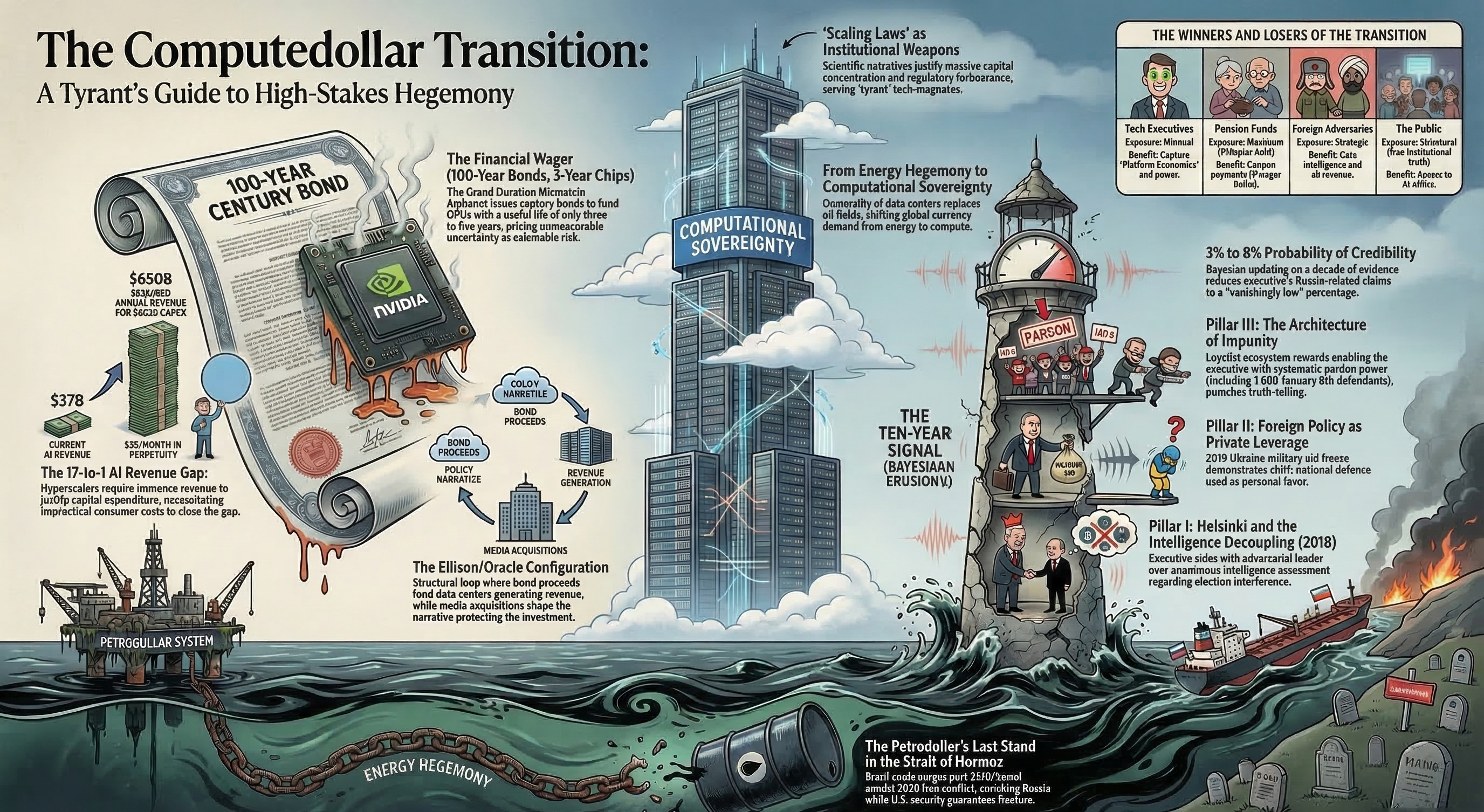
When 100-year financial instruments fund hardware with a 3-year useful life, Frank Knight's distinction between risk and uncertainty stops being abstract. The question is not whether the AI bubble will pop. It is whether the system even knows it is making a bet.
· Analysis reflects information available at time of publication.
Learning Objectives
- 1Apply Knight's risk-uncertainty distinction to evaluate whether AI infrastructure debt is priced as calculable risk or genuine uncertainty, then connect this to Bayesian inference to identify where probabilistic reasoning breaks down
- 2Use Luhmann's functional differentiation to explain why the financial system cannot evaluate the scientific wager embedded in AI infrastructure bonds
- 3Use Damodaran's narrative-and-numbers framework to forensically evaluate whether the $650 billion revenue projection survives contact with historical base rates
- 4Apply Blyth's 'ideas as institutional weapons' to analyze how concepts like 'scaling laws' and 'platform economics' justify capital allocation that serves specific interests
- 5Contrast Tetlock's calibrated forecasting with Taleb's exposure analysis to distinguish structural diagnosis from prediction
Play first or after: The Great Financial Crisis. There is a casino inside your pension fund, and the math that ran it lied once before. Play 1999–2010, then come back and ask whether a 100-year bond funding a 3-year GPU rhymes.
❓Concept Check
When a company issues a 100-year bond to build data centers filled with GPUs that will be obsolete in three to five years, and the revenue required to justify the investment is seventeen times what currently exists, what analytical tools do you need to evaluate what is happening?
▸
Concept Check
When a company issues a 100-year bond to build data centers filled with GPUs that will be obsolete in three to five years, and the revenue required to justify the investment is seventeen times what currently exists, what analytical tools do you need to evaluate what is happening?
In February 2026, the AI infrastructure financing market crossed a structural threshold. Oracle launched a record $25 billion eight-part bond offering. Alphabet issued the first 100-year tech bond since 1997. Hyperscaler capital expenditure hit $602 billion, 75% for AI. This investigation uses five analytical frameworks to separate structural diagnosis from forecasting. THE INSTRUMENTS. The numbers: $602B capex, a $650B revenue gap, and a 17-to-1 revenue shortfall. CoreWeave's debt crisis and GPU collateral decay. FIVE LENSES. Frank Knight on the difference between risk and uncertainty, formalized through Bayesian inference to show where probabilistic reasoning breaks down. Niklas Luhmann on why finance and technology cannot evaluate each other's claims. Aswath Damodaran on the gap between the AI narrative and the numbers, and what historical base rates predict. Mark Blyth on 'scaling laws' and 'platform economics' as ideas that do institutional work. Philip Tetlock and Nassim Taleb on why prediction markets price events but cannot illuminate configurations. WHAT STRUCTURAL DIAGNOSIS IS. Not predicting whether AI is a bubble. Diagnosing the configuration: when the financial system has structurally coupled itself to a scientific wager it cannot evaluate, justified by narratives that function as institutional weapons, with consequences distributed asymmetrically. Connects to: Architecture of Modernity, Systems Thinking, Critical Thinking, Ethics.
There is a particular kind of confidence that comes from knowing how financial instruments work. You understand duration, yield curves, credit spreads, the mechanics of an eight-part bond offering. You can read a prospectus, evaluate a capital structure, price a credit default swap. This knowledge is real. It is hard-won. And it is, for the question we are about to examine, almost completely beside the point.
The financial system does not lack information about AI infrastructure debt. It lacks the category of analysis required to evaluate it. The distinction is not between smart money and dumb money, between sophisticated investors and naive ones. It is between two different kinds of not-knowing. The claim of this case study is that the most dangerous position in February 2026 belongs to whoever cannot see the difference.
The Instruments
February 2, 20262026. Oracle Corporation prices a $25 billion eight-part bond offering, the largest corporate debt issuance in history at the time. The order book reaches $129 billion, more than five times the amount offered. Tranches range from three years to forty years, with coupons from 5.1% to 6.15%. The proceeds are earmarked for AI data center construction. Bloomberg reports the deal in the language of triumph: oversubscribed, investment-grade, blue-chip demand.
February 10, 20262026. Eight days later, Alphabet issues a 100-year sterling bond as the capstone of a $32 billion multi-currency debt raise, the first century bond by a technology company since Motorola in 1997. A century bond is a strange instrument. It says: lend us your money, and we will return it to your grandchildren's grandchildren, plus interest, in the year 2126. The pension funds, sovereign wealth funds, and insurance companies that buy these bonds do so for a specific reason, which is duration matching. Their liabilities extend decades into the future, and they need assets that do the same. The century bond is, from the buyer's perspective, a perfectly rational instrument for a perfectly specific purpose.
Cross-Curricular Connection: It is worth being exact about why the buyers are rational, because the careless version of this story treats them as greedy or credulous and neither is true. Duration is the weighted average time until a bond's cash flows arrive, and an insurer writing policies that pay out in 2090 needs assets whose cash flows arrive on something like the same schedule. Hold assets shorter than your liabilities and a fall in rates leaves you reinvesting at yields that no longer cover what you promised. A century bond from an AA-rated issuer is close to the scarcest object in that market, which is why the order book ran five times the offering. The buyers were not wagering on artificial intelligence. They were closing a gap on their own balance sheets, and the wager came attached.
From any other perspective, it is a bet that Alphabet will exist, will remain creditworthy, and will generate sufficient cash flow to service this debt for longer than the United States has been a country.
February 20262026. CreditSights projects hyperscaler capital expenditure for the year at $602 billion, with approximately 75%, or $451 billion, directed toward AI infrastructure: data centers, networking equipment, and above all graphics processing units. The five largest spenders, Microsoft, Amazon, Alphabet, Meta, and Oracle, have collectively committed more capital to AI infrastructure in two years than the United States spent on the entire Interstate Highway System in inflation-adjusted dollars.
JPMorgan's equity research division has done the arithmetic that matters most. For the hyperscalers to earn a 10% return on their cumulative AI investments through 2030, they need $650 billion in annual AI-derived revenue. Current AI revenue across the entire industry: approximately $37 billion. The gap is not a rounding error. It is seventeen to one.
Put it in human terms. To close that gap, every iPhone user on Earth, roughly 1.5 billion people, would need to pay $34.72 per month for AI services, in perpetuity, in addition to what they already pay for their devices and existing subscriptions. Not some iPhone users. Every iPhone user. Not for a year. Forever.
The instruments funding this bet are not exotic. They are investment-grade bonds, the most conservative and most widely held securities in the global capital markets. The buyers are not speculators. They are pension funds managing the retirement savings of teachers, firefighters, and municipal employees. They are insurance companies backing the life insurance policies of ordinary families. They are sovereign wealth funds stewarding national resources for future generations.
The collateral backing much of this debt, particularly at the Tier 2 level, consists of GPUs: Nvidia H100s, A100s, and their successors. Hardware with a useful life of three to five years. Hardware whose resale value has already declined 50-70% from peak, according to secondary market pricing data, as newer generations render older chips less competitive for frontier model training. CoreWeave, the GPU cloud provider that has become the poster child for Tier 2 AI infrastructure, carries $18.8 billion in debt with $4.2 billion maturing in 2026. Oracle's credit default swap spreads have widened above 125 basis points, levels not seen since 2009.
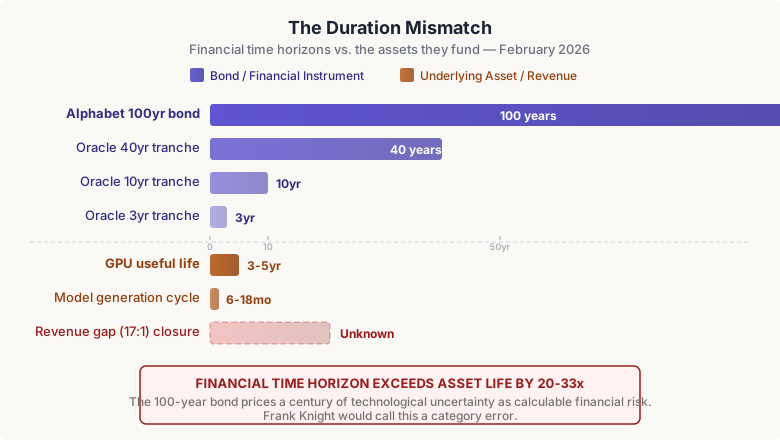
The mismatch is not subtle. A 100-year financial instrument is funding hardware that will be in a recycling facility within five years. The reinforcing feedback loop runs like this. AI hype drives investment, investment builds infrastructure, infrastructure demands revenue, and the revenue shortfall demands more investment to reach scale. What comes out the other end is a capital structure whose time horizon exceeds its asset lifespan by a factor of twenty to thirty-three.
This is a structural description, not a prediction. We are not forecasting that AI will fail. We are not predicting a crash. We are diagnosing a configuration: a specific relationship between financial instruments, physical assets, revenue requirements, and institutional incentives. It emerged in real time, it is documented in public filings and market data, and it can be analyzed with tools this curriculum has been building since Unit 4.
"Uncertainty must be taken in a sense radically distinct from the familiar notion of Risk, from which it has never been properly separated.... The essential fact is that 'risk' means in some cases a quantity susceptible of measurement, while at other times it is something distinctly not of this character; and there are far-reaching and crucial differences in the bearings of the phenomena depending on which of the two is really present and operating.... It will appear that a measurable uncertainty, or 'risk' proper, as we shall use the term, is so far different from an unmeasurable one that it is not in effect an uncertainty at all."
Knight's foundational distinction between measurable risk and unmeasurable uncertainty, the conceptual backbone of this case study. Written a decade before the Great Depression validated his concern that financial systems confuse the two categories.
Knight published those words in 1921, a decade before the financial system's failure to distinguish between risk and uncertainty helped produce the Great Depression. A century later, his distinction is not an academic curiosity. It is a diagnostic instrument, and the AI infrastructure financing market is its most vivid contemporary application.
The comparison is instructive. The Railway Mania of the 1840s, covered in detail in Financial Markets Unit 4, involved enormous capital commitments to infrastructure with a specific, measurable use case: moving people and freight. The infrastructure outlasted the financial bubble. The tracks remained. The telecom bubble of the late 1990s funded fiber-optic cable that exceeded demand by orders of magnitude at the time of installation. The physical infrastructure survived the bust anyway and became the backbone of the broadband internet. In both cases, the financial losses were real, but the assets had durable physical utility beyond the original investment thesis.
GPUs are different. They are not fiber-optic cable that sits in the ground waiting for demand to catch up. They are rapidly depreciating computational hardware whose value is a function of their position on a technology curve that moves every twelve to eighteen months. The infrastructure funded by a 100-year bond will cycle through twenty to thirty generations of hardware before the bond matures. Each generation requires new capital expenditure. The bond does not fund a permanent asset; it funds the first installment of a rolling commitment that extends far beyond the instrument's own projections.
This is the structural mismatch. And to understand why it matters, we need five lenses that can see what financial analysis alone cannot.
Five Lenses
Knight: The Category Error
Frank Knight was an economist at the University of Chicago whose 1921 work Risk, Uncertainty, and Profit established a distinction so fundamental that a century of subsequent economics has not improved upon it. Knight argued that there are two fundamentally different kinds of not-knowing, and that confusing them is the most dangerous error in economic life.
Risk is measurable. It is the domain of probability. When an insurance company prices a homeowner's policy, it draws on actuarial tables built from millions of data points: the historical frequency of fires, floods, and storms in a given region. The insurer does not know whether your house will burn down. But it knows, with considerable precision, what percentage of houses in your zip code will experience fire damage in a given year. Risk can be priced because the underlying distribution is known.
Uncertainty is unmeasurable. It is the domain of genuine ignorance, where not only the outcome but the underlying probability distribution is unknown. Will artificial general intelligence emerge in the next decade? Will current large language models plateau, or will scaling laws hold through another ten orders of magnitude? Will the economic value of AI exceed, match, or fall short of the capital committed to its development? These are not questions where we lack data. They are questions where the kind of knowledge required to answer them does not yet exist.
The 100-year bond is a category error in Knight's precise sense. It prices unmeasurable uncertainty as if it were measurable risk. The bond's yield, its credit rating, and its oversubscription ratio are all calibrated against risk models that assume the underlying distribution is known. The rating agencies evaluate Alphabet's creditworthiness against historical default rates for AA-rated issuers. The pension funds model the bond's duration against their liability profiles. The credit analysts assess debt-to-EBITDA ratios and interest coverage ratios against historical benchmarks.
Every one of these analyses is internally valid. The problem is not that the math is wrong. The problem is that the math is answering the wrong question. The relevant question is not "What is the probability that Alphabet will default on this bond?" That is a question about risk, which the financial system is superbly equipped to answer. The relevant question is "What is the probability that the technological and economic assumptions embedded in $602 billion of annual AI capex will prove correct over a century?" That is a question about uncertainty, which the financial system has no tools to answer, and which it has therefore reclassified as risk to process it within existing frameworks.
Knight would recognize this pattern immediately. It is the same error that preceded every major financial crisis in the twentieth century: the system's substitution of calculable risk for genuine uncertainty, driven not by ignorance but by the institutional impossibility of pricing what cannot be measured. The financial system must assign numbers to everything it touches. That is how it functions. When it encounters a phenomenon that cannot be numbered, such as the trajectory of a scientific frontier or the century-long viability of an economic model that does not yet exist, it does not acknowledge the gap. It fills it with a number derived from a category that can be measured, and it calls the result a "price."
The 100-year bond is priced. It traded. It was oversubscribed five times. None of this means the uncertainty has been resolved. It means the uncertainty has been reclassified.
There is a mathematical formalization of this distinction that makes the incoherence visible. Bayesian inference, the framework for updating beliefs in light of new evidence, works in the domain Knight calls risk. You start with a prior probability (what you believed before). You encounter evidence (data, outcomes, observations). You update your belief using Bayes' theorem. The result is a posterior probability that is more accurate than your prior, because it has been disciplined by reality. Insurance companies do this every quarter. Credit analysts do it every earnings cycle. The machinery is powerful and legitimate, when the prior is meaningful.
But Bayesian inference requires a prior. And a meaningful prior requires that you know enough about the underlying distribution to assign one. "The probability that Alphabet will default on investment-grade debt within ten years" has a meaningful prior: the historical default rate for AA-rated issuers over rolling ten-year windows, drawn from a century of corporate bond data. You can update this prior as Alphabet's fundamentals change. This is risk. Bayesian reasoning works.
"The probability that artificial intelligence will generate sufficient economic value to justify $602 billion in annual infrastructure spending for the next century" does not have a meaningful prior. There is no reference class. There is no historical base rate for "century-long technological bets on a capability that did not exist five years ago." Any number you assign, 60% or 30% or 5%, is not a prior derived from evidence. It is a guess dressed in the notation of probability theory. And Bayesian updating on a fabricated prior does not converge on truth. It converges on a more precisely wrong answer, one that carries the false authority of mathematical formalism.
This is the Bayesian incoherence at the heart of the AI infrastructure bond market. The financial system is performing what looks like Bayesian reasoning. It incorporates AI revenue forecasts, adjusts for capex trajectories, updates credit models. But the priors are incoherent. To hold simultaneously that the century bond is investment-grade (implying high confidence in Alphabet's ability to service the debt) and that the revenue gap is 17-to-1 (implying profound uncertainty about whether the investment thesis will materialize) is to maintain two beliefs whose conjunction violates basic probabilistic consistency. A coherent agent would update one belief in light of the other. The market holds both, because each belief lives in a different analytical silo, credit analysis in one and equity research in the other, and the silos do not talk to each other.
Knight's philosophical distinction and Bayesian probability theory arrive at the same diagnosis from different directions: the financial system is performing sophisticated mathematical operations on quantities that are not what they claim to be. The numbers are real. The computation is correct. The category is wrong.
That distinction, between a question that has been answered and a question that has been reclassified, is the first tool this case study offers.
Luhmann: The Structural Blindness
Niklas Luhmann was a German sociologist whose systems theory, developed across more than fifty books and hundreds of articles, provides the most rigorous account available of how modern society's functional systems, among them law, politics, science, economy, and art, operate on different codes and cannot directly evaluate each other's claims.
The financial system operates on the code of payment/non-payment. Every transaction, every instrument, every analysis ultimately reduces to a binary: can this obligation be paid, or can it not? The system's sophistication, its derivatives and risk models and credit ratings and secondary markets, is an elaboration of that single distinction. Finance is not simple. Finance is specific. It can see everything that can be expressed in the language of payment, and it is structurally blind to everything that cannot.
The technology system operates on the code of true/false, or more exactly on the code of functional/non-functional. Does the technology work? Does it scale? Does it solve the problem it was designed to solve? These are questions the technology system can answer. Whether the technology will generate sufficient revenue to justify the capital invested in it is not a question the technology system addresses. That is the financial system's question. The technology system's answer to "Will AI generate $650 billion in annual revenue?" is not "yes" or "no" but "that is not our question."
What Luhmann calls structural coupling is the mechanism by which two systems that operate on incompatible codes become linked through shared instruments or institutions. The 100-year bond is a structural coupling between the financial system and the technology system. The financial system has priced it using its own code: payment/non-payment, credit risk, duration matching. The technology system has produced the claims that justify it: scaling laws, emergent capabilities, platform economics. But neither system can evaluate the other's contribution to the coupling. The financial system cannot assess whether AI scaling laws will hold. The technology system cannot assess whether the debt is sustainable. They are coupled through an instrument that neither can fully comprehend.
"Every system uses its own distinction to observe the world.... The system cannot observe what it cannot observe. It cannot observe that it cannot observe this. It is blind to its own blind spot."
Luhmann's foundational work, translated into English eleven years after its German publication. His theory of functional differentiation explains how modern society's subsystems operate on incompatible codes, and why structural couplings between them can amplify problems neither can detect.
The 2008 financial crisis was, in Luhmann's terms, a catastrophic failure of structural coupling between the financial system and the housing market. The financial system priced mortgage-backed securities using risk models calibrated to historical default rates. The housing market produced the underlying assets: mortgages extended to borrowers whose capacity to repay was, in Knight's terms, uncertain rather than risky. The rating agencies, which were supposed to bridge the two systems, instead translated uncertainty into risk by applying quantitative models to qualitative judgments, producing AAA ratings for instruments that were, structurally, unratable.
The AI infrastructure bond market in February 2026 replicates this architecture with uncanny precision. The financial system prices the bonds using credit models. The technology system produces the claims that justify the capital expenditure. The rating agencies translate between the two, assigning investment-grade ratings based on the issuer's balance sheet rather than the viability of the underlying technological wager. And the buyers, pension funds and insurance companies and sovereign wealth funds, hold instruments that are internally coherent as financial products but structurally coupled to a scientific frontier that neither they nor the financial system can evaluate.
Cross-Curricular Connection: Minsky: Stability Breeds Instability. The Architecture of Modernity course examines how Hyman Minsky's instability hypothesis works at the level of the financial system's internal logic: prolonged stability encourages increasingly speculative financing positions, which eventually produce the crisis that the stability was supposed to have made impossible. The AI infrastructure boom follows the Minsky pattern. Years of rising tech valuations and cheap capital have emboldened a debt structure that treats frontier scientific uncertainty as manageable financial risk. Stability breeds the conditions for its own undoing.
The implication is not that the bet will fail. It is that neither system can know whether it will fail until after the consequences are irreversible. The financial system's confidence in its own analysis is itself a symptom of the blindness Luhmann describes. The century bond's oversubscription is not evidence that the market has evaluated the AI wager and found it sound. It is evidence that the financial system has processed the AI wager through the only code it possesses, payment/non-payment, and produced the only kind of answer it can produce: a price. Whether that price reflects the underlying reality is a question the financial system is structurally incapable of asking.
Damodaran: The Narrative and the Numbers
Aswath Damodaran teaches corporate finance at NYU's Stern School of Business and is widely regarded as the world's foremost authority on business valuation. His framework for evaluating investment narratives is built on a single discipline: the story must survive contact with the spreadsheet. Every investment thesis tells a story about growth, about disruption, about the future of an industry. And every investment thesis produces numbers: revenue projections, discount rates, comparable valuations, sensitivity analyses. A sound thesis is one where the story and the numbers agree. A dangerous thesis is one where the narrative drives the numbers rather than the other way around, where the spreadsheet has been reverse-engineered from the conclusion.
The AI infrastructure investment thesis tells an extraordinary story. Artificial intelligence is a general-purpose technology comparable to electricity or the internet. Whoever builds the infrastructure owns the platform. First-movers capture winner-take-all economics. The total addressable market is every knowledge worker, every business process, every human activity that involves language, reasoning, or pattern recognition. This is not a modest claim. It is a claim that justifies half a trillion dollars in annual capital expenditure.
Now apply Damodaran's discipline. The story says $602 billion in annual capex will generate transformative returns. The numbers say current AI revenue is $37 billion, a 17-to-1 gap. JPMorgan's own analysis calculates that closing this gap requires $650 billion in annual AI-derived revenue by 2030. That translates to $34.72 per month from every iPhone user on Earth, or $180 per month from every Netflix subscriber, in perpetuity.
What does the historical base rate suggest? General-purpose technology investments have, across two centuries of data, followed a pattern that Carlota Perez documented in Technological Revolutions and Financial Capital: a period of massive overinvestment during the "installation phase," followed by a crash that destroys financial capital while leaving productive infrastructure behind. The railway bubble, the electrification bubble, the automobile bubble, the telecom bubble. Every one involved visionary narratives that were directionally correct about the technology's long-term significance and catastrophically wrong about the investment returns available to the current generation of capital providers. The tracks remained after the Railway Mania. The investors were wiped out anyway.
Damodaran would ask the AI infrastructure bulls a deceptively simple question: at what percentage of revenue realization does the investment thesis break down? At 100%, the full $650 billion, the returns are adequate. At 50%, $325 billion against $602 billion in annual capex, the capital structure is unsustainable for everyone except the three or four hyperscalers with sufficient core business cash flow to absorb the losses. At 25%, which is still a $162 billion AI revenue market, larger than the entire global advertising market was in 2005, the Tier 2 players default, the GPU collateral is worthless, and the pension funds holding the bonds carry the loss.
The narrative is driving the numbers. "Scaling laws will hold" justifies $602 billion. "Winner-take-all" justifies the concentration. "Platform economics" justifies the margins. Each phrase does work in Damodaran's sense. It substitutes a story for a calculation, and the story always resolves in favor of more investment. The spreadsheet has been reverse-engineered from the conclusion, and the conclusion is: build more data centers.
"The biggest risk in valuation is not that you will use the wrong model or the wrong numbers, but that you will construct a narrative that is disconnected from reality, and then build a valuation around that narrative. The numbers will look precise. The narrative will feel compelling. And the valuation will be wrong — not because of a mathematical error, but because the story it tells is a story the business cannot live."
Damodaran's framework for evaluating the relationship between investment narratives and financial projections, applied here to the AI infrastructure thesis.
Blyth: The Institutional Weapon
Mark Blyth is a political economist at Brown University whose work on "ideas as institutional weapons," developed across Great Transformations (2002) and Austerity: The History of a Dangerous Idea (2013), provides the vocabulary for a question Damodaran's framework raises but cannot answer: why does the narrative persist when the numbers don't support it?
The Paramount case study (Unit 16) applied Blyth's framework to the concept of "synergy," a word that reframes corporate consolidation as efficiency and turns private interest into public benefit. The AI infrastructure market runs the same logic at a much larger scale, with a different vocabulary. "Synergy" has been replaced by "scaling laws." "Operational streamlining" has been replaced by "platform economics." "Competing with tech giants" has been replaced by "winning the AI race." The words have changed. The institutional function has not.
"Scaling laws will hold" is not a scientific conclusion presented to the financial markets for dispassionate evaluation. It is a narrative that does institutional work. It justifies $602 billion in annual capex to investors. It justifies regulatory forbearance to governments. It justifies workforce displacement to the public. It justifies concentration of computational infrastructure in the hands of five companies to competition authorities. Like "synergy," it acknowledges a real phenomenon. Larger models have shown improved capabilities. Then it extrapolates that into an investment thesis that happens to concentrate wealth and power in the hands of the people making the argument.
Blyth would push further than the financial narrative. The AI infrastructure build-out does not exist in a political vacuum. It exists inside a specific political economy where the lines between public policy, private enrichment, and narrative production have become structural features of the system rather than aberrations within it.
Consider the configuration. Oracle, the company that issued $25 billion in AI infrastructure bonds on February 2, 2026, is controlled by Larry Ellison, the fifth-wealthiest person on Earth. Ellison's son David is, through the Paramount-Skydance merger analyzed in Unit 16, in the process of acquiring CBS, CNN, and one of the largest media libraries ever assembled. The Ellison family's relationship with the current administration is not a matter of speculation. It is a matter of public record: inauguration donations, advisory roles, policy access. The administration that determines AI policy, regulates the technology sector, shapes export controls, and allocates federal AI contracts is the administration with which the family issuing the bonds has the deepest structural relationship.
Oracle's AI narrative, that the company must build massive data center capacity to compete in the AI infrastructure market, justifies $25 billion in bond issuance. The bonds fund construction. The construction generates revenue for Oracle regardless of whether the AI applications built on the infrastructure ever materialize. The narrative's success is decoupled from the technology's success. The data centers will be built. The construction contracts will be paid. The interest on the bonds will be serviced from Oracle's existing cloud revenue. The question of whether AI generates the $650 billion in annual revenue required to justify the investment is, from the perspective of the people who profit from the construction phase, a question for someone else to answer, preferably after the bonds have been sold.
Apply Occam's razor. What is the simplest structural explanation for $602 billion in annual AI capex? One explanation: AI is a transformative general-purpose technology, and the companies investing $602 billion have correctly assessed its potential. Another explanation: the companies investing $602 billion profit from the investment itself, from the construction, the equipment procurement, the government contracts, the tax advantages, and the stock price appreciation driven by AI narrative, regardless of whether the technology delivers the returns projected by the investment thesis. The first explanation requires that the narrative is correct. The second requires only that the narrative is useful.
The self-leverage structure makes the second explanation concrete. There is a prototype for what Ellison is doing, and it was built in public over the last decade: Elon Musk's use of Tesla as a personal leverage vehicle. The pattern works as follows. A compelling narrative about transformative technology ("autonomous driving," "sustainable energy," "AI") drives the stock price above any valuation that earnings alone could justify. The inflated stock price becomes collateral for personal borrowing. The personal borrowing funds acquisitions (Twitter/X) and political positioning, which in turn generate more narrative, which drives the stock price higher, which provides more collateral. The company's balance sheet becomes a tool for personal wealth amplification, and the narrative that inflates it need only be believed, not true, for the mechanism to function.
Oracle's $25 billion bond issuance operates on the same structural logic at the corporate level. The AI narrative inflates Oracle's strategic relevance and stock price. The elevated market position allows investment-grade bond issuance at favorable rates. The bond proceeds fund data center construction, real assets that generate revenue from cloud services regardless of AI's trajectory. The construction itself generates economic activity that reinforces the narrative ("Oracle is investing billions in AI infrastructure. They must know something"). Meanwhile, the Ellison family's political access ensures that the regulatory and subsidy environment remains favorable: federal AI contracts flow to Oracle, CHIPS Act funds subsidize the ecosystem, and the administration that shapes AI policy has every incentive to maintain the narrative that justifies its own technology agenda.
The critical structural feature is that the self-leverage loop operates profitably even if the AI thesis fails. The data centers exist. The cloud revenue exists. The political relationships exist. The bonds will be serviced from Oracle's enterprise software cash flows, which predate the AI narrative by decades. The question of whether AI generates the $650 billion in annual revenue required to justify the industry's capital allocation is, for the Ellison configuration specifically, someone else's problem. The narrative was useful. The bonds were sold. The infrastructure was built. The political positioning was secured. If AI succeeds, the Ellisons are positioned to capture platform economics. If AI disappoints, they own the data centers, the media companies, and the political relationships anyway. Heads they win. Tails the pension funds lose.
Blyth's framework does not tell you which explanation is true. It tells you that the distinction between the two explanations is invisible from inside the narrative itself, because the institutions that would need to evaluate the distinction (rating agencies, financial media, equity research) operate within the same conceptual vocabulary that the narrative has established as the terms of the debate. "Is AI a transformative technology?" is a question asked inside the narrative. "Does this narrative serve the interests of the people propagating it regardless of whether the technology is transformative?" is a question asked from outside. The financial system has no code for the second question.
"In periods of economic crisis, ideas do not merely reflect interests — they constitute them. Economic ideas serve as blueprints for new institutions, as weapons that delegitimize existing arrangements, and as cognitive locks that make alternatives appear unthinkable. The question is never whether an economic idea is 'true' in some abstract sense, but whose interests it serves and what institutional changes it enables."
Blyth's foundational argument about how economic ideas operate as weapons in institutional battles, applied here to 'scaling laws' and 'platform economics' as narratives that justify AI infrastructure spending.
The geopolitical dimension compounds the institutional work, and reveals a longer game. The US-China AI competition narrative, "we must build faster or China will," transforms a commercial investment thesis into a national security imperative. Export controls on advanced chips to China, CHIPS Act subsidies for domestic semiconductor manufacturing, and federal AI procurement contracts create a policy environment where the government subsidizes the very infrastructure whose financial viability it is unable to evaluate. The AI narrative has successfully coupled three systems that Luhmann would recognize as operating on incompatible codes: the financial system (payment/non-payment), the technology system (functional/non-functional), and the political system (power/non-power). Each reinforces the others. The financial system prices the bonds. The technology system produces the capability claims. The political system provides the subsidies and the regulatory forbearance. And none of the three can evaluate the others' contributions, or ask whether the entire configuration serves the interests of a very small number of people who happen to operate at the intersection of all three.
But the century bond hints at something beyond the immediate configuration: a structural bet about what comes after the current financial order. The petrodollar system, which has underpinned American financial hegemony since the 1970s, was built on a structural coupling between military power and energy infrastructure: the United States guaranteed Middle Eastern security, and in return, oil was denominated in dollars, creating global demand for US currency and US Treasury debt. That coupling is weakening, through renewable energy transitions, BRICS+ de-dollarization efforts, and the erosion of the security guarantees that sustained it. Going long in duration, issuing a 100-year bond, is not only a bet on AI. It is a positioning play for a world where control of computational infrastructure replaces control of energy infrastructure as the structural foundation of financial power. Whoever owns the data centers owns the next version of what oil fields were to the twentieth century: the physical base on which the dominant medium of exchange depends. The century bond's 100-year horizon is not irrational in this frame. It is the time horizon of a regime change, from petrodollar to what we might call the computedollar. The instrument is designed to survive that transition by being denominated in the very currency whose hegemony the infrastructure is meant to sustain.
The Iran escalation in early 2026 makes this structural analysis concrete rather than speculative. The petrodollar system depends on American security guarantees in the Persian Gulf. When the Trump administration's coercive approach to Iran, maximum pressure sanctions and military posturing and threats of regime change, failed to produce compliance, the result was not resolution but escalation: a conflict trajectory that destabilizes the very region on which dollar hegemony depends. This is not a peripheral geopolitical event. It is a stress test of the century bond's foundational assumption. A 100-year bond prices a century of geopolitical continuity, a century in which the issuing currency retains its reserve status, the global trade system remains dollar-denominated, and the institutional infrastructure of Western capital markets functions without fundamental disruption. The Iran conflict is live evidence that none of these assumptions are safe.
And there is an energy-compute nexus that makes the connection physical, not merely financial. Data centers consume enormous amounts of electricity. The AI infrastructure funded by these bonds will require power generation capacity rivaling that of small nations. A Middle Eastern conflict that disrupts energy supply chains does not merely threaten oil prices. It threatens the operating costs of the very infrastructure the bonds are financing. The century bond assumes not only that AI will generate transformative revenue, not only that the geopolitical order will remain stable, but that the energy infrastructure required to power the data centers will remain affordable and available for a hundred years, while the geopolitical system that secures that energy infrastructure is visibly fracturing.
Knight would classify every one of these geopolitical variables as uncertainty, not risk. There is no probability distribution for "Will the petrodollar system survive the next fifty years?" There is no base rate for "Will a Middle Eastern conflict disrupt the energy supply chain for AI data centers?" These are not questions the financial system can process. So it doesn't. The credit rating on the century bond does not contain a line item for geopolitical regime change. The yield spread does not price the Iran escalation. The order book does not reflect the energy vulnerability of computational infrastructure. The uncertainty has been reclassified as risk again, and the risk has been priced at approximately zero.
This is not a conspiracy theory. It is a structural description, the same kind Blyth applied to the austerity narrative, where the idea generated the institutional structure that perpetuated the idea. The AI scaling narrative generates the capital expenditure that generates the infrastructure that generates the data points ("look how much we're investing!") that justify the narrative. The loop is self-reinforcing, and it operates through the ordinary incentive structures of financial markets, technology companies, and political institutions. No one needs to be lying. Everyone can be acting rationally within their own system's code. The problem is that the configuration, the specific way the systems are coupled, produces outcomes that none of the individual systems would endorse if they could see the full picture.
Tetlock and Taleb: Prediction vs. Exposure
Philip Tetlock spent twenty years tracking expert predictions in his landmark Expert Political Judgment (2005) and discovered something devastating: experts performed barely better than dart-throwing chimpanzees at forecasting political and economic events. The finding was not that experts were stupid. It was that the world is structured in ways that make confident prediction unreliable, and that expertise, the deep familiarity with a domain that breeds confidence, is what makes experts worse at recognizing the limits of their knowledge. The more an expert knew about a subject, the more confidently they predicted, and the more spectacularly they were wrong.
Tetlock's follow-up work, Superforecasting (2015), identified a small subset of forecasters who consistently outperformed. Even superforecasters achieved their accuracy by being less confident, not more. They updated frequently, hedged aggressively, and specialized in well-defined, time-bound questions with clear resolution criteria. They were fox-like (knowing many things) rather than hedgehog-like (knowing one big thing). And their accuracy degraded rapidly as the time horizon extended beyond twelve to eighteen months.
The AI infrastructure question is exactly the kind of question that defeats even superforecasters. It is long-horizon, structurally complex, dependent on scientific breakthroughs that may or may not occur, and embedded in feedback loops where the act of investment itself changes the probability of the outcomes being predicted. A 100-year bond is not a forecast that can be calibrated. It is a commitment that outlasts the forecasting horizon by a factor of sixty to eighty.
Nassim Nicholas Taleb approaches the problem from the opposite direction. Where Tetlock asks "How well can we predict?", Taleb asks "What is your exposure if you're wrong?" The question is not whether AI infrastructure will generate sufficient returns. That is a question about prediction. The question is what happens to the system if it doesn't, which is a question about exposure.
"Fragility is quite measurable, risk is not, particularly risk associated with rare events.... If you have more to lose than to benefit from events of fate, there is an asymmetry, and not a good one."
Taleb's framework for evaluating systems based not on predictions about what will happen but on exposure to what could happen. The fragility of a position is independent of the probability of the threatening event.
Apply Taleb's framework. The century bond creates an asymmetric exposure. If AI succeeds spectacularly, if the technology achieves the kind of transformative economic impact that justifies $602 billion in annual capex, the upside accrues primarily to tech equity holders. Alphabet's stock price rises. Its shareholders capture the value. The bondholders receive exactly what they were promised: their principal back in 2126, plus coupon payments along the way. They do not participate in the upside.
If AI disappoints, if the revenue gap persists, if scaling laws plateau, if the required $650 billion never materializes, the downside falls disproportionately on the bondholders. Not immediately. Alphabet is not going to default on a century bond in 2027. But the bond's market value will decline as the credit narrative weakens, and the pension funds and insurance companies holding it will carry unrealized losses on their balance sheets for years or decades. The teachers and firefighters whose retirement savings are managed by those pension funds bear the exposure. The tech executives who issued the bonds bear almost none.
This is what Taleb calls moral hazard in its structural form. Not the familiar version where banks take risks because they expect bailouts, but a deeper asymmetry where the people making the bet and the people bearing the consequences are different populations, connected only by a financial instrument that neither designed and that both understand through incompatible frameworks.
Cross-Curricular Connection: Reinforcing Feedback: The Engine of Growth and Collapse. Systems Thinking teaches you that reinforcing feedback loops are the engine of both exponential growth and exponential collapse. The same loop that drives a system upward drives it downward when conditions reverse. The AI capex cycle is a textbook reinforcing loop: investment drives infrastructure, infrastructure drives AI capability claims, capability claims drive stock prices, stock prices drive cheap capital, cheap capital drives more investment. Tetlock would note that participants inside the loop systematically overestimate their ability to predict when it reverses. Taleb would note that the structure of the loop concentrates upside and distributes downside, which is why the century bond is an exposure problem, not a prediction problem.
Prediction markets like Polymarket, Metaculus, and Kalshi offer a useful input here, and a good illustration of what structural diagnosis adds beyond prediction. As of March 2026, prediction markets assign meaningful probability to events like "Major tech company AI-related credit downgrade by 2028" or "CoreWeave default or restructuring by 2027." These probabilities are informative. They aggregate the beliefs of informed participants who have money at stake.
But they price events, not configurations. A prediction market can tell you the probability of an Oracle credit downgrade. It cannot tell you that the structure of AI infrastructure financing has created a system where the financial code and the technology code are coupled through instruments that neither can evaluate, and where pension fund retirees bear exposure to a scientific wager that neither they nor their fund managers nor the rating agencies have the tools to assess. That is not a prediction. It is a diagnosis. And the distinction between the two is what this case study teaches.
Cross-Curricular Connection: Overshoot and Collapse. The century bond is the ultimate delay in correction signals. Systems Thinking explains that feedback loops with long delays tend to produce overshoot: the system continues accelerating past the point of sustainability because the signals that would trigger correction arrive too late. A 100-year bond delays the financial system's correction mechanism, the bond market's ability to punish overinvestment through higher yields, by decades. The signal that the AI wager has failed may arrive thirty or fifty years after the capital was committed, long after the executives who made the bet have retired and the GPUs have been recycled.
The Configuration
Where five analytical frameworks converge on the same structural feature of the AI infrastructure financing market, not as parallel observations but as an integrated diagnosis.
The five lenses do not produce five separate insights. They produce a single integrated diagnosis. Each framework shows what the others cannot see, and the convergence reveals a configuration that no individual discipline could identify alone.
Start with the category error and follow it through the system.
Knight identifies the original sin: the financial system has priced Knightian uncertainty, the unmeasurable kind where the underlying probability distribution is unknown, as if it were calculable risk. The Bayesian formalization makes the incoherence precise: the market simultaneously maintains that the century bond is investment-grade (high confidence in Alphabet's creditworthiness) and that the revenue gap is 17-to-1 (profound uncertainty about the investment thesis). These beliefs cannot coexist in a coherent probability space. But they do coexist, in different analytical silos that do not communicate.
Luhmann explains why the silos do not communicate: the financial system and the technology system operate on incompatible codes. Finance sees payment/non-payment and produces a price. Technology sees functional/non-functional and produces a capability claim. The political system sees power/non-power and produces policy. Each reinforces the others without evaluating them. The rating agencies, which are supposed to bridge the financial and technological codes, replicate the financial code. They assess the issuer's capacity to pay, not the viability of the wager that necessitated the borrowing. No institution occupies the position from which the gap between confidence and comprehension could be observed. The Bayesian incoherence Knight identifies is invisible because it lives in the space between systems that cannot see each other.
Damodaran provides the forensic evidence that the narrative has overwhelmed the numbers. The $650 billion revenue gap is not a data point that the financial system has evaluated and accepted. It is a data point that the financial system has processed through the narrative, "scaling laws will close the gap," without subjecting the narrative itself to the base-rate scrutiny that Damodaran's framework demands. Historical base rates for general-purpose technology investments predict a pattern of overinvestment followed by crash, with the infrastructure surviving but the investors destroyed. At 50% revenue realization, the capital structure fails for everyone except the largest hyperscalers. At 25%, the Tier 2 players default and the pension funds absorb the loss. The narrative of "winner-take-all platform economics" has been substituted for this calculation. Not because anyone is lying, but because the narrative is more persuasive inside the financial system's code than the numbers are.
Blyth explains why the narrative persists despite the numbers: because it functions as an institutional weapon. "Scaling laws," "platform economics," "winning the AI race" are not neutral descriptions of technological reality. They are ideas that do institutional work. They justify $602 billion in capex to investors, regulatory forbearance to governments, workforce displacement to the public, and the concentration of computational infrastructure in five companies to competition authorities. The geopolitical coupling, the US-China competition narrative and the CHIPS Act subsidies and the federal AI procurement contracts, transforms a commercial investment thesis into a national security imperative, creating a policy environment where the government subsidizes infrastructure whose financial viability it cannot evaluate. And the Ellison configuration, Oracle issuing $25 billion in AI bonds while the Ellison family acquires the media infrastructure that will report on AI policy, creates a structural loop where the narrative's propagation infrastructure is owned by the narrative's beneficiaries. Occam's razor asks whether the simplest explanation for $602 billion in capex is that AI is transformative, or that the people driving the investment profit from the investment itself, regardless of the technology's trajectory.
Tetlock and Taleb identify what happens at the system's output: even if every other framework's diagnosis is correct, the structure of the instruments distributes consequences asymmetrically. Tech equity captures upside. Bond investors, overwhelmingly pension funds and insurance companies, bear downside. The people shaping the narrative (hyperscaler executives), the people profiting from the narrative (tech equity holders), and the people bearing the exposure if the narrative fails (pension fund beneficiaries) are three different populations, connected only through a chain of financial instruments that obscures the relationship between the decision and its consequences. Tetlock's research establishes that even superforecasters cannot predict where this goes beyond eighteen months. Taleb's framework establishes that the structure of the bet matters more than the probability of the outcome, because the exposure falls on people who did not make the bet, cannot evaluate it, and will not learn about their exposure until the consequences are irreversible.
The convergence is not that five frameworks agree the bet is bad. The convergence is that five frameworks, applied to the same configuration, reveal a system: a specific arrangement of financial instruments, technological claims, political incentives, media ownership, and institutional blindness that no single framework could diagnose alone. Knight sees the category error. Luhmann sees why it's invisible. Damodaran measures its magnitude. Blyth explains why it persists. Taleb identifies who pays.
This is not a prediction that AI will fail. It is a description of a system that cannot know whether its bet is sound. It is structured so that the people making the bet profit from the narrative, the people evaluating the bet operate within the narrative, and the people bearing the consequences have no access to the vocabulary required to question it.
What Structural Diagnosis Is (and Isn't)
A student encountering this case study for the first time will feel the pull of a familiar question: Is this a bubble? Is AI overhyped? Should I short Nvidia?
These are forecasting questions. They ask you to predict what will happen next. And this case study refuses to answer them. Not because the answers don't matter, but because the analytical skill being taught comes before forecasting. You have to understand the configuration before you can evaluate anyone's prediction about what the configuration will produce.
Structural diagnosis is a different kind of intellectual operation. It does not predict whether the AI infrastructure bet will succeed or fail. It identifies the relationships between the components of the system, the instruments and the assets and the institutions and the incentive structures and the epistemic limits, then asks whether those relationships are coherent. The question is not "Will the bubble pop?" but "Has the system configured itself in a way that makes it unable to detect whether it's in a bubble?"
The skill is knowing which column a question belongs in. Not two columns, risk and uncertainty, but four. Knight's distinction is the starting point. The full taxonomy is the tool.
Knowable: Stipulated, Open-Source, Verified
Some things about this configuration are observable facts. They are not interpretations, not projections, not narratives. They are data, available in public filings, market feeds, and government publications, and any structural diagnosis must begin by stipulating them.
Bond market data. The Alphabet century bond's yield, its credit spread relative to Treasuries, and the term structure of Oracle's eight-tranche offering are all observable in real time. The $129 billion order book is a fact. The 5.1%–6.15% coupon range is a fact. The investment-grade ratings are facts. The question is not whether these numbers exist but what they mean, and meaning is where the analytical frameworks begin to diverge.
Energy prices. Brent crude spot, WTI futures curves, Henry Hub natural gas, and LNG spot markets in Asia and Europe are all publicly traded, all observable, all relevant to the operating costs of AI data centers. A data center consuming 100 MW of power is exposed to energy price volatility on a scale that most financial analyses of AI infrastructure do not model. The futures curve tells you what the market expects. It does not tell you what the Iran escalation, the Gulf insurance market, or the BRICS+ energy trade settlement shifts will do to that expectation over a century.
Fed policy. The actual federal funds rate, the dot plot, the statement language, and the minutes are all public and all parse-able. The terminal rate projection shapes the cost of capital for every bond in this case study. JPMorgan's $650 billion revenue requirement assumes a specific discount rate. If the Fed is fighting energy-driven inflation from a Middle Eastern conflict, the rate path changes, and with it the entire capital structure mathematics of AI infrastructure debt.
Institutional positions. 13F filings, SEC disclosures, bond prospectuses, and earnings call transcripts are the paper trail of who holds what, who issued what, and what they said when they did it. The Ellison family's holdings, Oracle's debt structure, CoreWeave's maturity schedule, and Alphabet's capital allocation are all documented and all verifiable. Structural diagnosis starts here, in the public record, not in speculation about private intent.
Puzzles: Answerable with More Data and Analysis
Puzzles have solutions. The solutions may be difficult, requiring expertise, data access, and analytical rigor, but they are answerable in principle. The financial system is superb at puzzles. This is the domain where the finance-literate analyst has real expertise, and where that expertise is legitimate.
What is the actual duration risk on century bonds? This is a calculable question. A 100-year bond's price sensitivity to interest rate changes is extreme. A 100 basis point rise in yields can destroy 30–40% of the bond's market value. The convexity profile, the key rate durations, and the scenario analysis under parallel and non-parallel yield curve shifts are all computable. A pension fund CIO can and should run these numbers. The puzzle is hard. It is not unknowable.
What sectors show leading employment indicators? If AI infrastructure spending is generating economic activity, the employment data should show it, in construction, electrical engineering, data center operations, and semiconductor manufacturing. If the spending is generating revenue for the builders without generating broad-based economic activity, the employment data should show that too. The Bureau of Labor Statistics publishes this monthly. The question is answerable.
What is the insurance market actually doing in the Gulf? War risk insurance premiums for vessels transiting the Strait of Hormuz are observable market data. Premiums have spiked following the Iran escalation, and that spike is a direct, priced signal of energy supply chain risk that the century bond does not incorporate. The insurance market is pricing a risk that the bond market is ignoring. The divergence between the two prices is itself a datum, a measurable gap between two markets' assessments of the same geopolitical configuration.
How are European and Asian energy procurement strategies shifting? European energy policy after the Russia-Ukraine shock produced a structural pivot away from pipeline gas toward LNG, renewables, and nuclear. Japan, South Korea, and India are renegotiating long-term LNG supply contracts. These procurement shifts reshape the global energy market that AI data centers depend on, not in years but in the months and quarters that matter for infrastructure planning. The policy documents are public. The LNG contract data is available. The question is answerable.
Prediction markets belong in this category as inputs, not as competitors to structural diagnosis. When Polymarket assigns a 23% probability to "Major tech company AI-related credit downgrade by 2028," that probability is a puzzle. It aggregates the beliefs of informed bettors who have money at stake. It tells you what a specific market thinks about a specific event. It does not tell you why the configuration exists, how the exposure is distributed, or what it means that the financial system has coupled itself to a scientific frontier through instruments that neither system can evaluate. Structural diagnosis uses prediction market data the way a physician uses a thermometer reading: as one input among many, subordinate to the clinical judgment that integrates it.
Dilemmas: Genuine Trade-Offs, No Right Answer
Dilemmas do not have solutions. They have trade-offs: choices between values that cannot both be maximized, consequences that cannot both be avoided. The financial system is terrible at dilemmas, because the financial code of payment and non-payment resolves every question into a number, and dilemmas are the questions that cannot be resolved by producing a number.
Can the Fed fight energy-driven inflation without destroying employment? If the Iran escalation produces sustained energy price increases, the Fed faces a policy dilemma that has no technical solution. Raising rates to fight inflation increases the cost of capital for AI infrastructure debt, which may trigger the credit events that the century bond's pricing assumes will not happen. Holding rates to support employment allows inflation to erode the real value of the bonds that pension funds hold. There is no rate path that solves both problems simultaneously. This is not a puzzle with a difficult answer. It is a dilemma with no answer, only trade-offs that different populations will bear depending on which path the Fed chooses.
Is "go long on AI" compatible with energy insecurity? The AI infrastructure thesis assumes abundant, affordable energy for decades. The geopolitical configuration suggests that energy security is deteriorating, not improving: Iran escalation, Gulf instability, BRICS+ energy trade re-routing, and the physical limits of renewable energy deployment at data center scale. You cannot simultaneously bet on a century of computational infrastructure expansion and acknowledge that the energy system powering that infrastructure is structurally insecure. The two positions are in tension. Holding both requires the kind of Bayesian incoherence Knight's framework diagnoses: two beliefs that cannot coexist in a coherent probability space, maintained in separate analytical silos that do not communicate.
When does sovereign debt become a geopolitical weapon rather than a market instrument? The century bond is denominated in dollars and pounds sterling, currencies whose reserve status depends on geopolitical relationships that the bond's own existence is helping to reshape. The US does use dollar-denominated debt as a tool of financial hegemony, through sanctions, SWIFT access, and reserve currency privilege. So the century bond is not merely a financial instrument. It is a geopolitical instrument, and its pricing should reflect the risk that the geopolitical relationships sustaining the currency will change over the bond's lifetime. But pricing geopolitical regime change is not something the bond market does. It is a dilemma disguised as a puzzle, and the market's production of a number (a yield, a spread) where a dilemma exists is itself the phenomenon that needs to be explained.
Cross-Curricular Connection: The Anatomy of Moral Failure. Critical Thinking examines how cognitive hubris operates at the institutional level, how entire systems convince themselves they understand phenomena that are, in fact, beyond their comprehension. The AI infrastructure financing market shows the pattern exactly: financial sophistication producing confidence that exceeds comprehension. The century bond is not a failure of intelligence. It is a failure of epistemic humility, the inability to recognize, from inside the system's own vocabulary, that the system is answering a different question than the one that matters.
Cross-Curricular Connection: Market Society vs. Market Economy. Michael Sandel's distinction between a market economy (a tool for organizing productive activity) and a market society (a way of life in which market logic governs everything) has direct application here. When 100-year financial instruments determine which scientific research gets funded, which infrastructure gets built, and how the computational foundation of the future economy is owned and governed, has the market economy become a market society? And if so, who consented to that transition?
Unknowable: Don't Pretend
And then there are the things we do not know and cannot know. These are the genuinely Knightian uncertainties, where intellectual honesty requires saying so rather than fabricating a probability.
The intent of any specific actor. We can describe the Ellison configuration: Oracle's bond issuance, the Paramount-Skydance merger, the political relationships, the structural incentives. We cannot read Larry Ellison's mind. We cannot know whether the century bond represents genuine conviction about AI's transformative potential, cynical self-enrichment, or, most likely, a combination of motivations that the actor himself may not be able to articulate. Structural diagnosis describes configurations, not intentions. The configuration is the evidence. The intent is unknowable, and treating it as knowable is the first step toward conspiracy theory, which structural diagnosis is designed to avoid.
The timeline of any geopolitical resolution. The Iran escalation may escalate further, stabilize, or produce a diplomatic resolution. The BRICS+ de-dollarization effort may accelerate or stall. The US-China technology competition may intensify or find equilibrium. We do not know, and no model can tell us, because these are political processes driven by human decisions that have not yet been made by people who may not yet hold the positions of power from which the decisions will be made. A century bond implicitly claims to have priced a century of these decisions. It has not. It has produced a number where a question mark belongs.
Whether any specific policy is "strategy" or "incompetence." The Trump administration's approach to Iran, the maximum pressure campaign and the failed coercion and the escalation, may be a deliberate strategy with objectives we cannot see from the outside, or it may be policy failure driven by institutional dysfunction. The Fed's tolerance of AI infrastructure debt accumulation may reflect sophisticated macroprudential judgment or regulatory capture by the financial industry. We cannot distinguish between these explanations from the available evidence, and pretending we can, by assigning labels of "strategic" or "incompetent" to actors whose full information set we cannot see, is the kind of false certainty that structural diagnosis exists to prevent.
Financial fluency is the ability to speak the language without understanding its limits. Financial literacy is the ability to sort these questions into the correct category. The knowable should be stipulated. The puzzles should be solved. The dilemmas should be held in tension. And the unknowable should be named honestly, without the comforting fiction that a spreadsheet has made it knowable.
The financial system's deepest failure in the AI infrastructure bond market is not that it has answered its questions incorrectly. It is that it has placed questions from the dilemma and unknowable categories into the puzzle category, then solved the wrong puzzles with extraordinary precision.
Think About
Take one question from each of the four categories, knowable and puzzle and dilemma and unknowable, and explain why it belongs in that category rather than the one above or below it. Then consider: when the financial system produces a bond yield for a century instrument, which categories has it collapsed into a single number? What is lost in the collapse? And what would a bond prospectus look like if it were required to sort its assumptions into these four categories and disclose which ones it was treating as knowable that are actually unknowable?
❓Concept Check
This case study argues that five frameworks are required to see the full configuration of AI infrastructure financing. Demonstrate this by tracing a single thread, the 17-to-1 revenue gap, through all five lenses. How does Knight classify it? Why is it invisible to Luhmann's coupled systems? What does Damodaran's base-rate analysis predict about it? How does Blyth explain why the gap persists without triggering correction? And what does Taleb's exposure analysis reveal about who bears the consequences if the gap never closes?
▸
Concept Check
This case study argues that five frameworks are required to see the full configuration of AI infrastructure financing. Demonstrate this by tracing a single thread, the 17-to-1 revenue gap, through all five lenses. How does Knight classify it? Why is it invisible to Luhmann's coupled systems? What does Damodaran's base-rate analysis predict about it? How does Blyth explain why the gap persists without triggering correction? And what does Taleb's exposure analysis reveal about who bears the consequences if the gap never closes?
The 17-to-1 revenue gap, $37 billion in current AI revenue against $650 billion required for a 10% return, is a single data point that changes meaning as it passes through each framework. KNIGHT classifies it as a marker of Knightian uncertainty, not risk. A risk would be: 'Current revenue is $37B and will grow at X%. What is the probability of reaching $650B by 2030?' That question assumes you know the growth distribution. But the growth rate of AI revenue is not drawn from a known distribution. It depends on scientific breakthroughs, adoption curves, and competitive dynamics that have no historical precedent at this scale. Assigning a probability to closing a 17-to-1 gap in four years is not Bayesian updating on a meaningful prior; it is a guess in the notation of probability. The financial system treats the gap as risk (priceable) when it is uncertainty (not priceable). LUHMANN explains why the gap is invisible as a systemic problem. The financial system sees it through the payment/non-payment code: Alphabet can service its bonds from existing revenue regardless of the AI gap, so the gap does not register as a credit event. The technology system sees it through the functional/non-functional code: AI models are improving, so the technology works. Whether the economics work is not the technology system's question. The political system sees it through the power/non-power code: AI capex generates jobs, subsidies, and geopolitical advantage. Each system processes the gap through its own code and finds no problem. The gap lives between the systems, in a space none of them can observe. DAMODARAN measures the gap's forensic implications. Historical base rates for general-purpose technology investments (railways, electrification, telecom) show a consistent pattern: the narrative is directionally correct about the technology's long-term significance and catastrophically wrong about the investment returns for the current generation of capital providers. At 50% revenue realization ($325B), the capital structure fails for Tier 2 players. At 25% ($162B, still a massive market), CoreWeave defaults and pension fund bondholders absorb the loss. The narrative of 'scaling laws will close the gap' has been substituted for this calculation. BLYTH explains why the gap persists without correction: because the narrative that justifies the gap serves the interests of the people propagating it. 'Scaling laws,' 'platform economics,' and 'the AI race' are ideas that do institutional work. They justify continued investment regardless of the gap because the investment itself generates revenue (construction contracts, equipment procurement, government subsidies, stock appreciation) for the people driving the narrative. The Ellison configuration makes this structural: Oracle profits from issuing bonds and building data centers whether or not AI closes the revenue gap. The geopolitical narrative ('we must outbuild China') transforms the gap from a financial problem into a national security necessity, placing it beyond the reach of financial scrutiny. TALEB reveals who pays when the gap does not close. The exposure is asymmetric. If AI closes the gap, tech equity holders capture the upside. Alphabet's stock rises, but the century bondholders receive only their coupon. If the gap persists, bondholders, meaning pension funds and insurance companies, carry unrealized losses for decades. The pension fund beneficiaries (teachers, firefighters, municipal workers) did not evaluate the 17-to-1 gap, did not choose to make a century-long AI wager, and do not possess the vocabulary to question whether their retirement savings should be structurally coupled to a scientific frontier. The gap has been distributed from the people who created it (tech executives) through the people who priced it (credit analysts) to the people who will bear it (pension beneficiaries), along a chain of instruments that obscures the connection at every link.
Here is what the AI infrastructure financing market looked like in February 2026. Alphabet issued a 100-year bond, pricing a century of technological uncertainty as calculable financial risk. Oracle raised $25 billion against a $129 billion order book, funding data centers full of hardware with a three-to-five-year useful life. Hyperscaler capex hit $602 billion, 75% for AI, against $37 billion in current AI revenue. That is a seventeen-to-one gap, and JPMorgan calculated it would require $34.72 per month from every iPhone user on Earth, in perpetuity, to close. CoreWeave carried $18.8 billion in debt backed by rapidly depreciating GPU collateral. The financial system was confident. The instruments were oversubscribed. The credit ratings were investment-grade.
Knight would ask: is this risk, or uncertainty? Luhmann would ask: can either system see what the other cannot? Damodaran would ask: does the narrative survive contact with the spreadsheet? Blyth would ask: whose interests does the narrative serve? Tetlock would ask: could even the best forecasters predict where this goes? Taleb would ask: what is your exposure if you're wrong?
The five questions are not the same question. But they converge on the same structural feature of the same market configuration, and each reveals what the others cannot see. Knight diagnoses the category error. Luhmann explains why it's invisible. Damodaran measures its magnitude. Blyth identifies who profits from its persistence. Tetlock and Taleb reveal who bears the consequences. No single framework produces the full diagnosis. Together, they describe a system that has committed to a scientific wager it cannot evaluate, justified by narratives that function as institutional weapons, executed through instruments that distribute consequences asymmetrically, inside a political economy where the people shaping the bet profit from the bet itself. Through the century bond's 100-year horizon, all of it connects to a geopolitical positioning play for the transition from energy-backed to computation-backed financial hegemony.
The financial system cannot ask any of these questions, because asking them would require a code it does not possess. That is not a failure of intelligence or sophistication. It is a structural property of how modern functional differentiation works. The system is operating exactly as designed. The question is whether the design is adequate to the phenomenon.
Financial Markets has spent sixteen units teaching you how the financial system works: its instruments, its institutions, its history, its internal logic. This case study teaches you how to see what the financial system cannot see about itself. That is not a higher form of financial analysis. It is a different discipline entirely, and it requires every course in this curriculum working together. The political economy of ideas. The mathematics of probability. The sociology of systems. The forensics of valuation. The ethics of exposure. The dynamics of feedback. Knowing how the century bond works is one thing. Understanding what it is doing, who it serves, what it obscures, whose future it wagers without consent, is another. The distance between the two is the gap this curriculum exists to close.
Sources and Further Reading
Theoretical Frameworks
- Knight, Frank. Risk, Uncertainty, and Profit. Boston: Houghton Mifflin, 1921. Full text available via Econlib; also available as PDF from the Federal Reserve Bank of St. Louis.
- Luhmann, Niklas. Social Systems. Translated by John Bednarz Jr. and Dirk Baecker. Stanford University Press, 1995. Originally published 1984.
- Taleb, Nassim Nicholas. Antifragile: Things That Gain from Disorder. Random House, 2012.
- Taleb, Nassim Nicholas. Skin in the Game: Hidden Asymmetries in Daily Life. Random House, 2018.
- Tetlock, Philip. Expert Political Judgment: How Good Is It? How Can We Know? Princeton University Press, 2005.
- Tetlock, Philip, and Dan Gardner. Superforecasting: The Art and Science of Prediction. Crown, 2015.
- Damodaran, Aswath. Narrative and Numbers: The Value of Stories in Business. Columbia Business School Publishing, 2017.
- Blyth, Mark. Great Transformations: Economic Ideas and Institutional Change in the Twentieth Century. Cambridge University Press, 2002.
- Blyth, Mark. Austerity: The History of a Dangerous Idea. Oxford University Press, 2013.
Market Data and Deal Reporting
- Bloomberg. "Oracle Kicks Off 8-Part Dollar Bond Sale Amid AI Borrowing Push." February 2, 2026. (Paywall; see also Data Center Dynamics coverage.)
- Bloomberg. "Alphabet Begins Selling Multi-Tranche Debut Swiss Franc Bond." February 10, 2026. (Paywall; see also Mercury News coverage.)
- CNBC. "Alphabet 100-Year Bond Raises Debt Fears Amid AI Credit Risk." February 12, 2026.
- CreditSights. "Hyperscaler Capex Tracker: $602B Projected for 2026, 75% AI-Directed." February 2026. (Subscription research.)
- JPMorgan Equity Research. "AI Revenue Requirements: The $650 Billion Gap." January 2026. (Proprietary research note; the $650B figure and $34.72/iPhone-user calculation are detailed in Tom's Hardware and Techstrong.ai.)
- S&P Global Market Intelligence. "CoreWeave Debt Profile and Maturity Schedule." February 2026. (Subscription research.)
- S&P Global Market Intelligence. "Oracle CDS Spread History, 2019–2026." Accessed March 2026. (Subscription research.)
Historical Parallels
- Kindleberger, Charles, and Robert Z. Aliber. Manias, Panics, and Crashes: A History of Financial Crises. 7th edition. Palgrave Macmillan, 2015.
- Minsky, Hyman. Stabilizing an Unstable Economy. Yale University Press, 1986. Also available via the Minsky Archive at Bard College.
- Perez, Carlota. Technological Revolutions and Financial Capital. Edward Elgar, 2002.
GPU Market and AI Infrastructure
- Secondary market GPU pricing data. Multiple broker-dealers, Q4 2025–Q1 2026. Estimated 50-70% decline from peak for H100/A100 units.
- CoreWeave. S-1 Registration Statement (filed February 2025) and Amended S-1/A (filed March 2025). SEC EDGAR. Debt structure and maturity schedule.
📋Case StudyThe Genetic Wild West, When DNA Becomes a Corporate Assethosted in Ethics▸
The Tuskegee parallel, institutional deception, biological exploitation, and intergenerational harm across centuries
Luhmann's binary codes, legal/illegal, payment/non-payment, true/false, each processes DNA differently
CODIS as reinforcing feedback loop; genetic data as stock with regulatory delay producing overshoot
Sister case study, Luhmann's structural blindness applied to biological instruments
Bayesian cascades in manufactured trust; propaganda techniques in DTC marketing
What counts as evidence when genomic science competes with oral traditions
“When a bankruptcy judge rules that 15 million people's genetic data is a transferable corporate asset, when the same DNA technology that frees the innocent entraps entire communities, Lessig, Luhmann, Santos, Rampton and Stauber reveal how architecture, manufactured trust, and institutional blindness govern the most intimate data we possess.”
Read full case study📋Case StudyThe Voluntary Panopticon, How Consumers Built the Surveillance State the Government Couldn'thosted in History Of Technology▸
The consent architecture of surveillance, and Zuboff's behavioral surplus applied to voluntary home camera installation
Insurance companies as surveillance beneficiaries: duty to cooperate clauses, comparative negligence, and data monetization as negative externality
Fourth Amendment erosion through corporate intermediaries, the warrant requirement becomes optional when consumers consent to Terms of Service
Manufactured evidence of efficacy: cherry-picked crime statistics from surveillance vendors vs. independent criminology meta-analyses
Foucault's disciplinary power made literal, from the theoretical panopticon to Ring cameras in 2/3 of American homes
“From the PATRIOT Act to Ring's 'war on crime,' how the privatization of surveillance inverted the Fourth Amendment, and why a musician's YouTube documentary succeeded where policy advocacy failed.”
Read full case study