Case Study: Who Owns the Conversation?
When a $111 billion media merger is justified by 'synergy' and 'transaction cost reduction,' Mark Blyth's question is whether the economic ideas are neutral analysis or institutional weapons, and whether the consolidated media entity becomes the vehicle for propagating the very narrative that justified its creation.
· Analysis reflects information available at time of publication.

Learning Objectives
- 1Apply Blyth's 'ideas as institutional weapons' framework to analyze how economic narratives like 'synergy' justify media consolidation
- 2Use Damodaran's narrative-and-numbers framework to forensically evaluate whether the deal's financial claims survive scrutiny
- 3Evaluate the merger's democratic consequences through Habermas's public sphere concept and Fraser's subaltern counterpublics
Play first or after: The Platform Power Reversal. On January 8, 2021, you decide whether a private company can silence a president. Then come back and ask who owns the conversation when two of America's four major newsrooms share one boardroom.
❓Concept Check
When a $111 billion media merger places CBS, CNN, and HBO under one roof, and the combined entity will report on whether its own merger was a good idea, what analytical frameworks do you need to see the full picture?
▸
Concept Check
When a $111 billion media merger places CBS, CNN, and HBO under one roof, and the combined entity will report on whether its own merger was a good idea, what analytical frameworks do you need to see the full picture?
On February 26, 2026, a $111 billion takeover bid for Warner Bros. Discovery created a combined entity controlling CBS, CNN, HBO, and Paramount+. That is two of America's four major news operations under one corporate roof. This investigation examines the deal through three frameworks, each revealing what the others cannot see. THE DEAL AND THE ACCUMULATION. The bidding war and thirty years of media consolidation, from the 1996 Telecommunications Act to seven billionaire media barons. THE PILGRIMAGE. The political and financial alignment that makes deals of this scale structurally possible. THE WEAPON. Mark Blyth on 'synergy' as an idea that does political work, not neutral financial description. THE SPREADSHEET. Aswath Damodaran on the gap between $6 billion in projected synergies and what three decades of media merger data actually predict. WHAT DEMOCRACY LOSES. Habermas and Fraser on the public sphere when communicative infrastructure consolidates into private hands. THE LOOP. Where all three frameworks converge on a single structural feature: the merged entity will own the newsrooms that report on whether the merger was a good idea. Connects to: Systems Thinking, Architecture of Modernity, Journalism, U.S. Politics.
February 26, 20262026. The Warner Bros. Discovery board of directors votes unanimously. The word they use is superior. David Ellison's Paramount-Skydance consortium has offered $111 billion in cash and equity, $31 per share, a 42% premium over WBD's pre-announcement trading price, and the board has determined that this bid is, in the precise legal language required by Delaware corporate law, the better deal. Netflix, which had offered $83 billion two months earlier, has already walked away. By the time the markets open on Thursday morning, the largest media merger in a decade is effectively done.
The combined entity will control CBS, CNN, HBO, Paramount+, Warner Bros. studios, Discovery networks, and one of the largest film and television libraries ever assembled under a single corporate roof. David Ellison, the 43-year-old son of Oracle founder Larry Ellison, will become the dominant figure in American media.
A Bloomberg anchor would tell you the deal works. The synergies are real, the capital markets support it, the regulatory environment permits it.
A political economist would ask: works for whom? And who decides what "works" means?
The Superior Proposal
The story of how $111 billion changed hands begins in the fall of 2025, when Warner Bros. Discovery announced a strategic review. CEO David Zaslav, who had spent three years trying to extract value from the troubled 2022 merger of WarnerMedia and Discovery, acknowledged what Wall Street already knew: the company was too small to compete with Netflix, Amazon, and Apple in the streaming wars, and too leveraged to invest its way out. WBD's stock had lost 70% of its value since the original merger closed. The strategic review was corporate language for surrender. The question was no longer whether WBD would be acquired, but by whom.
Netflix moved first. In December 2025, Greg Peters offered $83 billion, a deal that would have united the world's largest streaming platform with HBO's prestige brand and Warner Bros.' production infrastructure. The logic was vertical: Netflix had distribution, WBD had content. Wall Street analysts projected $4 billion in annual synergies, primarily from eliminating duplicate streaming technology and consolidating content spending.
But Ellison saw something Peters didn't, or wouldn't pay for. He launched an all-cash competing tender offer through the newly formed Paramount-Skydance, funded by $47 billion in equity from the Ellison family trust and RedBird Capital Partners, with the remainder in investment-grade debt. The premium was enormous. Netflix withdrew on February 24. Two days later, the WBD board declared the Paramount offer "superior."
Netflix did not leave empty-handed. Under the original merger agreement, as Bloomberg reported, WBD owed a $2.8 billion reverse termination fee, paid by Paramount as the cost of disrupting the existing deal. Netflix walked away from a merger it lost with more cash than most American media companies are worth. In the vocabulary of M&A, $2.8 billion is a "breakup fee." In plain language, it is the price of admission to the bidding war, a cost that appears nowhere in the $6 billion synergy arithmetic but lands on the combined entity's balance sheet alongside the $111 billion acquisition price.
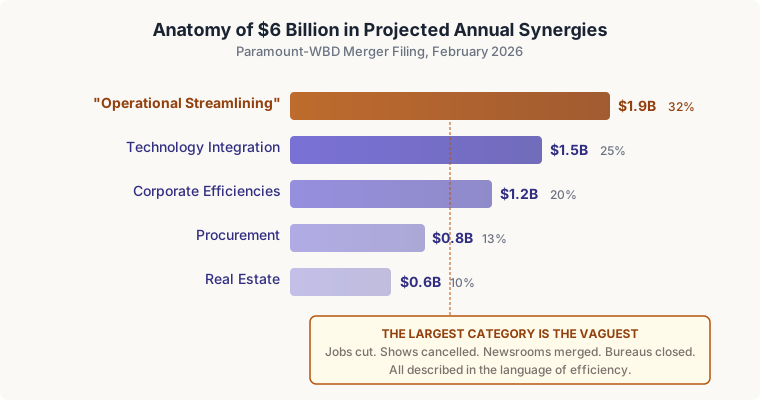
The projected synergies were $6 billion annually. The breakdown: $1.5 billion in technology integration, $1.2 billion in corporate efficiencies, $800 million in procurement consolidation, $600 million in real estate optimization, and $1.9 billion in what the merger filing called "operational streamlining." That last figure, the vaguest and the largest, would matter later.
Elizabeth Warren called it "an antitrust disaster." Zaslav told employees the deal would close in six to twelve months.
The Accumulation
But the Paramount-WBD merger is not the event. It is the latest expression of a pattern that has been accelerating for three decades. To see the pattern, you have to go back to the beginning.
19961996. Congress passes the Telecommunications Act, the first major overhaul of American communications law in sixty-two years. Among its provisions: the elimination of cross-ownership limits that had prevented a single company from owning both newspapers and television stations in the same market, and a dramatic loosening of the caps on how many radio and television stations a single entity could control. The Act was sold as deregulation that would increase competition. What it produced was consolidation. Within five years, Clear Channel Communications went from owning fewer than 70 radio stations to over 1,200.
20132013. Jeff Bezos, then worth approximately $25 billion, purchases The Washington Post for $250 million, roughly 1% of his personal fortune. It is the first major acquisition of a legacy newspaper of record by a technology billionaire. The price is less than what the Post's parent company paid for a single cable system in the 1980s. Bezos frames it as philanthropy: the Post needs digital transformation, and he can provide it. Seventeen years later, it is governed by a man whose other company holds billions in federal cloud computing contracts.
20182018. Biotech billionaire Patrick Soon-Shiong purchases the Los Angeles Times for $500 million. The West Coast's paper of record passes from a publicly traded media company to a single individual's private control. The editorial board will be overridden within seven years.
20192019. Disney completes its $71 billion acquisition of 21st Century Fox's entertainment assets. Rupert Murdoch, who spent four decades building a global media empire, sells the entertainment properties, the film studios and the cable channels and the international networks, but retains Fox News, Fox Business, and Fox Sports. The decision is revealing. Murdoch sells the properties that make money and keeps the one that makes power. Fox News is not a media business in any conventional sense; it is ideational infrastructure, a machine for producing the conceptual vocabulary through which millions of Americans process political information.
20222022. Elon Musk acquires Twitter for $44 billion, a price virtually every financial analyst considers absurd for a company that has never sustained profitability. He renames it X and fires 80% of the staff, including the trust and safety team. Within eighteen months, the platform that once called itself "the digital town square" has become a personal broadcast channel for the world's richest man. The acquisition's logic was never financial. It was infrastructural.
Each deal is larger than the last. Each buyer is wealthier. The gaps between major acquisitions are shrinking. And the regulatory environment is becoming more permissive, not less.
In July 2025, a federal appeals court struck down the FCC's remaining broadcast ownership limits, ruling that the caps on owning stations in the top four markets were arbitrary and unsupported by the administrative record. The Trump administration's Department of Justice, which had signaled its preference for "national champions" over aggressive antitrust enforcement, declined to challenge the ruling. Goldman Sachs projected a terminal federal funds rate of 3–3.25%, making the debt financing for mega-mergers historically cheap. Global private equity dry powder exceeded $2.6 trillion. The deal's architecture is a study in regulatory arbitrage, structured to close during the most permissive window for media consolidation in a generation.
The conditions were set. The only question was who would consolidate what.
The Pilgrimage
Here is a fact that requires no interpretation: within sixty days of the November 2025 election, billionaires whose companies hold more than $50 billion in federal contracts made identical $1 million donations to the incoming president's inauguration fund. Bloomberg reported that the visits to Mar-a-Lago constituted "a pilgrimage." Two billionaire-owned editorial boards, at the Washington Post and the Los Angeles Times, were overridden within seventy-two hours of each other, their planned presidential endorsements killed by owners who had business before the incoming administration.
Seven of the world's richest people are now media barons: Bezos (Washington Post), Musk (X), Murdoch (Fox News), Ellison (CBS, Paramount+, CNN pending), Soon-Shiong (Los Angeles Times), Slim (New York Times largest individual shareholder), Zuckerberg (Meta's news ecosystem). This is not a conspiracy theory requiring secret coordination. It is a structural description. The communicative infrastructure of American democracy is increasingly owned by individuals whose primary financial interests lie in technology, defense contracting, and government procurement, not in journalism.
The coercive dimension of this alignment became explicit during the bidding war itself. On February 19, one week before the WBD board vote, Susan Rice, the former Obama national security adviser and Biden domestic policy adviser who serves on Netflix's board of directors, appeared on Preet Bharara's podcast Stay Tuned with Preet (February 19, 2026) and warned that corporations demonstrating loyalty to Trump would face accountability if Democrats returned to power. Trump responded within hours on Truth Social, demanding that Netflix "immediately fire" Rice or "pay the consequences" (reported by Variety, CNBC, February 22, 2026). The threat was issued while Netflix's $83 billion bid for WBD was under federal regulatory review, review controlled by Trump's Department of Justice. Netflix withdrew from the bidding two days later.
Whether the threat directly caused the withdrawal is unknowable. What is knowable is the structural logic: a sitting president publicly threatened a company seeking his administration's regulatory approval, over the political speech of one of its board members. The "neutral market process" that the financial code describes was operating inside a political environment where the president was actively reshaping the bidder pool.
The Paramount-WBD merger sits at the intersection of these forces. David Ellison's father, Larry Ellison, is the fifth-wealthiest person on earth. Oracle holds billions in federal cloud computing contracts. The Trump administration's permissive posture toward media consolidation is not incidental to the deal. It is a precondition. The deal cannot close without regulatory approval. The regulators serve at the pleasure of a president whose inauguration was funded by the acquirer's family.
CBS plus CNN under one corporate roof means two of the four major American broadcast and cable news operations will answer to a single governance structure. Divestiture of one network is likely required by antitrust review. But which one? And to whom? And does divestiture of a single network solve the structural problem when the underlying pattern, billionaire acquisition of communicative infrastructure, continues to accelerate regardless?
This is not an accusation of quid pro quo. It is a description of structural alignment: a convergence of financial incentives, political access, and regulatory permissiveness that makes $111 billion deals possible in ways they were not a decade ago. The question is what vocabulary we use to describe this convergence, and whether that vocabulary is adequate to the stakes.
"In periods of economic crisis, ideas do not merely reflect interests — they constitute them. Economic ideas serve as blueprints for new institutions, as weapons that delegitimize existing arrangements, and as cognitive locks that make alternatives appear unthinkable. The question is never whether an economic idea is 'true' in some abstract sense, but whose interests it serves and what institutional changes it enables."
Blyth's foundational argument about how economic ideas operate as weapons in institutional battles, later applied to the austerity narrative in his 2013 book and applicable here to the 'synergy' narrative in media consolidation.
The Weapon
Mark Blyth is a political economist at Brown University whose 2013 book Austerity: The History of a Dangerous Idea dismantled the intellectual foundations of post-2008 fiscal policy across the developed world. His core insight was deceptively simple: the idea that governments should cut spending during recessions was not a conclusion derived from economic evidence. It was a narrative, a story that powerful financial actors told because it served their interests, and that became self-reinforcing because the institutions that might have challenged it had been captured by the idea itself. Central banks, finance ministries, and the financial press all operated within the same conceptual vocabulary, which meant the vocabulary could never be questioned from inside the system.
The concept Blyth developed across his career is "ideas as institutional weapons." Economic concepts like efficiency, competitiveness, and fiscal responsibility are not neutral analytical tools that disinterested experts apply to objective reality. They are narratives that reframe private interest as public benefit. Austerity reframes cutting public services as fiscal responsibility. Shareholder primacy reframes the enrichment of stockholders as the fundamental purpose of the corporation. And synergy, the magic word at the heart of every merger prospectus ever written, reframes corporate consolidation as efficiency.
Apply Blyth's framework to the Paramount-WBD deal and the language decodes immediately. "Creating a next-generation global media company to compete with tech giants" is the media industry's equivalent of "we must tighten our belts." It acknowledges a real problem: streaming fragmentation, content cost inflation, the platform dominance of Big Tech. Then it proposes a solution that happens to concentrate power and wealth in the hands of the people making the argument. The $6 billion in projected synergies is not a discovery arrived at through dispassionate analysis; it is a claim, and the claim does institutional work. It justifies a $111 billion price tag to shareholders. It satisfies regulatory reviewers who need a theory for why consolidation serves the public interest. It provides the vocabulary for the earnings call in which a CEO explains why ten thousand people are about to lose their jobs.
But Blyth would push further than the deal's language. The merger does not merely use the synergy narrative. It generates the institutional infrastructure for perpetuating it. The combined entity will own CBS News and CNN, two of the four major American news operations. After the merger closes, these newsrooms will cover media industry trends, antitrust policy, the political economy of information, and the health of American democracy. The entity that resulted from consolidation will report on whether consolidation is a problem. The narrative weapon manufactures its own legitimacy.
This is the feedback loop, and it is the most important structural feature of the deal. Consolidation produces media entities that propagate the economic ideas that justify further consolidation. Blyth identified the same self-reinforcing logic in the austerity narrative: the idea generated the institutional structure that perpetuated the idea, which generated further institutional change, in a cycle that could not be broken from inside because the vocabulary for challenging it had been crowded out by the vocabulary it was trying to challenge. In media, the loop is even tighter, because the institution in question is literally in the business of producing the narratives through which a society understands itself.
Murdoch understood this architecture before anyone else. Acquiring Fox News in the late 1990s was not a media play in the conventional sense. It was an ideational infrastructure play. The channel did not merely report on conservative politics; it generated the conceptual vocabulary through which millions of Americans processed political information. Every subsequent billionaire media acquisition operates on the same structural logic, whether the buyer articulates it in those terms or not. The medium is not the message. The ownership of the medium is the message.
Cross-Curricular Connection: Transaction Costs and the Coase Question. Systems Thinking teaches you Ronald Coase's theory: firms exist because transaction costs make market coordination expensive, so it becomes efficient to bring activities inside a single organization. Merging two media companies reduces those costs. It is a Nobel Prize-winning explanation, and it is not wrong. Blyth's question is whether this explanation also functions as a justification, whether Coase's vocabulary provides the respectable academic framework that makes "we want to control more of the information ecosystem" sound like "we're reducing inefficiencies for everyone's benefit."
The Spreadsheet
Aswath Damodaran teaches corporate finance at NYU's Stern School of Business and is widely regarded as the world's foremost authority on business valuation. His framework for evaluating mergers and acquisitions is built on a single distinction: the narrative versus the numbers. Every deal tells a story about growth, about synergy, about competitive positioning, about the future of an industry. And every deal produces a spreadsheet: discounted cash flows, comparable transaction multiples, risk-adjusted returns, sensitivity analyses. A good deal, Damodaran argues, is one where the story and the spreadsheet agree. A dangerous deal is one where the narrative drives the numbers rather than the other way around.
The $6 billion synergy figure at the heart of the Paramount-WBD merger demands exactly this kind of forensic scrutiny. Break it down. Technology integration accounts for $1.5 billion, which is plausible given that both companies operate duplicate streaming platforms, content management systems, and distribution infrastructure. Corporate efficiencies account for $1.2 billion, the standard post-merger headcount reduction in overlapping departments. Procurement accounts for $800 million in bulk purchasing power for content licensing, satellite bandwidth, and distribution agreements. Real estate accounts for $600 million, consolidating office space, studio lots, and production facilities across two corporate footprints.
So far, these figures are specific enough to evaluate. They point to concrete operations that can be measured against outcomes.
But then there is the $1.9 billion in "operational streamlining," the largest single synergy category and by far the vaguest. "Operational streamlining" is the line item where narrative does the most work and analysis does the least. It is where jobs disappear, shows are cancelled, newsrooms are merged, local bureaus are shuttered, and niche programming is replaced by broadly targeted content, all of it described in the antiseptic language of efficiency. Media assets have high asset specificity. Content libraries, studio relationships, talent contracts, and distribution agreements lose value when extracted from their institutional context. "Streamlining" those assets is not like consolidating warehouse space. It means dismantling creative ecosystems that took decades to build.
Damodaran would look at the base rate. The track record of media merger synergies is not encouraging.
AOL–Time Warner, which closed in 2000 at a combined valuation of $164 billion, promised transformative cross-platform synergies from combining internet distribution with content creation. By 2002, as PBS NewsHour documented, the company had written down $99 billion in value. It was the single most destructive merger in corporate history, a case study in what happens when narrative overwhelms numbers so completely that no one in the room can see the spreadsheet anymore.
AT&T's acquisition of Time Warner in 2018 was more disciplined. The company projected $2.5 billion in annual synergies in its merger proxy filing, split between $1.5 billion in cost savings and $1 billion in revenue gains. Within four years, AT&T reversed course entirely, spinning off WarnerMedia to Discovery at roughly half the acquisition value. The deal that was supposed to create "the future of media" instead created the very WBD that Ellison is now acquiring, a company so weakened by failed integration that it lost 70% of its stock value in three years.
Disney's 2019 acquisition of Fox projected $2 billion in annual cost synergies and largely achieved them, the rare success story in media M&A. But Disney is Disney, a company with decades of integration experience, unmatched brand equity, and the operational discipline to execute what most acquirers only promise.
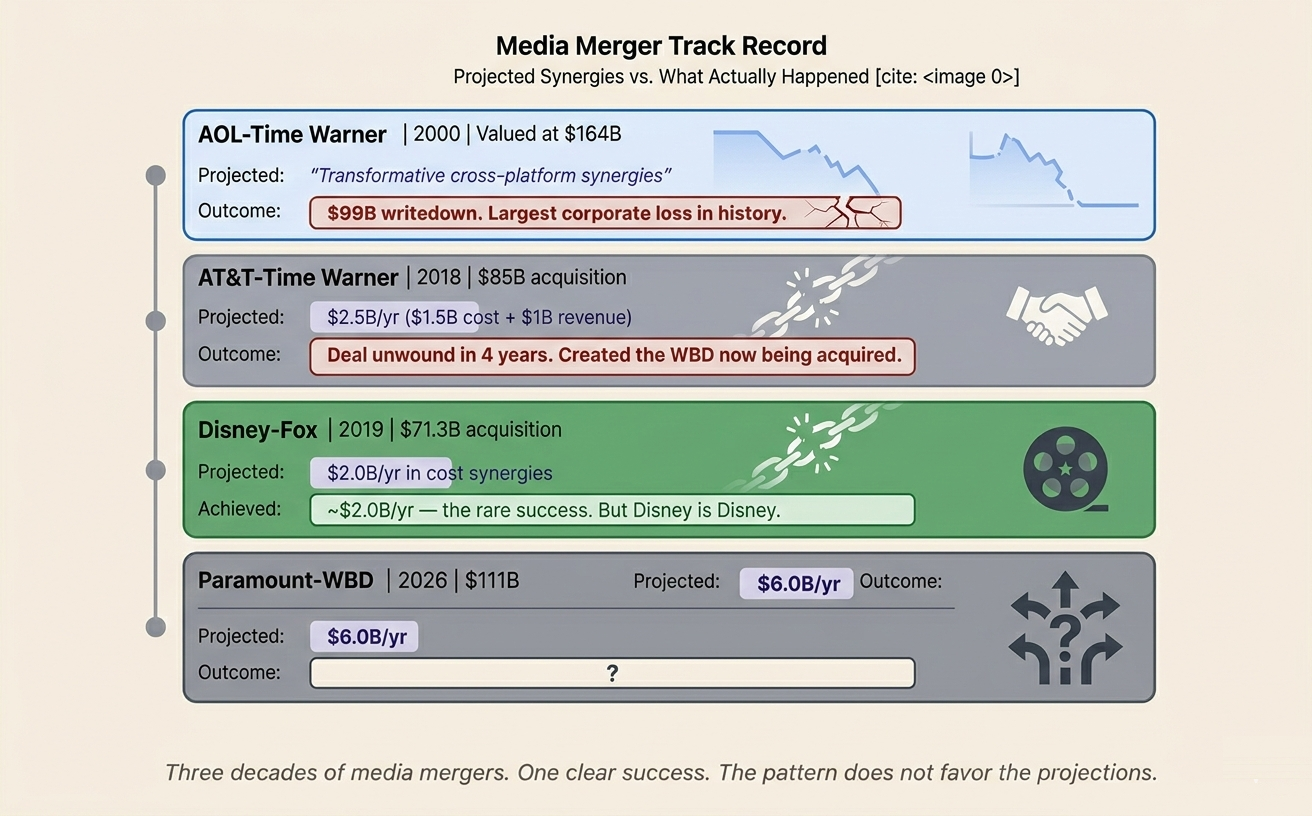
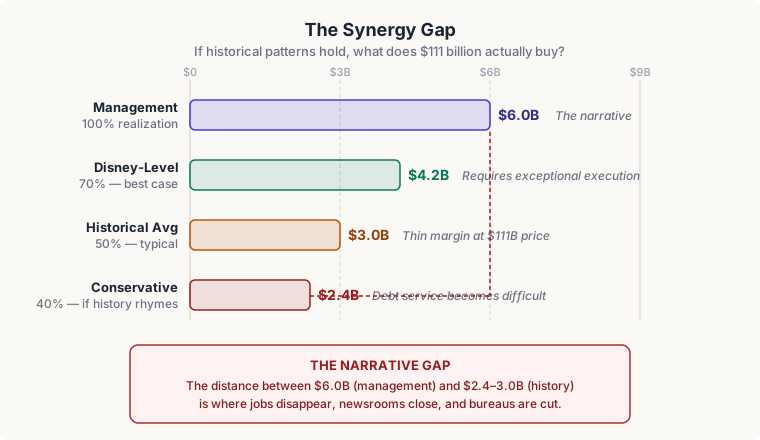
What does the Paramount-WBD deal look like if history rhymes? McKinsey's Perspectives on Merger Integration research shows that merger due diligence fails to provide an adequate roadmap for capturing synergies in more than 40% of deals. In media specifically, the track record ranges from catastrophic (AOL-TW) to reversed (AT&T-TW) to achieved-but-rare (Disney-Fox).
At 50% realization, $3.0 billion instead of $6 billion, the $111 billion price tag buys a company generating much less free cash flow than the models assume, and the debt service on the non-equity portion of the deal becomes considerably harder to sustain. At 70%, $4.2 billion and requiring Disney-level execution, the deal is defensible but thin, with limited margin for error in a media landscape that changes faster than merger integration timelines allow.
The difference between the narrative ($6 billion) and the probable reality ($2.4–$3.0 billion) is not a rounding error. It is the space where Blyth's analysis meets Damodaran's numbers: the narrative of synergy justified a price that the numbers may not support, and the people who will bear the cost of that gap, through layoffs and content reduction and bureau closures, are not the people who stood to gain from the gap's existence.
Cross-Curricular Connection: Lina Khan and the Antitrust Failure. Traditional antitrust analysis asks whether a merger will raise prices for consumers. Lina Khan's framework asks whether it will concentrate structural power, the ability to set the terms on which other participants in the market must operate. When the "product" being consolidated is news and public discourse, the Architecture of Modernity course examines why the consumer price test fails to capture what is actually at stake.
What Democracy Loses
Jürgen Habermas developed the concept of the public sphere in 1962: the communicative space between private life and state power where citizens form political opinions, deliberate over shared problems, and hold institutions accountable. The public sphere is not a metaphor for civic engagement, and it is not a synonym for "the media." It is a structural requirement of democratic governance. Without an institutional infrastructure through which citizens can access reliable information, form independent judgments, and communicate those judgments to one another and to power, elections become exercises in brand preference rather than informed self-rule. The public sphere is the operating system that democracy runs on.
Nancy Fraser, writing a generation later, identified what Habermas's original formulation missed. The public sphere was never singular, and it was never as open as Habermas imagined. It was stratified by class, race, and gender from the beginning. The bourgeois coffee houses where Habermas located the origins of public deliberation excluded women, the poor, and the enslaved.
"I propose to call these subaltern counterpublics in order to signal that they are parallel discursive arenas where members of subordinated social groups invent and circulate counterdiscourses, which in turn permit them to formulate oppositional interpretations of their identities, interests, and needs."
Fraser's foundational critique of Habermas, published in Social Text. The concept of 'subaltern counterpublics' becomes central to understanding what media consolidation displaces.
These counterpublics are not simply smaller versions of the dominant public sphere; they are structurally different, operating through different media, different vocabularies, and different institutional supports. Their existence is what prevents democratic discourse from collapsing into a conversation among elites about their own concerns.
CBS and CNN under a single corporate governance structure is a concrete, empirical test of both theories.
The concern is not that David Ellison will personally dictate editorial coverage, though the structural possibility exists, and the editorial overrides at the Washington Post and the Los Angeles Times provide recent and uncomfortable precedent. The deeper problem is institutional. Editorial decisions at both networks will now filter through a corporate governance structure whose fiduciary obligations run to shareholders, not to the public sphere. The incentive to investigate stories that threaten the parent company's regulatory interests, its relationships with government, or the financial interests of its largest shareholders does not disappear because a journalism code of ethics says it should be disregarded. It is simply outweighed, day after day, decision by decision, by more powerful structural incentives that point in the other direction.
Fraser would identify a more granular harm, one that is invisible from the altitude at which deal architects operate. The $6 billion in synergies, even the portion that actually materializes, will be extracted in part from the local affiliates, regional bureaus, and investigative units that are the most expensive and least profitable components of a news operation. These are the structures that feed stories upward from communities into national discourse: the local reporters who cover city councils, state legislatures, environmental violations, and police misconduct. They are the institutional infrastructure of Fraser's counterpublics: the channels through which voices that lack access to national platforms can still enter the public conversation. When those structures are "streamlined" out of existence to meet a synergy target, the voices they carried do not migrate to another platform. They go silent. The $6 billion figure has a democratic cost that appears nowhere in the merger spreadsheet, because the spreadsheet has no column for the health of a democracy's communicative infrastructure.
The pattern repeats across every billionaire media acquisition. Bezos and the Post. Musk and X. Soon-Shiong and the Times. Now Ellison and CBS-CNN. Each concentrates communicative power in a single individual's governance structure. The public sphere contracts through ownership, not through censorship, which is the word most people instinctively reach for. The range of perspectives narrows not because someone is being actively suppressed, but because the institutional infrastructure that supported diverse perspectives has been rationalized away, one synergy at a time, in the name of efficiency.
Cross-Curricular Connection: Local News Deserts. The Journalism course documents what happens empirically when local newsrooms close: corruption increases, voter turnout drops, civic engagement declines, and local politics collapses into national partisan categories. This case study reveals the financial mechanism that produces those outcomes. The $1.9 billion in "operational streamlining" is how news deserts are manufactured. Not by policy failure or technological disruption alone, but by the synergy arithmetic of media consolidation.
The Self-Legitimating Loop
Where political economy, financial analysis, and democratic theory converge on the same structural feature of the deal.
After the merger closes, CBS News and CNN will continue to cover media industry trends, antitrust policy, the political economy of information, and the state of American democracy. They will produce segments asking whether media consolidation is good or bad for the country. They will interview experts, cite academic studies, and host debates between people who disagree.
The entity that resulted from consolidation will report on whether consolidation is a problem.
This is the structural feature where all three analytical frameworks converge on the same point:
Blyth identifies the feedback loop: the transaction cost narrative justifies consolidation, and the consolidated entity becomes the vehicle for propagating the narrative. The institutional weapon manufactures its own legitimacy. Not through conspiracy or coordinated deception, but through the ordinary daily operation of a media company whose institutional existence depends on the narrative being accepted as true.
Damodaran identifies the valuation blind spot: the gap between projected and realized synergies cannot be honestly evaluated by the entity whose market valuation depends on the gap remaining invisible. When CBS reports on the merger's progress in year two, the $6 billion synergy figure will be the baseline against which success is measured, not the $2.4 billion that historical base rates suggest is more likely. The narrative set the price. The price set the expectations. The expectations will frame the coverage.
Fraser identifies the structural displacement: the counterpublics that might have challenged the narrative from outside the loop, local newsrooms and independent investigative outlets and regional bureaus and alternative media, are among the first casualties of the "operational streamlining" that produces the synergy numbers. The voices that could have articulated the democratic cost of consolidation have been rationalized out of the conversation by the very process they would need to critique.
This convergence, where political economy, financial forensics, and democratic theory all point at the same structural feature of the same deal, is what makes the case irreducibly cross-curricular. No single disciplinary lens can see the whole loop. Financial analysis can stress-test the synergy numbers but cannot see the feedback loop. Political economy can identify the feedback loop but cannot evaluate the capital structure. Democratic theory can name what is lost but cannot explain the financial mechanics that produce the loss. You need all three, held in tension, to see the full architecture of the problem.
The Codes That Cannot Speak to Each Other
There is a scene that recurs in every major merger. The same event gets processed at once through several interpretive frameworks that cannot communicate with each other, each rendering the others invisible.
The financial code. A Bloomberg anchor evaluates the deal through capital allocation efficiency. The $31-per-share premium is a data point in a capital cycle of falling rates, PE liquidity, and regulatory deregulation. The vertical integration logic is sound: combining content production with distribution reduces friction and captures margin across the value chain. The synergies, if realized, justify the price. The deal "works." The question of whether it works for democracy is not a question Bloomberg's analytical framework is designed to process. It is an externality.
The political code. Elizabeth Warren processes the same event through antitrust law and democratic accountability. CBS plus CNN equals dangerous concentration of the news infrastructure that self-governance requires. The political and financial alignment, the Ellison family's relationship with the administration and the regulatory permissiveness that makes the deal structurally possible, is the story, not the synergy math. The capital markets logic that makes the deal "work" is, from this vantage point, precisely the problem.
The labor code. Ten thousand employees process the event through job security, creative freedom, and bargaining power. "Operational streamlining" means their positions will be evaluated against a synergy spreadsheet, and many will be eliminated. The guilds, SAG-AFTRA and the Writers Guild and the NewsGuild, see monopsony: fewer buyers of creative and journalistic labor means lower wages, worse conditions, and less leverage. The narrative of "competing with tech giants" does not answer their question, which is whether they will have jobs in eighteen months.
The public code. Citizens who get their news from CBS or CNN process the event barely at all, because the merger coverage is produced by the entity being merged, and the structural conflict of interest embedded in that sentence is not the kind of thing that makes the evening broadcast.
These are not disagreements about facts that could be resolved by better information. They are incommensurable perceptions of the same event, each filtered through an interpretive code that renders the other codes invisible. The financial code cannot see democratic harm because democratic harm is an externality. The political code cannot see capital market logic because antitrust vocabulary was designed for an era of price-based competition among commodity producers, not for the consolidation of information infrastructure. The labor code cannot see either because the negotiating table was set before the guilds arrived. And the public code barely registers, because the institution that would carry it into the conversation is the institution being restructured.
The consequence, the dependent variable in this case study, will be determined by which code dominates the regulatory review process. At this moment, the financial code is winning, because its vocabulary is the vocabulary of the institutions that approve or reject the deal.
Blyth would recognize the endgame. He traced how the austerity narrative prevailed across Europe and the United States not because it was empirically vindicated, since the evidence ran strongly against it, but because the institutions that could have challenged it had already been captured by the idea itself. Finance ministries staffed by economists trained in the same paradigm, central banks operating within the same conceptual framework, financial media that reported the debate using the debate's own vocabulary. Media consolidation may follow the same trajectory: by the time the consequences are visible to the public, the institutions that would have reported on them will be owned by the entities that caused them.
Cross-Curricular Connection: Fraser's Challenge: Whose Public Sphere?. Fraser asks a question that neither Blyth's political economy nor Damodaran's financial forensics can answer from inside their own frameworks: not whether the deal is justified or profitable, but whose voices are structurally displaced when communicative infrastructure consolidates. The Architecture of Modernity course develops this question across the full arc of modern public sphere theory.
❓Concept Check
Using Blyth's 'ideas as institutional weapons' framework, explain how the concept of 'synergy' functions in the Paramount-WBD merger. Then, using Damodaran's narrative-and-numbers framework, evaluate whether the $6 billion synergy projection is likely to be realized based on historical media merger data. Finally, identify one thing that Blyth's framework can see that Damodaran's cannot, and one thing Damodaran's framework can see that Blyth's cannot.
▸
Concept Check
Using Blyth's 'ideas as institutional weapons' framework, explain how the concept of 'synergy' functions in the Paramount-WBD merger. Then, using Damodaran's narrative-and-numbers framework, evaluate whether the $6 billion synergy projection is likely to be realized based on historical media merger data. Finally, identify one thing that Blyth's framework can see that Damodaran's cannot, and one thing Damodaran's framework can see that Blyth's cannot.
Blyth's framework reveals that 'synergy' operates not as a neutral financial projection but as an institutional weapon, a narrative that reframes private consolidation as public efficiency, justifying regulatory approval, shareholder support, and workforce reduction. The word does political work: it makes a $111 billion concentration of media power sound like a technical optimization. Damodaran's framework subjects this narrative to empirical scrutiny: the track record of media merger synergies ranges from catastrophic (AOL-Time Warner: $99B writedown) to reversed (AT&T-Time Warner: deal unwound in four years, creating the very WBD now being acquired) to achieved-but-rare (Disney-Fox: ~$2B delivered, but Disney has exceptional integration capabilities most acquirers lack). McKinsey research shows merger due diligence fails in over 40% of deals. At 50% realization, the $6B becomes $3.0B, and the deal's financial logic thins considerably. The gap between the narrative and the probable outcome is not a rounding error. It is the space where the story exceeds the evidence. What Blyth sees that Damodaran cannot: the feedback loop, the fact that the merged entity will own the media outlets that evaluate whether the merger was a good idea, making the narrative self-legitimating in a way that financial analysis alone cannot detect. What Damodaran sees that Blyth cannot: the specific financial mechanics, discount rates and comparable transactions and debt service coverage ratios and free cash flow projections, that determine whether the deal survives contact with reality regardless of the narrative, and that provide the forensic tools to evaluate the claim on its own terms.
Think About
Consider the news and media you consumed today: the articles you read, the shows you watched, the platforms you scrolled through. How many of those sources are owned or controlled by one of the seven billionaire media figures described in this case study? What would it mean for your own information environment if the Paramount-WBD merger closes as planned, and what would you need to do to notice the difference?
The corporation is a legal technology. Financial Markets Unit 9 traces its invention: the limited-liability, joint-stock company, designed to concentrate capital for productive purposes. For four centuries, that technology has been refined, contested, regulated, and deployed across every sector of the global economy. It is among the most powerful institutional innovations in human history.
But when the "product" is information, when the corporation produces news and entertainment and public discourse rather than steel or automobiles or financial instruments, the productive purpose and the democratic purpose may be in structural conflict. The corporation concentrates capital with extraordinary efficiency. That is its design. Democracy requires the deconcentration of communicative power. That is its design. The same legal technology that enables a $111 billion media company also enables the feedback loop that Blyth identified: consolidation generates the narratives that justify consolidation, which generates further consolidation, in a cycle that becomes harder to see, let alone to break, with each turn.
Financial Markets teaches you how deals work. This case study asks what deals do, and whether the economic vocabulary we use to evaluate them is, as Blyth suspects, not a neutral instrument of analysis but a weapon that has already chosen its side.
Sources and Further Reading
Theoretical Frameworks
- Blyth, Mark. Great Transformations: Economic Ideas and Institutional Change in the Twentieth Century. Cambridge University Press, 2002.
- Blyth, Mark. Austerity: The History of a Dangerous Idea. Oxford University Press, 2013.
- Coase, Ronald. "The Nature of the Firm." Economica 4, no. 16 (1937): 386–405.
- Damodaran, Aswath. Narrative and Numbers: The Value of Stories in Business. Columbia Business School Publishing, 2017.
- Fraser, Nancy. "Rethinking the Public Sphere: A Contribution to the Critique of Actually Existing Democracy." Social Text 25/26 (1990): 56–80.
- Habermas, Jürgen. The Structural Transformation of the Public Sphere. Translated by Thomas Burger. MIT Press, 1989. Originally published 1962.
Deal Reporting and Financial Data
- Bloomberg. "Paramount Pays $2.8 Billion Netflix Breakup Fee in Warner Bros. Deal." February 27, 2026.
- Bloomberg. Billionaire inauguration donations and Mar-a-Lago reporting, December 2025–January 2026.
- CNBC. "Warner Bros. Discovery: Paramount-Skydance Deal Deemed Superior." February 26, 2026.
- CNBC. "Trump Demands Netflix Fire Susan Rice as DOJ Probes Warner Deal." February 22, 2026.
- Deadline. "Netflix Walks With A Cool $2.8 Billion Breakup Fee." February 2026.
- Paramount-Skydance merger filing. $6 billion synergy projections and deal structure, February 2026.
- Variety. "Donald Trump Demands Netflix Fire Board Member Susan Rice." February 22, 2026.
Historical Mergers
- AT&T Investor Relations. Time Warner merger proxy filing: $2.5 billion synergy projections, 2018. Deal unwound via WarnerMedia-Discovery spinoff, April 2022.
- Disney Investor Relations. 21st Century Fox integration cost synergy updates, 2019–2024. $2 billion target.
- PBS NewsHour. "AOL Time Warner Posts Record $99 Billion Annual Loss." January 30, 2003.
Industry Research
- Abernathy, Penelope Muse. The Expanding News Desert. Northwestern University Local News Initiative, 2023.
- McKinsey & Company. Perspectives on Merger Integration. 2010. Synergy realization and due diligence research.
Regulatory
- Telecommunications Act of 1996, Public Law 104-104.
- Federal appeals court ruling on FCC broadcast ownership limits, July 2025.
📋Case StudyThe Genetic Wild West, When DNA Becomes a Corporate Assethosted in Ethics▸
The Tuskegee parallel, institutional deception, biological exploitation, and intergenerational harm across centuries
Luhmann's binary codes, legal/illegal, payment/non-payment, true/false, each processes DNA differently
CODIS as reinforcing feedback loop; genetic data as stock with regulatory delay producing overshoot
Sister case study, Luhmann's structural blindness applied to biological instruments
Bayesian cascades in manufactured trust; propaganda techniques in DTC marketing
What counts as evidence when genomic science competes with oral traditions
“When a bankruptcy judge rules that 15 million people's genetic data is a transferable corporate asset, when the same DNA technology that frees the innocent entraps entire communities, Lessig, Luhmann, Santos, Rampton and Stauber reveal how architecture, manufactured trust, and institutional blindness govern the most intimate data we possess.”
Read full case study📋Case StudyThe Voluntary Panopticon, How Consumers Built the Surveillance State the Government Couldn'thosted in History Of Technology▸
The consent architecture of surveillance, and Zuboff's behavioral surplus applied to voluntary home camera installation
Insurance companies as surveillance beneficiaries: duty to cooperate clauses, comparative negligence, and data monetization as negative externality
Fourth Amendment erosion through corporate intermediaries, the warrant requirement becomes optional when consumers consent to Terms of Service
Manufactured evidence of efficacy: cherry-picked crime statistics from surveillance vendors vs. independent criminology meta-analyses
Foucault's disciplinary power made literal, from the theoretical panopticon to Ring cameras in 2/3 of American homes
“From the PATRIOT Act to Ring's 'war on crime,' how the privatization of surveillance inverted the Fourth Amendment, and why a musician's YouTube documentary succeeded where policy advocacy failed.”
Read full case study