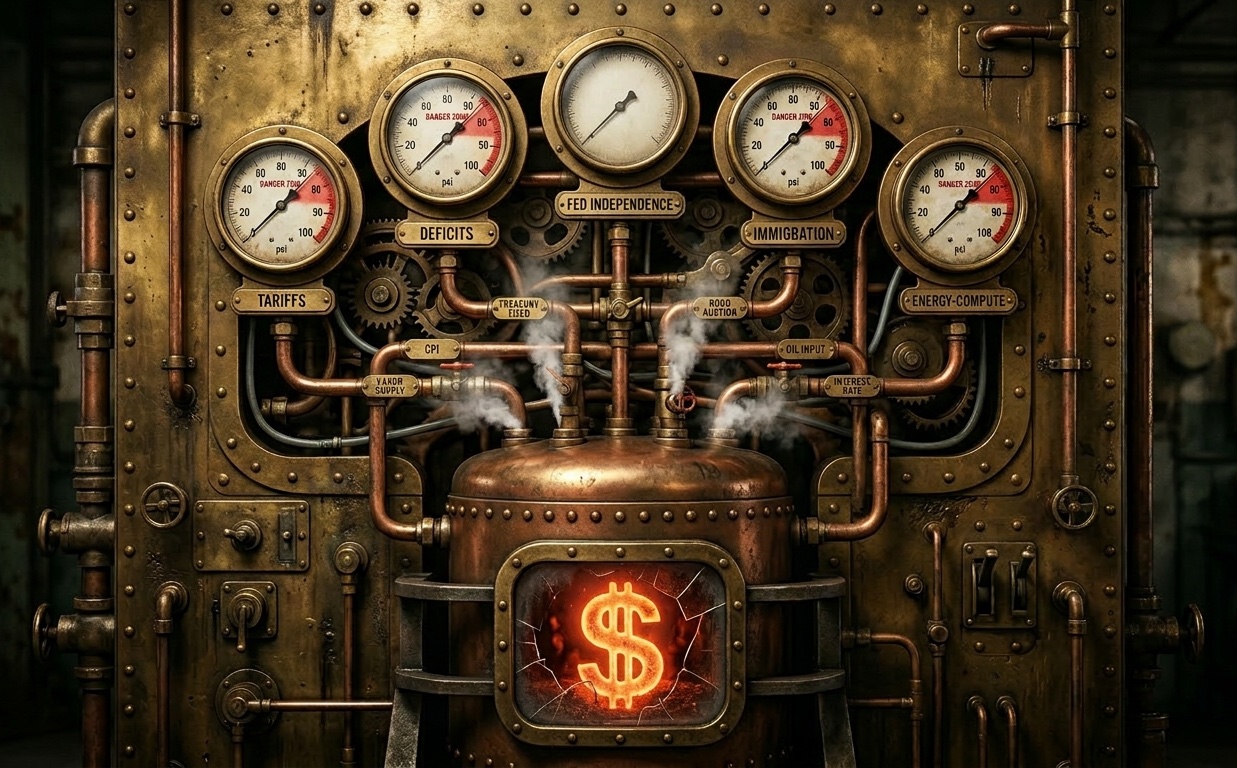
Reading Behind the Slides
How to Read an Establishment Forecast
This series began with The Economist's "2026: The New World Order Takes Shape," 14 slides of real data and structural gaps. The critical reading protocol, the Bayesian sequence of willful ignorance, and the slide-by-slide analysis that produced every article below.
The Analytical Framework
- Mark Blyth: ideas as institutional weapons, who benefits from the blindness?
- Niklas Luhmann: binary codes and functional differentiation, why institutions can't see across specializations
- Jürgen Habermas: colonization of the lifeworld, how money and power lock the codes
- Lawrence Lessig: four modalities of regulation, where architecture prevents correction
Article 1
The Five Gauges Are One Machine
Tariffs, deficits, Fed independence, immigration, and energy-compute are not five separate risks. They are pressure readings from one feedback loop, traceable in public data, invisible from inside any single expert's code-cage.
LiveArticle 2
The Jetsons Don't Need the Flintstones Anymore
AI investment, defense spending, and trade restructuring are wealth transfers disguised as policy. The 44% S&P concentration and "Stop Hiring Humans" compose into a class divide enabled by code-compliant micro-decisions.
LiveArticle 3
You Know Where You Are With Us
China's predictable authoritarianism is winning the counterparty game against America's transactional chaos. The global South isn't choosing ideology. It's choosing the deal partner who doesn't change terms mid-contract.
LiveArticle 4
Who Builds the Museums While the Islands Sink
The billionaire class builds narrative infrastructure while the systems they profit from produce climate refugees and mass deportation. The bystander class of professionals provides the code-compliant services that maintain the veil.
LiveArticle 5
The Bond Market Doesn't Bluff
The real signpost for 2026 isn't the midterms. It's whether sovereign risk reprices when Powell's term ends in May. The bond market is the one code-cage that can't be captured by political code.
Article 6
The Odyssey Is Not a Solo Journey
Odysseus gets his crew killed. The hero narrative obscures the collective action problem. Can democratic societies develop the cross-code perception needed to see aggregate effects before the cascade becomes irreversible?
NewArticle 7
The Gift Horse
China cut oil imports 30–35% in the year the Strait closed, and nobody can fully decompose how. America spent its new electricity on inference and socialized the bill. Two electrification programs, opposite purposes, read through Cembalest’s Trojan Fire Horse.
Companion Series: The Domestic Machine
Social Physics traced the economic machine, five gauges connected by one feedback loop. The Domestic Machine traces the same institutional architecture through its domestic enforcement dimension: immigration enforcement, labor trafficking, lethal deployments against citizens, sovereignty assertions, document control, loyalty, and war. Same methodology. Same scholars. Same honesty about what we got wrong. Read the companion series →
Companion Series: No Kings: The Chalice Overflows
Social Physics traced the economic machine. The Domestic Machine traced enforcement. No Kings: The Chalice Overflows traces what happens when the codes stop differentiating, 47 days from DHS shutdown through the AG’s firing, the Army Chief’s ouster during active war, and the judiciary’s refusal to collapse. Same methodology. Same scholars. More personality. Because the situation demands it. Read No Kings: The Chalice Overflows →
How to Read This Series
- The Receipt: Each article opens with a data table. The numbers are public, verifiable, sourced. Start here.
- The Pipes: The connections between the data points are traced through arithmetic, not assertion. Follow the feedback loops.
- The Framework: After the data speaks, the analytical tools are introduced with full attribution. You learn the machinery, not just the diagnosis.
- The Sources: Every article carries a ProPublica-grade bibliography. Every claim is traceable. FRED series IDs are provided so you can pull the charts yourself.
The Investigation in Order
One argument, in the order the year forced it
Written as the events arrived. Read top to bottom and you watch the argument grow, and watch what each dispatch couldn’t yet see become the subject of the next.
- 01Social Physics of the New DisorderMar 2026you are here
Read the economy as five gauges on one feedback loop, and called the bond-market repricing before it landed, but not yet the hand on the valve.
- 02The Domestic MachineMar 2026
Mapped the enforcement architecture and set the honest-reckoning self-audit this family now inherits as a rule, still reading enforcement as a domestic story, not a capital one.
- 03No Kings: The Chalice OverflowsApr 2026
Traced what happens when every institution collapses its judgment into one question: loyal, or disloyal, without yet pricing the assets marked against the code that broke.
- 04The ComputedollarMay 2026
Named the forced absorber: the pension as buyer of last resort in the AI capital cycle, reading compute as finance, before it was clear how much was physics.
- 05The StackJul 2026
Took the compute economy apart floor by floor, down to the power bill and the eleven days of gas under the whole supply, and left the questions open, on purpose.
- 06Hormuz and the Weighting GameAug 2026
Tallied six flows, talent, open weights, inference routing, data, allied standards, and capital, and argued the transfer to China's AI buildout runs one way, closing on the marginal cost of a watt as the deciding metric, the strait it's named for closes and reopens through all of it; the transfer doesn't stop either way.
- →The open questionunresolved
The Computedollar’s final article left four gaps open on purpose: labor displacement, stranded-asset risk under carbon pricing, the cognitive substrate of deliberation, and cross-asset contagion, each named with its framework hooks and none of them traced. What has happened since sits inside those gaps rather than closing them: an index architecture that split rather than held, an absorption capacity that turned out to have a limit, a strait that for five months neither closed nor reopened. The list ends here because the argument has not, not because the argument arrived.
The Education Machine (Apr 2026), the same rigor turned on mythology and merit rather than collapse. It sits beside the arc, not inside it, and reads on its own.