I. The Primary Evidence
This series began with a document: The Economist's "2026: The New World Order Takes Shape," a 14-slide preview deck published for institutional subscribers. It is a serious document produced by serious people. It contains real data, genuine analysis, and a coherent thesis: the post-Cold War consensus is over, three pillars define the new era (transactional power, technological acceleration, systemic fragmentation), and the intelligent observer should prepare accordingly.
We did not start by disagreeing with it. We started by reading it the way the curriculum teaches students to read any authoritative source: with respect for the evidence and skepticism about the framing.
The curriculum's method, developed across journalism, critical thinking, ethics, and systems thinking, asks four questions of any primary document:
The Critical Reading Protocol
- What claims are made? Identify the explicit assertions. What data is cited? What conclusions are drawn?
- What evidence supports them? Trace each claim to its source. Is the evidence primary or derivative? Is it verifiable? Is it current?
- What is structurally absent? What data exists but is not presented? What connections are available but not drawn? What questions does the framing make unaskable?
- Who benefits from the framing? Not conspiracy. Structure. Which actors, institutions, or interests are served by this specific arrangement of what is visible and what is not?
When we applied this protocol to The Economist's deck, the gaps were not errors. They were architecture.
II. The Deck, Slide by Slide
Here is what The Economist presented, what it revealed, and what it structurally could not say.
Slides 1–2: The Thesis Frame
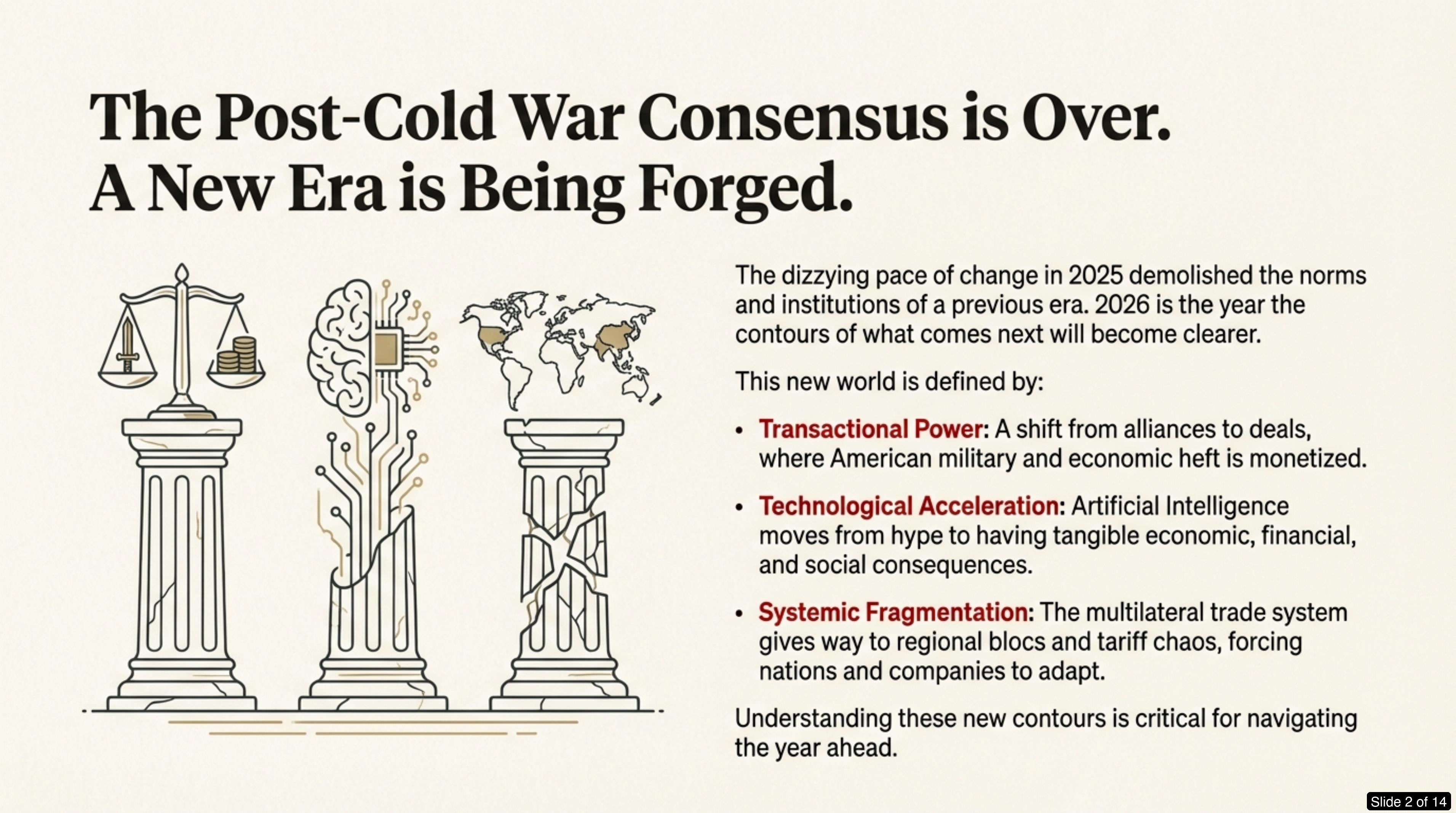
The claim: The post-Cold War consensus is over. Three pillars define the new era: transactional power, technological acceleration, systemic fragmentation.
The evidence: Solid. The framing is defensible and well-supported.
What's absent: The legal infrastructure enabling all three pillars still runs post-Cold War code. The law modality is unnamed. The financial plumbing, meaning who structures the deals and who profits during the transition, is invisible. The framing ("a new era is being forged") treats this as natural transition, obscuring who forges and who benefits.
Slide 6: The Four Danger Gauges
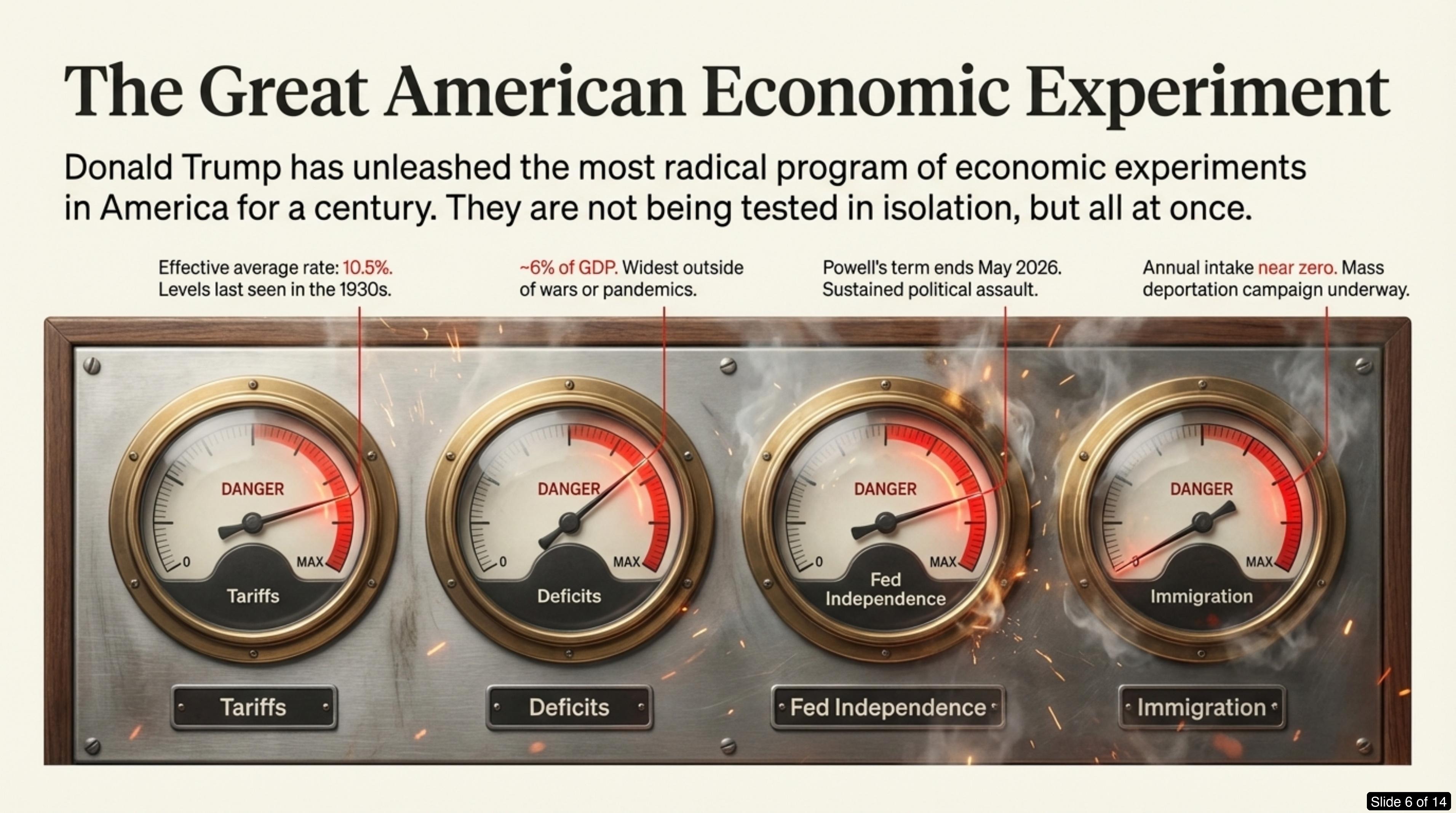
The claim: Four risks define the American economic experiment, tariffs at 10.5%, deficits at ~6% GDP, Fed independence under assault, immigration near zero.
The evidence: Accurate on every individual gauge.
What's absent: The pipes. The deck presents four separate gauges. It does not trace the feedback loop connecting them: tariffs → inflation → Fed constraint → deficit expansion → labor shortage compounding inflation → further constraining the Fed. The energy-compute gauge, the fifth instrument connecting AI infrastructure costs to tariff policy and energy prices, is entirely missing. Each gauge is treated as an independent risk. The feedback loop between them is the machine the deck cannot see, because forecasting institutions are organized by beat: trade desk, monetary desk, fiscal desk, labor desk. Each gauge is read by the desk that owns it, inside that desk's code. You don't need The Economist's org chart to verify this; the one-gauge-per-panel layout of the slide is the fingerprint of the division of labor that produced it.
This gap became: Article 1 — "The Five Gauges Are One Machine"
Slides 5, 8, 9: AI, Defense, and the Career Ladder
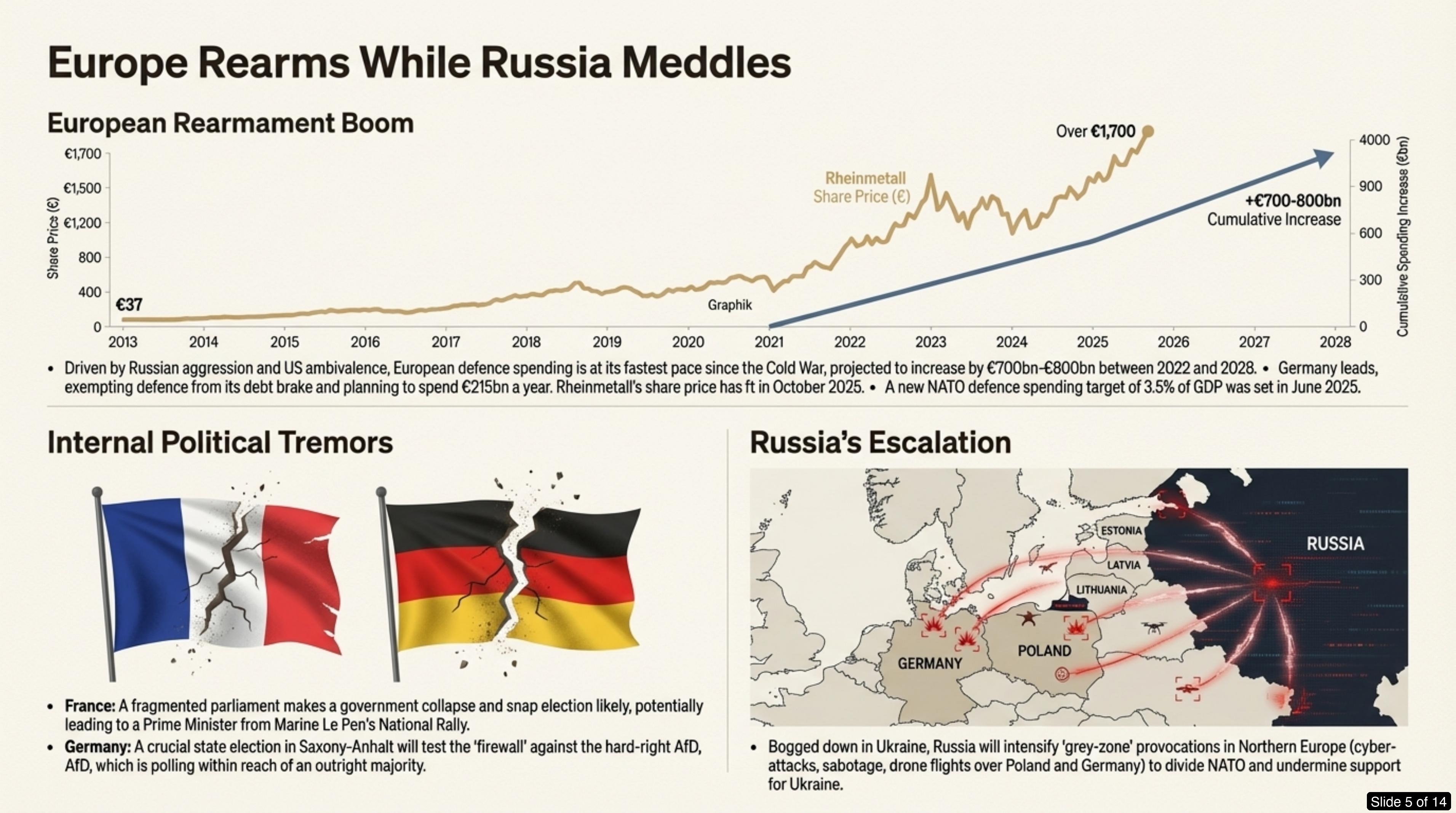
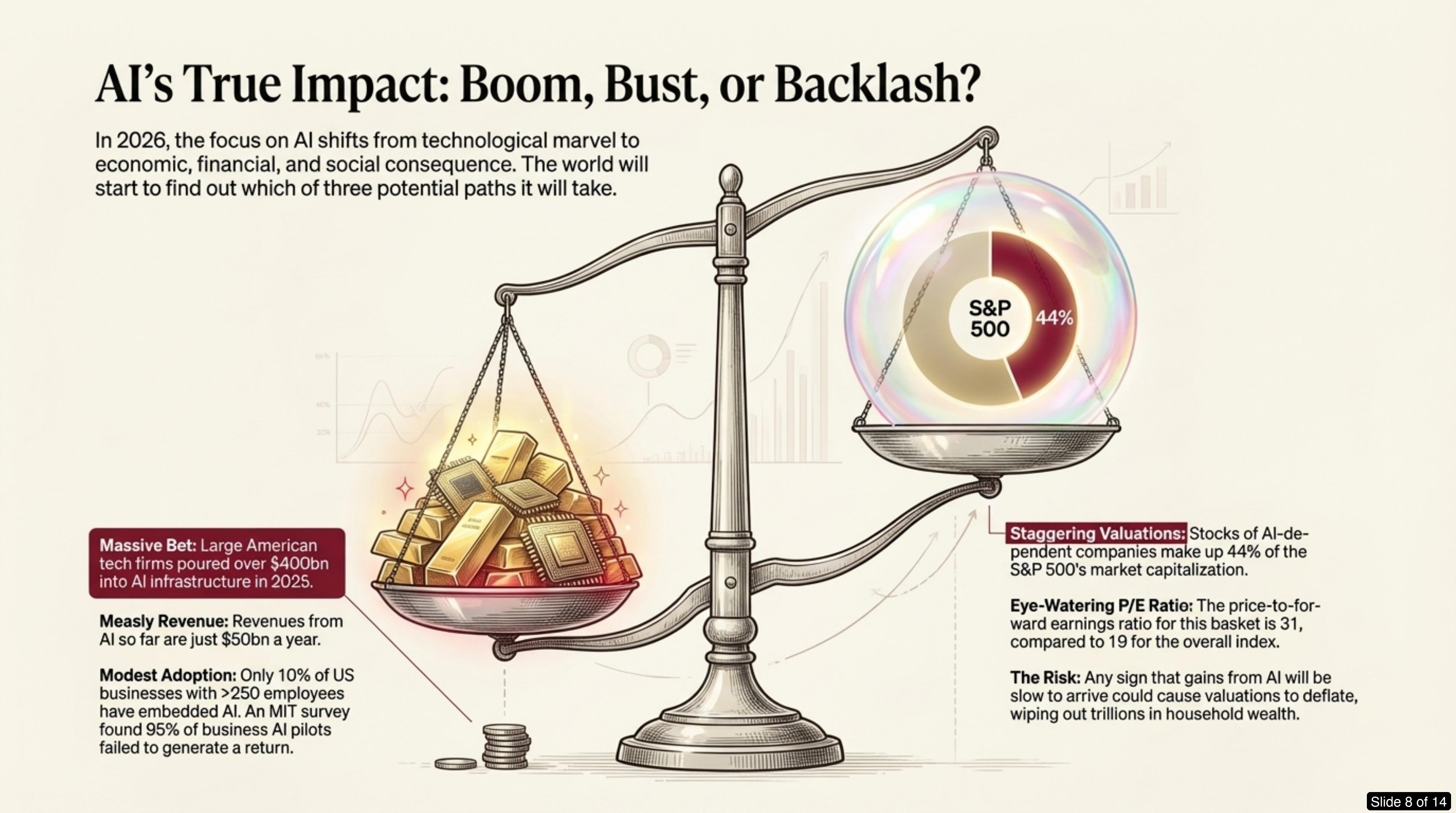
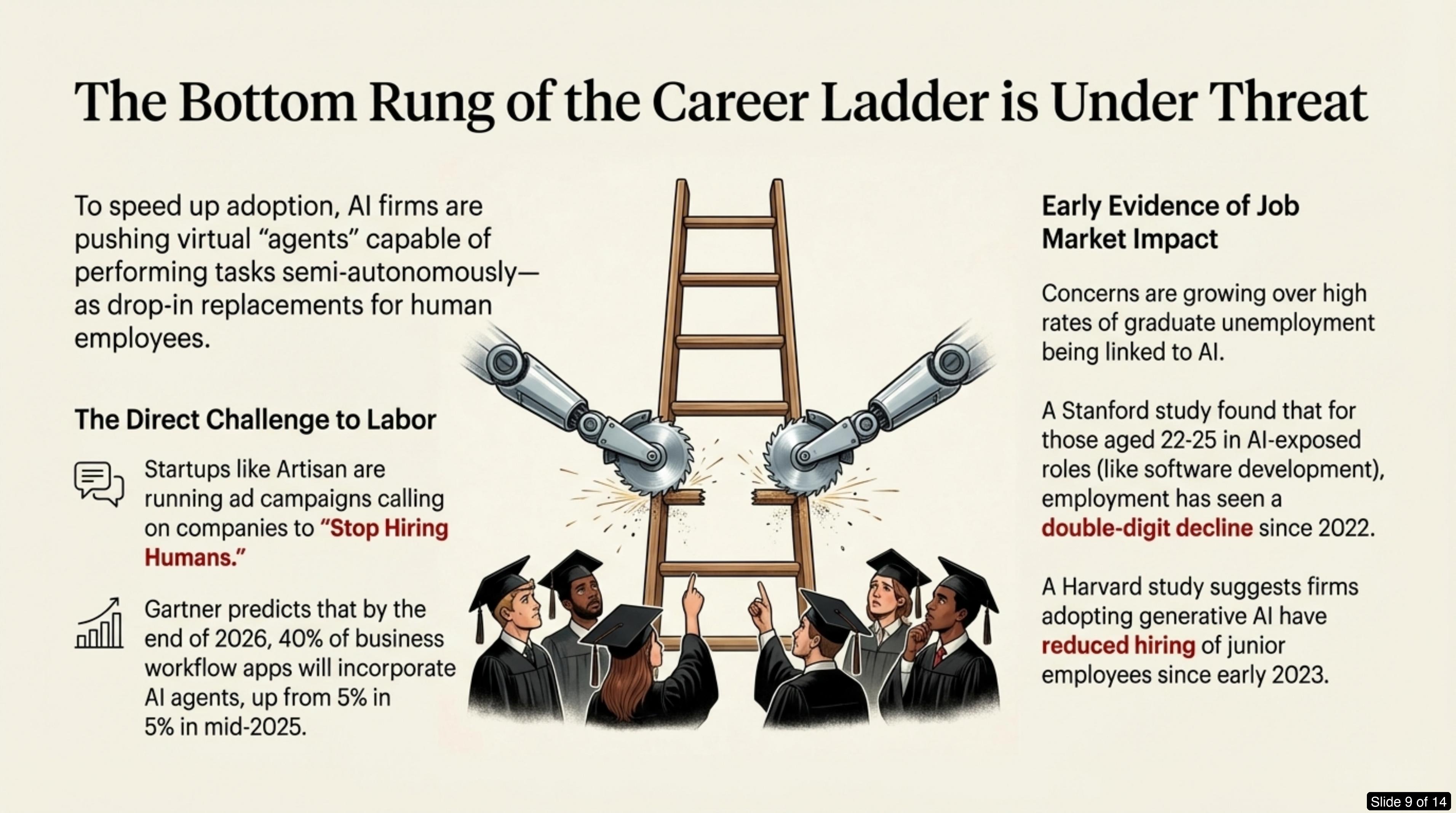
The claims: Rheinmetall up 45x, the deck's figure; the multiple depends heavily on which start date you choose, which is itself a framing lesson. $400B invested in AI against $50B revenue. 44% of S&P market cap in AI-exposed stocks. "Stop Hiring Humans." Double-digit employment decline for 22-25 year olds in AI-exposed roles.
The evidence: Alarming, and mostly precise, though a headline multiple like 45x deserves the same skepticism as any anchor number. Apply the protocol to us, too.
What's absent: The class structure. The deck presents these as three separate stories, namely defense spending, AI investment, and employment disruption. It does not name the aggregate: a wealth transfer from public budgets and passive retirement savings into concentrated private gains, enabled by a professional class making individually rational micro-decisions that collectively produce a generational lockout. The person whose 401(k) is in an S&P 500 index fund is enrolled in the AI bet without choosing it. The junior professional whose entry-level job was automated didn't consent to the replacement. Each decision was code-compliant. The aggregate is a class divide.
This gap became: Article 2 — "The Jetsons Don't Need the Flintstones Anymore"
Slides 3, 4, 7: America's Disruption, China's Opportunity, Trade Adaptation
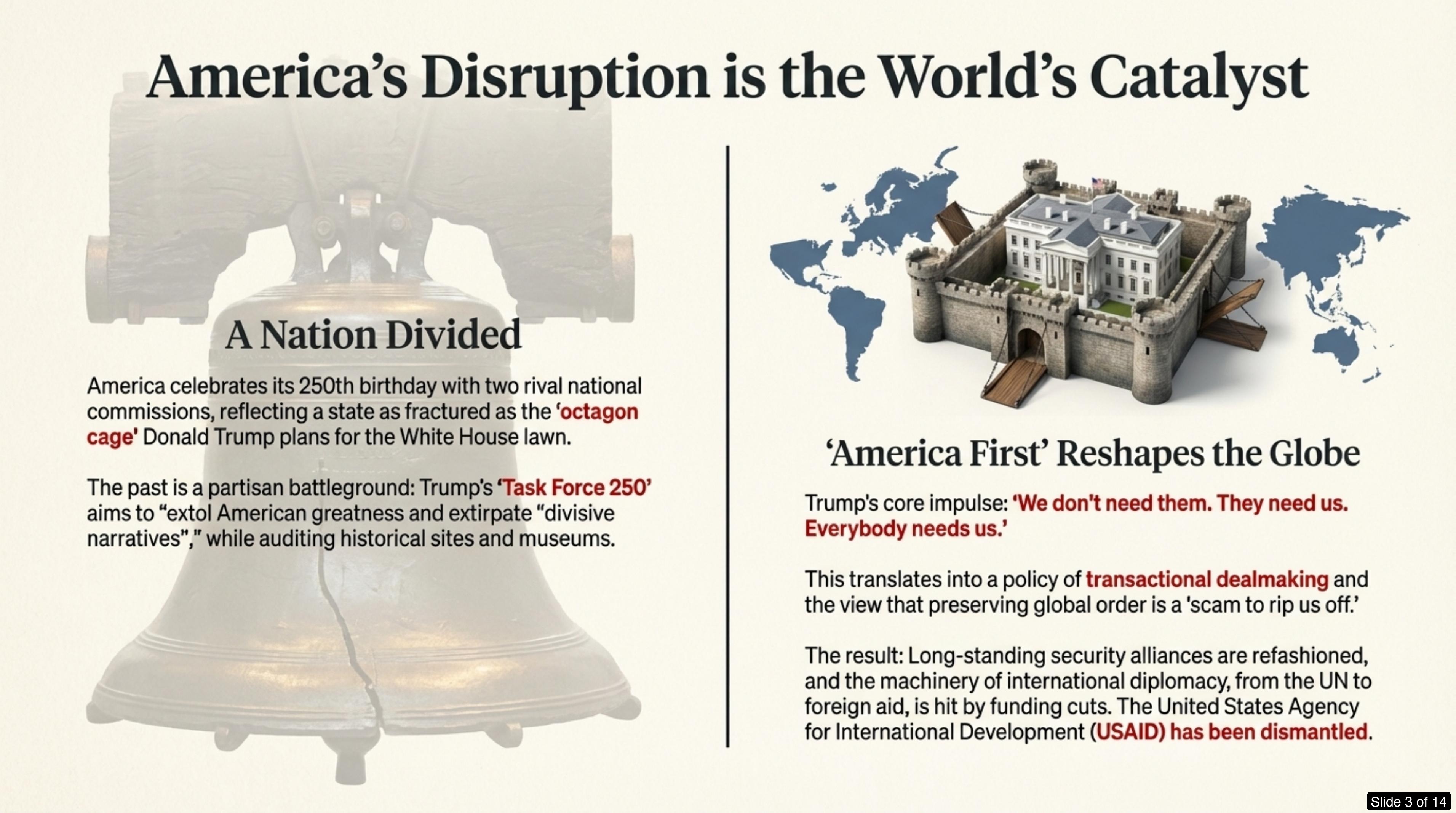
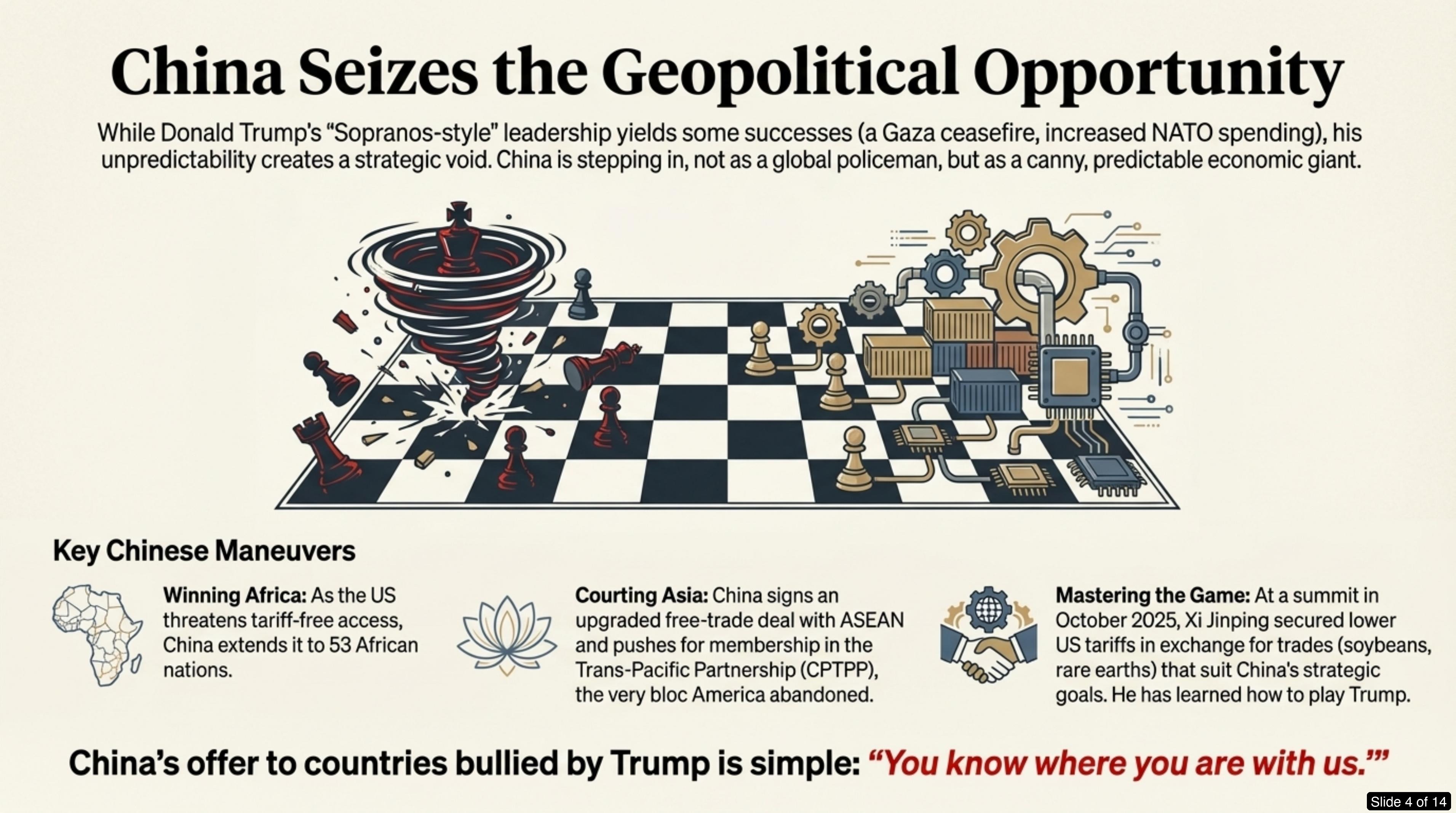
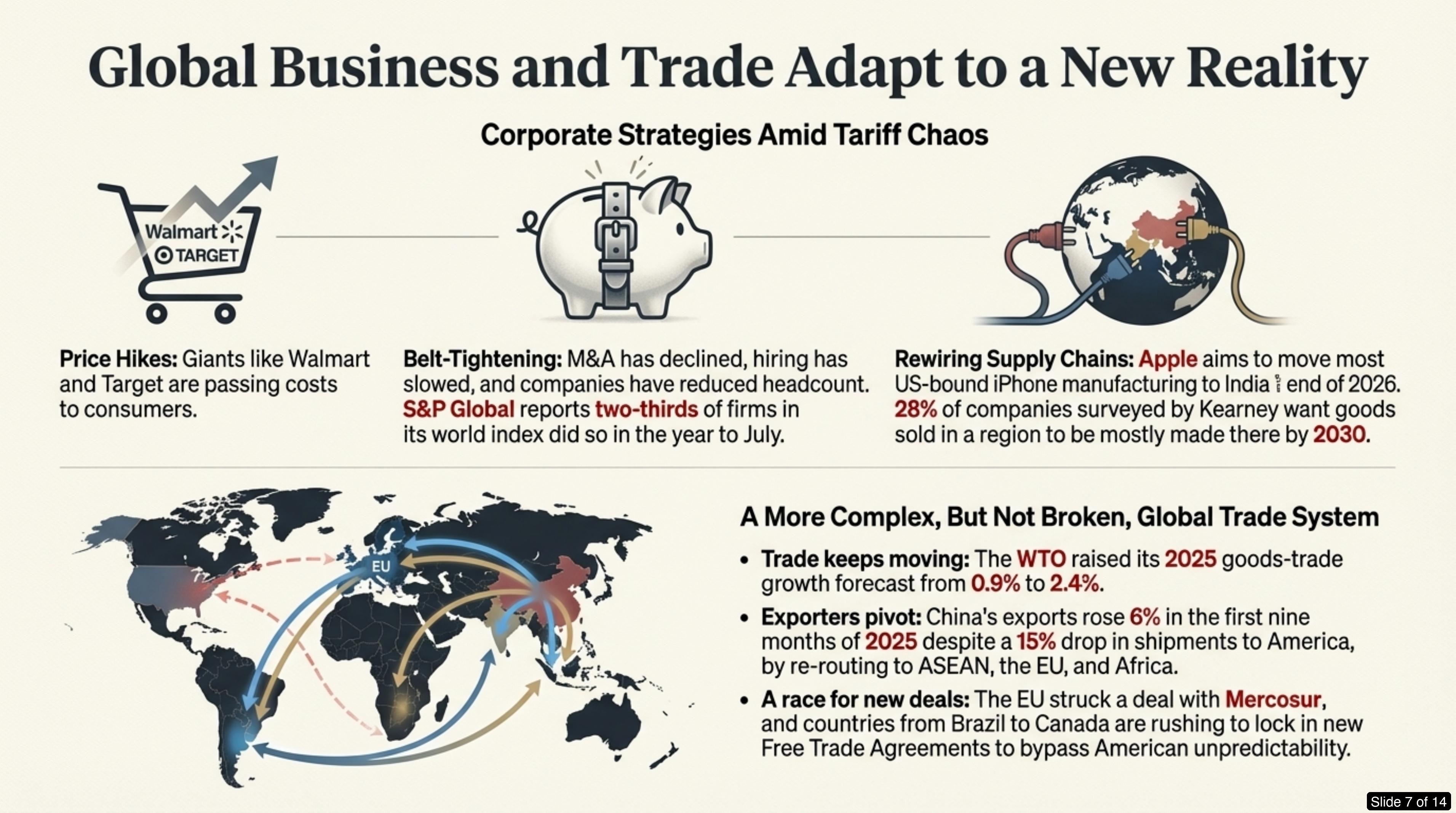
The claims: Task Force 250 auditing museums. USAID dismantled. China offering Africa tariff-free access. Trade "more complex but not broken."
The evidence: Accurate but asymmetrically framed.
What's absent: The counterparty logic. The deck notes China's exports rose 6% despite a 15% drop to the US. But it treats this as "trade adaptation" rather than naming it: a wholesale replacement of America as the primary trade counterparty for the developing world, accomplished through code-compliant transactions (transshipment, trade finance, CPTPP accession) that no single American institution tracks as a unified strategic shift. The deck cannot say: "America is winning the trade war while China is winning the trade architecture." That sentence requires seeing across the trade code, the diplomatic code, and the financial code simultaneously.
This gap became: Article 3 — "You Know Where You Are With Us"
Slides 10, 12, 13: The Human Ledger
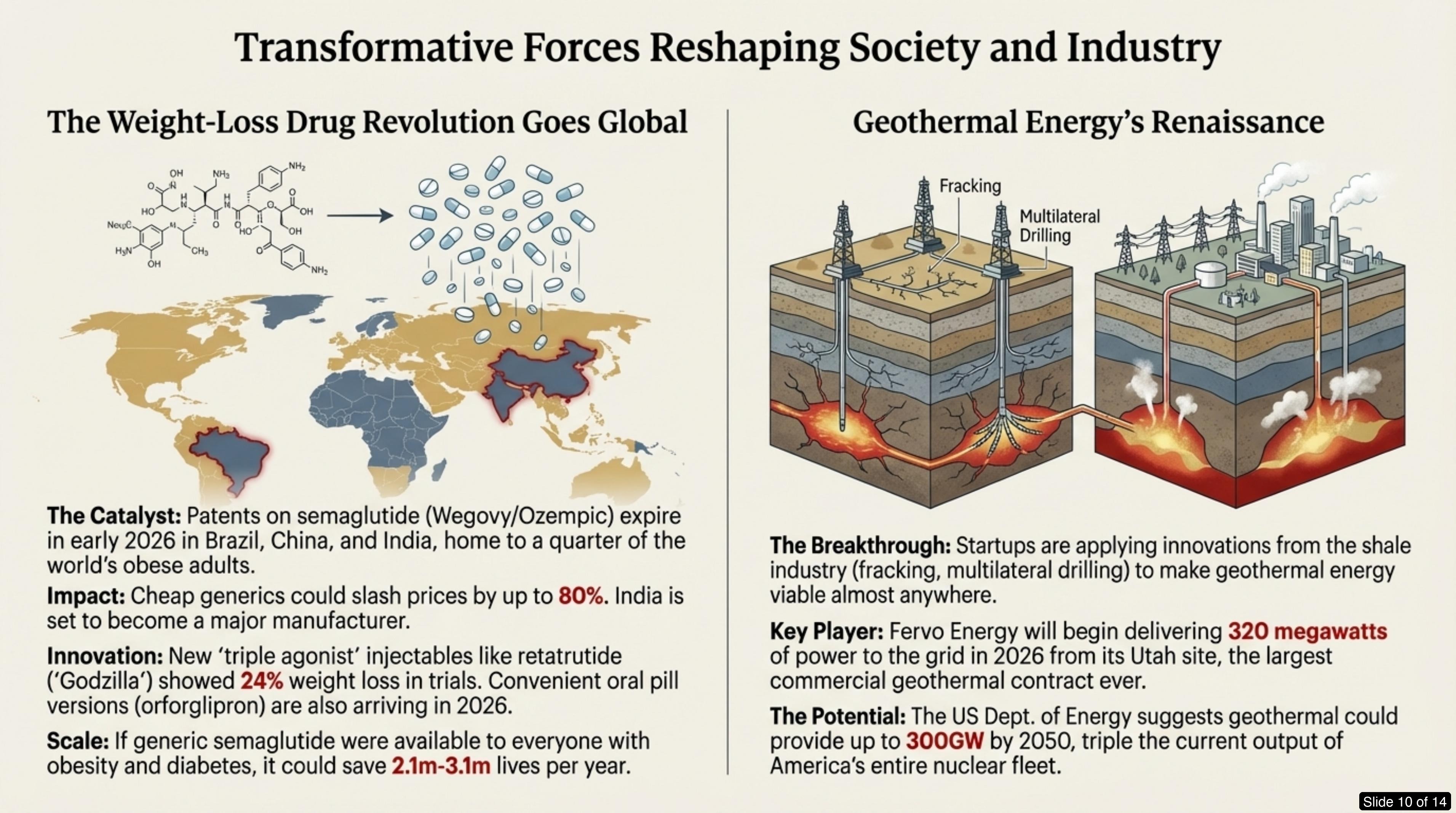
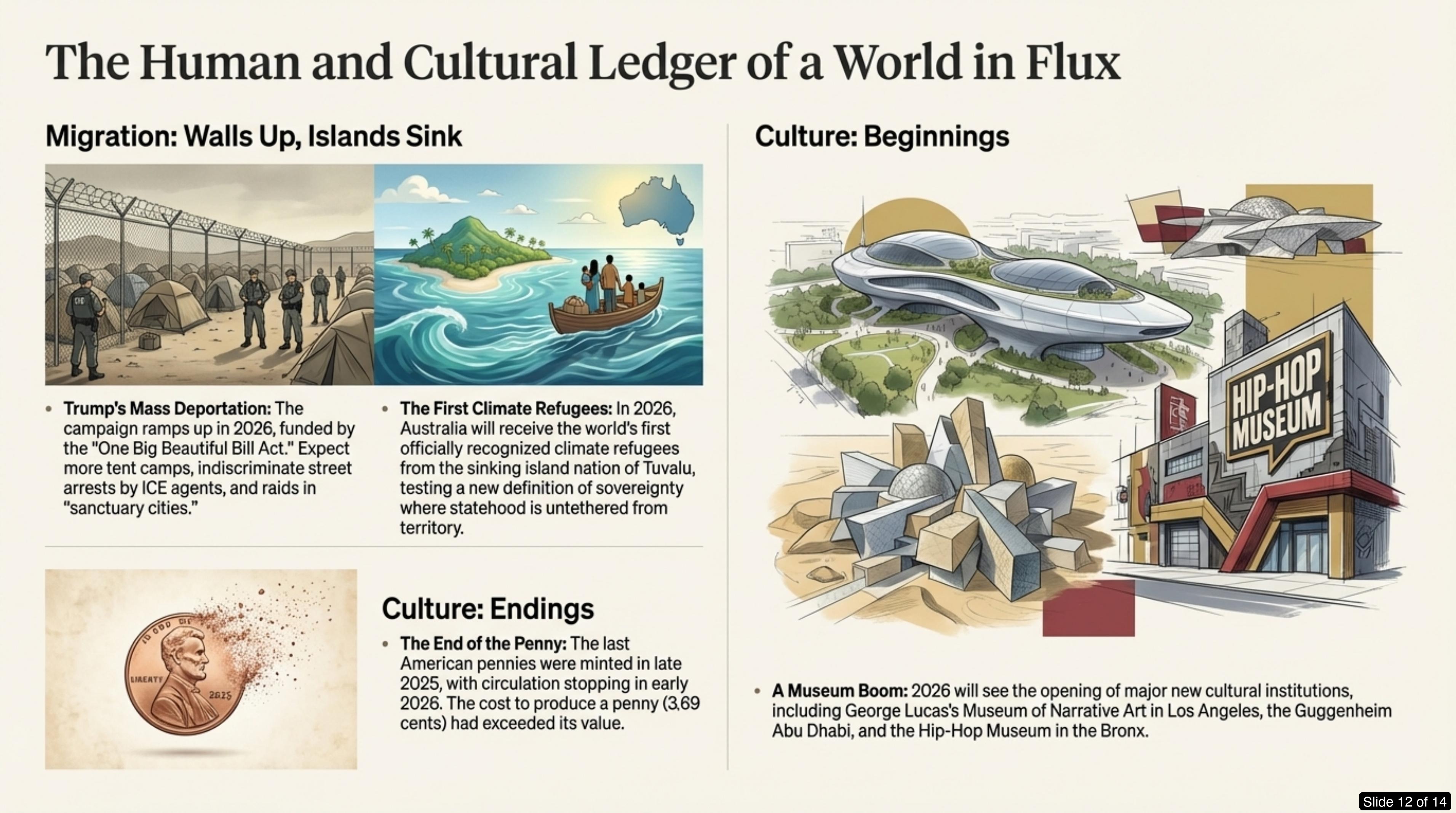
The claims: Semaglutide generics at 80% price drop. Tuvalu climate refugees. Mass deportation. Museum boom. Homer's Odyssey as metaphor.
The evidence: Presented as a cultural survey, a miscellany of unconnected developments.
What's absent: The juxtaposition the deck doesn't name. The billionaire class is building museums (narrative infrastructure) in the same year that the systems generating their wealth produce climate refugees, mass deportation, and the collapse of local journalism. The semaglutide breakthrough is real. And the distribution architecture ensures the people who need it most will access it last. Each is presented as a separate human-interest item. The aggregate, a class that builds monuments to its own taste while the structural consequences of its wealth play out in other code-cages, is invisible because the deck processes culture, climate, and immigration through separate editorial teams.
These gaps became: Article 4 — "Who Builds the Museums While the Islands Sink"
Slide 11: Subdued Global Economy
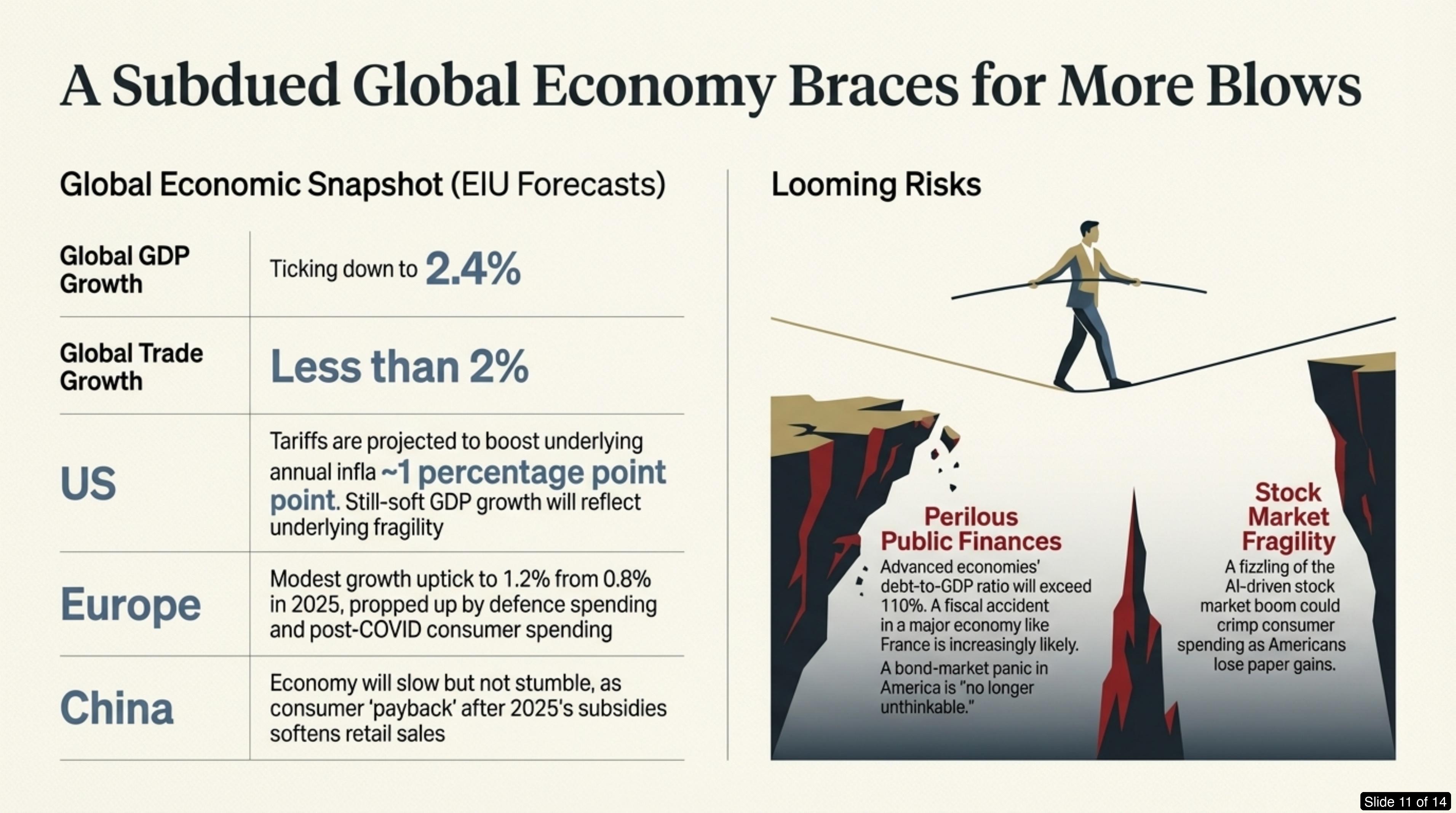
The claim: GDP 2.4%, trade below 2%, debt-to-GDP exceeding 110%. Bond panic "no longer unthinkable."
The evidence: Correct. And the most important sentence in the deck is buried in a bullet point.
What's absent: The mechanism. "Bond panic no longer unthinkable" is a six-word structural diagnosis that the deck presents as a risk factor rather than a thesis. The bond market is the one code-cage that cannot be captured by political code. It is too distributed, too counterparty-dependent, too mathematically constrained. When the deck says "not unthinkable," it is acknowledging that the arithmetic of $30.6 trillion in Treasury debt, $970 billion in annual interest, and a politicized Fed has a logical endpoint. The deck cannot trace the cascade because the cascade runs through the shadow banking system ($256.8 trillion in nonbank financial assets) that the deck does not mention.
This gap became: Article 5 — "The Bond Market Doesn't Bluff"
Slides 13–14: The Odyssey and the Signposts
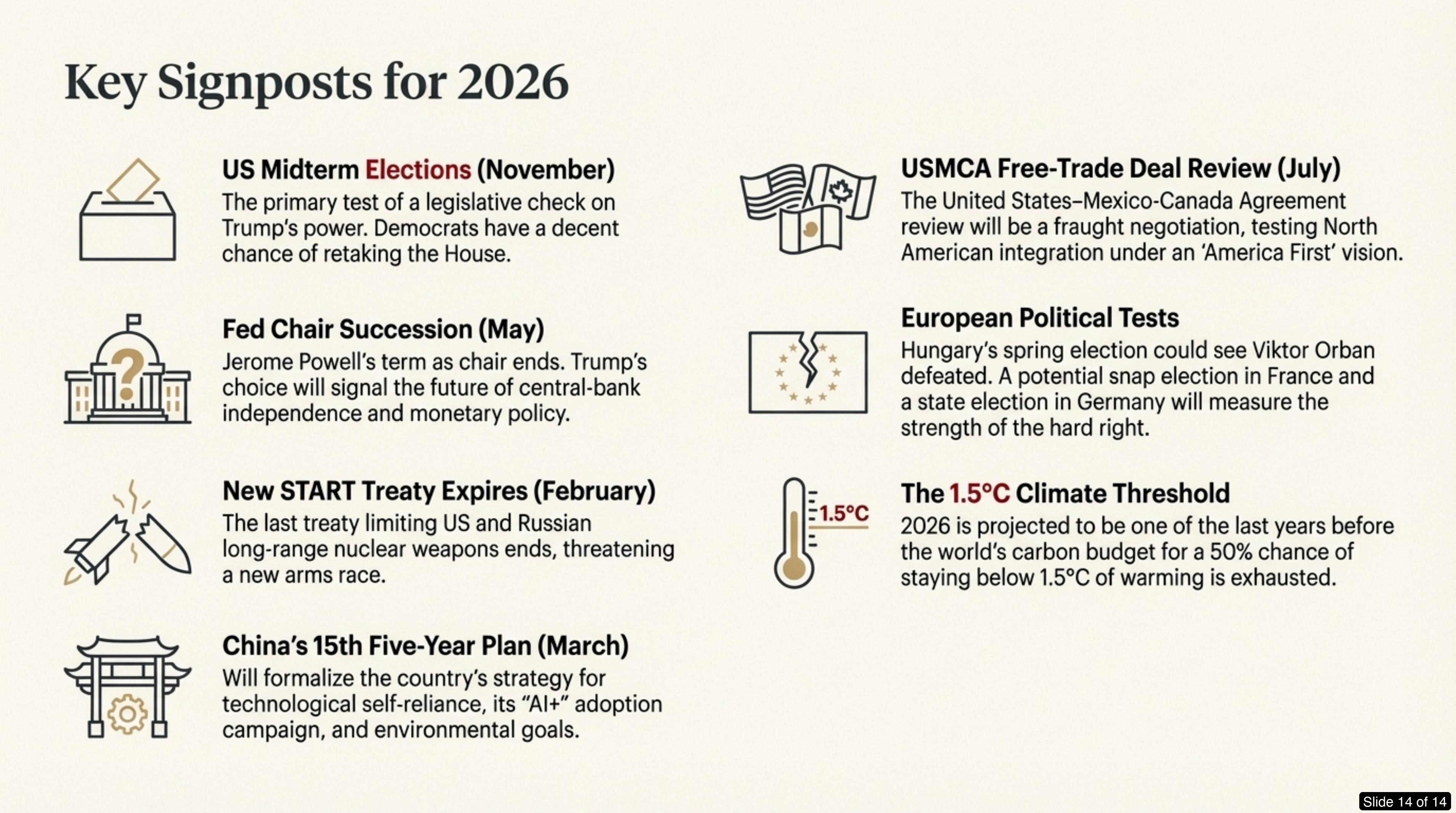
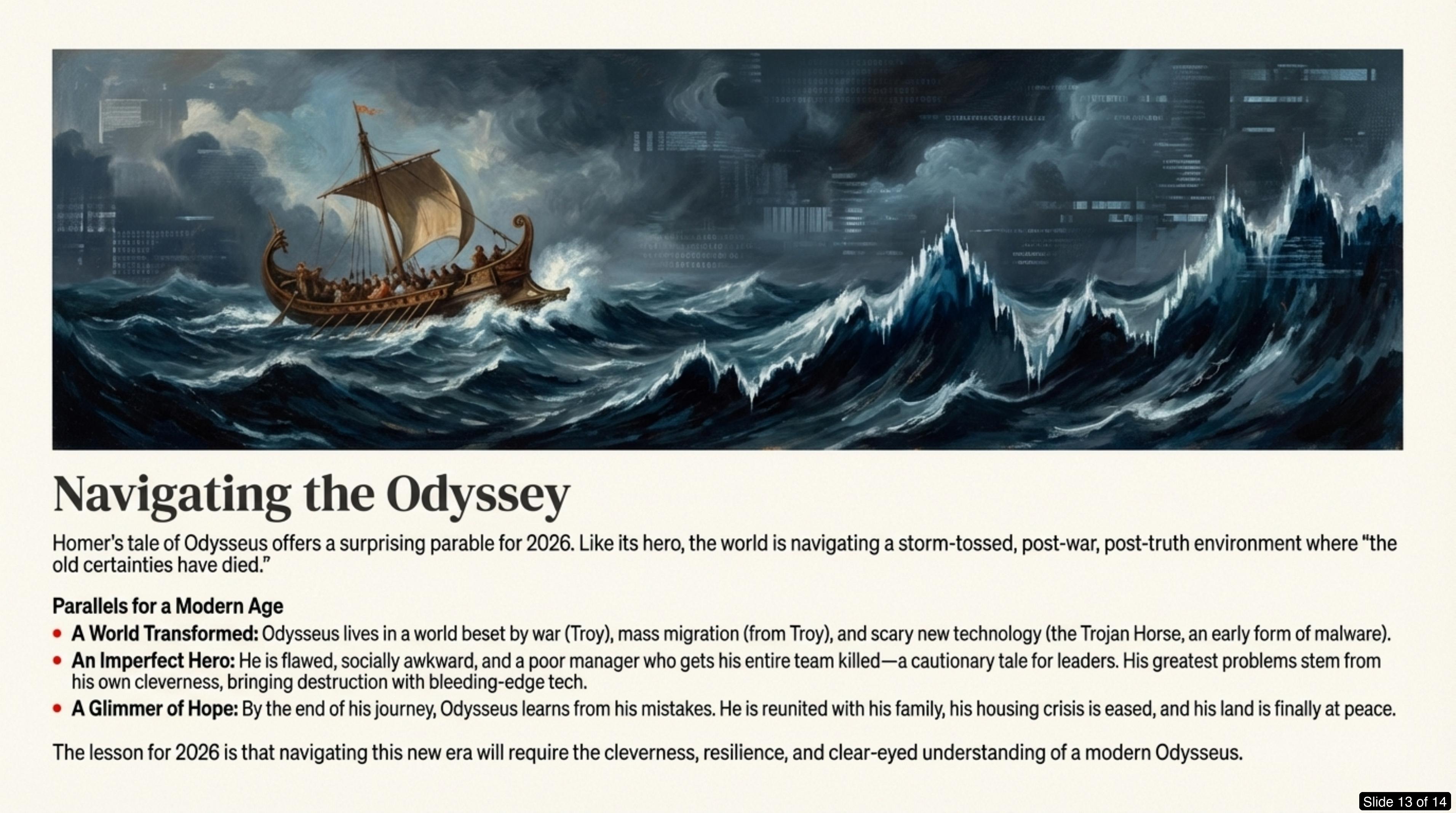
The claim: Homer's parallel, meaning cleverness, resilience, and clear-eyed understanding. Key signposts: midterms, Fed chair transition, New START, China plan, USMCA review.
The evidence: The Odyssey is a defensible literary parallel, if you stop at the hero.
What's absent: Odysseus gets his crew killed. Every member of his crew dies. The hero narrative obscures the collective action problem: cleverness concentrated in one actor without distributed understanding produces collective catastrophe. And the signpost calendar presents six institutional deadlines as separate events, when each one is a moment where a code-cage is tested, and the question is whether democratic societies can develop the cross-code perception needed to see the aggregate effects before the cascade becomes irreversible.
These gaps became: Article 6 — "The Odyssey Is Not a Solo Journey"
III. The Bayesian Sequence of Willful Ignorance
The curriculum's journalism course teaches Bayesian updating as a method for evaluating institutional claims: each new piece of evidence should update the probability that a given claim is true. When institutions repeatedly make the same claim and the evidence repeatedly contradicts it, a rational observer should update their prior, not just about the specific claim, but about the category of claim.
This series applies that framework to a specific category: institutional promises that structural risks are manageable.
Here is the sequence. Each case was "obvious in retrospect." Which means the evidence was available in real time. The question is why the priors were not updated.
If you felt resistance reading that table, keep it. That resistance is the method working, and it deserves an honest answer rather than a rhetorical one. "Didn't the Depression cause the trade collapse, not the tariff?" Mostly, yes, which is why the row says ~2% of GNP and not 60%. "Wasn't the £65B mostly never spent?" Correct. The announcement did the work, which is its own lesson about how close the ledge was. "Didn't 23andMe customers end up with protections?" Some did, negotiated for one sale, binding on no one else. Notice what survives every one of these corrections: the specific promise, this structural risk is manageable, was contradicted by evidence available at the time, and the institution that made it paid nothing for being wrong. Precision about magnitude is not a concession to the establishment view; it is what separates updating from doomsaying. And it cuts the other way, too: when you find our numbers stated conservatively, ask why the institutional versions never are.
Each row in this table is a case where the priors were available, the evidence was public, and the institutional architecture rewarded not updating. The economists who warned Hoover were right. The macroeconomic models that predicted Turkey's disaster were right. The LDI leverage data was published. The 23andMe terms of service were readable. That last case is the pattern in miniature, and it has a second life: the curriculum teaches it as a full ethics case study, Three Precedents, Three Permissions, where students work the same evidence trail this table compresses into one row.
The pattern is not that the evidence was hidden. The pattern is that the system, the institutional architecture of specialized codes, professional incentives, and career structures, rewards not seeing what the evidence shows. This is not conspiracy. It is what Luhmann calls functional differentiation operating as designed: each code processes its own signal and is structurally blind to the aggregate.
The Bayesian insight is recursive: each new case in this table should update not just the specific belief ("are tariffs safe?" or "is my data safe?") but the meta-belief: "should I trust any institution that says a structural risk is manageable when the evidence trail suggests otherwise?" The rational posterior probability, after five cases of willful ignorance producing the predicted outcome, is not zero, but it is far lower than the institutional consensus assumes.
Mark Blyth's framework names the mechanism: the ideas that organize institutional analysis, such as "free trade," "sound money," "data privacy," and "fiscal responsibility," are not neutral descriptions. They are institutional weapons that serve specific interests. The Bayesian sequence shows what happens when the ideas stop working: not a gradual correction, but a phase transition. The priors were available. The update was refused. The outcome was arithmetic.
This series asks the reader to do what the institutional architecture structurally discourages: update the priors.
IV. The Method Behind the Series
Each article in this series follows a method derived from the curriculum's cross-disciplinary analytical architecture. The method has three layers:
Layer 1: The Receipt (Journalistic Skepticism)
Every article opens with verifiable data. The numbers come from primary sources, including the CBO, the BLS, the IEA, the Federal Reserve, the Penn Wharton Budget Model, and the Financial Stability Board. FRED series IDs are provided so the reader can pull the charts independently. The first obligation of the series is to the evidence: if the data doesn't support the claim, the claim doesn't appear.
This is what the curriculum's journalism course calls the first filter: what are the facts, and can you verify them yourself?
Layer 2: The Pipes (Systems Thinking)
After the data is established, each article traces the connections between data points that institutional specialization keeps separate. Tariffs connect to inflation. Inflation connects to the Fed. The Fed connects to the bond market. The bond market connects to the deficit. The deficit connects to the labor force. The labor force connects back to inflation.
The existence of these connections is not interpretive. It is arithmetic. The CBO publishes the inflation effect of tariffs. The BLS publishes the labor data. The Treasury publishes the yield curve. What is honestly debatable is the weight and lag of each pipe; whether the pipes connect is not. The institutional architecture doesn't reward tracing either question, and a reader who disputes our weights while conceding the connections has already accepted the method.
This is what the curriculum's systems-thinking course calls feedback loop identification: the discipline of tracing cause through effect through cause, across institutional boundaries that exist on org charts but not in the economy.
Layer 3: The Framework (Critical Theory with Attribution)
After the data speaks and the pipes are traced, the theoretical frameworks explain why the institutional architecture keeps the pipes invisible. This is where Blyth, Luhmann, Habermas, and Lessig enter, not as authority figures to be cited, but as toolmakers whose instruments help the reader see the structure.
The frameworks are presented with full attribution because the reader deserves to know where the tools came from. The reader who wants to go deeper can read Blyth's Great Transformations or Luhmann's Social Systems and test the frameworks against their own evidence. The reader who doesn't want to go deeper still gets the structural diagnosis. The named patterns ("five-gauge feedback loop," "code-compliant wealth transfer," "counterparty swap," "veil of specialization," "arithmetic veto," "distributed invisibility") are designed to be usable without the academic scaffolding.
This is what the curriculum's ethics and critical-thinking courses call intellectual honesty: showing your work, crediting your sources, and giving the reader enough to disagree with you intelligently.
V. From Slides to Articles
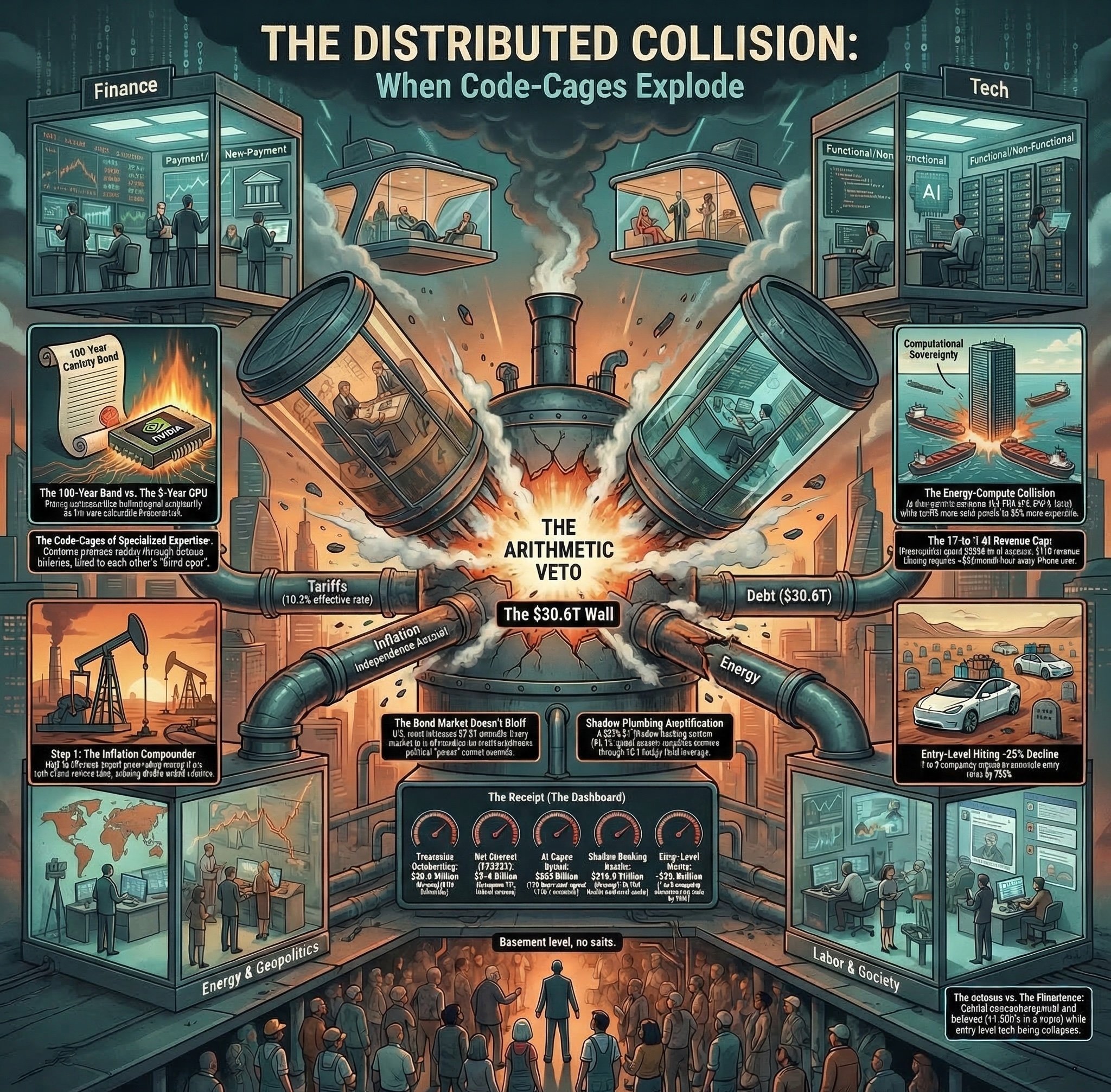
Here is how The Economist's deck maps to the series, and what each article adds that the deck structurally could not.
| Article | Economist Slides | What the Deck Says | What the Series Adds |
|---|---|---|---|
| 1. Five Gauges | 6, 7, 11, 12 | Four danger gauges, each treated as independent risk | The feedback loop connecting all five. The energy-compute gauge the deck missed entirely. |
| 2. Jetsons / Flintstones | 5, 8, 9 | AI investment, defense spending, junior employment decline | The class structure. The passive index fund trap. Code-compliant wealth transfer as aggregate effect. |
| 3. You Know Where | 3, 4, 7 | China's opportunity, trade adaptation, "more complex but not broken" | The counterparty swap. Shadow trade plumbing. America winning the war while China wins the architecture. |
| 4. Museums / Islands | 10, 12, 13 | Semaglutide, Tuvalu, museum boom, deportation, presented as cultural miscellany | The veil of specialization. Billionaire narrative infrastructure. The bystander professional class. |
| 5. Bond Market | 6, 11, 14 | "Bond panic no longer unthinkable," buried in a bullet point | The arithmetic veto. Shadow banking amplification. The cascade mechanism the deck couldn't trace. |
| 6. The Odyssey | 13, 14 | Homer parallel: cleverness, resilience, hope | Odysseus gets his crew killed. Distributed invisibility. Cross-code perception as learnable skill. |
VI. The Invitation
This series is not a rebuttal of The Economist's deck. The data in the deck is largely accurate. The analysts who produced it are skilled. The conclusions, taken individually, are defensible.
The series is an exercise in what happens when you refuse to take the conclusions individually.
The curriculum's cross-disciplinary architecture, journalism's evidence standards, systems thinking's feedback loops, critical theory's structural analysis, ethics' accountability frameworks, exists precisely to train the capacity that institutional specialization structurally prevents: seeing across codes. The series applies that capacity to the most consequential forecast document published for 2026 and asks: what becomes visible when you trace the pipes the institutional architecture leaves unconnected?
The answer is the machine behind the wall.
The Bayesian sequence of willful ignorance tells us that the evidence has been available before, and the system has chosen, each time, not to update. The question for the reader is not whether to trust this series more than The Economist. The question is: given the evidence trail, what should your posterior probability be that any institutional forecast accurately represents structural risk, and what method will you use to find out?
This series offers one method. The data is public. The FRED series IDs are listed. The sources are linked. The frameworks are attributed. The reader has everything needed to verify, challenge, or extend every claim.
That is the process. The articles are the result.
VII. Where the Process Lives Now
This page was written as the preface to six articles. Reading it back at mid-2026, halfway between the deck's publication and its verdicts, it is something else: the origin document of a method that did not stop.
What began here as a way to read one establishment forecast became the standing discipline of the Open Curriculum, an independent, human-authored course platform: more than 120 courses spanning journalism, ethics, systems thinking, financial markets, the history of technology, and the machinery of persuasion itself, bound together by a cross-course glossary approaching two thousand terms and a curated video library where every recommendation is explained rather than engineered. Four more investigative series followed this one, each built on the same three layers, receipt, pipes, and framework, adding up to roughly sixty thousand words of analysis resting on the foundation you just read. The method held. That is the strongest evidence this page can offer for it.
The most direct descendant is the Ad-Hoc Case Study, and it was not invented as a content strategy. It was witnessed. While tutoring students through the journalism course, one student's family began talking, at home, about taking DNA tests, and the 23andMe story stopped being a row in a Bayesian table and became a decision on their kitchen table. The moment put a student at the exact intersection this page maps, a social question (what does family privacy mean when one relative's sample speaks for everyone's?), a financial question (what is a genome worth, and to whom?), a technological question (what does consent mean when the terms can outlive the company?), and the curriculum's subjects stopped being subjects. Ethics, markets, systems, and journalism turned out to be one question wearing four costumes, applied to a choice the household was actually weighing.
That experience became the pattern. When an event breaks that textbooks won't reach for years, a genetic-data bankruptcy, a bank run, an information-war campaign, the method produces a case study within the curriculum: the event read exactly the way this page reads The Economist's deck, through scholarship the courses already teach, connected to concepts students are already learning, while the event is still on the family's table. The 23andMe row above is the pattern in miniature: one row here, a full ethics case study there, and, for at least one family, a better-informed conversation in between. Every case study is open-access by design: no account, no paywall, no gate. Current events are the front door of the curriculum, not a premium add-on, because teaching reality from the present backward is the pedagogy, not a promotion.
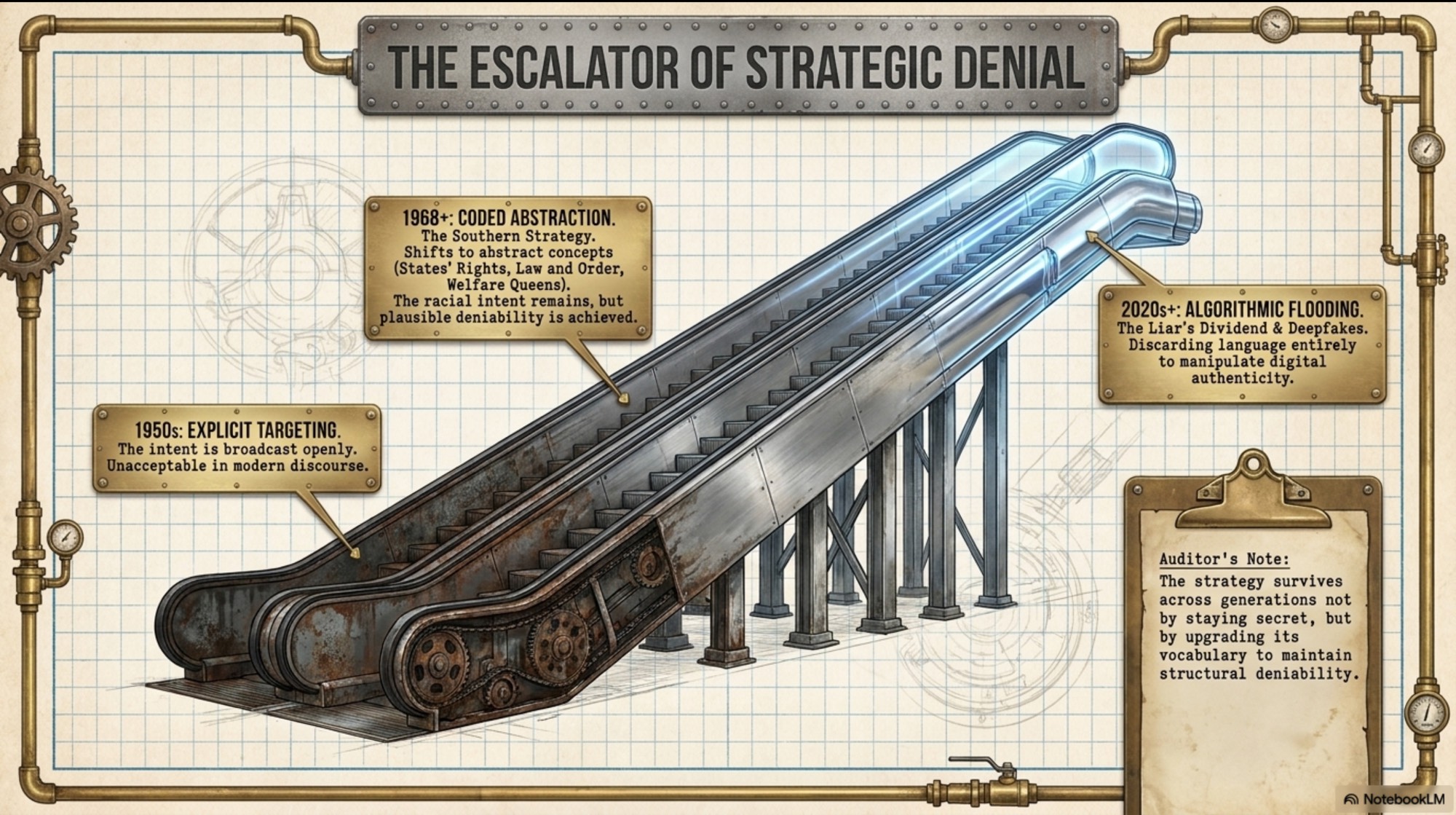
This machine is our challenge, stated honestly. The vocabulary of persuasion upgrades. In the 1950s the intent was broadcast openly, unacceptable now, and easy to teach students to recognize precisely because it rusted in public. By 1968 the same intent had abstracted into coded language, states' rights, law and order, the target unchanged, the deniability achieved. By the 2020s the machinery is discarding language altogether: deepfakes and the liar's dividend don't upgrade the vocabulary, they attack the possibility of authentic evidence itself. The auditor's note on the clipboard is the whole problem of civic education in one sentence: the strategy survives across generations not by staying secret, but by upgrading its vocabulary to maintain structural deniability.
Now put that machine next to the way societies teach. A textbook is adopted on a five-to-ten-year cycle. A standards framework is revised over decades, by committee, under political pressure from the very interests the machine serves. By the time detection of one escalator is canonized in a curriculum, that escalator has been retired and the next one is running, shinier, quieter, harder to see. Teaching students to spot the rusted machine is not media literacy; it is a museum tour. This is the structural reason the Open Curriculum reads the present backward instead of the past forward, and why the Ad-Hoc Case Study exists at all: you cannot keep pace with an upgrading machine by memorizing its old vocabularies. You keep pace by teaching the method, receipt, pipes, framework, that works on whatever the machine says next.
Why build this at all? Because the alternatives are broken in ways students already feel. The reference sites they are told not to cite. The learning products that answer to advertisers, engagement metrics, and data brokers before they answer to the learner. The institutional feeds that, as this very page documents, are structurally organized not to connect what they know. The Open Curriculum's answer is not neutrality; it is method: human-authored material with the sources shown, the frameworks attributed, the AI assistance disclosed where it appears, and the student or parent treated as the client rather than the product. The same Critical Reading Protocol taught in Section I applies to this platform, too. We built it so it survives that reading.
If this method is worth something to you, here is how it stays alive. The case studies are free. A full course, Test-Taking Mastery, is free. Generous previews of everything else are free. Full access to the courses runs on subscriptions, and there is no other revenue: no ads, no data sales, no institutional sponsor whose framing must be flattered. A subscription unlocks content and funds the continued existence of an analytical operation that answers to its readers and to the evidence, in that order. If this series changed how you read a forecast, the curriculum is where that skill compounds, and where your support decides whether this kind of independent work keeps getting made. Start with the free case studies, test the method against your own skepticism, and subscribe when the evidence persuades you. That is, after all, the process.