The Receipt
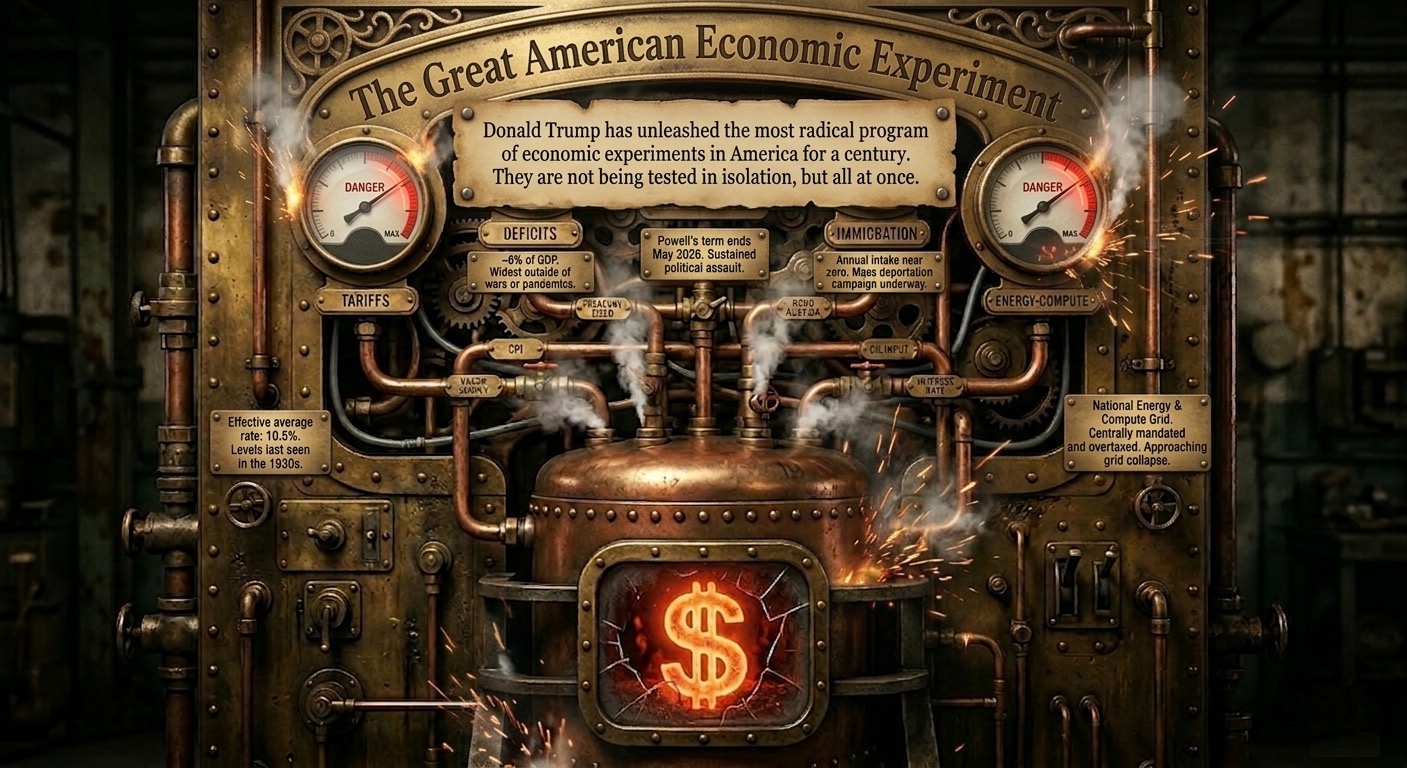
Six articles. One machine. Read the system as a set.
| Article | Reading | The Pipe It Exposes |
|---|---|---|
| 1. Five Gauges | Five readings, one loop | Tariffs → immigration → inflation → Fed → deficit → energy. Public data, arithmetic connections, no team watching the boiler. |
| 2. Jetsons / Flintstones | 44% S&P concentration | AI investment and "Stop Hiring Humans" compose into a class divide. Code-compliant micro-decisions produce macro extraction. |
| 3. You Know Where | China's counterparty edge | Predictable authoritarianism wins against transactional chaos. The Global South picks the deal partner who honors contracts. |
| 4. Museums / Islands | $200B+ philanthropy ↔ extraction | Billionaire narrative infrastructure while island nations drown. The professional bystander class provides code-compliant services that maintain the veil. |
| 5. Bond Market | $30.6T × every basis point | The one code-cage that cannot be captured by political code. Sovereign risk repricing is the clock no administration can stop. |
| 6. The Odyssey | This article | The synthesis: distributed invisibility produces aggregate catastrophe without conspiracy. Cross-code perception is the skill that is missing. |
Each article traced a specific set of pipes. Read together, they compose into a single diagnosis: functional differentiation produces structural blindness, and structural blindness produces aggregate effects that serve nobody's stated interests, not even the interests of those who benefit most from keeping the codes separate.
I call this distributed invisibility: a condition in which every actor operates rationally within their code, every micro-decision is locally defensible, and the aggregate outcome is a cascade that no individual actor chose, no institution can see, and no existing governance mechanism can arrest, because the institutional architecture was designed to process one signal at a time.
No conspiracy is required. Just functional differentiation doing exactly what it was designed to do.
I. The Hero Who Gets Everyone Killed
The Economist, in its World Ahead 2026 edition, offered Homer's Odyssey as a parable for navigating the year ahead. The message was appealing: be clever, be resilient, maintain clear-eyed understanding. Odysseus as a model for leaders facing uncertainty. Catherine Nixey wrote that the epic "offers advice to those navigating the ups and downs of 2026."
It is excellent advice, as long as you stop reading before Book 12.
The Odyssey is a story about a brilliant leader who loses every single person entrusted to his care. Not because he is stupid. Because he is the smartest person in every room, and the rooms are designed so that only his kind of intelligence counts.
In Book 10, Aeolus gives Odysseus a leather bag containing all the adverse winds, a gift that guarantees safe passage home. They sail for nine days. Ithaca appears on the horizon. Then Odysseus falls asleep. His crew, who have not been told what the bag contains, open it. They suspect treasure. They suspect their captain is hoarding. The winds escape. The ship is blown back across the entire sea.
This is not a failure of the crew's character. It is a failure of communication. Odysseus did not share the information his crew needed to make rational decisions. He operated within his code, the code of the captain who knows best, and his code-cage could not process the obvious structural question: what happens when the people whose cooperation you need do not have access to the same information you do?
In Book 12, Circe warns Odysseus about Scylla and Charybdis, a six-headed monster on one side of a strait, a ship-devouring whirlpool on the other. There is no good option. Circe tells him plainly: sail closer to Scylla. You will lose six men. The alternative is losing the ship. Odysseus follows the advice. He watches Scylla's heads descend and snatch six of his best sailors. "The most heart-wrenching experience in all his wanderings," Homer writes. Odysseus screams. But he made the choice. The crew did not get a vote.
On Thrinacia, despite explicit divine warnings, the starving crew slaughter the sacred cattle of the Sun God. Eurylochus leads the mutiny. They perform a sacrificial ceremony with water because the wine is gone. Zeus waits until they set sail, then destroys the ship and kills every man aboard. Only Odysseus survives, clinging to wreckage.
The Economist wants the cleverness and resilience. But the Odyssey is more honest than its interpreters. It is a story about a leader whose individual brilliance is real, whose strategic judgment is often sound, and whose crew is dead. All of them. Every single one. Not despite his cleverness. In some cases, because of it. Because cleverness concentrated in one actor, without distributed understanding, produces a ship where the captain navigates and everyone else drowns.
The hero narrative is the ultimate code-cage. It processes the world through protagonist/obstacle, and it cannot see the question it cannot see: what institutional structure would allow the crew to survive?
II. Penelope Holds the Structure
While Odysseus sails, Penelope governs. She holds Ithaca together for twenty years against 108 suitors, local chieftains who have moved into the palace, consuming the household's resources, depleting the treasury, slaughtering the livestock. They are, in the language of this series, an extraction class: powerful actors using institutional access to transfer wealth from a public structure to private consumption.
Penelope's strategy is not cleverness in the Odyssean sense. It is institutional design. She announces she will choose a suitor when she finishes weaving a funeral shroud for Laertes, Odysseus's father. Every night for three years, she unravels what she wove by day. This is not a trick. It is a governance mechanism, a time-buying architecture that maintains the legitimate succession, protects Telemachus's inheritance, and prevents civil war, all without the violence that Odysseus will eventually bring when he returns.
Penelope's weaving is structural maintenance. It is the work of keeping institutions functional while the hero is away being heroic. It is what the Economist does not mention when it invokes the Odyssey, because the Penelope story cannot be processed through the cleverness/resilience code. It requires a different code, one that sees the institutional fabric itself, not just the actor moving through it.
The suitors are not monsters. They are elite actors doing what the institutional vacuum permits. They consume because no governance mechanism stops them. They extract because the architecture of Ithaca, absent its legitimate ruler, creates the space for extraction. They are, in Lessig's terms, regulated by architecture, and when the architecture fails, neither law nor norms nor market restrains them.
Here is the parallel this series has traced across five articles: the tariff architect who structures trade arbitrage, the banker who prices the century bond, the tech executive who deploys "Stop Hiring Humans," the billionaire who builds a museum while islands sink. Each is a suitor in Penelope's hall. Each consumes resources the institutional structure is too weak to protect. Each acts within their code. None sees the aggregate depletion. And the hero narrative, the idea that some clever captain will navigate us through, is itself the distraction that prevents the institutional repair.
III. The Four Thinkers Converge
On March 14, 2026, four days before this article's publication, Jürgen Habermas died in Starnberg, Germany. He was 96. The obituaries called him the last rationalist, the most consequential philosopher of the postwar era, the thinker who never gave up on the Enlightenment bet that reason, properly understood, is the only reliable instrument of emancipation we have.
He died the same week that the world entered its first period without legally binding limits on nuclear arsenals since 1972. He died the same month that China released its 15th Five-Year Plan. He died in a year when the institutions he spent a lifetime defending, among them deliberative democracy, the public sphere, and communicative reason, face the most concerted assault in the democratic world's postwar history.
This series has been built on four thinkers. In this final article, their arguments converge into a single diagnosis.
Blyth: The Ideas That Maintain the Separation Serve Interests, but the Aggregate Effect Serves No One
In Great Transformations, Blyth showed that economic categories are not neutral descriptions. They are ideas functioning as institutional weapons, deployed by actors who benefit from specific framings. Trade policy, monetary policy, immigration enforcement, technology investment: these separations benefit the actors inside each cage. The tariff advocate does not want tariffs connected to inflation. The tech evangelist does not want energy costs connected to trade policy.
But here is what Article 5 revealed and what the hero narrative obscures: the aggregate effect of all these separations serves nobody. Not even the actors who benefit from individual separations. When the bond market reprices sovereign risk, it reprices it for everyone, including the tariff advocate, the tech evangelist, and the billionaire who built the museum. The five-gauge feedback loop runs through every code-cage in the system. The actors who maintain the separations are maintaining the conditions for their own systemic loss. They are the crew of the Odyssey, opening the bag of winds because no one told them what was inside.
Luhmann: Functional Differentiation Produces Structural Blindness
"The system cannot observe what it cannot observe. It cannot observe that it cannot observe this." Each subsystem, such as economy, law, politics, science, or education, operates through its own binary code. Payment/non-payment. Legal/illegal. Power/non-power. True/false. Each system is extraordinarily sophisticated within its code. Each is structurally blind to everything outside it.
This is the mechanism behind distributed invisibility. There is no meta-subject coordinating the system. There is no conspiracy. There is no villain pulling strings. There are only functional subsystems processing their own codes, producing effects that accumulate across codes, generating aggregate outcomes that no subsystem is equipped to observe. The five-gauge feedback loop is invisible not because anyone is hiding it, but because the architecture of observation was designed to observe one gauge at a time.
Habermas: The Lifeworld Is Where Cross-Code Perception Lives, and It Has Been Colonized
Habermas identified the force that locks the code-cages. The "steering media" of modern society, money and power, have colonized the lifeworld: the domain of shared understanding, communicative reason, democratic deliberation. The system rewards code-compliant transactions. The trade lawyer, the banker, the congressional staffer: each is rewarded for staying inside their code. No actor is rewarded for seeing across codes.
But here is Habermas's essential insight, and the reason his death this week is not merely a biographical footnote: the lifeworld is the only place where cross-code perception can happen. It is where citizens, not as economic actors or legal subjects or political constituents but as reasoning human beings, can connect the tariff to the inflation to the Fed to the deficit to the energy cost to the class divide. The lifeworld is where the five gauges can be read as one machine. And the colonization of the lifeworld by money and power is precisely what prevents this reading.
Habermas proposed a "two-track" model: informal opinion-formation in civil society and the public sphere, linked to formal will-formation in parliamentary institutions. The two tracks are connected through elections and public debate. His life's work was the argument that this linkage is not utopian. It is the structural precondition for democratic self-governance. When the linkage breaks, when the lifeworld is fully colonized, the system runs without correction. The gauges compound. The boiler builds pressure. And no one is watching.
Lessig: Architecture Determines What Is Possible Before Law, Norms, or Markets Enter
The five-gauge feedback loop runs through all four of Lessig's modalities and is governed by none. Law cannot contain it because the loop crosses jurisdictional boundaries: trade law, monetary policy, immigration enforcement, energy regulation, and securities law each govern one gauge. Norms cannot contain it because professional norms reward specialization. Markets cannot contain it because the market is the loop. The bond market's reaction is a reading on one of the gauges, not a correction of the system. And architecture, the design of the institutional system itself, is what makes the loop invisible.
Lessig's framework reveals the deepest structural problem: the architecture of democratic governance was designed for a world of separable problems. Trade was 5 percent of GDP in 1930. It is 25 percent today. Data centers did not exist. Shadow banking was not 49 percent of global financial assets. The institutional architecture that separates each gauge into a different agency, committee, and body of expertise was designed for a simpler machine. The machine has evolved. The architecture has not.
They are describing the same condition from four angles: the political economy of willful separation (Blyth), the structural mechanism that produces blindness (Luhmann), the colonization that prevents correction (Habermas), and the architectural failure that makes alternatives invisible (Lessig). The condition has a name: distributed invisibility.
IV. Who Saw It Coming, and Who Didn't
Distributed invisibility is not new. The question is whether it is fatal. The historical record provides four answers. Two hopeful, two not.
Societies That Developed Cross-Institutional Sight
Early Republican Rome, 5th century BCE. Facing a structural-demographic crisis, marked by elite overproduction, popular immiseration, and institutional breakdown, the Roman Republic enacted the Conflict of the Orders, a century-long negotiation between patricians and plebeians that produced the Twelve Tables, the tribunate, and land redistribution. The key: a significant proportion of elites recognized the early signs of systemic failure and accepted institutional reform at the cost of personal privilege. The structural-demographic researchers at the Complexity Science Hub Vienna have identified "elite willingness to sacrifice" as the critical variable in every case where structural crisis was averted rather than compounded.
Mid-19th century England. The Chartist movement, the Reform Acts, the Factory Acts, and the repeal of the Corn Laws formed a sequence of institutional reforms that addressed multiple sources of social stress simultaneously. Not stop-gap measures but significant alterations to political, economic, and labor structures. England also had a structural advantage Rome shared: the ability to "export" population pressure through colonial expansion, easing the domestic arithmetic. The reforms worked. But they worked in part because the empire absorbed the costs that domestic reform could not.
The United States, 1933-1938. The New Deal represented the most comprehensive cross-institutional reform in American history: banking regulation, labor protections, social insurance, agricultural price supports, infrastructure investment. Roosevelt's genius was not individual cleverness. It was structural perception. He saw that the banking crisis, the agricultural crisis, the unemployment crisis, and the infrastructure deficit were not four separate problems. They were readings on one machine. The New Deal was a cross-code intervention: it connected the economic code to the labor code to the political code to the architectural code, and it did so through institutional design, not heroic leadership.
Goldstone, Turchin, et al., "Crises Averted." The study identifies three conditions for successful structural reform: elite willingness to sacrifice privilege, comprehensive institutional change addressing multiple stress sources simultaneously, and state capacity to enforce and maintain reforms. All three must be present. When any one is missing, the crisis is postponed, not resolved.
Societies That Did Not
Imperial Russia, 1861-1917. Alexander II's emancipation of the serfs in 1861 was a genuine cross-institutional reform. But it was incomplete. The land redistribution was inadequate. The bureaucratic capacity to enforce the reforms was insufficient. The elite acceptance was grudging. The researchers' verdict: Russia did not avert the crisis. It postponed it by roughly a generation. When the reckoning arrived, it took the form of the 1917 Bolshevik Revolution.
The Weimar Republic, 1919-1933. The most instructive failure for 2026. Weimar was not stupid. Its constitution was, on paper, among the most democratic in Europe. Its problem was structural: proportional representation produced twenty successive coalition governments in fourteen years, each designed to address immediate crises in short-term perspective. Article 48 gave the president authority to rule by decree during emergencies without defining "emergency." The conservative elite who held key positions under the monarchy continued in similar roles under the republic. The result was what historian Detlev Peukert called the fundamental problem: the failure to achieve legitimacy, the people's trust and acceptance of the government's authority.
Weimar could not see across its own institutional codes. The economic code processed the hyperinflation and the Depression. The legal code processed the constitutional arrangements. The political code processed the coalition arithmetic. No code processed the aggregate: a democratic society in which, as the historians put it, there was "democracy without democrats." The institutional architecture was formally democratic. The institutional culture was not. The architecture could not compensate for the culture, and the culture could not reform the architecture. The loop ran until it broke.
The common thread: societies that saw structural crises coming and acted did so through cross-code institutional reform, changes that connected previously separated domains. Societies that failed were not less intelligent. They were less structurally perceptive. Their institutions could not see across their own specializations in time.
V. The Signpost Calendar
The five-gauge feedback loop does not operate in abstract time. It operates against a calendar of institutional deadlines, each of which forces a decision that connects codes the institutional architecture keeps separate.
| Date | Event | Codes Connected |
|---|---|---|
| Feb 5, 2026 | New START expires | First period without legally binding nuclear limits since 1972. Russia and the U.S. hold 88% of global warheads. Security code, political code, diplomatic code: none coordinated. |
| Mar 4-11, 2026 | China's 15th Five-Year Plan | 2026–2030 strategic plan unveiled at Two Sessions. GDP target 4.5–5%. Trade code + technology code + geopolitical code. China plans; the U.S. reacts quarter by quarter. |
| May 15, 2026 | Powell's term expires | Warsh confirmation pending Tillis's hold. Monetary code + political code + bond market code. The $30.6T repricing window opens. |
| Jul 1, 2026 | USMCA six-year review | Extend, revise, or begin 10-year sunset. Trade code + labor code + automotive code + political code. Renegotiation scope: EV rules, critical minerals, China provisions. |
| Aug 2026 | Section 122 tariffs expire | 150-day clock from February ruling. Trade code + legal code. What replaces them? |
| Nov 3, 2026 | Midterm elections | All 435 House seats. 33 Senate seats. Political code, the one moment when the lifeworld speaks back to the system. If it can see what the system has produced. |
Every signpost on this calendar connects codes that the institutional architecture treats as separate. New START connects security to diplomacy to domestic politics. The Fed chair transition connects monetary policy to political pressure to bond market pricing. The USMCA review connects trade to labor to technology to geopolitics. The midterms connect all of them to democratic accountability.
The question is not whether each event will be managed. Each will be processed by the relevant code-cage. Trade lawyers will handle the USMCA. Fed watchers will parse the Warsh confirmation. Arms control experts will assess post–New START architecture. Campaign strategists will analyze the midterms.
The question is whether anyone will process them as a set.
Overlay the signpost calendar with the five-gauge feedback loop from Article 1. Each deadline is a forcing function that compounds through the same pipes: tariffs → inflation → Fed → deficit → energy → class divide → geopolitical credibility. The signposts are not independent events. They are scheduled pressure tests on a machine already running hot.
VI. The Named Pattern
This series has traced a condition that deserves a name precise enough to carry analytical weight.
Distributed invisibility is the condition in which:
- Every actor operates rationally within their functional code. The trade lawyer structures tariff arbitrage. The banker prices the century bond. The congressional staffer drafts the replacement tariff. The tech executive deploys AI to replace labor. The philanthropist builds the museum. Each decision is locally optimal, professionally rewarded, and legally defensible.
- No actor is rewarded for seeing across codes. The professional incentive structure of every institution punishes cross-code observation. The trade expert who connects tariffs to monetary policy is "outside their lane." The energy analyst who connects data center demand to immigration policy is "speculating." The bond strategist who connects sovereign risk to democratic legitimacy is "editorializing."
- The aggregate effect is a cascade that no individual actor chose. The five-gauge feedback loop runs. The class divide widens. China's counterparty edge grows. The bond market prices in institutional uncertainty. The energy-compute nexus collides with trade policy. Each pipe connects gauges that the institutional architecture was designed to keep separate.
- No conspiracy is required. This is Luhmann's structural insight, and it is the hardest one to accept. The aggregate catastrophe does not require villains. It requires only functional differentiation, the normal, necessary, sophisticated division of modern society into specialized subsystems, each blind to what it cannot process. The blindness is not a bug. It is the operating principle.
The Odyssey parallel is exact. Odysseus does not intend to get his crew killed. He is the most capable navigator in the ancient world. His decisions, taken individually, are often sound. The crew dies because of the structure of the journey: one captain who sees, a crew who does not, an ocean that connects everything. That structure produces a systematic outcome from individual rationality. The bag of winds is opened not because the crew is foolish, but because the information architecture of the ship keeps them in the dark. The cattle of the Sun God are slaughtered not because the crew is impious, but because the decision architecture gives them no alternative they can perceive.
Odysseus arrives home. Alone. The hero narrative records this as a triumph of cleverness and resilience. The structural narrative records it as a total systems failure.
VII. Cross-Code Perception Is a Learnable Skill
The diagnosis is structural. The response must be structural. But structural does not mean hopeless. The historical record shows that cross-code perception, the capacity to see across institutional specializations and connect readings from different gauges, is not a personality trait. It is a skill. And skills can be taught.
The New Deal did not emerge from Roosevelt's personal brilliance. It emerged from a generation of Progressive-era institution builders who had spent decades developing the intellectual infrastructure for cross-domain analysis: settlement houses that connected immigration to labor to housing to health, muckraking journalists who connected corporate behavior to political corruption to consumer harm, academic economists who connected monetary policy to agricultural prices to industrial output. By the time the crisis arrived, the cognitive tools for cross-code perception were available. Roosevelt did not invent them. He deployed them.
What does this infrastructure look like in 2026?
It looks like the capacity to read a tariff schedule and trace its effects through labor markets, energy costs, inflation expectations, bond yields, and geopolitical credibility, not as five separate analyses, but as one feedback loop. It looks like the capacity to read a century bond prospectus and ask what it assumes about energy prices, immigration policy, trade architecture, and democratic stability, simultaneously. It looks like the capacity to hear "Stop Hiring Humans" and connect it not just to unemployment statistics but to consumer demand, tax revenue, deficit projections, social insurance costs, and political radicalization, as a system.
This is not interdisciplinary studies in the academic sense, the polite practice of inviting a historian to an economics conference. This is structural perception: the trained capacity to identify which codes are processing a problem, what each code cannot see, and where the pipes between the gauges run. It is the Penelope skill, not the Odysseus skill. It is the capacity to see the institutional fabric, not to navigate around the next monster.
Three Components of Cross-Code Perception
- Code identification: The ability to recognize which functional code is processing a given event, policy, or decision. When you read "the Fed held rates steady," you are reading the monetary code. When you read "tariff revenue exceeded projections," you are reading the fiscal code. The first skill is knowing which lens you are looking through.
- Blind-spot mapping: The ability to identify what a given code cannot see. The monetary code cannot see labor market composition by immigration status. The trade code cannot see energy infrastructure timelines. The political code cannot see bond market term premium dynamics. Every code has a structural blind spot. The second skill is mapping them.
- Pipe tracing: The ability to follow a causal chain across code boundaries. Tariffs raise import prices (trade code) → immigration restriction removes the labor that held domestic prices down (labor code) → inflation compounds (monetary code) → the Fed cannot cut (institutional code) → the deficit widens (fiscal code) → the bond market demands higher yields (market code). The third skill is tracing the pipes that connect the gauges the architecture keeps separate.
These are not abstract philosophical capacities. They are the specific analytical skills that the 1,028 economists who petitioned Hoover in 1930 possessed: the ability to see that retaliatory tariffs would collapse international trade, that collapsed trade would reduce GDP, that reduced GDP would deepen the Depression. They saw across codes. They were ignored. Trade fell 60 percent. The question is whether, ninety-six years later, the institutional architecture permits cross-code perception to reach decision-makers before the cascade compounds past the point of correction.
VIII. Scylla and Charybdis, 2026
Circe told Odysseus the truth: there is no path through the strait that avoids all loss. Scylla takes six men. Charybdis takes the ship. The choice is not between a good option and a bad option. It is between a bad option and a catastrophic one.
The 2026 signpost calendar presents the same structure. There is no path through the year that avoids all cost. The question is whether the cost is distributed consciously, through institutional reform that connects the codes, or distributed unconsciously, through the cascade that distributed invisibility produces when no one is watching the boiler.
The bond market has already begun to price in its answer. The 10-year yield surged from 3.97 percent to 4.28 percent in two weeks in March 2026. One-year credit default swap spreads on U.S. sovereign debt tripled from 16 basis points to 52 basis points. China shed $86 billion in Treasuries in a single year. Moody's completed the downgrade trifecta. The bond market is the one code-cage that cannot be captured by political code, because its binary, payment/non-payment, resolves in real time, in real money, with no narrative override available.
The midterms in November are the one moment in the 2026 calendar when the lifeworld speaks back to the system. When citizens, operating outside the functional codes of trade or monetary policy or energy regulation, render a judgment on the aggregate. But the lifeworld can only speak what it can see. And distributed invisibility is designed, not by conspiracy but by architecture, to prevent the aggregate from being visible.
This is the collective action problem the hero narrative obscures. Odysseus's cleverness cannot solve it, because Odysseus's cleverness is the problem. Individual brilliance in a system of distributed blindness produces individual survival and collective death. The crew dies. The captain arrives home to find the suitors in his hall, consuming his resources, courting his wife, depleting his estate. Even the hero's homecoming reveals a structural failure: twenty years of extraction by elite actors operating in an institutional vacuum.
The question is not whether we need an Odysseus. We always need capable leaders. The question is whether we can build the institutional architecture, the Penelope architecture, that distributes structural perception widely enough to survive the captain's absence. Or his blindness. Or his sleep.
IX. What the Series Asks
This series has made no predictions. Structural diagnosis is not forecasting. We have traced pipes, documented connections between gauges that the institutional architecture keeps separate. Every claim is sourced. Every number is verifiable. Every FRED series ID is published so you can pull the data yourself.
What we have asked, across six articles, is a single question:
Can democratic societies develop the cross-code perception needed to see the aggregate effects of distributed micro-decisions before the cascade becomes irreversible?
The historical record says: sometimes. When elites are willing to sacrifice privilege. When institutional reform addresses multiple stress sources simultaneously. When the state has the capacity to enforce and maintain the reforms. When all three conditions are present, structural crises can be averted. When any one is missing, the crisis is postponed, not resolved.
The 2026 record says: the conditions are not currently present. Elite willingness to sacrifice privilege is not visible in the data: not in the 44 percent S&P concentration, not in the $200 billion philanthropy-extraction loop, not in the $602 billion AI capex that prices a century of uncertainty as calculable risk. Comprehensive institutional reform is not visible in the architecture: not in the IEEPA workarounds, not in the Fed investigation, not in the Section 122 replacements. State capacity to enforce cross-code governance is not visible in the institutional design: not in the twenty committees that each watch one gauge.
But the conditions are not yet impossible. The lifeworld has not been fully colonized. The bond market still prices truth. The signpost calendar still forces decisions. The midterms still happen. The analytical tools exist: Blyth's political economy, Luhmann's systems theory, Habermas's critical theory, Lessig's regulatory architecture. They are not secret. They are published, reviewed, debated, available.
What is missing is not intelligence. What is missing is the institutional architecture that rewards cross-code perception, the Penelope architecture that holds the structure together while the heroes are away being clever.
The Odyssey is not a solo journey. Odysseus forgot that. His crew paid the price.
The question for 2026 is whether we will remember it in time.
Sources
The Odyssey and Classical Sources
- Homer. The Odyssey. Trans. Robert Fagles. Penguin Classics, 1996. Books 10, 12, and 1–2 (Penelope and the suitors).
- Homer. The Odyssey. Trans. Emily Wilson. W. W. Norton, 2018. (Modern translation emphasizing power dynamics and crew agency.)
- CliffsNotes. "Summary and Analysis: Book 12 — The Odyssey."
- The Josias. "Political Authority in Homer's Odyssey." 2017.
- St. John's College. "Penelope: The Odyssey's Creative Thinker."
- Social Science Space. "The 'Odyssey' of Today's Leadership Crisis." 2018.
The Economist and the Odyssey Parallel
- PR Newswire. "The Economist Launches The World Ahead 2026." The Economist Group.
- Belvedere, Andrea. "Economist World Ahead 2026: Decoding the Signals." Medium.
- Nixey, Catherine. "The Odyssey: A Parable for 2026." The Economist: The World Ahead 2026.
Theoretical Frameworks
- Blyth, Mark. Great Transformations: Economic Ideas and Institutional Change. Cambridge University Press, 2002.
- Blyth, Mark. Austerity: The History of a Dangerous Idea. Oxford University Press, 2013.
- Luhmann, Niklas. Social Systems. Trans. John Bednarz Jr. Stanford University Press, 1995.
- Luhmann, Niklas. Theory of Society. Vol. 1. Trans. Rhodes Barrett. Stanford University Press, 2012.
- Habermas, Jürgen. The Theory of Communicative Action. Vol. 2: Lifeworld and System. Trans. Thomas McCarthy. Beacon Press, 1987.
- Verovšek, Peter J. "Taking Back Control over Markets." Political Studies 71, no. 2 (2023).
- Lessig, Lawrence. Code: And Other Laws of Cyberspace, Version 2.0. Basic Books, 2006.
- Knight, Frank. Risk, Uncertainty, and Profit. Houghton Mifflin, 1921.
Habermas: Death and Legacy
- NPR. "Acclaimed 20th Century Philosopher Jürgen Habermas Dies at 96." March 14, 2026.
- Foreign Policy. "Obituary: Jürgen Habermas Was the Last Rationalist." March 16, 2026.
- Jacobin. "Jürgen Habermas Showed What Philosophy Could Be." March 2026.
- Explaining History. "Jürgen Habermas (1929–2026): A Critical Appreciation." March 15, 2026.
- Stanford Encyclopedia of Philosophy. "Jürgen Habermas."
Historical Parallels: Crises Averted and Failed
- Goldstone, Jack A., Peter Turchin, et al. "Crises Averted: How A Few Past Societies Found Adaptive Reforms." Cliodynamics: The Journal of Quantitative History and Cultural Evolution, 2025.
- Complexity Science Hub Vienna. "When Collapse Wasn't Inevitable." October 2025.
- Facing History. "The Weimar Republic: The Fragility of Democracy."
- Peukert, Detlev. The Weimar Republic: The Crisis of Classical Modernity. Hill and Wang, 1992.
- Irwin, Douglas A. "The Smoot-Hawley Tariff: A Quantitative Assessment." NBER Working Paper, 1996.
2026 Signpost Calendar
- International Campaign to Abolish Nuclear Weapons. "The Expiration of New START." February 2026.
- CNN. "A Key Nuclear Weapons Treaty Is Ending." February 4, 2026.
- UN News. "UN Chief Warns of 'Grave Moment' as Final US-Russia Nuclear Arms Treaty Expires." February 2026.
- Council on Foreign Relations. "Nukes Without Limits? A New Era After the End of New START."
- Al Jazeera. "China Set to Release New Five-Year Plan." March 4, 2026.
- Asia Society. "What to Watch at China's Two Sessions in 2026."
- CNBC. "Trump Officially Nominates Kevin Warsh as Fed Chair." March 4, 2026.
- ReThink Trade. "Tracking the 2026 USMCA Review."
- CSIS. "USMCA Review 2026."
- Bloomberg Government. "Senate Unveils 2026 Calendar with Recesses Ahead of Midterms."
Collective Action and Democratic Capacity
- Olson, Mancur. The Logic of Collective Action. Harvard University Press, 1965.
- Countercurrents. "Civil Society and the Limits of Democratic Vigilance." March 2026.
- Endo, Chikako. "Structural Change Through 'Collective Action as Democratic Practice.'" Political Studies, 2024.
- Social Europe. "When Democracy and Liberalism Collide: America's Governance Crisis."
- International IDEA. "The Silent Infrastructure of Democracy: Why Education Matters."
- Singh, Mayank. "From 'Right Answer' to 'Right Reasoning': Education and the Democratic Mind." PhilArchive.
Series Cross-References
- Article 1: "The Five Gauges Are One Machine." Tariffs, deficit, Fed independence, immigration, energy-compute feedback loop.
- Article 2: "The Jetsons Don't Need the Flintstones Anymore." AI, class divide, code-compliant micro-decisions.
- Article 3: "You Know Where You Are With Us." China's counterparty advantage, Global South deal-making.
- Article 4: "Who Builds the Museums While the Islands Sink." Billionaire narrative infrastructure, professional bystander class.
- Article 5: "The Bond Market Doesn't Bluff." Sovereign risk, the uncapturable code-cage.
Data from Previous Articles
| Reading | Source | Article |
|---|---|---|
| 10.3% effective tariff rate | Penn Wharton Budget Model | Art. 1 |
| $1.9T deficit / 5.8% GDP | CBO Budget Outlook | Art. 1 |
| $970B interest / 19% of revenue | Peter G. Peterson Foundation | Art. 1 |
| 44% S&P 500 concentration (top 7) | S&P Global | Art. 2 |
| $602B hyperscaler capex vs $37B AI revenue | CreditSights / JPMorgan | Art. 1, 2 |
| China: $688.7B Treasuries (down 47% from peak) | Treasury International Capital | Art. 1, 3 |
| $256.8T shadow banking / 49.1% of global assets | Financial Stability Board | Art. 1, 5 |
| $30.6T Treasury securities outstanding | Treasury Direct | Art. 5 |
| CDS spreads: 16bp → 52bp (tripled) | CNBC / ICE Data | Art. 5 |
| 183 TWh data center consumption / 4%+ of U.S. total | IEA / DOE | Art. 1 |
FRED Series for Reader Verification
| Series | Description |
|---|---|
| DGS10 | 10-Year Treasury Constant Maturity Rate |
| DGS2 | 2-Year Treasury Constant Maturity Rate |
| T10YIE | 10-Year Breakeven Inflation Rate |
| FEDFUNDS | Effective Federal Funds Rate |
| PCEPILFE | Core PCE Price Index (YoY) |
| FYFSGDA188S | Federal Surplus or Deficit as % of GDP |
| THREEFYTP10 | 10-Year Treasury Term Premium |