Why This Series Exists
I used to explain things for a living. Not formally: nobody hires you to explain. But when Lehman fell in 2008 and the CDOs unwound and the people around me asked what just happened?, I was the person who could answer, because I'd crossed enough disciplines, engineering, the Navy, finance, to see the machine from outside any single code-cage. Explaining the machine was a calling I didn't choose. It chose me when the machine broke.
The machine is breaking again. Different variables, same architecture. And the corpus I've been building, 21 courses, 301 units, 10 case studies, 1 interactive game (more on the way), is busting its pressure vessel. The curriculum can explain how systems work. It can't say I can't believe I have to explain this. It can't present the institutional absurdity straight-faced and let you realize it's comedy. It can't tell you that the Attorney General got fired for not being mean enough, and that her replacement is the president's personal defense lawyer, and that you couldn't write this in Idiocracy because the test audience would say it's too on the nose.
This series can. Same rigor. Same sourcing. Same four scholars. More personality. Because the situation demands it.
Reading the Receipt
How to Read an Institutional Collapse
This series began on February 14, 2026, the day the Department of Homeland Security went dark. Over the next 47 days, every major institution produced public evidence about what it was becoming. The receipt printed itself. We just read it.
The Analytical Framework
- Mark Blyth: Narrative construction as personnel management: "transitioning to the private sector" disguises a purge as a career move
- Niklas Luhmann: De-differentiation in real-time: when every institution's binary code collapses into loyal/disloyal
- Jürgen Habermas: The lifeworld under bombardment: gas prices, unpaid wages, and constitutional erosion experienced simultaneously by the same families
- Lawrence Lessig: Architecture concentrating power: DHS unfunded + war initiated + Epstein files controlled + judiciary challenged = one actor, four levers
Article 1
The Shutdown and the War
On February 14, the Department of Homeland Security went unfunded. Fourteen days later, the executive branch launched a war. 61,000 TSA workers were already unpaid. The Strait of Hormuz would close within 72 hours. Oman's foreign minister said a deal was "within our reach," on the day of the strikes. What institutional architecture allows one person to defund their own department and start a war in the same month?
LiveArticle 2
The Strait and the Signal
Oil crossed $100. Then $166. Tanker traffic dropped 70%. The February jobs report showed a net loss of 92,000 positions. Consumer confidence hit 53.3, lowest since the 2022 inflation peak. JP Morgan raised recession probability to 35%. The president called it the greatest economy ever. The Bureau of Labor Statistics disagreed. Markets don't listen to what leaders say. They listen to what leaders don't say.
LiveArticle 3
The Three Departures
The only three officials removed in 47 days were the only three who retained operational independence. The DHS Secretary contradicted the White House. The Attorney General wasn’t loyal enough. The Army Chief of Staff was replaced, during active combat, by the Defense Secretary’s personal aide. On March 20, the man who investigated the president died at 81. The president posted: “Good, I’m glad he’s dead.” The system doesn’t require conspiracy. It requires only that loyalty be the criterion.
LiveArticle 4
It's The Same Constitution
Three things happened on April 1. The Supreme Court heard arguments on birthright citizenship, and the Chief Justice told the solicitor general, "it's the same constitution." The president gave a speech calling the war "near completion" while threatening to "hit them extremely hard for two to three more weeks." Then he called America stupid. Oil jumped $7 a barrel during the speech. The judiciary held its code. The SAVE Act tried to solve a problem that doesn't exist: Utah audited 2 million voters and found zero noncitizen votes.
LiveArticle 5
The Bayesian Receipt
Every executive claim from 47 days, evaluated against its own evidence. "Close to completion" and "hit them hard for 2-3 more weeks": in the same speech. "Not shooting back": while IRGC missiles targeted the 5th Fleet. "Greatest economy ever": with 92,000 jobs lost. The null hypothesis on executive reliability can now be excluded. The counter-evidence lives in one place: the Supreme Court, where functional differentiation held. When it holds in the judiciary and collapses everywhere else, what kind of system are we describing?
LiveArticle 6
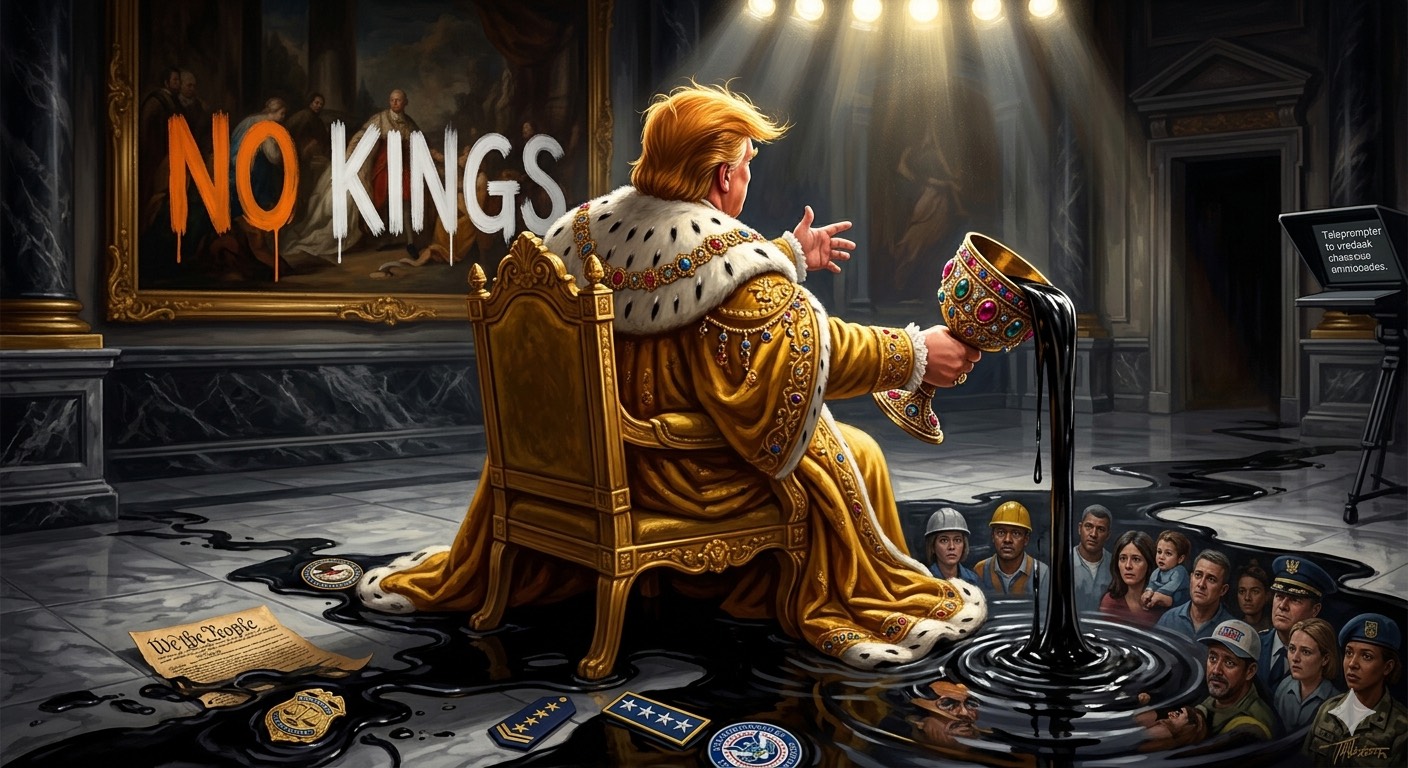
“They Call Me KING Now, Do You Believe It?”
On April 1, the president told his budget director not to send money for daycare because “we’re fighting wars.” He called Medicare, Medicaid, and daycare “all these little scams.” He said “they call me KING now.” The White House deleted the video. Two days later, the budget request arrived: $1.5 trillion for defense, a 66% increase, the largest in the post-war era. The money existed. The Constitution says “common Defence and general Welfare.” The budget says instead of. The conjunction is load-bearing.
Companion Series
Social Physics of the New Disorder traced the economic machine, five gauges connected by one feedback loop. The Domestic Machine traced the enforcement dimension. No Kings: The Chalice Overflows traces what happens when the codes stop differentiating, when every institution's binary collapses into loyal/disloyal. Same methodology. Same scholars. Same honesty about what we got wrong.
How to Read This Series
- The Receipt: Each article opens with a timeline of public, verifiable events. Dates. Prices. Quotes. Vote counts. Start here.
- The Pipes: The connections between events are traced through evidence, not assertion. Follow the structural links.
- The Framework: After the evidence speaks, the analytical tools are introduced with full attribution. Four scholars, applied honestly.
- The Sources: Every claim is traceable. CNN, NPR, BLS, FRED, court filings, congressional records, Truth Social posts. We don't ask you to trust us. We ask you to check.
The Investigation in Order
One argument, in the order the year forced it
Written as the events arrived. Read top to bottom and you watch the argument grow, and watch what each dispatch couldn’t yet see become the subject of the next.
- 01
Read the economy as five gauges on one feedback loop, and called the bond-market repricing before it landed, but not yet the hand on the valve.
- 02The Domestic MachineMar 2026
Mapped the enforcement architecture and set the honest-reckoning self-audit this family now inherits as a rule, still reading enforcement as a domestic story, not a capital one.
- 03No Kings: The Chalice OverflowsApr 2026you are here
Traced what happens when every institution collapses its judgment into one question, loyal, or disloyal, without yet pricing the assets marked against the code that broke.
- 04The ComputedollarMay 2026
Named the forced absorber: the pension as buyer of last resort in the AI capital cycle, reading compute as finance, before it was clear how much was physics.
- 05The StackJul 2026
Took the compute economy apart floor by floor, down to the power bill and the eleven days of gas under the whole supply, and left the questions open, on purpose.
- 06Hormuz and the Weighting GameAug 2026
Tallied six flows, talent, open weights, inference routing, data, allied standards, and capital, and argued the transfer to China's AI buildout runs one way, closing on the marginal cost of a watt as the deciding metric, the strait it's named for closes and reopens through all of it; the transfer doesn't stop either way.
- →The open questionunresolved
The Computedollar’s final article left four gaps open on purpose, labor displacement, stranded-asset risk under carbon pricing, the cognitive basis of deliberation, and cross-asset contagion, each named with its framework hooks and none of them traced. What has happened since sits inside those gaps rather than closing them: an index architecture that split rather than held, an absorption capacity that turned out to have a limit, a strait that for five months neither closed nor reopened. The list ends here because the argument has not, not because the argument arrived.
The Education Machine (Apr 2026), the same rigor turned on mythology and merit rather than collapse. It sits beside the arc, not inside it, and reads on its own.