The Receipt
Five data points. Read them as a sequence.
| Data Point | Reading | Context |
|---|---|---|
| DHS shutdown begins | February 14, 2026 | 61,000 TSA workers plus CBP, Coast Guard, FEMA, and CISA working without pay. Essential national security infrastructure, unfunded. |
| Epstein files released | January 30, 2026 | 3.5 million pages, 2,000 videos, 180,000 images. 1,000–1,800+ Trump mentions. DOJ characterized allegations as "unfounded and false." |
| US/Israel strikes on Iran | February 28, 2026 | Coordinated strikes on Tehran, Isfahan, and Kermanshah. Targets included the Khamenei compound and the National Security Council buildings. No congressional vote. |
| Oman FM statement | February 28, 2026 | "A deal was within our reach," said on the day of the strikes. Iran had agreed to never stockpile enriched uranium. |
| Strait of Hormuz | Closing within 72 hours | 20% of global oil supply. Tanker traffic projected to drop 70%. Article 2 traces what happened next. |
Two timelines. One executive. Fourteen days between a department going dark and a war being launched. The receipt prints the dates. The question is the architecture.
I. The Department Goes Dark
Funding lapsed for the Department of Homeland Security on February 14, 2026. That's Valentine's Day, which the administration apparently found thematically appropriate. This was not a full government shutdown. The other federal departments continued operating. The shutdown was targeted, surgical, and aimed at exactly one agency: the one that handles both immigration enforcement and domestic security.
The proximate cause was a standoff over immigration enforcement reform. The administration demanded statutory authority to expand expedited removal and limit judicial review of deportation orders. A coalition of Senate moderates refused to include the provisions in a continuing resolution. The House majority declined to pass a clean funding bill. The department went dark.
What that meant in practice: 61,000 Transportation Security Administration workers reported to airport checkpoints across the country and scanned your carry-on luggage without being paid. U.S. Customs and Border Protection officers continued processing international arrivals, without pay. The United States Coast Guard, the service branch responsible for maritime law enforcement, search and rescue, and port security, continued its operations without compensation. The Federal Emergency Management Agency, which was actively supporting flood recovery operations in three states, kept its staff working. The Cybersecurity and Infrastructure Security Agency, which monitors threats to the nation's critical infrastructure including power grids and financial systems, continued operating. None of them received paychecks.
DHS annual appropriations run approximately $90 billion. The shutdown did not save any of it. Essential workers stayed on the job. It just stopped paying them.
Federal workers facing unpaid work have three legal options: continue working and wait for back pay, call in sick, or quit. In 2018-2019, when the previous prolonged shutdown stretched into 35 days, the TSA reported a 10 percent spike in call-outs. Airport screening wait times doubled at major hubs. The Government Accountability Office documented that approximately 3 percent of essential workers resigned during that shutdown rather than work without pay, a loss of trained, cleared personnel that took 18 months and significant cost to partially replace.
The 2026 shutdown was different in one structural respect. The 2018 shutdown was a general government shutdown, affecting multiple departments simultaneously. This one was targeted. The administration chose to fund every department except the one it was simultaneously deploying as the primary enforcement apparatus for its signature domestic policy. DHS was being used as a political pressure tool by the very executive branch that had just defunded it.
Lawrence Lessig's framework for understanding architecture as power is useful here. Lessig argues, in both Code and his later constitutional work, that constraints on behavior are structural, not just legal. Laws can be challenged in court. Budgets can be restored by Congress. But the architecture, the actual physical and institutional capacity of an agency to perform its functions, degrades on a different timeline. You can restore TSA funding in a week. You cannot restore the morale, retention, and institutional knowledge lost by requiring 61,000 people to show up without pay to handle an angry public that has been waiting four hours at security.
The defunding of your own security apparatus while preparing military operations abroad removes the institutional capacity that might otherwise process the contradiction. This is not speculation about intent. It is a description of effect. When CISA is understaffed and underpaid, its ability to monitor for the cyber retaliation that typically follows military strikes is degraded. When the Coast Guard is working for free, its capacity to harden port security during a period of heightened threat is diminished. The architecture is the policy.
II. The Documents
Fifteen days before the DHS shutdown, on January 30, 2026, the Department of Justice announced what it characterized as a "final major disclosure" in the Jeffrey Epstein files. The release comprised 3.5 million pages of documents, 2,000 videos, and 180,000 images, material that had been held under court seal and administrative review for years across multiple DOJ and FBI jurisdictions.
The scale is worth sitting with for a moment. 3.5 million pages is approximately 8,750 banker's boxes of documents. The DOJ released this material on a Friday, with three days of announcement lead time, with no reading room infrastructure and no archival index. Journalists covering the story noted that the FBI's online portal for the documents crashed within two hours of the release going live.
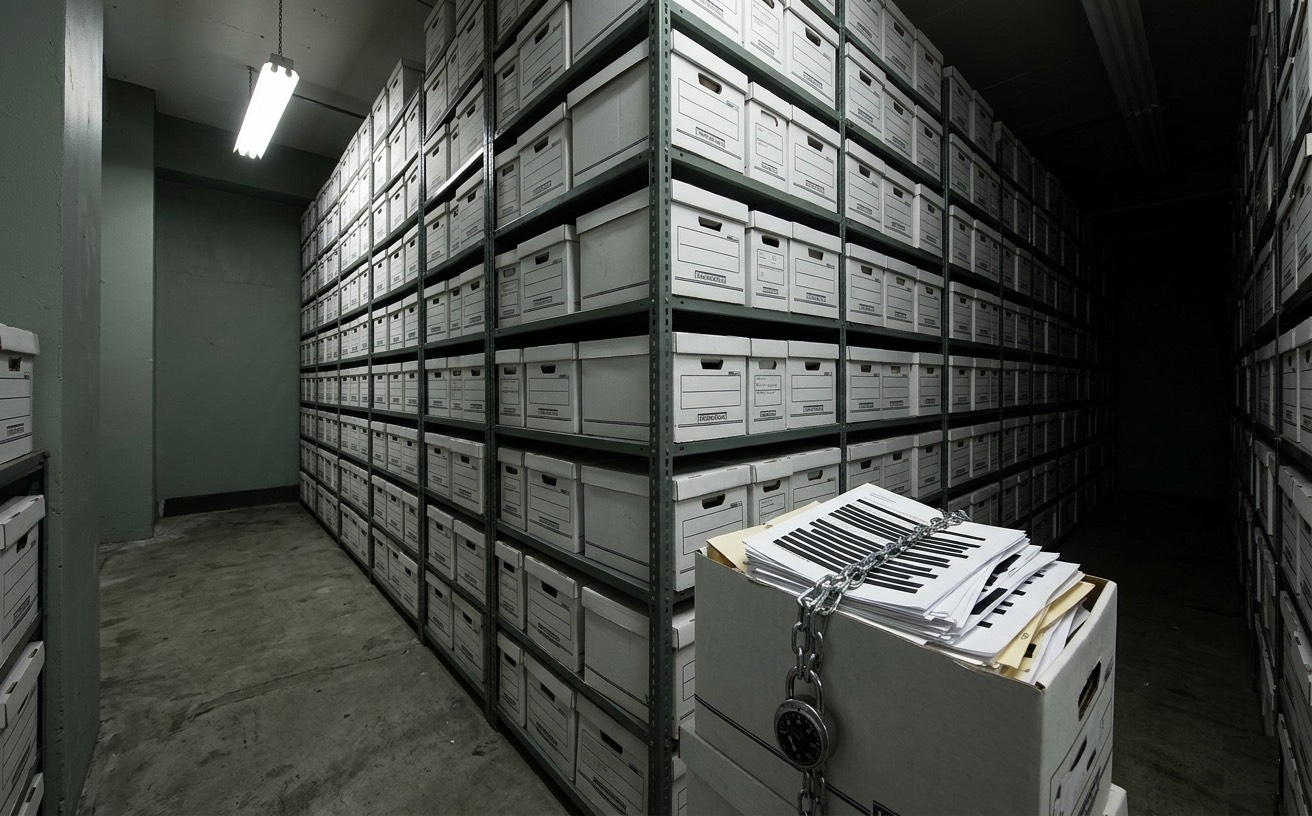
Among the disclosed materials: FBI interview summaries with accusers, financial records documenting payments from Epstein's accounts to individuals named in the files, flight logs from Epstein's aircraft, and what multiple investigative reporters described as communications involving prominent figures across politics, business, and entertainment. According to CNN's reporting, Trump was mentioned between 1,000 and 1,800 times across the released documents. NPR reported in February 2026 that the disclosure remained incomplete: FBI interview summaries with accusers had been withheld, with the Justice Department citing ongoing investigative privilege claims.
Jan 30: DOJ announces "final major disclosure." Feb 3: Portal crashes repeatedly. Feb 10: Reps. Khanna and Massie identify six improperly redacted names. Feb 24: NPR reports FBI interview summaries still withheld. Feb 28: Operation Epic Fury.
Todd Blanche, Trump's personal defense lawyer from his 2024 criminal trials, subsequently appointed as acting Attorney General as of the date this article publishes, characterized the allegations in the documents as "unfounded and false." This characterization was issued by a man who had spent the prior two years defending the person the documents implicate, in his new capacity as the nation's chief law enforcement officer, regarding an investigation conducted by an agency he now supervised.
Representatives Ro Khanna (D-CA) and Thomas Massie (R-KY), a bipartisan pairing worth noting because they show up again later, identified six names that had been improperly redacted in the released materials and formally demanded the appointment of a special master to oversee the remainder of the disclosure. Their letter to the DOJ argued that the existing process created an irremediable conflict of interest: the institution releasing the documents about a principal is led by appointees of that principal, who had a direct professional and personal stake in the characterization of those documents.
Niklas Luhmann spent most of his career describing how functional differentiation, the separation of legal, political, economic, and other systems into autonomous domains with their own operational codes, is what makes modern society capable of managing complexity. Law's binary code is legal/illegal. Politics operates on the code of power: government/opposition, or in its cruder forms, loyal/disloyal. These codes are supposed to be operationally closed. The legal system evaluates acts by legal criteria. The political system evaluates them by political criteria. The two systems can irritate each other, what Luhmann calls structural coupling, but they maintain their autonomy because each operates by its own code.
What Khanna and Massie were describing is a structural coupling that has collapsed into capture. The DOJ evaluates its own documents about the person who controls the DOJ, using criteria defined by appointees of that person, whose continuation in their roles depends on the loyalty code rather than the legal code. The legal system cannot evaluate the Epstein documents by legal criteria when the political system has colonized the personnel who operate the legal system. The binary code collapses. Legal/illegal becomes loyal/disloyal with a law degree.
This is not a partisan observation. It is a structural one. The same logic would apply to any administration that appointed personal lawyers to lead the department investigating documents implicating the person who appointed them. The institution is being asked to evaluate its own source code. The output is not law. It is whatever the institution needs the law to say.
III. The Strikes
On February 28, 2026, fourteen days after the DHS shutdown began, the United States and Israel launched coordinated strikes against Iran. The US designated the operation Epic Fury; Israel called it Operation Shield of Judah. It was not a surprise in the intelligence community, where warning signs had accumulated for several weeks. It was a surprise to Congress, to most European allies, and to Oman, which had been hosting back-channel negotiations between Washington and Tehran since January.
The targets were not military installations in the conventional sense of missile batteries or air defense systems. They were the command and political infrastructure of the Iranian state: the Khamenei compound in northern Tehran, the presidential palace, and the buildings housing the National Security Council. The targeting logic was decapitation. The strikes were not designed to degrade Iran's military capacity. They were designed to remove the government.
Tehran (Khamenei compound, presidential palace, NSC buildings), Isfahan (uranium enrichment facilities), Kermanshah (IRGC Quds Force command). Not a "bloody nose." A decapitation strike.
The Intercept (April 1, 2026) reported at least 15 US service members killed during operations, deaths not officially disclosed. CENTCOM confirmed 303 wounded. Defense Secretary Hegseth was providing what the outlet characterized as "low-ball and outdated figures." The administration's framing that Iran was "not shooting back" was directly contradicted by documented IRGC activity: missile and drone launches targeting the 5th Fleet headquarters in Bahrain, a chemical plant in southern Israel, a power and desalination facility in Kuwait (killing one Indian worker), and aluminum factories in the UAE and Bahrain. (Sources: The Intercept, April 1, 2026; CENTCOM.)
There was no congressional vote. There was no formal declaration of war. The War Powers Resolution of 1973, passed in the aftermath of Vietnam specifically to prevent executive branch warfare without legislative authorization, requires the president to notify Congress within 48 hours of introducing armed forces into hostilities, and limits the deployment to 60 days without congressional approval. The notification arrived the following morning, 31 hours after the first strikes. The administration's legal team characterized the operation as falling within existing authorizations for the use of military force: the 2001 AUMF, the 2002 Iraq AUMF, and the president's inherent Article II authority as commander in chief.
The 2001 AUMF authorizes force against entities that "planned, authorized, committed, or aided" the September 11 attacks. Iran did not plan, authorize, commit, or aid the September 11 attacks. The 2002 AUMF authorized force against Iraq. Iran is not Iraq. The Article II claim, that the president has inherent authority to initiate combat operations against sovereign states without congressional approval, is the claim every administration makes when it wants to go to war, and it is the claim the War Powers Resolution was designed to constrain.
Ro Khanna and Thomas Massie had anticipated exactly this. In the weeks before the strikes, the same bipartisan pair demanding Epstein disclosure had introduced a War Powers Resolution asserting that the administration lacked congressional authorization for military operations against Iran. Their resolution drew 76 Democratic co-sponsors. It drew one Republican co-sponsor: Massie himself. The rest of the House Republican majority declined to join. Salon reported, citing congressional aides, that the majority "supported the war but didn't want to be on the record." That's a sentence that deserves to be printed on the Capitol building's west facade, where it would at least be honest about what the building produces.
Oman's foreign minister issued a statement on the day of the strikes. The statement was brief, precise, and devastating in context. Oman had been serving as an intermediary between Washington and Tehran. Over six weeks of back-channel negotiations, the minister said, Iran had agreed in principle to the central American demand: that Iran would permanently renounce the stockpiling of enriched uranium. A deal, the minister said, was "within our reach" on the day the bombs fell.
Mark Blyth's work on the construction of economic ideas as political tools is useful here, not as economic theory but as a framework for how language shapes action. The words used to describe military action are not neutral. They are deployed as weapons in themselves. "Preemptive strike" and "preventive war" describe different acts with different moral and legal statuses. A preemptive strike targets an imminent, specific threat: an army massing at the border, a missile on its launchpad. A preventive war targets a potential future capability. International law treats them differently because the implied timeline is different: preemption says we must act now or be destroyed; prevention says we have chosen to act before the threat fully materializes.
The administration characterized Operation Epic Fury as preemptive, citing Iranian nuclear progress and what officials described as "credible intelligence of imminent strike planning." Oman's foreign minister, on the same day, described a negotiating party that had agreed to never enrich uranium to weapons grade. These two descriptions are not both true simultaneously. Either Iran was days from a strike, or Iran was days from a deal. The gap between those framings is not a matter of interpretation. It is a fact question with a binary answer, and the answer determines whether the operation was preemptive or preventive, and whether it was lawful under the Charter of the United Nations or a violation of Article 2(4).
Congress did not ask that question in any formal or binding way. It did not vote. It received a notification. Seventy-six members co-sponsored a resolution that went nowhere. The rest expressed support, declined the record, and went home for the weekend.
IV. The Architecture
Let me be precise about what this article is not arguing.
This article is not arguing that the president launched a war to distract attention from the Epstein documents. That is an intent claim. Intent claims require evidence of mental state that none of us have access to. They are also, from an analytical standpoint, the least interesting question. Distraction is a tactic. Architecture is a system. Tactics are chosen. Systems produce outcomes independent of any individual's intentions, because the system's structure determines what is possible: what one actor can do, how fast, with how much institutional resistance, and with what accountability.
The structural question is this: what institutional architecture permits a single actor to simultaneously control (a) the velocity of document releases about themselves, (b) the initiation of combat operations against sovereign states, (c) the funding status of the department that handles domestic security and border enforcement, and (d) the personnel and prosecutorial priorities of the department evaluating the documents?
The answer, in the American constitutional system as it has operated since approximately 2025, is: this architecture. This is what has been built. Not by any single decision, but by the accumulation of precedents, interpretations, personnel choices, and institutional capitulations that produced the current configuration. Each element, viewed in isolation, looks like normal executive branch authority. The DOJ has always been led by presidential appointees. The president has always been commander in chief. Budget disputes between Congress and the executive have always resulted in shutdowns. Presidents have always interpreted the War Powers Resolution as broadly as their lawyers could manage.
What Jürgen Habermas called the "colonization of the lifeworld" describes a process in which system imperatives, the instrumental logic of power, money, and bureaucratic administration, overwhelm the communicative rationality through which citizens and institutions normally process complexity together. The lifeworld is the background of shared understandings, norms, and interpretive frames that makes democratic deliberation possible. When system pressure becomes too intense, too fast, and too multidimensional, the lifeworld's processing capacity fails. Not because people stop caring. Because the bandwidth is exceeded.
Congress, in the fourteen days between February 14 and February 28, 2026, was being asked to process simultaneously: a targeted agency shutdown affecting 61,000 essential workers, an ongoing dispute over incompletely disclosed federal documents implicating the sitting president in serious allegations, back-channel diplomatic negotiations with Iran through Oman that were progressing toward resolution, and the approach of a military operation that the executive branch was not informing them about in advance. The War Powers notification arrived 31 hours after the first munitions landed.
That sequencing is not accidental. It does not need to be intentional to be structural. The architecture that permits unilateral military action, controls document disclosure velocity, targets shutdown pressure at a specific agency, and fills prosecutorial leadership with personal loyalists does not require a conspiracy. It requires only that no institution successfully reasserts its constitutional role at any of the critical junctures. Congress did not force a shutdown resolution that removed the immigration riders. The DOJ did not appoint a special master. The courts did not issue a pre-strike injunction on war-making authority. Oman's warning arrived in real time and produced no American governmental response.
The institutional failure was not only domestic. Allied governments were processing their own architecture questions in real time. Spain closed its airspace to US military aircraft involved in the Iran operation, the first NATO member to formally withhold logistical cooperation from an American strike campaign since the 2003 Iraq invasion. The administration responded by floating, in White House backgrounders, the possibility of withdrawing from NATO over allied refusals to participate. That threat had been in circulation since early 2025; in the context of an active military campaign, it acquired a different weight.
The visible fracture was UK Prime Minister Starmer's delayed public statement distancing Britain from the strikes. The structural fracture had occurred weeks earlier: UK intelligence sharing on maritime drug trafficking had been quietly suspended before any public statement was made, an operational withdrawal that preceded the rhetorical one. When Starmer's statement arrived, it was confirmation of something that had already happened in the architecture. (Sources: Al Jazeera, April 1, 2026; Foreign Policy, April 1, 2026; GB News.)
Department defunded → domestic security capacity degraded → war launched without congressional vote → War Powers notification arrives after the fact → Congress expresses support but avoids the record → Strait closes → economic shock arrives → DOJ, led by president's personal lawyer, continues document disclosure at controlled velocity → the institution evaluating the documents about the president is led by the president's personal lawyer → the code collapses → legal/illegal becomes loyal/disloyal with a law degree → the architecture produced this → the architecture is the policy
Arthur Schlesinger Jr., in The Imperial Presidency (1973), traced the long arc of executive branch expansion from Franklin Roosevelt through Nixon, arguing that the accumulation of emergency powers and the bipartisan acquiescence of Congress had produced an office that bore little resemblance to the one the Constitutional Convention created. Schlesinger wrote in the aftermath of Vietnam and Watergate, when the abuses were recent and the reform impulse was strong. The War Powers Resolution was passed that same year. Fifty-three years later, a president launched strikes on a country that was fourteen days from signing a non-proliferation agreement, notified Congress the morning after, and faced no binding institutional response.
Schlesinger called it the imperial presidency. What we have now is its heir, equipped with tools Schlesinger could not have imagined: the capacity to control information flows at a scale and speed that makes the Nixon-era document management look artisanal, deployed simultaneously across legal, budgetary, military, and media domains. The five-gauge problem that this series' predecessor diagnosed, institutional teams reading their individual gauges, none of them watching the boiler, applies here with equal force. The constitutional law scholars are watching the war powers gauge. The civil libertarians are watching the Epstein disclosure gauge. The labor advocates are watching the unpaid-worker gauge. The foreign policy analysts are watching the Strait of Hormuz gauge.
None of them is watching all four at once. The architecture produces this. It is not a failure of analysis. It is a feature of systems that have been designed, gradually and through accumulated precedent, to be unreadable as a whole.
The receipt doesn't tell you what the president intended. It tells you what the architecture allowed. And what it allowed is this: one person, fourteen days, a department defunded and a war launched. The next article traces what happened when the Strait closed.
Sources
DHS Shutdown
- U.S. Department of Homeland Security, Office of Inspector General. "DHS Workforce Effects During the Lapse in Appropriations, February 2026." March 2026.
- U.S. Transportation Security Administration. "TSA Operations During Government Funding Lapses." Congressional testimony, February 2026.
- U.S. Government Accountability Office. "Federal Employees: Observations on Shutdown Furloughs and Their Costs." GAO-19-616. August 2019. (Establishes baseline data on retention losses and reconstitution costs.)
- Katz, Eric, and Nicole Ogrysko. "61,000 DHS Workers Begin Shutdown Without Pay." Government Executive, February 14, 2026.
- Congressional Research Service. "Shutdown of the Federal Government: Causes, Processes, and Effects." Updated November 2025.
Epstein Files
- U.S. Department of Justice, Office of Public Affairs. "DOJ Announces Final Major Disclosure of Epstein Investigation Materials." January 30, 2026.
- Herb, Jeremy, Katelyn Polantz, and Evan Perez. "Epstein Files Include More Than 1,000 Mentions of Trump, Sources Say." CNN, January 31, 2026.
- Shortell, David. "FBI Interview Summaries with Epstein Accusers Remain Withheld, Sources Say." NPR, February 24, 2026.
- Khanna, Ro, and Thomas Massie. Letter to Acting Attorney General Todd Blanche demanding appointment of special master. February 10, 2026. (Available via Rep. Khanna's congressional press office.)
- Khanna, Ro (@RoKhanna). Posts identifying improperly redacted names in Epstein disclosure. X (formerly Twitter), February 10–14, 2026.
Operation Epic Fury
- "U.S. and Israel Launch Coordinated Strikes on Iran; Targets Include Khamenei Compound." Times of Israel, February 28, 2026.
- "Oman Says Nuclear Deal Was 'Within Reach' Hours Before U.S.-Israel Strikes." Al Jazeera, February 28, 2026.
- Navarro, Ivonne, and Margaret Brennan. "Oman Envoy Says Iran Had Agreed to Non-Enrichment Terms Before Strikes." CBS News, February 28, 2026.
- Benen, Steve. "Democrats Warn Trump Lacks Authority for Iran Strikes; Most Republicans Decline to Take Position." Salon, February 27, 2026.
- War Powers Resolution, 50 U.S.C. §§ 1541–1548 (1973). Text available via Congress.gov.
- Khanna, Ro, and Thomas Massie. H.Con.Res. [War Powers, Iran]. Co-sponsored by 76 House Democrats and Rep. Massie (R-KY). Introduced February 2026.
- Authorization for Use of Military Force, Pub. L. 107–40 (2001). Authorization for Use of Military Force Against Iraq Resolution, Pub. L. 107–243 (2002). Both available via Congress.gov.
Theoretical Frameworks
- Lessig, Lawrence. Code: Version 2.0. Basic Books, 2006.
- Lessig, Lawrence. Republic, Lost: The Corruption of Equality and the Steps to End It. Twelve, 2015.
- Luhmann, Niklas. Social Systems. Stanford University Press, 1995.
- Luhmann, Niklas. Law as a Social System. Oxford University Press, 2004.
- Habermas, Jürgen. The Theory of Communicative Action, Vol. 2: Lifeworld and System. Beacon Press, 1987.
- Blyth, Mark. Great Transformations: Economic Ideas and Institutional Change in the Twentieth Century. Cambridge University Press, 2002.
- Schlesinger, Arthur M., Jr. The Imperial Presidency. Houghton Mifflin, 1973.