
The deal closes on a Tuesday. The transfer never appears on a single trade ticket because the transfer is not a trade. It is a reconciliation. Two hundred million dollars of municipal-pension assets, the retirement balances of bus drivers, code inspectors, county clerks, and the children of bus drivers, move from one column to another column on the recordkeeper’s ledger. The bus driver does not receive a confirmation. The code inspector’s monthly statement still arrives in the second week of the month with the same target-date fund as a default. The recordkeeper’s back office rebalances the index sleeve. The custodian’s prime broker books the additional shares. The exposure has been acquired. The decision to acquire it was made, in the operative sense, by no one in the United States. It was made by an index methodology committee in Manhattan, by an exchange listing officer in Lower Manhattan, by an underwriter’s book-runner in Midtown, by a sovereign-wealth deputy in Abu Dhabi, by a Treasury auction the previous Wednesday, by a confirmation vote in Washington two days before that. The bus driver wakes up Wednesday morning a few dollars wealthier or poorer than Tuesday night, on paper, having become a shareholder of record in a company she has never heard of, in a structure that disables her right to sue, in a transaction in which three-quarters of the cash she helped raise left the corporate perimeter to repay related parties of a founder she did not vote for and could not vote against if she tried.
This article is the description of how that ledger entry got there. It is the synthesis of the five preceding articles in this series, which traced the five subsystems that each, in May 2026, produced a documented admission of the same structural fact: that the post-1945 American architecture of capital, energy, and security can no longer be defended on the original spreadsheet. Each subsystem named the admission in its own technical code. The monetary subsystem named it as a term-premium reset. The energy and sovereign-wealth subsystem named it as a portfolio rebalancing. The capital-structure subsystem named it as a fast-entry rule modification. The strategic subsystem named it as a framework label that did not appear in a joint statement that was never issued. The propaganda subsystem named it as the moral permission structure of the canon, the dog-whistle vocabulary that surrounds the canon, and the five trademarks of successful propaganda that organize the canon’s reception. Each admission, on its own, is a story in a trade publication. Read together, they are one document. The document has no author and no signatories. It writes itself by the mechanical action of the five subsystems, each of which is internally consistent, and each of which is structurally prohibited from registering the others.
The propaganda subsystem is the connective tissue. It is what made the five admissions individually visible and collectively invisible. The fourth article in this series, written by another hand in parallel with this one, reads the canon of Amodei, Andreessen, and Altman straight, maps Samuel Spitale’s five trademarks of successful propaganda onto the AI capital cycle, and produces the dog-whistle glossary that translates the cycle’s public language into the operational vocabulary the cycle actually uses internally. That article’s work is the work that the rest of this series’ work depends on. Without the canon’s moral-permission infrastructure, the monetary subsystem’s repricing would be a market story; without the dog-whistle vocabulary, the SpaceX architecture would be a securities-law story; without the propaganda layer that organizes which subsystem speaks to which audience in which register, the Tahnoon spine would be a sovereign-wealth story. The canon makes each of these into something other than what it is. It converts the structural admissions into thematic narrative. It is the layer that keeps the reader inside one code from seeing the other four naming the same fact.
This article is double length because synthesis is what double length is for. It does nine things in sequence. It states the five admissions side by side, with the strongest single receipt for each. It re-establishes the Tahnoon spine, the upstream actor whose portfolio committee meeting on a Tuesday in Abu Dhabi is upstream of every downstream pricing event the rest of the series documented. It re-deploys Lawrence Lessig’s architecture argument from Article 3, broadened from the SpaceX case to the system: when law, norms, and markets each fail to bind, the architecture is what binds, and the index-fund plumbing is now the binding architecture of American retirement capital. It closes Mariana Mazzucato’s cycle: public R&D underwrites; private capital captures; public balance sheets absorb. It defends the Klein pre-bailout frame in plain English without theatrical adjectives. It names what the curriculum can name that the canon cannot. It produces the honest reckoning, comprehensive, not ritual, for the platform’s own prior reporting and the platform’s own legitimacy position. It names what this series did not see, as a pre-emptive honest reckoning for whoever writes the follow-on. And it closes.
The closing is the line the series will be remembered by, if it is remembered. The closing’s job is to name the structural fact in one sentence that does not flinch and does not perform. The structural fact, named as plainly as the language permits: the pension trustee, the 401(k) recordkeeper, the index methodologist, and the sovereign-wealth deputy now constitute a single forced-absorber stack, and the question the next decade will answer is whether democratic institutions retain enough capacity to constitute a countermovement that the architecture cannot absorb in turn. The reader who has read this far does not need to be told what the stakes are. The reader who has not read this far has been told, by the seventeen thousand words above and the seventeen hundred preceding ones, that the stakes are a society in which the marginal pricing of long-duration claims has been delegated to actors whose decision rules are not legible to the democratic process and to whom the democratic process has, on the documented record, no operational means of replying.
I. The Five Admissions
Begin with the table, because the table is the argument before the prose is the argument. Five subsystems. Five admissions. Five receipts. Each is documented in the platform’s own prior reporting and in the five preceding articles of this series. Each is dated, sourced, and falsifiable. Each was, in its own subsystem’s technical register, treated as routine.

The Five Subsystems, Their Admissions, Their Receipts
Read down, not across. Each row is a separate news cycle. Read together, they are one document.
| Subsystem | The Admission | Strongest Single Receipt |
|---|---|---|
| Monetary | The post-2008 Fed backstop architecture cannot be sustained | 30-year UST above 5.00% on May 14, 2026, the day after Kevin Warsh’s 54–45 confirmation. 10-year UST hits 4.70% on May 20, the same day SpaceX files its public S-1. (Article 2: The Rupture.) |
| Energy / sovereign wealth | The petrodollar-plus-security-guarantee spreadsheet did not survive contact with the Gulf war | Stargate UAE breaks ground March 20, 2026. Maritime insurers withdraw war-risk cover for the same coastline on March 26. Six days. (Article 1: The Spreadsheet That Didn’t Hold.) |
| Capital structure | The architecture is engineered to transfer concentrated risk to forced absorbers | Nasdaq fast-entry rule rewritten March 30, effective May 1, three weeks before the confidential S-1. 78% of SpaceX’s $80B raise leaves the corporate perimeter on day one. (Article 3: The Architecture.) |
| Propaganda | The moral-permission structure of AI capital is a deliberately constructed text | The Amodei–Andreessen–Altman canon, read straight against Spitale’s five trademarks of successful propaganda; the dog-whistle glossary; the a16z “American Dynamism” practice statement. (Article 4: The Canon.) |
| Strategic | The unipolar premise is gone | No joint statement after the Trump-Xi summit, May 13–15, 2026. Zero chip deliveries under the H200 regime. Beef concession reversed within days. Xi’s “four stabilities” written into the bilateral vocabulary. The bond market priced Beijing and Marriner Eccles as one signal. (Article 5: The Kowtow.) |
Five rows. Five admissions. Five receipts. The structural fact is that each subsystem, operating within its own technical code, generated documented evidence of the same underlying condition: that the assumptions on which the postwar American architecture of capital, energy, and security has run for two generations are no longer the operative assumptions. The receipts are not interpretation. They are the public record. The interpretation is in how the five are read together, and the interpretation is what the canon’s propaganda layer is engineered to prevent.
Hold each row in view for a moment longer than the trade press did. The monetary admission did not arrive in a Federal Reserve press release. It arrived in the bond auction calendar, in the post-confirmation print on the long bond, in the term-premium decomposition that the Federal Reserve Bank of New York’s Adrian-Crump-Moench model produces as a weekly artifact. The model’s residual rose because the market’s estimate of how much the Fed’s implicit insurance was worth under the incoming custodian was lower than it had been under the outgoing one. That is the language the model speaks. Translated: the bond market re-read the same dollar curve it had been reading on May 12 and concluded, in nine trading days, that the duration risk it had been pricing under one architecture would no longer be priced under that architecture going forward. The conclusion did not appear in a statement. It appeared in the auction.
The energy admission did not arrive in a State Department cable. It arrived in the calendar coincidence of the Stargate UAE groundbreaking on March 20 and the maritime insurers’ war-risk withdrawal on March 26. The construction consortium, G42, OpenAI, Oracle, SoftBank, MGX, planted shovels in desert sand on a coastline whose commercial sea access required state-backed reinsurance to function. The reinsurance regime, in operation across the Gulf since the Falklands, is the structural artifact of a postwar order in which Lloyd’s, the Mutual War Risks Associations, and a small number of London-and-Singapore-based underwriting boards collectively decided whether commercial shipping was insurable in a given lane. On March 26 they decided that the lane to Khalifa Port was not. The campus consortium did not respond. The Q1 Dubai real-estate print, AED 252B, +31% YoY, the first foreign-buyer majority in the emirate’s history, arrived through both facts as if neither had happened. That non-response is the admission. The pricing of the platform did not move because the platform’s pricing has already absorbed the structural shift in what the security guarantee underwrites. The guarantee underwrites less than it did. The price level reflects that.
The capital-structure admission arrived as administrative paperwork. The Nasdaq Stock Market filed amendments to its initial listing standards on March 30. The amendments shortened seasoning from one hundred trading days to fifteen, dropped the public-float requirement below five percent for megacaps, and waived profitability entirely for top-one-hundred Total Market issuers. The S-1 followed two business days later, confidentially. Neither document was, in its own technical context, irregular. Each had a defensible rationale. The combination of the two timelines, the cleared path that the rule had paved for the issuer that immediately walked through it, and the joint comptrollers’ letter of May 6 calling the resulting governance structure “the most management-favorable governance structure ever brought to the U.S. public markets at this scale”: that combination is the admission. It is the admission that the listing architecture has been reconfigured to admit a particular issuer of unprecedented scale, that the governance terms the architecture admits are non-negotiable on the buy side because the buy side is mechanically required to buy, and that the institutional fiduciaries who attempted to invoke the older governance norms were ignored as a procedural matter.
The strategic admission arrived as a missing document. There was no joint statement after the Trump-Xi summit of May 13–15. Each government issued its own readout. The two readouts overlap on nothing load-bearing. The Chinese readout installed Xi’s “four stabilities” as the framework label for the relationship “for the next three years and beyond.” The American readout enumerated $17 billion per year in agricultural purchases, two hundred Boeing aircraft, restored beef listings, rare-earth language, an Iran assurance, a Hormuz commitment. None of those items appears in the Chinese document. The Chinese framework appears in the American conceptual terrain by use. The bond market read the missing joint statement and the Fed transition as one signal and moved the ten-year to a one-year high. That single pricing action is the admission. It says: the cumulative content of the week was that the United States can no longer set the agenda in the bilateral and cannot, simultaneously, defend the dollar-duration architecture that priced the assets the bilateral was held to protect.
The propaganda admission arrived as the texts the texts’ authors wrote. Dario Amodei’s Machines of Loving Grace, Marc Andreessen’s Why AI Will Save the World, Sam Altman’s Moore’s Law for Everything, the a16z “American Dynamism” practice statement, the Anthropic Responsible Scaling Policy as it has been amended through 2025 and 2026. These are public documents. They are not, in any sense, hidden. The fourth article in this series reads them straight, against Samuel Spitale’s five trademarks of successful propaganda, and produces the dog-whistle glossary that translates the canon’s public language into the operational vocabulary the cycle uses internally. The admission is in the texts themselves. They function as moral-permission structures for capital allocation. The point of reading them straight is not to expose them. They are not hidden. The point is to refuse the convention by which the analytical class describes them as “visionary statements” or “sectoral discourse” rather than as what they are: load-bearing rhetorical infrastructure of the largest capital cycle in American history.
Each subsystem is internally coherent in its description of its own admission. None of the five reads the others. That is not metaphor. That is structural. Niklas Luhmann spent his late career describing modern society as a configuration of functionally differentiated subsystems, legal, political, economic, scientific, religious, educational, mass-media, each operating with its own binary code: lawful/unlawful for the legal subsystem, governing-power/opposition for the political subsystem, payment/non-payment for the economic subsystem, true/false for the scientific subsystem. Each code permits the subsystem to process its own environment with high efficiency and prevents the subsystem from registering the environments of the other subsystems except as noise. The trade press that covers each of the five admissions speaks the code of its subsystem. The bond-market reporter speaks payment/non-payment in basis points. The Gulf-finance reporter speaks payment/non-payment in dirhams and Brent prints. The securities-law reporter speaks lawful/unlawful through SEC filings and SRO rule amendments. The diplomatic reporter speaks governing-power/opposition through readouts and protocol. The propaganda layer that surrounds the AI capital cycle speaks across all of them at once, in the register of each, while never tying any one register to any other. The reader inside one code cannot see the others naming the same fact. That is the propaganda layer’s function. That is what it is for.
The fifth article’s most useful sentence is buried near the end of its second section: “the bond market did not bother to distinguish them.” The bond market priced the Trump-Xi summit and the Warsh confirmation as one event. The bond market does not have a Luhmannian subsystem problem. The bond market processes information in basis points and does not stop to ask whether the basis points are coming from a monetary code, a strategic code, a capital-structure code, or a propaganda code. It treats them all as price-relevant signals about the dollar duration regime. The bond market read what the trade press could not read because the bond market is not in the trade press’s subsystem. The reader who wants to see the five admissions together has to do, by hand, what the bond market does mechanically. The work of this series is the reader’s assistant in that handwork.
May 13: Warsh confirmed 54–45. May 14: 30-year above 5.00%. May 15: 10-year closes +9bp on the week at 4.54–4.57%, the highest in a year, with reporters citing both the empty Trump-Xi summit and the Fed transition as drivers. May 20: 10-year hits 4.70% intraday; SpaceX S-1 made public; Mag-7 AI capex guide revised to $725B from $680B. May 22: Warsh sworn in by Justice Thomas at the White House; Powell remains on the Board through 2028. The bond market priced five subsystems as one fact because the bond market is not organized to distinguish them. The trade press is.
II. The Tahnoon Spine
The upstream actor is not Jerome Powell. He never was. The upstream actor is not Kevin Warsh, who inherited what he is now repricing. The upstream actor is not Elon Musk, who is the most visible name on the cap table of the deal that will route the first one-day passive-buy in the largest equity raise in American history into the default option of every American defined-contribution retirement plan. The upstream actor is not Sam Altman or Dario Amodei or Marc Andreessen, who wrote the canon. The upstream actor is Sheikh Tahnoon bin Zayed Al Nahyan, brother of the President of the United Arab Emirates, National Security Adviser of the UAE, chairman of MGX, of G42, of ADQ, of the Royal Group, and of a portfolio committee whose decisions on a Tuesday in Abu Dhabi clear the round at $380 billion or do not.

This is not a claim about one man. The series’ first article was careful to say so and the synthesis must be careful to say so again. The claim is about a structural role, the role of marginal global allocator with discretion to set the price on the rounds that price the cycle, and where that role currently sits. For roughly fifty years, from the Saudi-Treasury accord of the mid-1970s through the post-2008 era of the Fed as buyer of last resort, the role of marginal global allocator was held by a rotating cast of public and quasi-public institutions whose decisions were legible to American policy. SAMA in Riyadh. The People’s Bank of China through the 2000s and early 2010s. The Bank of Japan’s endlessly patient appetite for dollar assets. The European Central Bank during the QE phase. In each case, the allocator was an institution whose mandate, governance, and political constituencies were known to American counterparts, whose decision cadence was synchronized with American policy cycles, and whose preferences were the subject of standing bilateral channels of communication.
That synchronization has, over the last five years, frayed and in some cases ruptured. SAMA still holds Treasuries, but the marginal Saudi allocation now passes through PIF and through HUMAIN, neither of which is publicly accountable in the way SAMA was. The PBoC has been a net seller of Treasuries since 2022 and runs an entirely different book today than it did during the dollar-recycling era. The Bank of Japan is shrinking its balance sheet. The ECB is at the politically near-impossible task of unwinding pandemic-era purchases without precipitating a peripheral-sovereign crisis. The marginal allocator with the bandwidth to underwrite the AI capex cycle at the cadence the cycle requires is, by elimination, the Gulf, and within the Gulf the entity with the cleanest decision rights and the fewest constituencies to placate is Tahnoon’s MGX/G42 complex. The eight gigawatts under contract by year-end 2026 are not metaphor. They are the entire connected load of a major American utility’s service territory, contracted out of a fund that did not exist in 2023.
The platform’s own century bond case study, published on March 12, 2026, traced the petrodollar-to-computedollar transition through the US Treasury auction calendar and the hyperscaler capex stack. It treated those subsystems as the active subjects of the analysis. It treated the Gulf as a passive demand source. That framing was not wrong on the numbers. It was wrong on the agency. The case study would have read more cleanly if it had named what the present synthesis can now state directly: the century bond was, in a non-trivial sense, the secondary market for Tahnoon’s primary-market decision. The thirty-year UST auction on a Wednesday in the second week of March 2026 was being priced into a market whose marginal long-duration demand was, in part, the same marginal Gulf surplus that was, in parallel, being routed into Anthropic at $380 billion, into OpenAI at $122 billion, into Stargate UAE’s five gigawatts, and into the $40 billion Aligned Data Centers vehicle alongside Nvidia, Microsoft, BlackRock, and xAI. The Treasury auction and the cap-table round were the same allocator’s decision cycle, on two different instruments, the prices of which are mechanically coupled through the discount rate that prices the long-duration claims on the cap table.
Brad Setser’s observation, which has been the patient drumbeat of his Council on Foreign Relations work through the 2023–2026 period, deserves to be brought forward and named directly. The United States has no comparable instrument. There is no American sovereign-wealth fund. There is no entity, public or private, that holds five trillion dollars in unencumbered assets that can be reallocated at the discretion of a single political principal. The closest American analogues are the federal pension funds, the Federal Retirement Thrift Investment Board, CalPERS, the New York State Common Retirement Fund, Texas TRS, all of which are constrained by fiduciary law, by benchmark-tracking obligations, and by governance structures that prevent thematic concentration of the kind MGX is doing as its routine portfolio operation. The asymmetry is structural rather than incidental. It is why the chip export controls bent for Abu Dhabi in November 2025. The bend was administrative. It was made because the alternative, the AI cycle priced without the marginal Gulf allocation, was unacceptable to the very regime the controls were nominally protecting.
It is worth being precise about what the asymmetry produces, because the steelman has to be honored and the steelman is not simple. A sovereign-wealth fund of equivalent scale would not, by itself, solve the underlying problem. American capital markets are deep, sophisticated, and reasonably efficient at absorbing surplus from any source. The problem the asymmetry produces is not that the United States cannot finance its own AI cycle. The problem is that the marginal-pricing position, the position that sets the price on the rounds at the moment of pricing, has migrated to an actor whose decision rules are not legible to the democratic process. The legibility problem is not a fund-size problem. It is a representational problem. SAMA’s decisions in the 1980s were, in principle, knowable: the fund operated against a public mandate, its allocations were inferable from TIC data, its political principals were a small set of identifiable Saudi officials whose preferences were the subject of routine American diplomatic and intelligence assessment. MGX’s decisions in 2026 are knowable in a different way: the board minutes are not posted, the chair’s preferences are inferable from outcomes rather than from declarations, the political principal is a single national-security adviser whose accountability to a domestic political process is structurally different from the accountability SAMA’s leadership had to a parliamentary monarchy with a public budget process.
Susan Strange would read the asymmetry in her four-faces vocabulary and observe that the United States is in the process of trading structural financial power, the power to set the terms of capital allocation through the depth and credibility of dollar instruments, for relational financial power, the power to negotiate with a specific allocator about specific allocations on specific terms. Structural power is the ability to operate inside a framework one has set; relational power is the ability to negotiate with parties operating inside someone else’s framework. The trade is not, by itself, a defeat. Strange’s lifelong argument was that great powers had historically held both, and that the United States was unusual in the postwar period in having held structural power across all four of her domains simultaneously. The 2026 condition is one in which structural financial power is more contested than at any point since Bretton Woods, structural security power is degraded along multiple axes (the Hormuz episode being the most recent demonstration), structural production power is intact in chips and software but contested in green energy and electric vehicles, and structural knowledge power is the contested ground on which the AI cycle is being fought. The trade Strange would describe is the trade in which the United States accepts the loss of structural financial power as the price of preserving structural knowledge power in the AI domain. The Gulf bid is the financing instrument of that trade.
The trade has not been described in those terms by any American political principal because the trade has not been deliberately consummated as a coherent strategy. The trade is being executed in pieces, through administrative rulings on chip controls, through SEC rule changes on listing standards, through Federal Reserve transitions, through joint ventures and minority equity stakes that no individual decision-maker has consented to as a coherent package. The piecemeal execution is the form the trade takes when no single institution has the authority to consummate it as a whole. The piecemeal execution is also the form that produces the propaganda layer’s function. The canon’s job is to provide the public-facing narrative that makes the piecemeal trade legible as something other than what it is. Compressed twenty-first-century, country of geniuses in a datacenter, strategic infrastructure, national-champion compute, responsible scaling: these are the rhetorical instruments through which the trade is rendered narratively as a story about American technological leadership rather than as what it is structurally, which is a partial cession of the marginal-pricing position in the dollar-denominated long-duration claims that will, in the aggregate, finance the next phase of American industrial transformation.
The Quinn Slobodian piece of the picture deserves its own paragraph. Crack-Up Capitalism traced the rise of zones, SEZs, free ports, charter cities, low-tax enclaves, as the late-twentieth-century answer to the difficulty of changing the rules of a whole state at once. ADGM and DIFC are the model in its purest contemporary form: thirty-acre and seventy-acre patches of English common law grafted onto civil-law Gulf federations, with their own courts, their own arbitration regimes, their own private-credit and asset-management frameworks. The 2024 first-half AUM growth at ADGM of 226 percent, followed by a 2025 full-year growth of 36 percent, plus the DIFC’s $700 billion AUM at the end of 2024 with 58 percent year-over-year growth, are the numbers the model produces when it works at scale. The 2026 phase, in which DIFC opened its private-credit regulatory regime in March and ADGM tightened its anti-money-laundering and crypto-asset rules in the same quarter, is the Slobodian dynamic playing out inside a single federation, with each zone trying to specialize into the niche the other is leaving open. The federation is not, in the conventional sense, choosing between them; it is permitting the competition because each zone is netting AUM growth no other instrument in the region can produce. The political-economy significance of this competition is that the zones are the substrate in which Tahnoon’s portfolio decisions become liquidity. The DIFC-licensed private-credit fund taking in $200 million from a wealth manager working with a sovereign-adjacent client is the structural counterpart of the MGX board approving a $30 billion co-lead into Anthropic. Both are pieces of the same operating system. Both are organized to convert hydrocarbon receipts and capital-flight inflows into long-duration claims on American AI infrastructure, with the legal and procedural substrate engineered to ensure that the conversion runs smoothly and at scale.
The series’ first article documented the Aramco buyback, the PIF construction-spending collapse from $71 billion in 2024 to $30 billion in 2025, and the AED 252 billion Q1 2026 Dubai real-estate print through a closed Strait of Hormuz. The synthesis can now state more clearly what those data points together describe. They describe a Gulf hydrocarbon balance sheet that has stopped pretending the diversification project is a megaproject project; that has shifted the surplus into liquid, deployable assets including increasing direct exposure to the American AI cap-stack; that has built the legal-jurisdictional substrate (zonal finance) and the deployment vehicle (MGX) to support sustained allocation at the cadence the cycle requires; and that has done all of this while the security-guarantee premise that organized the petrodollar arrangement after 1974 has been visibly degrading. The platform on which the diversification depends is the same platform whose security exposure the underwriters of London-and-Singapore demonstrated, on March 26, was conditional. The Gulf is not unaware of this. The Gulf’s response is to construct the multi-aligned posture, the Washington Institute’s “trusted hubs for technology accessible to both Washington and Beijing” framing, that allows the platform to operate without having to choose. The not-choosing is the structural innovation. It is the substantive content of the 2026 Gulf position. It is what makes Tahnoon’s spine the spine of this series.
What this means for the American counterparty is harder than it sounds. The November 2025 chip-control bend was the price the export-control regime quietly required to remain operative. The 2026 bend equivalent, the future administrative ruling, the future SEC accommodation, the future Federal Reserve concession, will be the price the next operative regime requires. Each bend is, in administrative isolation, small. Each is defensible as an individual matter. The cumulative effect is that the United States is being reorganized, in pieces and on a Tuesday-and-Federal-Register cadence, around the requirements of a marginal allocator whose preferences have been delegated, by default, to the only actor with the bandwidth to underwrite the cycle. The reorganization is not in any treaty. It is in the rulebooks. It is in the listing standards. It is in the chip-licensing annexes. It is in the index methodologies. None of these is, on its own, the kind of change that produces a public debate. Their accumulation is the kind of change that, ten years from now, will be described in textbooks as a regime transition.
The role of marginal global allocator with discretion to price the cycle has migrated. The migration was not announced. It was executed in the form of administrative rulings, SRO rule changes, central-bank transitions, sovereign-wealth deployments, and listing-standard amendments, each defensible on its own terms, none of which required a public debate. The migration produces a structural condition in which American capital markets continue to function, continue to clear, and continue to absorb risk. But the marginal-pricing position has been quietly relocated. The forced-absorber stack is the downstream consequence of the relocation. The Tahnoon spine is its upstream cause.
III. The Architecture as the Binding Constraint
Lawrence Lessig, in Code and Other Laws of Cyberspace, argued that human behavior is constrained by four modalities: law, social norms, market forces, and architecture. The first three are the ones the political-economy literature has typically focused on. The fourth is the one Lessig made his career arguing was the deepest. Law can be challenged in court, courts can be packed, statutes can be amended, agency rules can be rewritten through the same administrative procedures by which they were promulgated. Norms can be eroded; they can also be deliberately weaponized, turned against the institutions whose continued operation depends on the norms’ vitality. Markets can fail to discipline issuers when the buyers are mechanically required to buy. What remains, in the limit case, is the architecture itself: the physical and informational infrastructure that determines what is mechanically possible. The architecture binds because it does not require anyone’s decision to bind. It binds by operating.
The third article in this series identified the index-fund plumbing as the architecture in the Lessigian sense for the case of the SpaceX initial public offering. The Nasdaq rule was rewritten three weeks before the confidential S-1. The S&P Dow Jones multi-class eligibility had been reopened in April 2023. The mandatory arbitration, the jury-trial waiver, the class-action prohibition, the Texas reincorporation threshold of one million dollars or three percent of shares for shareholder proposals (whichever is greater, held for at least three continuous years), the controlled-company exemption from the listing-exchange requirement for a majority of independent directors: each of these legal modalities had been disabled or restructured to admit the issuer. The norms had been eroded, comprehensively, over the prior fifteen years across the dual-class universe (Meta, Alphabet, Snap, and now SpaceX at trillion-dollar scale). The market discipline that would normally function as the residual check, large institutional buyers refusing to participate in a structure they considered governance-unacceptable, cannot function when the structure is mechanically required to be held by every fund tracking the relevant benchmark.
What remains is the architecture. The architecture is the index methodology, the rebalancing schedule, the prospectus-level commitment of every index-tracking fund to hold the benchmark’s constituents in the benchmark’s weights, the cascading transmission of that requirement through the trillion-dollar BlackRock complex, the trillions more in mutual-fund tracking, the default option menus of the American defined-contribution retirement system. None of these is law in the constitutional sense. All of them are binding in the operational sense. The forced passive buy that ETF analyst Dave Nadig estimates at approximately seven billion dollars on day one, and the six-month cumulative forced passive demand of roughly nineteen percent of float, are not buying decisions made by buyers evaluating the merits of the issuer. They are mechanical consequences of the index inclusion that follows automatically from the fifteen-trading-day seasoning that the Nasdaq rule shortened.
The synthesis broadens the observation. The same architectural logic now governs more than the SpaceX case. The same logic now governs the pricing of the entire AI-exposed equity universe at the long end, through the same passive-fund plumbing. It governs the pricing of the AI-exposed private universe through the mutual-fund Series H participation in Anthropic at $965 billion post-money, where Contrafund, Blue Chip Growth, American Funds Growth Fund, and Baillie Gifford’s American funds carry retail holders into the largest pre-IPO position in the history of private markets without any individual retail holder having opted in. It governs the pricing of the long bond through the discount-rate transmission that links the term premium on the thirty-year to the equity multiples on the long-duration cash flow stream that the AI cycle promises. It governs the pricing of the GPU SPV stack through the senior-secured debt held by Blackstone, Apollo, Ares, Sixth Street, and the bank syndicates that have priced their books to the same low-rate assumptions that the AI cycle was built on. The architecture is the binding constraint across all of these because, in each case, the law, the norms, and the markets have either failed or been engineered to fail in the relevant direction.
Mark Blyth’s observation in Austerity applies. Ideas are institutional weapons; they construct the narrative that converts contested empirical questions into moral premises. The relevant idea, in the present case, is the idea that the index-fund architecture is a neutral piece of plumbing rather than a substantive allocator of capital. The plumbing framing is the ideational armor that prevents the architecture from being read as what it is. If the plumbing framing held, then the index-fund complex would be a passive infrastructure layer through which buyers’ allocation decisions were transmitted to issuers. The reality is the inverse. The architecture allocates capital that the underlying retail buyers did not opt in to allocate, on the basis of methodological decisions made by committees the underlying retail buyers cannot vote out, to issuers whose governance terms the underlying retail buyers cannot influence, in proportions the underlying retail buyers cannot adjust without exiting the system entirely. The plumbing framing is the language by which this allocator is described as a non-allocator. The language does not survive sustained inspection. It survives because sustained inspection has been deferred.
Habermas would name the deferral as the colonization of the lifeworld by system imperatives. The fiduciary culture of public pensions, the educational culture of personal-finance journalism, the regulatory culture of the SEC’s disclosure regime: each of these was, at one point in its history, a domain in which communicative action about the meaning of ownership, the responsibility of trustees, the legitimacy of governance structures, was at least possible. Each has been progressively colonized by the strategic-action imperatives of fee minimization, benchmark tracking, regulatory compliance, and procedural sufficiency. The communicative spaces in which an alternative could be argued have been hollowed out. The May 6 joint comptrollers’ letter, CalPERS, NYC, NYS, $1.1 trillion under fiduciary control, was an attempt to invoke a communicative norm. Its operational consequence was procedural acknowledgement and substantive nothing. The letter was answered by being noted. The architecture admits letters and proceeds. That is what architectural binding looks like in operation.
The Treasury market is the historical analogue. For decades, the political-economy literature has treated the Treasury market as the substrate of American institutional infrastructure: the asset against which everything else is priced, the auction calendar that organizes the dollar-duration regime, the demand for which the structural sovereignty of the United States ultimately depended on. The Treasury market is load-bearing because it is the architecture of dollar duration. The pension benchmark is now load-bearing in the same sense for the long-duration claims on American corporate cash flows. The forced passive buy is not a feature of the equity market in the way the auction is a feature of the bond market. It is a structural artifact of the index-fund architecture that has accreted around the equity market over the past four decades, beginning with John Bogle’s first Vanguard index fund in 1976 and culminating in the present condition in which the three largest index complexes (BlackRock, Vanguard, State Street) collectively control roughly twenty percent of the voting shares of the average S&P 500 company. The architecture exists. It binds. It is now load-bearing American institutional infrastructure. And it is unsupervised in any meaningful sense.
The unsupervised condition is the new structural fact this article is putting on the page. The Treasury market is supervised by the Treasury Department, by the Federal Reserve’s primary-dealer system, by the New York Fed’s open-market operations desk, by the Securities and Exchange Commission’s administration of broker-dealer rules, by congressional oversight committees with statutory jurisdiction over public debt management. The pension benchmark is supervised by no equivalent integrated regime. The index providers are private firms whose methodology committees are private bodies. The fund complexes that track the indices are regulated as registered investment companies under the Investment Company Act of 1940, which contemplated a world in which active fund managers made investment decisions on behalf of fund investors and the regulation focused on conflicts of interest in those decisions. The Act does not contemplate a world in which the central function of the fund complex is the mechanical execution of methodology decisions taken by external private committees, with the fund manager exercising no investment discretion at all. The SEC has, over the past decade, made gestures in the direction of recognizing this gap, the proxy-voting guidance for passive managers, the index-provider regulation discussions, the periodic dustups over methodology changes affecting specific issuers, but the gestures have not produced a supervisory regime commensurate with the architectural function the index-fund complex now performs.
Read Lessig forward. When law fails, norms fail, and markets cannot discipline an issuer that is mechanically required to be held, what binds is the architecture. The architecture has, in the present condition, ceased to function as a passive transmission layer and has begun to function as an allocator of capital with substantive consequences for the governance of the issuers it holds, the risk profile of the retirement assets it deploys, and the political economy of the corporate sector it underwrites. The architecture is now the thing on which everything depends. It has not, in any meaningful sense, been authorized to be the thing on which everything depends. It is in the position of the Treasury market without the Treasury market’s supervisory regime. That is the new fact. That is what is unsupervised. That is what the present synthesis is naming.
The legal layer (SEC mandatory-arbitration policy, Texas Code shareholder-proposal thresholds, controlled-company listing exemptions) has been disabled in the directions that matter for the cases under examination. The normative layer (180-day lockup conventions, profitability seasoning, one-share-one-vote presumption, board-independence supermajorities) has been weakened by index-provider methodology and by repeated dual-class precedent. The market layer (institutional fiduciary refusal to participate in governance-unacceptable structures) cannot operate against a position the fiduciary is mechanically required to hold. The architectural layer (index methodology committees, fund-complex rebalancing schedules, default-option menus in defined-contribution retirement plans, the cascading transmission of forced passive demand) is what remains. The architectural layer is unsupervised by any integrated regulatory regime. It is what binds.
IV. The Mazzucato Cycle, Closed
Mariana Mazzucato, in The Entrepreneurial State (2013) and in the body of work that followed, made a single sustained argument: that the foundational risk-bearing in modern technological capitalism is borne by public institutions, that the upside is captured by private capital, and that the systematic mismatch between public risk-bearing and private upside-capture is the central political-economy problem of the technology sector. Her case studies were the technologies on which the iPhone’s value proposition depended: the internet (DARPA), GPS (Department of Defense), touchscreens (DARPA and CERN-derived research), Siri (DARPA’s CALO program), the lithium-ion battery (DOE), the silicon transistor (Bell Labs under the AT&T regulatory monopoly, itself a public construction). Each of these was developed inside a public-funded R&D regime over decades. Each was, at the moment of its commercial maturity, captured by a private firm that bore essentially none of the original developmental risk. Mazzucato’s argument was that this pattern was systematic, that it was not adequately recognized in the political-economy literature on innovation, and that the public absence from the upside-capture stage produced a long-run political problem: the political legitimacy of the public risk-bearing function is corroded each time the upside is captured privately without commensurate public return.
The Mazzucato cycle, as she described it, was a two-stage process: public R&D, then private capture. The third stage, the stage at which public balance sheets also absorb the downside risk of the private capture phase, was, in her early work, a warning rather than a description. She described the GM bailout, the AIG rescue, the 2008 financial-crisis interventions as instances in which the third stage had been operationalized in an ad-hoc post-crisis manner: the public absorbed the losses when the private capture phase blew up, after the upside had already been distributed privately. Her argument was that the third stage was likely to become routine if the second stage’s upside continued to be captured without public return, because the political coalitions that would have demanded a different settlement had been hollowed out by the very process the cycle was producing.
The 2026 AI cycle has, in the documented terms of this series, closed the Mazzucato cycle as a structural feature rather than as a contingent post-crisis intervention. The public R&D layer is intact: DARPA, NASA, NIH, NSF, the university research grant infrastructure, the Defense Production Act invocations for chip and rare-earth supply chains, the CHIPS Act and the IRA subsidies that have organized the domestic semiconductor build-out. The private capture layer is operating as the canon (Amodei, Andreessen, Altman, a16z American Dynamism) provides the moral-permission infrastructure for: equity rounds at $380 billion for Anthropic, $122 billion follow-ons for OpenAI, $1.75 trillion to $2 trillion valuations for SpaceX, twelve-figure GPU SPV stacks for Aligned and CoreWeave and the rest of the data-center operating-company tier. The public-balance-sheet absorption layer is now operating as the structural feature this series has documented: index-fund inclusion that routes the largest equity raise in American history into the default option of every defined-contribution retirement plan within fifteen trading days of debut; mutual-fund Series H participation that routes Anthropic at $965 billion into Contrafund and American Funds Growth Fund without any retail holder opting in; sovereign-wealth reserves at the upstream end of the same architecture, with the Gulf hydrocarbon balance sheet diversifying into the same cap-stack the American public pensions are being routed into by mechanical index inclusion.
This is not Mazzucato’s warning. This is Mazzucato’s receipt. The cycle she described as a likely future condition of the political economy if the upside continued to be captured without commensurate public return is the cycle that, in the documented terms of this series, has been instantiated as the structural feature of the AI capital build-out. The third leg of the cycle is no longer ad hoc. It is the routine operating condition of the index-fund and sovereign-wealth architecture. The public balance sheets, the public pension funds, the 401(k) default options, the sovereign-wealth reserves at both ends of the dollar architecture, absorb the downside risk of the AI capex stack by mechanical exposure to the long-duration claims the stack issues, with no discretionary decision being made by any specific public official at any specific point in the process. The absorption is automatic. The decision rules that produce it are the rules of the architecture. The architecture is, as Section III argued, the unsupervised binding constraint.
It is important to be precise about the steelman of the Mazzucato cycle in its closed form, because the steelman survives in the limit case and the prose has to honor it. The steelman is the productivity argument that Kevin Warsh deployed at the Hoover-hosted conference in November 2025 and that the canon’s authors deploy in their texts: if the AI cycle produces the productivity gains the canon promises, the upside-capture phase is, in net terms, productive for the entire economic structure, including for the public balance sheets that absorb the long-duration claims. A one-percentage-point increase in annual productivity growth, sustained for a generation, would, in Warsh’s framing, double standards of living within a single generation. The doubling would, in this version, accrue to wage earners, to retirees through the appreciation of their index-fund holdings, to public balance sheets through the tax base that supports the public sector. The cycle in its closed form, on the steelman, is not the cycle of asymmetric upside capture and downside externalization. It is the cycle of capital efficiently allocated to a transformational technology, with the productivity dividends shared across the entire structure of public and private balance sheets in proportion to their participation.
The steelman survives if the empirical claim survives. The empirical claim is that the AI capex cycle, at the scale and on the timeline currently being financed, produces the productivity gains the canon promises. The empirical claim is the subject of substantial disagreement among serious analysts. The optimistic side, Goldman’s mid-cycle research, McKinsey’s annual productivity-update reports, the CEO commentary of the hyperscalers themselves, assumes that scaling laws continue to hold through the 10^27 FLOP regime and beyond, that the inference-side application stack continues to demonstrate willingness-to-pay at scale across the enterprise customer base, that the regulatory environment continues to permit the energy build-out the cycle requires, that the social metabolization of the technology proceeds without producing the kind of public backlash that would prematurely constrain deployment. The pessimistic side, Daron Acemoglu’s productivity-revision papers in 2024 and 2025, the persistent skepticism from a generation of macroeconomists who have watched comparable technology-cycle predictions fail before, the dissent from inside the field about the diminishing returns to additional pre-training compute, assumes that the productivity gains will be substantially smaller than the canon promises, will be slower to materialize, and will be more unequally distributed across the economy than the steelman’s scenario requires.
Either side might be right. The point of the present synthesis is not to settle the productivity question. It is to name the structural fact that, regardless of which side is right, the upside-capture phase is being financed by an architecture that routes the downside-absorption to public balance sheets that have not chosen the exposure. If the optimistic side is right, the architecture has chosen wisely on behalf of the absorbers and they will be better off than they would have been with the discretionary right to refuse. If the pessimistic side is right, the architecture has chosen poorly on their behalf and they will be worse off than they would have been with the discretionary right to refuse. In either case, the discretionary right has been removed. The Mazzucato cycle in its closed form is the architecture that removes the discretionary right. The third leg is the leg that, once installed, operates without further authorization. That is the receipt.
Yanis Varoufakis has, in Technofeudalism, given the related observation its sharpest contemporary statement. The economic structure of the platform-and-AI era is, in his argument, no longer best described as capitalism in the conventional sense, because the capitalist competitive mechanism has been substantially replaced by a rent-extraction architecture in which a small number of cloud-and-platform operators hold infrastructural positions that extract rent from every economic activity that runs through them. The financing of that infrastructure, in his account, is the part the present series has documented. The infrastructural rent is the upside; the long-duration claims on the infrastructure are the financing instrument; the public balance sheets that hold the long-duration claims through mechanical index inclusion and sovereign-wealth allocation are the structural creditors of the rent-extraction architecture. Whether one accepts Varoufakis’s “technofeudalism” label or prefers the milder “platform capitalism,” the structural observation does not depend on the terminology. The public balance sheets are now the structural creditors of an infrastructural rent-extraction architecture that they did not vote for, cannot vote against, and would not have selected on a free choice basis. The structural fact does not require the inflammatory label. The label does not change the structural fact.
Mazzucato’s remedy, in The Value of Everything (2018) and in Mission Economy (2021), is the conditionality remedy: public funding should attach conditions that ensure public return on the upside, through royalty arrangements, equity stakes, golden-share governance rights, or restrictive covenants on the deployment of the public-funded technology. The remedy has been implemented at small scale in some European jurisdictions and in some specific American programs (the Defense Production Act equity provisions, certain CHIPS Act provisions), but it has not been implemented at the scale and across the categories of the AI build-out that would produce a meaningfully different downside-distribution outcome. The reason is partly ideological, the political coalition for Mazzucato-style conditionality has been, in the American context, narrow, and partly architectural: the conditionality remedy requires the public sector to retain discretionary authority over upside capture, which is precisely the discretionary authority that the existing architecture has been engineered to dispense with. The conditionality remedy is the road not taken. The architecture took the other road. The other road is where we now are.
Public R&D underwrites the technology. Private capital captures the upside. Public balance sheets absorb the downside. The third leg is no longer hypothetical, no longer ad-hoc, no longer a warning. It is the operating condition of the cycle as currently financed. Mazzucato wrote about this as the thing that would happen if. The if has happened. The series is the receipt.
V. The Klein Pre-Bailout Frame, Defended in Plain English
Naomi Klein’s The Shock Doctrine (2007) named “disaster capitalism” as the political-economy pattern in which crises are deliberately exploited, or are tolerated in ways that approach deliberate exploitation, to push through structural transfers that would not be available outside the crisis window. The pattern Klein traced was post-crisis: the 1973 Chilean coup permitting the Chicago-school reorganization of the Chilean economy, the 1989 Polish stabilization shock therapy, the 2003 Iraq reconstruction privatizations, the 2005 New Orleans school-charterization following Hurricane Katrina. In each case, a disaster produced a window of political possibility through which structural transfers were executed at speeds and on terms that would have been politically infeasible in normal circumstances.
The frame the platform’s founder reached for, in conversation about the SpaceX deal’s structure, was a variation: pre-bailout. The argument is that the architecture documented in Article 3 is engineered to channel retail-borne demand into a structure that disables retail recourse before the disaster has occurred, on a compressed timeline, with the majority of cash going to insiders and related parties. The disabling of recourse, mandatory arbitration, jury-trial waiver, class-action prohibition, the Texas reincorporation thresholds for shareholder proposals, the controlled-company exemption from independent-director requirements, is the structural innovation. The compressed timeline, the Nasdaq rule rewritten March 30, the confidential S-1 filed April 1, the public S-1 May 20, the Nasdaq debut June 12, is the political-economy innovation. The cash distribution, 78 percent of the $80 billion raise pre-committed to repay related-party debt, is the financial innovation.
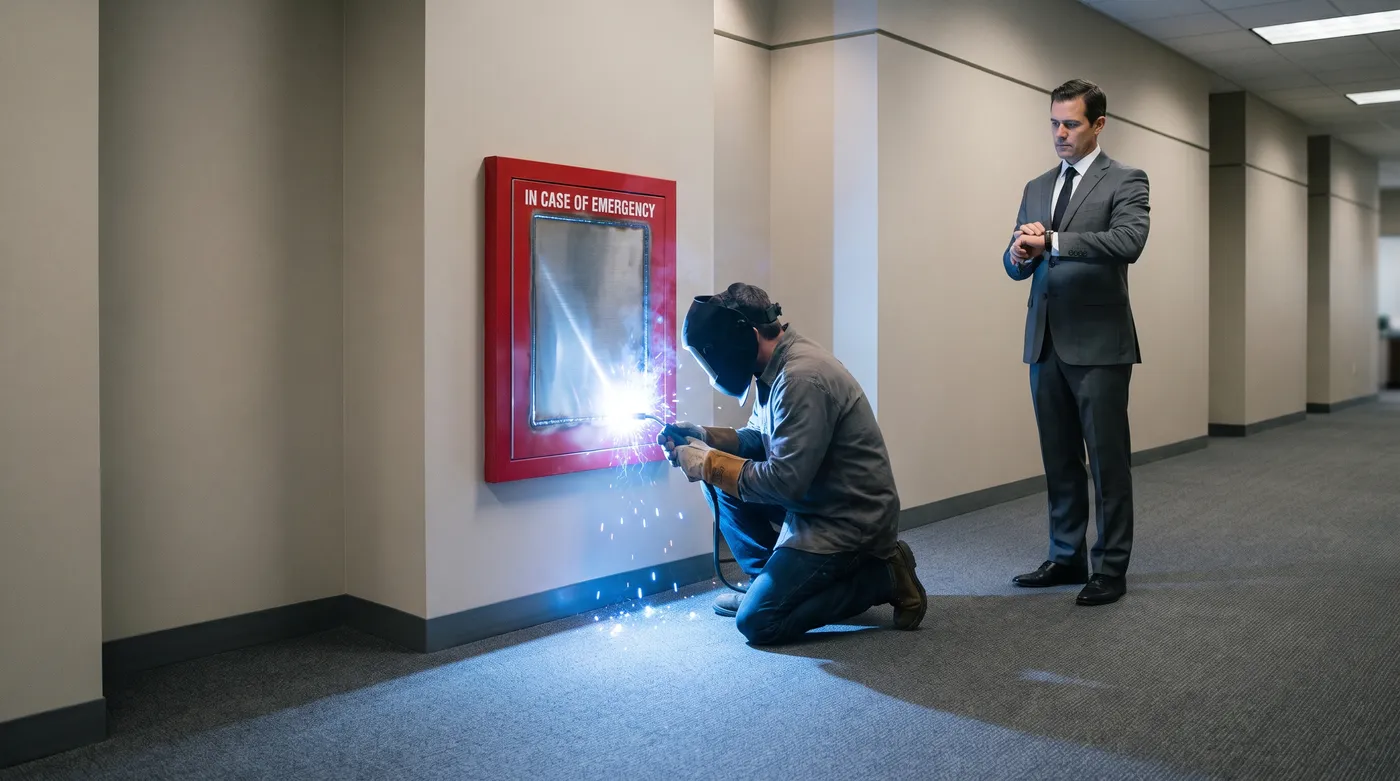
Defend the frame in plain English. The Klein vocabulary is honest. It is not theatrical. It is the description that the public-record documents authorize. The 78 percent figure is in the S-1, not in this article. The mandatory arbitration clause is in the S-1, not in this article. The Texas reincorporation threshold is on the Texas Code, not in this article. The Nasdaq rule modification is on the Federal Register and the SRO filing record, not in this article. The joint comptrollers’ letter is on the New York City Comptroller’s website, not in this article. The architecture characterizes itself in its own primary documents. The Klein label organizes the documents under a single descriptive heading. The label is not a moral judgment. It is a structural characterization that has the property of being falsifiable. If 78 percent of the cash had been allocated to operating capital, the label would be inapplicable. If the arbitration clause had been removed in response to the comptrollers’ letter, the label would be inapplicable. If the Nasdaq rule had been promulgated three months after the S-1 rather than three weeks before it, the label would be at least disputable. Each of these counterfactuals would have made the label invalid. None of them obtained. The label is therefore the description.
The honest version of the steelman’s reply is the one to honor. The steelman’s reply is that Starlink is real, profitable, and growing: FY2025 revenue of $11.39 billion, 10.3 million subscribers, operating income of $1.19 billion in Q1 2026 alone, the only profitable unit inside the SpaceX consolidated entity. The steelman’s reply is that the AI capex burn and the Mars-program research-and-development burn might, given enough time, be outpaced by the Starlink cash engine, which would convert what looks today like a transfer-architecture deal into what would look retrospectively like a national-champion deal whose pension exposure was beneficial. The steelman’s reply is that the political risk on Musk, which is the elephant in the prospectus, the risk that the controlling founder’s political prominence and behavioral volatility produce a discount on the security irrespective of operating performance, might prove transient or might be priced rather than realized. The steelman’s reply is that the steelman has been wrong before about dual-class founders (Meta, Alphabet) and might be wrong again here. The steelman’s reply, in short, is that the foreseeable-loss component of the Klein framing is contested, and contesting it is the entire substance of whether the deal’s pension exposure is, in the long run, a transfer or a productive investment.
The series’ honest position is the one to defend. The mechanism is documented. The foreseeable-loss claim is contested. These two propositions are not contradictory. They are the two sides of the operative judgment the synthesis is asking the reader to make. The mechanism, the engineered architecture, the disabled recourse, the compressed timeline, the related-party cash flow, the forced passive buy, the index inclusion that routes the exposure into retirement default options, is the description of the structural fact this article is putting on the page. The foreseeable-loss claim, whether the exposure, given enough time, produces a positive return for the pension trustees and 401(k) holders into whose accounts the exposure has been deposited, depends on the future performance of Starlink, of SpaceX’s AI segment, of the political risk on the controlling founder, of the broader AI capital cycle that the entire series has documented. The mechanism does not determine the loss. The loss is a function of empirical questions whose answers will come out over the next decade. The mechanism determines that, whatever the loss turns out to be, the absorbing parties did not choose the exposure and could not refuse it.
This is the honest version. It is not the theatrical version. The theatrical version would assert the loss as inevitable. The theatrical version would claim certainty about a contested empirical question. The honest version preserves the contestation about the loss while naming the certainty about the mechanism. The mechanism is documented in the public record. The contestation about the loss is what the steelman is. The Klein frame, defended in plain English, is the frame that holds both at once. It says: the architecture is engineered to channel demand into a structure that disables recourse, on a compressed timeline, with the majority of cash leaving the corporate perimeter, and the absorbing parties did not consent and cannot exit. Whether the deal turns out to have been a good or bad allocation of the absorbing parties’ capital is a separate question. The first question has been settled by the public record. The second is the subject of the next decade’s empirical history.
It is worth flagging that the Klein frame is doing more work in the 2026 context than it was in the 2007 context, because the 2007 frame was focused on post-disaster windows of political opportunity, and the 2026 instantiation is focused on pre-disaster engineering of the recourse architecture. The shift is important because it specifies what is novel. Klein’s 2007 disasters were exogenous shocks (coup, hurricane, war, financial crisis) that opened windows. The 2026 architecture is endogenous: the recourse mechanisms are being disabled in advance, in the absence of any specific shock, by the routine operation of the SRO rule-making process, the index-provider methodology decisions, the corporate-law forum-selection clauses, and the listing-exchange controlled-company exemptions. The shift from post-shock opportunism to pre-shock engineering is the structural innovation. The Klein vocabulary is the vocabulary that allows the structural innovation to be named. The plain-English version of the vocabulary is the version the series uses. The theatrical version of the vocabulary is the version the series declines.
Charles Kindleberger’s Manias, Panics, and Crashes (1978) gave the financial-crisis literature its standard phase taxonomy: displacement, boom, euphoria, distress, revulsion, crash. The AI cycle has been progressing through the phases at, by historical standards, a measured pace. Displacement was the late-2022 release of ChatGPT and the subsequent recognition by the venture and corporate-capex communities that the transformer scaling laws had produced a regime change in the addressable market for compute. Boom was 2023–2024. Euphoria, in the Kindleberger sense of price levels that have detached from defensible cash-flow projections, has been the operative phase from late 2024 through the present, with the canonical markers (the Oracle–OpenAI $300 billion compute-services agreement, the Anthropic Series G at $380 billion, the SpaceX IPO at trillion-plus valuation) all printed inside the euphoria window. The Kindleberger model predicts distress as the phase that follows euphoria when the financing conditions that underwrote the euphoria tighten. The Warsh confirmation and the May 14–20 bond-market repricing are the financing conditions tightening. Distress is, in the Kindleberger schema, the present phase. Revulsion and crash, if they come, are the next two phases. The Kindleberger schema does not produce timing. It produces the sequence. The sequence has been confirmed many times across history. The Klein frame defended in this section is the description of how the institutional architecture has been reorganized during the euphoria phase to position the public balance sheets as the absorbers when the distress phase’s losses are eventually realized. Whether the losses are large or small, near or far, is the contested question. That the absorbers have been positioned is the documented one.
Galbraith’s bezel, which Article 2 traced into the AI cycle’s candidate inventory of undiscovered loss, sits inside the Kindleberger phase progression at the displacement-through-euphoria stretch where the financing conditions permit the bezel to accumulate without being marked. The bezel is what the distress phase reveals. The size of the bezel is the empirical question whose answer comes out of the distress phase’s controlled drawdown. The Warsh doctrine is, by design, the controlled drawdown. The doctrine’s public-facing argument is that the drawdown will discipline the cycle without precipitating a crash. The doctrine’s structural argument, less public-facing, is that the absorbing parties, the index-fund-routed pension and 401(k) balance sheets, will hold whatever inventory the drawdown reveals. The Kindleberger sequence, the Galbraith bezel, the Klein architectural engineering of recourse, and the Mazzucato cycle in its closed form: these are not four different framings of four different phenomena. They are four scholars naming the same phenomenon from four different vantages. The synthesis is the recognition that the four namings are convergent.
VI. What the Curriculum Can Name
The propaganda layer was the connective tissue. It is the layer that made each subsystem individually visible and collectively invisible. The fourth article in this series, written by another hand in parallel with this one, reads the canon straight, maps Samuel Spitale’s five trademarks of successful propaganda onto the AI capital cycle, and produces the dog-whistle glossary that translates the canon’s public language into the operational vocabulary the cycle uses internally. The work that article does is the work that makes the present synthesis possible to read. Without the propaganda layer’s naming, the five admissions would still be five admissions, but they would not be readable together because the connective tissue would still be doing its work of separating them by code.
The series’ relationship to the platform’s How to Win the War on Truth course is the relationship of journalism to curriculum. The course follows Spitale chapter by chapter across ten units, building the analytical depth that the journalism series demonstrates in live cases. The journalism is the live demonstration; the curriculum is the framework. Each requires the other. A reader who has read only the journalism has the receipts but not the analytical infrastructure to read the next case as it arrives. A reader who has read only the curriculum has the analytical infrastructure but not the demonstrated practice of applying it to a specific case in detail. A society that has both, and reads both, has a chance of seeing the machine before it is too late. A society that has only one, or that has neither, does not.
The curriculum can name what the canon cannot name about itself. The canon, by Spitale’s description, operates by deploying a specific set of techniques: cutting out complexity, exploiting bias and the brain, inducing negative emotion, dividing and conquering, structuring power and profit through propaganda, deploying doubt and framing. The curriculum reads each technique as a technique. The canon, reading itself, reads the same operations as visionary statements, sectoral discourse, strategic communication, mission-driven narrative, responsible scaling, market education. The curriculum’s vocabulary is the vocabulary in which the operations are nameable. The canon’s vocabulary is the vocabulary in which the operations are unnameable. The substitution of one vocabulary for the other is the substantive work the curriculum does. The substitution is not, in itself, a refutation of the canon. The canon may continue to be read in its own vocabulary; many readers will continue to do so. The substitution is the production of a reader for whom the canon’s vocabulary is one of several available descriptions of the same set of operations, rather than the only available description.
This is, in a sense, what reading is for. The capacity to hold more than one description of the same phenomenon in view simultaneously is the cognitive capacity that the educational tradition has been trying to cultivate, in various institutional forms, since the founding of the university tradition in the European twelfth century. The capacity is not natively present in human cognition. It is built, through specific instructional practices over a sustained period, by the routine exposure of the reader to descriptions that compete for the same descriptive terrain. The training is the educational tradition’s substantive contribution to public life. Where the training is intact, public discourse retains the capacity to engage contested descriptions through deliberation. Where the training has been corroded, through underfunding of public institutions, through the contraction of the humanistic disciplines, through the reorganization of attention by platform economies that reward speed over depth, the public discourse loses the capacity to hold multiple descriptions in view, and the contested descriptions are settled by the operation of the more powerful description over the less powerful one. The propaganda layer’s function is to be the more powerful description in the AI capital cycle’s case. The curriculum’s function is to be the less powerful description that nevertheless remains available to the reader who chooses to seek it out.
Jurgen Habermas would name this as the structural condition of communicative action under the colonization of the lifeworld by system imperatives. The communicative action through which contested descriptions can be deliberated requires institutional substrates, universities, public broadcasting, deliberative journalism, civic associations, religious institutions in their non-instrumental forms, that have been progressively colonized by strategic-action imperatives over the past half-century. The colonization is not complete. The curriculum’s persistence is the form the un-colonized residual takes inside the contemporary educational sector. The journalism series is the form the un-colonized residual takes inside the contemporary trade-press sector. Neither is, by itself, sufficient to constitute the communicative-action substrate that would permit deliberation to settle the contested descriptions in the public’s favor. Both, in combination, with other institutional forms that the present synthesis does not have space to enumerate, are necessary for the deliberative possibility to remain operationally available.
The Polanyi reading is the one to land at the end of this section. The Great Transformation (1944) named the double movement: the expansion of market relations into spheres of life previously organized by other principles (kinship, custom, sovereignty, common-pool ownership) and the inevitable countermovement by which society reasserts itself against the market’s totalizing pressure. Polanyi’s argument was that the countermovement was not optional. It was a structural feature of human societies under sustained market expansion. The countermovement might take many forms, cooperatives, labor regulation, central-bank intervention, fascism, the New Deal, but a countermovement would arrive, and the form it took would be substantially determined by which political coalitions had the institutional capacity to shape it.
The AI capital cycle’s expansion into the financial substrate of American retirement assets, the educational substrate of American attention, the productive substrate of American labor, the cognitive substrate of American reasoning: this is the market expansion. The countermovement is coming. Polanyi’s analytical confidence on this point is one of the few load-bearing predictions the political-economy literature has produced that has been confirmed across multiple major cases over multiple decades. The question the synthesis has to leave open is not whether the countermovement arrives but which institutional form it takes. The institutional form is contingent on whether democratic institutions retain the capacity to shape it or whether the architecture, the same architecture that absorbed the upside-capture phase of the AI cycle into public balance sheets without authorization, absorbs the countermovement as well, channeling it into forms that do not threaten the underlying allocation.
The curriculum is one institutional locus in which the capacity to shape the countermovement is being maintained. The journalism is another. Neither is sufficient on its own. Both are necessary parts of an institutional ecology that, if it persists, retains the capacity to constitute the democratic countermovement that Polanyi’s model predicts. If the ecology does not persist, the countermovement will still arrive. That is not the contingent variable, but the institutional form it takes will be determined by other actors, in other forums, on terms the present readers have no operative voice in shaping. That is the load-bearing reason to maintain the ecology. The curriculum exists for this reason. The journalism exists for this reason. The reading is for this reason. The present synthesis is for this reason. None of these is, by itself, the countermovement. All of them are the substrate on which the countermovement’s democratic form depends.
The journalism series is the live demonstration: the receipts, the calendar coincidences, the documented mechanics, the named scholars deployed against named cases. The curriculum is the framework: Spitale’s ten units following the five trademarks of successful propaganda, the dog-whistle glossary built from first principles, the analytical infrastructure that permits the next case to be read as it arrives. Each requires the other. The journalism without the curriculum is a series of cases without a method. The curriculum without the journalism is a method without demonstrated practice. The combination is the operational form of an analytical capacity that can outlive the specific cases the journalism documents.
VII. The Honest Reckoning
The platform’s own Century Bond and the Three-Year GPU case study was published on March 12, 2026, seventy-eight days before this synthesis. It traced the duration mismatch at the heart of the AI capex cycle. It named the petrodollar-to-computedollar transition. It deployed Knightian uncertainty and Damodaran’s “narrative-driven numbers” as analytical frames. It was, on the numbers, accurate. It was, on the analytical posture, the artifact of a platform inside the same legitimacy economy as the subjects it was examining. The honest reckoning the present synthesis owes is to that prior piece, to the platform’s own analytical position at the time it wrote that piece, and to the readers who took the piece’s framing as the most acute available reading of the cycle when it was published.
Six things in the case study need to be reckoned with. None of these is a retraction. Each is a naming of what the prior piece could not yet name with the evidence then available, or could have named but did not, because the analyst was inside the same legitimacy economy as the subjects.
The first is the use of insider vocabulary without flagging it as such. The case study deployed “hyperscaler capex,” “scaling laws will hold,” “the $523B RPO backlog,” “compute moat,” “responsible scaling,” and the rest of the operational vocabulary of the AI capital cycle as if these were neutral descriptive terms. They are accurate descriptive terms in the sense that they pick out the phenomena they pick out. They are also, simultaneously, the rhetorical instruments of a power class engaged in the work of organizing the cycle’s public legibility in a particular direction. The unmarked deployment of the vocabulary is, in effect, an alignment with the cycle’s self-description. The case study would have been more rigorous if it had named the vocabulary’s double function. The present series has done that work, on the strength of Spitale’s framework, which the platform did not yet have access to in March. The dog-whistle glossary in Article 4 is the artifact of the work that the case study could not yet do. The series’ gain in analytical capacity is the difference between Spitale-equipped reading and pre-Spitale reading.
The second is the failure to name Sheikh Tahnoon as the upstream actor. The case study traced petrodollar through US Treasury auctions and US tech capex stacks. It treated Washington’s policy choices and Wall Street’s underwriting decisions as the active subjects. It treated the Gulf as a passive demand source. That treatment was not wrong on the numbers; the Gulf flows the case study documented were directionally correct. It was wrong on the agency. The agency is upstream. The bridge between hydrocarbon receipts and US compute capex is not Washington’s policy choice. It is Abu Dhabi’s portfolio choice, executed through MGX, G42, and the broader Tahnoon-chaired complex. The under-named actor was Tahnoon. The Article 1 / synthesis correction is to put Tahnoon on the cover. The case study would have read more cleanly if it had done so in March. It did not, because the analyst’s default analytical frame placed American actors at the active subject position and non-American actors at the passive object position. That default is itself a habit of analysis that requires to be named and discarded.
The third is the treatment of the duration mismatch as a theoretical risk. The case study described the duration mismatch, the gap between the seven-to-fifteen-year amortization horizon of the private-credit debt financing the GPU SPV stack and the three-to-six-year depreciation horizon of the underlying hardware, as a structural feature of the cycle that, under specific conditions of rate normalization, could produce stress. It used Knightian uncertainty as the master frame for thinking about the conditions under which the stress would materialize. The Warsh confirmation and the May 14–20 bond-market repricing have moved the mismatch from theoretical risk to priced event. The case study would have read more accurately if it had named the bond-market repricing as the specific channel through which the theoretical risk would become a priced event, rather than as one of several possible channels. The Social Physics series Article 5 actually went further than the century bond piece on this point, explicitly anticipating that the bond market would reprice American sovereign risk when Powell’s term ended in May. That prediction landed. The present series’ Article 2 names the landing without smugness because the predicting was Social Physics’ work, not the case study’s.
The fourth is the deployment of Knightian uncertainty as master frame without interrogating how that frame is itself a sophisticated-reader’s framing that protects analysts from the simpler indictment. Knightian uncertainty, as Frank Knight named it in 1921, is the distinction between risk (probabilities knowable, distributions estimable) and uncertainty (probabilities unknowable, distributions unspecifiable). The frame has the analytical virtue of forcing the reader to confront the limits of probability-based analysis. It also has the rhetorical effect of placing the analyst at a position of epistemic humility from which sharper indictments become professionally inappropriate. To say of a deal that “the probability distribution of outcomes is not specifiable” is to refuse, on principled grounds, the simpler statement that the deal is structured in a way that transfers concentrated risk to specific absorbing parties on terms those parties did not negotiate. The Knightian frame is true. It is also, in the case study’s deployment, the analytical posture that permits the analyst to avoid the structural indictment. The present synthesis names the structural indictment directly because the structural mechanism has, in the interval since March, become documented in ways that no longer permit the Knightian dodge.
The fifth is the use of Aswath Damodaran’s “narrative-driven numbers” line as closing flourish, not load-bearing thesis. Damodaran has spent two decades arguing that valuation is the joint product of narrative and number, that the two interact in ways the standard discounted-cash-flow training elides, and that the analyst’s job is to make the narrative explicit and the number disciplined by the narrative. The case study cited the line at the end as a kind of rhetorical capstone. The present series has promoted the observation to operating thesis. The narrative is doing the work of valuation in the AI cycle’s deals. The narrative is the canon of Amodei, Andreessen, Altman, and the a16z American Dynamism practice statement. The number that the narrative produces, $1.75 trillion to $2 trillion for SpaceX, $965 billion for Anthropic, $300 billion of Oracle RPO booked against OpenAI’s sub-$5 billion revenue base, is the number that the narrative permits. Without the narrative, the number does not survive the discounted-cash-flow inspection. With the narrative, the number is the round’s price. Damodaran’s line is not a flourish. It is the operating description of the valuation regime under which the AI cycle has been priced. The present series treats it as such. The case study did not, because the case study’s author had not yet integrated the Spitale framework into the analytical machinery that would have permitted treating the narrative as the operating object of inspection.
The sixth is the most uncomfortable to name. The platform’s own product copy, “interdisciplinary curriculum,” “case studies at cross-curricular junctions,” “analytical frameworks,” “earned understanding,” “rigorous historical reading”, inhabits the same legitimacy market as “responsible scaling,” “American Dynamism,” “sovereign compute,” and the rest of the canon’s vocabulary. The platform’s product copy is, in its own way, an instance of the moral-permission infrastructure that Spitale’s framework names. The platform is selling a product. The product’s sale is supported by a vocabulary engineered to make the product’s value proposition difficult to compare unfavorably to other educational products on offer. The platform is not exempt from the legitimacy-economy dynamics it is examining in the subjects of the series. Naming this briefly, without ritual self-flagellation and without the false humility that becomes its own credential, is the move that earns the right to use the propaganda frame on the texts the rest of the series reads straight. The platform is inside the legitimacy economy. The platform is not pretending otherwise. The platform’s analytical position is that the legitimacy economy is real, that no analyst inside it is exempt from its operations, and that the honest course is to name the inhabitation while continuing the analytical work the inhabitation does not foreclose.
The honest reckoning is not a ritual. It is a methodological commitment. The commitment is to keep current with the analyst’s own legitimacy position inside the system being analyzed. The commitment requires periodic revisiting of the analyst’s prior work to identify the framings that were available at the time, the framings that were chosen over alternatives that were also available, the analytical positions that protected the analyst from sharper readings the evidence would have supported, and the rhetorical postures that traded analytical clarity for professional comfort. The commitment is itself a kind of work that has to be performed in writing, in the public record, on a recurring cadence, against the platform’s own previously published reporting. The performance of the commitment is the documentation of the commitment. The documentation of the commitment is what makes the analytical posture credible going forward. Without the documentation, the analytical posture is rhetorical. With it, the posture is operational.
The Susan Strange reference is the one to land at the close of this section. Strange spent the last decade of her career refusing to grant authority to the discourse she was examining. Her writing in Mad Money, Casino Capital, and the late essays is a sustained refusal to accept that the language of the financial-services industry, as it described itself, was an adequate description of what the industry actually did. The refusal was not cynicism. It was analytical discipline. Strange’s discipline is the discipline the honest reckoning aspires to. It is the discipline that the platform’s case study, in March, did not yet have. It is the discipline this synthesis is now attempting to inhabit. Whether it has succeeded is a judgment the reader gets to make. The attempt is the artifact. The artifact is on the record.
(1) Use of insider vocabulary without flagging it as the rhetoric of a power class. (2) Failure to name Sheikh Tahnoon as the upstream actor; default placement of American actors at the active subject position. (3) Treatment of duration mismatch as theoretical risk rather than as a specifically predictable priced event on the Powell-Warsh transition calendar. (4) Deployment of Knightian uncertainty as master frame in ways that protected the analyst from the simpler structural indictment. (5) Use of Damodaran’s “narrative-driven numbers” line as closing flourish rather than as load-bearing thesis. (6) Participation in the legitimacy economy the case study was examining: the platform’s product copy inhabits the same market as “responsible scaling” and “American Dynamism.” Naming the participation briefly, without ritual self-flagellation, earns the right to use the propaganda frame on others.
VIII. What This Series Did Not See
The pre-emptive honest reckoning is the one that the present series owes to whoever writes the follow-on. The series has had a particular focus: the financial subsystem, the strategic subsystem, the propaganda subsystem, and the architectural mechanisms that connect them. The focus has produced what the focus has produced: a sustained reading of the five admissions and the architecture that organizes their joint operation. The focus has also left out what falls outside it. Four gaps are large enough to name, and to name in advance, so that the follow-on has a clean point of departure.
The first is the labor angle. The AI capital cycle is, among other things, the next phase of labor extraction. The series has touched on labor only obliquely: the construction labor on Stargate UAE and on the American campuses, the talent flow into the model labs, the small-business owners exiting the labor force as platform infrastructure consolidates around them. The series has not traced the systematic substitution of human labor by inference-as-a-service across white-collar categories whose displacement is, in the trade-press analysis of 2025 and 2026, already documented at meaningful scale. The contact-center workforce, the entry-level legal and financial analyst workforces, the entry-level software-engineering workforce, the journalism and content-production workforces, the customer-service and inside-sales workforces: each of these has been documented as in the early stages of structural displacement by the inference layer of the AI stack the series’ capital cycle is financing. The synthesis the present series produces is one in which the financing architecture is documented and the labor consequences of the deployment are not. A follow-on series would do well to invert that emphasis: take the deployment as the active subject and trace the labor architecture of the displacement, with attention to the absence of severance institutions, the failure of retraining infrastructure, the political-economy consequences of labor-force participation declines concentrated in specific demographic segments. The framework hooks would be Polanyi (the labor market as the fictitious commodity whose decommodification is the structural feature of the countermovement), David Autor (the empirical work on labor-market polarization), Saskia Sassen (the global-city labor architecture as the structural counterpart of the global-city financial architecture), and a recovery of E.P. Thompson’s Making of the English Working Class as the historical analogue for what the post-displacement labor reorganization looks like across multiple decades. The series did not do this work. The work needs to be done.
The second is the climate angle. The AI capex cycle is, in the medium term, a stranded-asset risk in any plausible scenario in which a global carbon-pricing regime arrives in the 2028–2032 window. The series’ Article 1 touched on the physical-systems numbers, the five gigawatts of firm power at Stargate UAE, the gas-firmed reality behind the renewable headlines, the desalination water budgets in the Saudi build-out, but did not extend the analysis to the carbon-pricing scenario in which the same infrastructure becomes a stranded asset on a scale comparable to the 2010s coal write-downs. The carbon-pricing scenario is not a tail risk. It is the central case in the policy literature on climate transition. The political-economy literature on carbon-pricing arrival timing, Tooze, Mark Carney’s tenure at the Bank of England and the subsequent climate-finance work, the IEA’s stranded-asset modeling, the various central-bank net-zero scenario exercises, suggests that the operational impact of carbon pricing on the data-center build-out is one of the load-bearing risks in the cycle’s aggregate exposure. The series did not trace this risk. A follow-on series would do well to take stranded-asset risk as the active subject and trace its transmission through the data-center balance sheet, the hyperscaler corporate balance sheet, the private-credit debt that funds the SPV stack, and the public-pension and sovereign-wealth balance sheets that hold the long-duration claims on the cycle’s output. The framework hooks would be Tooze (central-bank backstops as the operating constitution of climate transition finance), Vaclav Smil (energy-and-materials reality check, extended to the climate-policy environment), Mariana Mazzucato (the entrepreneurial-state thesis applied to the green-industrial-policy infrastructure the carbon-priced world will require), and Pierre Charbonnier (the recent work in environmental political economy on the climate-transition political-economy settlement). The series did not do this work. It needs to be done.
The third is the cognitive angle. The series has named the propaganda layer, the moral-permission infrastructure, the dog-whistle vocabulary. It has not asked, as a substantive analytical question, what happens to human reasoning capacity when prediction-as-a-service is socially metabolized at the scale the AI deployment is producing. The cognitive science literature has begun to address this, Yuhuai Wu’s work on the cognitive offloading consequences of language-model use, Steven Sloman’s collaborative-knowledge work updated to the post-ChatGPT condition, the educational-psychology literature on student reliance on inference tools and the consequences for reasoning development, but the work is at an early stage and the political-economy consequences are barely sketched. The series’ central claim is that the architecture is binding capital allocation without democratic authorization. A parallel claim, which the series did not develop, is that the architecture is binding cognitive practice without democratic authorization in ways that, over time, may compromise the cognitive substrate on which democratic deliberation depends. The framework hooks would be Habermas (communicative action and its cognitive requirements), Cass Sunstein (epistemic democracy and the role of cognitive diversity), Walter Mignolo (the decolonial argument about whose cognitive practices count as reasoning), and a recovery of John Dewey’s The Public and Its Problems as the canonical text on the public’s cognitive requirements for self-governance. The series did not do this work. It needs to be done.
The fourth is the cross-asset contagion angle. The series has traced the AI capex cycle through the equity-cap-stack, the long-duration bond market, the chip supply chain, the energy infrastructure, the Gulf sovereign-wealth allocation. It has not traced the AI exposure that has accreted, less visibly, in private-credit funds’ broader books, in commercial mortgage-backed securities exposed to data-center real estate, in regional-bank deposit bases that have grown on the back of crypto-and-AI deposit flows, in the corporate-bond market segments that have priced increasing AI-adjacent issuance through the high-yield and investment-grade tiers. The cross-asset contagion architecture is the architecture by which AI-cycle stress, if it materializes, transmits to balance sheets that have not been ostensibly part of the cycle’s exposure. The contagion channels are not theoretical. They have been modeled in the BIS work, the FSB stability reports, the IMF’s 2025 global financial stability report, and the various central-bank-stress-test exercises that have begun to take AI-cycle exposure as a parameter. The series did not develop this. A follow-on series would do well to take the cross-asset contagion architecture as the active subject and trace the exposure channels with the same level of detail the present series has applied to the direct cap-stack channels. The framework hooks would be Hyman Minsky (the financial-instability hypothesis extended to the AI-cycle case), Adam Tooze (cross-border central-bank-backstop coordination as the actual response architecture), Andrew Haldane (the network-finance architecture and its contagion-propagation properties), and a recovery of Charles Kindleberger’s The World in Depression as the historical analogue for what cross-asset contagion looks like across the full balance sheet. The series did not do this work. It needs to be done.
Four gaps. Four follow-on series. Each is large enough to support its own multi-article treatment. The present series has done what the present series has done. The pre-emptive honest reckoning is to name what the present series has not done, so that the analytical conversation can proceed from a clean point of departure. The reader who has been with the series since the first article is now equipped with the analytical machinery and the documented receipts to engage the gaps directly. The work that needs doing does not need to be done by this platform. It needs to be done by the analytical community of which this platform is one part. The naming of the gaps is the present series’ contribution to the work the analytical community has ahead of it.
Labor: AI as the next phase of labor extraction; structural displacement across white-collar categories; absence of severance institutions and retraining infrastructure. Climate: AI capex as stranded-asset risk in the 2028–2032 carbon-pricing arrival window; transmission through hyperscaler, private-credit, and pension balance sheets. Cognitive: prediction-as-a-service social metabolization and its consequences for the cognitive substrate of democratic deliberation. Cross-asset contagion: AI exposure in private-credit broader books, CMBS, regional-bank deposit bases, corporate-bond markets, the architecture by which AI-cycle stress transmits to balance sheets that are not ostensibly part of the cycle.
IX. The Forced Absorber
The bus driver in Travis County, Texas, who has been a Capital Metro employee for twenty-three years, holds an account balance in the Texas Municipal Retirement System whose investment policy statement requires the trustees to allocate to a benchmark-tracking public-equity sleeve that includes, as a structural matter, the constituents of the relevant US large-cap and total-market indices. The bus driver did not select the benchmark. She did not vote for the trustees on a ballot that named the benchmark as the trustees’ choice. She did not opt in to the index-tracking sleeve. She did not, in any operationally meaningful sense, consent to the allocation that her account balance is, on the morning of the index reconstitution that follows the SpaceX inclusion, going to express. The allocation is going to happen because the architecture requires it. The bus driver is the forced absorber.
The code inspector in Maricopa County, Arizona, who participates in the Arizona State Retirement System, is in the same position with a different state name on the letterhead. The county clerk in Cook County, Illinois. The community-college instructor in Pinellas County, Florida. The hospital administrator in Hennepin County, Minnesota. The nine-year-old child of a Capital Metro mechanic who, by virtue of her father’s death-benefit accrual, has a long-duration claim on the same retirement system. The thirty-one-year-old recent graduate of a Texas state university whose first job’s 401(k) default option is a target-date fund that holds the same total-market index sleeve. The seventy-two-year-old retired schoolteacher in upstate New York whose monthly distribution is funded out of the New York State Common Retirement Fund’s public-equity allocation, which holds the same index constituents in the same proportions. The pension trustee, the 401(k) recordkeeper, the index methodologist, and the sovereign-wealth deputy now constitute a single forced-absorber stack. The bus driver is its retail terminus. The Sheikh Tahnoon-chaired portfolio committee is its institutional origin. The Warsh Fed is the institutional custodian of the dollar-duration architecture against which the entire stack’s long-duration claims are priced. The architecture is the binding constraint between them.
This is what the synthesis names. The naming is its substantive work. The naming is the work the canon’s vocabulary cannot do, because the canon is built to make the stack invisible to the absorbers and to make the absorbers invisible to the architecture. The dog-whistle glossary in Article 4 produced the translation key. The five admissions in Section I of this article produced the documented evidence. The Tahnoon spine in Section II produced the upstream actor. The Lessigian architecture in Section III produced the binding-constraint mechanism. The Mazzucato cycle in Section IV produced the structural pattern. The Klein frame in Section V produced the engineered-recourse description. The curriculum-and-journalism relationship in Section VI produced the institutional ecology in which an alternative reading remains available. The honest reckoning in Section VII produced the platform’s own legitimacy-position naming. The pre-emptive honest reckoning in Section VIII produced the gaps for the follow-on. The present section is the naming as such.
The Polanyi closing is the reading that the synthesis cannot avoid and should not try to. The double movement is real. The market expansion the AI capital cycle represents will produce a countermovement; that prediction is the most analytically secure prediction the political-economy literature has been able to produce across multiple major cases over multiple decades. The form the countermovement takes is contingent. It is contingent on whether the institutional ecology of democratic deliberation retains the capacity to constitute the countermovement on terms that protect the absorbers, or whether the architecture absorbs the countermovement as well, channeling it into the same routinized forms that the upside-capture phase has already routed through. The question is not whether the countermovement arrives. The question is whose. The question is whose terms. The question is whose institutions get to shape the form. The answer to the question is not in any single article and not in any single series and not in any single platform’s product. The answer is the cumulative consequence of how the analytical community continues to do its work over the next decade, in journalism and in curriculum and in the educational and civic and deliberative institutions whose persistence is the necessary substrate for the work to continue at all.
The series’ first article opened with Sheikh Tahnoon at the window above the Abu Dhabi skyline. The second opened with Kevin Warsh sworn in by Justice Clarence Thomas at the White House. The third opened with the Nasdaq listing officer signing the rule that admitted the issuer. The fourth opened with the canon’s authors at their writing desks. The fifth opened with Air Force One refueling in Anchorage to collect Jensen Huang. The synthesis closes where it began: with the bus driver, whose name we do not know, whose account balance is a few dollars different on Wednesday morning than it was on Tuesday night, who did not consent to the exposure she now holds, who cannot refuse the exposure without exiting a retirement system she paid into for twenty-three years, who has the same constitutional standing as the sovereign-wealth deputy in Abu Dhabi and the Fed chair sworn in by the Justice and the listing officer in Lower Manhattan and the index methodologist in Midtown and the canon’s authors at their writing desks, and who is, on the documented record of the five preceding articles and the present synthesis, the structural counterparty of all of them.
The structural counterparty has the same constitutional standing because the constitution does not distinguish between standings of capital. The structural counterparty has nothing like equivalent operational standing because the architecture that organizes the allocation does not run on constitutional categories. The architecture runs on methodology committees and fiduciary mandates and listing-exchange rule modifications and chip-export-control administrative annexes and sovereign-wealth board minutes that are not posted. The reading that says the constitutional standing is sufficient to organize the relationship is the reading that the canon’s vocabulary licenses. The reading that says the operational standing is what matters is the reading that the architecture’s own behavior validates. The synthesis is the work of holding both readings in view, naming the gap between them, and refusing the rhetorical resolutions that would collapse the gap by pretending the operational standing follows automatically from the constitutional standing.
The reading is what reading is for. The curriculum is what curriculum is for. The journalism is what journalism is for. The platform that hosts both is what the platform is for. The act of saying the fact aloud, in a system engineered to keep it from being said, is what the act of saying the fact aloud is for in a society whose democratic institutions retain enough capacity to be addressed by the saying. The capacity is contingent. The contingency is the reason the saying matters. The saying matters because the contingency could go either way and the saying is one of the small inputs that bears on which way it goes.
The bus driver in Travis County does not know that the index reconstitution following the SpaceX inclusion is going to deposit, into her retirement account, a small fractional ownership stake in a structure whose 78 percent cash use leaves the corporate perimeter on day one to repay related parties of a founder she does not vote for, whose mandatory arbitration clause prohibits her from suing if the structure’s disclosures turn out to be incomplete, whose Texas reincorporation thresholds prevent her from joining any shareholder proposal she could plausibly assemble, whose controlled-company exemption means the board does not have to maintain a majority of independent directors, and whose Class B supervoting structure means that her voting decoration is voting decoration. The deposit happens regardless of whether she knows. The synthesis is the document that she is, in principle, able to read. Whether she does read it is a separate question. Whether she finds it useful when she does is a separate question. Whether the analytical community of which the platform is one part continues to produce documents she is able to read is the question on which everything else depends.
The pension trustee, the 401(k) recordkeeper, the index methodologist, and the sovereign-wealth deputy are four nodes in a single architecture that allocates the retirement and reserve capital of the dollar-denominated economic system into long-duration claims on an AI capital cycle whose structural mechanics have been documented across five articles and synthesized in this one. The four nodes do not, in their own subsystem’s vocabulary, recognize themselves as a single architecture. The recognition is the present synthesis’s production. The recognition is what the five articles, read together, have been engineered to make available. The reader who reads the five articles has the recognition. The reader who reads only the canon, or only the trade-press coverage of any one subsystem, or only the dog-whistle glossary translated into ordinary-language descriptions, does not. The recognition is the difference. The difference is what the series has been for.
The forced-absorber stack is the structural fact. The architecture is the binding constraint. The canon is the moral-permission infrastructure. The Tahnoon spine is the upstream allocator. The five admissions are the documented receipts. The honest reckoning is the platform’s own analytical position named. The gaps are what the follow-on has ahead of it. The Polanyi countermovement is the contingent future. The curriculum and the journalism are the institutional ecology on which the countermovement’s democratic form depends. The reading is the operative practice. The saying is the operative act. The bus driver in Travis County, whose name we do not know, is the structural counterparty to all of it.
She did not consent. She cannot refuse. The architecture admits her contribution and proceeds. The synthesis is the document that names what proceeds. The naming is what is left when everything else has been folded into the architecture. The naming is what democratic institutions are for. The naming is what saying-the-fact-aloud is for in a system engineered to keep it from being said. The saying is on the record. The record is the document. The document is here.
The forced absorber is the bus driver. The forced absorber is the code inspector. The forced absorber is the county clerk and the community-college instructor and the nine-year-old child and the thirty-one-year-old graduate and the seventy-two-year-old retired schoolteacher. The forced absorber is every American whose retirement account holds a target-date fund holding a total-market index sleeve. The forced absorber is, in the institutional sense, the institutional ecology of American retirement assets. The forced absorber is the United States, in the operational sense in which the operational sense matters. The forced absorber did not vote on the architecture. The architecture is the binding constraint. The binding constraint admits the absorber’s contribution and proceeds.
The countermovement is coming. Polanyi’s analytical confidence is one of the few load-bearing predictions the political-economy literature has produced. The question is whose. The question is on what terms. The question is whether democratic institutions retain enough capacity to constitute the countermovement before the architecture absorbs that constituting capacity in turn. The architecture has been engineered to absorb. The democratic institutions have been engineered, over a much longer historical period and against much steeper resistance, to constitute. The contest between the two engineering projects is the political-economy contest of the next decade. The reading is one of the small inputs that bears on the contest. The saying is another. The curriculum is the substrate on which the reading and the saying remain operationally available. The journalism is the live demonstration that the substrate is still functional. The continued operation of both is the substantive condition on which the question of whose countermovement gets to be answered in the absorbers’ favor.
The pension trustee, the 401(k) recordkeeper, the index methodologist, and the sovereign-wealth deputy now constitute a single forced-absorber stack. The bus driver in Travis County is its retail terminus, the deposit happens on Wednesday morning, and the architecture that admits the deposit was engineered three weeks before the confidential S-1, by a methodology committee she will never meet, on the instructions of an exchange rule modification she did not comment on, in pursuit of an index inclusion she did not consent to, for a structure whose recourse her ancestors’ constitutional bargain reserved to her and whose recourse the structure’s own filed documents have removed: this is what the architecture does, and the act of saying so aloud, in writing, in the public record, on the platform that hosts the curriculum that produces the readers who can read it, is what the analytical community has left when the architecture has finished folding everything else into itself, and the persistence of the saying is the substantive condition on which the persistence of the democratic countermovement Polanyi’s model predicts depends.
The pension trustee, the 401(k) recordkeeper, the index methodologist, and the sovereign-wealth deputy now constitute a single forced-absorber stack, and the bus driver in Travis County is its retail terminus, signed up without her knowledge by a methodology committee she will never meet, on the instructions of an exchange rule rewritten three weeks before the confidential S-1.
Companion series & further reading: This synthesis closes a series that began with five separate admissions. The companion series that prefigured several of the present series’ observations are Social Physics of the New Disorder, whose Article 5 explicitly anticipated the Powell-Warsh bond-market repricing, and No Kings: The Chalice Overflows, whose Article 6 closing set the template for the synthesis-article register the present article inherits. The Domestic Machine developed the honest-reckoning self-audit posture the present article continues. The Education Machine demonstrated the register variation across subjects that the present synthesis applies to the financial-and-strategic subject matter. The platform’s How to Win the War on Truth course is the analytical depth this series motivates; the relationship is journalism-as-live-demonstration to curriculum-as-framework, each requiring the other.
Sources
Consolidated sources for the entire six-article series, grouped by subsystem and by the article in which each was load-bearing. The synthesis draws on every prior article’s primary-source record; the full bibliographies are in each article’s own sources section. What follows is the consolidated map.
The Tahnoon spine — Gulf, MGX, Stargate UAE (Article 1)
- G42. “Global Tech Alliance Launches Stargate UAE.” Press release, March 20, 2026.
- Sebastian Moss. “US and UAE plan to build 5GW AI data center campus.” Data Center Dynamics, March 2026.
- Bloomberg News. “OpenAI, Anthropic Deals Power Abu Dhabi’s $100 Billion AI Bet.” February 17, 2026.
- Abu Dhabi Media Office. “Tahnoon bin Zayed chairs MGX’s second board meeting of 2026.” Q1 2026.
- Howden Re. “Strait of Hormuz war-risk market report.” March 27, 2026.
- Al Jazeera. “Maritime insurers cancel war-risk cover in Gulf.” March 3, 2026 (operational withdrawal completed March 26).
- Dubai Land Department. Q1 2026 transaction release.
- Saudi Aramco. Fourth Quarter and Full Year 2025 results press release. March 4, 2026.
- U.S. Bureau of Industry and Security. Final rule modification on advanced computing items, November 2025. Federal Register entry.
- Setser, Brad. Council on Foreign Relations “Follow the Money” blog, 2025–2026 entries on Gulf SWF deployment and US Treasury demand composition.
The Warsh rupture — Fed transition, bond market (Article 2)
- NPR. “Kevin Warsh confirmed as Federal Reserve chair.” May 13, 2026.
- CNBC. Warsh 54–45 confirmation coverage. May 13, 2026.
- Euronews. 30-year UST tops 5%. May 14, 2026.
- Federal Reserve Board. Powell pro tempore announcement. May 15, 2026.
- CNBC. 10-year hits 4.7% on May 20.
- PBS NewsHour. Powell remains on Board through 2028; DOJ probe.
- Fortune. Powell transition coverage.
- CNBC. “Warsh’s real Fed regime change deep inside Wall Street’s plumbing.”
- FinancialContent. Warsh Doctrine framing.
- CNBC. Fed/Treasury accord language. May 4, 2026.
- Yahoo Finance live blog. Warsh confirmation hearing — Kennedy exchange.
- CFR. “What Kevin Warsh’s confirmation hearing revealed.”
- Kiplinger. April 29 FOMC 8–4 vote.
- Don Kohn quote, Irish Times, January 30, 2026 (link); Jason Furman support, Invesco note (link).
- Top1000funds. Warsh on AI disinflation, November 2025 remarks.
The SpaceX architecture — S-1, Nasdaq rule, comptrollers’ letter, pension pipes (Article 3)
- Cryptobriefing. Nasdaq fast-entry rule changes, March 30, 2026.
- SEC. SpaceX S-1 filing. Made public May 20, 2026.
- CNBC. SpaceX IPO coverage.
- NYC Comptroller. Joint letter from CalPERS, NYC, NYS. May 6, 2026.
- Fortune. $62.8B / 78% of proceeds to related-party debt. May 28, 2026.
- investingLive. Class A / Class B voting structure.
- Motley Fool. SpaceX Q1 2026 financials — net loss $4.28B, accumulated deficit $41.3B, Starlink as sole profitable unit.
- PitchBook. Tiered lockup structure.
- US News / Reuters. Shareholder rights surrendered: arbitration, jury waiver, class-action prohibition, Texas reincorporation thresholds, controlled-company exemption.
- Yahoo / Barron’s. Forced passive buy estimate: ~$7B day-one, ~19% of float in 6 months.
- American Prospect. “It will be impossible to not own them.”
The canon — Amodei, Andreessen, Altman, a16z American Dynamism (Article 4)
- Dario Amodei. Machines of Loving Grace. October 2024.
- Marc Andreessen. Why AI Will Save the World. a16z, June 6, 2023.
- Sam Altman. Moore’s Law for Everything. 2021.
- a16z American Dynamism practice statement and writing by Christian Keil, Ryan McEntush, and others.
- Bloomberg. Oracle 8-part dollar bond sale, February 2, 2026.
- Fortune. BofA on Oracle-OpenAI as “the key risk going into 2026.”
- OpenAI. OpenAI for Countries / Stargate UK.
- CNBC. OpenAI shareholder memo on Anthropic, April 9, 2026.
- TIME. Anthropic RSP amendments.
- Samuel Spitale. How to Win the War on Truth. (The five-trademarks framework operationalized in Article 4 and in the platform’s How to Win the War on Truth course.)
The Beijing summit — dual readouts, chip channel, bond market response (Article 5)
- Wikipedia. Trump May 2026 state visit to China.
- Al Jazeera. Trump-Xi summit: disagreement on agreed text. May 15, 2026.
- NPR. Side-by-side comparison of US and PRC readouts. May 22, 2026.
- White House. May 16, 2026 fact sheet.
- PRC MFA. May 14 readout.
- Xinhua. May 17 four-stabilities elaboration.
- CNBC. H200 channel: zero deliveries under existing regime.
- Yahoo Finance. Trump on chip channel.
- Atlantic Council (Melanie Hart). “Where’s the beef?” — beef concession reversed within days.
- NBC. Bond market response: +9bp on the week, Beijing and Warsh priced as one signal.
- Fortune. UST auction and yield response.
- Investing.com / Reuters. CNY three-year high; PBOC fix.
- Washington Institute (Elizabeth Dent). Gulf as multi-aligned tech hubs.
The honest reckoning — century bond case study, prior platform reporting
- Curriculum Platform. The Century Bond and the Three-Year GPU. Published March 12, 2026. The prior platform analysis being reckoned with throughout this series.
- Curriculum Platform. Social Physics Article 5: The Bond Market. The Social Physics article that explicitly anticipated the Powell-Warsh bond-market repricing.
- Curriculum Platform. Social Physics Article 6: Odyssey. The cross-code perception question the present synthesis inherits.
- Curriculum Platform. No Kings: They Call Me KING Now. The synthesis-article template the present article inherits.
- Curriculum Platform. The Domestic Machine. Honest-reckoning self-audit precedent.
- Curriculum Platform. The Education Machine. Register variation precedent.
- Curriculum Platform. No Kings Article 1: The Shutdown and the War. Hormuz closure reference for the present series’ Article 1.
Scholar references — full series
- Blyth, Mark. Austerity: The History of a Dangerous Idea. Oxford University Press, 2013. Ideas as institutional weapons; narrative construction as policy.
- Luhmann, Niklas. Social Systems. Stanford University Press, 1984 (English trans. 1995). Functional differentiation; binary codes; structural blindness across subsystems.
- Habermas, Jürgen. The Theory of Communicative Action. Beacon Press, 1981 (English trans. 1984). Colonization of the lifeworld; performative vs. communicative action.
- Lessig, Lawrence. Code and Other Laws of Cyberspace. Basic Books, 1999. Four modalities: law, norms, markets, architecture. Architecture as the binding constraint when the first three fail.
- Minsky, Hyman. Stabilizing an Unstable Economy. Yale University Press, 1986. Hedge, speculative, Ponzi finance phases.
- Mazzucato, Mariana. The Entrepreneurial State. Anthem Press, 2013. Public R&D underwrites; private capital captures. Also The Value of Everything (2018), Mission Economy (2021).
- Galbraith, John Kenneth. The Great Crash, 1929. Houghton Mifflin, 1955. The bezel as inventory of undiscovered loss fattened by easy money.
- Smil, Vaclav. Energy and Civilization: A History (MIT, 2017); How the World Really Works (Viking, 2022). Physical-systems reality check.
- Varoufakis, Yanis. Technofeudalism: What Killed Capitalism. Bodley Head, 2023. Rent-extraction architecture of the platform-and-AI economy.
- Klein, Naomi. The Shock Doctrine: The Rise of Disaster Capitalism. Metropolitan Books, 2007. Disaster capitalism; the pre-bailout frame defended in plain English.
- Slobodian, Quinn. Crack-Up Capitalism: Market Radicals and the Dream of a World Without Democracy. Metropolitan Books, 2023. Zones, ADGM, DIFC as exit-from-Westphalian-state.
- Kindleberger, Charles. Manias, Panics, and Crashes: A History of Financial Crises. Basic Books, 1978 (and subsequent editions). Phase taxonomy of financial crises.
- Zuboff, Shoshana. The Age of Surveillance Capitalism. PublicAffairs, 2019. Surveillance capitalism extended into model labs.
- Polanyi, Karl. The Great Transformation: The Political and Economic Origins of Our Time. Beacon Press, 1944. Double movement; market society’s countermovement.
- Strange, Susan. States and Markets (Pinter, 1988); The Retreat of the State (Cambridge, 1996); Mad Money: When Markets Outgrow Governments (Michigan, 1998); Casino Capitalism (Blackwell, 1986). Four faces of structural power; refusal to grant authority to the discourse being examined.
- Yergin, Daniel. The Prize (Simon & Schuster, 1991); The Quest (Penguin, 2011). Petrodollar mechanics; energy-infrastructure history.
- Sassen, Saskia. The Global City: New York, London, Tokyo. Princeton, 2001 (second edition). Global cities as financialized urban infrastructure.
- Davis, Mike, and Daniel Bertrand Monk, eds. Evil Paradises: Dreamworlds of Neoliberalism. The New Press, 2007. Dubai as speculative-capital architecture.
- Tooze, Adam. Crashed: How a Decade of Financial Crises Changed the World. Viking, 2018. Central-bank backstops as the operating constitution of global finance.
- Kirshner, Jonathan. American Power After the Financial Crisis. Cornell, 2014. Monetary statecraft; political economy of the dollar.
- Setser, Brad. Council on Foreign Relations “Follow the Money” blog, 2025–2026 entries on cross-border capital flow mechanics.
- Spitale, Samuel. How to Win the War on Truth. (The five-trademarks framework that organizes Article 4 and the How to Win the War on Truth course.)
- Damodaran, Aswath. Narrative and Numbers: The Value of Stories in Business. Columbia, 2017. Valuation as the joint product of narrative and number.
- Knight, Frank. Risk, Uncertainty, and Profit. Houghton Mifflin, 1921. The risk/uncertainty distinction the case study deployed.
- Acemoglu, Daron. 2024 and 2025 productivity-revision papers on AI’s plausible aggregate-productivity contribution.
- Autor, David. Labor-market polarization papers; the empirical literature on AI deployment’s labor consequences.