
The Receipt
Eight data points across nine days. Read them as a sequence; the bond market did.
| Data Point | Reading | Context |
|---|---|---|
| Senate confirms Kevin Warsh as Fed Chair | May 13, 2026, 54–45 | Narrowest Federal Reserve chair confirmation in the post-1977 modern era. Senator John Fetterman (D-PA) the only Democratic crossover. |
| 30-year US Treasury yield | May 14: above 5.00% | First sustained 5%+ print on the long bond since the regional-bank stress episode of late 2023. The market read the confirmation as a duration event before Warsh had been sworn in. |
| Powell becomes chair pro tempore | May 15 | Outgoing chair held the chair pending Warsh’s swearing-in. The Board release was a single paragraph; the unspoken half was that Powell had already informed the White House he would remain on the Board. |
| 10-year UST hits 4.7% | May 20 | Sixteen-month high. Same day SpaceX filed its public S-1. The $1.75T–$2T deal was priced into a long-rate environment that had ceased to exist that morning. |
| Warsh sworn in | May 22 | Sworn in by Justice Clarence Thomas at the White House, not at the Eccles Building. Powell stayed on the Board through 2028, citing the DOJ probe into the Fed HQ renovation as the explicit reason. |
| April 29 FOMC vote (released May 21) | 8–4 to hold | Governor Stephen Miran among the four dissenters seeking a 25-basis-point cut. The widest FOMC split since the 2019 mid-cycle adjustment. |
| 10-year UST close, Friday May 15 | 4.54–4.57%, +9bp on week | Reporters tied the move to both the empty Trump–Xi summit and the Warsh handoff. The bond market priced Beijing and Marriner Eccles as one signal. |
| Mag-7 AI capex guide, revised | $725B (from $680B) | Revised upward into the rate move. Every basis point at the long end is now leveraged across that capex base and the equity multiples that support it. |
The receipt prints eight data points across nine trading days. Read together, they describe a discrete monetary event: the post-2008 Federal Reserve backstop architecture, the architecture that suppressed term premium across the dollar curve and that, over the subsequent fifteen years, became the implicit underwriter of every long-duration claim in the global dollar system, was repriced on the calendar of Kevin Warsh’s confirmation. The article that follows traces the mechanism of the repricing, the doctrine Warsh proposes to use to manage it, and the specific things the curve steepening will do to deals that have already been written.
I. The Nine Days
Begin with the chronology, because the chronology is the load-bearing fact. Wednesday, May 13: the Senate vote on the Warsh confirmation, 54–45, with John Fetterman the lone Democratic crossover. Thursday, May 14: the 30-year Treasury auction prints with the long bond yield breaching 5% intraday and closing above it. Friday, May 15: Powell’s scheduled chairmanship ends; the Board releases a one-paragraph statement designating him chair pro tempore until Warsh’s swearing-in. Monday May 18 through Tuesday May 19: the bond market continues to bid yields higher, with the ten-year drifting from 4.54% on Friday’s close to 4.66% by Tuesday afternoon. Wednesday, May 20: the ten-year prints 4.7% in mid-session; in the same hours, the public S-1 filing for SpaceX’s initial public offering becomes available on EDGAR. Thursday, May 21: the April FOMC minutes are released; the 8–4 vote becomes public knowledge. Friday, May 22: Warsh is sworn in by Justice Clarence Thomas at a White House ceremony; Powell announces he will remain on the Board of Governors through the end of his governor term in 2028, citing the Department of Justice probe into the Marriner Eccles Building renovation as the reason he had been “left no choice but to stay until I see them through.”
Each of those events is a separate news cycle. Most coverage has read them as a series of independent stories: a confirmation story, an auction story, a swearing-in story, an IPO story, a Fed minutes story. The bond market read them as one story. That is what the +9bp move on the ten-year through the week of May 11–15 was, and it is what the move through 5% on the thirty-year was. The market is not in the habit of distinguishing signal from noise on the basis of which beat a journalist covers. It is in the habit of pricing duration to whatever cumulative information has arrived. The cumulative information that arrived in those nine days was: the institution that had been the lender of last resort to the dollar-duration architecture for fifteen years was changing hands, and the incoming custodian had been on record for the prior decade arguing that the architecture itself was a mistake.
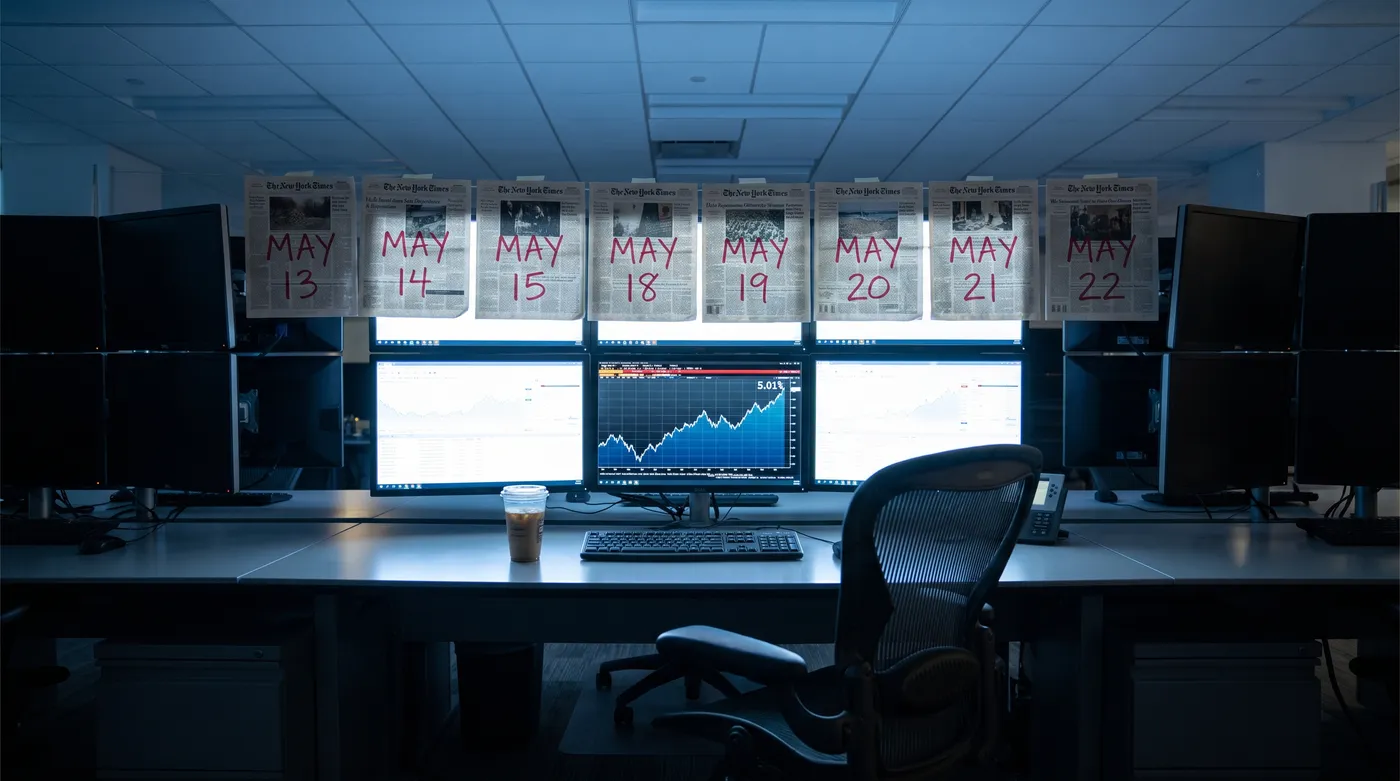
The 54–45 confirmation vote is, by itself, a structural fact worth dwelling on. There has not been a Federal Reserve chair confirmed with that narrow a margin since the modern era of independent Fed governance began, conventionally dated to the 1977 Federal Reserve Reform Act, which reformulated the chair’s legal status and the FOMC’s relationship to Congress. Volcker was confirmed 84–0 in 1979. Greenspan went 91–7 in 1987. Bernanke was 70–30 in 2010, the contentious confirmation of the post-crisis era. Yellen was 56–26. Powell’s first confirmation in 2018 was 84–13; his second, in 2022, was 80–19. Warsh’s 54–45 is not within the band of normal partisan acrimony. It is the band of a chair installed by one political coalition over the active opposition of the other, with one Democrat, Fetterman, who has spent the last two years building his own idiosyncratic political brand, providing the bare margin of bipartisan cover.
The vote tells the bond market two things about the political economy of the institution. The first is that the new chair’s mandate is partisan, which makes the institutional norms around Fed independence weaker than they were on May 12. The second is that the next chair confirmation, whoever it is, will be even more contested, because the floor for what counts as acceptable has been moved. The market does not need to predict what the next confirmation will look like; it needs to price the option on the chair’s replacement in 2030 differently than it was pricing it on May 12. That option, repriced, shows up in the term premium at the long end, where the present value of distant-future Fed credibility is what is being discounted.
It is worth being clear about what “term premium” means here. The yield on a thirty-year Treasury is, in conventional decomposition, the average of expected short rates over the next thirty years plus a residual that compensates the investor for holding the duration risk, the risk that inflation, policy, or fiscal conditions will turn out differently than the expected-short-rate path anticipates. The residual is the term premium. For most of the post-2008 period, term premium on the US ten-year ran near zero or even negative, an anomalous condition the Federal Reserve Bank of New York’s Adrian-Crump-Moench model has been tracking and publishing for fifteen years. The anomaly was sustained by the combination of large-scale asset purchases (the various QE programs), forward guidance about future short rates, and the implicit insurance that the Fed would step in if duration prices moved disorderly. When the market in May 2026 reprices duration through the five percent threshold on the thirty-year and the four-seventy line on the ten-year, the move is, in the language of the model, a term-premium move. The expected-short-rate path has not changed dramatically; the residual compensation the market is demanding to bear the duration has. That residual is, in the most literal possible sense, the market’s estimate of how much the Fed insurance is worth under the incoming custodian. The estimate is markedly lower than it was on May 12.
II. The Same Day
Wednesday, May 20, was the day the ten-year hit 4.7%. It was also the day SpaceX’s public S-1 filing went live on EDGAR. The two events are not coincidentally aligned; they are connected at the level of the underwriter’s calendar. The IPO timing had been set weeks in advance, anchored to the Nasdaq fast-entry rule modification of March 30, which had cleared the path for a June 12 listing. The bond-market repricing was, from the deal team’s point of view, the most adverse possible backdrop against which to file. The filing went forward anyway because the alternative, postponing the S-1 in hopes of a friendlier rate environment, was, by mid-May, less attractive than the option to price into whatever conditions arrived.
The mechanical effect of a long-rate move on a $1.75T to $2T equity offering is direct and arithmetic. Equity valuations at long-duration-cash-flow companies trade inversely to the long discount rate. Move the long rate from where it was when the deal book was being assembled in March (around 4.4% on the ten-year, around 4.7% on the thirty-year) to where it sat on the morning of the public filing (4.7% on the ten-year, above 5% on the thirty-year), and the implied valuation of the offering falls by something on the order of fifteen to twenty percent under a standard discounted-cash-flow framework. The deal team did not respond by cutting the deal price; they responded by holding the valuation and hoping the rate environment would normalize before the June 12 pricing date. That hope was a bet that the May 20 print on the ten-year was an overshoot, not a regime change.
The third article in this series takes up the SpaceX filing in detail. For purposes of this article, the load-bearing fact is the calendar coincidence and what it reveals about the dependency between the AI capex cycle and the underlying dollar-duration assumption. The SpaceX S-1 is the largest single equity issuance the U.S. capital markets have ever attempted to absorb. Its use-of-proceeds statement allocates 78% of the expected raise to repaying related-party debt, which means the deal is structurally a refinancing of existing leverage rather than a fresh-money funding for new investment. The refinancing assumes a certain cost of equity capital. The cost of equity capital depends on the long rate. The long rate had just moved.
The Mag-7 AI capex revision, $725B for 2026, up from a $680B guide given at the end of January, arrived in the same news cycle. The revision was, in the market’s reading, neutral-to-bullish on the underlying AI demand and unambiguously bearish on the implicit cost-of-capital assumption. More capex means more debt issuance, more Treasury supply (because the federal government will issue against the deficit financing the corporate tax base that supports the capex), more long-duration claims to be absorbed by a marginal buyer pool that has been getting smaller for the last several years. Every basis point at the long end is leveraged across the $725B capex base. A one-basis-point move is, in present-value terms, around $700M of equity-multiple compression across the Magnificent Seven, multiplied across the durable-multiple-expansion portion of the broader AI-exposed equity universe. The repricing on May 20 was not a one-basis-point move. It was, in cumulative terms across the prior week, closer to twenty-five basis points on the ten-year and forty on the thirty-year.
10-year UST hits 4.7% (16-month high). SpaceX S-1 filed publicly. Mag-7 capex guide revised to $725B. April FOMC minutes (8-4 to hold) released next day. The bond market and the equity-capital-markets calendar collided in a single twenty-four-hour window. The Mag-7 revision and the SpaceX filing were anchored to the old curve. The curve had moved.
III. The Doctrine
Warsh has not yet, as of this article’s publication on May 28, given an FOMC press conference. The first one is scheduled for the June meeting. What is known about his intended policy posture comes from three sources: his published commentary over the last decade (op-eds in the Wall Street Journal, speeches at Stanford and Hoover where he has been a fellow), his confirmation hearing testimony on April 7, and a small number of off-record briefings that have surfaced in the trade press through April and May. What the documented record establishes is a doctrine that the financial press has begun to call “QT-for-Cuts.”
The shorthand is dense; unpack it. “QT” is quantitative tightening, the term of art for the Fed shrinking its asset holdings. The Fed’s holdings, as of May 2026, are approximately $6.7T in Treasuries and approximately $2.5T in agency mortgage-backed securities, the latter accumulated during the post-2008 and post-Covid asset-purchase programs. The conventional posture under Powell was passive QT: let maturing securities roll off without reinvestment, at a capped pace that the FOMC periodically adjusted. Warsh has been on record for the last three years arguing that passive QT is too slow and that the Fed should be an active seller of its MBS book in particular, both because the MBS holdings represent an implicit subsidy to the housing market that the Fed should not be running and because, in his framing, a smaller balance sheet creates the headroom for the Fed to use balance-sheet expansion as a genuine policy tool in the next crisis. The doctrine, in his version, sells down the MBS book on a schedule that the trade press estimates at eighteen months to two years to zero out the holdings, while permitting the Treasury holdings to drift down through passive roll-off, with the Fed’s remaining balance-sheet position eventually a “Treasury-only portfolio.”
The “for-Cuts” half is the part that breaks with the post-Volcker consensus. In conventional monetary practice, QT and rate cuts move in opposite directions: QT is tightening, rate cuts are loosening, and the two together would be incoherent. Warsh’s argument is that the two operate on different parts of the yield curve and can therefore be deployed simultaneously to produce a specific curve shape. Selling MBS at the long end raises the long rate; cutting the policy rate lowers the short rate; the combination is a deliberate curve steepening. The doctrine’s policy claim is that this steepening (a) restores the term-premium signal that QE had distorted, (b) lowers funding costs for short-dated corporate and household borrowing, and (c) signals to long-duration borrowers that the era of free term-structure financing is over. The doctrine’s political claim is that the policy rate gets cut, which addresses the public-facing demand from the executive branch and from the construction- and real-estate-sensitive constituencies that have been pressing for cuts since late 2024, while the long rate’s ascent is presented as a market verdict on fiscal credibility rather than as a Fed policy choice.
The intellectual antecedent is the 1951 Treasury-Federal Reserve Accord. Warsh has used “Fed/Treasury accord” language explicitly in the May 4 CNBC interview that introduced the framing, and the historical reference is worth unpacking because the parallel he is drawing inverts the original. The 1951 Accord ended a wartime and immediately-postwar arrangement under which the Federal Reserve had pegged Treasury yields at levels the Truman administration required to finance the war debt cheaply. The Accord asserted Fed independence from Treasury, the Fed would set monetary policy according to its own mandate, and the Treasury would issue debt at whatever yields the market priced. The 1951 settlement is the foundation of the modern doctrine of central-bank independence, and every Fed chair from McChesney Martin to Powell has cited it as the constitutive moment.
Warsh’s proposed Accord inverts the historical one. Rather than asserting Fed independence from Treasury, his version proposes a coordinated arrangement in which the Fed and Treasury jointly manage the balance-sheet posture, the maturity profile of Treasury issuance and the composition of Fed holdings, to produce a target curve shape. The framing is not partisan in itself; Janet Yellen as Treasury Secretary engaged in coordination of a different kind with the Powell Fed during the 2023 banking stress. What is novel is the explicit naming of the coordination as an “accord,” which positions the arrangement as a structural feature of policy rather than as an emergency intervention. The 1951 Accord asserted that the Fed and Treasury were separate institutions with separate mandates. The 2026 version, if Warsh implements it as advertised, asserts that they are jointly responsible for the cost-of-capital regime. The historical doctrine of independence becomes, in the new framing, “operational independence”, a narrower claim about the Fed’s discretion within an agreed coordination framework, rather than the broad doctrine of independence the post-1951 consensus has rested on.
This is the place to land the distinction Warsh tried to draw at his confirmation hearing. To Senator John Kennedy of Louisiana, who asked whether the nominee would function as a “human sock puppet” for the executive branch, Warsh’s answer was “Absolutely not”, followed by the explicit and careful sentence: “The president never asked me to pre-determine, commit, fix, or decide on any interest rate decision, in any of our discussions — nor would I agree to do so.” In his prepared remarks: “I do not believe the operational independence of monetary policy is particularly threatened when elected officials — presidents, senators, or members of the House — state their views on interest rates.”
The careful reader should hold both sentences in view. The first defends independence-of-policy: no commitment to a particular rate path has been extracted from the nominee. The second defends a narrower thing: independence-of-policy is not, on Warsh’s view, threatened by independence-of-rhetoric, by the President of the United States publicly demanding that the Fed cut rates, by senators threatening to defund the Federal Reserve System over policy choices, by the explicit politicization of monetary policy as a campaign issue. These are not the same claim. The first sentence is a defense of the institution’s formal autonomy. The second is a normalization of the political pressure environment within which the institution operates. The bond market read the two sentences together as a single message: that the Fed under Warsh will preserve its formal policymaking discretion while accepting a political-economy environment in which the Treasury, the White House, and the legislative branches will speak with their preferred policy outcomes in mind, and the Fed will produce its own decisions inside that pressure field.
Whether this is, as Warsh has argued, the honest acknowledgment that the post-Volcker consensus on independence was always more rhetorical than real, or whether it is the institutional reframing that licenses the politicization the consensus was constructed to prevent, is the question the next twelve to twenty-four months will answer. The bond market has already taken a position. The +9bp on the ten-year through May 11–15 and the breach of 5% on the thirty-year are the position. The market, in its peculiar, decentralized, mechanical way, is reading the difference between “operational independence” and the older doctrine and pricing the difference as a duration risk.
IV. The Bezel
John Kenneth Galbraith introduced the “bezel” in The Great Crash, 1929, his short and devastating 1955 history of the speculative period that ended on Black Thursday. The bezel, in Galbraith’s definition, is the inventory of embezzlement and undiscovered loss that fattens during periods of easy money, when nobody is checking, and is revealed when the tide goes out. Auditors do not detect it; counterparties do not demand it back; victims do not yet know they are victims. The bezel exists; it is large; it is not visible until liquidity ebbs. Then, suddenly, it is. The 1929 examples Galbraith dwelt on were the investment trusts whose net asset values had been propped by the same speculative stocks they held; the brokerage houses whose customer-margin books were being silently lent to the brokerage’s own proprietary positions; the corporate treasuries that were treating loans to insiders as receivables. When the crash came, the loans were uncollectable, the trusts’ NAVs collapsed below their issued share counts, and the bezel went from invisible to visible in a matter of weeks.
The candidate bezels of 2024–2026 are a set of practices that have grown to substantial scale during the era of suppressed term premium and abundant private credit. Three of them are worth naming in detail because they sit directly inside the AI-capex stack the Warsh doctrine is now repricing.
The first is the circular vendor-financing dynamic inside the model-and-chip oligopoly. Nvidia takes equity in Anthropic, OpenAI, xAI, CoreWeave, and a half-dozen other AI labs and infrastructure operators. The labs and operators use the equity proceeds to buy Nvidia GPUs at Nvidia’s posted prices. Nvidia books the GPU sales as revenue, which supports the public-equity valuation that funds the next round of strategic equity investments. The cycle is not, by itself, fraudulent, many of the strategic investments will prove valuable; many of the GPU sales support real workloads, but the cycle has the property that demand and supply are partially the same balance sheet, which means the receivables generated by the sales are partially obligations of the company that funded the sales. The economic substance of some unknown fraction of the $300B-plus revenue line at Nvidia is not arm’s-length demand but vendor-funded demand. In a normal-rate environment, this is fine; the cycle can run indefinitely if the cost of capital stays low and the AI demand growth stays exponential. In a steepening-curve environment, the cycle compresses: the strategic investments mark down because the cost of equity has risen, which constrains the next round of investment, which reduces the GPU buy, which presses on the revenue line that supports the equity that funded the cycle.
The second is the data-center special-purpose vehicle structure funded by private credit. A typical 2025–2026 vintage SPV is capitalized 20% equity and 80% senior secured debt, with the debt provided by some combination of Blackstone, Apollo, Ares, Sixth Street, and a syndicate of regional and international banks acting in club deals. The equity comes from infrastructure sponsors and increasingly from sovereign vehicles. The SPV signs a long-term capacity agreement with a hyperscaler, which lenders treat as the credit support for the senior debt. The GPUs inside the SPV depreciate on an accounting schedule of three to six years; the debt amortizes on a schedule of seven to fifteen years. The mismatch is intentional and conventional. It works as long as the hyperscaler honors the capacity contract for the full term. If the contract is renegotiated, suspended, or terminated, for any reason, including the hyperscaler discovering that next-generation chips have rendered the contracted hardware uneconomic, the senior debt becomes a claim against a depreciating asset whose contractual cash flows have ceased. The lenders own the chips; the chips do not, at that point, have a market.
The third is the booking convention for “remaining performance obligations”, the famous “RPO backlog” that Oracle, Microsoft, Amazon, and Google variously report as evidence of contracted-future-revenue strength in the AI segment. The accounting standard (ASC 606) permits booking RPO when there is a signed contract and a determinable amount; it does not require the counterparty to be a creditworthy independent enterprise with revenues sufficient to discharge the obligation. The OpenAI–Oracle $300B compute-services agreement, when first disclosed in October 2025, was added to Oracle’s RPO as if it were equivalent to a contract with a Fortune 50 client with $50B of EBITDA. OpenAI’s 2025 revenue was below $5B and its operating losses were extensive. The RPO booking is not improper under the standard; it is the standard. What it conceals is that some material fraction of the AI-capex revenue stack is a circular receivable booked against counterparties whose ability to pay depends, in turn, on continued access to debt and equity capital under the same low-rate conditions that produced the RPO in the first place.
None of these is necessarily a bezel. Each might run its course honestly, producing the productivity gains the Amodei–Andreessen–Altman canon (the subject of this series’ fourth article) promises. The bezel framing is Galbraith’s, and it is empirical rather than predictive: in periods of easy money, undiscovered loss accumulates; in the next contraction, the inventory is revealed. The Warsh doctrine is, by design, the next contraction. QT-for-Cuts is a controlled drawdown of the tide. If the controlled drawdown finds inventory, the inventory becomes visible. If it does not find inventory, the cycle continues at a higher cost of capital and Warsh’s doctrine is vindicated. The market’s pricing through May 14–20 is consistent with the view that the controlled drawdown will, at minimum, find some inventory in the long-duration AI-exposed segment. The size of the inventory is the unknown.
V. The Countermovement, Arriving Captured
Karl Polanyi, in The Great Transformation, named the double movement that organizes modern political economy: the expansion of market relations into spheres of life that had previously been organized by other principles (kinship, custom, sovereignty, common-pool ownership), and the inevitable countermovement by which society reasserts itself against the market’s totalizing pressure. The countermovement, in Polanyi’s account, can take many forms: cooperatives, labor regulation, central-bank intervention, fascism, the New Deal. It is not necessarily progressive; it is reactive to the disorganization that fully marketized life produces. What is constant in Polanyi’s account is that the countermovement is itself a political project, and that political projects can be captured by the interests they are nominally constituted to resist.
One way to read the Warsh nomination is as a countermovement against the post-2008 financialization of monetary policy. The Powell Fed, in its critics’ view (a view shared across surprising parts of the political spectrum), permitted the Federal Reserve’s balance sheet to become the implicit underwriter of every long-duration claim in the dollar system. QE was supposed to be temporary; it became structural. The Fed’s mortgage holdings were supposed to be sold down post-crisis; they grew. The MOVE index, which measures Treasury volatility, was suppressed by Fed presence rather than by genuine market depth. The Powell Fed’s 2023 banking-stress interventions made explicit what had been implicit since 2008: the Fed would not permit large-scale duration losses to mark to market on regulated balance sheets. The criticism of this posture is not a partisan position; some version of it is held by Larry Summers (a Democrat), by John Cochrane (a Hoover libertarian), by John Taylor (a Republican), and by various former Fed governors of both parties. Warsh’s public writing through this period was the most aggressive version of the criticism inside the Republican policy establishment, but the substantive position was broadly shared.
The Polanyi framing reads Warsh, then, as the countermovement’s instrument: an institutional reassertion against an unconstrained financialization that had become structurally distorting. The doctrine of QT-for-Cuts is, on this reading, an attempt to restore a normal term-structure signal, to permit long rates to reflect actual term-premium pricing rather than Fed suppression, while preserving the central bank’s ability to set the short rate as a stabilization tool. The countermovement’s political coalition includes the executive branch (which wants short-rate cuts), the regional banking lobby (which wants steeper curves), the Hoover-and-Cato monetary intellectuals (who want sound money), and the populist-right base (which has been told to see the Powell Fed as the institution that bailed out Wall Street while letting inflation hollow out wage earners).
The Polanyi irony is the one to land. Countermovements often arrive captured by the interests they ostensibly resist. The Warsh countermovement is structured to restore market discipline at the long end, which sounds like a victory for the saver class against the leveraged-asset class, while delivering policy-rate cuts that lower funding costs for the short-dated borrowing that the leveraged-asset class relies on most heavily. The result is curve steepening, which transfers cost from short-end borrowers to long-end holders. The short-end borrowers are, disproportionately, the private-credit funds that have financed the AI-capex SPVs and the corporate treasuries that operate on commercial-paper rollovers. The long-end holders are, disproportionately, the pension funds and insurance companies that have lengthened duration over the last decade in search of yield. The countermovement delivers a windfall to one class of capital allocators and a markdown to another. The asset class that absorbs the markdown is the one that has been the most disciplined; the asset class that captures the windfall is the one that has been the least.
This is not what the Polanyi reading would predict if the countermovement were operating as the political-economy literature describes it. It is what the Polanyi reading would predict if the countermovement has been captured by the interests it appears to constrain. The bond market’s pricing through May 14–22 is consistent with either reading; the +9bp move on the ten-year and the breach of 5% on the thirty-year reflect a curve steepening that, on its face, looks like the disciplined market signal Warsh has been advocating, and on a longer view looks like a wealth transfer engineered by capture. Which reading is right is a question of motive and effect over time, not a question that can be settled by the May 22 close.
The platform’s Century Bond and the Three-Year GPU case study, published on March 12, 2026, named the duration mismatch between AI infrastructure financing and AI infrastructure depreciation as the central risk in the cycle. It treated the mismatch as a risk, a potential event whose probability and timing were Knightian uncertainties. The Warsh confirmation and the May 14–20 bond-market repricing have moved the mismatch from risk to priced event.
The platform’s prior series Social Physics Article 5: The Bond Market went further. It anticipated the repricing explicitly: “the bond market reprices American sovereign risk when Powell’s term ends in May.” That prediction landed. This article names the landing without smugness. There is no “told you so” available because what didn’t survive contact with reality was the implicit assumption that the architecture would have time to adjust. The architecture did not have time. The transition from one chair to the next was sufficient information to reset the curve in the nine trading days between May 13 and May 22.
What the case study’s Knightian framing could not do, and what the new piece does, is name the mismatch as priced. Damodaran’s “narrative-driven numbers,” which the case study used as a closing flourish, can now be promoted to operating thesis. The narrative drove the numbers up; the narrative’s underwriter changed; the numbers came down. The mechanism is not mysterious. It was named in advance. It still arrived.
VI. The Steelman, at Length
Take the steelman seriously, because the steelman is strong. Kevin Warsh is not Arthur Burns. He is not a political appointee whose career path makes him serially deferential to the executive that nominated him. He is a Morgan Stanley M&A banker turned Fed governor (2006–2011) who spent the worst financial crisis since 1933 inside the Marriner Eccles Building, working the phones with Hank Paulson, Tim Geithner, and Ben Bernanke. The Bear Stearns rescue, the AIG bailout, the Lehman weekend, the TARP architecture, the various swap-line activations, the bank-stress-test design: he was at the table for all of it. The institutional knowledge he brings to the chair is, on the merits, unambiguous. There is no honest reading of his resume in which he is unqualified for the role; the dispute is about policy posture, not competence.
Don Kohn, who served as Vice Chair under Bernanke and is widely respected across the central-bank community as one of the most thoughtful Fed officials of the post-Volcker generation, gave a quote to the Irish Times in January 2026 that the Warsh team has been quietly circulating: “He brought a lot of real experience, he knew these people on Wall Street — he knew the difference between when they were arguing their book and when they were bringing us good information.” Kohn is not a partisan endorser; he is a former colleague describing a working competence. The endorsement is worth weighing as such. It is the kind of endorsement that does not get retracted lightly, and it carries information about how the institution’s own veterans read the nominee.
Jason Furman, who chaired the Council of Economic Advisers under Obama and has spent the last decade as one of the most measured center-left voices on macroeconomic policy, supported the Warsh nomination publicly; the Invesco note on the confirmation captured his position. Furman’s reasoning was a version of: the Powell Fed’s mishandling of the 2021–2022 inflation, particularly the protracted “transitory” framing and the slow pivot to tightening, justifies a replacement chair whose policy posture is more inflation-conservative even if the price is partisan controversy. The cross-spectrum quality of the endorsements, Kohn from inside the institution, Furman from the center-left academic and policy world, tells the bond market that the chair has institutional permission to take the institution somewhere new, even if the political confirmation vote was narrow.
The other half of the steelman is structural. Powell remaining on the Board of Governors through 2028 is precisely the structural counterweight that critics of the chair-replacement process have demanded for years. The Federal Reserve Board is a seven-member body in which the chair has formal first-among-equals status but in which each governor has an equal vote on the FOMC’s policy decisions. A chair who arrives with a narrow confirmation margin and an aggressive policy doctrine, facing a board that includes his immediate predecessor as a continuing member with the institutional standing the predecessor accumulated over eight years in the chair, is a chair whose policy choices will be constrained by the practical politics of the FOMC table in ways the bare statutory authority of the chair’s office understates. Powell’s decision to remain, ostensibly because of the DOJ probe into the Marriner Eccles renovation, but in practical effect as a continuing institutional check on the incoming chair, is the kind of internal-governance counterweight a healthy institution produces when its norms are under strain.
It is also worth noting what Warsh said in November 2025, in remarks at a Hoover-hosted conference and reproduced in the Top1000funds piece on his ideology. On artificial intelligence: “AI will be a significant disinflationary force, increasing productivity and bolstering American competitiveness... A 1-percentage-point increase in annual productivity growth would double standards of living within a single generation.” The line is interesting on multiple counts. It is the productivity-moonshot version of the AI case, Amodei’s “compressed 21st century,” rendered in monetary-policy vocabulary. It assumes the AI capex cycle delivers the productivity gains the canon promises. It is, in Warsh’s framing, why a tighter monetary posture is sustainable: if AI is disinflationary at the productivity-supply margin, the Fed can run a tighter rate path without producing the kind of demand destruction that would otherwise be required to bring inflation to target.
This is the steelman’s strongest claim. If Warsh is right that AI delivers a one-percentage-point productivity boost, the QT-for-Cuts doctrine becomes coherent: long rates rise to reflect normal term-premium pricing, short rates fall to support productive investment, the productivity gains accommodate the tighter monetary posture, and the cycle ends with a higher equilibrium real rate, a healthier curve shape, and an AI capex stack that has been disciplined by genuine market pricing. The reader who finds this account compelling should hold it firmly. It is the version of events the new chair, his advisers, and a substantial fraction of the responsible center-and-right monetary intelligentsia believe in.
The reader who is unconvinced should not be unconvinced because Warsh’s thesis is implausible. It should be because the thesis depends on an empirical claim, that AI delivers the productivity gains on the timeline the canon promises, that is itself the subject of substantial disagreement among serious analysts. The thesis is, in this respect, a bet on a particular outcome of the AI cycle. The bet might be right. If it is wrong, the costs of being wrong are concentrated in the long-duration claims the QT-for-Cuts doctrine is actively repricing downward. Warsh and his Fed will, in the next several years, be the chief allocators of that risk, whether or not the institutional doctrine of independence licenses the framing.
VII. Who Owns the Upside
Mariana Mazzucato has spent her career arguing that the public sector underwrites the foundational risk of the technologies that private capital subsequently harvests. The Entrepreneurial State thesis, in its strongest form, says that the iPhone is a DARPA product (the touchscreen, GPS, voice recognition, the internet itself); that the pharmaceutical industry depends on NIH-funded basic research it then patents and prices for monopoly returns; that the renewable-energy industry exists because of three decades of public R&D and procurement that derisked the technology to the point where private capital could profitably scale it. The Mazzucato claim, when made in the context of any particular industry, is contested in detail; the structural claim, that public capital is the systematic risk-bearer-of-first-resort in the innovation economy, is broadly defensible.
The Mazzucato question for the AI cycle, until recently, has been: who is the public underwriter? The conventional answer points to DARPA grants in the 2010s that funded early deep-learning research, to NSF and NIH grants that built the university computational infrastructure where the AI research community trained, to the national labs that ran the early large-scale machine-learning experiments. These are real, and they belong on the ledger. But they are an order of magnitude too small to account for the underwriting of the 2024–2026 AI capex cycle. DARPA’s entire AI-relevant budget over the last decade is, in aggregate, a small fraction of the $725B that Mag-7 alone will spend on AI capex in a single year of 2026.
The harder answer, which the new piece is in a position to name because Warsh’s doctrine has brought the underwriting machinery into the open, is that the underwriter of the AI cycle is the Federal Reserve, via term-premium suppression. For roughly fifteen years, the Fed’s balance-sheet operations kept the long rate below where market-clearing pricing would have placed it. That suppression made it possible for hyperscalers to issue thirty-year debt at four percent and for private-credit funds to underwrite seven-year SPV debt at five percent and for the AI capex cycle to finance itself on a cost-of-capital basis that, in the absence of Fed suppression, would not have cleared. The suppression was not flagged as an AI subsidy because it was not earmarked as one. It was the implicit subsidy that came along with the post-2008 monetary architecture. The architecture sat in place; the AI cycle priced into the architecture; the architecture is now being repriced.

This is the moment the Mazzucato question becomes urgent. If the Fed’s term-premium suppression was the underwriter of the AI capex cycle, and if Warsh is now systematically shrinking that subsidy, the cycle’s economic profile changes. The upside, if and when it materializes, was already privatized: it accrues to the equity holders of the model labs and the hyperscalers, to the venture funds and sovereign vehicles that financed the equity, and to the private-credit funds that financed the debt. The downside, if it materializes, will be distributed more broadly: to the pension funds that hold the public-equity exposure through index inclusion (the subject of this series’ third article), to the insurance companies that hold the long-duration debt, to the sovereign vehicles whose private-investment marks are taken on a delayed schedule, and ultimately to the federal balance sheet via whatever stabilizing operations the next crisis requires.
The Mazzucato claim has historically been: if the public underwrites, the public should share the upside. The claim is, in policy terms, a case for public ownership stakes in publicly-underwritten R&D outputs, for procurement-conditioned licensing terms, for the kind of risk-and-reward sharing that the Norway state oil fund represents on the resource side and that no American institution represents on the technology side. The Warsh doctrine is implicitly answering a different question. If the Fed’s subsidy was unintended, an emergent property of post-2008 monetary normalization rather than a deliberate industrial policy, then the subsidy can be withdrawn without any corresponding claim on the upside. The upside stays with the equity holders; the subsidy goes away; the markdowns flow to wherever they land. This is not Mazzucato’s preferred outcome. It is what the political-economy literature would call the unprincipled version of the entrepreneurial state cycle: public risk-bearing on the upswing, private capture of the gains, public absorption of the downside, with no institutional mechanism to assert the public claim at any stage.
The American answer to the Mazzucato question, on this reading, is the pension benchmark. The public claim on the upside of the AI cycle, to the extent any public claim exists at all, is the claim of the pension funds and 401(k) defaults that hold equity exposure through index inclusion. This is a weak claim in two ways. First, the exposure is forced, not chosen; the pension is in the position of having to hold what the index says it holds, regardless of the trustees’ assessment of the underlying. Second, the exposure is to public-equity claims of issuers whose governance is structured to prevent shareholder discipline, which means the public claim is on the residual cash flows after insiders have extracted their priority claims. The third article in this series describes this architecture in detail; it is the load-bearing fact of the Forced Absorber thesis the series’ final article will develop.
VIII. What Is Being Repriced
It is useful, in closing, to be specific about what the May 14–22 rate move actually reprices. The headline number, the 30-year above 5%, obscures the cross-asset implications. The post-2008 architecture suppressed term premium not only on Treasuries but on every long-duration claim in the dollar system, because the Treasury curve is the reference rate that prices everything else. Mortgage rates, corporate bond spreads, leveraged loan terms, private-credit covenant levels, public-equity multiples, private-market valuations, all are anchored, at various removes, to the dollar long-rate baseline that QE constructed and that Warsh’s doctrine proposes to dismantle.

The cross-asset arithmetic is mechanical. A 50-basis-point move in the ten-year, sustained, marks down the 30-year Treasury index by approximately 10%, the investment-grade corporate index by 4 to 6%, the high-yield index by 2 to 3% on rates and additional amounts on spread widening, residential mortgage rates by approximately 45 basis points (with the basis-spread compression as the Fed sells MBS adding another 15 to 25), commercial real estate cap rates by 50 to 75 basis points (on the rate move alone, before any change in NOI), and the present value of long-duration equity cash flows by amounts that vary by sector but that, for the most growth-heavy parts of the AI-exposed equity universe, are double-digit percentages. Charles Kindleberger, in the phase taxonomy of Manias, Panics, and Crashes, would call this the transition from euphoria to distress, the moment at which the durable-multiple-expansion thesis stops being the price-setting input and the rate environment takes over.
Kindleberger’s phase sequence is: displacement, boom, euphoria, distress, revulsion. Displacement, for the AI cycle, was the November 2022 release of ChatGPT, which made the capability legible to non-technical decision-makers and gave the capex cycle its narrative engine. Boom was 2023–2024, when the Mag-7 capex guides ratcheted upward and the hyperscaler equity multiples expanded into the news. Euphoria was, depending on which observer one credits, either the Stargate USD 500B announcement of January 2025 or the OpenAI–Oracle $300B deal of October 2025, in either case, the moment at which the deals stopped being calibrated against demonstrated demand and started being calibrated against narrative expectations. Distress, on the Kindleberger model, is the phase in which leveraged participants start to be forced sellers because their funding conditions have tightened. The May 14–22 rate move did not, by itself, force any seller. It changed the funding conditions under which the next round of leveraged participants will be evaluated. It is the precursor to distress, not distress itself.
Adam Tooze, in Crashed, made the argument that the post-2008 international monetary system rests not on the formal architecture of Bretton Woods institutions but on the network of central-bank swap lines and asset-purchase agreements that the Fed and a few partner central banks operate as a kind of unwritten constitution. The swap lines that the Fed extended in 2008–2009, and again in 2020, allowed the European Central Bank, the Bank of Japan, the Bank of England, the Swiss National Bank, and a handful of others to borrow dollars at the discount window equivalent in their own jurisdictions. The arrangement is not codified in any treaty; it is renewed at the Fed’s discretion; it has functioned as the binding-constraint backstop of the dollar system through every crisis of the post-2008 period. Tooze’s claim is that this unwritten constitution is more binding, in practice, than any of the formal multilateral arrangements, because it is the arrangement that determines whether dollar liquidity is available to the foreign banking systems that price most of the world’s long-duration assets.
Warsh inherits this unwritten constitution. His doctrine, as articulated, proposes to amend it, to make the Fed’s balance-sheet posture more disciplined, the asset purchases more conditional, the swap-line arrangement more contingent. The argument is that the unwritten constitution had become an open commitment to socialize dollar-system risk on the Fed’s balance sheet, that this commitment is not sustainable, and that the disciplined version is the version compatible with long-run institutional credibility. The market’s May 14–22 reaction is the first redline edit on the amendment. The MOVE index spike through the week, the long-bond pricing through 5%, the curve steepening visible on every desk; these are the market’s way of saying that the unwritten constitution it had been operating under has, in fact, been amended, and the new version is more expensive to hold.
The Gulf side: The monetary admission this article documents has a structural counterpart in the energy-and-capital admission that Article 1: The Spreadsheet That Didn’t Hold traces. Sheikh Tahnoon’s portfolio committee chose to underwrite American AI on a cost-of-capital assumption that the bond market has now repriced. The Stargate UAE campus and the MGX position in Aligned Data Centers were authorized in a long-rate regime that ceased to exist on May 14. The next round will be priced into the new regime. The flows do not stop; they re-price.
IX. What the Next Article Traces
The third article in this series takes up the SpaceX S-1 filing in the structural detail it deserves. The May 20 timing, the filing day that was also the day the ten-year hit 4.7%, is one piece of the story. The deeper story is the architecture of forced absorption that the filing reveals: the Nasdaq fast-entry rule rewritten on March 30, three weeks before the confidential S-1; the 78% of expected proceeds allocated to repaying related-party debt; the Class B supervoting structure that gives Musk 85.1% of the vote against 42% of the economics; the mandatory arbitration and class-action prohibition that limit shareholder recourse; the joint letter from CalPERS, the New York State Comptroller, and the New York City Comptroller calling the structure “the most management-favorable governance structure ever brought to the U.S. public markets at this scale”; and the projected $7B day-one passive-fund forced buying on Nasdaq-100 inclusion. The architecture is engineered to channel retail-borne demand into a structure that disables retail recourse, on a compressed timeline, with the cash going to insiders. The Warsh repricing is the rate environment into which this architecture is being deployed.
The fourth article in this series takes up the propaganda layer that ensures these mechanisms remain individually visible but collectively invisible, the Amodei–Andreessen–Altman canon and the dog-whistle vocabulary that organizes AI-capital discourse. The fifth article takes up the strategic-admission counterpart to this article’s monetary admission, the Trump–Xi summit in Beijing on May 13–15, the +9bp on the ten-year that priced both events as a single signal, and the structural inversion of US bargaining power that the empty joint statement made visible. The sixth article synthesizes.
For purposes of this article, the load-bearing claim is narrower. The post-2008 Federal Reserve backstop architecture, which had been the implicit underwriter of every long-duration claim in the dollar system, was repriced on the calendar of Kevin Warsh’s confirmation. The repricing was not a forecast; it was an event. The 30-year above 5% on May 14, the 10-year at 4.7% on May 20, the +9bp on the ten-year through the week; these are the price prints. The institutions whose financing assumed the prior architecture, among them SpaceX, Anthropic, Stargate UAE, the Aligned Data Centers vehicle, the MGX portfolio, and the entire AI capex stack, were priced against the prior architecture and have not yet been repriced against the new one. The reset, when it arrives across the stack, will be the priced event the century bond case study could only call a risk.
The duration mismatch stopped being theoretical on May 14. That is the rupture. The next four articles trace what flowed through it.
Sources
Warsh confirmation and swearing-in
- NPR. “Kevin Warsh confirmed as Federal Reserve Chair, replacing Jerome Powell.” May 13, 2026.
- CNBC. “Kevin Warsh wins Senate confirmation as the next Federal Reserve Chair.” May 13, 2026.
- Yahoo Finance. “Fed confirmation hearing live blog: Kevin Warsh faces Senate lawmakers.” April 7, 2026.
- Council on Foreign Relations. “What Kevin Warsh’s confirmation hearing revealed about the future of the Fed.”
- Federal Reserve Board. “Press release: Powell to serve as chair pro tempore.” May 15, 2026.
- Top1000funds. “Strong governance and new ideas central to Kevin Warsh ideology.” February 2026. (Source for the Hoover/November 2025 AI quote.)
Powell’s continued governorship
- PBS NewsHour. “Powell says he will stay on Fed Board after chair term ends, addressing Trump’s attacks.”
- Fortune. “Jerome Powell on the Federal Reserve Board: incoming chairman Kevin Warsh, Trump, Fed rate cuts.” May 1, 2026.
- U.S. Department of Justice / Office of the Inspector General. Public statements on the Marriner Eccles Building renovation probe.
The bond-market response
- Euronews. “US 30-year bond yield tops 5% as Kevin Warsh takes Fed helm and inflation rises.” May 14, 2026.
- CNBC. “Treasury yields surge as inflation data points to tricky rates path.” May 15, 2026.
- NBC News. “Bonds, oil, prices, stocks: Trump’s China trip.”
- Fortune. “US debt demand, long-bond yield, Treasury auction, inflation, Iran war, US-China summit.” May 15, 2026.
QT-for-Cuts doctrine and Fed/Treasury accord
- CNBC. “Kevin Warsh’s real Fed regime change may happen deep inside Wall Street’s plumbing.” May 22, 2026.
- FinancialContent. “The Warsh Shock: Wall Street braces for a new era of sound money and active QT.” February 26, 2026.
- CNBC. “Fed, Kevin Warsh, interest rates.” May 4, 2026. (Source for the “Fed/Treasury accord” framing.)
- Federal Reserve Bank of New York. Adrian-Crump-Moench term-premium model; published series, 2010–present.
- U.S. Federal Reserve System. Treasury-Federal Reserve Accord of March 4, 1951; primary documents.
FOMC composition and the April vote
- Kiplinger. “Fed meeting updates and commentary, April 2026.”
- Federal Reserve Board. April 29, 2026 FOMC minutes; release May 21, 2026.
- Irish Times. “Kevin Warsh: the Fed chair nominee forged by the 2008 financial crisis.” January 30, 2026. (Source for the Don Kohn quote.)
- Invesco. “Kevin Warsh nominated Fed Chair.” (Source for the Jason Furman endorsement.)
Scholar references and historical analogies
- Minsky, Hyman P. Stabilizing an Unstable Economy. Yale University Press, 1986.
- Minsky, Hyman P. “The Financial Instability Hypothesis.” Levy Economics Institute Working Paper No. 74, May 1992.
- Galbraith, John Kenneth. The Great Crash, 1929. Houghton Mifflin, 1955 (with later editions).
- Polanyi, Karl. The Great Transformation: The Political and Economic Origins of Our Time. Beacon Press, 1944 (with 2001 Beacon edition).
- Tooze, Adam. Crashed: How a Decade of Financial Crises Changed the World. Viking, 2018.
- Mazzucato, Mariana. The Entrepreneurial State: Debunking Public vs. Private Sector Myths. Anthem Press, 2013.
- Kindleberger, Charles P., and Robert Z. Aliber. Manias, Panics, and Crashes: A History of Financial Crises. Seventh edition. Palgrave Macmillan, 2015.
- Kirshner, Jonathan. American Power after the Financial Crisis. Cornell University Press, 2014.