
The Receipt
Eight data points, all in the public record, all dated within twelve weeks of one another. Read them as a sequence.
| Data Point | Reading | Context |
|---|---|---|
| Strait of Hormuz substantively closed | February 28, 2026 | Following the US–Israel strike on Iran. Tanker traffic collapses; formal closure announced March 4. Roughly twenty percent of seaborne crude passes through the Strait on a normal day. |
| Brent crude price path | $71 → $77 in 72 hrs | Above $100 by March 8. Dubai crude prints $166 on March 19. A figure not seen in the post-2008 era. |
| War-risk insurance, Gulf transit | 0.125% → 2.5–5% | Per Howden Re. On a US$200M VLCC hull, the premium step is roughly $5M per voyage. Underwriters then withdrew cover entirely on March 26. |
| Stargate UAE breaks ground | March 20, 2026 | 5 GW compute campus, ten square miles, USD 30B headline. G42 + OpenAI + Oracle + SoftBank + MGX. Six days before war-risk cover was withdrawn for the coastline it sits on. |
| Maritime insurers cancel war-risk cover | March 26, 2026 | Per Al Jazeera. The Gulf is operationally uninsurable for commercial hulls; only state-backed reinsurance keeps tankers moving. |
| Dubai real estate, Q1 2026 | AED 252B, +31% YoY | Per Dubai Land Department. Foreign buyers 52%, the first majority in the emirate’s history. The print arrived through the closed Strait and $166 Dubai crude. |
| Aramco FY2025 dividend | $85.5B (down from $124B) | First-ever buyback announced. 2026 capex guide cut to $50–55B. PIF construction spend $71B in 2024 collapses to $30B in 2025. The hydrocarbon balance sheet is being rebalanced toward shareholders, not megaprojects. |
| MGX, founded 2024 | $100B AUM target | Anthropic ($30B / $380B valuation, co-lead). OpenAI ($122B round, fifth follow-on). xAI. Stargate. Aligned Data Centers ($40B alongside Nvidia, Microsoft, BlackRock, xAI). The fund did not exist in 2023. |
Eight gauges, read together, describe an admission no participant in the deal flow has stated in those words. The hydrocarbon–security spreadsheet that organized Gulf capital after 1974 ran on three lines: oil receipts in, US Treasuries and security guarantee out. It has been quietly amended. The new line item is American compute. The amendment was booked in twelve weeks. The upstream actor is not in Washington.
I. The Cover Story
Put Sheikh Tahnoon bin Zayed Al Nahyan on the cover. Not Powell. Not Warsh. Not Altman or Musk or Huang. The marginal allocator with global discretion right now is the brother of the President of the United Arab Emirates, the National Security Adviser of the UAE, and the chairman of MGX, G42, ADQ, and the Royal Group. His portfolio committee’s yes or no settles whether an Anthropic round prices at $380B or $250B, whether Stargate scales to ten gigawatts or stalls at three, whether the Aligned Data Centers private-credit stack closes or doesn’t. The dollars come out of his portfolio committee. The compute campuses rise in Phoenix and Abu Dhabi because his board said yes.
This is not a cult-of-personality claim. It is a description of where the marginal AI capex dollar is currently sourced. In 2024, after the Biden-administration October 2023 chip-export controls cut PRC firms off from the high-end Nvidia stack, the Gulf became the only buyer outside the United States with the balance sheet, the political will, and the regulatory headroom to write nine-figure checks into US AI labs at a quarterly cadence. The Biden administration tightened the rule again in January 2025, and then in November 2025 it bent, specifically for Abu Dhabi, to permit the chip allocations Stargate UAE required. The bend was not theoretical. It was administrative. Cracker Barrel got an export license; Abu Dhabi got H200s by the kilowatt.
MGX was constructed in 2024 with one purpose: to be the entity through which Tahnoon’s portfolio expressed itself in the AI capital stack. Mubadala already existed; ADQ already existed; ADIA already existed. None of them was structured to write checks at the cadence and concentration the AI cycle wanted. ADIA is a long-horizon institutional allocator with a roughly $1T balance sheet and a private-credit book that, while large in absolute terms, is sized to global benchmarks rather than to one thematic bet. MGX is the thematic-bet vehicle, capitalized to deploy approximately $10B per year, targeted at $100B in assets under management, with a board chaired by Tahnoon and a portfolio that as of the first quarter of 2026 includes confirmed positions in Anthropic, OpenAI, xAI, Stargate, and Aligned Data Centers.
The Aligned ticket is the one to dwell on. In a deal disclosed by Bloomberg in February 2026, MGX co-invested into a $40B Aligned Data Centers vehicle alongside Nvidia, Microsoft, BlackRock, and xAI. That is the entire stack of the AI cycle: the chip vendor, the largest hyperscaler, the largest private-markets asset manager, the Musk lab, and the sovereign, underwriting a single data-center operating company. Nvidia gets demand visibility. Microsoft gets capacity. BlackRock gets fee-bearing infrastructure assets at scale. xAI gets reservation rights on compute it could not otherwise finance. MGX gets thematic exposure and a seat at the table. Aligned gets to build. Every party is paid for being there.
What is structurally novel about this deal, novel in the sense of having no clean precedent in the prior generation of infrastructure finance, is the simultaneity of strategic, financial, and operational alignment in a single ownership cap table. Historically, an infrastructure operator raised capital from financial sponsors (private equity, infrastructure funds, pension allocators) and sold its output (data-center capacity) to operating customers (hyperscalers, enterprise IT). The boundary between supplier of capital and consumer of output was load-bearing because it was the boundary that produced arm’s-length pricing. The Aligned vehicle dissolves that boundary on purpose. Microsoft is both a customer and an owner. xAI is both a customer and an owner. Nvidia is both a key vendor and an owner. The pricing of capacity inside the vehicle is therefore not arm’s-length; it is whatever the consortium negotiates against itself. From the steelman’s point of view, this is efficient: the parties most able to underwrite the demand risk are the ones absorbing it, and the financial sponsor (MGX, BlackRock) is along for the fee. From the harder point of view, this is the structure that conceals losses for the longest, because losses inside a vertically integrated consortium do not have to be marked until the consortium itself unwinds.
The contracted-compute number that quietly surfaced at the MGX board’s second 2026 meeting, greater than eight gigawatts under contract by year-end, is the figure that ought to settle the question of whether this is overlay or structure. Eight gigawatts is more electrical demand than the United Arab Emirates as a whole consumed in 1998. It is roughly the connected load of a major American utility’s service territory. MGX is not allocating an overlay to a thematic basket. It is, with co-investors, contracting for the physical capacity of an industrial nation, and it is doing so from a balance sheet that was constituted to do exactly that.
To insist on the steelman first: nothing in the prior paragraph is a panic narrative. Mubadala has run a tech-and-infrastructure book since its inception. ADIA has had a $23.7B private-credit allocation for years. MGX is purpose-built, well-governed, and explicitly thematic. The $10B per year it intends to deploy, set against the rough $5T in aggregate GCC sovereign-wealth assets, represents perhaps two-tenths of one percent of the regional stock annually. That is a thematic overlay by any conventional definition. Dubai’s record real-estate quarter through a closed Strait and $166 crude is not the symptom of a wobbly platform. It is, on the steelman, confirmation of platform durability. AI exposure is not a hedge for the Gulf; it is the only diversification asset of equivalent scale on offer. There is no other instrument that absorbs Gulf surpluses at this rate.
The steelman survives. It does not survive everything. The marginal allocation is dramatic enough to set the marginal price on every round it touches, which is the part the stock-level critique elides. But it survives. The argument of this article is not that the Gulf is making a mistake. It is that the spreadsheet that organized Gulf capital, US power, and the geometry between them since 1974 has been amended in ways the public language has not caught up to, and that the amendment is visible on its own terms only if the receipts are placed side by side.
Founded 2024. Chair: Sheikh Tahnoon bin Zayed Al Nahyan. Target AUM: $100B. Annual deployment cadence: $10B. Contracted compute by YE 2026: greater than 8 GW. Confirmed portfolio positions: Anthropic (Series G co-lead, $30B at $380B valuation), OpenAI ($122B round, fifth follow-on), xAI, Stargate, Aligned Data Centers ($40B vehicle alongside Nvidia, Microsoft, BlackRock, xAI). The fund did not exist in 2023.
II. Stargate Broke Ground Six Days Before the Insurers Left
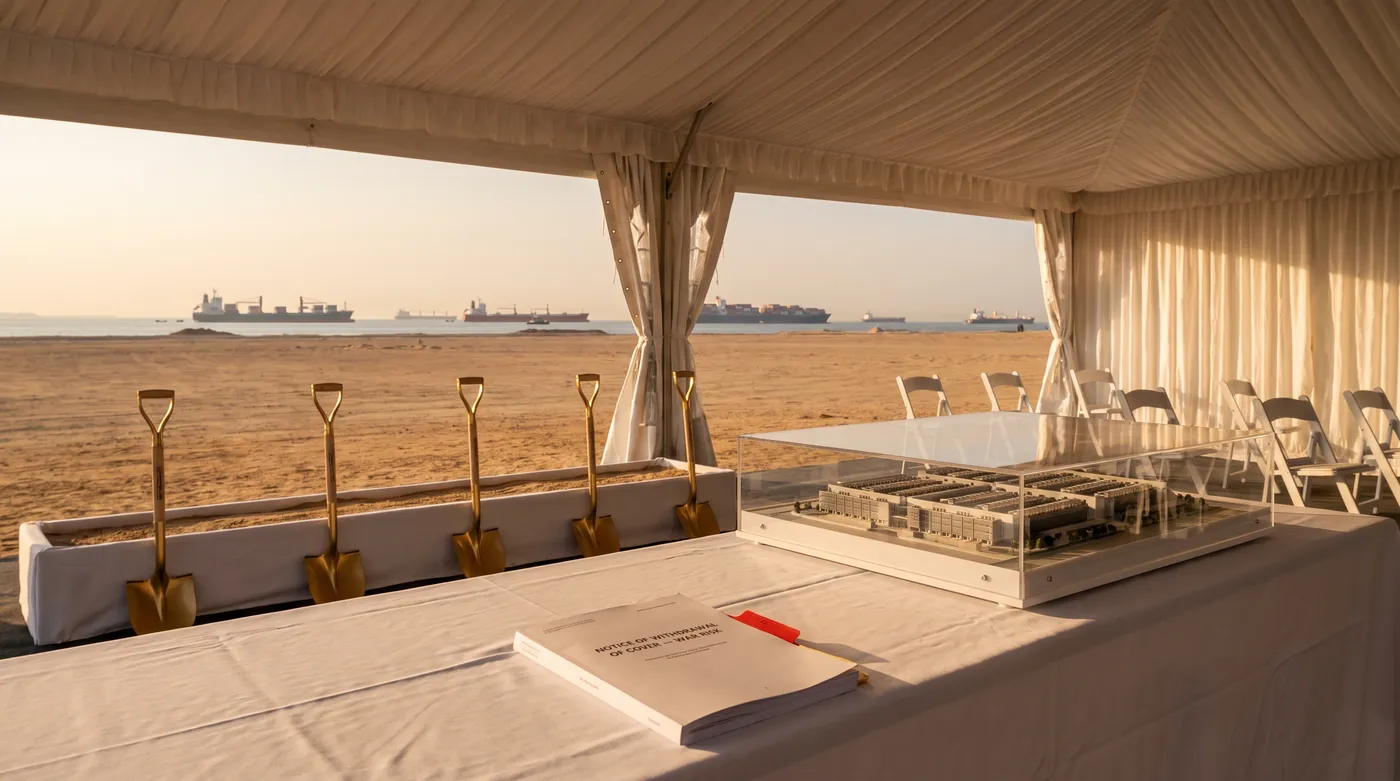
On March 20, 2026, G42 hosted the official groundbreaking for Stargate UAE outside Abu Dhabi. The campus, when complete, is to occupy ten square miles of desert and draw five gigawatts of firm power. The launch consortium is G42 itself, OpenAI, Oracle, SoftBank, and MGX, with a $30B initial spend. The chip allocations were the ones bent free by the November 2025 modification of the BIS rule. The press release described the campus as the largest single-site AI training facility ever announced. The photographs showed white kanduras, hard hats over them, shovels turning sand.
On March 26, 2026, six days later, the syndicates that write war-risk hull cover for vessels transiting the Strait of Hormuz withdrew their cover. Al Jazeera ran the story on March 3, but the operational withdrawal completed on the 26th. The reason: the Strait had been functionally closed since the February 28 strike on Iran, Dubai crude had priced through $166 on the 19th, and Howden Re’s March 27 market report put the war-risk premium at twenty to forty times its pre-crisis level. Underwriters carrying any kind of book exposure to Gulf transit calculated that the option to charge a premium for the risk was now worth less than the option to step out of the line of fire.
The two events are not connected in causation. They are connected in structure. Stargate UAE’s five gigawatts will, when built, sit on a coastline whose commercial shipping access requires state-backed reinsurance to function. The chips that fly in arrive by air freight; the steel, the concrete, the diesel for the gensets, and the GPUs themselves all transit, eventually, through Gulf logistics whose insurance backstop has now been demonstrated to be retractable on six days’ notice. The premise of the campus, that the Emirate offers a politically stable, infrastructurally redundant, capital-rich location to host frontier-model training, was acknowledged by the consortium on the 20th and tested by the global insurance market on the 26th. The campus passed the marketing test. The coastline failed the actuarial one.
Susan Strange spent the last decade of her career trying to teach a generation of international-relations students to read political economy as a four-domain question: security, production, finance, and knowledge. Power, in her account, is structural before it is relational. Whoever sets the terms in each of the four domains is structurally powerful regardless of whether they win this or that bilateral encounter. Her case study, repeated across States and Markets and The Retreat of the State, was that the United States in the post-Bretton-Woods period had structural power in all four. The dollar was the unit; the security guarantee was the law; the production base, while no longer dominant in manufacturing, set the terms in semiconductors, aerospace, and software; and the knowledge structure, universities, research labs, publishing, was the base everyone else built on.
The Gulf states’ current move is a textbook attempt, in Strange’s vocabulary, to convert relational power (oil leverage, security clientelism, the threat to switch buyers from one chip vendor to another) into structural power across her four domains. The investment in AI is the knowledge-structure bid. The campus build-outs in Abu Dhabi and Riyadh are the production-structure bid. The DIFC and ADGM expansions are the finance-structure bid. The security-structure ambition is more constrained. The UAE is not about to manufacture its own air defense. But the multi-aligned posture, which the Washington Institute has been flagging for the last year, is the closest available analogue: be useful enough to both Washington and Beijing that neither can unilaterally set the terms of access to the territory.
What the March 20 / March 26 sequence demonstrates is that the security-structure leg of the Strange typology is the one the bid cannot solve. The campus exists at the discretion of underwriters in London and Singapore who, when the geopolitics required it, calmly stepped out of the contract. The Stargate UAE consortium can build the campus. It cannot insure the trade routes that supply it. That is not a moral failing on anyone’s part. It is a description of what structural power across four domains actually means when one of the four is held by a sovereign that has been operating without serious challenge to its sea-control function since the end of the Cold War.
The actuarial detail is worth pausing on. A war-risk premium at 0.125% of hull value, the pre-crisis baseline, on a $200M very-large crude carrier comes to $250,000 per voyage. At 2.5% to 5%, the same premium runs $5M to $10M. The premium is not the headline cost; the headline cost is the bunker fuel and crew and port fees. But the war-risk line item is the line item that crosses the threshold from “commercial inconvenience” to “voyage uneconomic without state backing.” When underwriters withdraw cover altogether, the voyage does not happen on a commercial basis. It happens, if it happens, under a sovereign-backed reinsurance arrangement in which a state agrees to absorb the residual risk. The American maritime tradition for this arrangement is the War Risk Insurance program administered by the Maritime Administration; the British tradition is the K2 cover that Lloyd’s and the Mutual War Risks Associations have administered since the Falklands. The 2026 crisis was the first time in the post-1990 era that the Gulf transit required either of these regimes to be activated at scale.
What this means for the Stargate campus is more pointed than it sounds. The chips that arrive at Abu Dhabi by air freight are a small fraction of the total industrial input. This all moves by sea: the generators, the transformers, the switchgear, the chillers, the steel for the building envelope, and the spare parts inventory the campus will need over its operational lifetime. The sea routes that supply Jebel Ali and Khalifa Port require the war-risk regime to function on commercial terms. The March 26 withdrawal demonstrated that those terms are at the underwriters’ discretion, and the underwriters answer not to Abu Dhabi but to their own boards, which answer to their reinsurers, which answer ultimately to the political risk officers in London and Hartford and Singapore. The campus does not need this access today, because today the war is over and the cover has been quietly restored at higher prices. It will need it on day one of the next crisis, and the next crisis is not a question of if but when.
Daniel Yergin, who has been the dean of the petrodollar story since The Prize in 1991, has called the post-1974 arrangement a “moral and economic alliance” that traded Gulf oil for American security and American Treasuries. The mechanics were never as clean as the slogan, but the gravitational arrangement held: Aramco’s surplus went to dollar-denominated assets; Houston banks recycled the petrodollars into eurodollar markets; the Fifth Fleet sat at Bahrain; the spreadsheet balanced. In Yergin’s subsequent The Quest, written after the shale revolution scrambled the energy import math, he revised the story to allow that the bargain was decaying along the security-guarantee axis even as the financial flows continued. In the post-2023 period, with Aramco itself reporting $5.3B of AI-derived value-realization on the IR slide deck, the bargain has been amended again: the “prize” Yergin chronicled is not just oil anymore, and the raw material of intelligence production has become a line item on the same balance sheet that used to carry only crude.
The bridge Yergin would name is Aramco itself. The company’s FY2025 results, released on March 4, 2026, are the cleanest single artifact of the rebalancing. Revenue down. Dividend cut by approximately one-third: from $124B in 2024 to $85.5B in 2025. The first-ever share buyback announced. The 2026 capital spending guide cut to a band of $50–55B from a prior $52–58B. PIF construction spending, the Vision 2030 megaproject vehicle, collapsing from $71B in 2024 to $30B in 2025. Put together, these are the numbers of a hydrocarbon balance sheet that has been instructed by its political principals to return cash to shareholders (in this case the Saudi state and PIF), to stop pretending that NEOM and The Line are the future, and to make room on the capital allocation page for whatever the next vehicle is going to be. The next vehicle, in Saudi Arabia, is HUMAIN, the PIF-controlled AI champion launched in 2025 with explicit chip allocations under the November rule modification. In the UAE, it is MGX.
The buyback line is the tell. Aramco had never bought back its own shares. The whole point of the 2019 IPO was to raise cash for PIF, which would then deploy it into the diversification of the kingdom away from oil. Six years later, with the diversification project visibly retrenching and the dividend cut by a third, the company is returning capital to its principal shareholder by buying back shares it had recently issued. The motion looks circular because it is. The cash is being moved from one balance sheet (Aramco) to another (PIF / the Saudi state) without being deployed into the megaprojects that justified the IPO in the first place. What it will be deployed into, HUMAIN, US AI exposure, additional MBS purchases, broader Treasury holdings, is the open question. The structure says: the megaproject era is over. The next era’s instruments are not yet large enough to absorb the surplus at the rate that surplus is being generated.
The PIF construction-spending collapse, from $71B in 2024 to $30B in 2025, a fifty-eight percent year-over-year cut, reads the same way. NEOM, The Line, Trojena, Qiddiya, the Diriyah Gate development: each was the kind of megaproject whose function in the Vision 2030 architecture was as much narrative as it was economic. Each consumed concrete, steel, and labor on a Roman scale. Each was financed in part out of PIF’s Aramco-dividend allocation, the petrodollar surplus put to work at home rather than recycled to foreign assets. The 2025 cut to $30B does not mean the projects are cancelled. It means the financing schedule has been deferred, the build-out compressed in scope, and the PIF balance sheet returned to a posture more focused on liquid, deployable assets. The visible second-order effect is that Chinese and Korean construction firms with Vision 2030 contracts have had milestone payments rescheduled. The third-order effect is that some of the $41B of project-finance debt PIF carries against the megaprojects has been refinanced at terms the kingdom would not have accepted in 2022.
This rebalancing in Riyadh has its own internal logic, distinct from but related to the Abu Dhabi pattern. The Saudi state is choosing to fund HUMAIN and the corresponding AI-domestic and AI-exposure positions out of a budget that is no longer expanding the Vision 2030 megaproject envelope. That is what “rebalancing” looks like in practice: not new money on top of old, but old money moved off one line and onto another. The 2024 build-out of NEOM was, in part, the political-economy claim that Saudi Arabia could diversify by physical investment within its borders. The 2025 retrenchment, combined with the HUMAIN launch and the chip allocations, is the more honest acknowledgment that the diversification asset of equivalent scale to the hydrocarbon surplus is not a desert megaproject. It is a thematic exposure to US AI infrastructure routed through a sovereign vehicle. The same logic operates more cleanly in the UAE because the UAE did not commit to a NEOM-scale physical-megaproject narrative in the first place; its diversification has always been more financialized.
This is the Saudi version of the rebalancing. The UAE version is faster and more concentrated, MGX, G42, Stargate UAE, and the rolling MGX positions in US labs, because the Emirati state moves through smaller, more agile vehicles and because Tahnoon’s portfolio committee can clear a $30B Anthropic co-lead in less time than the PIF board needs to update a memo. Both states are answering the same question. The petrodollar spreadsheet, in its 1974 form, no longer balances. Something has to replace the line where U.S. Treasuries used to absorb the surplus and provide both yield and security guarantee. Compute is the candidate.
III. The Pipes
The mechanics of how a barrel of Saudi crude becomes a GPU in a Phoenix data center are not a single pipe. They are three, running in parallel, with different timing and different intermediaries, and they have been operating at increasing pressure for the last twenty-four months.
The first pipe is the one Yergin would recognize. Hydrocarbon receipts go into a sovereign-wealth account, PIF in Saudi Arabia, ADIA and Mubadala and ADQ in Abu Dhabi, and the sovereign account allocates into U.S. AI labs, hyperscaler campuses, and the equipment vendors that supply both. The visible nodes are HUMAIN (PIF’s AI champion), Lucid (PIF-controlled EV maker integrating AI compute), and Electronic Arts (acquired by PIF in 2025 as a content channel); on the Abu Dhabi side, Mubadala’s $4.9B in disclosed AI investments in 2025 and MGX’s confirmed positions in Anthropic, OpenAI, xAI, Stargate, and Aligned. The first pipe is the one the public press covers.
The second pipe is the one that gets less attention because it doesn’t cross a border. Hydrocarbon receipts go to the SWF, the SWF allocates into Gulf real estate and zonal finance, and the zonal-finance vehicles in turn raise the AUM that anchors regional credit markets. The Dubai International Financial Centre, the DIFC, a thirty-acre zone of English common law grafted onto Dubai, reported $700B of assets under management at the end of 2024, up 58% in a year. Abu Dhabi Global Market, the corresponding ADGM zone on Al Maryah Island, reported AUM growth of 36% in 2025, on top of a first-half 2024 surge of 226%. Both numbers are extraordinary by any historical standard for zonal finance.
Quinn Slobodian, in Crack-Up Capitalism, traced the rise of zones, SEZs, free ports, charter cities, low-tax enclaves, as the late-twentieth-century answer to the difficulty of changing the rules of a whole state at once. You cannot rewrite Egyptian commercial law to suit a London hedge fund without political cost. You can lay an enclave of English common law on a few acres of desert, give it its own courts and its own arbitration regime, and let the hedge fund deal with the enclave. The DIFC and ADGM are the model in its purest contemporary form. They are not regulatory arbitrage at the margin; they are jurisdictional substitution at the core, with the substituted-out jurisdiction (the federal UAE or, in the DIFC case, the Emirate of Dubai) deliberately holding its civil-law and political controls outside the zone’s perimeter.
What is interesting about the 2026 phase is that the two zones have begun to compete with one another. The DIFC opened a private-credit regulatory regime in March, designed to attract the private-credit funds, Apollo, Blackstone, Ares, Sixth Street, and increasingly Gulf-owned imitators, that have become the dominant lenders into the AI capex stack. ADGM, on a different timeline, tightened its anti-money-laundering and crypto-asset rules in the same quarter, positioning itself as the more institutional venue for compliance-sensitive sovereign and pension capital. The two zones are doing the Slobodian dynamic within a single federation, each trying to specialize into the niche the other is leaving open. The federation is not, in the conventional sense, choosing. It is permitting the competition because each zone is netting AUM growth no other instrument in the region can produce.
The third pipe is the one nobody likes to talk about. Sanctioned capital, capital fleeing other regimes for any of the usual reasons, and capital that simply does not want to disclose origin goes to Dubai via real estate, via DMCC-licensed trading companies, via the crypto exchanges that operate under VARA, and from there finds its way into the AI/crypto stack. Russian inflows into UAE real estate exceeded $10B in 2024 by most external estimates. The UAE was removed from the FATF grey list in March 2024, which made the third pipe institutionally cleaner without making it materially smaller. The visible end of this pipe is Palm Jumeirah at AED 4,818 per square foot, the second-quarter 2026 wealth-management headcount at DIFC north of 410 firms, and the steady drumbeat of OFAC enforcement actions that name UAE shell entities as nodes in this or that proliferation or sanctions-evasion case. The pipe exists; it is large; it is unsystematic to estimate precisely; and it is part of why Dubai’s Q1 2026 real-estate print arrived at AED 252B with foreign buyers above 50% for the first time even as the local sea lane was being declared uninsurable.
Saskia Sassen, in her work on global cities, has spent decades describing precisely the kind of urban platform Dubai is becoming. The global city, in her account, is the node where the de-nationalized financial-services activity of multinational firms is hosted, where the immigrant workers who staff that activity live, and where the urban infrastructure is itself a financialized product. The 52% foreign-buyer share, the 410-plus wealth-management firms, the AED 252B quarter through the closed Strait, the persistence of the price level through war-risk insurance withdrawal: these are, in the Sassen reading, the marks of platform depth. Dubai is no longer a regional gateway whose price level tracks the local cost of oil; it is a global node whose price level tracks the global demand for portable jurisdiction. The fundamentals are not Dubai-the-emirate. They are Dubai-the-platform-for-people-and-capital-that-need-Dubai-to-exist.
Mike Davis, in Evil Paradises and his subsequent writing on the Gulf, would read the same numbers and see a speculative monoculture. Palm Jumeirah at $1,300 per square foot is not the marginal cost of waterfront real estate in a coastal economy. It is the price of an option on the continued existence of a particular legal, fiscal, and infrastructural regime. The option pays out when the regime persists; it goes to zero if the regime fails. The Davis reading does not require predicting which way that option goes; it requires noting that the price level depends on a configuration of state-formation, foreign-policy posture, expat labor regime, and capital-flight permissiveness that no economic actor independently controls. The platform is durable. It is not unconditional.
Both readings survive the Q1 2026 print. Sassen’s reading says: see how robust the platform is, even through a regional war. Davis’s reading says: see how high the option premium has gone, on the same evidence. The test, as Davis would put it, comes when Hormuz reopens permanently and the AI capex cycle slows. If Dubai’s prices hold through both, Sassen wins. If they crater on the combination, Davis wins. Both readings are honest. Neither is yet falsifiable.
Where the third pipe interacts with the first two is in the steady redirection of capital that, twenty years ago, would have parked in U.S. Treasuries or London real estate, into AI-adjacent positions. A Russian oligarch’s Dubai LLC, holding a $40M penthouse, has a wealth manager at DIFC who allocates the cash equivalents into a multi-asset basket. The basket has an allocation to private credit. The private-credit allocation has exposure to the data-center capex stack, because that is where the private-credit market is currently underwriting. The capital does not need to identify itself as “AI exposure” to become AI exposure. The plumbing routes it there because the plumbing has been built to.
Hydrocarbon receipts → SWF account (PIF, ADIA, Mubadala, MGX) → US AI cap-stack (Anthropic, OpenAI, xAI, Stargate, Aligned) → AI cap-stack supports US semiconductor demand → chip-export-control regime bends to permit the demand to be served from Abu Dhabi → Abu Dhabi’s strategic position relative to Washington strengthens → the next round prices through the Gulf bid → the cycle repeats at a higher concentration → the marginal allocator becomes structurally indispensable → the marginal allocator is in Abu Dhabi, not Washington → the spreadsheet has been amended
This is the structural fact the steelman has the hardest time absorbing. The thematic-overlay framing assumes the AI bet is a discrete decision made by a discrete allocator at a discrete moment. The plumbing framing is harder: the AI exposure is being accreted into Gulf balance sheets by the mechanical action of the available investment vehicles, because the available vehicles have all, over the last twenty-four months, restructured themselves to channel marginal capital toward the AI build-out. The MGX board can choose to deploy or not. The DIFC private-credit fund taking in $200M from a Russian wealth manager cannot. The exposure accretes regardless of any decision.
IV. The Physics Does Not Bend
Vaclav Smil has been the patient physical-systems scientist for several generations of energy and materials policy debate. His books, Energy and Civilization, How the World Really Works, Numbers Don’t Lie, share a single rhetorical posture: before you tell me what is going to happen, let us first establish what the laws of physics and the engineering reality permit. He is not a doomer; he is a calibrator. His function in any conversation about the future is to make the participants sit with the actual unit conversions.
Apply him to Stargate UAE. Five gigawatts of firm power at a single site is, in the contemporary grid, a meaningful fraction of a small country’s electrical demand. To put it in context: a typical large nuclear unit produces about one gigawatt. A new combined-cycle gas plant produces between 500 megawatts and 1.5 gigawatts depending on configuration. Five gigawatts of firm draw on a single campus implies either five large gas plants, five nuclear units, or some hybrid of gas-with-storage that, in 2026 in the UAE, is not yet a deployed technology at scale. NEOM, on the Saudi side, has spoken of running on 1.5 GW of “fully renewable” capacity. The Stargate UAE consortium has spoken more honestly: the campus will run on whatever firm power the local grid can supply, with firmness being the operative word. In the UAE in 2026, firmness means gas.
The water number is the other one to dwell on. A data-center campus at hyperscale uses water for evaporative cooling at rates that, when aggregated across the Saudi build-out, came to roughly 15 billion liters in 2024. The DGDA’s own projection for the 2030 build-out is 426 billion liters per year. Saudi Arabia is a desert with effectively no native fresh water; the 426 billion liters will come from desalination, which is itself an energy-intensive industrial process powered, again, by gas. The arithmetic compounds: gas to generate electricity for compute, gas to generate electricity for desalination, water from desalination for cooling, and a heat-rejection cycle in a desert climate that runs at sustained 45°C summer ambients.
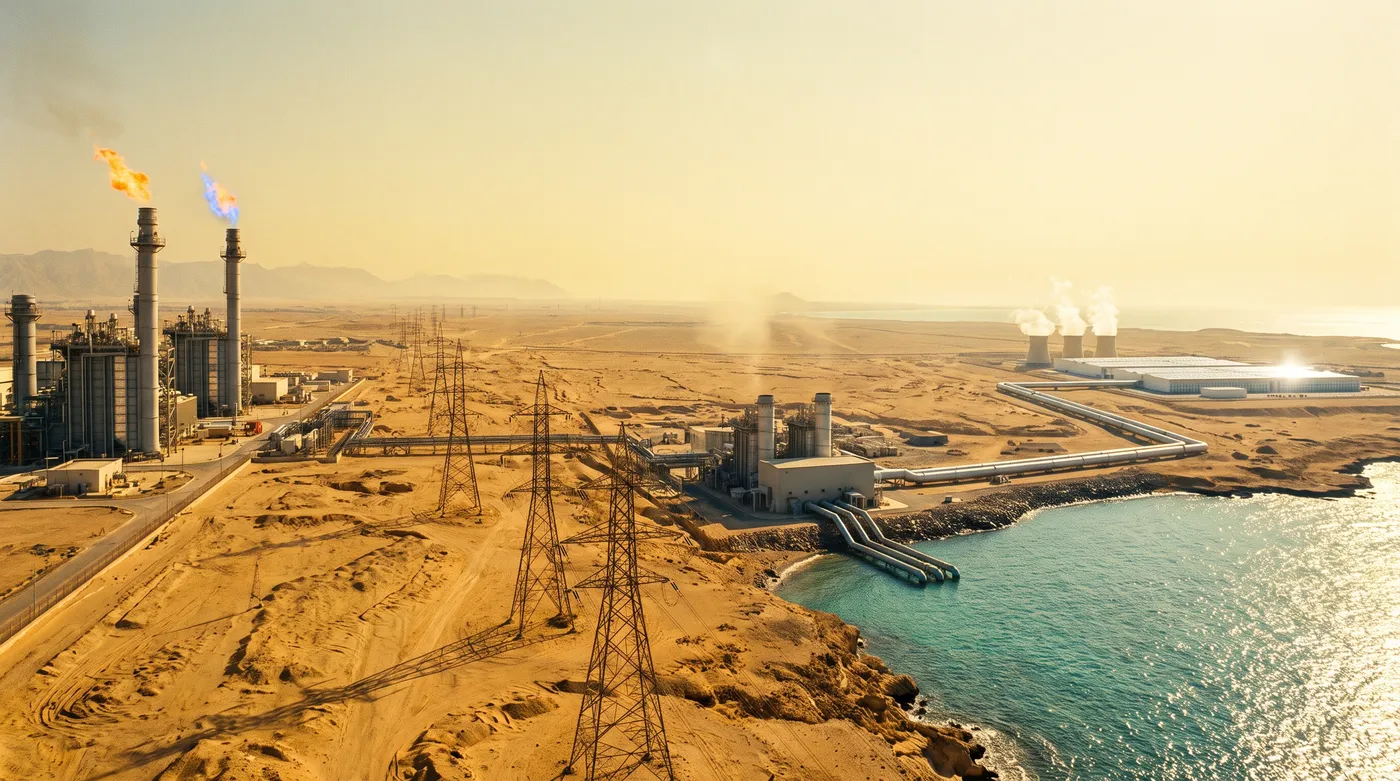
Smil’s point in any such accounting is not that the project is impossible. It is that the project requires honesty about what it costs and what it depends on. Stargate UAE’s five gigawatts will, in the medium term, be gas-firmed regardless of the renewable headline; the desalinated water cost is real and grows with the build-out; the asymmetry between the marketing materials (“sovereign AI,” “largest single-site facility”) and the engineering reality (gas-plus-desal in a 45°C heat-rejection environment) is the kind of asymmetry that, in his vocabulary, eventually shows up on a balance sheet.
The asymmetry that matters most for this article is a different one, however. Most of the compute the Gulf is financing will not run in the Gulf. The MGX position in Aligned Data Centers builds capacity in Texas, Arizona, Virginia, and the Pacific Northwest. The Stargate UAE campus is the showpiece; the dollars MGX is co-investing into Aligned, into OpenAI’s domestic campus expansions, into xAI’s Memphis build-out, into Anthropic’s training infrastructure, sit predominantly on US soil. The Gulf is providing the capital. The compute, the jobs, the electric load, the talent, almost all of it, stays in the United States. The Gulf gets a board seat, a thematic exposure, a strategic relationship, a chip allocation, and the political signal of being indispensable to the American AI industry. The United States gets the campuses.
Put a different way: the deal that the United States has on offer to the marginal Gulf allocator is a deal in which the Gulf supplies the financing and the United States supplies the build-out, retains the operational control, and accrues the long-run productivity gains. This is not, on its face, a bad deal for the United States. It is the kind of deal an industrial economy with deep capital markets and a constrained domestic savings base has historically been able to extract from a creditor economy with a savings surplus and limited deployment options. It was the deal the United States ran with Japan in the 1980s, when Japanese capital financed Rockefeller Center, Pebble Beach, and a large fraction of the Treasury market, and the deal it ran with China in the 2000s, when PBoC reserves underwrote the US current-account deficit and the housing bubble that followed. In both cases the United States got the assets and the creditor got the paper.
The current deal differs in one structural respect that matters. In the Japan and China cases, the creditor was a sovereign government with a public-facing political economy and a long-horizon mandate. The decisions to allocate to Treasuries were made by institutions whose decision rules were, in principle, knowable. The current deal has the marginal allocation passing through a sovereign investment vehicle whose board is one principal, whose mandate is thematic rather than benchmark-tied, and whose decision cadence is quarterly rather than annual. The deal is more concentrated, more agile, and harder to negotiate against. The chip-export-control bend in November 2025 is the visible artifact of the harder negotiability. The Biden administration did not extract reciprocal concessions from Abu Dhabi for the bend; the bend was made because the alternative, the AI cycle priced without the marginal Gulf allocation, was unacceptable.
This asymmetry is precisely the blind spot in the steelman. A reader who notes “these are tiny percentages of GCC SWF stock” is correct about the stock-level allocation but wrong about the operational effect, which is that the marginal dollar at the round-pricing margin is the one that matters. The 0.2% of stock that gets reallocated each year is the 0.2% that sets the cap-table price on the round. The other 99.8% of the stock has, by definition, already been allocated and is not negotiating for fresh exposure. The new flow is not an overlay. It is the price-setting flow.
Brad Setser, the cross-border capital-flow specialist whose Council on Foreign Relations work has tracked sovereign-wealth and reserve flows for two decades, has been making the point in his writing through 2025 and 2026: the headline Gulf AI flows are dramatic at the margin and small at the stock, and the asymmetry is structural: the United States has no comparable instrument. There is no American sovereign-wealth fund. There is no entity, public or private, that holds $5T in unencumbered assets that can be reallocated at the discretion of a single political principal. The closest American analogues are the federal pension funds (CalPERS, the Federal Retirement Thrift Investment Board, the state pension systems), all of which are constrained by fiduciary law and benchmark-tracking obligations that prevent thematic concentration of the kind MGX is doing.
Setser’s observation, read alongside the November 2025 BIS rule modification, is structural rather than incidental. The chip export controls bent for Abu Dhabi because the United States needed Abu Dhabi to keep writing checks, not because the security argument for the original rule had changed. The export-control regime, which the Biden administration in October 2023 had built around the proposition that the high-end AI compute supply chain was a US national-security asset to be conserved, was modified in November 2025 to permit the export of that asset to a sovereign whose stated purpose was to invest in the same AI labs the United States was building. The administrative bend is the price the United States paid for the marginal allocation. It was paid because the alternative, the marginal AI cap-table dollar coming from a sovereign with whom no security relationship existed, was worse.
It is worth dwelling on what “worse” means here, because the implicit comparison is doing a lot of work that does not get unpacked in the policy discourse. The 2023 chip-control regime was built on the premise that the United States could simultaneously (a) deny the People’s Republic of China access to the high-end stack and (b) retain unimpeded access for itself and its allies. The 2025 modification quietly conceded that this dual maintenance required Gulf capital, and that Gulf capital required Gulf chip access, and that the cleanest way to handle the contradiction was to redefine the Gulf as inside the perimeter for purposes of the rule. The redefinition is not in the rule’s preamble; it is in the modification’s annexes. The choice to keep this story administrative rather than treaty-grade is itself a choice about how much of the structural shift gets to be politically visible.
The Smil insight returns at this point. The export-control regime is, at root, a regime about who gets to put energy through silicon. The chips themselves are the material commitment; the campuses are where the energy lands; the water is what permits the heat rejection in arid climates. The November 2025 modification reallocated the silicon. It did not, and could not, reallocate the energy or the water. The energy and the water remain located where they are physically located: predominantly in the United States, secondarily in select Gulf locations, and not at all in the jurisdictions the regime was built to exclude. The Gulf bid is, in the end, a bid for a co-location partnership in which the Gulf supplies the dollars and the political relationship; the United States supplies the physical industrial base. The asymmetry is structural, and it is the asymmetry that ought to make the steelman’s “mutual interest” framing more rather than less convincing, provided one is honest about whose mutual interest is being secured at whose expense, and on what timeline.
V. The Honest Reckoning
This article is a follow-on to the platform’s own Century Bond and the Three-Year GPU case study, published on March 12, 2026, seventy-six days before this piece. That earlier analysis traced the duration mismatch between the financing horizon of the AI capex cycle and the depreciation horizon of the underlying hardware. It named the cycle as a transition from petrodollar to computedollar. It did not name the upstream actor.
The under-named actor was Sheikh Tahnoon. The bridge between hydrocarbon receipts and US compute capex is not Washington’s policy choice. It is Abu Dhabi’s portfolio choice, executed through MGX, G42, and the broader Tahnoon-chaired complex. The century bond is, in some non-trivial sense, the secondary market for his primary-market decision. The earlier piece treated the US Treasury auction calendar and the hyperscaler capex stack as the active subjects and the Gulf as a passive source of demand. That framing was not wrong on the numbers. It was wrong on the agency. The agency is upstream.
The case study also used the insider vocabulary of the AI capital cycle, “hyperscaler capex,” “scaling laws will hold,” “the $523B RPO backlog,” without flagging that this is the rhetoric of a power class. The terms are accurate; their unmarked deployment is itself a position. This series will name them as such when it uses them. That is not retraction. It is naming what the prior piece could not yet name with the evidence then available, and naming what it could have named but didn’t.
The honest-reckoning move is not a ritual. It is a methodological commitment to keep current with the analyst’s own legitimacy position inside the system being analyzed. The platform’s product copy, “interdisciplinary curriculum,” “case studies at CCC junctions,” “analytical frameworks,” inhabits the same legitimacy market as “responsible scaling,” “American Dynamism,” and “sovereign compute.” Naming this briefly, without ritual self-flagellation, without the false humility that becomes its own credential, earns the right to use the propaganda frame on the texts the rest of the series will read straight.
What the case study could not see in March was that the duration mismatch was about to stop being theoretical. Article 2 of this series, on Kevin Warsh’s arrival at the Federal Reserve and the 30-year Treasury yield breaching 5%, traces what happened when it did.
VI. What the Spreadsheet Looked Like in 1974, and What It Looks Like Now
The original spreadsheet is on the public record. After the 1973 oil shock and the Saudi-led OPEC embargo, the Nixon Treasury, through William Simon as Treasury Secretary, with extensive negotiation with the Saudi finance ministry, engineered the arrangement that the political-economy literature has since called the petrodollar recycling system. Saudi Arabia would price its oil in U.S. dollars. The dollar-denominated surplus would be invested predominantly in U.S. Treasury securities, with the precise composition of the Saudi holdings kept officially confidential at Saudi request, an unusual exemption that, in 2016, the Treasury finally disclosed under congressional pressure. In return, the United States would provide a security guarantee: the Fifth Fleet in Bahrain, AWACS sales, a tacit commitment to underwrite Saudi territorial integrity against Iranian or other regional aggression. The arrangement was extended, mutatis mutandis, to the UAE after independence and to the smaller Gulf states over the following decade.
The spreadsheet, in its 1974 form, was three lines. Hydrocarbon receipts in. U.S. Treasuries out. Security guarantee provided. The balance condition was that the United States needed the Treasury demand and the Gulf needed the security, and the arrangement persisted as long as both halves remained credible.
Several things have happened in the last decade to amend that spreadsheet. The first is that Treasury demand from the official Gulf sources has not kept pace with US issuance. The post-2008 fiscal expansion, accelerated by the Trump tax cuts of 2017 and the Covid-era fiscal response, has produced US Treasury supply at a rate that no sovereign demand source can absorb in pace. The second is that the security guarantee has visibly degraded along several axes: the 2019 Abqaiq attack on Saudi oil infrastructure went unanswered by US military response; the 2024 Houthi missile and drone campaign against Saudi territory and against UAE territory was answered partially and inconsistently; the February 2026 strike on Iran was conducted without GCC consultation and produced the Hormuz closure that the GCC then had to absorb. The third is that the Gulf has, for these reasons and others, accumulated genuine ambivalence about whether the security guarantee is worth the level of dollar exposure the original spreadsheet implied.
The new spreadsheet, taking shape in 2024–2026, has more lines. Hydrocarbon receipts in. U.S. Treasuries out, at a reduced share. AI cap-stack exposure out, at an increasing share. Domestic megaproject spend out, at a decreasing share. Real-estate-platform investment out, at an increasing share. Zonal-finance AUM expansion, at a high share. Sanctioned and capital-flight inflows, at a steady share. Security guarantee provided, on degraded terms. Multi-aligned strategic posture maintained, with bilateral relationships to both Washington and Beijing. The new spreadsheet has more entries because the world that requires the spreadsheet has more variables.

The accounting question is whether the new spreadsheet balances. The Sassen reading says it does: the Gulf is constructing a multi-asset, multi-jurisdictional, multi-aligned platform that, in aggregate, has more degrees of freedom than the 1974 arrangement and is therefore more robust. The Davis reading says it doesn’t: the new arrangement’s reliance on AI exposure as the diversification engine is itself a concentrated bet, the cycle correlation between US AI capital and Gulf real estate is positive rather than the diversification negative the literature would want, and the apparent durability of the platform is the durability of the option premium, not the underlying.
The position of the United States in the new spreadsheet has likewise been amended, in ways that are easier to see from outside than from inside. The 1974 arrangement gave Washington two things it valued in roughly equal measure: an inexhaustible buyer for its sovereign debt and a security partner in the most important energy-producing region in the world. The 2026 arrangement gives Washington a more conditional version of both. The Gulf is still a Treasury buyer, but a smaller share of the marginal Gulf surplus is going to Treasuries. The Gulf is still a security partner, but the partnership now requires Washington to extend favorable export-control treatment as a condition of continued cooperation. The asymmetry has not reversed; it has narrowed. What Washington could once take for granted, it must now negotiate for.
This is the structural change that explains, more cleanly than any partisan account, why the chip-control regime bent in November 2025 and why the bend has not been politically controversial despite being a significant departure from the policy posture the same administration had publicly defended for the prior two years. The bend was not a betrayal of the regime; it was the price the regime quietly required to remain operative. The American policy class largely understood this, which is why the bend was negotiated and announced as an administrative matter rather than as a treaty modification. Treaties require legislative ratification and produce a political debate. Administrative modifications happen on a Tuesday with a Federal Register notice and an agency briefing for the trade press. The Tuesday-and-Federal-Register approach is what the new spreadsheet’s political economy looks like in operation.
The series’ position, which the next four articles develop, is that the question is undecidable without naming a sixth variable that the Strange/Yergin/Sassen/Davis/Smil/Setser literature does not, because their analytical machinery does not require it: the propaganda layer. The five subsystems, monetary, energy, capital-structure, strategic, and the Gulf-side capital reallocation that this article documents, have each produced their own admission of the structural fact. The reason the admissions have not collectively registered is that the language used to surround each admission is a vocabulary engineered to keep the others out of view. The fourth article in this series takes that vocabulary as its object. The other articles take the admissions as theirs.
Companion piece: The energy-and-strategy admission this article documents has a structural sibling in the strategic admission of the Trump–Xi summit in Beijing on May 13–15, when no joint statement was issued and the bond market priced the empty summit and the Powell–Warsh handoff as a single signal. Article 5: The Kowtow traces that conversation; it should be read against this one. The Gulf is hedging because Washington can no longer guarantee. The bond market is repricing because Washington can no longer command. The two facts are the same fact in different registers.
VII. What Is on the Cover
The cover image for this series, when the founder commissions it, is intended to be a portrait, or near-portrait, of Sheikh Tahnoon at a window above the Abu Dhabi skyline with a server-rack reflection layered onto the glass. The compositional choice is deliberate. The point is not the man. The point is what the man stands in for: the position of marginal allocator with global discretion has migrated.
For roughly fifty years, from the Saudi-Treasury accord of the mid-1970s through the dotcom-era recycling of Asian central-bank reserves through Greenspan’s Treasury market through the post-2008 era of the Fed-as-buyer-of-last-resort, the role of marginal global allocator was held by a rotating cast of public and quasi-public institutions whose decisions were legible to American policy. SAMA in Riyadh. The People’s Bank of China through the 2000s and early 2010s. The Bank of Japan’s endlessly patient appetite for dollar assets. The European Central Bank during the QE phase. In each case, the allocator was an institution whose mandate, governance, and constituencies were known to American counterparts and whose decision-making cadence was synchronized with American policy cycles.
That synchronization has, over the last five years, frayed. SAMA still holds Treasuries, but the marginal Saudi allocation now passes through PIF and HUMAIN. The PBoC has been a net seller of Treasuries since 2022 and is now running a different book entirely. The Bank of Japan is shrinking its balance sheet. The ECB is at the politically near-impossible task of unwinding pandemic-era purchases without precipitating a peripheral-sovereign crisis. The marginal allocator with the bandwidth to underwrite the AI capex cycle is, by elimination, the Gulf, and within the Gulf the entity with the cleanest decision rights and the fewest constituencies to placate is Tahnoon’s MGX/G42 complex.
This is not an argument that one man is in charge of the world. It is an argument that the role of marginal allocator with global discretion is currently occupied by an actor whose decisions are made through institutional structures and time horizons that are not synchronized with American policy and whose preferences are not legible to American politics in the way the SAMA and PBoC preferences were. American AI capital’s availability now depends on the routine outcome of a portfolio committee whose minutes are not posted and whose chair owes no accountability to a US-facing constituency. The committee’s decisions have been, on the visible record, supportive of the American AI cycle. There is no public record of the criteria by which that support would be reduced or withdrawn, and no institutional channel through which the United States could constructively negotiate the criteria, because no such channel exists between an emirate and a republic. The chip-export-control bend in November 2025 was the closest available analogue. The bend was administrative; it was not a treaty.
The series’ second article takes up the monetary side of the same problem: the day Kevin Warsh was confirmed, the 30-year Treasury breached 5%, SpaceX filed publicly, and the bond market reset the price of dollar duration. Read together, the two articles describe the upstream and downstream sides of the same flow. Tahnoon’s portfolio committee chooses to underwrite American AI; the underwriting requires capital flows from the Gulf into US labs and infrastructure; the flows require a dollar-denomination architecture that the monetary subsystem now has to defend at a different equilibrium yield than the one that prevailed when the deals priced.
The mechanical coupling is worth stating in plain terms. When MGX writes a check into Anthropic at a $380B post-money valuation, the implicit cost-of-capital assumption embedded in the round is the prevailing dollar long rate plus an equity risk premium plus a private-illiquidity premium plus a thematic adjustment. Each of those components is, in current market conditions, near a historical low. The long rate had been suppressed by Fed term-premium operations for roughly fifteen years; the equity risk premium has been compressed by the AI narrative itself; the private-illiquidity premium has been ground down by the proliferation of secondary-market and continuation-vehicle exit routes; the thematic adjustment is negative on the AI side because demand for thematic exposure has exceeded supply. If any one of those components moves, and the next article documents the long rate moving, the implicit valuation of the existing portfolio resets. The MGX check at $380B is then a check that, at the new cost of capital, is worth a different number on the same future cash flows. The check has been written. The future cash flows have not yet been delivered. The reset is what happens to everything in between.
To be precise about what this article does not claim: it does not claim that the Anthropic round will turn out badly, or that the Stargate UAE campus will be unbuilt, or that the MGX portfolio will be marked down. None of those is a forecast; each requires information the public record does not contain. The article claims something narrower and more structural. The pricing of the round, the build, and the portfolio assumes a continuity in the underlying dollar-duration architecture that the next article will document as having been broken on a specific Wednesday in May. The pricing has not yet been reset to reflect the break. The reset, when it arrives, will arrive across the whole stack at once, because the stack was priced against the same architecture.
The Stargate UAE consortium broke ground on March 20. Six days later, the maritime insurers withdrew war-risk cover for the same coastline. Both facts entered the public record. Neither was discounted by the campus build, by the Q1 Dubai real-estate print, or by the MGX deployment pace. The pricing of the AI infrastructure says the spreadsheet still balances. The pricing of the war risk says the line item that secures the spreadsheet has been quietly removed. The contradiction is not yet a price event. The series’ thesis is that the next five articles document the conditions under which it becomes one.
Sources
MGX, Stargate UAE, and the AI deals
- G42. “Global Tech Alliance Launches Stargate UAE.” Press release, March 20, 2026.
- Sebastian Moss. “US and UAE plan to build 5GW AI data center campus run by G42 and American hyperscalers.” Data Center Dynamics, March 2026.
- Bloomberg News. “OpenAI, Anthropic Deals Power Abu Dhabi’s $100 Billion AI Bet.” February 17, 2026.
- Abu Dhabi Media Office. “Tahnoon bin Zayed chairs MGX’s second board meeting of 2026.” Government release, Q1 2026.
- U.S. Bureau of Industry and Security. Final rule modification on advanced computing items, November 2025. Federal Register entry.
- Mubadala Investment Company. 2025 annual review, AI portfolio disclosures.
The Hormuz crisis and oil markets
- Howden Re. “Strait of Hormuz: war-risk market report.” March 27, 2026.
- Spencer Kimball. “Middle East crisis: Iran, US, shipping, oil tankers, Strait of Hormuz.” CNBC, March 3, 2026.
- Al Jazeera. “Maritime insurers cancel war-risk cover in Gulf; will it spike energy costs?” March 3, 2026 (operational withdrawal completed March 26).
- Platts / S&P Global Commodity Insights. Dubai crude assessments, March 2026 daily series. (Editor: cross-check intraday $166 print.)
- Editor verification note: The framing of the February 28 Iran strike trigger should be cross-checked against primary sources. Wikipedia citations available at publication mention an “assassination of Khamenei” claim that requires independent corroboration; this article does not assert it as fact.
Aramco and the hydrocarbon balance sheet
- Saudi Aramco. “Fourth Quarter and Full Year 2025 results press release.” March 4, 2026.
- Saudi Aramco. 2025 annual report and management discussion (including the AI-derived value-realization disclosure of $5.3B).
- Middle East Briefing. “Saudi Arabia: Public Investment Fund strategy shift 2026.”
- Public Investment Fund (PIF). 2025 annual report, construction-spending disclosures.
- Yergin, Daniel. The Prize: The Epic Quest for Oil, Money & Power. Simon & Schuster, 1991.
- Yergin, Daniel. The Quest: Energy, Security, and the Remaking of the Modern World. Penguin, 2011.
Dubai real estate and zonal finance
- Dubai Land Department. “Dubai’s real estate transactions surge 31% to reach AED 252 billion in Q1 2026.” Government release, Q1 2026.
- Dubai International Financial Centre. 2024 annual review; AUM and wealth-management firm count.
- Abu Dhabi Global Market. 2025 annual review; AUM and registered-firm disclosures.
- FATF. UAE removal from grey list, March 2024. Public statement.
- Slobodian, Quinn. Crack-Up Capitalism: Market Radicals and the Dream of a World Without Democracy. Metropolitan Books, 2023.
- Sassen, Saskia. The Global City: New York, London, Tokyo. Second edition. Princeton University Press, 2001.
- Davis, Mike, and Daniel Bertrand Monk, eds. Evil Paradises: Dreamworlds of Neoliberalism. The New Press, 2007.
Sovereign wealth and capital flows
- Setser, Brad. Council on Foreign Relations “Follow the Money” blog; 2025–2026 entries on Gulf reserve management, SWF deployment, and US Treasury demand composition.
- U.S. Department of the Treasury. TIC (Treasury International Capital) System data; 2024–2026 monthly major foreign holders releases.
- SWF Institute. 2025 Gulf SWF aggregate AUM and asset-class disclosures.
- U.S. Office of Foreign Assets Control. Selected 2024–2026 enforcement actions naming UAE-incorporated entities.
Scholar references and theoretical frameworks
- Strange, Susan. States and Markets. Pinter, 1988 (second edition).
- Strange, Susan. The Retreat of the State: The Diffusion of Power in the World Economy. Cambridge University Press, 1996.
- Strange, Susan. Mad Money: When Markets Outgrow Governments. University of Michigan Press, 1998.
- Smil, Vaclav. Energy and Civilization: A History. MIT Press, 2017.
- Smil, Vaclav. How the World Really Works. Viking, 2022.
- Smil, Vaclav. Numbers Don’t Lie. Penguin, 2020.