
In May 2026, a fintech called Ramp took its own internal spreadsheet-search tool, handed the job to a Chinese-designed open-weight model roughly a tenth the size of a frontier system, fine-tuned it for a few hours on nothing but Ramp's own proprietary data, and watched it beat Claude Opus 4.6, the frontier model, the expensive one, the one that is supposed to know more about everything, at Ramp's own task. Not by a landslide. Four points of accuracy, on one internal benchmark, reported by the vendor who sold Ramp the fine-tuning. But four points is real, and it is the cleanest evidence in this entire series for one specific, load-bearing idea: that a company's own data, mapped and governed, can out-perform somebody else's genius. Palantir has built the best balance sheet in this series on that idea. The market has built one of its most extreme multiples on it, in the same six months, and has mostly declined to ask the Buffett question: is this a moat, or a story about a moat, priced as though the moat were already dug and paid for.
Part 6 of The Stack, one rung from the top. We arrive here from the harness, the orchestration layer that lets an enterprise route spend around a frontier lab's per-token price. This is where that routed spending actually lands: the ontology and data-platform businesses selling enterprises the alternative to renting a model: own your data, own the ontology, and treat the model underneath as a replaceable part. Same two questions as every layer below: who books the equity, and who eats the subsidized loss? Here the equity story is the strongest in the series, real free cash flow, near-zero debt, attached to one of its most extreme multiples; the loss, if there is one, is a sovereignty pitch that turns out to have a government sitting behind it after all.
/ 01When the Small Model Wins
Start with the fact, because the fact is what everything else in this layer is trying to monetize. Ramp partnered with Prime Intellect to turn its own “Ramp Sheets” product, fourteen finance-specific task types, three tools, fifteen turns, into a trainable reinforcement-learning environment. They took Qwen3.5-35B-A3B, an open-weight base model from Alibaba, and fine-tuned it into a retrieval subagent called FastAsk. The untrained base checkpoint scored 56.25% on Ramp's internal spreadsheet-navigation benchmark. After a few hours of RL training, reported as a “4x reward and 10% evaluation gain” over the base, FastAsk scored 66.25%. Claude Opus 4.6, the frontier model, scored 61.88% on the same benchmark. FastAsk ran at Claude Haiku-class latency and a fraction of Opus's per-query cost.3
J.P. Morgan's Michael Cembalest cites this result in his June 2026 report as direct evidence for a thesis this whole layer is selling: “an open model that is smaller but trained on a company's own data may be superior to a frontier model, regardless of how much smarter the frontier model is.”1 Read that sentence at full weight and it reorders the stack. If a model a tenth the size, built by a lab in Alibaba's supply chain rather than a frontier lab in California, can out-perform the most expensive model money can rent, on a real task, at a fraction of the cost, then the durable asset was never the model. It was the ontology: the mapped, governed, access-controlled representation of what Ramp actually knows about its own business, that no frontier lab has ever seen.
Trace this result to its source and the trail runs cold at one place: Prime Intellect's own case-study page and a corroborating social post, both from the vendor that sold Ramp the reinforcement-learning infrastructure and therefore has a direct commercial interest in the result looking as good as possible.3 The original Ramp Labs blog post, dated May 7, 2026, the ostensible primary source, was not independently located or read for this piece; it exists in citation only, cited by Cembalest, who is himself citing Prime Intellect's page rather than Ramp's own.4 This is one company, one internal benchmark, one model family, a four-point edge, graded by the party that built the fine-tune. It is genuinely strong evidence. It is not yet independently verified evidence, and the two are not the same sentence.
Small, vendor-reported evidence used correctly is still evidence, and the Buffett instinct here cuts in the result's favor, not against it: Ramp presumably didn't fine-tune FastAsk as a marketing exercise. A live production workload, at Haiku-class latency and materially lower cost than an Opus call, is a real economic decision a company made with its own money. The result doesn't need to generalize to every enterprise task to be true about this one. What it needs, and what this series owes you, is honesty about how narrow “this one” is before the number gets repeated as a law of the layer rather than a single data point in one company's spreadsheet tool.

/ 02The Businesses
Palantir's Q1 2026 numbers, filed with the SEC, read like nothing else in this series so far: not a fee, not a mark, not a receivable against a counterparty whose revenue doesn't exist yet, but cash. Total revenue $1,632.6M, up 85% year over year; government segment $858.4M, commercial $774.2M, U.S. commercial revenue $595M, up 133%. Gross margin 87%, up from 80% a year earlier. GAAP net income $870.5M; GAAP diluted EPS $0.34, up from $0.08. Adjusted free cash flow $925M, a 57% margin. Net dollar retention 150%, up 1,100 basis points sequentially. Cash and short-term Treasuries totaled roughly $8.0B, against $0 in noncurrent debt. The company's own “Rule of 40” score, growth plus margin, hit 145%, a figure Palantir's investor materials position alongside Nvidia, Micron and SK Hynix, which is to say: Palantir is explicitly benchmarking itself against the silicon layer's growth economics, not typical enterprise-software comps.5

The product architecture is the pitch made literal. Foundry is the ontology itself. It ingests an organization's data and models it into a governed semantic layer that other applications, including AI agents, read and write against. AIP layers LLM-driven agents on top of that ontology, with the model underneath treated as a swappable component. Gotham is the original defense and intelligence line. Palantir also disclosed a $5.6B cloud-services minimum commitment running through February 2036, small next to the multi-trillion-dollar RPO tally this series documented one rung down in Part 3, but the same shape of thing: a long-dated forward commitment against usage that hasn't happened yet, this time on the ontology layer's own books.5
Palantir trades at roughly 80x trailing sales, down from a 2025/early-2026 peak north of 115x, and near 150x forward earnings.6 One sell-side DCF model puts fair value anywhere from $58 a share (bear) to $204 (bull), a spread of more than 3x that is itself a measurement of how much of the current price is a bet on a decade of flawless execution rather than a valuation grounded in today's cash flows; independent commentary frames the arithmetic bluntly: sustaining the current multiple on traditional terms requires profits to grow roughly 500% with no further price appreciation at all.6 Layer in FY2025 stock-based compensation of $684M against roughly $75M of buybacks, a persistent non-cash drag doing real dilutive work even as it's excluded from Palantir's preferred “adjusted” presentation, and a CEO who has been a documented, repeated net seller of stock through 2026: $65.9M on February 20, $54M more on May 20, 35 total sale transactions against zero buys over a multi-year lookback.7 None of this proves the business is fake. Insider selling at a company with concentrated founder equity is common and can mean diversification rather than a signal. But it is exactly the tension this series holds next to the free-cash-flow numbers rather than instead of them.
Palantir's CEO, Alex Karp, has stopped being subtle about what this layer is selling against. In a July 1, 2026 interview he called token-based AI pricing “completely wrong,” said enterprises are “livid” that they “waste…time with tokens,” “get no value,” while the labs “get my IP,” and accused frontier labs of imposing a “wealth tax”: charging for tokens while extracting the enterprise's own data to improve the labs' next model.8 He separately called the industry “effing insane” and said models “have been completely, irresponsibly, oversold.”9
“They get my IP…and they don't give me anything for it. It's a wealth tax.” — Alex Karp, CNBC, July 1, 2026
This is Karp arguing his own book in the most literal sense available. A direct competitor to OpenAI and Anthropic explaining, in public, why enterprises should route their spend to Palantir instead. The Keene discipline here isn't to dismiss it; it's to treat it as exactly what it is: a real articulation of a real tension, every prompt an enterprise sends a frontier lab is also, functionally, free training data for that lab's next model, delivered by the single person with the largest financial interest in enterprises believing it.
Databricks tells a similar story with far less disclosure. It is private, so every figure below is a company press release or funding-round report, not an SEC filing. As of January 2026, Databricks reported an annualized revenue run rate of $5.4B, up 65% year over year, with AI-specific product revenue exceeding $1.4B, roughly a quarter of the total. It counts 800-plus customers spending over $1M a year, 70-plus over $10M, and more than 60% of the Fortune 500 among its 20,000-plus customers, including Block, Comcast, Condé Nast, Rivian and Shell.10 Its valuation trajectory is the fastest re-pricing in this layer: $62B in December 2024, above $100B at a September 2025 Series K, $134B in a February 2026 round that raised roughly $7B, about $5B of equity plus $2B of new debt, JPMorgan leading the debt tranche, and, by June 2026, The Information reported Databricks in talks for a further round at $165–175B.10
Databricks describes itself as delivering positive free cash flow over the trailing twelve months. The February 2026 round layered $2B of new debt capacity onto the equity raise in the same breath. Plausible, non-damning explanations exist: GPU and compute-lease financing is capital-intensive even for an “asset-light” software company, pre-IPO liquidity for long-tenured employees, an opportunistic war chest at favorable rates. But a data-layer company taking on debt while claiming organic cash-flow strength is exactly the kind of claim that deserves a from-scratch financial-statement pull once an S-1 exists. Until then, treat the “cash-flow-positive” label as a company assertion, not an audited fact.10
The other three names in this layer are public, SEC-reporting, and smaller in ambition but not in growth. Snowflake posted Q1 fiscal-2027 revenue of $1.39B, up 33%, with net revenue retention of 126% and remaining performance obligations of $9.21B, up 38%; its AI push is branded Cortex, and its data-sovereignty pitch centers on an EU “zonal repository” for usage telemetry.11 MongoDB posted $687.6M, up 25%, with its Atlas cloud database now roughly three-quarters of total revenue and free cash flow of $197.5M in the quarter, a materially thinner claim on the ontology thesis than Palantir or Databricks, since Atlas is infrastructure underneath agents rather than a governed business ontology, and it is sized accordingly.12 ServiceNow posted $3,770M, up 22%, with free cash flow of $1,665M, a 44% margin, and its AI product, Now Assist, tracking toward $1.5B of annual contract value, though ServiceNow now embeds AI across every product tier rather than metering it separately, which makes isolating “AI revenue” from the base platform increasingly an act of definition rather than measurement.13
| Company | Quarter revenue | YoY growth | FCF margin | Status |
|---|---|---|---|---|
| Palantir | $1,632.6M | +85% | 57% (adj.) | SEC-filed |
| Databricks | $5.4B ARR | +65% | “positive” (unaudited) | Private |
| Snowflake | $1.39B | +33% | 16.7% (19.1% adj.) | SEC-filed |
| MongoDB | $687.6M | +25% | ~29% | SEC-filed |
| ServiceNow | $3,770M | +22% | 44% | SEC-filed |
/ 03Capex-Light, But Outside the Ring or Inside It?
Here is the thing this layer has going for it that no layer below it can claim: none of these five companies build a data center, buy a GPU at hyperscaler scale, sign a multi-gigawatt power contract, or carry an SPV's off-balance-sheet construction debt. Palantir's capex-to-revenue ratio runs around 0.01, roughly $7.4M of capex against $1.63B of Q1 revenue.7 Snowflake, MongoDB and ServiceNow show similarly asset-light profiles. None of the five appear in Part 1's stranded-shell story or Part 2's depreciation-life fight. J.P. Morgan's own framing backs this up structurally: its chart of AI-era excess stock returns shows the overwhelming majority captured by infrastructure providers, semiconductors, electrical equipment, power, while “baskets of companies presumed to benefit from selling AI products” run flat to the equal-weighted S&P 500 outside that infrastructure basket.2 By that read, this layer hasn't even been fully paid yet for standing outside the ring.
One aggregator source puts Palantir's LTM capex through December 2025 at $610.2M, wildly inconsistent with the $7.4M quarterly figure implied by the same source's Q1 2026 number.7 This needs a direct cash-flow-statement pull to resolve, not a guess; both numbers are cited here because the discrepancy itself is the honest finding: even a “capex-light” company's capex line isn't as clean in the secondary record as the thesis wants it to be.
But index mechanics don't check a company's capex intensity before buying it, and here the steelman runs into a genuine counter-case. Palantir joined the S&P 500 in September 2024 as a direct listing, a distinction J.P. Morgan's own analysts flag in a dedicated footnote, because direct-listed float behaves differently from an underwritten IPO's lockup-driven schedule.1 It sits inside J.P. Morgan's own 42-stock “Direct AI” universe, which collectively represents roughly 50% of S&P 500 market cap.2 Separately, the S&P 500's top ten names now represent a record ~41.2% of the index, and more than $40 of every $100 of new passive inflow lands in just those ten companies.14 Palantir's own 2026 stock performance has been volatile in exactly the way that dynamic would predict, down materially year to date even as the underlying business posted 85% revenue growth, which is more consistent with a multiple that trades on momentum and flow than one that trades purely on fundamentals.
And the revenue growth itself is not as independent of the lower layers as the capex-light framing implies. Cortex, Mosaic AI, AIP, Now Assist, the fastest-growing product line at every company in this section, all run on top of GPU compute that is, in the overwhelming majority of cases, rented from the same hyperscalers documented in Part 3. If the capex cycle in Parts 1 through 3 stalls, this layer's own growth story is not obviously insulated from it; it is downstream of it, one rung removed. Capex-light describes the balance sheet. It does not describe the counterparty risk sitting one layer beneath the ontology, and it does not describe whether the equity trades on fundamentals or on the same passive, momentum-driven flow this series has documented at every richer layer of the stack.
/ 04Escape, or a Relocated Toll Booth?
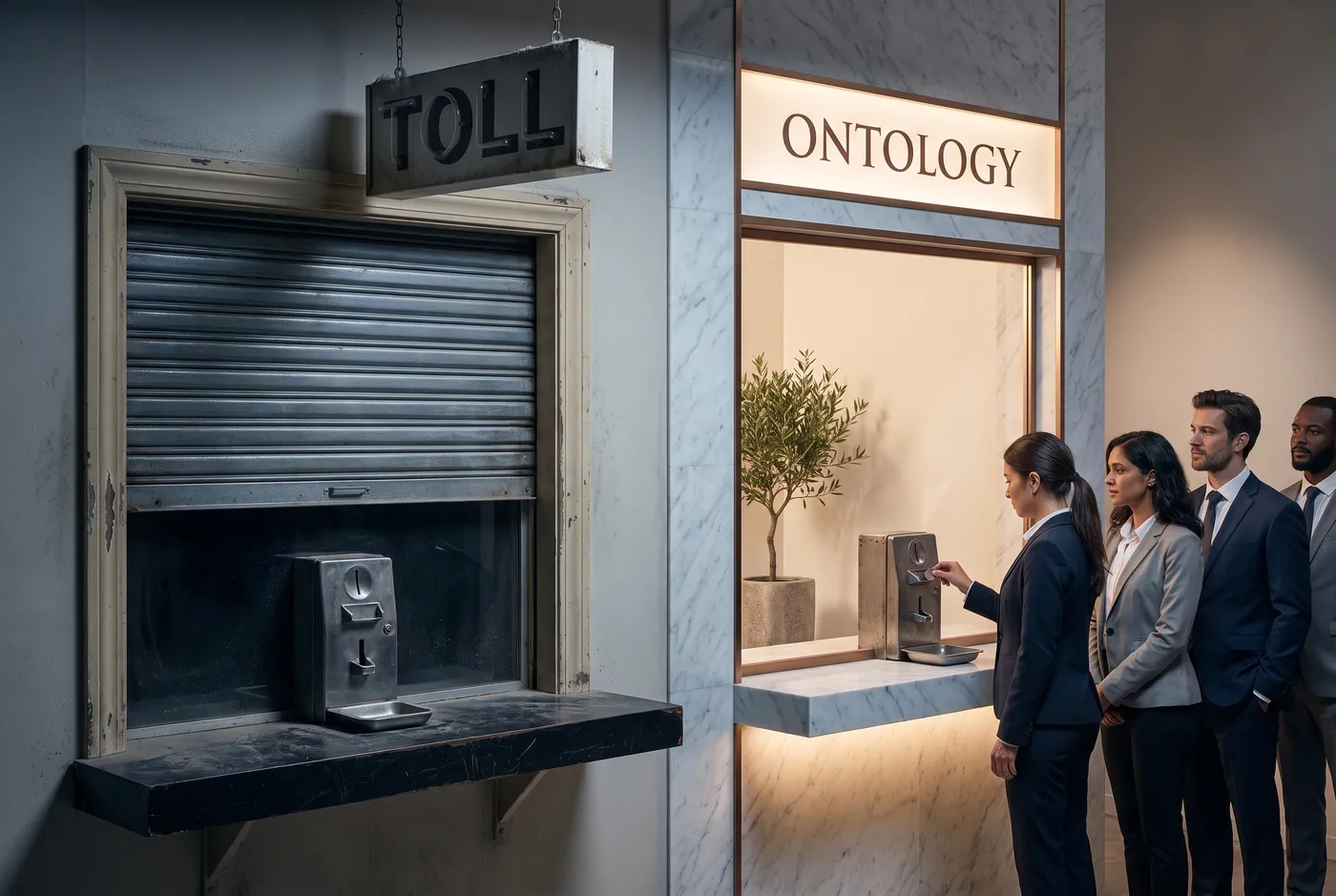
The Ramp pattern, fine-tune a smaller open model on your own proprietary data, own the resulting weights, stop paying a frontier lab's per-token rate, is a genuine, verifiable escape from frontier-lab lock-in specifically. FastAsk beat Opus 4.6 on Ramp's own benchmark; that is a real, if narrow, data point, flag and all. But “escape frontier-lab lock-in” is not the same sentence as “escape lock-in.” The toll booth doesn't disappear. It relocates, in two directions at once.
The enterprise fine-tunes on its own data
A smaller open model, trained on proprietary data the frontier lab never sees, stops paying per-token frontier-API rates. This is the real, Ramp-evidenced escape, genuine and specific to the frontier lab.
The training and inference still rent compute
Databricks and Snowflake are themselves multi-cloud resellers sitting on top of AWS, Azure and GCP compute, not independent infrastructure. The toll moves up, to whichever hyperscaler is renting the GPU the fine-tuning actually runs on.
The ontology itself becomes the toll
The fine-tuned weights and the governed data model live inside AIP, Mosaic AI training compute, or Cortex compute credits: metered, proprietary, and hard to exit once an enterprise's ontology lives there. The toll moves sideways, to the platform vendor.
“The toll booth didn't disappear. It moved next door and started calling itself an ontology.”
Karp's wealth-tax argument, taken at face value, proposes exactly this substitution: stop paying OpenAI's or Anthropic's toll, pay Palantir's instead. That may genuinely be a better toll for the enterprise: data ownership, governance, no IP leaking back into a competitor's training set. But it is still a toll, priced by a platform vendor whose own multiple, per Section 2, is priced for a decade of near-perfect execution. Model-agnosticism is real. Toll-agnosticism is not on offer from anyone in this layer.
The geopolitics of this layer, unlike Parts 1 and 2's tariffs and export controls, is almost entirely about data sovereignty, and it tightened materially across the last twenty months. The EU AI Act's high-risk-system obligations reach full enforcement in August 2026, with penalties up to 7% of global annual turnover, exceeding GDPR's own ceiling.16 The European Commission formally proposed the Cloud and AI Development Act on June 3, 2026, a four-tier sovereignty framework whose top tier requires the provider to be owned and controlled from within the EU, including citizenship requirements for personnel with system access, a bar no U.S.-headquartered vendor in this layer clears as currently structured.15 Gartner projects European sovereign-cloud spending to grow from $6.9B in 2025 to $12.6B in 2026 and approach $23.1B by 2027, a market growing directly at this layer's expense unless it restructures.15
And “data residency” is not sovereignty. Every one of these five companies is a Delaware- or otherwise U.S.-incorporated entity. Locating data in an EU region, Snowflake's Frankfurt deployments and new EU “zonal repository,” Databricks' fourteen EU cloud regions, MongoDB Atlas's EU instances, satisfies GDPR's residency requirement, but it does not remove the parent company's exposure to the U.S. CLOUD Act, which can compel a U.S.-headquartered provider to produce data, including in some analyses decryption keys, regardless of where the data physically sits.17 This is precisely the gap the “Schrems III” challenge is testing at the Court of Justice of the EU as of mid-2026, the third round of litigation against the EU–US data-transfer framework, with a preliminary ruling expected late 2026 or early 2027 and legal observers describing a “meaningful risk” the framework is invalidated a third time.18
Watch that gap play out on one company in real time, because it is the sharpest data point in this entire brief. NATO's Communications and Information Agency signed Palantir to deploy the Maven Smart System at SHAPE in March 2025, one of the fastest procurements in NATO's history, and a NATO commander was subsequently quoted saying there is “no alternative to Palantir” in Europe.19 At the same time, Germany's domestic intelligence agency chose the French vendor ChapsVision over Palantir, explicitly citing sovereignty concerns.20 And on June 16, 2026, France's DGSI, its domestic intelligence service, terminated a decade-long Palantir relationship weeks after renewing it for a further three years in December 2025. Prime Minister Sébastien Lecornu said France “cannot accept new strategic dependencies in the digital sphere” and “cannot rely on tools developed by foreign powers,” announcing an additional €655M (~$760M) of domestic AI investment through 2030.21
On June 12, 2026, the U.S. government ordered Anthropic to disable access to its most capable models, Claude Fable 5 and Mythos 5, for all foreign nationals, including Anthropic's own foreign employees, citing a national-security concern; Anthropic complied globally within days. Commerce reversed the restriction roughly eighteen days later, and Anthropic began restoring access.22 Lecornu cited that episode directly as the precipitating reason for dropping Palantir, reasoning from “Washington can turn off a U.S. lab's foreign access overnight” to “we cannot trust a U.S. ontology vendor either,” even though the Fable/Mythos incident had nothing to do with Palantir specifically.21 The causal link rests on Lecornu's own public remarks and secondary reporting connecting the two events, not a documented internal French memo, but the timeline is tight, multiple outlets draw the same connection, and it is, on the evidence available, the cleanest proof in this series that “own your data instead of renting the model” does not fully solve the sovereignty problem it claims to solve. Palantir's Foundry deployment is itself a U.S. company, subject to the same category of government leverage that just interrupted a lab's access with eighteen days' notice.
/ 05Follow the Equity
The Keene move for this layer is to separate three things that get conflated every time it's covered bullishly. First, the ontology moat itself, genuine: owned data, governed access, and now a demonstrated, if narrow, model-agnostic performance edge in the Ramp case. Second, the equity multiple, not obviously supportable without a decade of continued 80%-plus growth, and showing real fragility already: a bear-to-bull DCF spread of more than 3x, persistent insider selling, heavy stock-based compensation running well ahead of buybacks. Third, the sovereignty claim, real relative to a pure frontier-API dependence, but not absolute, given the vendor's own U.S. domicile and the demonstrated willingness of the U.S. government to interrupt AI access on national-security grounds with eighteen days' notice. All three can be true at once: a real moat, an unsupportable multiple, an incomplete sovereignty pitch. The honest article says so rather than resolving the tension in either direction.
Here is what makes this layer different from every rung below it, and it deserves to be said plainly before the bear case crowds it out: this is the one layer in the series where the equity holder and the value-creator are, on the available evidence, substantially the same party. Palantir's free cash flow is real cash generated from real, growing enterprise contracts, not a mark on another company's private valuation, the way Part 2 found a quarter of Nvidia's profit to be, and not a receivable against a counterparty whose revenue doesn't exist yet, the way Part 3 found roughly two trillion dollars of cloud backlog to be. That is a genuinely different animal than anything else this series has taken apart, and it is why this layer's risk is a multiple risk rather than a counterparty or a stranded-asset risk.
But the token doesn't stop moving just because the equity is cleaner. Enterprises frustrated by frontier-lab metered pricing, Karp's “wealth tax,” echoed by the harness-layer migration one rung down, are routing real spend toward platforms that let them fine-tune a cheaper model on owned data instead. That is a genuine value-capture shift. The risk that used to sit with the frontier lab doesn't vanish when it moves; it lands on a vendor whose own multiple prices a decade of flawless execution, whose growth is still indirectly levered to the capex cycle documented in Parts 1 through 3, and whose sovereignty pitch, per France's DGSI, has the same government sitting behind it that can interrupt a rival lab's access overnight.
Six layers are now on the table, and the pattern repeats at every one of them in a different costume: hold the upside, hand off the risk. Except here, for once, the party holding the upside is also the party that earned it. The question the whole series has been building toward is which variable actually decides who captures value going forward and who becomes the layer everyone else's subsidy lands on. On the evidence in this piece, it is exactly the combination Karp is selling and France just tested: data sovereignty, plus a model-agnostic harness, is close to that variable: real enough to explain Ramp's four points and Palantir's free cash flow, incomplete enough that a foreign government can still walk away from it on eighteen days' notice. Part 7 follows one token up all six layers and lands it on whoever's left holding it.