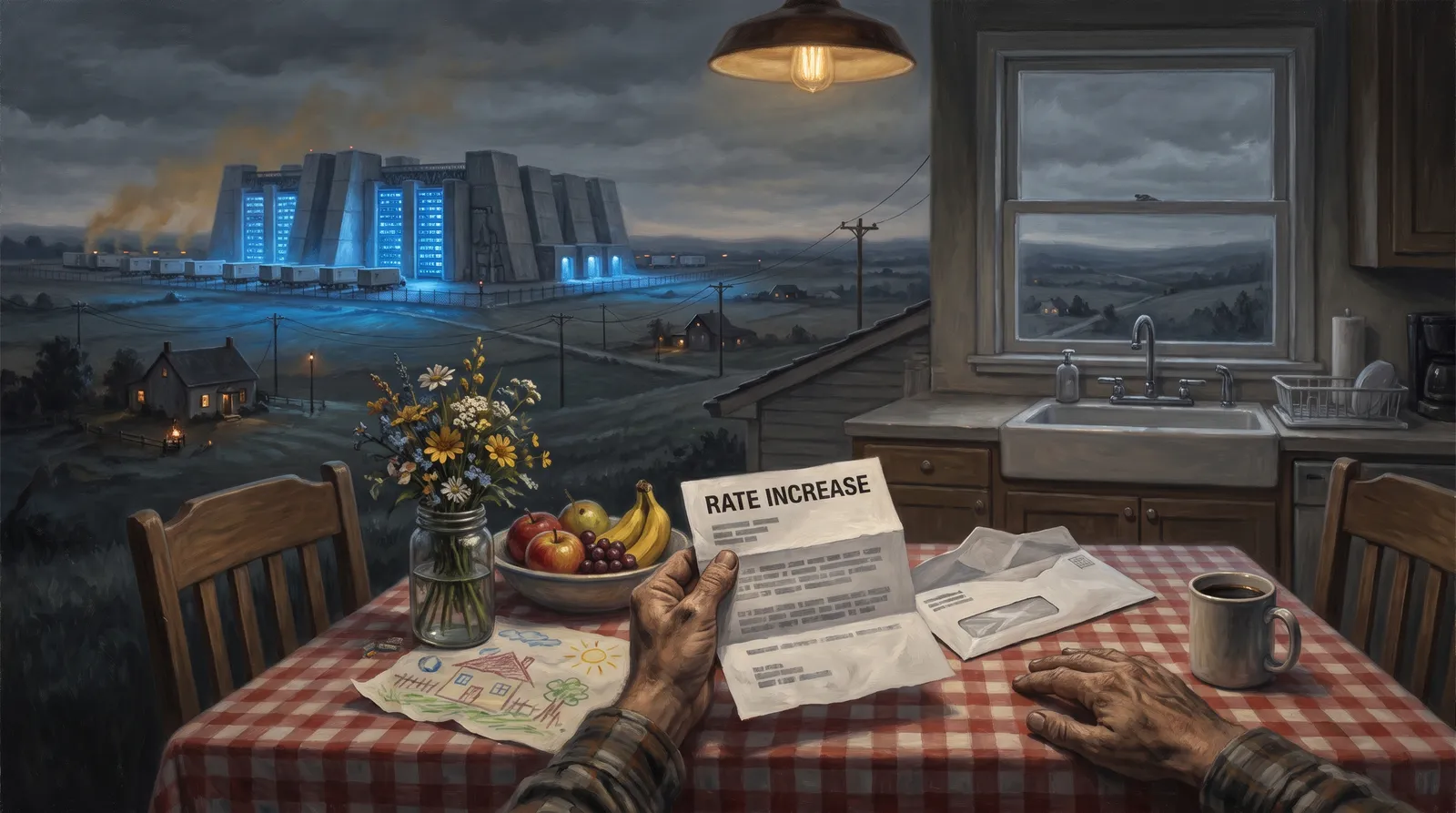
Somewhere in Ohio this summer, a family opened an electric bill that had gone up again, for reasons the bill did not explain. A measurable slice of that increase is the cost of standing up power for data centers, buildings full of chips that may, or may not, turn out to be as busy as the people financing them promise. That is the quiet middle of this whole story. Not whether artificial intelligence is real: it is, and parts of it are genuinely useful. The open question is whether the thirst for it, the near-bottomless demand a trillion dollars of construction is betting on, is as large as advertised, and who is left holding the bill if it isn't.
This is the last part of The Stack, a plain-language teardown of the AI economy floor by floor. You don't need the first six parts to read it. You need one idea: a single dollar of AI activity climbs through six layers on its way to your screen, and at almost every floor the people doing the work or carrying the risk get paid a fee, while the people holding the equity keep the upside. This part follows that dollar to the top, asks who ends up paying, and, for once, leaves some of the questions open. It's also where this series meets its sister series, the Computedollar, and a J.P. Morgan report that, it turns out, quietly contains most of the evidence.
/ 01Six Installments, One Token
Start at the bottom and walk a dollar up. Six floors, six moments where the price gets quietly subsidized before it reaches you. Here they are, each at its most concrete number.
The Shell — the capped fee
Somebody builds the building. The engineering firm on one of the biggest AI campuses pours a $7 billion project and books a fee: no ownership stake in the boom it's pouring. Its record backlog is real revenue; none of it is a share of the upside. The owner keeps that, and keeps the risk that the building is obsolete before it opens.1
The Silicon — the mark
About a quarter of Nvidia's quarterly profit isn't a sale at all. It's the company marking up the value of stakes it holds in the AI labs that buy its chips. Real, disclosed, and not cash. One rung down, a single accounting choice about how fast to depreciate a chip swings Oracle's earnings by 17%.2
The Cloud — the receivable
The rented-computer layer reports roughly $2 trillion of promised future revenue: contracts signed against customers who, in many cases, haven't earned the money to pay yet. Oracle's promised backlog alone went from $138 billion to $553 billion in nine months.3
The Frontier — the same mark, bigger
In a single quarter, Alphabet booked about $28.7 billion and Amazon about $16.8 billion in gains on their stakes in one private lab, Anthropic, 60% and 51% of their profit, on stakes they built for a few billion in cash. Not a customer paying a bill. A number written down about something they own.4
The Harness — the upside-down price
A $200-a-month coding subscription can burn through compute that costs thousands to serve. Someone eats that gap, and in mid-2026 the platforms started quietly clawing it back, plan by plan.5
The Data — the multiple
At the top, the company that owns the data instead of renting the model has genuinely better economics: strong cash flow, little debt. But it trades at a price that already assumes a decade of flawless execution. Here the subsidy isn't a hidden loss; it's a promise of perfection, paid up front.6
Read them together and a pattern shows up. These aren't six different problems. They're three moves, repeated. Sometimes the builder takes a safe fee and hands the risk to whoever owns the asset. Sometimes a company's profit isn't a sale but a number it wrote down about a private company it owns a slice of. And sometimes a price is simply set below what the thing costs to deliver, on the bet that scale, or a rising stock, makes up the difference later. None of this is illegal. Most of it is disclosed, if you know which footnote to read. But add it up and the price at the top understates what the whole thing actually costs, and the difference gets made up by someone.
“At three of the six floors, the profit isn't a sale. It's a number a company wrote down about something it owns.”
/ 02Who Actually Pays
The subsidy doesn't vanish. It lands on people, and the striking thing about all of them is that none of them were in the room.
The clearest is the family we started with. PJM, the grid operator for thirteen states, runs a yearly auction to keep electricity available; its own independent monitor attributes about $9.3 billion of one year's price increase, and $23 billion across three, to data-center demand.7 That flows straight onto household bills. The monitor's own suggested fix is that data centers should bring their own power rather than draw down the shared grid, which is another way of saying that even the people who referee this market read the current bill as a transfer, not a fair price.


Then there's the debt. The buildings, enormous, specialized, and going stale faster than they can be poured, are increasingly financed through off-balance-sheet vehicles, so the borrowing doesn't show up against the tech giants' own credit.9 The bonds land with private-credit funds, and behind those funds, several steps removed, sit pensions and insurers. Which is to say: ordinary people's retirements, quietly exposed to whether a data center in Louisiana fills up on schedule.8
And then the strangest absorber of all, the one the Computedollar series is named for. Index funds, the default home for most 401(k) money, buy each stock in proportion to how many shares are freely trading. So when insiders at a newly public company are cleared to sell, more shares hit the market, and the index is required to buy more, automatically, with no human deciding it's a good idea.10 The largest test of this is dated and coming: something like $900 billion of SpaceX stock unlocks between August and December 2026, and the passive money obligated to absorb it is, in the end, the retirement savings of people who have never heard the word “float.”10 The coding tool Cursor now sits inside SpaceX.11 The labs' valuations sit inside the tech giants' reported profits.4 Even Palantir, the one company here that looked like it might stand outside the machine, is now one of the names that soaks up more than forty cents of every new passive dollar.12 Pull any thread far enough and it ends at the same quiet buyer: a pension, a target-date fund, a person who was never asked.
It's worth sitting with that, because it's easy to lose in the numbers. The people most exposed to how this ends are, almost by design, the people with the least say in it and the least ability to get out.
/ 03Is Anyone Actually Thirsty?
Here is the question the buildout would rather you not ask: what if the demand isn't there?
Every floor above assumes a thirst for AI compute that's close to bottomless, enough to fill every building, honor every backlog, justify every mark. For two years that assumption held mainly because the largest buyers kept saying it did. So it's worth noticing when one of them changes its story.
On July 1, 2026, Meta, which had spent two years insisting its enormous buildout was for its own products, was reported to be planning a cloud business to sell its excess AI compute to outside customers: hosted models and raw GPU cycles alike. Its stock jumped nearly 9% the same day.13 Read one way, that's a confident expansion into a new market. Read the rest of the tape and it's a warning. The same news knocked the pure-play compute renters down hard. CoreWeave fell 14%, Nebius 17%, and the selloff dragged the chipmakers with them.13 The market did the arithmetic out loud: if the biggest builder in the world suddenly has compute to spare, then the thing everyone was told was impossibly scarce might not be, and everyone whose valuation rests on that scarcity just got cheaper. If your own demand were truly filling those buildings, you wouldn't be shopping for other people's.
There's a name for what people here are quietly afraid of, and it's Meta's own: the metaverse moment, the point where a spectacularly expensive bet on future demand meets the demand that actually shows up, and the two don't match. Even J.P. Morgan's house strategist reaches for the same phrase to frame the AI buildout.14 Nobody knows yet whether it applies. But the shape of the risk is familiar, and the last time this shape appeared, the company writing the checks ate the loss itself. This time the checks are financed by other people's debt and other people's index funds.
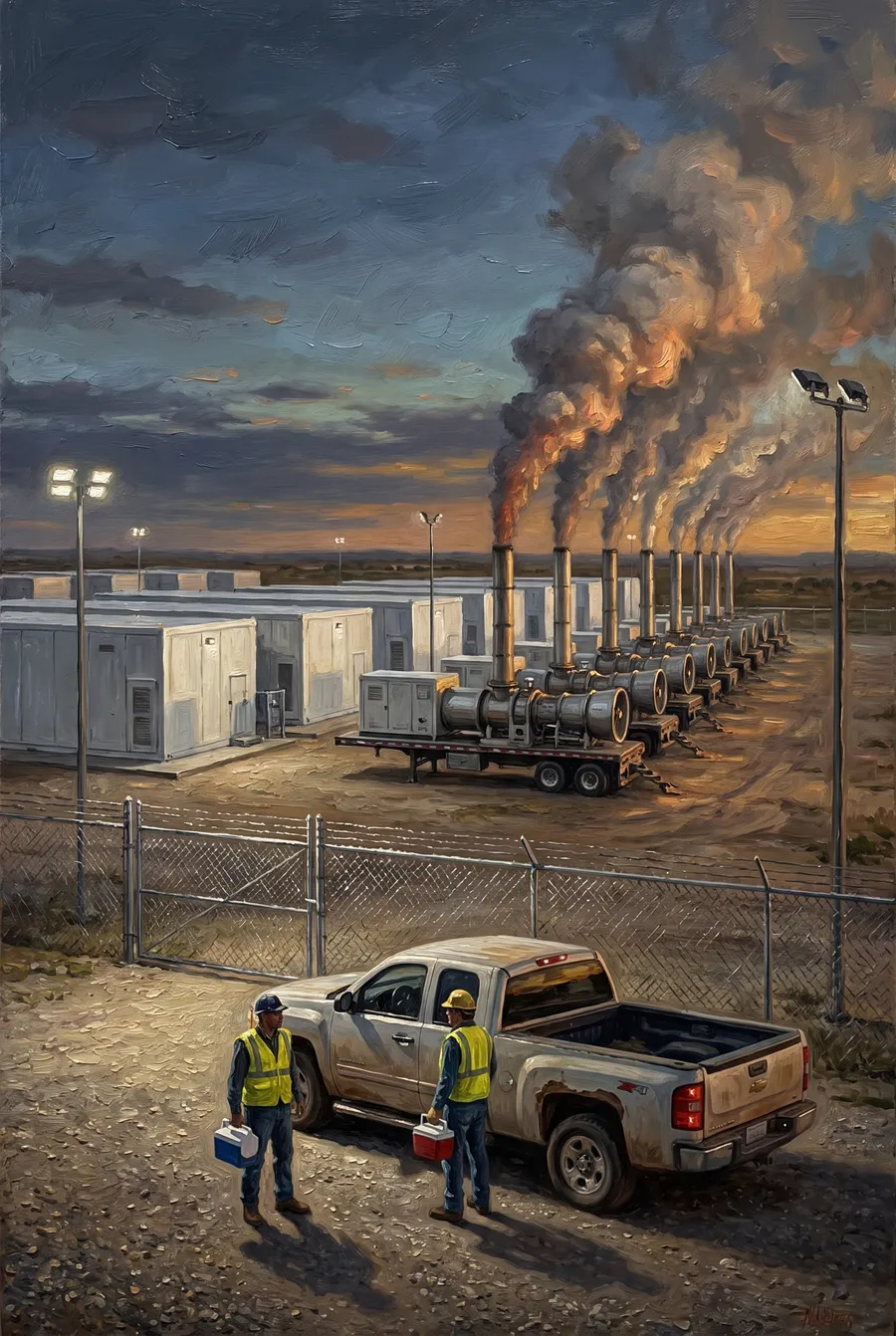
And there's a second pattern, a separate one, in the physical world, that Main Street can see without reading a single filing: the way the cost of the buildout gets socialized while the upside stays private. To get ahead of the slow, permitted, utility-scale grid, some of the biggest projects have simply generated their own electricity on-site: rows of gas turbines trucked in and fired up, in some cases ahead of the permits, to feed chips now rather than wait years for an interconnection.15 The most-reported example grew up around Elon Musk's data-center buildouts, though the pattern is general. And here's the part worth holding onto: whether or not the thirst at the top turns out to be real, the exhaust from those turbines is real, and it's breathed by whoever lives nearby, usually the people with the least power to object. That is this whole series in one image. The upside is a bet on the future; the cost is local, physical, and now.
“The upside is a bet on the future. The cost is local, physical, and now.”
/ 04The Commodity Trap
There's an irony in the pessimist's case that deserves to be said plainly, because it cuts against the easy version of this story, including the version I've been telling.
Suppose the pessimists are right: AI models are becoming a commodity, roughly interchangeable, racing toward a price near zero. The clearest proof that smaller-and-cheaper can match the frontier is already public: a mid-sized firm fine-tuned a model a fraction of the size on its own data and beat the best frontier model at that firm's own task.17 If that's the direction of travel, the interesting question isn't whether American tech is overbuilt. It's who wins a commodity war.
And the uncomfortable answer is: not the player who has to show a profit every ninety days. Commodity fights are won by whoever can produce at scale, indefinitely, without needing a return, which describes a patient state far better than it describes a market wired to mark everything up to the next funding round. Chinese open-weight models are already within a few points of the frontier at a fraction of the cost, and China's ability to make its own chips has climbed from almost nothing to a serious share in a handful of years.16 The American answer to “is the moat safe?” has been financial: mark the stakes up, raise more, build more. The other answer has been industrial: make the thing cheap, and let cheapness be the weapon.
So here's a possibility I can't rule out, and won't pretend to. The commodification some of us have described as a risk to the incumbents may also be, without anyone quite choosing it, an advantage handed to a competitor who doesn't play by quarterly rules. I don't know how that resolves, and I distrust anyone who says they do. It belongs in your head at the same time as the bull case, not instead of it.
/ 05What Losing Is Supposed to Look Like
There's one company the consensus has spent two years calling the loser of the AI age, and it's worth ending near, because the case against it quietly reveals the scoreboard everyone has been using.
The charge against Apple is real and has a paper trail. Its assistant, Siri, sat mostly frozen for years while the rest of the industry rebuilt around a new kind of model; by Apple's own internal assessment it trailed the leading chatbots badly; and in 2026 Apple stopped trying to catch the frontier alone and agreed to pay Google roughly a billion dollars a year to run Gemini inside the iPhone. A closed ecosystem shielded a weak product from competition. That's a genuine consumer-harm story, and the antitrust critics are not wrong to tell it.19
But now read the tape the way a trader would, not the way a headline does. In the same stretch, Apple's highest-memory Macs sold out, and Apple raised prices. These are the machines, built on its new M5 silicon, that can actually run a large model on your desk with no cloud, no subscription, and no data leaving the device.20 That is real demand, paid in cash, for a physical thing, from people who wanted AI they could own. Set it beside the rest of this series: the marks that aren't sales, the backlogs booked against customers who can't pay yet, the $200 seats that cost thousands to serve. Apple is one of the very few names in the entire stack selling something a customer actually buys, at a profit, today.
And the “humiliating” Google deal? A billion dollars a year, cancellable, for a model Apple can swap the moment a cheaper one is good enough, while Google pays Apple twenty times that to remain the default on the device Apple controls.19 That is not a company that lost the model race. It is a company that declined to run it: it let everyone else pour hundreds of billions into frontier models, watched those models drift toward the commodity we described a section ago, and set itself up to buy the commodity cheap while keeping the customer, the device, and the data. Which is, almost exactly, the winning position this series has been pointing at since it reached the top of the stack: own the relationship, rent the model.
The bias worth naming lives in the scoreboard itself. We have been trained to score this race by who promised the most: the biggest number, the boldest launch, the fastest “we've basically solved it.” On that scoreboard, restraint reads as defeat, and Apple is losing. On the older scoreboard, who takes in more cash than they lay out, the picture turns over. Which of those two scoreboards you trust is, in the end, the whole question this series has been asking.
/ 06The Map Was Already Drawn
One more thing, because it's the strangest part.
Almost every number in this series comes from two reports by one careful reader of data, Michael Cembalest, who runs market strategy for J.P. Morgan's wealth business: the ratepayer math, the circular profits, the island with eleven days of gas under the entire chip supply, the labs' own admission that they don't know when they'll make money.4 He documents the machine completely. He even prints a warning label before the AI section:
“This section includes technical AI jargon, conjecture on AI products and services that are rapidly changing, views on non-public companies whose disclosures can be opaque or incomplete, and thoughts about the future which may be wildly off the mark… take a deep breath.” — Cembalest, “Semiquincententacles,” June 2026
And then, because his job is to keep clients invested, he files all of it under a reassuring heading and moves on.18 That's not a lie: every number checks. It's something subtler and more human: the difference between describing a fire very well and pulling the alarm. This series' only real addition is to say the sentence the description was built to avoid: that the bill for all of this has a name and an address, and there's a decent chance it's yours.
/ 07Questions You're Allowed to Ask
I said at the start I'd leave some things open, so here they are, not as a verdict, but as the questions any person is entirely within their rights to ask the next time someone tells them the AI boom is nothing to worry about.
- If the demand is really bottomless, why did one of the biggest buyers just go looking for other customers to sell its spare compute to?
- When my electric bill goes up to power a data center, did anyone ask me, and if that data center ends up half-empty, does my bill come back down?
- If my pension is required to buy the shares insiders are selling, who wrote that rule, and whose interest does it actually serve?
- If the whole game turns into a race to make AI cheap, are we sure we're built to win that race, or are we handing it to someone who doesn't need to turn a profit?
- And the oldest question, the one Warren Buffett asks in every cycle: when the tide goes out, who's swimming naked, and why is it so often the people who never got to place the bet?
None of these have clean answers yet, which is the honest state of things in the summer of 2026. What's not in doubt is the shape of it. A handful of people are making an enormous, borrowed bet on a future that may or may not arrive, and they've arranged matters so that if it arrives they keep most of the gains, and if it doesn't, the losses are spread quietly across people who were never at the table: the family with the electric bill, the worker with the pension, the neighbor downwind of the turbines.
You don't have to be against artificial intelligence to think that second half deserves far more attention than it's getting. You just have to be someone who pays a bill.