Critical Thinking & Historical Analysis
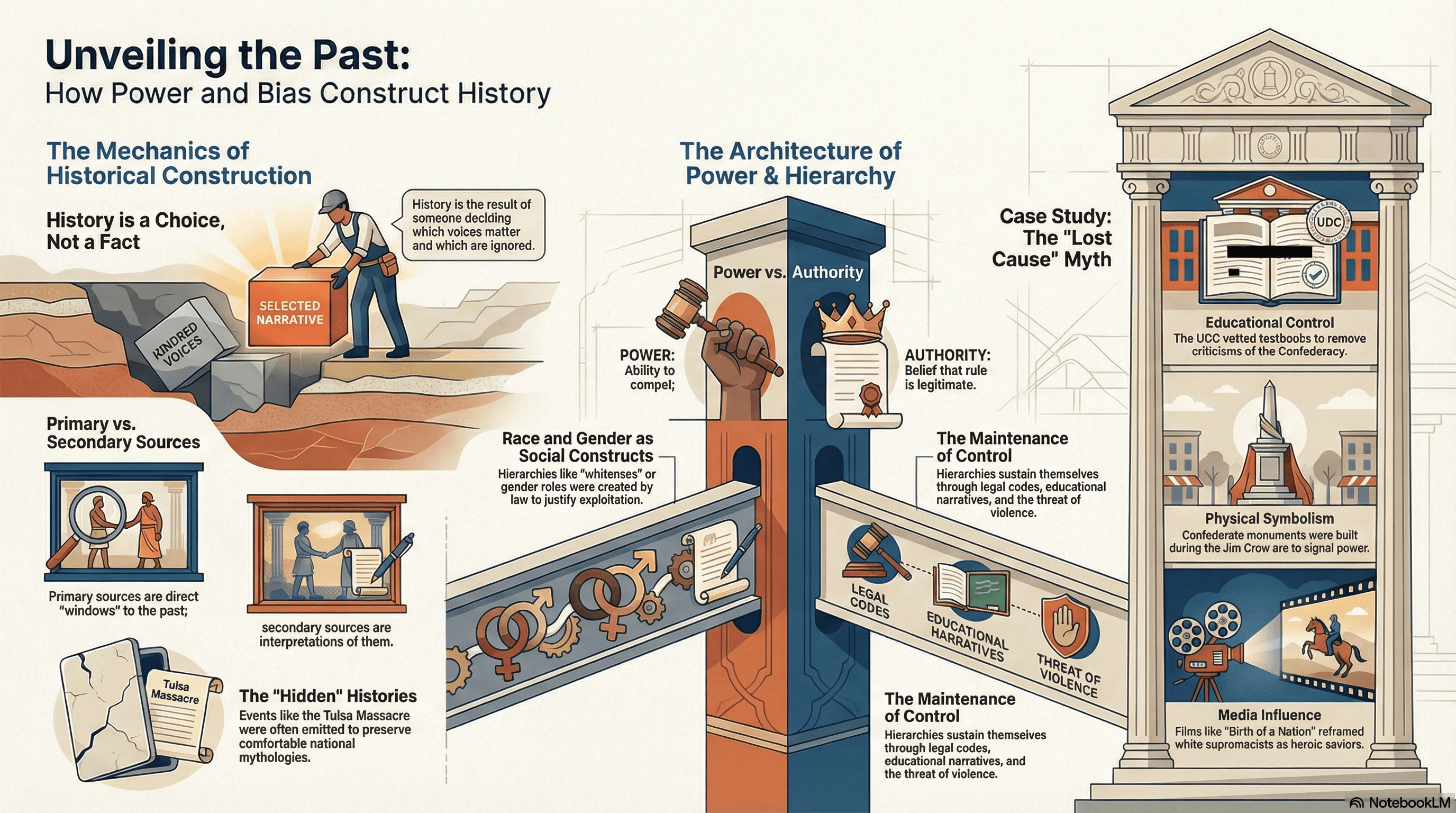
A comprehensive curriculum exploring power, race, gender, economics, and critical thinking through historical analysis.
Critical Thinking & Historical Analysis
Audio Overview
What You Will Learn
Architecture of Belief
Understand how belief systems are constructed and maintained, and how religious authority has been used to justify power.
Unit 11
Narrative Fallacy & Overton Window
Examine how narratives shape understanding and how the range of acceptable ideas is controlled.
Unit 12
Myth of Neutrality
Challenge the idea that science, technology, innovation, and trade are morally neutral.
Unit 13
Curated Video Library
9 curated videos to explore — plus 16 more matched to individual units inside the course
Sandel opens this live session at Harvard's Institute of Politics by playing audio of Obama's 'you didn't build that' and Romney's '47 percent' remarks, then asks the audience to debate what these 'so-called gaffes' reveal about competing visions of society. What follows is a masterclass in Socratic method: Sandel pushes a student named Aaron who objects to redistribution ('I don't feel that I or anyone else should be forced to pay for anyone else's services') to articulate the philosophical assumptions underlying his position, then invites a counter-argument about whether doctors should be 'punished' for universal healthcare. The session demonstrates every skill this course teaches -- identifying hidden assumptions, evaluating evidence, recognizing how framing shapes conclusions -- in real time with real people who disagree. Sandel does not lecture; he creates conditions for the audience to discover their own unexamined premises. For students who will spend an entire unit on the Key Assumptions Check, watching Sandel perform live assumption-surfacing on a politically charged topic is more instructive than any worksheet.

In under five minutes, this TED-Ed animation makes three cognitive biases viscerally clear through interactive thought experiments. It opens with a game show scenario that demonstrates loss aversion -- why we take guaranteed bonuses but gamble to avoid losses, even when the odds are identical. It then shows how the conjunction fallacy tricks college students into choosing less likely dice outcomes because they 'expect to see more green rolls,' and how the anchoring effect causes students asked whether Gandhi died before or after age 9 to guess an average of 50, while those anchored at 140 guess 67. The animation concludes by explaining that heuristics 'can sometimes save our lives' but that 'today's environment requires far more complex decision-making' than our evolved shortcuts can handle. This is the perfect companion for Unit 1 because it gives students three concrete, testable biases they can identify in their own thinking before the course asks them to apply these concepts to history, politics, and power. At under five minutes, it is the lowest-commitment entry point in the entire showcase.
Michael Sandel opens at the RSA by diagnosing the populist backlash against mainstream politics not as mere xenophobia or economic complaint but as a crisis of 'social esteem' -- the feeling that governing elites have not only failed economically but have conveyed 'the message that those who have not flourished in the new economy have only themselves to blame.' This is a visual essay in the RSA tradition: Sandel builds his argument systematically, distinguishing between the technocratic faith that 'the right answer to every policy question is whatever the experts say' and a genuinely democratic politics that takes moral disagreement seriously. His critique of meritocracy -- that it produces not just inequality but humiliation -- provides the philosophical framework for understanding why power structures persist even in democracies. The talk connects to Unit 2's analysis of cultural power, Unit 3's examination of economic systems, and Unit 12's treatment of how dominant narratives constrain political imagination. Sandel models the kind of rigorous, accessible public philosophy this course aspires to teach.
The day after Martin Luther King Jr. was assassinated, third-grade teacher Jane Elliott in Riceville, Iowa divided her class by eye color and told the blue-eyed children they were superior. Within fifteen minutes, 'wonderful, cooperative, thoughtful children turned into nasty, vicious, discriminating little third graders.' This FRONTLINE documentary films the original 1970 experiment and then reunites the students fourteen years later to reflect on what they learned. The experiment is the most visceral demonstration in existence of how hierarchies are constructed and internalized -- the exact argument Unit 4 makes about race as a social construct. When Elliott reverses the hierarchy the next day, brown-eyed children who had struggled academically suddenly performed card-pack phonics exercises in two and a half minutes instead of five and a half -- proving that the cognitive effects of oppression are immediate and measurable. For students who might resist the idea that race is 'made' rather than 'found,' watching eight-year-olds construct and dismantle a racial hierarchy in a single classroom is more persuasive than any textbook argument.

Michael Stevens opens by asking 'where is your mind?' and proceeds to dismantle the assumption that reasoning evolved to find truth. Drawing on Hugo Mercier and Dan Sperber's argumentative theory of reasoning, Stevens explains that reason may have evolved not as a tool for individual discovery but as a social instrument for persuasion -- 'our brains didn't evolve to find truth, they evolved to win arguments.' He introduces behavioral inertia, status quo bias, and the concept of 'hyper objects' -- problems so massively distributed in time and space that they overwhelm our evolved cognitive machinery. The video is the ideal orientation for this course because it frames the entire curriculum's project: understanding why the organ we use to think is not optimized for the kind of thinking modern problems require. Stevens's accessible style -- moving from camels measuring the Earth's circumference to Timothy Morton's philosophy of hyper objects -- models exactly the intellectual range this course demands. When students encounter specific fallacies and biases in later units, they will already have Stevens's framework for understanding why those failures are features, not bugs, of human cognition.

This FRONTLINE documentary follows the January 6th investigation from the attack through the federal indictment, interviewing the prosecutors, committee members, and witnesses who built the case against a former president. The documentary is essential viewing for this course not because of its political content but because it is a masterclass in how evidence is gathered, evaluated, and contested in real time. Tim Heaphy, the chief investigator, describes hiring fourteen former prosecutors to 'digest a large amount of documents and discern what's relevant and separate that from what's not' -- the exact analytical process this course teaches. Meanwhile, the documentary shows how competing narratives about the same events -- insurrection versus political persecution -- can coexist in a polarized society. When your student reads about narrative fallacy and the Overton Window in Unit 12, they will already have a vivid contemporary case study of how narrative control operates. The film also demonstrates every form of power analyzed in Unit 2: political, cultural, and the physical power that underlies all others.
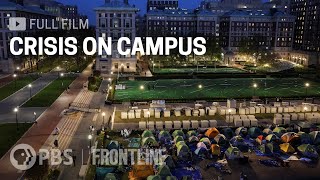
This FRONTLINE documentary follows the campus protests that erupted after October 7th, 2023, tracking how students, administrators, politicians, and donors each constructed competing narratives about the same events. The film interviews students on all sides -- a Jewish student who describes breaking the Sabbath for the first time to locate siblings in Israel, and Palestinian students who drafted a statement holding 'the Israeli regime entirely responsible for all unfolding violence' without mentioning Hamas. The documentary is essential for this course because it is a real-time case study in every critical thinking concept the curriculum teaches: framing (how the same events are narrated through different lenses), power (how wealthy donors and congressional hearings pressured university responses), the Overton Window (what was speakable and unspeakable on campus), and the narrative fallacy (how both sides constructed coherent stories that excluded inconvenient complexity). Students will see people their own age grappling with exactly the tensions this course examines -- and failing in instructive ways.

This video presents Bonhoeffer's provocative argument that stupidity is 'not merely a weakness' but 'a profound and destructive social force that is paradoxically much more dangerous than evil itself.' Bonhoeffer, writing from inside Nazi Germany, observed that stupidity is not an intellectual deficit but an active refusal to think critically -- 'a refusal to think critically which makes it an insidious and self-perpetuating force.' The video then connects Bonhoeffer to Hannah Arendt's 'banality of evil,' showing how Eichmann exemplified not malicious intent but 'thoughtless obedience fueled by stupidity rather than malicious intent.' For a course that opens by asking students to question everything they think they know, this video provides the moral stakes: the failure to think critically is not merely an academic shortcoming but a precondition for atrocity. The connection between power and intellectual passivity -- how 'those in power often surround themselves with advisers and systems that confirm their biases, creating a feedback loop of ignorance' -- maps directly onto the course's analysis of how hierarchies maintain themselves.

Carole Cadwalladr, the journalist who broke the Cambridge Analytica story, opens by confessing that coming back to TED after her first talk 'led to a three-year legal battle culminated in London's high court in which it felt like I was on trial for my life.' She then delivers an urgent argument that 'politics is technology now' and that we are 'already living inside the architecture of totalitarianism' because 'the entire business model of Silicon Valley is surveillance.' Her comparison of Google's data holdings to the East German secret police -- who 'kept detailed files on almost one in three of their citizens' while Google has more on 'every single one of us' -- makes the abstract concept of information asymmetry concrete and alarming. This talk connects directly to Unit 13's analysis of technology as non-neutral and Unit 12's examination of narrative control, but it also models intellectual courage: Cadwalladr names specific threats at personal cost. For a course that asks students to question power, watching someone who nearly lost everything for doing exactly that provides a powerful example of what critical thinking demands in practice.
Explore These Channels
The RSA
The RSA (Royal Society of Arts) produces visual essays and public lectures that model exactly the kind of rigorous, accessible argumentation this course teaches. Their RSA Animate series transforms complex ideas about cognitive biases, motivation, and social change into hand-drawn visual arguments that make abstract thinking visible. Their Replay series features extended lectures by public intellectuals like Michael Sandel, who demonstrates Socratic questioning in real time. For a course built on the premise that critical thinking is a skill that must be practiced rather than memorized, the RSA's combination of visual clarity and intellectual depth provides an ideal complement to the curriculum's written materials.
Michael Stevens approaches questions about cognition, reasoning, and human nature with a combination of philosophical depth and infectious curiosity that makes complex ideas accessible without dumbing them down. His video on the future of reasoning -- which draws on Hugo Mercier, Dan Sperber, and Timothy Morton -- covers more cognitive science in 30 minutes than most introductory courses manage in a semester. For students encountering critical thinking concepts for the first time, Stevens models what it looks like to take ideas seriously while remaining genuinely playful, and his production quality sets a standard that signals this material is worth their sustained attention.
WORLD
Pulling the Thread is a six-episode documentary series that investigates why conspiracy theories are so alluring by examining the cognitive science behind conspiracy thinking. Each episode isolates a specific mental shortcut -- proportionality bias, confirmation bias, the illusion of understanding, narrative pattern-matching -- and traces it through a real conspiracy theory from the JFK assassination to Sandy Hook denialism. The filmmakers, Kristen Psacharopoulos and Danny Alpert, interview both academic researchers and actual conspiracy believers, creating a portrait of conspiracy thinking that is empathetic without being credulous. For a course that teaches students to recognize these exact cognitive patterns in their own thinking, this series provides a complete applied curriculum on media literacy and epistemic humility.