On July 9, 2026, at a Micron Technology event in New York, US Commerce Secretary Howard Lutnick named two companies by name and told them, in public, that they had “no choice.” Samsung Electronics and SK Hynix (South Korea's two largest firms, employers of hundreds of thousands, the anchor tenants of Seoul's own 800-trillion-won domestic semiconductor buildout) would have to follow Micron's lead and invest on American soil, Lutnick said, or face the alternative he raised in the same breath: tariffs on chip imports as high as 100%.14 It is worth sitting with what that sentence actually does. South Korea is a treaty ally. Samsung and SK Hynix are not adversary firms being sanctioned; they are the industrial core of a country the United States has garrisoned for seventy years. And the country trying to talk them out of investing in Seoul's own strategic-sector plan, using the threat of a tariff, is not Beijing. It is Washington, in the same eighteen-month window this series has spent four parts documenting as a period of one-way American generosity toward China.
Part 5 of Hormuz and the Weighting Game. Part 4 followed the data traveling inside a routed API call. This part follows something less quantifiable but just as costed: the coalition that used to backstop American export-control enforcement, and what eighteen months of tariffs, "freeloader" rhetoric, and a "protection money" framing of chip alliances did to it. This is not a detour from the series' one-way-transfer argument. It is the same argument, run against a second set of counterparties. Part 6 closes the ledger on all five flows at once.
/ 01The Tally
Start with the Tally itself, because the alliance-erosion thread is the one this series' own pre-mortem flagged as most likely to get compressed into a single gestured-at paragraph under time pressure. It doesn't compress. Ten named, dated incidents, spanning two continents and eighteen months, carry figures specific enough to check.
| Incident | Detail | Date |
|---|---|---|
| US steel/aluminum tariffs on EU | 25% imposed; EU retaliates with ~€21B package across 1,300+ tariff codes | Mar–Apr 2025 |
| EU–US "Turnberry" framework deal | 15% across-the-board tariff (down from 30% threatened); EU commits $750B in US energy purchases, $600B in US investment | Jul 27, 2025 |
| NATO Hague summit | Defense-spending target raised 2%→5% of GDP by 2035; Trump threatens Spain will "pay double" in trade talks over its resistance | Jun 25, 2025 |
| US–Japan trade deal | 15% reciprocal tariff; Japan commits $550B in US strategic-sector investment | Jul–Sep 2025 |
| US–Korea trade deal | Threatened 25% tariff cut to 15%; Korea commits $350B in US investment | 2025 |
| Lutnick names Samsung, SK Hynix | Public ultimatum to invest on US soil "or else," with a 100% chip-tariff threat raised as leverage | Jul 9–10, 2026 |
| Taiwan "50-50" chip-split proposal | Lutnick pitches an even US/Taiwan production split; Taiwan's Vice Premier publicly rejects it | Oct 1–2, 2025 |
| US–Taiwan investment deal | $250B channeled into US semiconductor sector; most advanced nodes (2nm and below) stay in Taiwan through the decade | Jan 2026 |
| WTO anti-dumping/countervailing filings vs. China | Surge to 180 investigations initiated in 2024, more than double the 2022 count | 2024 |
| EU automotive-sector exposure | 350,000 EU jobs at risk by 2030 from Chinese EV competition; 104,000 already eliminated 2024–25 | 2024–2030 (proj.) |
A tally is not a verdict. Some of these ten rows are cleanly resolved trade deals; others are live coercion episodes with no settled outcome yet. What they share is that every one of them names a real country, a real dollar or percentage figure, and a date, not a mood. The rest of this part earns each row.
/ 02Europe: The Tariff, the Act, and the License
The European sequence starts, like most of this administration's tariff diplomacy, with steel. On March 12, 2025, the United States imposed 25% tariffs on EU steel, aluminum, and derivative products; the EU's Council approved a first retaliatory package on April 9 covering roughly €21 billion of US goods across more than 1,300 tariff codes (reviving suspended 2018/2020 countermeasures on Harley-Davidson motorcycles and bourbon whiskey alongside new tranches on poultry, meat, eggs, oils, plastics, and leather), and by early May Brussels was publicly floating a further €95 billion consultation and opening a WTO dispute.1 The two sides spent the next eleven weeks negotiating instead of escalating, and on July 27, 2025, at Turnberry, Trump and Commission President Ursula von der Leyen struck a framework: a flat 15% tariff on most EU exports to the US, down from the 30% Trump had threatened, in exchange for $750 billion in EU purchases of US energy and $600 billion in EU investment in the United States over the deal's term.1 Von der Leyen's own word for the arrangement, at the signing, was "all-inclusive." Her word for the process that produced it, weeks earlier at the European People's Party's Valencia congress, was different: "global markets are shaken by the unpredictable tariff policy of the US administration. US tariffs on the rest of the world are at their highest in a century."2
Germany's chancellor-in-waiting was more direct still. On election night, February 23–24, 2025, before he had been sworn in, Friedrich Merz told German television: "For me, the absolute priority will be to strengthen Europe as quickly as possible so that, step by step, we can really achieve independence from the USA." He went further in the same appearance: "I never thought I would have to say something like that on a TV programme, but after Donald Trump's latest comments in the last week, it is clear that the Americans, or at least this portion of the Americans, this government, care very little about the fate of Europe."3 That quote did not survive contact with governing intact. By the time Merz addressed the Munich Security Conference as sitting chancellor, his language had softened to calling for the transatlantic partnership to be "repaired and revived," not replaced. The honest version of this account states both halves: the sharpest anti-American rhetoric from a major European leader this decade came from a man who, eighteen months into actually running the country, walked it back. Disappointment and dependency are not mutually exclusive; Europe's posture across this window holds both at once.
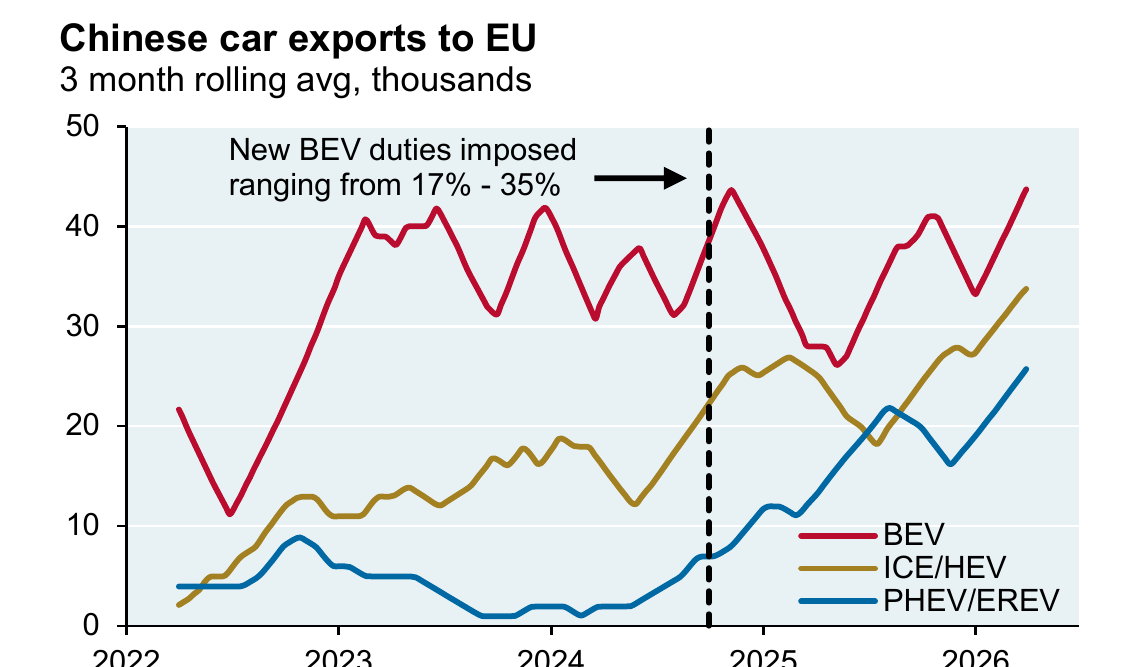
That chart matters to this part precisely because of what it is not. It is not evidence of American tariff pressure on Europe. It is Europe's own countermeasure against Chinese EV dumping, and the line barely bends: Chinese battery-electric exports to the EU kept climbing through duties as high as 35%, because the underlying cost gap is large enough that even a steep tariff doesn't close it. Read alongside the US tariff sequence, it complicates any simple story where an alienated Europe simply pivots toward Beijing. Cecilia Malmström, the EU's own former Trade Commissioner, wrote for the Peterson Institute in June 2026 that Brussels now considers its China trade relationship "unsustainable," entering what she called a "do no harm" phase: not an embrace, a triangulation between an unreliable ally and an adversarial rival.7 The single line from that piece that best serves this series' thesis, that Europe "can no longer rely on the erratically-led United States as an ally in dealing with Beijing," did not surface in a direct read of the published page during this research pass and should be treated as needing final verification against the live PIIE text before being quoted as a verbatim sentence, rather than as settled fact.7
Where Europe's diversification is not in question is in its trade agreements. The EU concluded FTAs with Mercosur (January 2026), India (January 2026), and Australia (March 2026) in rapid succession, a pace analysts at E3G and the University of Florida's Center for European Studies explicitly link to US tariff pressure and geopolitical uncertainty, framed by EU officials as "rebalancing," not "decoupling."8 The distinction is real and worth preserving: the evidence in this section shows Europe hedging away from Washington. They do not show Europe running toward Beijing. Those are different findings, and only one of them is documented here.
The AI Act and the deregulation race
The regulatory divergence that was supposed to define this period (American deregulation against a European rulebook) happened, but not as cleanly as either side's talking points suggest. Trump signed "Removing Barriers to American Leadership in Artificial Intelligence" on January 23, 2025, reversing the prior administration's risk-mitigation emphasis in favor of "American AI dominance."5 At the Paris AI summit two and a half weeks later, Vice President JD Vance told a European audience directly that "excessive regulation" of AI in Europe could "cripple" the industry. That was an in-person American official criticizing EU policy on European soil, at a summit ostensibly about cooperation.5 The complication arrived later: by November 2025, Fortune was reporting the EU itself moving to weaken and delay parts of the AI Act under lobbying pressure from Big Tech and the competitive gravity of US deregulation, and a December 2025 analysis from the Heinrich Böll Stiftung's Washington office documented AI deregulation "sweeping both sides of the Atlantic": not a clean US-deregulates/EU-holds-firm binary, but American deregulatory pressure exporting itself into a nominally more cautious European regime.5 That complication belongs in the honest accounting of this thread rather than smoothed away: the AI Act divergence is real, dated, and quotable at its origin point, but it did not stay static, and the direction of travel by late 2025 was convergence under American pressure, not defiance.
The Netherlands, ASML, and the MATCH Act
The friction with the deepest structural stakes for this series runs through a single company. The Dutch government withdrew ASML's license to export certain deep-ultraviolet lithography machines to China earlier than the Netherlands had planned, partly under direct US pressure: the mechanism by which Washington's chip-export policy has, for years, run not through its own authority alone but through its ability to lean on the one country whose company builds the machines that make advanced logic possible.6 That leverage cuts both ways, and in June 2026 it cut back. The proposed MATCH Act would let Washington dictate to allied governments what their domestic chip-toolmakers may ship to China; critically, it also provides that if the US cannot reach agreement with an ally on the terms, it will simply impose export restrictions on that ally directly.6 Dutch Foreign Trade Minister Sjoerd Sjoerdsma is reported opposing the bill's extraterritoriality and stating a preference for "highly targeted proportionate measures," assessed case-by-case, "without disrupting international value chains." That reporting is corroborated independently by both NL Times and Bloomberg on the same June 24, 2026 date, though the exact Sjoerdsma quote wording could not be confirmed against a primary Dutch-language source in this research pass and should be verified before further reuse.6 Dutch industry commentary went further, with bits-chips.com describing the MATCH Act as a potential "another 'Greenland moment' for the EU": an explicit domestic analogy to a separate, well-known sovereignty dispute, offered as shorthand for what allied coercion looks like when it's aimed at the Netherlands specifically.6
The export-control regime that is supposed to prevent exactly the one-way capability transfer Parts 1 through 4 of this series document does not run on US authority alone. It runs on the cooperation of the few countries, the Netherlands foremost among them, whose companies make the equipment the controls are meant to restrict. A bill that tells the Dutch government it will simply be overridden if it doesn't agree fast enough is not a parallel, unrelated irritant sitting next to the one-way-transfer argument. It is a direct threat to the mechanism that argument depends on for enforcement. An ally alienated on ASML licensing terms is an ally less inclined to move fast and in lockstep the next time Washington needs coordinated action to close a loophole China is already exploiting.
Finally, the NATO track, because defense-spending friction bleeds directly into the tech-cooperation layer this series cares about. At the Hague summit on June 25, 2025, allies agreed to raise the defense-spending target from 2% to 5% of GDP by 2035: 3.5% "hard defense," 1.5% "resilience," a category that explicitly includes cybersecurity, meaning this fight was never purely about tanks.4 Trump took credit at the summit and, in the same appearance, threatened that Spain "will pay double" in future trade negotiations over its resistance to the target: an explicit, public linkage of defense-spending noncompliance to tariff retaliation.4 By July 2026, NPR and Time were both reporting a renewed pressure campaign and a "widening rift" ahead of a follow-up summit, with Trump's own language across the period leaning on "freeloader" framing that multiple analysts characterize as a departure in tone and intensity from prior administrations' more diplomatic burden-sharing pressure, a distinction the steelman section below takes seriously rather than assuming.4
/ 03Asia: Ultimatums, "Protection Money," and the Hedge
Japan's disappointment registered early and stayed on the record. On July 8, 2025, Japan called Trump's fresh tariff-letter salvo, delivered ahead of an August 1 deadline, "regrettable": diplomatic language, but a public rebuke from a treaty ally nonetheless.12 Prime Minister Shigeru Ishiba had already said Japan was "extremely disappointed" following the broader April "Liberation Day" tariff wave, and senior LDP official Itsunori Onodera called the tariff-letter delivery method "entirely unacceptable," a quote well-corroborated in substance though its exact dateline within the surrounding weeks was not independently re-verified in this research pass.12 The deal that followed, announced July 22, 2025, set a 15% reciprocal tariff on most Japanese imports; by September 4, a memorandum of understanding had Japan committing $550 billion in strategic-sector US investment (semiconductors, pharma, metals, shipbuilding, energy, AI, quantum) deployable before January 2029.12 Foreign Policy's own July 2025 headline framed it plainly: "Why Japan Might Be America's Most Frustrated Ally," noting that despite being the single largest source of foreign direct investment in the United States and a core security partner, Ishiba faced sustained tariff threats through the entire negotiation.12
Korea's deal landed at the same 15% rate (cut down from a threatened 25%) with a $350 billion investment commitment, bringing the combined Japan-Korea package to roughly $900 billion in pledged US investment inside a single year.13 Underneath the trade numbers sits an older and more pointed grievance: Trump, both on the campaign trail and in a 2025 Cabinet meeting, claimed South Korea contributes "nothing" or "very little" toward the cost of the roughly 28,500 US troops stationed there, a claim the historical record contradicts (Korea's cost-sharing agreements date to 1991, running $830 million in 2017 and $924 million by 2019), and separately floated a $10 billion annual figure as what Korea "should" pay. The actual new agreement, running through 2030, sets Korea's 2026 contribution at 1.52 trillion won, roughly $1.14 billion: real money, and a real increase from 2025's 1.4 trillion won, but far short of the number used to pressure it.13
Then came the Lutnick episode this section opened with, which is worth returning to in full because it is the single most concretely sourced coercion episode in the entire Asia set. At the July 9–10, 2026 Micron event, Lutnick named Samsung Electronics and SK Hynix directly, said Micron's domestic buildout meant its Korean rivals would have "no choice but to follow" and invest on US soil, and raised the prospect of 100% tariffs on chip imports as leverage.14 This collides directly with South Korea's own domestic semiconductor mega-project (roughly 800 trillion won, about $536 billion, of Korean industrial policy), which Korean outlets describe as creating a "no-win," "boomerang" dilemma for the two firms: Seoul's own investment plan is the leverage being used against it.14 The episode is corroborated across at least four independent Korean and US outlets with consistent dates and consistent framing, which is more sourcing depth than almost any other single incident in this part carries.
President Lee Jae-myung's response to the accumulated pressure (not just the chip episode, the whole eighteen-month run of it) is the clearest pivot-hedge statement from a sitting head of state in this entire research set: "The Korea-US alliance is indeed the foundation [of Korea's foreign policy]… Japan is also important. But we cannot be unilaterally bound to those alone. We should also maintain amicable relations with China and Russia — trade with them, and cooperate with them."15 Read that sentence against the series' own thesis and the mechanism is exact: it is not abandonment of the US alliance, and it is not a pivot to Beijing. It is a named ally, on the record, explicitly declining to be the reliable counterweight the United States needs it to be, because reliability, in Lee's own framing, is a bet he is no longer willing to make exclusively.
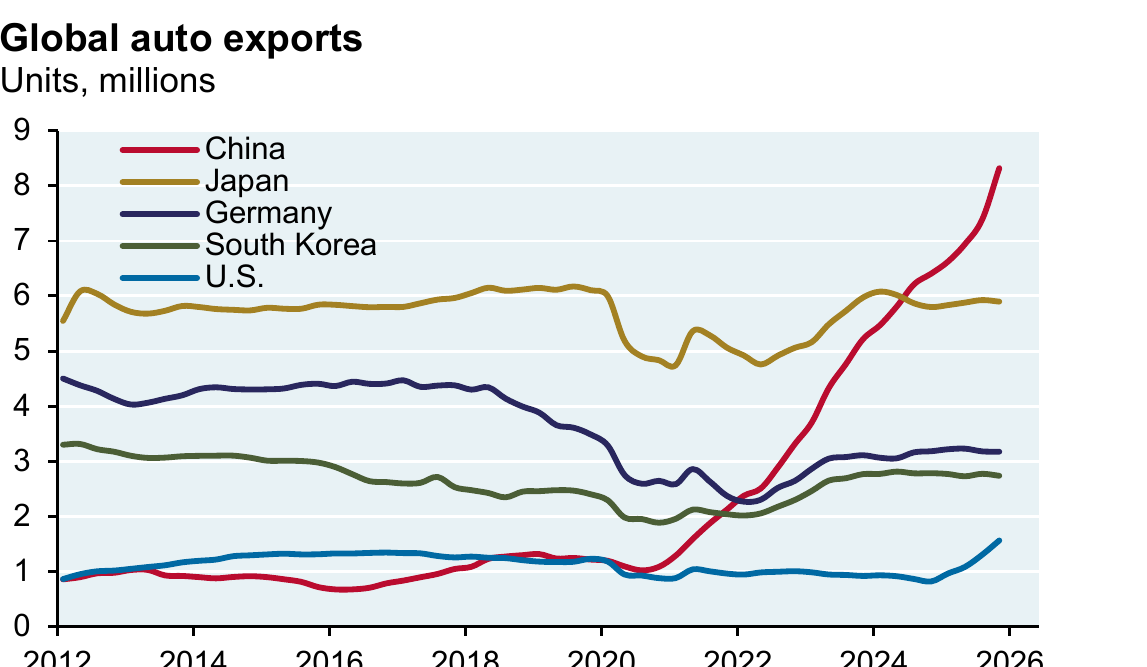
This is the competitive-displacement backdrop against which the tariff and investment fights above are happening, and it is worth naming precisely because it cuts against any reading of the allied-disappointment thread as purely about hurt feelings. China's global auto-export volume sat below Germany's, Korea's, and even the United States' as recently as 2020. By 2024 it had passed Japan (the longtime global leader), and by 2026 it was exporting more than two and a half times Japan's volume.16 Japan, Germany, and South Korea are all named allies in the tariff and defense-cost disputes above, and all three are simultaneously losing global export share to the same country the United States is structurally advantaging on talent, weights, and energy in Parts 1 through 3 of this series. Squeezing these three allies on trade terms while they absorb a real competitive hit from China is not two unrelated stories running in parallel. It is the same displacement, felt twice, by the same countries, in the same window.
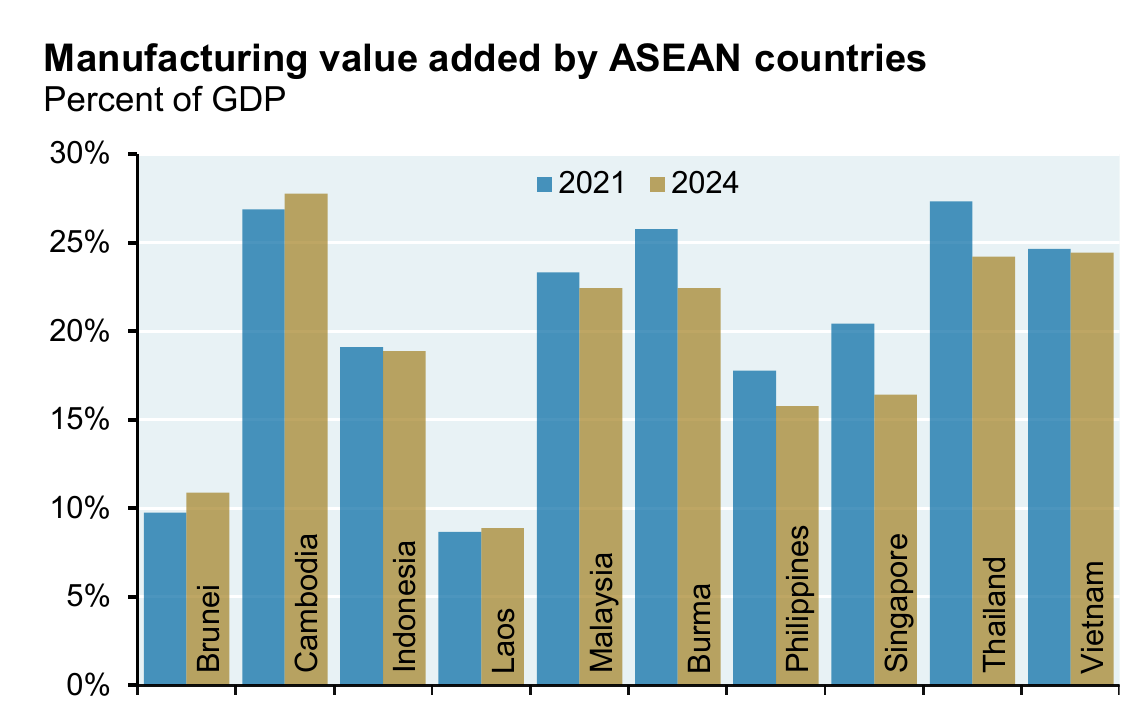
The ASEAN data extends the same point past the EU/Japan/Korea/Germany set this part has focused on: manufacturing's share of GDP fell in six of ten ASEAN economies between 2021 and 2024, Thailand and Singapore among the sharpest declines. These are not treaty allies in the NATO or US-Japan sense, but they are exactly the kind of Asian partners a genuine counterbalancing coalition against Chinese economic dominance would need on its side; they are losing manufacturing share to the same overcapacity this series' energetic axis (Part 3) documents as a structural, not cyclical, feature of the Chinese economy.17
Taiwan: from "insurance policy" to "negotiating chip"
Taiwan's arc across this period is the sharpest of any ally's, because it runs through the country whose fabrication capacity is, by this series' own vertical axis, the least substitutable asset in the entire AI supply chain. Four days after hosting TSMC Chairman C.C. Wei at the White House in early March 2025 to announce an additional $100 billion in US investment (on top of $65 billion already committed to Arizona), Trump said of Taiwan's chip dominance: "[Taiwan] stole it from us. They took it from us, and I don't blame them."18 That framing hardened into an actual policy proposal seven months later. On October 1–2, 2025, Commerce Secretary Lutnick proposed a "50-50" production split: "The idea that I pitched [Taiwan] was, let's get to 50-50. We're producing half, and you're producing half." Taiwan's Vice Premier Cheng Li-chiun rejected it publicly and specifically: "I want to clarify that this is the US's idea. Our negotiation team has never made a 50-50 commitment to a chip split," and Taiwan "will not agree to such a condition."19 Domestic reaction was sharp across party lines: the opposition Kuomintang called it "an act of exploitation and plunder"; Taiwan People's Party chairman Huang Kuo-chang said it would "hollow out the foundations of Taiwan's technology sector."19
A further deal in January 2026 channeled $250 billion of Taiwanese investment into the US semiconductor sector, while the most advanced nodes (2nm and below) reportedly stay in Taiwan through at least the end of the decade: the "silicon shield" pressured, not yet dismantled.20 But the rhetoric kept running ahead of the deals. In May 2026, during a Trump visit to Beijing, Fox News captured him repeating the theft framing: "They stole our chip industry… We lost our chip industry," a striking detail precisely because of where he said it. The same claim used to pressure a US ally, delivered from the capital of the rival that ally is supposed to help counterbalance.21 And roughly two weeks later, Fortune's own headline captured the thesis this whole part is arguing more cleanly than any paraphrase could: "Trump thinks Taiwan is a 'very good negotiating chip' with China."21 An ally's most strategically important asset, treated as leverage to use against the rival it exists to help counterbalance, is not a metaphor this series is imposing on the material. It is the headline the material produced on its own.
Honesty requires a counter-example. The Pentagon's 2025 review of AUKUS (the US-UK-Australia submarine and technology pact) generated months of Australian uncertainty before concluding on December 5, 2025 that the agreement should proceed. The residual risk that remains, a possible delay in delivering Australia's first Virginia-class submarine, traces to US domestic submarine-construction backlogs, not deliberate policy hostility. That is a different failure mode from the Lutnick-Samsung or Lutnick-Taiwan episodes above: bureaucratic uncertainty and industrial-capacity limits, not a coercive ultimatum. Lumping it into the same "coercion" bucket would overstate the case. Not everything alienating an ally in this window was a choice.
One more data point belongs here because it is the clearest evidence that allied hedging is already producing action, not just rhetoric: following the April 2025 "Liberation Day" tariff wave, China, Japan, and South Korea's trade ministers revived stalled trilateral free-trade talks, agreeing to "closely cooperate for a comprehensive and high-level" framework, explicitly timed to, and framed against, the US tariff shock.8 Two American treaty allies sitting down with the rival the United States needs them to help counterbalance, specifically because of American tariff pressure, is a documented, multi-source-corroborated fact. It is the single cleanest piece of evidence in this part that the coalition-shrinking effect this section documents is not hypothetical.
/ 04The Multiplayer Game
It would be a mistake to treat everything in this part as a separate story from the one-way-transfer argument running through Parts 1 through 4: a political embarrassment sitting next to the real economic argument rather than inside it. The honest version is sharper: a country simultaneously over-generous to its rival and hostile to its coalition partners is not running two policies. It is running one policy badly, in a game that has more than two players, and the game-theoretic literature this series has leaned on elsewhere in the horizontal and energetic axes applies here with unusual precision, because alliance behavior is exactly what several of these frameworks were built to explain.
Start with Keohane and Nye's distinction between sensitivity and vulnerability, which did the heaviest lifting in Part 1's talent argument and Part 3's energy argument.22 The same distinction explains why the tariff and burden-sharing pressure documented above bought less real compliance than its architects expected. The EU, Japan, and Korea are all genuinely sensitive to American tariff threats: the pain registers fast, and it registers in real GDP terms. But sensitivity is not vulnerability, and each of these allies has, over the same window, been visibly reducing its vulnerability: the EU's Mercosur, India, and Australia FTAs; the China-Japan-Korea trilateral revival; Lee Jae-myung's explicit refusal to be "unilaterally bound." None of this is decoupling from the United States. All of it is exactly what Keohane and Nye's theory predicts a state does when it wants to keep feeling the exchange without paying the vulnerability price for it; it means the leverage Washington believes tariff threats buy is smaller than the sensitivity numbers alone would suggest, because the allies are actively working the vulnerability side of the ledger in response.
Axelrod's "shadow of the future" supplies the second half of the mechanism.22 Iterated cooperation between the US and its allies has, for seventy years, rested on the credible expectation that today's concession will be reciprocated across many future rounds: a long, stable shadow. What the tariff sequence, the NATO cost fight, and the Lutnick ultimatums do, independent of whether any single deal resolves favorably, is shorten that shadow: an ally that has watched the terms of engagement change abruptly, publicly, and more than once inside eighteen months has rational reason to discount how far into the future it can trust the current terms to hold, and to hedge accordingly. This is the same electoral-cycle-discontinuity argument Part 2 made about China's advantage over US policy consistency, applied here to a different set of counterparties: the shorter and less credible the shadow of the future looks to an ally, the more that ally's rational move looks like diversification now rather than patient reciprocity later, which is precisely what the EU's FTA pace and the China-Japan-Korea trilateral revival document in real time.
Structural realism supplies the sharpest version of why this matters strategically, not just diplomatically. Grieco's relative-gains logic, which Part 2 used to explain why Washington eventually moved to close open-weight and talent channels benefiting China disproportionately, applies reflexively to the allies themselves.23 Lee Jae-myung's hedge is not sentiment; it is a relative-gains calculation, made by a government that watched Washington extract a $350 billion investment commitment and a chip-tariff threat in the same eighteen months and concluded that being "unilaterally bound" costs it relative position. Waltz's core claim (that in an anarchic system, relative gains matter more than absolute ones) does not stop applying just because the actor making the calculation is a US ally rather than a rival.23 An alliance strategy that assumes allies will absorb relative-gains losses indefinitely, purely out of loyalty, is not a realist strategy. It is the liberal-institutionalist assumption structural realism itself exists to correct; the corrective, this time, is arriving from Seoul and Brussels rather than from Washington.
Put the two threads together and the "doubly costly" framing this series has argued from the start stops being rhetorical. The export-control architecture that is supposed to prevent the one-way capability transfer Parts 1 through 4 document does not run on unilateral American authority; it runs on the Netherlands licensing ASML correctly, on Japan and Korea coordinating their own equipment and materials controls, on Taiwan keeping its most advanced nodes inside a trusted perimeter. Every one of those is a cooperation problem, and cooperation problems are exactly what a shortened shadow of the future and a rising vulnerability-reduction incentive make harder to solve on short notice, the next time Washington needs fast, coordinated allied action to close a loophole China is already exploiting. Alienating the allies is not a cost that sits beside the one-way-transfer thesis. It is a second mechanism, running through the same coalition, that makes the first mechanism harder to ever correct.
“A country can be one-way generous to its rival, or it can be careless with its allies. Doing both in the same eighteen months is the harder story, and the more honest one.”
/ 05The Honest Steelman: And Where It Runs Out
The strongest version of the case that none of this is unusual deserves a fair hearing, because burden-sharing pressure on allies is not a Trump invention. Political scientist Brian Blankenship's The Burden-Sharing Dilemma documents that Kennedy, Johnson, and Nixon all "frequently wielded threats of abandonment" to push West Germany and South Korea toward greater defense spending: the coercive-diplomacy mechanism itself is a mid-twentieth-century American pattern, not a 2025 novelty.24 Obama used strikingly similar rhetoric ("free riders aggravate me," 2016) and strikingly similar leverage, threatening the US-UK "special relationship" over the 2%-of-GDP NATO target until David Cameron complied.24 A Brookings analysis credits the first Trump administration's burden-sharing pressure, whatever its diplomatic cost, with real results: it "pushed European defense budgets toward the NATO two-percent target, drove Japan to double its defense spending, and prompted coordination on China's technology challenge."24 And on its own terms, the Hague summit was a coalition-management success, not a failure: allies did agree to the 5%-by-2035 target, with only Spain, Belgium, and Slovakia holding out. If pressure produces the spending outcome Washington wants, the critique of the pressure campaign has to reckon with that result, not just the rhetoric used to get there. Every tariff dispute in this part, too, resolved into a negotiated deal rather than an open trade war: the EU, Japan, and Korea all landed at 15% after threats in the 20–30%-plus range, the same threat-then-negotiate sequence used in prior-administration trade disputes going back to Reagan-era voluntary export restraints with Japan in the 1980s.
That is the honest steelman, and it is stronger than a polemical framing of this part would suggest. Here is where it runs out. No prior administration ran tariff threats, defense-cost renegotiation, AI-Act-adjacent regulatory friction, and named-company chip-investment coercion against the EU, Japan, Korea, and Taiwan simultaneously, inside an eighteen-month window, while separately easing the enforcement grounds that, per this series' own vertical and horizontal axes, benefited the rival those allies exist to help counterbalance. Scale and simultaneity are the piece the historical precedent does not have to answer for. The Dispatch's Connor Fiddler, a source sympathetic to the complexity of alliance management rather than hostile to it, put the 2025 pattern in five words that survive the steelman better than any counter-argument this research found: "winning deals but losing allies."24 Every deal in the Tally above closed. The question this part has actually been documenting is what closed alongside them.
/ 06The Ledger of Allies, Correctly Counted
There is a historical inversion worth naming before this part closes, because it runs through the same waterway this series is named for. In 1956, Washington overrode London and Paris at Suez, forcing a British-French withdrawal from Egypt against their own wishes: the established power dictating terms to its junior allies near a strategically vital strait. Seventy years later, near a different but adjacent strait, the roles are reversed: it is Washington pressing London and Paris for solidarity over Iran and Hormuz, and finding hesitation instead, captured in Trump's own social-media framing of NATO allies as having "done absolutely nothing to help."25 An alliance structure built on one country's willingness to dictate terms near a strait does not automatically transfer that willingness to the allies it dictated to, once the roles invert and it is their help being asked for instead.
Put the ten entries in the Tally back together. The EU absorbed a 15% tariff and committed $750 billion in energy purchases while its own auto sector loses 350,000 jobs to a competitor its most senior former trade official now calls unsustainable to deal with. Japan and Korea absorbed 15% tariffs and $900 billion in combined investment commitments while watching China overtake them both in global export volume and while their two largest chipmakers were told, by name, in public, that they had "no choice." Taiwan absorbed a "50-50" ultimatum it rejected outright, then watched its own president invoke the theft framing again from inside the capital of the rival its fabs are supposed to help counterbalance. None of these allies walked away from the United States. Every one of them, on the documented record above, moved to need it less. That is not the same as loyalty eroding into betrayal. It is something more specific and, for the purposes of this series' argument, more costly: a coalition quietly re-pricing its own reliance on a partner at the exact moment that partner needed it most reliable. Part 6 totals every flow from Parts 1 through 5 and asks what the whole ledger, priced honestly, actually says about who wins the next phase of this competition.