Every ledger has two columns so a reader can check the arithmetic against itself. This one has five rows instead, because the arithmetic this series is checking was never a single account. It was five separate, independently sourced flows, argued five separate times against five separate steelmans, each closing on the same distinction: not whether both countries feel the exchange, but which one pays more to walk away from it. Four of those five rows hold up as strongly at the end as they did when their part opened. The fifth does not, and a series that spent five parts insisting on that distinction between feeling a cost and paying it owes its own final part the same discipline. This is the part where the discipline gets applied to the series itself.
This is Part 6, the capstone, of Hormuz and the Weighting Game. If you're arriving here first: start with the Reader Protocol, which names the premise, the three axes, the fourth thread, and the game theory this series has argued against, not around, since before the first Tally appeared. This part does not open a new axis. It closes all five that came before: talent (Part 1), weights (Part 2), energy (Part 3), data (Part 4), and allies (Part 5). It also confronts the series' own origin material, which concluded something more cautious than the thesis this series has spent five parts arguing.
/ 01The Tally of Tallies
Five rows, one per part, each with its own headline figure and its own confidence label: strong, qualified, or thin, carried forward from what each part's own honest-reckoning section actually found, not smoothed upward for a tidier finale. This table does not sum to a single number. Adding a talent-flow percentage to a grid-auction dollar figure to a benchmark-citation count would be false precision wearing the costume of rigor, and this series has spent five parts refusing exactly that move whenever a source tried it on its own numbers. What the table does instead is put five independently sourced, independently steelmanned flows next to each other so the shape of the asymmetry is visible at a glance, before the rest of this part explains what that shape means and where it doesn't quite hold.
| Axis | Headline figure | Strength |
|---|---|---|
| Talent (Part 1) | 71% of DeepSeek's 80 US-experienced researchers now work in China, atop a US-favoring stock 5.5× larger | Strong |
| Weights (Part 2) | Chinese-origin models: 46.4% of OpenRouter token share (Jun 2026), overtaking the US three's combined 35.7% | Strong |
| Energy (Part 3) | PJM capacity price $28.92 → $329.17/MW-day; 63% ($9.3B) of one year's increase attributed to data centers | Strong |
| Data (Part 4) | The Western-built yardstick (MMLU/GPQA/Arena) draws no reciprocal citation — but Chinese labs pay ~$500M/yr to US annotation vendors, and Beijing is now drafting its own outbound data controls | Thin |
| Allies (Part 5) | Ten named, dated incidents across 18 months — Samsung/SK Hynix's public "no choice" ultimatum, Taiwan's rejected "50-50" split, $2.15T combined allied investment/purchase commitments | Strong |
Say plainly what that fourth row is doing in a series that has otherwise built a four-for-five case, because burying it in a footnote after four confident rows would be the exact move this series has spent five parts criticizing in its own sources. Part 4 went looking for a data-and-alignment flow running the same direction as the other three axes and found something narrower and more interesting instead: a real, durable, one-way flow of legitimating infrastructure (the benchmarks, not the training corpora) sitting next to a genuinely reciprocal, commercial, dollar-denominated relationship in the layer underneath it. That is not the same finding as Parts 1 through 3 and 5 produced. It is a thinner, more qualified, more interesting finding, and the honest thing to do with it is exactly what this row does: report it as thin, not round it up to match its neighbors.
/ 02The Pipes, Connected
A tally is not an argument on its own; it's a set of numbers waiting for the pipes that connect them, which is the device this series has used since Section 05 of the Reader Protocol. Run the five rows above through the pipes and they turn out not to be five parallel, independent stories. They're one causal chain, walked five times from five different entry points.
A researcher's judgment leaves first, and no customs form can hold it
Dr. Lin's composite carried across the border, in Part 1, what a manifest can't itemize: six years of debugging intuition, the pattern-match for which architecture choice scales. James Scott's high-modernist state can count a chip and log a passport; it has never had an instrument for a trained mind. That's the opening pipe, and every downstream flow in this series depends on the fact that it stayed open.
That judgment meets a checkpoint someone else already published
Part 2's correction matters here specifically: DeepSeek's January 2025 release wasn't a gift the returning researcher's cluster simply accepted. It was the shock that forced every subsequent American open-weight move, from Altman's public reversal to gpt-oss, into existence. A returnee's tacit knowledge is worth more, faster, inside a race someone else's publication schedule is now setting the pace of.
The race runs on whichever grid is cheaper
Part 3 answered the question Part 2 could only gesture at: why does absorbing a capability convert into shipped advantage faster on one side of the Pacific. A coal-and-overcapacity power floor several times cheaper than PJM's underwrites the distillation and fine-tuning that turn a returnee's judgment and a published checkpoint into a deployed model, at a speed no American grid, permitted the way it's currently permitted, can match.
The deployed model gets graded on a scale it didn't write, and it doesn't seem to mind
Here the chain bends, and Part 4 is the part that found the bend. The model built on cheap power and returned talent still has to prove itself on MMLU, GPQA, and Chatbot Arena: instruments no Chinese lab built and every Chinese lab cites. That's a real one-way flow, just not the one the series expected: authority over the definition of "capable," not raw training material.
Enforcing any of this requires allies who are no longer sure it's worth it
Part 5 closed the loop on the mechanism, not the metaphor: the export-control architecture meant to slow every flow above runs on the Netherlands licensing ASML correctly, on Japan and Korea coordinating equipment controls, on Taiwan keeping its most advanced nodes inside a trusted perimeter. Eighteen months of tariffs and "no choice" ultimatums did not break that coalition. It made every partner in it rationally less inclined to move fast the next time Washington needs it to.
Read the chain start to finish and the five parts stop looking like five separate arguments for the same conclusion. They look like five load-bearing joints in a single mechanism, and the mechanism is the actual subject of this series: not five gifts, but one structure that keeps producing the same directional output regardless of which entry point a reader starts from.
/ 03The Honest Reckoning, Applied to the Series' Own Case
This section exists because a capstone that quietly smooths its own weakest finding into the confident register of its strongest four is doing exactly what this series accused its sources of doing every single time a figure needed a confidence flag. So: state it again, at full length, in the part readers are most likely to skim expecting a victory lap.
Part 4 went looking for a data-and-alignment flow running the same direction as talent, weights, and energy: American RLHF and preference-pair labor quietly training Chinese models for free, the same shape as an open-weight checkpoint or a returning researcher. That specific claim did not survive its own research. What survived instead, stated in full rather than rounded toward the thesis: annotation labor is geographically symmetric, not one-way. American vendors (Scale, Surge) source contractors from the Philippines, Kenya, and Venezuela; a 2026 peer-reviewed study in Global Media and China documents Chinese AI firms running the identical outsourcing structure through Egypt, Morocco, and Kenya. Neither country's raw annotation labor flows toward the other; both draw on the same Global South labor pool through the same kind of chain. And the sharper finding, the one that should have reframed the axis's teaser copy before the index page ever went live: the top six Chinese AI labs collectively spend roughly $500 million a year with the same American data-labeling vendors (AfterQuery, Mercor, Surge AI, Turing) that supply OpenAI and Anthropic. That's not extraction. It's commerce, at market rates, paid in dollars, for access to infrastructure that still concentrates in the United States.
The honest version of Part 4's finding is narrower than "data flows one way," and narrower is not the same as false. What survived scrutiny (American-built benchmarks as the shared, unreciprocated scoreboard for whether a model is any good) is real, durable, and arguably more consequential long-run than a training-data leak would have been, because it's a flow of authority rather than material: whoever writes the test defines what "catching up" means. But it is one real flow sitting inside an axis that also contains a documented reversal (Chinese labs paying American vendors) and a documented symmetry (Global South annotation labor on both sides). A series that reports four strong axes and one axis with this much internal complexity, and calls all five "strong," has stopped doing the thing it spent five parts insisting its sources do.
There's a second twist inside the same axis worth carrying into this final accounting, because it cuts in a direction the series' opening premise did not anticipate. In July 2026, China's own Ministry of Commerce began consulting Alibaba, ByteDance, and Zhipu about export controls: not on chips, but on the outbound transfer of training data and on whether foreign users should keep being able to freely download the weights of China's most capable models. A government does not draft controls on an asset it believes only ever flows inward. If Beijing's own regulators think China's data and weights have been leaving the country too freely, that is either evidence this whole series has one axis partly backward, or evidence that both governments are independently worried about losing control of the same intangible, border-blind category of asset, for structurally the same reason James Scott's theory predicts: a state's administrative apparatus renders factories and chip shipments legible and has never had the instruments to see an Elo vote or a downloaded checkpoint until long after it has already shaped the technology built on top of it. Read that way, China's July 2026 pivot isn't a contradiction of Part 1's Scott argument. It's a second capital confirming it, on a different axis, in real time.
So the fourth row of the Tally above stands as written: thin, not strong, not absent. One real, durable, one-way flow of legitimating infrastructure, inside an axis whose other findings run symmetric or reversed. That is the honest total for Part 4, and it is the one entry in this Ledger this series is least tempted to inflate and most obligated not to.
/ 04The Rival Hypothesis, Argued to the End: Not Around It
Here is the confrontation this series has been building toward since the callout box in Section 01 of the Reader Protocol, and it deserves to be met head-on rather than gestured at from a safe distance in a closing paragraph. This series' own origin material (the founder's recorded, transcribed drafting session that produced the brief this whole project grew from) did not conclude "one-way." It concluded something more cautious and, on its own terms, more defensible: the United States and China are "each other's Trojan horses," locked in "a mutually assured arbitrage" where each side's strategy depends on the other's continued production of gifts. That is a real conclusion, reached independently, by the same research process that eventually produced this series' sharper claim. The one-way framing this series has argued for five parts is not a claim the source material already established and this series merely reported. It is a deliberate sharpening the founder made beyond what even that source concluded, which means the burden of proof has sat on this series' own shoulders from the first line of the Reader Protocol, not on a skeptical reader's default doubt.
Has the series carried that burden across five parts? The honest answer requires adding one more piece of steelman that hasn't appeared anywhere in Parts 1 through 5, because it belongs here, at the end, where the full weight of a rival hypothesis should get its last and best hearing rather than its first and easiest one. The bidirectional case has a component this series has not yet stated: hardware and component supply-chain dependency running China to United States, not the reverse. China's 2025 export restriction on gallium, germanium, and rare-earth processing produced real, exercised leverage: the Nexperia semiconductor dispute disrupted supply chains as far downstream as Honda plants in Mexico. ASML, the company whose lithography machines make advanced chip fabrication possible at all, derives roughly 27% of its 2025 revenue from China, against roughly 16% from the United States: meaning the company that controls the chokepoint technology this series' own Part 5 documents Washington leaning on has a real financial hostage exposed to Chinese retaliation, not a costless lever it can pull without consequence to itself. And Chinese manufacturers (Innolight, Eoptolink) are reported to control more than 60% of the global data-center optical-transceiver market, a component-level dependency running toward the United States from inside the very AI buildout this series frames as a one-way American gift.1
That is a real, material, exercised counterweight, and it belongs in this series' final accounting rather than in a footnote nobody reads. It is also, on inspection, a different kind of fact than the five rows in the Tally above. Every axis this series tracked is about capability transfer (talent, weights, energy, data, coalition access) that compounds, deepens, and redirects a country's capacity to build the next model. The hardware-and-component dependency above is a transactional vulnerability: real, currently exercised, and importantly, the kind of dependency a state can substitute away from on a multi-year industrial-policy timeline, the way the United States is currently attempting with rare-earth processing and China itself is currently attempting with EUV-adjacent lithography research. It changes the price of confrontation. It does not, on the evidence this series has gathered across five parts, change the direction of the underlying capability transfer, which is the actual thing "one-way" was ever a claim about.
/ 05Sensitivity and Vulnerability, Totaled
Robert Keohane and Joseph Nye's distinction did the heaviest lifting in every part of this series, and it does the heaviest lifting here too, because it is the only tool sharp enough to hold "the rival hypothesis is genuinely strong" and "the one-way thesis survives it" as true at the same time without contradiction. Run all five axes, plus the hardware steelman just granted, through the same filter this series has applied consistently since the Reader Protocol.
Sensitivity (how fast and how sharply a change on one side produces costly effects on the other, holding policy constant) is genuinely symmetric across every axis this series tracked. A US lab feels a researcher's departure the moment the Slack channel goes quiet. China's exporters feel a US tariff the moment a shipment is delayed at a port. Both governments feel a security-dilemma spiral the moment the other side ships a capability advance, exactly as Jinghan Zeng's 2025 documentation of the ChatGPT-to-DeepSeek action-reaction cycle shows in real data.2 Chinese labs feel their $500-million annual dependence on American annotation vendors the moment a pricing or policy shift moves through that market. ASML feels a Chinese retaliation threat as sharply as any American chipmaker feels an export-control tightening. None of that symmetry is manufactured or overstated by this series; every part reported it, in full, before arguing past it.
Vulnerability (the cost of the best available alternative, once a state actually tries to adjust) is where the five parts, added together, stop being symmetric. A US lab can, in principle and at a cost, replace a departed researcher through its higher-education and immigration pipeline; the MacroPolo data says that pipeline still employs 59% of the world's elite AI researchers, a stock large enough to absorb real marginal losses. China's adjustment path away from its own energy-and-overcapacity structure, should it choose to change course, runs through a five-year-plan apparatus that already executed exactly that kind of phase-out on schedule in 2026, a state pulling a policy lever it built and controls end to end. America's adjustment path away from PJM's grid strain runs through permitting reform and transmission buildout that no single administration, on an electoral cycle Robert Axelrod's own framework predicts will keep interrupting it, currently controls end to end. Chinese labs can substitute away from American annotation vendors, at a cost and on a timeline, the same way American labs could in principle out-recruit Chinese returnees at a cost and on a timeline. The asymmetry these five parts document isn't that adjustment is impossible on the American side. It's that American adjustment costs run consistently higher, and take consistently longer, than Chinese adjustment costs, across every channel this series actually measured.
That is the technically precise formulation this whole series has been building toward, stated once, plainly, at the end: the flows this series tracked are sensitivity-symmetric and vulnerability-asymmetric. Both countries feel every exchange on this Ledger. Only one of them currently holds a policy lever it can pull, on its own schedule, to stop paying for it. That is not the same claim as "there is no exchange," which the rival hypothesis correctly refutes. It is a narrower, harder-to-dismiss claim that the rival hypothesis's own best evidence, run through Keohane and Nye's own distinction, does not actually contradict.
/ 06Which Game Were We Actually Playing
Named once at the start, in the Reader Protocol's Section 04, and now closed with the full weight of five parts' evidence behind it: this series has argued the US-China AI relationship is an iterated game with asymmetric payoffs, in which both sides are rational and the structure (not intent, not naivety) favors China. Here is what each scholar in this series' palette actually contributed to reaching that conclusion, gathered in one place for the first time.
Thomas Schelling explained what a published checkpoint and a tightened export-control list both are: commitment devices, not gifts or precise economic levers. Once DeepSeek's weights were public, in Part 2's account, no future policy reversal could claw them back; every American open-weight release that followed functioned the same way, a manufactured irreversibility signaling that its author was in the race and could not credibly threaten to leave it. Robert Jervis supplied the mechanism for why the race, once started, kept accelerating rather than settling: AI is close to a textbook offense-dominant, low-differentiability technology, where a benchmark release or a "safety" advance is nearly impossible for a rival to read as defensive-only, and Zeng's 2025 study confirmed the resulting spiral in actual dated data, from ChatGPT's 2022 debut through DeepSeek's shock and into 2025's export-control tightening. Robert Axelrod explained why that spiral resolved asymmetrically rather than into stable mutual cooperation: China's multi-decade planning horizon gives it a longer shadow of the future than a United States whose four-year electoral cycle lets each administration reverse the last one's China policy, a structural, not moral, reason the American side struggles to sustain a patient, iterated strategy. Keohane and Nye, as Section 05 just showed, supplied the single load-bearing distinction the whole series rests on: sensitivity is not vulnerability, and the rival hypothesis's best evidence proves the former, not the latter. And structural realism (Waltz's relative-gains logic, Grieco's formalization of it, Mearsheimer's account of why a rising power's rise reads as threatening even when framed benignly) explains the timing this series has documented across five parts: the correction, when it finally came (export-control tightening, the AI Action Plan, a congressional investigation into US firms' Chinese-model use), came late, years after an absolute-gains, engagement-era policy design had already let the underlying cost structure tilt.
Two scholars from outside the core IR canon did work the others couldn't. AnnaLee Saxenian's "new argonauts" gave Part 1's talent axis its actual mechanism: returnees don't just carry capital home, they carry the tacit, socially embedded knowledge of how a frontier cluster operates, and use it to build a second cluster that competes with, rather than merely imports from, the first: the reason Shenzhen's buildout reads as more than a headcount subtraction. James C. Scott's theory of the high-modernist state explained, across Parts 1 and 4 both, why the apparatus built to stop this transfer keeps missing it: a customs officer can inspect a laptop and a manifest can log a chip shipment, but no visa category or export-control rule was ever built to detain a trained intuition or an Elo vote, and China's own belated pivot toward outbound data controls is Scott's thesis playing out symmetrically, in the second capital, on a lag.
One more voice belongs in this final accounting, not because an earlier part used him and this one is completing the set, but because his specific finding closes a gap the rest of the palette leaves open. William Spaniel's formal work on Sino-Indian relations (not a Ukraine-adjacent or Cold War case, an actual Asian great-power rivalry with a fifty-year data record) makes a precise, counterintuitive claim directly relevant to the rival hypothesis this section has just conceded real ground to: raising the cost of conflict through economic interdependence does not monotonically reduce the odds of confrontation. Under uncertainty about an opponent's true resolve, rising interdependence can worsen informational asymmetry about how far the other side is actually willing to go, widening rather than narrowing the range of conditions under which conflict occurs, before the relationship eventually settles once costs are high enough that even a resolved actor accepts a low-value peace.3 That is a formal rebuttal to the naive version of the mutual-hostage reading: "more trade, more entanglement, therefore fundamentally safer, therefore fundamentally symmetric," a line this series' own honest steelmanning has repeatedly had to argue past. Interdependence is real. It does not, by Spaniel's own modeling of a directly comparable Asian rivalry, automatically produce the stable, cooperative equilibrium the rival hypothesis's more optimistic advocates assume it does.
RAND's formal prisoner's-dilemma model of the race to AGI is real and was named correctly in the Reader Protocol as a different axis from this one: a model of development pace and catastrophic risk, not of distributional capture. That distinction holds through the final part. Nothing in this Ledger's totaling of talent, weights, energy, data, and allies says anything about whether racing to frontier AI itself is dangerous. It says who is currently capturing more of the value produced by the race, regardless of how the race ends.
/ 07Polyphemus, One More Time
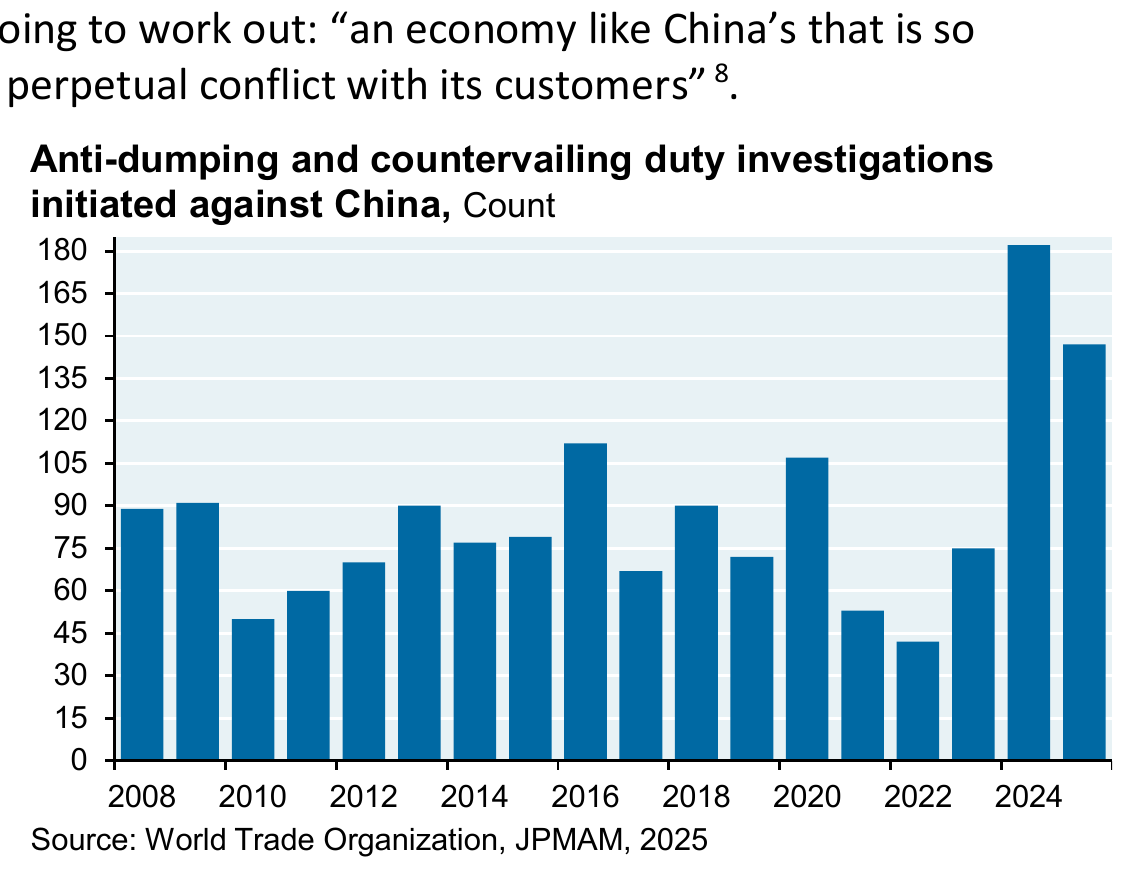
The chart above sits on the same page of Cembalest's note as the frame this series is about to borrow for the last time. Cembalest reaches for the Odyssey twice in "The Year of the Trojan Fire Horse." The Trojan Horse gives this series half its title. Polyphemus, the one-eyed cyclops, gives it the device this final part needs most: a single point of focus, however excellent, misses the picture. Read only the energy column and Chinese clean-tech exports look like an unambiguous gift to every importer. Read only the trade and deindustrialization column (the WTO filings surging past 180, the 350,000 European auto jobs at risk) and the same exports look like an attack on the industries that can't compete with them. Cembalest's own words: "Both columns are correct. Neither is the whole."4
This series has not simply borrowed that frame. It has extended it into territory Cembalest's own note never argued, and the honest close has to say so plainly rather than let the borrowed authority of a respected source imply this series' conclusion was already someone else's. Cembalest's Polyphemus point is about a single axis (energy) read through two lenses that both happen to be true. This series' Polyphemus problem is structurally different and, in a way, harder: it is five separate axes, four of which read cleanly one-way and one of which reads genuinely mixed, and the temptation Polyphemus warns against isn't reading only one lens on one axis. It's reading only the four clean axes and letting the fifth, messier one quietly not count. A series that took Cembalest's own device seriously and then applied it only where it was convenient would be the exact failure mode the device exists to name.
Held honestly, both things this series has argued are true at once, the way Polyphemus demands. It is true that talent, weights, energy, and allied cohesion show a strong, durable, vulnerability-asymmetric transfer running from the United States toward China, argued against real steelmans and surviving them. It is also true that the data axis complicates that picture in a way the other four don't, that a real hardware-and-component dependency runs the other direction, and that this series' own origin material concluded something more cautious than the thesis built on top of it. Neither of those two paragraphs is the whole. Together, weighted honestly rather than averaged for comfort, they are this series' actual final position: a one-way thesis that survives contact with its own best complications, not one that pretends the complications never surfaced.
/ 08What Would Change This Verdict
Every honest-reckoning aside in this series, per the Reader Protocol's own standing instruction, has stated the strongest real evidence against its part's claim before arguing past it. This is the last chance to run that instruction in its hardest form: not what evidence exists today, which the five parts above have already reported in full, but what evidence, if it appeared tomorrow, would actually require this series to reverse its conclusion rather than merely footnote a complication.
- On talent: a sustained, multi-year reversal in the MacroPolo tracker's own headline number (the 5.5× US retention edge closing rather than the marginal, elite cohort continuing to tilt within a stable larger stock) would mean the "atop a much larger stock that still favors the United States" qualifier in Part 1 had quietly become false, not just narrower.
- On weights: an American open-weight release that reset the pace of the race the way DeepSeek's did in January 2025 (not matching the frontier, but forcing the field's commoditization timeline the way R1 did) would undo Part 2's sequencing argument on its own terms, since the whole claim rests on who is setting the pace, not who eventually ships a comparable model.
- On energy: American grid buildout closing the PJM-to-Chinese-industrial-rate gap on a timeline measured in a few years rather than a decade-plus of permitting reform would remove the vulnerability asymmetry Part 3's entire argument depends on; a temporary auction-price dip would not, since the underlying coal-and-overcapacity floor is the load-bearing fact, not any single auction cycle.
- On data: the one flow this series calls durable (American-built benchmarks as the uncontested shared scoreboard) would be falsified the first time a major American lab's own release notes cited C-Eval or CMMLU alongside MMLU and GPQA as evidence of quality, the same way DeepSeek and Qwen currently cite the Western instruments. This research found zero such instances. One would matter.
- On allies: a documented case of the Netherlands, Japan, South Korea, or Taiwan declining a specific US request for coordinated export-control action (not rhetoric, not a hedge like Lee Jae-myung's, an actual refusal with material consequences) would confirm Part 5's "harder to enforce" prediction has already started resolving into fact rather than remaining a documented risk.
None of these five conditions has been met as of this writing. Stating them plainly, rather than leaving the thesis unfalsifiable by never naming what would break it, is the strongest form this series' honest-reckoning device has taken across six parts, a firmer, more credible move than simply restating confidence one more time at the end.
/ 09The Ledger, Closed
This series opened, in the Reader Protocol, by naming the game it believed it would end up describing: an iterated contest with asymmetric payoffs, both sides rational, the structure favoring China. Five parts and one honest reckoning later, that is still the conclusion this series stands behind: four axes strong, one axis thinner than the rest and reported as such, a genuine hardware-dependency counterweight granted in full, and a rival hypothesis that turned out to be this series' own starting point before the founder chose to argue past it. The Stack took the AI compute economy apart floor by floor and asked who holds the equity. Its own capstone left one question deliberately open: if AI models are racing toward commodity pricing, who wins a commodity war? Its answer, offered there as a possibility it could not rule out, was that commodity fights are won by whoever can produce at scale, indefinitely, without needing a return, "which describes a patient state far better than it describes a market wired to mark everything up to the next funding round." This series is, in effect, the six-part answer to that open question. It asked who holds the exposure, and found the same answer Cembalest's energy data gave Social Physics, Article 7 a month earlier, extended across four more axes than energy alone: not that the exchange is one-sided in what both countries feel, but that it is one-sided in what only one of them can currently afford to stop feeling.
That distinction is the whole series in one sentence, and it survives the ending better than a cleaner verdict would have. A prisoner's dilemma requires two players with genuinely symmetric incentives to defect. What five parts of sourced, steelmanned, occasionally self-correcting research found instead was a game where both players are rational, both players feel every move, and only one player's structure (its grid, its electoral cycle, its higher-education pipeline, its coalition of allies it has spent eighteen months telling they have "no choice") lets the other absorb the same shocks more cheaply, more quickly, and on a schedule it controls. That is not a morality play. It is an accounting, and accountings are supposed to be checkable, which is why every figure in this Ledger traces back to a part that showed its work, including the one part whose work came back thinner than the founder's brief expected.
“A scale does not need to fall to prove it is unbalanced. It only needs one side that can keep adding weight, and one side that has started borrowing the strength to hold its own pan level.”
That's the Ledger. Read it against the origin material this series was honest enough to publish its own disagreement with, and the verdict is not that the mutual-arbitrage reading was wrong: it's that mutual arbitrage and one-way transfer were never mutually exclusive claims in the first place, once sensitivity and vulnerability stopped being treated as the same word. Both sides are still trading. Both sides still need what the other produces. And across the five axes measured honestly (four strong, one thin, none inflated), only one side has needed, so far, to ask its allies to cover the difference.