Think for Yourself
The Unofficial Guide to Not Getting Fooled. How con artists, cult leaders, televangelists, and politicians use the same playbook to hijack your brain — and how to stop them.
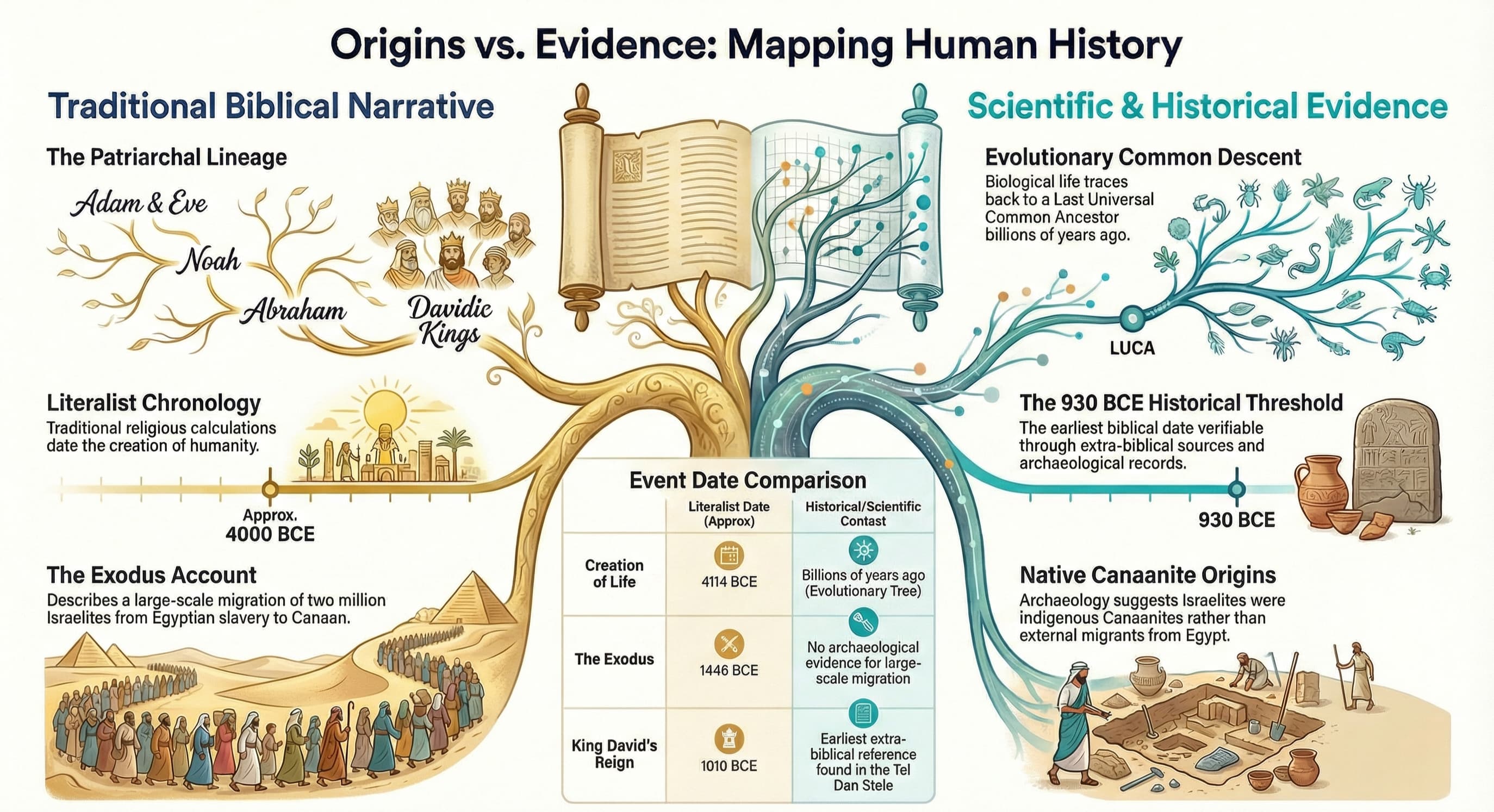
Origins vs. Evidence: Mapping Human History. The earliest biblical date verifiable through extra-biblical sources is 930 BCE — everything before that is mythology presented as history. This course teaches you how to tell the difference.
Think for Yourself
Audio Overview
NOT Anti-Religion. Anti-Exploitation.
This course only respects justified true beliefs — and ruthlessly examines institutions, leaders, and movements that weaponize faith, fear, and identity to extract money, obedience, or political power from people who trust them.
What You Will Learn
Brain Traps
Your brain has bugs. Confirmation bias, authority bias, sunk cost — the same shortcuts that helped your ancestors survive now help con artists thrive.
The Exploitation Playbook
From medieval indulgences to modern prosperity gospel, from Jonestown to QAnon — the manipulation playbook never changes. Learn it so you can spot it.
Intellectual Self-Defense
Seven questions that break every con. A Bayesian toolkit for updating your beliefs exactly as much as the evidence demands — no more, no less.
Curated Video Library
5 curated videos to explore — plus 12 more matched to individual units inside the course
![bending truth | how adults get indoctrinated [cc]](https://img.youtube.com/vi/IaUhR-tRkHY/mqdefault.jpg)
TheraminTrees is a former Jehovah's Witness who escaped and then spent years anatomizing exactly how indoctrination works -- not on children or vulnerable people, but on competent, intelligent adults who would swear it could never happen to them. This video walks through the specific psychological mechanisms that make indoctrination possible: incremental commitment (you start with something reasonable and each step is slightly more extreme), social isolation (your information environment narrows until the group's reality is the only reality), and identity fusion (your sense of self becomes so entangled with the group that leaving feels like dying). What makes this essential for the course is the narrator's refusal to treat indoctrination as something that happens to weak people. He demonstrates, with clinical precision, that the techniques work on everyone because they exploit universal features of human cognition -- the same brain traps Unit 1 names and the same cult mechanics Unit 3 dissects. If your student watches one video from this entire library, it should be this one.

Janja Lalich is a cult researcher and former member of a political cult who spent decades studying how groups capture minds. In under seven minutes, this TED-Ed animation covers the ground that Unit 3 spends an entire lesson on: the difference between a community and a cult, how charismatic leaders exploit moments of personal vulnerability, and why educated, skeptical people are not immune. Lalich explains that cults target people during transition moments -- new job, new city, recent loss -- and offers belonging before the control kicks in. The animation illustrates Jonestown, Heaven's Gate, and NXIVM-style groups with enough visual clarity to make the mechanisms stick. At 5.8 million views, this is also the most-watched video in the library, making it the ideal low-commitment entry point for students who think cults are something that happen to other people. Pair it with Unit 3's BITE model for the full picture.

This FRONTLINE documentary follows the real-world pipeline that Unit 3 describes theoretically: how online radicalization works, step by step, with cameras on the actual people being radicalized. The film traces the neo-Nazi movement from anonymous internet forums through the Charlottesville rally, documenting how memes become ideology, irony becomes sincerity, and keyboard warriors become street fighters. For a course that teaches the ironic-to-sincere pipeline and the BITE model applied to online spaces, this documentary provides the evidence that those frameworks describe reality, not theory. Students will see the exact process Unit 3 warns about -- the jokes that get less funny, the community that becomes your identity, the moment when pushing back means losing everything -- playing out with real names and real consequences. It is uncomfortable to watch. It should be.

Michael Stevens opens with a deceptively simple question -- where is your mind? -- and spends thirty minutes tracing how human reasoning actually works, where it breaks down, and why the tools we built to extend our thinking (phones, algorithms, social media) might be undermining the very faculties they were designed to enhance. The video covers the 'mercenary' theory of reasoning -- that human brains evolved not to find truth but to win arguments -- and the research showing that people are better at spotting flaws in other people's reasoning than in their own. This maps directly onto Unit 5's distinction between scout mindset and soldier mindset, and Julia Galef's argument that the desire to be right and the desire to see clearly are different things. At 12 million views, Vsauce has the production values and pacing to hold any student's attention, and the video's core message -- that reasoning is a tool that can be used well or badly, and that knowing its limits is the first step to using it well -- is the thesis statement of the entire course.

Timothy Snyder -- the Yale historian whose 'On Tyranny' is referenced in Unit 4 -- delivers a lecture that maps directly onto the course's central argument: that political movements borrow the playbook of cults and religious leaders. Snyder asks why modern right-wing movements seem to revolve around 'cult leaders who are regarded as heroes and treated as gods,' and traces a line from ancient paganism through fascism to the present moment. His key insight is that what looks postmodern (the rejection of truth, the embrace of spectacle) is actually premodern -- a return to politics organized around the body and suffering of a leader rather than around ideas or institutions. For a course that teaches students to recognize the fear-enemy-savior pattern, Snyder provides the historical scaffolding that shows this pattern is not new, not accidental, and not limited to one country or era. The lecture is dense but rewarding, best suited for students who have already absorbed Units 1 through 3 and are ready for the political dimension.
Explore These Channels
TheraminTrees produces meticulously researched video essays on manipulation, indoctrination, and the psychology of control -- drawing on personal experience as a former Jehovah's Witness and extensive engagement with the cult research literature. His videos on grooming, gaslighting, emotional blackmail, and 'bending truth' are essentially the video equivalent of the BITE model applied to everyday life. For a course that teaches students to recognize manipulation in pledges, religion, cults, politics, and online spaces, TheraminTrees provides a single channel that covers all five domains with the same direct, unsparing tone the course itself uses. His narration style -- calm, precise, refusing to moralize while making the mechanisms visible -- models exactly the skepticism-not-cynicism distinction Unit 5 teaches.
DarkMatter2525 has spent over a decade producing animated video essays about religion, mythology, and the institutional incentives that keep belief systems running long after their stated purposes have eroded. The channel's editorial signature -- animated dramatizations paired with rigorous textual analysis of religious sources -- is exactly the format that lets a curious teenager engage with arguments that would feel preachy in lecture form. For a course whose Unit 2 dissects religion-as-business and whose Unit 3 looks at the cult mechanics inside religious institutions, DarkMatter2525 provides the long-form companion that goes deeper than the unit text dares to in a school setting. The channel's tone is sharp but not contemptuous of believers themselves; it focuses on the institutional and rhetorical mechanisms rather than mocking individual faith.
Ian Danskin's Innuendo Studios produces the 'Alt-Right Playbook' series -- the most rigorous open-internet documentation of the specific rhetorical and organizing techniques the contemporary far right uses to recruit, radicalize, and retain members. Each episode names a specific tactic (the never-ending debate, the card says moops, you go high we go low) and demonstrates it operating in real political content with receipts. For Units 3 and 4, this is the channel that connects the BITE model to its contemporary online deployment. Danskin's pedagogical signature -- careful sourcing, intellectually generous treatment of opposing arguments before dismantling them, refusal to moralize -- makes the channel a master class in exactly the skepticism-not-cynicism Unit 5 teaches.
Dan Olson's Folding Ideas is the long-form epistemology channel that does what an entire semester of philosophy class struggles to do: it shows what skepticism actually looks like in practice. 'In Search of a Flat Earth' (4.7M views, 76 minutes) is one of the most pedagogically valuable videos on YouTube for teaching evidence-based reasoning, because it walks through the process of examining a fringe claim seriously and on its own terms before the conclusions land. The channel's broader catalog -- on cryptocurrency manias, parasocial relationships, conspiracy thinking -- gives students a sustained model of what intellectual self-defense looks like when applied to contemporary online environments. For Unit 5 (Intellectual Self-Defense), Folding Ideas is the indispensable model.
Cody Johnston's Some More News produces hour-long documentary essays that combine satirical commentary with serious investigative sourcing -- and the show's editorial discipline (every claim cited, every source linked in the description) is exactly the standard students need to see modeled. For Unit 4 specifically, the show's deep dives on Christian nationalism, dominionism, and the rhetorical takeover of mainstream Christianity by political movements provide the sustained primary-source-adjacent treatment the unit text can only gesture toward. The host's tone -- exhausted, sardonic, refusing to flatten the argument into either despair or false hope -- is the rhetorical posture Unit 5's intellectual self-defense kit is preparing students to adopt.
Professor Dave Farina's channel pairs basic-science instruction with a long-running and increasingly visible practice of debunking pseudoscience claims in real-time debate -- including head-to-head encounters with prominent flat-earthers, anti-vaxxers, and creationists. For Units 1 and 5, the value is methodological: students see what it actually looks like to evaluate a specific empirical claim against evidence in front of an opponent who is committed to denying that evidence. The channel's debunking videos are also rare examples of long-form content that holds adolescent attention while modeling the seven-question framework Unit 5 teaches: students see Dave testing claims for plausibility, internal consistency, and explanatory parsimony in motion. Watch with the seven-question framework loaded as the analytical lens.