The American Political System
Hidden Mechanics and Unwritten Rules. Why the Constitution was designed to make democracy difficult, how institutions transformed from their original design, and what political science research reveals about the gap between theory and practice.
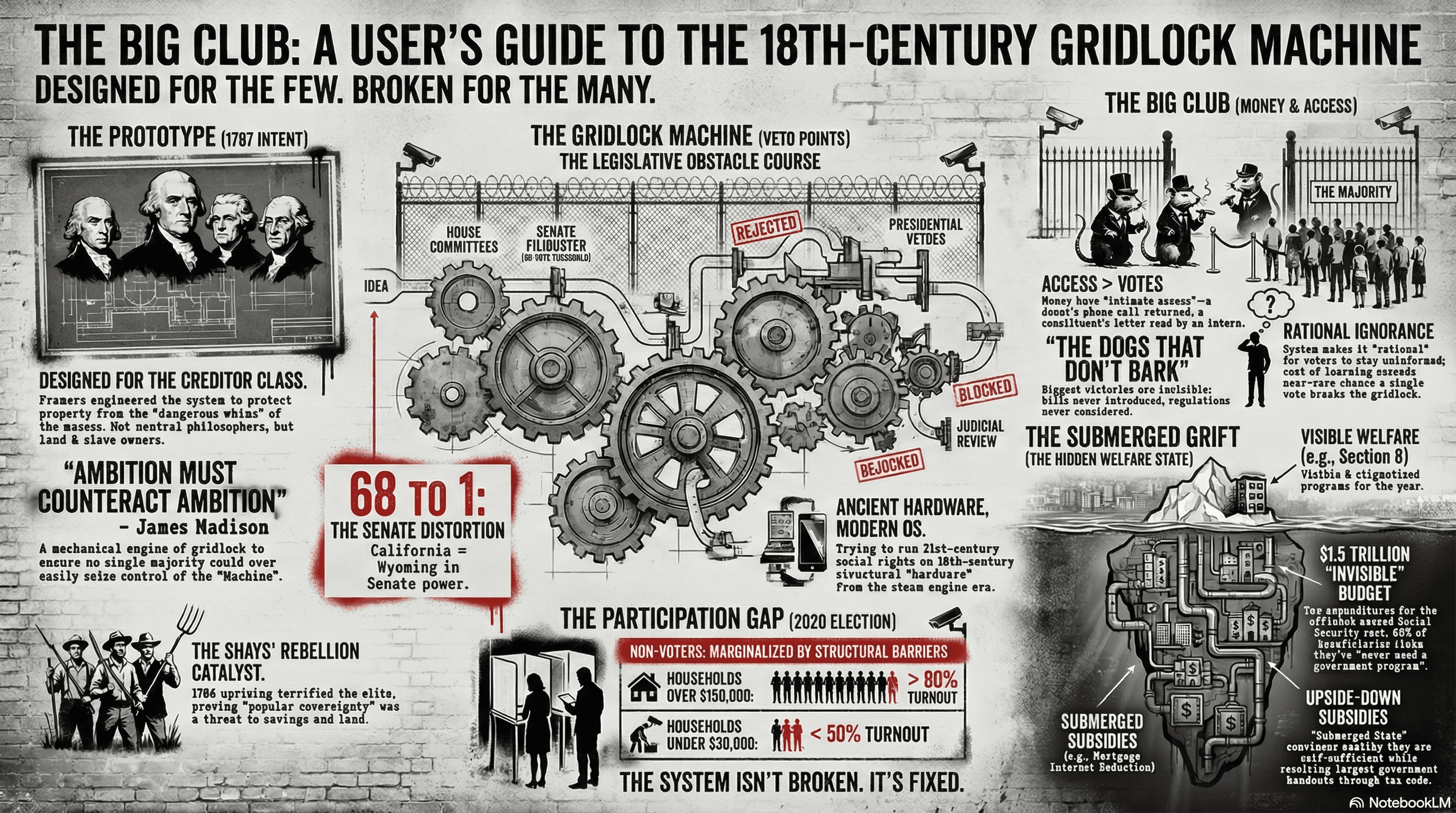
The Constitution Was Designed to Frustrate Democracy
Audio Overview — US Politics: Hidden Mechanics
What You Will Learn
Non-Obvious Insights
Counter-intuitive findings from political science research that challenge assumptions about how democracy works.
Hidden Mechanisms
The gap between formal rules and actual practice. What the Constitution says versus how power actually operates.
Scholarly Debates
What academics actually argue about, not settled consensus. Real tensions between competing values.
Curated Video Library
8 curated videos to explore — plus 11 more matched to individual units inside the course
Michael Sandel convenes a live Socratic seminar at Harvard's Kennedy School just before the 2012 election, using Obama's 'you didn't build that' remark and Romney's '47 percent' comment as entry points into a structured philosophical argument about redistribution, desert, and the social contract. Sandel opens by playing both clips and then asking the audience to vote on whether every American is entitled to decent health care regardless of ability to pay -- and what follows is an hour of genuine philosophical argument between students, members of the public, and Sandel himself. The pedagogical method is as important as the content: Sandel demonstrates how to hold politically charged questions in a framework of mutual respect and structured argument, which is exactly the intellectual disposition this course demands. His treatment of the welfare state as a philosophical question about what citizens owe each other connects directly to Unit 6's analysis of the hidden welfare state, while his framing of redistribution as a debate about the 'moral significance of individual success in a market economy' bridges Units 6 and 10.
FRONTLINE's two-hour documentary traces the decade of political polarization from Obama's 2004 convention speech through Trump's presidency, and it does so through the institutional mechanisms this course teaches. The film opens with Obama's promise of unity -- 'there is not a liberal America and a conservative America, there is the United States of America' -- and then systematically documents how that promise collided with structural realities: the Tea Party's exploitation of safe districts, McConnell's strategic obstruction in the Senate, the rise of partisan media ecosystems, and Sarah Palin's pre-Trump populism. Steve Schmidt, a Bush advisor, describes how Palin 'electrified the GOP base like no one I had ever seen' and represented 'the beginning of the shift where the people began to believe they could take the power back from the elite.' For students who have read about asymmetric polarization in Unit 2 and affective partisanship in Unit 5, this documentary makes the abstract mechanisms visceral: you watch sorting, negative partisanship, and institutional forbearance eroding in real time across a decade of American politics.

Michael Stevens opens with a question that sounds philosophical but turns out to be deeply political: 'Where is your mind?' He argues that the mind is not confined to the brain but extends through 'an ever-expanding organ of tissue and wood and stone and steel and people' -- that we are 'a species of individuals that is also one big interdependent lumbering growth.' The video then pivots to the science of reasoning itself, drawing on Hugo Mercier and Dan Sperber's argumentative theory of reason to explain why reasoning evolved not to find truth but to win arguments in social groups. This reframes the course's central puzzle: if reasoning is fundamentally social and adversarial rather than truth-seeking, then the polarization, motivated reasoning, and tribal epistemology students encounter throughout the course are not bugs in human cognition but features. At 30 minutes with 12 million views, this is the gateway video -- Vsauce's massive audience means many students will already know the channel, and Stevens's trademark style of starting with a simple question and arriving at genuinely unsettling conclusions models the intellectual posture the entire course demands.
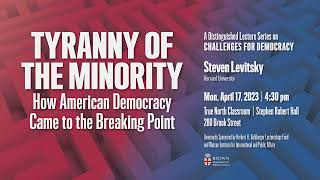
This is the single most important video for this course. Steven Levitsky delivers the lecture version of his and Daniel Ziblatt's framework at Brown University, tracing how American democracy's anti-majoritarian institutions -- the Electoral College, the Senate, the filibuster, and judicial review -- have been weaponized by partisan minorities to block majority preferences. Levitsky opens by noting that his earlier book How Democracies Die focused on threats from demagogues, but that he has 'come to realize that the bigger threat to American democracy is not the breakdown of norms by one leader but the exploitation of counter-majoritarian institutions by a party that cannot win national majorities.' He connects fourteen of the course's glossary terms in a single lecture: from institutional forbearance and mutual toleration to democratic backsliding, gerrymandering, and the filibuster. The lecture maps directly onto Units 1 through 11, providing students with the overarching analytical framework before they encounter the institutional details. When your student reads about veto players in Unit 1 or the accidental filibuster in Unit 2, Levitsky's argument that these mechanisms have been 'repurposed for minority rule' will already be in their head.

FRONTLINE investigates what happens when one of the world's richest men acquires a platform that had become the de facto public square for political debate and journalism. The documentary traces Musk's transformation from a quirky tech entrepreneur posting rocket launch commentary to a political actor whose platform decisions -- reinstating banned accounts, amplifying certain political voices, throttling others -- reshape the information environment in which democracy operates. Former Twitter employees describe being 'terrified' as Musk gutted content moderation teams, and researchers document measurable increases in harassment and disinformation. The film's power for this course lies in its treatment of a question Unit 8 raises about money and power: what happens when wealth so vast it can purchase a global communications platform is deployed not to buy elections directly but to reshape the arena in which political discourse occurs? Students who have read about dark money and institutional corruption will recognize a new mechanism of influence that existing campaign finance frameworks cannot capture.
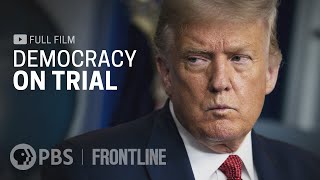
FRONTLINE's definitive documentary on the January 6th prosecution traces the full arc from Trump's refusal to accept the 2020 election results through the special counsel's indictment on charges of conspiring to defraud the United States and disenfranchise voters. The documentary features interviews with key participants on multiple sides: prosecutors who built the case, Republican officials who resisted pressure to overturn results, and legal scholars who debate whether the prosecution itself threatens democratic norms. What makes this essential viewing is its refusal to treat January 6th as a simple story of heroes and villains. Instead, it traces how institutional mechanisms -- the Electoral Count Act, the certification process, the independence of state election officials -- were both tested and vindicated. For students working through this course's argument that American institutions were designed to frustrate majorities, this documentary shows what happens when those same institutions are asked to defend democracy against an assault from within. The contrast between institutions that held and those that nearly broke is the empirical core of Units 10 and 11.

In just seven minutes, the Wall Street Journal delivers the most concise and politically neutral explainer available on the unitary executive theory -- the legal doctrine that Article II vests all executive power in a single president. The video features Michael Waldman of the Brennan Center arguing that the theory 'would undo a lot of what we rely on to regulate the economy' alongside John Yoo, who helped develop the theory during the Bush administration and argues it is 'not new and it's not a theory, it's a description of what the framers did in Article 2.' The video traces the doctrine from Justice Scalia's famous lone dissent through the Roberts Court's incremental expansion of presidential removal power, landing on the current constitutional collision: if the president can fire heads of independent agencies, impound congressionally appropriated funds, and override regulatory decisions, what remains of the separation of powers? This is the ideal companion for Unit 3 because it presents the strongest version of both sides without editorializing, and at seven minutes it is the lowest-commitment entry point in the showcase.

This tightly produced video essay examines what the channel calls 'stealth authoritarianism' -- the phenomenon of democratic institutions being hollowed out from within while maintaining the outward appearance of democratic governance. The video opens with a striking chart showing the number of countries with multi-party elections over time, then demonstrates how that metric conceals the reality of democratic erosion: 'The United States is counted starting in 1825 when slavery was still legal and voting limited to some white men. Is that really democracy?' The essay traces how Hungary's Fidesz party won only 45 percent of the vote but secured supermajorities through gerrymandering and court-packing, and then asks whether similar mechanisms are operating in the United States. At 29 minutes, it covers democratic backsliding, executive overreach, federalism as a tool of resistance, and the distinction between overt authoritarianism and institutional capture -- connecting to Units 1, 3, 9, and 10 simultaneously. The production quality and pacing make it particularly effective for students who absorb political analysis better through visual storytelling than through academic prose.
Explore These Channels
FRONTLINE has produced the definitive documentary investigations of American political institutions under stress. Their political documentaries -- including Democracy on Trial, America's Great Divide, Trump's Showdown, and the January 6th investigations -- feature extensive interviews with participants on all sides: prosecutors and defense attorneys, Republican and Democratic officials, career civil servants and political appointees. For a course that treats American institutions as designed to frustrate democracy, FRONTLINE's investigative journalism provides the empirical evidence that textbooks cannot: you watch institutional forbearance erode in real time through the testimony of the people who were in the room.
Khan Academy
Khan Academy's Foundations of American Democracy playlist provides the baseline constitutional literacy that this course then systematically complicates. Their videos on the social contract, Federalist No. 10, the Electoral College compromise, the Three-Fifths Compromise, separation of powers, federalism, and the amendment process cover exactly the material this course expects students to already know -- or to learn quickly. The videos are short (4-10 minutes each), clearly produced, and deliberately nonpartisan. Students who need scaffolding before tackling this course's more provocative arguments about the Constitution's anti-majoritarian design will find the Khan Academy playlist an efficient way to acquire the factual foundation the course assumes.
Democracy Docket, founded by election law attorney Marc Elias, produces structured conversations with constitutional scholars, sitting members of Congress, and federal litigators on the legal mechanisms that shape American democracy: voting rights, gerrymandering, campaign finance, judicial independence, and executive power. Their panels consistently feature multiple perspectives -- Congressman Jamie Raskin alongside Harvard and NYU law professors -- and focus on the institutional mechanisms rather than partisan outcomes. The channel's emphasis on how constitutional litigation actually works, from district courts through the Supreme Court, provides students with a procedural understanding of judicial review that complements Unit 4's theoretical treatment.