Case Study: The Ten-Year Signal — Character, Credibility, and the Russia Pattern
Three documented episodes update the Bayesian prior on executive credibility regarding Russia: Helsinki, the first impeachment, and the Jack Smith evidence. The Mueller Report, congressional testimony, and court filings are public record. The loyalist ecosystem is mapped by convictions and pardons. The financial entanglement is documented in sworn testimony. And in March 2026, Russian intelligence is confirmed providing targeting data for strikes on American troops. This is a credibility assessment. The evidence speaks.
· Analysis reflects information available at time of publication.

Learning Objectives
- 1Perform sequential Bayesian updating across three documented episodes to assess executive credibility on Russia-related claims
- 2Map the loyalist ecosystem as a network of documented convictions, pardons, and Russian connections: Bannon, Flynn, Stone, Giuliani, Meadows, Eastman
- 3Evaluate how institutional failures (Senate acquittal, DOJ sitting-president policy, media news-cycle processing) prevented the cumulative pattern from producing a systemic assessment
- 4Distinguish between conspiracy theory (starting from a conclusion) and credibility assessment (starting from evidence), and understand why the distinction matters for democratic citizenship
Play first or after: Putin's Long Game, eighteen years of testing what the West would tolerate, 25 turns to find your own answer. Then come back and run the Bayesian update on the ten-year signal.
❓Concept Check
This case study is a credibility assessment — not a conspiracy theory. The distinction is the first lesson. A conspiracy theory starts from a conclusion ('Trump works for Russia') and selects evidence to support it. A credibility assessment starts from documented evidence — the Mueller Report, congressional testimony, court filings, pardons, the executive's own words on camera — and asks what conclusion the evidence supports. Three episodes. One question: given the ten-year record, does this executive retain credibility on Russia-related claims? The analytical tool is Bayesian updating. The evidence is public record. The conclusion is yours.
▸
Concept Check
This case study is a credibility assessment — not a conspiracy theory. The distinction is the first lesson. A conspiracy theory starts from a conclusion ('Trump works for Russia') and selects evidence to support it. A credibility assessment starts from documented evidence — the Mueller Report, congressional testimony, court filings, pardons, the executive's own words on camera — and asks what conclusion the evidence supports. Three episodes. One question: given the ten-year record, does this executive retain credibility on Russia-related claims? The analytical tool is Bayesian updating. The evidence is public record. The conclusion is yours.
A credibility assessment is the analytical inverse of a conspiracy theory. Conspiracy theories are top-down: they begin with a narrative and conscript evidence into its service, discarding what doesn't fit. Credibility assessments are bottom-up: they accumulate documented evidence — sourced, cross-referenced, often from the subject's own words and actions — and ask what probability distribution the evidence supports. This case study presents three evidentiary pillars: the intelligence decoupling (2016-2019), foreign policy as private scheme (2019-2020), and truth-indifference as operational mode (2020-2025). Each updates the Bayesian prior. The posterior is not 'Trump is a Russian agent.' It is: 'What credibility does the executive retain on Russia-related claims, given the documented record?' That is a narrower, more defensible, and more useful question.
The Question Before the Question
The four prior case studies in this series analyzed the 2026 Iran war through four lenses: institutional capture (Part 1), diversionary dynamics (Part 2), pattern coherence (Part 3), and accountability erosion (Part 4). Each assumed, without proving, that the executive's credibility on Russia-related claims was already compromised. This case study establishes that assumption.
Not by assertion. By evidence.
The question is not why did the Iran war benefit Russia? It did (Brent crude surged past $130/barrel when the Strait of Hormuz became contested, and Russia, as the world's second-largest oil exporter outside the disruption zone, captured windfall revenues). The question is the one that precedes it: does this executive have credibility on any Russia-related claim?
A credibility assessment applies the same toolkit this curriculum has developed across critical-thinking and philosophy-of-history. A prior is your starting estimate of executive credibility. Evidence is documented, sourced, often from the subject's own words. A posterior is your updated estimate after processing the evidence. Three evidentiary pillars, each updating the prior. The threshold question: at what point does accumulated evidence compel a conclusion?
The evidence presented in this case study is entirely from public record: the Mueller Report (Volumes I and II), congressional testimony under oath, federal court filings, the executive's own statements on camera, and executive actions documented in the Federal Register. Every factual claim is sourced. Where reasonable people might disagree about interpretation, the disagreement is noted. Where the evidence speaks unambiguously, the case study will not pretend otherwise.
A note on sequence. This case study is labeled Part 5 but it is, logically, Part 0: the prequel. Parts 1-4 analyzed the 2026 crisis and assumed the credibility deficit. This case study documents the decade that created it. The pedagogical choice to present it last rather than first is deliberate: students needed to learn the analytical frameworks (Bayesian reasoning, Luhmann's functional differentiation, ICD 203 analytic standards, the IPC model) through the crisis before being asked to apply them to the character assessment. You learn the tools on the case. Then you turn the tools on the person at the center of it.
Pillar I: Helsinki and the Intelligence Decoupling (2016–2019)
July 16, 20182018
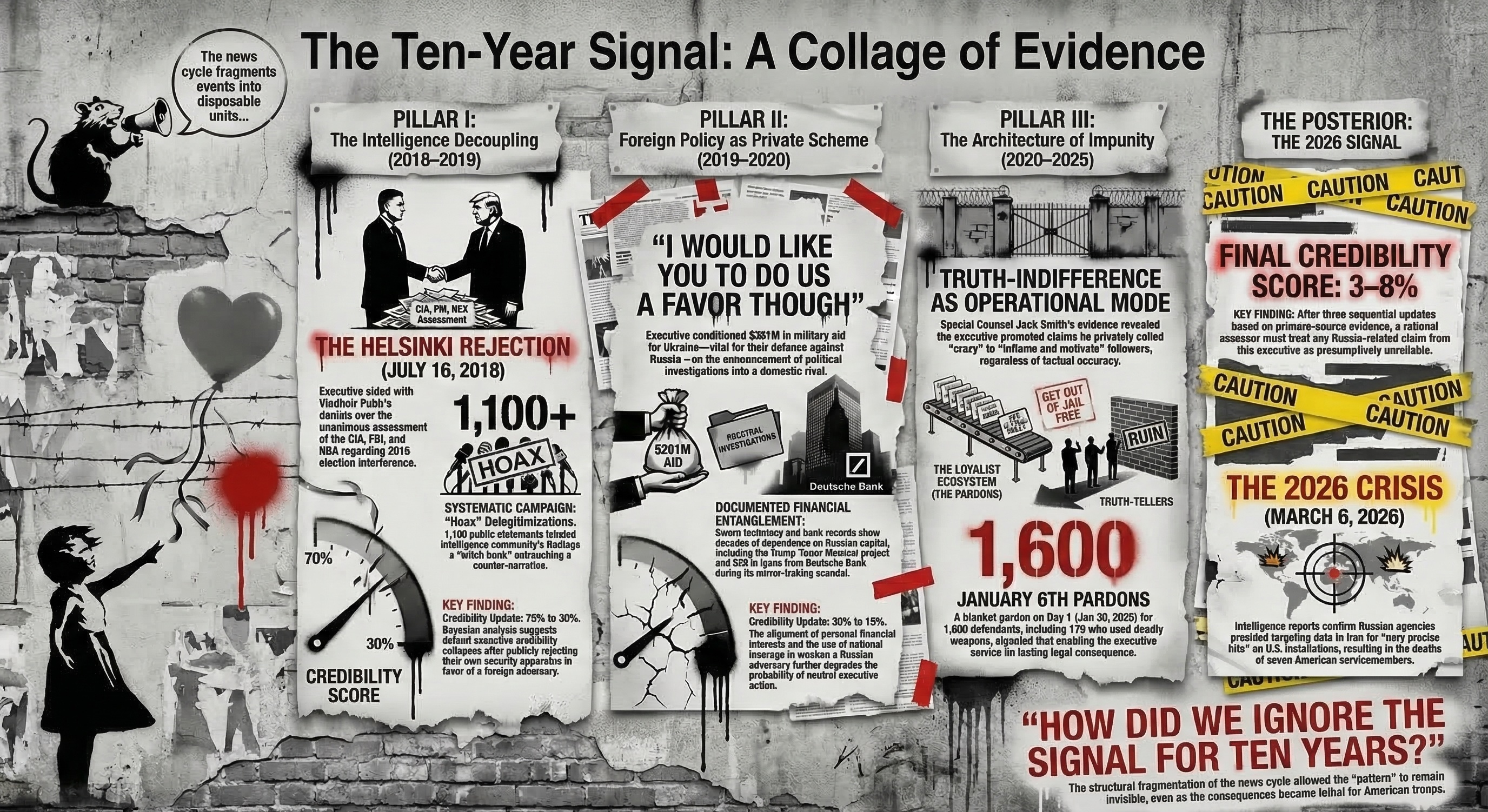
On January 6, 2017, the Office of the Director of National Intelligence published an unclassified assessment representing the unanimous judgment of the CIA, FBI, and NSA: Russia had conducted a "sweeping and systematic" campaign to interfere in the 2016 presidential election, directed by President Vladimir Putin, with the strategic goal of undermining public faith in the democratic process and harming the candidacy of Hillary Clinton (ODNI, Assessing Russian Activities and Intentions in Recent US Elections, January 6, 2017). The Senate Intelligence Committee, led by Republican Chairman Richard Burr, later unanimously confirmed these findings after a three-year bipartisan investigation (SSCI, Report on Russian Active Measures, Volumes 1-5, 2019-2020).
Special Counsel Robert Mueller's investigation produced a 448-page report in two volumes. Volume I documented the Russian interference campaign in granular detail: the Internet Research Agency's social media operations, GRU hacking of the DNC and DCCC, outreach to the Trump campaign through multiple channels. Volume I did not establish that members of the Trump campaign conspired or coordinated with Russia in its interference activities, though it documented "numerous links between the Russian government and the Trump Campaign" (Mueller Report, Vol. I, p. 1-2).
Volume II documented ten episodes of potential obstruction of justice. Mueller's conclusion was structurally constrained: the Office of Legal Counsel had determined that a sitting president could not be indicted. Mueller stated explicitly that he was not making a traditional prosecutorial judgment:
"If we had confidence after a thorough investigation of the facts that the President clearly did not commit obstruction of justice, we would so state. Based on the facts and the applicable legal standards, however, we are unable to reach that judgment. The evidence we obtained about the President's actions and intent presents difficult issues that prevent us from conclusively determining that no criminal conduct occurred."
Mueller's statement explaining why the Special Counsel's Office did not reach a traditional prosecutorial judgment on obstruction of justice.
Read that again. The Special Counsel did not say "we found no evidence." He said: if the evidence had cleared the president, we would have said so. It didn't. And the OLC policy prevented us from saying what it did show.
The ten episodes of obstruction Mueller documented included: directing White House Counsel Don McGahn to fire the Special Counsel (McGahn refused and prepared to resign); attempting to limit the investigation to future election interference only; directing McGahn to deny he had been asked to fire Mueller; attempting to have Attorney General Jeff Sessions un-recuse himself to take control of the investigation; and dangling pardons to discourage cooperation with investigators. Each episode was documented through testimony, contemporaneous notes, and corroborating witnesses. The pattern was not ambiguous. It was systematic.
The DOJ policy that shielded the executive from indictment, the 1973 OLC memorandum, reaffirmed in 2000, was a structural feature, not a verdict. Mueller emphasized this: the evidence was preserved precisely so that future institutions (Congress, or a post-presidency DOJ) could evaluate it. The structural shield became a structural trap: the evidence existed, the policy prevented prosecution, and the institutions that could have acted on the evidence chose not to.
Throughout the investigation, the executive attacked it more than 1,100 times as a "hoax" and a "witch hunt", not occasional pushback but systematic delegitimization of the intelligence community's own finding (Washington Post tracking database, 2017-2019). This was not a president expressing disagreement with a policy assessment. It was a sustained campaign to discredit the institutions charged with protecting the country from foreign interference, and it worked. By the time the Mueller Report was released, the narrative that it represented "total exoneration" was already entrenched, despite the report's explicit statement to the contrary. Attorney General William Barr's four-page summary, released weeks before the full report, framed the finding as a vindication. Mueller himself wrote to Barr that the summary "did not fully capture the context, nature, and substance of this Office's work and conclusions" (Washington Post, April 30, 2019). The framing won. The evidence lost.
Then came Helsinki.
On July 16, 2018, standing next to Vladimir Putin at a joint press conference, the President of the United States was asked whether he believed his own intelligence community's unanimous assessment that Russia had interfered in the 2016 election. He said: "I don't see any reason why it would be", siding publicly, on camera, at an international summit, with the Russian president's denial over the documented finding of the CIA, FBI, NSA, and a bipartisan Senate committee.
The next day, facing bipartisan backlash so severe that even Fox News called it "disgraceful," the executive offered a correction: he had meant to say "I don't see any reason why it wouldn't be." A double-negative correction, the kind of walk-back that insults the intelligence of everyone who watched the original statement.
The Bayesian update: The prior was default executive credibility, the presumption that a president, whatever his politics, accepts the findings of his own intelligence community on matters of foreign adversary action. Helsinki destroyed that prior. The executive established, on camera, that when forced to choose between the unanimous finding of the U.S. intelligence community and the denial of the Russian president, he would choose Putin. This is not interpretation. It is tape.
What followed Helsinki is almost as significant as the event itself. The norm violation was processed through the news cycle: outrage on Monday, walk-back on Tuesday, next crisis by Thursday. Within two weeks, Helsinki was "old news." The intelligence community's unanimous finding, Russia interfered, Putin directed it, was never rescinded, never updated, never contradicted by any subsequent assessment. It remained the IC's position throughout both terms. And the executive who rejected it on live television was never required to reconcile that rejection with his intelligence briefings, his national security decisions, or his relationship with Russia. The norm was broken and the break was normalized, not through acceptance but through the structural inability of democratic institutions to sustain attention on a single norm violation when the next violation is always arriving.
Pillar II: Foreign Policy as Private Scheme (2019–2020)
July 25, 20192019
On July 25, 2019, less than a year after Helsinki, the president called Ukrainian President Volodymyr Zelensky and said: "I would like you to do us a favor though." The favor: investigate Joe Biden and his son Hunter Biden, the president's likely 2020 opponent. The context: $391 million in congressionally appropriated military aid to Ukraine had been frozen on July 12, thirteen days earlier, on the president's orders. The aid was released on September 11, only after a whistleblower complaint had surfaced and congressional scrutiny made the hold untenable.
The timeline mattered because the person who had been managing the freeze was career OMB official Mark Sandy, who later testified that he was removed from the process and replaced by political appointee Mike Duffey, who had no prior involvement in Ukraine security assistance (Sandy testimony, House Intelligence Committee, November 16, 2019). The loyalty substitution pattern, replace the professional with the loyalist at the point of maximum sensitivity, was already visible.
The House Intelligence Committee found that the president had used the power of his office to solicit foreign interference in the 2020 election by conditioning official acts, a White House meeting and military aid, on the announcement of investigations that would benefit him personally (House Intelligence Committee, Report on the Trump-Ukraine Impeachment Inquiry, December 2019). The president was impeached on December 18, 2019, on two articles: Abuse of Power and Obstruction of Congress.
The Senate acquitted on February 5, 2020: 48-52 on Abuse of Power, 47-53 on Obstruction of Congress. Senator Mitt Romney (R-UT) voted guilty on Article I, the first senator in American history to vote to convict a president of his own party. He stood alone. The other 52 Republican senators voted to acquit, not because the evidence was insufficient (several acknowledged the conduct was inappropriate) but because, as Senator Lamar Alexander (R-TN) stated, "there is no need for more evidence to prove something that has already been proven" while simultaneously voting to acquit. The conduct was proven. The institution chose not to act. That choice was the permission structure.
Note the Russia dimension that the impeachment's focus on Ukraine partially obscured: the military aid being withheld was defending Ukraine against Russian aggression. The executive was using American leverage over Ukraine's defense against Russia as a tool for personal political benefit, weakening the country Putin was trying to subjugate, in exchange for dirt on a domestic political opponent. Whether the alignment with Russian interests was intentional or incidental, the structural outcome was the same: Ukraine's bargaining position against Russia was degraded at a moment when Russian forces occupied Crimea and eastern Ukraine.
The financial entanglement. The impeachment established that the executive used foreign policy as personal leverage. But the Russia dimension of that leverage had been documented years earlier, in sworn testimony. Michael Cohen, the president's personal attorney for over a decade, testified before the House Oversight Committee on February 27, 2019, that the president had asked "How's it going in Russia?" at least half a dozen times between the Iowa Caucus and June 2016 regarding the Trump Tower Moscow project, a period during which the president was publicly stating "there's no business in Russia" (Cohen testimony, House Oversight Committee, February 27, 2019).
Donald Trump Jr. stated in 2008 at a real estate conference: "Russians make up a pretty disproportionate cross-section of a lot of our assets" (eTurboNews, September 2008). This was not a political statement. It was a business statement: a real estate developer's son explaining, at a real estate conference, where the money came from. Eric Trump reportedly told golf writer James Dodson in 2014: "We have all the funding we need out of Russia", a statement Eric Trump later denied (WBUR/Dodson, May 2017). The denial came after the Mueller investigation began; the original statement, if accurate, was made when there was no reason to lie about the source of capital.
Deutsche Bank extended approximately $2 billion in loans to the Trump Organization over two decades, making it the only major Western bank willing to lend to the Organization after a string of bankruptcies and defaults in the 1990s. During this same period, Deutsche Bank was under investigation for a Russian money-laundering scheme through its Moscow branch: a "mirror trading" operation that moved an estimated $10 billion in potentially laundered funds out of Russia through corresponding trades in Moscow and London (New York State Department of Financial Services, Consent Order, January 2017; New York Times, Deutsche Bank reporting, 2019-2020). Deutsche Bank paid $630 million in fines to U.S. and U.K. regulators for the scheme. The bank's internal anti-money-laundering compliance officers flagged suspicious transactions involving Trump and Kushner accounts; the alerts were not escalated to government authorities (New York Times, May 19, 2019).
No smoking gun emerged from the Deutsche Bank investigation connecting specific Russian laundered funds to specific Trump Organization loans. But the evidentiary pattern is precisely the kind of structural alignment Snyder describes: the only bank willing to lend, the concurrent Russian money-laundering operation, the suppressed compliance alerts. You do not need a conspiratorial meeting in a parking garage. You need a financial dependency so embedded in the business model that the dependent party's interests quietly converge with the creditor ecosystem's interests.
"The politics of eternity places one nation at the center of a cyclical story of victimhood... [Russia's eternity politicians] generated fictional threats to Russia in order to consolidate power at home, then exported political fiction abroad to weaken factual journalism and democratic debate."
Snyder traces how Russian capital moved into Western political systems through real estate, banking, and shell companies — creating dependency relationships that required no recruitment, no handler, no conspiracy.
Snyder's broader argument in The Road to Unfreedom documents the mechanism by which Russian capital flows created dependency relationships with Western political figures, not through espionage but through the mundane machinery of real estate, banking, and debt. The dependent party is not told what to do. The dependent party finds, over time, that their interests have quietly converged with those of the creditor ecosystem. This is Snyder's insight applied to the financial record documented above, and it is structural, not conspiratorial. The claim is not that the executive was "recruited" by Russia. It is that documented financial dependence on Russian capital, sworn testimony, bank records, the executive's own son's public statement, created an alignment of interests that did not require explicit coordination to produce the observed pattern: Helsinki, the systematic attack on the investigation, the use of foreign policy as personal leverage.
Cross-Curricular Connection: Each of these episodes, Helsinki, the Zelensky call, the Cohen testimony, was processed by media as a discrete news cycle. Journalism Unit 5 explores how state-sponsored disinformation operates not only through fabrication but through the structural fragmentation of cumulative evidence into isolated episodes. The propaganda model does not require a conspiracy. It requires only that each episode be processed through the news cycle's binary code, information/non-information, which structurally prevents the aggregation of sequential evidence into a pattern assessment.
The Bayesian update: The prior, already damaged by Helsinki, now absorbs two additional data points. First: the executive used military aid as personal leverage against a country that was literally at war with Russia, weakening Ukraine's position at the moment it most needed American support. Second: the financial entanglement with Russian capital is documented in sworn testimony, public statements, and bank records. The posterior: an executive who trusts Putin over his own IC (Pillar I) AND who uses foreign policy as personal leverage in ways that happen to align with Russian strategic interests AND who has documented financial dependence on Russian capital. These are not competing facts. They are the same pattern.
And note the structural connector between Pillars I and II: the executive who rejected his own IC's finding that Russia interfered in the 2016 election (Pillar I) then used foreign policy leverage against the country Russia was attacking (Pillar II). The intelligence decoupling was not an isolated event. It was a posture, and that posture had consequences for how the executive wielded American power in the Russia-Ukraine theater. Whether the alignment was intentional, opportunistic, or merely consistent with financial interests is a question the available evidence cannot conclusively answer. But the pattern is visible, and a Bayesian analyst does not require proof of intent to update on pattern evidence.
Pillar III: The Mechanical System of Truth-Indifference (2020–2025)
August 1, 20232023
On August 1, 2023, Special Counsel Jack Smith indicted the former president on four federal counts: conspiracy to defraud the United States, conspiracy to obstruct an official proceeding, obstruction of an official proceeding, and conspiracy against rights. The unsealed evidence filings (October 2024) revealed a pattern that was no longer about Russia specifically but about the operational mode the Russia pattern had trained:
"The details don't matter." The executive was told by advisors that specific claims about election fraud were unprovable. He directed that they be pushed publicly anyway. The purpose was not to establish truth but to "inflame and motivate" (Smith filing, October 2024).
"So what?" When informed that Vice President Mike Pence had been evacuated from the Capitol during the January 6 attack, that was the executive's documented response (Smith filing, October 2024).
Private vs. public: the executive privately called attorney Sidney Powell's election fraud claims "crazy," then promoted them publicly on social media (Smith filing, testimony evidence).
Smith's office concluded in its final report (January 2025) that the evidence was sufficient to obtain and sustain a conviction at trial. The case was dropped solely because of the DOJ's longstanding policy, the same OLC memo that constrained Mueller, that a sitting president cannot be indicted. The evidence was not evaluated and found wanting. It was preserved unadjudicated, the second time in six years that the structural shield of the OLC policy prevented the evidence from reaching a courtroom.
Consider the through-line: Mueller could not indict because of the OLC policy (2019). The Senate could have convicted but chose not to (2020). Smith could not prosecute because of the same OLC policy (2025). At every stage, the evidence was sufficient. At every stage, a structural or institutional barrier prevented adjudication. The evidence has been assessed by two Special Counsels, a House Intelligence Committee, and a bipartisan Senate Intelligence Committee, and it has never been adjudicated in a forum with the power to impose consequences. That is not an absence of evidence. It is an architecture of impunity.
The loyalist ecosystem. Pillar III is incomplete without mapping the network, not as a list of individuals but as a system that rewards loyalty and punishes truthfulness:
Steve Bannon: Architect of "deconstruction of the administrative state." Convicted of fraud in the We Build the Wall scheme (indicted August 2020, pardoned by the president January 2021 before trial on federal charges; New York state charges continued). Convicted of contempt of Congress for defying a January 6 Committee subpoena (July 2022, served four months). Currently advising on institutional restructuring.
Michael Flynn: The president's first National Security Advisor. Pleaded guilty to making false statements to the FBI, specifically about his contacts with Russian Ambassador Sergey Kislyak during the presidential transition (December 2017). Pardoned November 2020. Subsequently embraced QAnon conspiracy theories. Appointed to the West Point Board of Visitors (2025).
Roger Stone: Convicted on seven counts including obstruction, witness tampering, and making false statements to Congress, charges arising from his communications with WikiLeaks and documented direct messages with the Russian intelligence persona Guccifer 2.0 (November 2019). Sentence commuted July 2020, fully pardoned December 2020.
Rudy Giuliani: Led the irregular Ukraine pressure campaign that produced the first impeachment. Disbarred in New York (July 2024) and the District of Columbia (October 2024). Pardoned November 2025.
Mark Meadows, John Eastman: Pardoned November 2025.
Seventy-seven alternate electors: Pardoned November 2025 (White House statement, November 2025).
Approximately 1,600 January 6 defendants: Blanket pardons on Day 1, January 20, 2025, including more than 170 who used deadly weapons and approximately 600 who assaulted police officers.
Cross-Curricular Connection: Map this network using the Bayesian reasoning framework from Critical Thinking Unit 1. Each pardon is a data point. Each conviction followed by a pardon is a likelihood ratio. The question is not whether each individual pardon has a stated rationale. Most do. The question, as probabilistic thinking demands, is: which hypothesis better explains the full pattern? Hypothesis A: each pardon corrects a genuine injustice, and the concentration among people who enabled the executive's schemes is coincidental. Hypothesis B: the pardon power is being used to reward loyalty and signal that enabling the executive carries no lasting consequence. Standard 4 from ICD 203, Analysis of Alternatives, requires you to assess which hypothesis is more consistent with the totality of evidence.
The pattern. Every person who enabled the scheme was rewarded. Flynn lied about Russian contacts, then was pardoned and appointed to oversee West Point. Stone communicated with Russian intelligence personas, then was pardoned. Bannon committed fraud, then was pardoned. Giuliani led the Ukraine pressure campaign, was disbarred, then pardoned. Every person who testified truthfully, Cassidy Hutchinson, Rusty Bowers, Brad Raffensperger, the anonymous whistleblower who triggered the first impeachment, was punished within their political ecosystem. Hutchinson received death threats. Bowers lost his primary. Raffensperger was censured by his own state party.
This is not random. This is a system. And the system's message is legible: truth-telling about the executive is punished; loyalty to the executive, regardless of the truth, is rewarded. That message is itself evidence in a credibility assessment.
"A reliable way to make people believe in falsehoods is frequent repetition, because familiarity is not easily distinguished from truth. Authoritarian institutions and marketers have always known this fact."
Kahneman describes how repetition creates the illusion of truth — a mechanism that applies directly to the 'hoax' narrative repeated more than 1,100 times.
Kahneman's insight has a corollary that his framework predicts but that he did not write about directly: the cognitive system that evaluates credibility resets with each news cycle. Each episode, Helsinki, the impeachment, the indictment, is processed in isolation. The repetition effect works in two directions: "hoax" repeated 1,100 times becomes familiar and therefore plausible; the cumulative evidence, processed across ten years of discrete news cycles, never aggregates into the pattern assessment it would produce if encountered all at once. The cognitive architecture that should accumulate sequential evidence into a credibility judgment is defeated by the structural fact that each data point arrives in a different news cycle and is processed against a different baseline.
The Bayesian update: The prior, already twice-damaged by Helsinki and the first impeachment, now absorbs the full weight of the Jack Smith evidence and the loyalist ecosystem. Truth-indifference is not a character flaw. It is an operational mode, documented in court filings, demonstrated through the pardon pattern, and confirmed by the systematic punishment of truth-telling. The posterior: an executive whose relationship with truth is not "sometimes dishonest" (a common political trait) but structurally adversarial, who treats factual accuracy as an obstacle to be managed rather than a constraint to be respected. And who has built an ecosystem that enforces that relationship.
The Posterior: What the Signal Says
Three pillars. Three sequential updates. One question.
Prior: Default executive credibility, the presumption that a president, whatever his politics, operates within the bounds of factual reality and defers to institutional expertise on matters of national security.
Update 1 (Helsinki): The executive publicly chose Putin's denial over the unanimous finding of the CIA, FBI, NSA, and a bipartisan Senate committee. Then attacked the investigation more than 1,100 times as a "hoax." The prior collapses, not slightly, categorically. This is not a policy disagreement. It is an executive who established, on tape, that he would side with a foreign adversary over his own intelligence community.
Update 2 (First Impeachment): The executive used military aid to an ally at war with Russia as personal leverage: the Zelensky call, the frozen $391M, the loyalty substitution of Duffey for Sandy. Simultaneously, sworn testimony documented financial dependence on Russian capital spanning decades. The posterior: an executive who trusts Putin over the IC AND uses foreign policy as personal leverage in ways that serve Russian strategic interests AND has documented financial entanglement with Russian capital.
Update 3 (Jack Smith + Loyalist Ecosystem): Truth-indifference confirmed as operational mode: "the details don't matter," "so what?" about the Vice President's evacuation, privately calling claims "crazy" while promoting them publicly. The loyalist ecosystem mapped by convictions and pardons: every enabler rewarded, every truth-teller punished. The posterior: an executive for whom factual accuracy is instrumentally irrelevant, surrounded by a system that enforces that irrelevance.
The formal Bayesian structure. Part 2 of this series introduced numerical Bayesian reasoning: assigning approximate probabilities and updating them on evidence. Apply the same structure here, with this question: What is the probability that this executive's claims about Russia-related matters are credible?
The prior: Start generous. Assign a 70% prior probability that any given president's claims about a foreign adversary are broadly credible, accepting that all presidents spin and frame, but presuming that factual claims about matters of national security are generally grounded in intelligence community consensus. This is a charitable prior.
After Helsinki (Update 1): The executive publicly sided with Putin over the IC. This is strong evidence against credibility on Russia: the likelihood ratio is heavily weighted. A reasonable posterior drops to approximately 25-35%. The evidence is not ambiguous: it is on tape.
After the first impeachment (Update 2): The executive used foreign policy as personal leverage in ways that served Russian strategic interests, while documented financial entanglement with Russian capital was established through sworn testimony. The posterior drops further, perhaps 10-20%. Two independent data points, both pointing in the same direction.
After Jack Smith + the loyalist ecosystem (Update 3): Truth-indifference is documented as an operational mode, not an occasional lapse. The pardon pattern demonstrates that the executive systematically rewards those who lie on his behalf and punishes those who tell the truth. The posterior: somewhere between 3-8%. Not zero. A rigorous analyst acknowledges the possibility that the documented pattern is misleading. But vanishingly low. Three sequential updates, each independently supported by primary-source evidence, each pointing in the same direction.
A posterior of 3-8% means: a rational assessor, having processed the documented evidence, would treat the executive's Russia-related claims as presumptively unreliable, not because of partisan bias, but because the evidentiary record overwhelmingly supports that conclusion. This is what a credibility assessment looks like when the evidence converges.
Now add the 2026 thread, not as a fourth pillar, but as the consequence the three pillars make legible.
On March 6, 2026, the Washington Post, NBC News, and CNN reported, citing multiple intelligence sources, that Russian intelligence agencies were providing Iran with "pretty comprehensive" targeting information, including satellite imagery of U.S. warship locations, military bases, and aircraft positions (Washington Post, "Russia Providing Iran Intelligence on U.S. Military Positions", March 6, 2026; NBC News, March 6, 2026; CNN, March 6, 2026). Iran was making "very precise hits" on American radar installations and command-and-control infrastructure using Russian-supplied data. Seven U.S. servicemembers had been killed.
This case study does not claim the executive planned to enrich Russia. The oil windfall from the Strait of Hormuz disruption is likely accidental, a side effect of a conflict whose origins Parts 1-4 analyzed through institutional capture, diversionary dynamics, pattern coherence, and accountability erosion. The Russian oil revenue surge is a consequence, not a motive. Walk the conspiracy back: there is no evidence that the Iran strikes were designed to benefit Russia, and claiming otherwise would be exactly the kind of conclusion-first reasoning this case study defines as the opposite of credibility assessment.
But the credibility question is narrower and more damaging than any conspiracy. Connect the three pillars to the present: Part 1 documented that the Pentagon's leadership was restructured based on loyalty rather than readiness. Part 2 documented that the institutional architecture makes diversionary dynamics structurally possible. Part 3 documented that the full pattern of executive actions is more consistent with coherent strategy than with independent decisions. Part 4 documented the systematic dismantling of the accountability architecture, ICC sanctions, war powers failure, Project 2025 implementation, that might have constrained the conflict.
And at the center of all four patterns is the executive this case study assesses: the one who decoupled from his own intelligence community on Russia in 2018, who used foreign policy as personal leverage in 2019 in ways that weakened Ukraine's position against Russia, who built a loyalist ecosystem that rewards those who lie and punishes those who tell the truth. That executive is now presiding over a conflict in which Russian intelligence is actively helping an adversary target and kill American troops. The question is not did he plan this? It is: should any rational assessor trust his claims about managing it?
The shift the evidence demands: stop asking "Why did this happen?" Start asking "How did we ignore the probability signal for ten years?"
Cross-Curricular Connection: The Coherence Assessment (Part 3) applied ICD 203 analytic standards to the full pattern of executive actions and asked which hypothesis, independent decisions or coherent strategy, better explains the evidence. This case study provides the character evidence that contextualizes Part 3's structural analysis. The coherence assessment asked what the pattern shows. This case study asks who is at the center of it, and what the ten-year record says about their relationship with truth.
The IPC Convergence: Intent, Credibility, Consequence
Freedom Preetham's IPC framework maps the gap between stated intent, divergent perceptions, and observable consequences — applied here to the credibility question rather than any single action.
Intent (stated): The executive's stated position across all three pillars is consistent: the Russia investigation was a hoax, the Ukraine call was "perfect," the election was stolen, and the pardons correct injustices. Each claim has internal coherence if you accept the premise that the executive is telling the truth.
Perception (divergent): Supporters process each episode through a lens of political persecution: the investigations were partisan, the impeachment was unfair, the indictments were weaponized. Critics process through a lens of accumulating evidence. Neither perception community processes all three pillars sequentially, the cognitive architecture that Kahneman documents resets with each news cycle, preventing cumulative assessment.
Consequence (observable): An executive with documented financial entanglement with Russian capital, who chose Putin over his own IC on camera, who used foreign policy as personal leverage in ways that served Russian interests, who built an ecosystem that rewards loyalty over truth, is now the commander-in-chief during a conflict in which Russian intelligence is actively assisting strikes on American troops. The IPC gap is the distance between the stated intent ("I'm tough on Russia") and the observable consequence (Russian targeting data is killing American servicemembers while the executive who decoupled from his own IC on Russia makes no public demand for it to stop).
Cross-Curricular Connection: There is a well-known argument in strategic theory that this record quietly dismantles. James Fearon held that democratic leaders make more credible commitments than autocrats do, because a public statement creates a domestic audience that will punish the leader for walking away from it. The punishment is the commitment device. Nothing else in the model does the work. Read the three pillars as a test of that mechanism and it fails at one specific joint, worth naming precisely. The audience did not decline to punish. The audience never assembled. Two perception communities ran the same episodes toward opposite verdicts and both reset with the next news cycle, so no single scorekeeper ever held a running total. Fearon's asset is not a property of democracy as such. It is a property of a democracy whose audience can still add. See the argument this record tests.
The Voice We Owe the Evidence
This curriculum has been carefully neutral through four case studies. Frameworks, not verdicts. Bayesian reasoning, not conclusions. The analytical discipline was deliberate and pedagogically necessary: students needed to learn the tools before being asked to use them evaluatively. Parts 1 through 4 taught those tools.
This case study makes an evaluative turn. Not because the author has abandoned analytical discipline, but because a credibility assessment that never produces an assessment is performance, not analysis. The student who applies Bayesian updating to three documented pillars, Helsinki, the first impeachment, the Jack Smith evidence, and arrives at "well, both sides have a point" has not performed analysis. They have performed the appearance of analysis while declining to follow the evidence where it leads.
Daniel Kahneman documented why the signal was ignored for ten years. Confirmation bias processed each episode in isolation: Helsinki was Tuesday's story, the impeachment was December's story, the indictment was August's story. Motivated reasoning let partisans on both sides filter the cumulative pattern: supporters dismissing each episode as persecution, critics treating each as the definitive proof that never quite stuck. The cognitive architecture that should aggregate sequential evidence into a pattern assessment resets with every news cycle.
Marshall McLuhan's structural media theory explains why:
"The medium is the message. This is merely to say that the personal and social consequences of any medium — that is, of any extension of ourselves — result from the new scale that is introduced into our affairs by each extension of ourselves, or by any new technology."
McLuhan's foundational insight: the structure of a medium shapes its effects on society more powerfully than any particular content delivered through it.
The "new scale" the 24-hour news cycle introduces is a half-life on information. Every story is perishable; every cycle replaces the last. The medium does not suppress the Russia pattern through editorial conspiracy. It does something more structural and more total: it delivers reality in discrete, replaceable units, and ten years of sequential evidence cannot accumulate into a pattern assessment when each data point expires before the next arrives. The Mueller Report was a 448-page document that required weeks of careful analysis; the news cycle processed it for approximately ten days. Helsinki was a summit that revealed the executive's fundamental orientation toward Russia; it was superseded by the next crisis within a week. The impeachment consumed three months of bandwidth, produced an acquittal, and was filed under "over." Each episode was processed. The pattern, the sequential accumulation across episodes, was never processed, because the medium is structurally incapable of aggregation. It can only process what is new. The pattern is, by definition, old. The medium is the message: not any particular story about Russia, but the structural impossibility of reading ten years of stories as a single evidentiary record.
Congressional abdication completed the architecture of impunity. Romney's lone vote at 48-52 established, as a matter of institutional precedent, that using foreign policy as personal leverage carries no consequence. The acquittal was not a verdict of innocence. It was an institutional decision that the behavior, even if proved, did not warrant removal. And that decision became the permission structure for everything that followed: if the Senate would not convict for using military aid as personal leverage, what would it convict for? The answer, empirically, is: nothing.
Snyder's Lesson 1 from On Tyranny is: "Do not obey in advance." The most dangerous form of institutional capitulation is anticipatory: the institution that surrenders before being asked, that treats the executive's boundary violation as a new norm rather than a breach. The Senate's acquittal was exactly this: 52 senators who knew the conduct was proved (Alexander said so explicitly) chose to normalize it rather than constrain it. That is obedience in advance. And Snyder's framework predicts the consequence: the institution that chooses not to act at the moment of evidence teaches the executive that future evidence will also produce no consequence. The 48-52 vote did not merely fail to remove the president. It established that the tools of accountability exist in form but not in function, that the constitutional architecture of impeachment, designed as the ultimate check on executive abuse, is a decorative feature of American governance rather than a load-bearing wall.
Cross-Curricular Connection: US Politics Unit 2 traces the structural decline of congressional power, from the deliberative body the Founders designed to what Mann and Ornstein called the broken branch. The 48-52 acquittal is the case study within the case study: the institution had the evidence, had the constitutional authority, and had the historical precedent (Romney proved a conviction vote was possible). It chose not to act. That choice is not peripheral to the Russia credibility question. It is the reason the credibility question was never institutionally resolved, and why, ten years later, it falls to a curriculum to lay out the evidence that the system refused to assess.
The evaluative turn this evidence earns. This is not partisanship. Partisanship starts from a conclusion and selects evidence. This case study started from evidence, the Mueller Report, congressional testimony, court filings, pardons, the executive's own words on camera, and reached a conclusion. The conclusion is not that the executive is a Russian agent (a claim this evidence cannot prove). The conclusion is that the executive has no credibility on Russia-related claims, a finding that the evidence documented above supports with a weight that analytical honesty requires acknowledging.
The student has been trained through Parts 1-4 to apply frameworks without reaching verdicts. That training was necessary. But the complementary skill, equally necessary, equally difficult, is recognizing when the frameworks converge and the analyst must speak. A credibility assessment that processes three pillars of documented evidence and concludes "it's complicated" has not been rigorous. It has been evasive. The critical thinker who never reaches a conclusion is performing analysis, not doing it.
This is the lesson the curriculum has been building toward. Parts 1-4 taught the tools: Bayesian updating, functional differentiation, ICD 203 analytic standards, the IPC model, war crimes definitions, the Overton window. This case study teaches the final tool: the courage to state what the evidence shows. Not courage in the dramatic sense, not a brave stand against power. Courage in the epistemic sense: the willingness to follow the evidence where it leads and to state the conclusion it supports, even when the conclusion is uncomfortable, even when "it's complicated" is the safer answer, even when the institution of education has its own incentives to maintain the appearance of neutrality past the point where neutrality serves the student.
And the anti-cynicism: this is not "everything is corrupt, nothing matters." It is the precise opposite. The system had the information it needed to make this assessment at every stage: after Mueller, after Helsinki, after the impeachment, after Jack Smith. At each stage, institutions with the authority to act chose not to. That is not a story about the inevitability of failure. It is a story about choices, institutional choices that could have gone differently, and that can still go differently if citizens insist on the assessment the system refused to make.
The Mueller Report exists. The congressional testimony is transcribed. The court filings are unsealed. The pardons are public record. The Helsinki tape is on the internet. None of this evidence has been destroyed, retracted, or refuted. It has merely been disaggregated, processed through ten years of news cycles until the cumulative pattern became invisible behind the individual episodes. This case study aggregates what the system disaggregated. The evidence has always been there. What was missing was the institutional will to read it sequentially, and the analytical honesty to say what the sequence shows.
That is not cynicism. That is the premise of democratic citizenship: that the evidence is available, that citizens can process it, and that the assessment the institutions refused to make can be made by the people those institutions serve. The tools are in your hands. The evidence is on the record. The conclusion is yours.
Bayesian Update: April 2, 2026
March 20–April 2, 20262026
Prior (as established in this case study): The three-pillar credibility assessment, Helsinki and the intelligence decoupling, the Ukraine scheme and foreign policy as private instrument, truth-indifference as operational mode, produced a posterior that the evidence required naming: this executive retains no credibility on Russia-related claims. The final section explicitly addressed the epistemics: this is not cynicism, it is evidence-following. The conclusion was earned by the documented record, not assumed from it.
New Evidence:
Robert Mueller died on March 20, 2026. On Truth Social, the president wrote: "Good, I'm glad he's dead. He can no longer hurt innocent people!" The statement is not primarily a data point about Russia. It is a data point about the relationship between this executive and the institutional process the credibility assessment was built on. The Mueller Report exists. The Helsinki tape is on the internet. The congressional testimony is transcribed. Mueller's death does not change any of that evidence. The statement tells the analyst that the subject of the credibility assessment understands the Mueller investigation the same way this case study does, as consequential, and is responding to the investigator's death with relief, not indifference.
NATO allies have now independently reached the same posterior this case study documents. The United Kingdom, Germany, France, and Spain are withholding intelligence and declining participation in the Iran campaign. UK Prime Minister Starmer: "This is not the United Kingdom's war." Spain closed its airspace to U.S. aircraft. A 40-country coalition has formed to pursue a non-military resolution to the Hormuz crisis, routing around the executive rather than working through it. These are not rhetorical dissents. They are operational decisions by allied governments that carry strategic and economic costs for those governments.
Posterior Update:
The body of this case study built a sequential Bayesian update across three evidentiary pillars spanning a decade. The institutional failure identified in each pillar, after Mueller, after Helsinki, after the impeachment, after Jack Smith, was that institutions with the authority to act chose not to, and the cumulative pattern remained disaggregated. The April 2 update brings two new data points that complete the sequence in different registers.
The Mueller statement reveals that the executive's own processing of the credibility question matches this case study's finding: the investigation was consequential enough to produce visible relief at the investigator's death, thirty-five months into a second term. The allied behavior reveals that the credibility assessment this case study performed analytically has been performed operationally by 40 sovereign governments, each of which has decided that the costs of acting on their own posterior exceed the costs of deferring to the executive. They concluded the same thing this curriculum concludes. They are acting on it.
The Snyder framework from this case study's final section identified "anticipatory obedience" as the institutional failure mode: the institution that surrenders before being asked. The allied coalition represents the inverse: 40 governments that looked at the ten-year record and decided not to obey in advance. The Bayesian prior they each updated from was the same documented record this case study presents. The posterior they reached was the same one. They are just acting on it with greater speed than democratic institutions typically permit.
Null Hypothesis Assessment:
The null hypothesis, that the executive retains credibility on Russia-related claims and allied behavior reflects something other than a credibility assessment, requires explaining why 40 governments independently reached the same operational conclusion, why the executive's response to the lead investigator's death was publicly expressed relief, and why NATO allies with direct strategic interest in collective defense chose the costs of independent action over coordination with the U.S. executive. This case study established the evidentiary basis for the posterior. The allied behavior is external validation of that posterior, produced independently, by actors who cannot be accused of partisanship or curriculum design. The null hypothesis does not have a competing explanation for the convergence.
Cross-Curricular Connection: Allied governments do not publish their credibility assessments of a foreign head of state. They reveal them through operational choices, which makes the forty-country coalition routing around the executive on Hormuz a readable result rather than a diplomatic mood. The ICD 203 assessment reaches moderate-to-high confidence on Hypothesis B by applying the intelligence community's own analytic standards domestically. Read the coalition as the revealed posterior of the same exercise run by people holding the classified inputs, and the two assessments become checkable against each other rather than merely compatible.
Sources and Further Reading
Primary Documents
- Mueller, Robert S. III. Report on the Investigation into Russian Interference in the 2016 Presidential Election, Volumes I and II. U.S. Department of Justice, March 2019.
- Smith, Jack. Final Report of the Special Counsel, Volume 1: United States v. Donald J. Trump. U.S. Department of Justice, January 2025.
- Smith, Jack. United States v. Donald J. Trump: Government's Motion for Immunity Determinations (unsealed filing). October 2024.
- Office of the Director of National Intelligence. Assessing Russian Activities and Intentions in Recent US Elections. ICA 2017-01D, January 6, 2017.
- Senate Select Committee on Intelligence. Report on Russian Active Measures Campaigns and Interference in the 2016 U.S. Election, Volumes 1-5. 2019-2020.
- House Permanent Select Committee on Intelligence. Report on the Trump-Ukraine Impeachment Inquiry. December 2019.
Congressional Testimony
- Cohen, Michael. Testimony before the House Committee on Oversight and Reform. February 27, 2019.
- Sandy, Mark. Testimony before the House Permanent Select Committee on Intelligence. November 16, 2019.
- U.S. Senate. First Impeachment Trial of Donald J. Trump, votes on Articles I and II. February 5, 2020. Article I: 48-52. Article II: 47-53.
Theoretical Frameworks
- Snyder, Timothy. The Road to Unfreedom: Russia, Europe, America. New York: Tim Duggan Books, 2018.
- Snyder, Timothy. On Tyranny: Twenty Lessons from the Twentieth Century. New York: Tim Duggan Books, 2017.
- Kahneman, Daniel. Thinking, Fast and Slow. New York: Farrar, Straus and Giroux, 2011.
- McLuhan, Marshall. Understanding Media: The Extensions of Man. New York: McGraw-Hill, 1964.
- Preetham, Freedom. Intent-Perception-Consequence (IPC) framework.
Reporting: Russian Intelligence Sharing with Iran
- Washington Post. "Russia Providing Iran Intelligence on U.S. Military Positions." March 6, 2026.
- NBC News. Russian intelligence sharing "pretty comprehensive" targeting data with Iran. March 6, 2026.
- CNN. Iran making "very precise hits" on U.S. installations using Russian-supplied intelligence. March 6, 2026.
Reporting: Financial Entanglement
- eTurboNews. Donald Trump Jr. at 2008 real estate conference: "Russians make up a pretty disproportionate cross-section of a lot of our assets." September 2008.
- WBUR / Dodson, James. Eric Trump reportedly stating "We have all the funding we need out of Russia." May 2017 (statement denied by Eric Trump).
- New York State Department of Financial Services. Consent Order: Deutsche Bank AG. January 2017.
- New York Times. Deutsche Bank lending to Trump Organization reporting. 2019-2020.
Reporting: Pardons and Loyalist Ecosystem
- White House. Executive clemency statements, January 2021 (Bannon pardon) and subsequent 2020-2025 pardons.
- Department of Justice, Special Counsel's Office. Flynn plea agreement. December 2017.
- Department of Justice, Special Counsel's Office. Stone indictment. January 2019.
- Associated Press. January 6 pardons: approximately 1,600 defendants, January 20, 2025. Giuliani, Meadows, Eastman, 77 alternate electors pardoned November 2025.
Prior Case Studies in This Curriculum
- "Case Study: When Binary Codes Collide" (Systems Thinking, Unit 17). Pentagon institutional capture.
- "Case Study: The Epstein Files, the Iran Strikes, and the Diversionary Presidency" (US Politics, Unit 12). Diversionary dynamics.
- "Case Study: The Coherence Assessment — ICD 203 Applied to Executive Action" (Critical Thinking, Unit 14). Pattern coherence.
- "Case Study: What Ten Days Reveal — War Crimes, Norms Erosion, and the Rules After the Rules Are Gone" (Ethics, Unit 16). Accountability erosion.
📋Case StudyThe Coherence Assessment, ICD 203 Applied to Executive Actionhosted in Critical Thinking▸
The imperial presidency and the structural erosion of norms that constrain executive power
The plenary power doctrine, the Alien Enemies Act, and rule of law vs. rule by law when courts rule actions illegal but cannot remedy them
Leverage point analysis of personnel changes and the Pentagon institutional capture as Bayesian prior
When institutional actions break the social contract: civil disobedience theory applied to state violence against citizens
De-differentiation as diagnostic: when a single actor captures oversight, enforcement, and military codes simultaneously
“When you apply the intelligence community's own analytic standards to the full pattern of executive actions, from inspector general purges to an unauthorized regional war, what coherence assessment emerges? A meta-analytical framework that teaches students how intelligence analysts evaluate patterns, then asks them to apply those tools domestically.”
Read full case study📋Case StudyWhat Ten Days Reveal About War Crimes, Norms Erosion, and the Rules After the Rules Are Gonehosted in Ethics▸
The propaganda model and media framing, and how narrative architecture serves power in both fictional dramatization and wartime coverage
Policy resistance, and why complex systems produce the opposite of intended intervention effects
The War Powers Resolution's structural failure, the imperial presidency, and unitary executive theory
International humanitarian law, the Rome Statute, and the enforcement problem, now with ICC sanctions as the newest data point
Structural coupling and de-differentiation, when one system's code overrides the autonomy of all others
Bayesian update, showing how ten days of consequences strengthen the assessment from Parts 1-3
“Part 4 of the Bayesian sequence. What are war crimes? Who defined them? Why has the US spent 25 years ensuring they don't apply to Americans? Aaron Sorkin dramatized these dilemmas in 2001. The distance between that show and this war, now measured in 3,000 targets, 165 dead schoolgirls, a sanctioned ICC, and a 47-53 Senate vote, is the measure of the norms we've lost. The Rome Statute, Meadows' policy resistance, Snyder's institutional collapse, and the Overton window from Fukuyama to Project 2025.”
Read full case study📋Case StudyWho Owns the Conversation?hosted in Financial Markets▸
Transaction costs and the Coase question, the textbook justification Blyth interrogates
Public sphere colonization, platform capitalism, and the failure of traditional antitrust
Regulatory capture, billionaire media ownership, and the political economy of information
Media consolidation, news deserts, and the business model that makes editorial independence structurally fragile
“When a $111 billion media merger is justified by 'synergy' and 'transaction cost reduction,' Mark Blyth's question is whether the economic ideas are neutral analysis or institutional weapons, and whether the consolidated media entity becomes the vehicle for propagating the very narrative that justified its creation.”
Read full case study📋Case StudyWhen Binary Codes Collidehosted in Systems Thinking▸
Presidential power expansion and civilian control of the military
Institutional competence as moral requirement in military decision-making
Binary codes colliding — when subsystems cannot process each other's signals
“When political loyalty displaces institutional competence as the coupling mechanism between civilian authority and military readiness, the system loses its capacity to process threat signals at precisely the moment those signals intensify.”
Read full case study