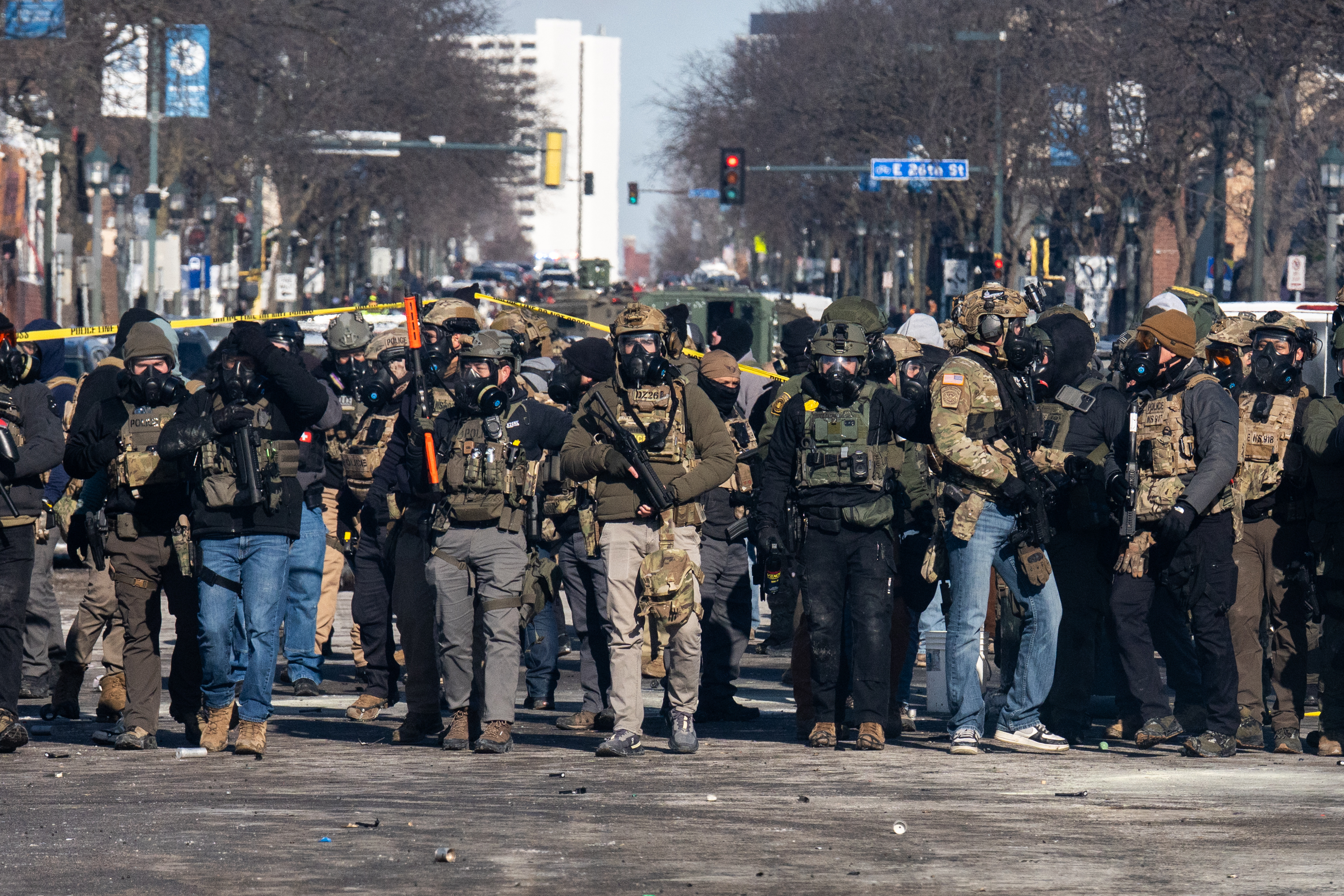
Renée Good was thirty-seven years old. She was an American citizen. She lived in Colorado but was in Minneapolis on the morning of January 7, 2026, when she stopped her car sideways in the street on a tree-lined block in south Minneapolis. Unmarked government vehicles were moving through the neighborhood. Whistle blasts, the now-familiar community alert that immigration officers were present, pierced the early January chill. Good motioned for the unmarked vehicles to pass.
For several minutes, she partially blocked traffic. ICE agent Jonathan Ross circled her vehicle on foot. Other agents approached. One ordered her to get out of the car while reaching through her open window. Good briefly reversed, then began moving forward and to the right, into the direction of traffic. Ross was standing at the front-left of the vehicle. He fired three shots.
Renée Good was shot in the head. She was the first recorded homicide in Minneapolis in 2026. She was a U.S. citizen killed by a federal immigration enforcement agent in a residential neighborhood, during an operation whose stated purpose was arresting undocumented immigrants.
Seventeen days later, Alex Pretti was dead on the same streets.
Pretti was thirty-seven years old. He was an intensive care unit nurse at a Department of Veterans Affairs hospital. He cared for the sickest patients in the federal system: veterans on ventilators, veterans in organ failure. He lived less than two miles from the intersection of 26th Street and Nicollet Avenue in the Whittier neighborhood, where on the morning of January 24, 2026, he was using his cell phone to record federal immigration agents conducting operations in a neighborhood known for its ethnic diversity.
Bystander videos show what happened next. Pretti was directing traffic when an agent knocked down a woman bystander. Pretti went to help her up. As he stood with his arm around the woman, an agent sprayed him in the face with a chemical irritant. A group of agents tackled him to the ground. One agent yelled "He's got a gun!" multiple times. Two Customs and Border Protection officers, Border Patrol agent Jesus Ochoa, 43, and CBP officer Raymundo Gutierrez, 35, discharged their Glock pistols. Pretti was shot multiple times.
Alex Pretti was a U.S. citizen. He had a legally carried firearm that multiple videos show he never drew. He was filming with his phone. He was helping a woman who had been knocked to the ground. He was killed by federal agents assigned to an immigration enforcement operation, seventeen days after another U.S. citizen was killed by federal agents in the same city, during the same operation.
This article is about the pipe that put those agents on those streets. Not the individual judgments of Jonathan Ross, Jesus Ochoa, or Raymundo Gutierrez. Those are the subjects of investigations that may or may not be conducted honestly. This article traces the institutional architecture: how an immigration enforcement apparatus acquired tactical capabilities, deployed them in civilian neighborhoods, and produced lethal outcomes against the citizens it claims to protect. The enforcement pipe connects to the labor pipe traced in Article 1. The same apparatus that creates labor shortages by removing workers now deploys lethal force in the communities those workers inhabited.
The Receipt
Seven data points. Read them as a deployment chain.
| Gauge | Reading | Context |
|---|---|---|
| Renée Good | U.S. citizen, killed Jan 7 | Shot in the head by ICE agent Jonathan Ross while sitting in her car on a residential street. Three shots fired. |
| Alex Pretti | U.S. citizen, killed Jan 24 | ICU nurse, VA hospital. Shot multiple times by CBP agents Ochoa and Gutierrez while filming and helping a bystander. Never drew his legally carried firearm. |
| Operation Metro Surge | 3,000+ federal agents | 2,000 ICE + 1,000 CBP officers deployed to Minneapolis–St. Paul. Called the "largest immigration enforcement operation ever carried out." |
| Tactical units deployed | BORTAC, SRT, CBP SRT | Border Patrol Tactical Unit + ICE Special Response Teams + CBP Special Response Team. Full tactical gear, assault rifles, flash-bang grenades, chemical dispersants. |
| Federal agent shootings since Jan 2025 | 33+ shootings, 9 deaths | At least 19 people wounded. The Wall Street Journal documented 13 instances of agents firing at or into civilian vehicles since July 2025. |
| Economic impact (January 2026) | $203.1 million | Lost wages, business revenue, rent assistance, food needs for 76,200 residents. City staff and police overtime: $6 million+. Small businesses: $10–$20M/week ongoing losses. |
| DOJ civil rights investigation | Pretti: opened. Good: none. | Career civil rights prosecutors excluded from Pretti probe. Six DOJ prosecutors resigned. No civil rights investigation opened into Good's killing. |
Every number has a team. The DHS communications office releases arrest totals. The city government tracks economic damage. The DOJ Civil Rights Division, or what remains of it, opens or declines investigations. The media counts shootings. Each team processes its own data. The question nobody's team is designed to answer: How did an immigration enforcement operation deploy tactical teams trained for border interdiction into residential neighborhoods of an American city, and what institutional architecture authorized, directed, and failed to constrain that deployment?
Here is the feedback loop:
Immigration enforcement apparatus expanded → tactical teams (BORTAC, SRT) deployed in civilian neighborhoods → rules of engagement designed for border operations applied in residential areas → citizens killed → DHS labels victims "domestic terrorists" to justify lethal force → the enforcement that creates labor shortages (Article 1) now deploys lethal force against the citizens it claims to protect → accountability mechanisms (civilian oversight, DOJ investigation) structurally inadequate for reviewing federal tactical deployments → career prosecutors resign → political base supports enforcement regardless → further expansion of tactical deployment → loop closes
I call this the enforcement lethality loop: the point at which an immigration enforcement apparatus acquires the capability, the deployment pattern, and the institutional insulation to use lethal force against citizens, while the institutional architecture that should constrain that force is dissolved from within.
I. The Deployment
On December 4, 2025, the Department of Homeland Security announced Operation Metro Surge, an immigration enforcement operation targeting the Minneapolis–St. Paul metropolitan area. On January 6, 2026, DHS announced an expansion, describing it as the largest immigration enforcement operation ever carried out. More than three thousand federal agents were deployed to a single American metropolitan area.
The composition of those three thousand agents is where the story shifts from immigration policy to something else entirely.
At the heart of the deployment were hundreds of agents from units designed for high-risk tactical operations: ICE's two Special Response Teams, CBP's Special Response Team, and the Border Patrol Tactical Unit, BORTAC. These are not immigration case officers with warrants and clipboards. BORTAC was created in 1984 to handle high-risk situations along the border: drug interdiction, hostage rescue, operations in remote terrain. Its members are equipped with full tactical gear, military-style helmets, and assault rifles. The Special Response Teams carry crowd-control weapons: pepper balls, foam launchers, flash-bang grenades. They have deployed less-lethal munitions and chemical dispersants in Minneapolis with little or no warning.
The ACLU described what happened in direct terms: "Trump is sending Special Forces-style agents into pro-immigrant cities." The description is not hyperbole. BORTAC agents have deployed to Iraq and Afghanistan. They have trained with the U.S. military's Joint Special Operations Command. Their operational protocols were developed for border interdiction and international counternarcotics operations. Those protocols were applied on the tree-lined residential streets of south Minneapolis, in a neighborhood where families walk to the grocery store and children ride bicycles to school.
The mismatch between capability and context is not an operational error. It is a design choice. When you deploy agents equipped with assault rifles, flash-bang grenades, and military-style helmets into a residential neighborhood, the equipment communicates before the agents speak. The tactical gear converts a civilian environment into an operational environment. Residents become potential threats. Bystanders become potential combatants. The architectural conversion of civilian space into tactical space, the physical conversion, measured in body armor and weapon systems, not in legal declarations, is itself an exercise of power that requires no legal authorization and produces no administrative record. No one signed an order converting Nicollet Avenue into a tactical operations zone. The agents' gear did it.
This is Lessig's insight in its most visceral form. The architecture of regulation is not always a code or a policy or a market structure. Sometimes the architecture is literally physical: armed men in tactical gear standing on a residential street, converting the architecture of a neighborhood into the architecture of an operation by their presence alone.
"ICE Continues to Remove the Worst of the Worst from Minneapolis Streets as DHS Law Enforcement Marks 3,000 Arrests During Operation Metro Surge." DHS framing: criminal aliens, public safety. Deployed assets: BORTAC, SRT, tactical teams with assault rifles in residential neighborhoods. The framing and the deployment occupy different realities.
The authority chain matters. Operation Metro Surge was authorized by the Department of Homeland Security under the direction of Secretary Kristi Noem. The deployment placed federal tactical teams under federal authority in a jurisdiction where they had no existing relationship with local law enforcement, no familiarity with the neighborhoods, and no accountability to civilian oversight. The Minneapolis Police Department was not consulted about the deployment. Mayor Jacob Frey was not informed in advance. The Minnesota Attorney General, the City of Minneapolis, and the City of Saint Paul filed federal lawsuits arguing that the deployment was unconstitutional and unlawful.
Lawrence Lessig's framework identifies what happened with precision. When law fails (when the legal challenges to the deployment are still being litigated while the deployment is ongoing) and when norms fail (when professional law enforcement norms about rules of engagement in civilian neighborhoods are overridden by tactical protocols designed for border operations) and when markets fail (when the economic damage of $203 million in a single month does not trigger a policy correction), then architecture is what remains. The physical deployment of tactical teams in civilian space is the architecture. The flash-bang grenades are the architecture. The assault rifles are the architecture. The architecture overrides law, norms, and market signals simultaneously, because the architecture is there: physically present in the neighborhood, with weapons, with operational orders, with a chain of command that runs to Washington and bypasses every local institution.
II. Renée
The DHS account of Renée Good's killing changed in the hours after it happened.
Secretary Noem alleged that Good had been "stalking" and "impeding" agents all day, that she had been "harassing" them, and that she "attempted to run a law enforcement officer over" before she was shot. The framing was immediate and specific: Good was a threat. Good was weaponizing her vehicle. Good's death was the consequence of her own aggression.
Minneapolis Mayor Jacob Frey reviewed the available video footage and stated publicly that it did not appear to support the DHS account. The Minnesota Bureau of Criminal Apprehension opened an investigation. CNN obtained and published videos and reports showing the sequence: Good's car stopped sideways in the street, the agents approaching, Good briefly reversing, then moving forward and to the right, away from Ross, into the direction of traffic, and Ross firing three shots as the vehicle passed him, turning away from him.
An independent autopsy commissioned by Good's family found she was shot in the head.
She was not the target of the immigration operation. She was not undocumented. She was not a criminal suspect. She was a thirty-seven-year-old American woman from Colorado who stopped her car on a residential street in south Minneapolis and motioned for unmarked vehicles to pass. For this, she was shot in the head by a federal immigration agent and posthumously labeled a threat to officer safety by the Secretary of Homeland Security.
The Minnesota Bureau of Criminal Apprehension opened an investigation into the shooting. Video evidence and official reports published by CNN show the sequence of events. The DHS account, that Good "attempted to run a law enforcement officer over," is contradicted by available evidence showing the vehicle moving away from the agent at the moment of shooting.
Mark Blyth's framework identifies the idea doing the work in the aftermath. "Public safety," the same idea that frames the entire enforcement operation, was deployed post-hoc to justify the killing. Good was not reframed as a victim of an agent's judgment error. She was reframed as a threat. The reframing transforms the accountability question: instead of asking "Why did a federal agent shoot an unarmed civilian in a residential neighborhood?", the institutional response asks "Why did this civilian threaten a federal agent?" The burden shifts from the institution to the dead person. The idea of "public safety" performs this inversion automatically, because within the enforcement code, any action that interferes with enforcement is, by definition, a threat to public safety.
Blyth has documented this pattern across institutional crises: the ideas that frame the institutional response serve the interests of the institution, not the interests of accurate description. "Stalking." "Impeding." "Attempted to run over." Each word was deployed by the Secretary of Homeland Security before an investigation had been completed, before evidence had been reviewed, before the video was public. The ideas arrived before the facts because the ideas were doing institutional work that the facts might not support.
No civil rights investigation has been opened into Renée Good's killing.
The Steelman
The strongest case for the DHS position on the Good shooting is that federal agents conducting lawful operations in an environment with known community resistance faced a vehicle whose driver refused commands to exit and whose movements could reasonably be perceived as threatening. Vehicle-ramming attacks against law enforcement have occurred. An agent surrounded by a moving vehicle is in a position of vulnerability. The use-of-force decision is made in seconds, not minutes, and is evaluated against the officer's reasonable perception of threat at the moment of the decision.
This is a genuine argument and should not be dismissed. Use-of-force jurisprudence does evaluate the reasonableness of the officer's perception at the moment of action, not in the calm clarity of retrospective video review. Graham v. Connor, the Supreme Court's foundational use-of-force case, holds that the "reasonableness" of force "must be judged from the perspective of a reasonable officer on the scene, rather than with the 20/20 vision of hindsight."
The steelman fails for two reasons, and both are architectural rather than individual. First, the question is not only whether Ross's perception was reasonable in the moment of the shooting. The question is why a federal immigration agent was on foot, circling a civilian vehicle, on a residential street in south Minneapolis, during an operation that had deployed three thousand agents into a metropolitan area without coordinating with local law enforcement. The tactical situation that created Ross's split-second decision was itself the product of an operational architecture that put immigration enforcement agents in positions that civilian law enforcement protocols are specifically designed to avoid. Minneapolis police are trained in de-escalation. They have community relationships. They know the neighborhoods. Ross had none of this. The architecture of the deployment, federal agents without local knowledge, operating without local coordination, in a community that perceived them as hostile, created the conditions under which a split-second decision became lethal.
Second, the DHS response to the shooting was not a careful evaluation of whether the use of force was justified. It was an immediate characterization of the victim as a threat: "stalking," "impeding," "attempted to run over," issued before the evidence was reviewed, contradicted by the evidence when it was reviewed, and never retracted. The institutional response was not an attempt to determine truth. It was an attempt to control narrative. And the narrative served the institution's interest in continuing the deployment without accountability.
III. Alex
Alex Pretti participated in protests against Good's killing. A recording from a January 13 protest showed him in a confrontation with federal immigration officers. He was known in the neighborhood. He was an ICU nurse who cared for veterans. He lived nearby. He was, in the language that institutions use when they want to dismiss someone, an "activist."
On the morning of January 24, Pretti was on 26th Street and Nicollet Avenue with his cell phone, recording federal agents conducting operations. Multiple bystander videos captured the sequence that followed.
An agent knocked down a woman bystander. Pretti went to help her up. He stood with his arm around her. An agent sprayed him in the face with a chemical irritant, pepper spray, at point-blank range, while he was standing with a woman he had just helped off the ground. Agents tackled him. On the ground, an agent yelled "He's got a gun!" multiple times. Two agents fired their Glocks.
ProPublica identified the shooters through government records: Border Patrol agent Jesus Ochoa, 43, who joined CBP in 2018, and CBP officer Raymundo Gutierrez, 35, who joined in 2014. Gutierrez was assigned to a Special Response Team, the high-risk unit equivalent of a police SWAT team. Both men were deployed to Minneapolis as part of Operation Metro Surge. Neither had any prior relationship with the community, the neighborhood, or the local law enforcement agencies that would normally operate in that space.
ProPublica identified CBP agents Jesus Ochoa and Raymundo Gutierrez as the shooters. Gutierrez was assigned to CBP's Special Response Team. Both were deployed under Operation Metro Surge. Multiple bystander videos show Pretti never drew the legally carried firearm that was found on his person.
The DHS response was immediate and categorical. Secretary Noem said it appeared Pretti intended to do "maximum damage" and kill law enforcement. She said he was "brandishing" a weapon. FBI Director Kash Patel echoed the claim. Both statements were made the day of the shooting, before a completed investigation, and they were contradicted by multiple videos that show Pretti never took his firearm out of its holster.
NPR headline, January 25: "Watch: Videos Refute DHS Account of Fatal Shooting in Minneapolis." CNN headline, the same day: "What Trump Officials Claimed About Alex Pretti — and What the Evidence Actually Shows." The gap between the institutional narrative and the documented evidence was not subtle. It was a chasm measured in video timestamps.
A Quinnipiac poll found 62 percent of voters said Pretti's shooting was "not justified." Sixty-one percent said the Trump administration was "not giving an honest account of the incident." Fifty-eight percent said Noem should be removed from her position.
Senator Dick Durbin asked Noem directly whether she would retract calling Good and Pretti "domestic terrorists." She did not.
62% said the Pretti shooting was "not justified." 61% said the administration was not giving an honest account. 58% said Noem should be removed. 60% said ICE should withdraw from Minneapolis. These are not partisan splits. They are supermajority findings in a national poll.
The night of Pretti's killing, thousands attended candlelight vigils across the Twin Cities. On January 26, the University of Minnesota called for a general strike. By January 27, it had expanded into a "National Shutdown" scheduled for January 30. Bruce Springsteen and Tom Morello performed at a benefit concert for the families of Good and Pretti. The National Nurses United union, Pretti's professional community, organized a week of action.
Niklas Luhmann's structural analysis becomes inescapable here. The law enforcement code processes the world through a binary: legal/illegal, threat/non-threat. When BORTAC and SRT agents trained for border operations are deployed in civilian neighborhoods, they carry their operational code with them. The code does not adjust for context. A person filming with a phone becomes a potential threat, because in the border code, anyone observing an operation is a potential counter-surveillance operative. A person helping a knocked-down bystander becomes a potential combatant, because in the tactical code, anyone moving toward agents during an operation is a potential attacker. A person with a legally carried firearm becomes a lethal threat, because in the military code, the presence of a weapon is a binary input: armed/unarmed.
The military code, threat/non-threat, has colonized the law enforcement code, legal/illegal. Citizens become targets when the codes collapse. Pretti was not processing the situation through the tactical code. He was processing it through the civilian code: someone fell down, help her up. Someone is filming a government operation in a public space, which is a constitutionally protected activity. Someone has a legally carried firearm, which is a constitutionally protected right. Every action Pretti took was legal. None of it registered as such in the tactical code that the deployed agents carried into his neighborhood.
Luhmann would say: the system cannot observe what it cannot observe. The tactical code cannot observe legality. It can only observe threat level. And when the tactical code is deployed in a civilian space, legality ceases to be a relevant input. The architecture determines the outcome. The architecture was the deployment itself.
IV. The Accountability Architecture
The Department of Justice opened a civil rights investigation into Alex Pretti's killing on January 30, 2026. It did not open a civil rights investigation into Renée Good's killing. Two American citizens killed by federal agents in the same city, during the same operation, seventeen days apart. One investigation opened. One not.
The investigation that was opened tells its own story about institutional capacity. CBS News reported that career federal prosecutors in the DOJ's Civil Rights Division who specialize in excessive force cases were excluded from the Pretti probe. Instead, a lawyer from the division's employment litigation section was assigned. The distinction matters: excessive force investigation is a specialized discipline requiring forensic expertise, ballistics analysis, and deep familiarity with use-of-force case law. Employment litigation is a different field entirely.
Six DOJ prosecutors resigned. Additional resignations followed. Prosecutors in Minneapolis warned that more would come over the lack of investigations into the two killings. The institution tasked with investigating federal use of force was hemorrhaging the people who knew how to conduct those investigations.
Shooting occurs
  │
  ├── DHS labels victim "domestic terrorist" (within hours)
  │
  ├── Local investigation (BCA) → Limited jurisdiction over federal agents
  │
  ├── DOJ Civil Rights Division
  │     ├── Pretti: Investigation opened
  │     │     └── Career prosecutors excluded
  │     │     └── Employment litigator assigned instead
  │     └── Good: No investigation opened
  │
  ├── 6 DOJ prosecutors resign → more departures follow
  │
  ├── Congressional oversight
  │     └── Noem refuses to retract "domestic terrorist" label
  │
  └── Federal lawsuits filed (MN AG, Minneapolis, St. Paul)
        └── Operation continues during litigation
The structure of the accountability gap is not accidental. It is architectural.
Federal agents who use lethal force occupy a unique position in the institutional order. Local law enforcement is subject to civilian oversight boards, county prosecutors, and state attorney general investigations. Local officers operate under agreements with the communities they police. When a Minneapolis police officer killed George Floyd in 2020, the Hennepin County Attorney charged the officer, a state jury convicted him, and the DOJ opened a separate federal civil rights investigation that led to additional convictions.
Federal agents deployed under Operation Metro Surge operate outside this entire accountability architecture. They are not subject to Minneapolis civilian oversight. They are not accountable to the Hennepin County Attorney. The Minnesota Bureau of Criminal Apprehension can investigate, but its jurisdiction over federal agents is limited. The only institution with clear authority to investigate federal use of force is the Department of Justice, the same Department of Justice that is part of the executive branch that authorized the deployment, that appointed the Secretary who labeled the victims "domestic terrorists," and that is now conducting an investigation from which the career prosecutors who specialize in these cases have been excluded.
Jürgen Habermas identified the structural condition that makes this architecture so consequential. When the steering media of administrative power overwhelm the capacity for democratic deliberation, the "lifeworld," the domain of shared understanding, community norms, and communicative reason, is colonized. The Whittier neighborhood of Minneapolis was a lifeworld: a community of families, small businesses, ethnic restaurants, a VA hospital where Alex Pretti cared for veterans. Operation Metro Surge colonized that lifeworld with three thousand federal agents, tactical teams, assault rifles, chemical dispersants, flash-bang grenades, and an authority chain that ran to Washington and bypassed every local institution.
The community's response, the whistle alerts, the protests, the vigils, the general strike, was an attempt to reassert communicative action against the colonization. But communicative action requires institutional channels: city councils, oversight boards, courts, legislatures. Every channel available to the community of Minneapolis was structurally inadequate to the federal deployment. The city council could not recall the agents. The oversight board had no jurisdiction. The courts were hearing challenges while the operation continued. The state legislature could pass resolutions that the federal government would ignore. Habermas's thesis is not abstract here. It is measured in flash-bang grenades deployed without warning and chemical dispersants sprayed at a man helping a woman off the ground.
V. The Pattern of Shootings
Good and Pretti were not the only people shot by federal immigration agents. They were the most visible.
As of late February 2026, at least thirty-three shootings by immigration agents had occurred since January 20, 2025, resulting in nine deaths. Nineteen people had been wounded. The Wall Street Journal identified at least thirteen instances of immigration officers firing at or into civilian vehicles since July 2025 alone. The American Immigration Council documented six deaths in ICE detention facilities in the first weeks of 2026, following a two-decade high of thirty-two deaths in ICE custody in 2025.
The pattern extends beyond Minneapolis. An off-duty ICE officer shot and killed Keith Porter Jr., a forty-three-year-old father of two, in the Northridge neighborhood of Los Angeles on New Year's Eve 2025. Shootings occurred in five states and Washington, D.C. The Minneapolis killings were not an anomaly. They were the most documented instances of a pattern that the institutional architecture does not have a mechanism to aggregate, analyze, or correct.
33+ shootings since January 20, 2025. 9 deaths. 19 wounded. 13 instances of agents firing at or into civilian vehicles. 32 deaths in ICE custody in 2025 (two-decade high). 6 deaths in custody in early 2026. These numbers come from tracking by the Marshall Project, PBS, and the American Immigration Council, because no federal agency publishes a comprehensive use-of-force database for immigration enforcement.
The absence of a comprehensive database is itself an architectural feature. The Department of Defense publishes use-of-force data. Major metropolitan police departments publish use-of-force data. The FBI compiles a national use-of-force database for local law enforcement agencies (though participation is voluntary). ICE and CBP do not publish comprehensive, publicly accessible use-of-force data. The tracking is done by journalists and advocacy organizations, case by case, shooting by shooting. The architecture of data collection determines what is visible. What is not collected cannot be analyzed. What is not analyzed cannot produce accountability. What does not produce accountability does not produce correction.
Stanford Law professor Robert Weisberg, asked by journalists whether ICE agents could be prosecuted, explained the constitutional barriers: federal officers performing official duties are generally shielded from state prosecution under the Supremacy Clause. Criminal prosecution of federal agents for excessive force typically requires the DOJ itself to bring charges, the same DOJ from which career civil rights prosecutors are being excluded. The architecture of immunity is the architecture of the deployment: federal authority, deployed in local space, subject only to federal accountability mechanisms that are being dismantled from within.
VI. The City
Minneapolis calculated the cost. The City of Minneapolis released a comprehensive impact assessment in February 2026: $203.1 million in one month.
The number breaks down into categories that together describe the colonization of a city's lifeworld. $47 million in lost wages from residents who were afraid to leave their homes and go to work. $81 million in revenue losses for restaurants and small businesses. $15.7 million in emergency rent assistance needs. A weekly cost of $2.4 million to meet food needs for approximately 76,200 people, roughly 20 percent of the city's population. More than $6 million in city staff payroll, police overtime, and operational expenses to manage the federal operation the city had never requested.
Restaurants and shops adopted closed-door policies, locking entrances and monitoring who entered, in fear of federal agents. Communities that had taken decades to build, the Somali business district along Lake Street, the Latino groceries on Nicollet Avenue, the Vietnamese restaurants in south Minneapolis, emptied. People who had lived in the neighborhood for years did not go to work. Children did not go to school. The food supply chain, dependent on the immigrant labor force documented in Article 1, contracted.
The Minnesota Reformer attempted to measure the total economic damage after the operation wound down in February and found the task nearly impossible: "Measuring the economic damage of Minnesota's ICE surge is hard." Hard because the damage extends beyond the immediate period of the deployment into long-term behavioral changes that economic models struggle to capture. A family that stopped sending children to school in January does not resume normal behavior in February because a press release announces reduced agent numbers. A restaurant that lost its cooks does not rehire them from a labor pool that has been terrorized. A business owner who invested a decade building a clientele in the Whittier neighborhood does not recoup that investment when the clientele is afraid to walk outside. The Star Tribune documented "staggering economic, societal impacts" that city officials said would be "felt for decades, even generations to come."
The $203 million figure is the measurable floor, not the ceiling. It does not capture the departure of families who decided Minneapolis was no longer safe. It does not capture the businesses that will close in the coming months as accumulated losses exceed their reserves. It does not capture the psychological toll on children who watched tactical teams with assault rifles patrol their neighborhoods. These costs are real. They are not measurable in the accounting framework the city used for its impact assessment. They are the lifeworld damage that Habermas's framework describes: the erosion of shared understanding, community trust, and the capacity for communicative action that occurs when the steering media of administrative power physically occupies the space in which community life takes place.
$203.1 million in one month. $47M lost wages. $81M business revenue. $15.7M rent assistance. $2.4M/week food needs for 76,200 people. $6M+ city operations. Ongoing losses estimated at $10–$20M per week. "The impacts will be felt for decades, even generations to come."
The Social Physics feedback loop traced the macroeconomic consequences of immigration restriction: inflation, labor shortages, deficit effects. This is the microeconomic face of that loop. A single American city. $203 million. Twenty percent of the population requiring food assistance. Businesses locked their doors. Veterans lost their ICU nurse. The enforcement that was supposed to make the city safer produced an economic and social catastrophe measurable in dollars, in meals, in lives.
The pipe from Article 1 connects here. The enforcement that removes undocumented workers from farms in Georgia creates labor shortages that increase demand for H-2A guest workers who are recruited through trafficking-vulnerable channels. That same enforcement apparatus, when deployed in Minneapolis, removes workers from restaurants and construction sites, costs the city $203 million, kills two citizens, and generates the political capital for more enforcement. The labor pipe and the enforcement pipe are the same pipe, viewed from different ends. Sofi's blueberry field in Georgia and Pretti's street corner in Minneapolis are connected by the institutional architecture that processes both through the same binary: enforcement/non-enforcement.
VII. The Loyalty Apparatus
There is a dimension of the Minneapolis events that the enforcement code cannot process but that the political code makes visible.
Secretary Noem labeled both Good and Pretti "domestic terrorists" within hours of their deaths. She did not retract the label under direct questioning by a United States Senator. FBI Director Patel echoed her characterization of Pretti. The characterization was contradicted by available video evidence, by the Quinnipiac poll showing supermajority public disagreement, and by the DHS's own shifting accounts of both incidents.
The label is not analytical. It is performative. It performs loyalty to the enforcement apparatus by demonstrating willingness to defend its lethal outcomes regardless of evidence. It signals to the agents in the field that the institutional leadership will protect them. It signals to the public that challenging the enforcement operation is equivalent to terrorism. And it signals to the career prosecutors in the DOJ, the ones who resigned, the ones who were excluded, that the institutional leadership does not want honest investigation. It wants institutional solidarity.
NPR documented a broader pattern in a January 31 report titled "DHS Keeps Making False Claims About People. It's Part of a Broader Pattern." The Stateline project at Pew documented the same phenomenon: "Footage, Documents at Odds with DHS Accounts of Immigration Enforcement Incidents." The pattern is not isolated to Minneapolis. It is institutional: the enforcement apparatus generates post-hoc narratives that justify its actions regardless of the evidence, and the political leadership amplifies those narratives as demonstrations of loyalty.
DHS has issued accounts of enforcement incidents that were subsequently contradicted by video evidence and official records in multiple cases. The pattern, immediate characterization of victims as threats, followed by evidence that contradicts the characterization, is documented across the Minneapolis events and beyond. Former DHS officials told ABC News the tactics "undermine public trust."
Blyth would recognize what the loyalty apparatus does to the information environment. The idea of "domestic terrorism" is not a description of Good or Pretti's actions. It is an institutional weapon deployed to restructure the accountability conversation. Once a victim is labeled a terrorist, the investigation becomes an investigation of the victim rather than the agent. The burden of proof shifts. The question changes from "Why did federal agents shoot unarmed citizens?" to "What were these people doing that provoked the agents?" The idea does institutional work. And it does that work regardless of whether the idea is true, because the institutional function of the idea is not to describe reality. It is to manage accountability.
This is where the enforcement pipe connects to the loyalty pipe that Article 4 will trace in detail. The same executive authority that deployed tactical teams in Minneapolis controls the Department of Justice that investigates, or declines to investigate, the killings those teams produce. The same Secretary who labels victims "domestic terrorists" oversees the agents who killed them. The accountability architecture is not merely inadequate. It is captured. The institution that should investigate is controlled by the authority that authorized the deployment. The pipe runs through itself.
VIII. The Precedents Nobody Wants
The United States has a history of federal tactical deployments against its own citizens that produced lethal outcomes and subsequently revealed catastrophic failures of judgment, rules of engagement, and accountability. The two most prominent cases, Ruby Ridge (1992) and the Branch Davidian siege at Waco (1993), produced congressional investigations, DOJ reviews, policy reforms, and a permanent expansion of domestic suspicion of federal tactical operations.
At Ruby Ridge, a U.S. Marshals Service deputy killed Sammy Weaver, a fourteen-year-old boy, and an FBI sniper killed Vicki Weaver, an unarmed woman holding her infant daughter, during a standoff at a remote Idaho cabin. The DOJ's subsequent investigation found that the FBI's rules of engagement at Ruby Ridge were unconstitutional: a "shoot on sight" order that violated the Fourth Amendment. The incident led to policy reforms, to congressional hearings, and to a $3.1 million wrongful death settlement.
At Waco, a Bureau of Alcohol, Tobacco, and Firearms raid on the Branch Davidian compound led to a fifty-one-day siege that ended with a fire that killed seventy-six people, including twenty-five children. The Treasury Department's review found serious failures in planning, intelligence, and decision-making. The event shaped American attitudes toward federal tactical operations for a generation.
Minneapolis in January 2026 is not Ruby Ridge. It is not Waco. The scale is different, the context is different, the political environment is different. But the structural question is the same: What happens when federal tactical teams trained for specialized operations (border interdiction, counternarcotics, hostage rescue) are deployed against civilians in situations their training and operational codes were not designed for? The answer, documented across three decades and three deployments, is lethal force applied by agents whose threat-assessment protocols are miscalibrated for civilian encounters.
The difference in 2026 is the accountability structure. After Ruby Ridge and Waco, the DOJ investigated itself with sufficient rigor to produce reforms, settlements, and policy changes. The DOJ of 2026 excluded its own career excessive-force prosecutors from the Pretti investigation, declined to open an investigation into Good's killing, and watched six prosecutors resign in protest. The accountability mechanism that corrected the earlier failures is itself being dissolved.
IX. The Question That Matters
There is a structural difference between a law enforcement agency that occasionally uses excessive force and an enforcement apparatus that is architecturally insulated from accountability for lethal force. The first is a system with failures that can be corrected. The second is a system whose architecture prevents correction.
The Minneapolis events of January 2026 sit at the boundary between those two descriptions, and the question of which one applies is not a matter of opinion. It is a matter of institutional architecture. If the DOJ investigation of Pretti's killing is conducted rigorously, by prosecutors with expertise in excessive force, using forensic evidence and the extensive video record, and if the investigation of Good's killing is opened, and if the findings produce accountability for the agents and policy corrections for the deployment, then the system has failures but retains the capacity for correction. If the investigation is conducted by employment litigators while career prosecutors resign, and if Good's killing is never investigated, and if the DHS narrative of "domestic terrorism" stands unchallenged by the institution tasked with challenging it, then the architecture has foreclosed correction.
We are watching the answer form in real time.
The four scholars converge on the diagnosis. Blyth identifies "public safety" and "domestic terrorism" as the ideas that function as institutional weapons, deployed to justify the lethality after the fact, maintained by the political interests that benefit from an unaccountable enforcement apparatus. Luhmann identifies the structural mechanism: the military threat/non-threat code has colonized the law enforcement legal/illegal code, and the resulting code-collapse cannot process the legality of filming, the legality of carrying a firearm, or the legality of helping a woman off the ground. Habermas identifies the colonization of the Whittier neighborhood's lifeworld by the steering media of administrative power: three thousand agents, tactical gear, chemical weapons, an authority chain that runs to Washington and bypasses every local institution that should mediate between power and community. Lessig identifies the architecture that overrides all other modalities: the physical deployment of tactical teams in civilian space is the regulation, and no law, norm, or market signal can override the architecture while it is present.
Renée Good was shot in the head on a residential street in south Minneapolis. Alex Pretti was shot multiple times while filming with his phone and helping a woman off the ground. Both were U.S. citizens. Both were killed by federal agents deployed under an immigration enforcement operation. The enforcement apparatus designed for immigration has a lethality dimension, and in January 2026, it was pointed at the citizens of Minneapolis.
The labor pipe from Article 1 feeds the enforcement pipe of this article. The enforcement pipe feeds the sovereignty pipe of Article 3. The question is not whether any single pipe is dangerous. The question is what the machine produces when all the pipes are running, and when the institutional architecture that should constrain each pipe is being dissolved from within.
Our ICE Minneapolis dashboards, three versions, published in January 2026, focused on media coverage framing. We tracked cable news mentions, built a Ground News-style bias spectrum, plotted political compass positions of stakeholders. We measured who was talking about Minneapolis. We measured how they were talking about it. We did not trace the institutional authority chain that put three thousand agents on those streets.
Three dashboards. Zero lines tracing the actual chain of command. Zero analysis of the rules of engagement. Zero investigation of how BORTAC protocols designed for border operations were applied in residential neighborhoods. Zero connection to the labor pipe that created the conditions for the deployment.
Lessig's framework explains the failure precisely: the dashboard format constrained what we could analyze. A media coverage dashboard operates in the media code: it processes information/non-information. It can tell you which outlets covered the story and how they framed it. It cannot tell you who authorized the deployment, under what legal authority, with what rules of engagement, and through what institutional architecture. We were building dashboards when we should have been tracing pipes. The format was the limitation. Recognizing that limitation is what this series does differently.
Sources
Renée Good
- Wikipedia. "Killing of Renée Good." Accessed March 2026.
- MPR News. "Renee Good Killed by ICE Agent in Minneapolis." January 7, 2026.
- CNN. "Whistles, Then Gunfire: How the Deadly ICE Shooting Unfolded in Minneapolis." January 10, 2026.
- CNN. "Reports, Videos Show How ICE Agent Jonathan Ross Fatally Shot Renee Good." January 17, 2026.
- NBC News. "Renee Good Was Shot in the Head, Autopsy Commissioned by Her Family Finds."
- Minnesota Bureau of Criminal Apprehension. "BCA Statement Regarding Investigation."
- Colorado Public Radio. "Two Months After Renée Good's Death, Her Loved Ones Grapple with Loss." March 11, 2026.
Alex Pretti
- Wikipedia. "Killing of Alex Pretti." Accessed March 2026.
- ProPublica. "Two CBP Agents Identified in Alex Pretti Shooting." February 1, 2026.
- PBS News. "A Second U.S. Citizen Was Killed by Federal Forces in Minneapolis."
- NPR. "Watch: Videos Refute DHS Account of Fatal Shooting in Minneapolis." January 25, 2026.
- CNN. "What Trump Officials Claimed About Alex Pretti — and What the Evidence Actually Shows."
- The 19th. "In Minneapolis, Alex Pretti Died as He Lived: Taking Care of Others."
- Washington State Nurses Association. "Alex Pretti Killing Prompts Protests and Memorials."
Operation Metro Surge
- Wikipedia. "Operation Metro Surge." Accessed March 2026.
- Britannica. "2025–26 Minnesota ICE Deployment."
- DHS Press Release. "ICE Continues to Remove the Worst of the Worst: 3,000 Arrests." January 19, 2026.
- ACLU. "Trump Is Sending Special Forces-Style Agents into Pro-Immigrant Cities."
- City of Minneapolis. "MN Attorney General, Minneapolis and Saint Paul Sue to Halt ICE Surge."
- Minnesota Reformer. "The End of Operation Metro Surge, in Data."
Economic Impact
- City of Minneapolis. "Operation Metro Surge Results in $203 Million Impact." February 2026.
- Star Tribune. "ICE Surge Leaves Minneapolis with Staggering Economic, Societal Impacts."
- FOX 9. "Operation Metro Surge Cost Minneapolis at Least $203 Million."
- Minnesota Reformer. "Measuring the Economic Damage of Minnesota's ICE Surge Is Hard."
Federal Use of Force Data
- Wikipedia. "List of Shootings by U.S. Immigration Agents in the Second Trump Administration."
- PBS News. "Shooting Deaths Climb in Trump's Mass Deportation Effort."
- The Marshall Project. "How Many People Have Been Killed by ICE and Border Patrol?"
- American Immigration Council. "6 Deaths in ICE Custody and 2 Fatal Shootings: A Horrific Start to 2026."
- Stanford Law School. "Can ICE Agents Be Prosecuted?" Robert Weisberg.
Accountability and DOJ
- NPR. "Alex Pretti Shooting Prompts DOJ Civil Rights Probe." January 30, 2026.
- CBS News. "DOJ's Alex Pretti Shooting Probe Excludes Prosecutors Who Specialize in Civil Rights Cases."
- The Hill. "DOJ Opens Federal Civil Rights Probe into Death of Alex Pretti, but Holds Back on Renee Good."
- Just Security. "What a Proper Investigation of Alex Pretti's Killing Would Look Like."
- NPR. "DHS Keeps Making False Claims About People. It's Part of a Broader Pattern." January 31, 2026.
- Stateline / Pew. "Footage, Documents at Odds with DHS Accounts."
DHS Statements and Public Response
- Fox News. "DHS Secretary Noem Alleged ICE Shooting Victim Was 'Stalking' Agents."
- CBC News. "Kristi Noem Stands by Remarks Accusing U.S. Citizens of Terrorism."
- ABC News. "ICE Gets Even Worse Ratings After Pretti's Fatal Shooting." Quinnipiac poll data.
- ABC News. "Former Officials Say DHS Tactics Undermine Public Trust."
- The Carter Center. "Statement on Latest ICE Shooting in Minneapolis."
Historical Precedents
- U.S. Department of Justice. "Report Regarding Internal Investigation of Shootings at Ruby Ridge, Idaho." 1994.
- U.S. Treasury Department. "Report of the Department of the Treasury on the Bureau of Alcohol, Tobacco, and Firearms Investigation of Vernon Wayne Howell (David Koresh)." September 1993.
- Brennan Center for Justice. "The Posse Comitatus Act, Explained."
- Congressional Research Service. "The Posse Comitatus Act and Related Matters." Report R42659.
- House Oversight Committee Democrats. "Minnesota Oversight Report." 2026.
Theoretical Frameworks
- Blyth, Mark. Great Transformations: Economic Ideas and Institutional Change. Cambridge University Press, 2002.
- Blyth, Mark. Austerity: The History of a Dangerous Idea. Oxford University Press, 2013.
- Luhmann, Niklas. Social Systems. Stanford University Press, 1995.
- Luhmann, Niklas. Theory of Society. Vol. 1. Stanford University Press, 2012.
- Habermas, Jürgen. The Theory of Communicative Action. Vol. 2: Lifeworld and System. Beacon Press, 1987.
- Lessig, Lawrence. Code and Other Laws of Cyberspace. Basic Books, 1999. Updated edition: Code: Version 2.0, 2006.