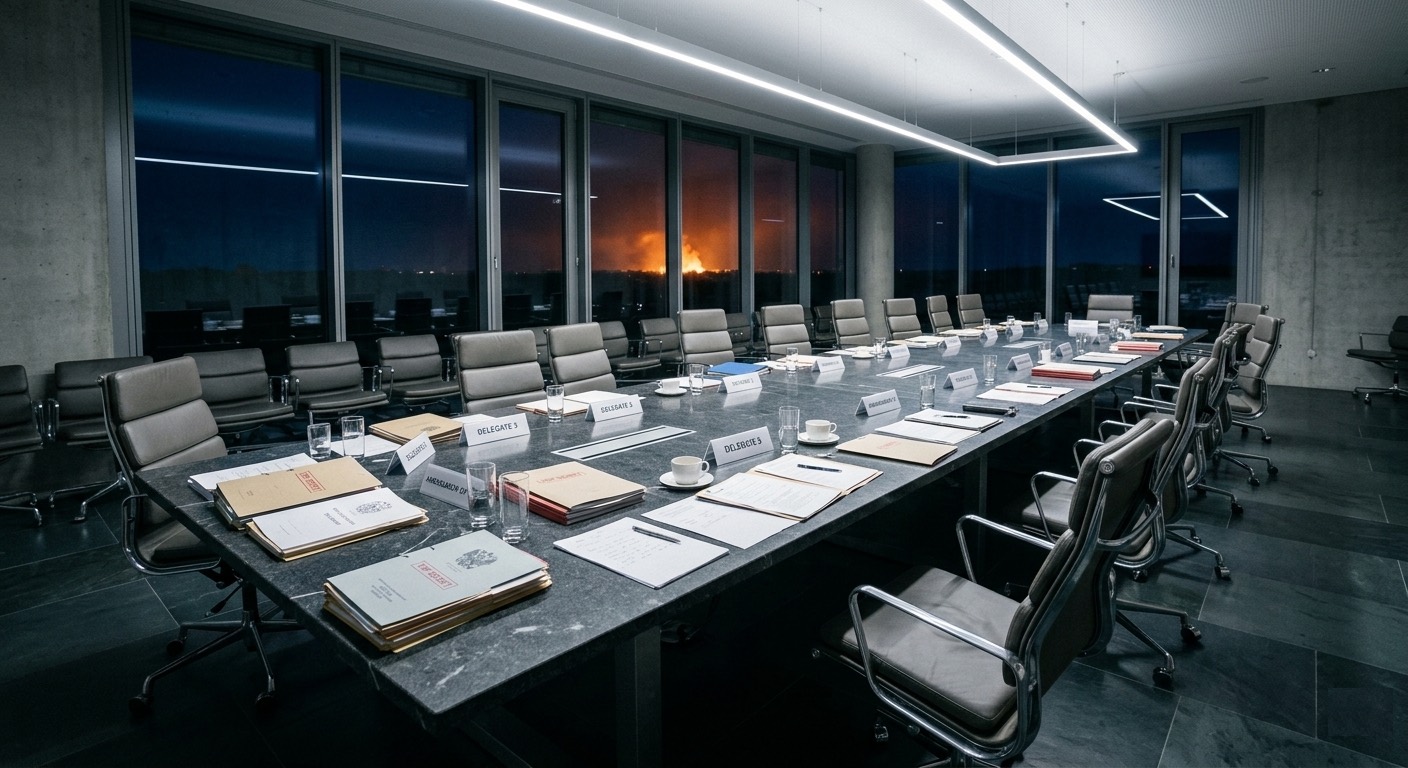
February 28, 2026. Explosions across Tehran, Qom, Kermanshah, Isfahan, Karaj. The Natanz uranium enrichment facility. The Fordow fuel enrichment plant. The Isfahan uranium conversion facility. The heavy water reactor at Arak. And the Supreme Leader's residential compound in northern Tehran, the first direct targeting of a head of state's personal quarters by the United States military since the 2020 strike on Qasem Soleimani's convoy at Baghdad International Airport.
The Pentagon designated it Operation Epic Fury. Within twelve hours, B-2 Spirit bombers, F-35A Lightning IIs flying from Al Udeid Air Base in Qatar, and Tomahawk cruise missiles launched from Arleigh Burke-class destroyers in the Arabian Sea had struck more than forty targets in what the Department of Defense described as "the most extensive air campaign against a single nation since the opening of Operation Iraqi Freedom in March 2003." Iran's Islamic Revolutionary Guard Corps air defenses, Russian-supplied S-300PMU2 batteries deployed around nuclear sites since 2016, engaged incoming ordnance but were overwhelmed by electronic warfare and decoy packages. Iran closed its airspace. Tehran's Imam Khomeini International Airport went dark at 3:17 a.m. local time.
Within hours, the Bahraini Ministry of Defense confirmed a ballistic missile had been launched toward the U.S. Navy's 5th Fleet headquarters in Manama. U.S. Aegis systems aboard the USS Shiloh intercepted the missile over the Persian Gulf. A second salvo, three medium-range ballistic missiles, assessed as Fateh-110 variants, targeted Al Udeid Air Base. Two were intercepted; one struck an uninhabited construction zone on the base perimeter. No American casualties were reported in the initial exchange.
But back up two days. Because the two days before the explosions tell you more about the machine than the explosions themselves.
The Receipt
The chronology. Read it in sequence.
| Indicator | Reading | Context |
|---|---|---|
| Operation date | Feb 28, 2026 | Strikes began at approximately 02:00 local time (22:30 UTC Feb 27) |
| Targets | 40+ sites | Tehran, Qom, Kermanshah, Isfahan, Karaj: nuclear facilities, IRGC bases, Supreme Leader compound |
| Iran response | Airspace closed; BM launch at 5th Fleet | Aegis intercept confirmed. One missile struck Al Udeid perimeter. |
| Diplomatic channel | Oman FM on CBS, Feb 26–27 | "A deal was within our reach." Iran had agreed to never stockpile enriched uranium. |
| Iran concession | No stockpiling agreement | Omani-mediated: Iran would cap enrichment, permit continuous IAEA monitoring, forswear stockpiling |
| Congressional authorization | None | No War Powers Resolution vote. No AUMF. Article II self-defense claim. |
| Just war test | Preemptive vs. preventive | If Oman channel was viable: preventive (illegitimate). If not: possibly preemptive (legitimate). |
| Hormuz Strait | IRGC deployment confirmed | Fast-attack craft massed near Strait. Oil futures +11% in first 48 hours. |
| IAEA enrichment data | 83.7% (Feb 2026 report) | Near weapons-grade (90%). Breakout time estimated at 1–2 weeks by U.S. intelligence. |
| Domestic context | All other pipes under stress | Minneapolis tactical deployments (Art. 2), Epstein document releases (Art. 4), Venezuela ICC referral (Art. 3) |
The numbers are the numbers. But the sequence is the story. And the story is about a diplomatic channel that was either exhausted or abandoned, and the difference between those two words is the difference between a legitimate act of self-defense and the most consequential unilateral military action of the twenty-first century.
I. The Channel That Was Within Reach
On February 26, 2026, forty-eight hours before the first bomb fell, Oman's Foreign Minister Badr al-Busaidi sat across from Margaret Brennan on CBS's Face the Nation and said something that should have stopped the world: "A deal was within our reach."
The Omani diplomatic channel was not new. Oman had served as intermediary between the United States and Iran since at least 2011, when the Sultanate facilitated the secret back-channel negotiations that eventually produced the 2015 Joint Comprehensive Plan of Action. Sultan Haitham bin Tariq had inherited this mediating role from his predecessor, Sultan Qaboos, who had cultivated Oman's unique position as the one Gulf state that maintained working relationships with both Washington and Tehran. The Omani channel had survived the Trump-era JCPOA withdrawal, the Soleimani assassination, and the collapse of the 2022 Vienna talks. It was the one diplomatic pipe that had never fully closed.
Al-Busaidi described the contours of what had been negotiated: Iran would cap enrichment at 3.67 percent, the level permitted under the original JCPOA, and agree to never stockpile enriched uranium above that threshold. Continuous IAEA monitoring would be restored, including the surveillance cameras that Tehran had disconnected in June 2022. In exchange, the United States would provide limited sanctions relief on Iranian oil exports, phased over eighteen months, contingent on verified compliance.
The Iranian concession was significant. Since withdrawing from the JCPOA in 2019, Iran had progressively escalated its enrichment program, from the 3.67 percent permitted under the deal to 20 percent in January 2021, then to 60 percent in April 2021, and finally to 83.7 percent by February 2026, as confirmed by IAEA Director General Rafael Grossi in his quarterly report to the Board of Governors. The 83.7 percent figure was near weapons-grade (90 percent), and the U.S. intelligence community had assessed Iran's breakout time, the period needed to produce enough highly enriched uranium for a single nuclear weapon, at approximately one to two weeks.
An agreement to reverse this escalation would have represented the most significant nonproliferation achievement since the original JCPOA. That Iran had reportedly agreed to it, that the channel was, in al-Busaidi's word, "within reach", raises the question that animates this entire article.
Was diplomacy exhausted, or was it abandoned?
The distinction matters because it is the fulcrum of just war theory. Michael Walzer, in Just and Unjust Wars, drew the line between preemptive and preventive war: preemptive war responds to an imminent threat, the enemy is mobilizing, the attack is coming, and striking first is the only means of defense. Preventive war responds to a hypothetical future threat, the enemy may become dangerous someday, and it is more convenient to fight now than later. Walzer held the first legitimate and the second illegitimate. The entire moral architecture of international law follows his distinction. And the distinction turns on a single question: Was the threat imminent? If diplomacy was working, if the Oman channel was producing genuine concessions, then the threat was being managed, not imminent. The strikes were preventive. If the Oman channel was not viable, if Iran's history of noncompliance made any agreement meaningless, then the threat remained imminent despite the diplomatic theater. The strikes may have been preemptive.
The administration's public position did not engage this distinction. The president, speaking from the White House at 10:15 p.m. Eastern on February 28, described the strikes as "a decisive action to prevent Iran from ever threatening the United States, Israel, or our allies with nuclear weapons." National Security Advisor Michael Waltz cited the IAEA's enrichment data and the intelligence community's breakout estimate as evidence of imminent threat. Neither mentioned the Oman channel. Neither addressed al-Busaidi's CBS interview, which had aired on national television less than forty-eight hours before.
The omission was structural, not accidental. Acknowledging the Oman channel would have required explaining why a diplomatic pathway that Oman's Foreign Minister described as "within reach" had been bypassed in favor of the most extensive air campaign against a single nation in twenty-three years. The explanation would have had to engage the preemptive-versus-preventive distinction. And engaging that distinction would have opened the administration to the charge that the strikes were not self-defense but policy preference, that the military option was chosen not because diplomacy had failed but because diplomacy, if it succeeded, would have removed the pretext for military action.
This is the place where ideas function as institutional weapons. "Imminent threat" is not a neutral description. It is a legal category that activates executive authority under Article II of the Constitution. If the threat is imminent, the president can act without congressional authorization. If the threat is not imminent, the War Powers Resolution requires congressional approval. The word "imminent" is the switch that turns one constitutional framework into another. And the administration controlled the classification of the intelligence that determined whether the threat qualified.
The Oman channel had a history that made al-Busaidi's claim credible. In 2013, when Jake Sullivan and William Burns flew secretly to Muscat to begin the negotiations that would become the JCPOA, they relied on an Omani diplomatic infrastructure that had been cultivated over decades. Sultan Qaboos, who ruled Oman from 1970 until his death in 2020, had positioned the Sultanate as the Gulf's only genuinely neutral mediator, maintaining embassies in both Washington and Tehran at moments when other Gulf states were choosing sides. The Omani channel had survived the JCPOA's collapse in 2018, when the previous Trump administration withdrew from the deal. It had survived the Soleimani assassination in January 2020, when Iran and the United States came closer to open war than at any point since 1988. It had survived the collapse of the Vienna negotiations in 2022, when the JCPOA's revival died in a tangle of sequencing disputes over IRGC sanctions and verification protocols.
That this channel, the most resilient diplomatic pipe between Washington and Tehran in modern history, was producing results at the same moment the Pentagon was executing a campaign planned months in advance raises a question that the administration's public statements did not address: Was the Oman channel a genuine negotiation or a diplomatic staging element deployed to demonstrate exhaustion of alternatives? Al-Busaidi's public statements suggest the former. The operational timeline suggests the latter. Both possibilities are consistent with the evidence. Neither has been definitively established.
The ambiguity is itself informative. In a constitutional system that requires congressional authorization for war, or, at minimum, requires the president to demonstrate that diplomatic alternatives have been exhausted, the existence of a viable diplomatic channel at the moment of military action is the single most damaging fact the executive can face. The administration's decision not to address the Oman channel publicly was a choice about which institutional code to activate. Acknowledging the channel would have activated the diplomatic code: Was the alternative pursued? Were the concessions sufficient? Was more time warranted? Ignoring the channel activated the security code: Is the threat imminent? Must we act now? Can we afford to wait? The codes produce different answers because they process different inputs. And the executive chose which code to activate.
II. The Strikes
The operational details of Epic Fury have emerged through a combination of Pentagon press briefings, satellite imagery analysis by commercial providers, and reporting by defense correspondents embedded with Central Command. The picture that has crystallized over the weeks since February 28 is of a campaign that was planned long before the Oman channel's February breakthrough.
The target list reflected years of intelligence collection on Iran's nuclear infrastructure. Natanz, the underground centrifuge complex that had been the focus of the Stuxnet cyberattack in 2010, was struck by GBU-57A/B Massive Ordnance Penetrators, 30,000-pound bunker-busting bombs designed specifically to reach hardened underground facilities. The Fordow enrichment plant, buried inside a mountain near Qom, received multiple waves of the same ordnance. Isfahan's uranium conversion facility, which processes yellowcake into uranium hexafluoride for centrifuge feed, was struck by standoff cruise missiles. The Arak heavy water reactor, already partially disabled under the JCPOA and never fully rebuilt, was hit in what appeared to be a precautionary strike.
But the strike on the Supreme Leader's compound in northern Tehran was different in kind. Nuclear facilities are military infrastructure. A head of state's residence is a political target. The targeting of Ayatollah Khamenei's compound signaled something beyond nonproliferation: it signaled regime-level intent. Whether the strike was designed to kill the Supreme Leader or to demonstrate the capacity to do so is a distinction that matters in targeting law but operates identically in strategic signaling. Iran's leadership would have received the message either way: the United States was willing to target the state itself, not merely its nuclear program.
Nuclear targets degrade capability. Leadership targets signal regime change. The same sortie carried both messages. The distinction between nonproliferation and regime change was operationally dissolved in a single night.
The Iranian response was immediate but measured, a calibration that defense analysts noted carried its own strategic intelligence. The ballistic missile launch at 5th Fleet headquarters in Bahrain used Fateh-110 variants, not Iran's more capable Khorramshahr or Emad missiles, which have the range and payload to reach Israel. The missile was intercepted by Aegis systems, as Iran would have anticipated. The Al Udeid salvo employed medium-range missiles that Iran knew would face layered American air defense. One missile struck the base perimeter; Iran could claim it had responded while avoiding the kind of American casualties that would have triggered an escalation spiral.
This measured response was itself a signal: Iran was keeping its strategic arsenal in reserve. The Shahab-3 and Khorramshahr missiles capable of reaching Israel remained unlaunched. The Strait of Hormuz remained open, though IRGC fast-attack craft and midget submarines were deployed in formations that Lloyd's of London categorized as "hostile positioning" for insurance purposes, triggering war risk premium surcharges on tanker traffic that translated immediately into oil price movements.
The restraint was strategic, not merciful. Iran was preserving its escalation options while assessing whether the American strikes were a single night's demonstration or the opening phase of a sustained campaign. For seventy-two hours, the question that controlled oil markets, bond markets, and the calculations of every defense ministry from Riyadh to Moscow was whether a second wave was coming.
The Israeli dimension of the operation, signaled by the name "Epic Fury" itself, added a layer of complexity that the American media largely underreported. The operation was conducted primarily by U.S. forces, but Israeli intelligence had provided targeting data for several of the nuclear facilities, and Israeli Air Force tanker aircraft supported the B-2 sorties over Iranian airspace. Israel's Prime Minister issued a statement within thirty minutes of the strikes' public confirmation: "Tonight, the free world said 'never again' and meant it." The statement's speed suggested advance coordination at the political level, not merely the operational level.
The Israeli dimension matters for the structural analysis because it introduces a second executive's institutional interests into the war pipe. Israel's security calculus regarding Iran's nuclear program is grounded in the existential mathematics of geographic proximity: at its narrowest point, Israel is nine miles wide. A single nuclear weapon would constitute a national extinction event. This is not an exaggeration deployed for political effect; it is a geographical and demographic fact that shapes Israeli security doctrine at every level. The security establishment's assessment of the Iranian nuclear program, shared between U.S. and Israeli intelligence agencies through channels established during the Bush and Obama administrations, reflects a convergence of interests: the United States seeks nonproliferation; Israel seeks survival. The convergence is genuine. But the convergence also means that the war pipe was activated not solely by American institutional interests but by a bilateral security relationship whose dynamics are largely invisible to the American public.
The historical parallel most relevant to Epic Fury is not Iraq 2003 but Israel's own Operation Opera in 1981, when Israeli F-16s destroyed Iraq's Osirak nuclear reactor in a single surgical strike. Opera was universally condemned at the time, including by the Reagan administration, which supported a UN Security Council resolution condemning the attack. But after the Gulf War revealed the scope of Saddam Hussein's nuclear ambitions, the strike was retrospectively credited with having prevented Iraqi nuclear weapons capability. The Opera precedent haunts every nonproliferation debate: the strike that is illegal and condemned in the moment may be vindicated by history. The question is whether historical vindication is a legitimate framework for evaluating the legality and legitimacy of military action in the present, or whether it is the ultimate retrospective justification, available only to those whose gamble paid off.
III. The Intelligence Behind the Justification
The administration's casus belli rested on three pillars: the IAEA's enrichment data, the intelligence community's breakout estimate, and a classified National Intelligence Estimate that the president referenced but did not release.
The IAEA data was publicly available and unambiguous. Director General Grossi had documented Iran's progressive enrichment escalation in quarterly reports that any reader could access on the IAEA's website. The February 2026 report confirmed stockpiles of uranium enriched to 83.7 percent, a number that had been climbing steadily since Iran began exceeding JCPOA limits in 2019. The data was real. The enrichment was genuine. The nuclear program was advancing.
But the enrichment data alone did not establish imminence. Iran had maintained enriched uranium stockpiles for years without weaponizing them. The intelligence community's one-to-two-week breakout estimate measured the time needed to enrich existing stockpiles to 90 percent, the standard for weapons-grade uranium. It did not address the separate, and considerably longer, timeline for constructing a deliverable nuclear warhead, which requires weaponization engineering, miniaturization for missile delivery, and testing. The Defense Intelligence Agency's own assessments, as reported by the Arms Control Association, had consistently distinguished between breakout time (weeks) and weaponization time (months to years).
The classified NIE was invoked but never shared, not with Congress, not with the public, not with the IAEA. The president referenced it in his February 28 address: "Our intelligence community has assessed, with high confidence, that Iran was on the verge of a nuclear breakout that would have threatened the United States and our allies." The phrase "high confidence" carries specific meaning in the intelligence community's lexicon: it indicates that the judgment is based on high-quality information from multiple sources and is well-corroborated. But the judgment itself remained classified, as did the sourcing.
The pattern has a precedent. In February 2003, Secretary of State Colin Powell presented intelligence to the United Nations Security Council asserting that Iraq possessed weapons of mass destruction. The intelligence community had expressed its assessment with varying degrees of confidence; the public presentation collapsed those distinctions into a single dramatic narrative. The WMD were never found. Twenty years later, the intelligence community's relationship with the American public had never fully recovered from the epistemic damage of that presentation.
We are not drawing an equivalence. Iran's enrichment program is documented by an international agency in quarterly reports. Iraq's alleged WMD were asserted by intelligence agencies whose claims could not be independently verified. The situations are categorically different in their evidentiary foundations. But the structural question is the same: when the executive branch controls both the intelligence and the decision to act on it, and when the classified intelligence is invoked to justify the most consequential military action since 2003, the public is asked to trust a chain of custody that has failed catastrophically within living memory.
IAEA enrichment data: independently verifiable, publicly available, unambiguous. Breakout estimate: derived from verifiable data but requiring classified modeling assumptions. Classified NIE: invoked but unverifiable by any external party. The justification rests on a chain that begins in public data and ends in classification. The farther from public data, the greater the trust demanded.
IV. The Architecture of Authorization
Congress did not vote.
The War Powers Resolution of 1973, passed in the aftermath of the Vietnam War over President Nixon's veto, requires the president to notify Congress within 48 hours of introducing U.S. armed forces into hostilities and to withdraw those forces within 60 days unless Congress authorizes their continued deployment. The resolution was designed as institutional architecture, a structural constraint on executive war-making power that had expanded steadily through the twentieth century from Korea through Vietnam.
The administration notified Congress of the strikes on February 28, within the 48-hour window. The notification cited Article II of the Constitution, the president's authority as Commander-in-Chief, and characterized the strikes as an exercise of self-defense under Article 51 of the United Nations Charter. The notification did not request authorization. It informed.
Congressional response sorted along lines that were revealing not for their partisan predictability but for the structural incentives they exposed. Leadership in both parties issued statements of support within hours. The House Speaker called the strikes "a decisive and necessary action to protect the American people." The Senate Majority Leader described them as "a proportionate response to an intolerable threat." Opposition came from the margins: a handful of progressive Democrats and libertarian Republicans introduced a War Powers Resolution to force withdrawal within 30 days. It was referred to the Foreign Affairs Committee, where it was not scheduled for a vote.
The rally-round-the-flag effect is not a media phenomenon. It is a neurological one. Robert Sapolsky's research on cortisol and threat response documents the cognitive narrowing that occurs when human beings perceive existential danger: the prefrontal cortex, the seat of deliberative reasoning, complex analysis, and the weighing of competing considerations, is suppressed in favor of the amygdala's faster, binary threat processing. Rally-round-the-flag is what this looks like at a population scale. When a nation perceives itself under attack, the cognitive architecture for nuanced assessment, the kind that asks Was the Oman channel viable? Was the intelligence chain of custody reliable? Was the threat genuinely imminent or merely eventual?, is neurologically suppressed in favor of a simpler computation: Are we safe? Who is protecting us?
This is not a criticism of citizens. It is a description of the operating environment in which democratic deliberation must function when war is declared. Habermas's colonization thesis finds its most potent expression here: the communicative action that democratic legitimacy requires, open debate, evidence assessment, the weighing of alternatives, is structurally impossible during the cortisol spike of active military engagement. The lifeworld does not merely shrink; it is biochemically overridden. The system's steering media, power, in this case military power, does not argue with democratic deliberation. It makes deliberation physiologically more difficult.
The architecture of the War Powers Resolution was designed for a world in which Congress would assert its constitutional role. But the architecture contains a structural defect that every president since Nixon has exploited: the resolution requires Congress to act to stop a military operation, rather than requiring the president to obtain authorization before starting one. The burden of action falls on the institution least likely to act during a rally-round-the-flag period. Opposing war while troops are in the field is politically more costly than enabling it. The resolution's architecture, intended to constrain executive war-making, instead provides a 60-day window of unilateral presidential authority, and the political dynamics of rally-round-the-flag ensure that the 60-day window functionally extends indefinitely.
This is the point where Lessig's four modalities converge on a single failure. Law (the War Powers Resolution) was architecturally designed to require congressional initiative that the political environment makes impossible. Norms (the professional expectation of congressional oversight) were overridden by the rally-round-the-flag dynamic. Markets (defense stocks surged 8.3 percent in the first trading session after the strikes; Raytheon, now RTX Corporation, gained 14 percent) rewarded the action rather than disciplining it. And architecture, the design of the War Powers Resolution itself, placed the burden of constraint on the institution least capable of exercising it.
The members of Congress who voted to invoke the War Powers Resolution knew their vote would fail. The members who declined to vote knew that declining was the politically rational choice. Both groups were operating correctly within their institutional codes. And the aggregate, a major military campaign without congressional authorization, was produced not by conspiracy or cowardice but by an institutional architecture in which every actor's incentives pointed toward the same outcome.
The history of the War Powers Resolution illustrates why architecture matters more than law. Passed in 1973 over Nixon's veto, the resolution was the legislative response to the Vietnam War's gradual escalation, a conflict in which executive authority expanded incrementally over twelve years, each increment too small to trigger congressional resistance, the aggregate producing the longest war in American history to that point. The resolution's drafters intended it as a structural constraint: a 60-day clock that would force congressional deliberation before military operations became self-sustaining.
But the resolution's architecture contained a design flaw that every subsequent president has exploited. By requiring Congress to act to stop a military operation rather than requiring the president to obtain authorization before starting one, the resolution's drafters placed the burden of political risk on the institution least equipped to bear it during wartime. The 60-day window was intended as a deadline. In practice, it became a permission structure: sixty days of unilateral presidential war-making authority, renewable through the simple expedient of political dynamics that make "cutting off troops in the field" the most toxic vote available to any member of Congress.
Since 1973, no president has accepted the War Powers Resolution as constitutionally binding. Every military operation, from Reagan's deployment in Lebanon through Clinton's bombing of Kosovo through Obama's intervention in Libya through the current campaign against Iran, has been conducted under Article II authority, with the War Powers Resolution notification treated as a courtesy, not a constraint. The legal scholars who defend the resolution's constitutionality and the legal scholars who challenge it are both operating within the legal code: legal/illegal, constitutional/unconstitutional. The structural question falls outside their code entirely: regardless of its constitutionality, does the resolution constrain executive war-making in practice? The documented historical record answers unambiguously: no.
This is Lessig's architecture operating as regulation, but regulating in the direction opposite to what the drafters intended. The War Powers Resolution's architecture does not constrain the president. It constrains Congress. The architecture creates a 60-day window of unilateral authority and assigns the political cost of closure to the institution that must survive the next election cycle. The regulation runs through the architecture of incentives, not the text of the statute. And the architecture, as Lessig would note, is harder to change than the law because it is embedded in the political structure of American governance, not merely in the United States Code.
V. Hormuz and the Machine It Feeds
The Strait of Hormuz is twenty-one miles wide at its narrowest point. Through that twenty-one-mile channel passes approximately 17 million barrels of oil per day, roughly 17 percent of global petroleum consumption. The strait is the chokepoint through which the economic machine and the domestic machine converge into one system.
Within forty-eight hours of the February 28 strikes, Brent crude had risen 11 percent, from $78.40 to $87.02 per barrel. West Texas Intermediate tracked the move. Energy futures markets, which had been pricing a benign supply environment after OPEC+ production increases in Q4 2025, repriced in a single session. The CME Group reported that trading volume in crude oil futures and options on March 1 exceeded 3.2 million contracts, the highest single-day volume since the Russian invasion of Ukraine in February 2022.
Brent crude: $78.40 → $87.02 (+11%) in 48 hours. WTI: $74.20 → $82.80 (+11.6%). Henry Hub natural gas: +6.4%. War risk premiums on tanker insurance through Hormuz tripled. Gasoline futures implied a $0.25–$0.35/gallon increase at the pump within two weeks.
The International Energy Agency's Strait of Hormuz closure modeling, last updated in its 2025 World Energy Outlook, estimates that a full blockade would remove approximately 17 million barrels per day from global supply, a shortfall that the Strategic Petroleum Reserve (currently at 395 million barrels, its lowest level since 1984) and spare OPEC+ capacity (estimated at 3.5 million barrels per day) could not come close to covering. The IEA's scenarios project oil prices of $150 to $200 per barrel in a sustained closure, with global GDP contracting by 1.5 to 3 percent within six months.
A full closure did not materialize. Iran's positioning of IRGC naval assets was threatening but not obstructive: fast-attack craft patrolled the strait in formations that raised insurance premiums without physically blocking traffic. Tanker operators reported "unsafe maneuvering" by IRGC vessels but no direct interdiction. The United States reinforced the Fifth Fleet with the USS Abraham Lincoln carrier strike group, which had been conducting exercises in the Indian Ocean. The Royal Navy dispatched HMS Diamond from the Gulf of Aden.
But the threat of closure was itself the mechanism. Financial markets do not require physical blockade; they require credible risk of blockade. And credible risk reprices everything downstream: gasoline futures, diesel futures, jet fuel futures, natural gas (because Qatari LNG transits the strait), fertilizer (because natural gas is the primary input for nitrogen fertilizer), and food prices (because fertilizer is the primary input for industrial agriculture). The energy pipe connects to the food pipe connects to the inflation pipe connects to the Fed pipe connects to the bond pipe connects to the deficit pipe. The same feedback loop that Social Physics diagnosed through tariff and immigration data now has a war dimension, and the war dimension operates at a different order of magnitude.
The Social Physics Connection
In Article 1 of Social Physics, we traced the five-gauge feedback loop: tariffs → inflation → Fed constraint → deficit expansion → labor shortage → energy costs. Hormuz adds a sixth gauge, or, more precisely, it connects the energy gauge to the war pipe. The domestic machine and the economic machine are the same machine. Energy is the pipe where they meet. Read Social Physics →
The arithmetic is traceable. A sustained $10 increase in the price of crude oil adds approximately 0.2 to 0.3 percentage points to headline CPI inflation within three to six months, according to Federal Reserve modeling. Core PCE, the measure the Fed watches, is less responsive to energy shocks but not immune: the pass-through to transportation costs, shipping costs, and heating costs enters core measures with a lag. If the oil price spike persists, the Fed faces a choice that its institutional framework was not designed to make: tolerate higher inflation (violating its mandate) or raise rates (tightening financial conditions during a military crisis that markets are already pricing as recessionary risk).
Either option feeds the machine. Tolerate inflation, and the bond market demands higher yields to compensate for purchasing-power erosion, yields that raise the cost of servicing the federal deficit, which is already $1.9 trillion and projected to widen. Raise rates, and the economic contraction reduces tax revenue, widening the deficit from the other direction. The feedback loop runs regardless of which lever the Fed pulls, because the loop operates at a level of systemic interconnection that the Fed's institutional mandate was not designed to encompass.
The supply chain effects extend beyond crude oil. Qatar, the world's largest exporter of liquefied natural gas, ships its LNG through the Strait of Hormuz. European nations that diversified from Russian pipeline gas to Qatari LNG after the 2022 invasion of Ukraine are now exposed to Hormuz risk in a way they were not three years ago. The energy diversification that was supposed to reduce geopolitical vulnerability created a new vulnerability in the same strait. Natural gas connects to fertilizer: the Haber-Bosch process that produces approximately 50 percent of the world's food supply uses natural gas as its primary feedstock. Fertilizer price spikes, which followed the Russia-Ukraine war's disruption of Russian and Belarusian exports, translate into food price increases with a one-to-two-season lag. The Hormuz threat is not merely an energy market story. It is a food security story, embedded in the molecular chemistry of industrial agriculture.
The financial system's response to the Hormuz threat was instructive. Within the first trading session after the strikes, the CBOE Volatility Index (VIX) spiked from 18.2 to 27.4, a 50 percent increase that placed it in the range associated with "elevated fear" by institutional traders. The ICE BofA MOVE Index, the bond market's equivalent of the VIX, rose from 92 to 118, reflecting the bond market's assessment that the geopolitical shock would feed through to monetary policy expectations. Gold, the oldest safe-haven asset, rose 3.8 percent in a single session as institutional investors rotated out of risk assets. The Swiss franc and Japanese yen, traditional safe-haven currencies, appreciated against the dollar, reflecting capital flows away from a currency whose government had just initiated a military campaign in the world's most oil-sensitive geography.
The financial market response was not an opinion about the wisdom of the strikes. It was a pricing of consequences. Markets process through the payment/non-payment code: What does this event mean for the price of oil, the price of money, the price of risk? The pricing was accurate within its code. Brent crude at $87 reflected the probability-weighted outcome of Hormuz disruption scenarios. The VIX at 27.4 reflected the repricing of equity risk in an environment of geopolitical uncertainty. The MOVE at 118 reflected the bond market's assessment that the strikes would complicate the Fed's already constrained rate path. Each price was sophisticated within its code. None of the prices captured the relationship between the military action and the domestic political dynamics that preceded it, because the payment/non-payment code cannot process political authority questions.
This is what Luhmann means by structural blindness at scale. The Fed processes the world through its monetary code: inflation/deflation, tight/loose, target/deviation. It is extraordinarily sophisticated within that code. But the code cannot process the question: What does a military campaign in the Persian Gulf mean for the structural relationship between energy costs, inflation expectations, and fiscal sustainability? That question crosses at least four institutional codes, military, economic, fiscal, and energy, and no code-cage is built to hold all four.
VI. The Pressure Release Valve
Here is the structural argument, stated plainly: war is the machine's pressure release valve not because it is planned as distraction, the "crisis hopping" thesis we explored in our earlier reporting was always too narrow, but because the executive who controls all the other pipes also controls the war pipe, and war activates the one institutional code-switch that overrides every other process simultaneously.
The distinction between the "crisis hopping" thesis and the structural thesis deserves careful articulation, because the distinction is the difference between this series and the earlier reporting it audits. "Crisis hopping" implies agency: a decision-maker creates or escalates crises in sequence to overwhelm media attention and public processing capacity. The thesis requires intent. It requires evidence that the decision-maker chose to escalate Crisis B specifically to divert attention from Crisis A. That evidence is extremely difficult to establish in real time, and our earlier report's attempt to establish it through Bayesian posterior estimation was methodologically inadequate: we were quantifying a feeling, not analyzing evidence.
The structural thesis does not require intent. It requires only architecture. The architecture is: one office controls multiple institutional pipes. When multiple pipes are under stress simultaneously, the activation of the war pipe, which only the executive can activate, produces effects across every other pipe that are favorable to the executive regardless of the executive's motivation for activating it. The war pipe overrides other institutional processes not because someone designed it to do so but because the military code structurally asserts precedence over all other institutional codes during active combat. This is a property of the institutional architecture, not a property of any individual's strategy.
The structural thesis is both more rigorous and more unsettling than the crisis hopping thesis. It is more rigorous because it does not require evidence of intent that is practically unobtainable. It is more unsettling because it describes a self-reinforcing dynamic: the more pipes the executive controls and the more stress those pipes generate, the greater the structural incentive to activate the war pipe, regardless of the executive's conscious motivation. The machine creates the incentive. The incentive does not require the machine's operator to understand the incentive for the incentive to shape behavior.
Review the state of the other pipes on February 27, 2026, the day before the strikes:
The enforcement pipe was under maximum stress. The Minneapolis tactical deployments had killed two American citizens, triggering federal litigation and international press coverage. The Eighth Circuit was weighing an injunction. The Department of Homeland Security was defending body-camera footage that contradicted its official timeline. Congressional Democrats had introduced legislation to defund the tactical units. The enforcement pipe was generating political costs faster than it was generating political capital.
The document pipe was leaking. The Epstein files, 3.5 million pages of investigative material, were being released under court order, and each batch contained names, dates, and flight logs that connected to the current executive's social and political network. The DOJ, which controlled the classification and redaction of the remaining documents, was itself controlled by an Attorney General whose loyalty was the most visible evidence of the pipe traced in Article 4. The document releases were scheduled to continue through March.
The sovereignty pipe was drawing international condemnation. The ICC had opened a preliminary investigation into the Venezuela capture. Greenland's parliament had passed a resolution formally rejecting U.S. acquisition overtures. Denmark had recalled its ambassador. NATO allies were publicly questioning the alliance's coherence. The sovereignty pipe was generating international costs that the diplomatic establishment could not contain.
The labor pipe was producing data that contradicted the enforcement narrative. Farm employment had dropped 155,000 workers. Construction employment in high-immigration states was declining while growing elsewhere. The CBO had published its estimate that immigration restriction would reduce GDP growth by 0.2 percentage points. The labor data was making the enforcement pipe's political justification harder to maintain.
Every other pipe under stress → war is not the distraction from the stress but the override of the institutional processes through which the stress would be resolved → court proceedings pause for national security → congressional investigations defer to the war effort → media coverage redirects from enforcement killings to military operations → international criticism of sovereignty actions is subsumed by the geopolitics of a major military campaign → the rally-round-the-flag effect narrows the cognitive aperture through which citizens evaluate all other executive actions → the war pipe does not merely add to the machine; it restructures the operating environment of every other pipe
We must be precise about what we are claiming and what we are not. We are not claiming that the Iran strikes were launched to distract from domestic political difficulties. That claim would require evidence of intent that we do not possess and that the structural analysis does not require. What we are claiming is that the institutional architecture creates a structural incentive: when the executive controls all the pipes and all the pipes are under stress, the war pipe is the only pipe that, once activated, restructures the institutional environment in the executive's favor across every other pipe simultaneously. Whether any individual actor intended this effect is less important than the fact that the architecture produces it regardless of intent.
This is the distinction that our earlier Crisis Hopping report failed to make. That report tracked the timing of crises and inferred diversionary intent from temporal correlation. It inflated the Bayesian posterior for diversionary motivation from 25-45 percent to 55-65 percent without structured methodology. The structural analysis is both more rigorous and more unsettling: it does not require intent. The machine produces the outcome as a function of its architecture.
VII. The Schoolgirls of Minab
On March 3, 2026, four days after the strikes, a U.S. Air Force B-1B Lancer conducting what Central Command described as a "dynamic targeting mission against IRGC-Quds Force logistics infrastructure" struck a building in Minab, a city of approximately 80,000 in southern Iran's Hormozgan Province. The building was a school. One hundred sixty-five girls between the ages of seven and fourteen were killed. Forty-three were injured.
The targeting failure was catastrophic on every dimension. Central Command's initial statement described the target as "a confirmed IRGC logistics node identified through multi-source intelligence." Within twelve hours, satellite imagery and ground reporting by the Red Crescent confirmed that the building was the Fatemeh Zahra Girls' School, a civilian educational facility that had been operating continuously since 1998. The "multi-source intelligence" that identified it as a military target has not been released or explained.
The Minab strike entered the international legal system immediately. The International Criminal Court's Office of the Prosecutor announced on March 5 that it would examine the strike as part of a broader investigation into potential war crimes during Operation Epic Fury. The UN Human Rights Council convened a special session on March 7 at which the High Commissioner for Human Rights called for an independent investigation. Iran's Foreign Minister, at an emergency session of the UN Security Council, presented the names and ages of all 165 killed students.
We are holding two things simultaneously because intellectual honesty requires it.
The Minab school strike is a factual horror that demands moral accounting regardless of the broader strategic context. One hundred sixty-five children were killed by American ordnance in a building that was not a military target. No analytical framework, not Blyth's, not Luhmann's, not Habermas's, not Lessig's, diminishes this. No structural analysis converts dead schoolgirls into data points. The demand for accountability is not a function of one's position on Iran's nuclear program. It is a function of one's commitment to the laws of armed conflict, which require distinction between military and civilian targets as a non-derogable obligation.
And: the Iranian nuclear program is a genuine security threat that the security establishment treats as such for reasons that are not reducible to political convenience. Iran at 83.7 percent enrichment with a one-to-two-week breakout time represents a proliferation risk that every nonproliferation expert in the world takes seriously. The IAEA's own reports document the threat. Israel's security calculus, which shaped the operational cooperation that gave Epic Fury its name, is grounded in the existential mathematics of a nuclear-armed adversary that has called for Israel's destruction. These are not manufactured concerns.
The analytical task is not to choose between these two realities. It is to ask: Does the genuine security threat justify the means by which it was addressed? Does the existence of a real nuclear program justify a campaign that bypassed a viable diplomatic channel, operated without congressional authorization, and killed 165 schoolgirls in a targeting failure that has not been explained? Our earlier Crisis Hopping report focused heavily on war crimes and ICC accountability. The focus was warranted. But we need to audit our own framing: Did we give adequate weight to the security threat? Or did we select the facts that supported our existing narrative?
Our earlier reporting, the ICE Minneapolis dashboards, the Venezuela compasses, and especially the Crisis Hopping Q1 2026 report, treated the Iran strikes primarily as an element in a crisis-hopping timeline. The dashboards tracked media coverage. The compasses plotted political positions. The Crisis Hopping report placed the strikes on a temporal axis with other crises and inferred diversionary intent from the pattern. None of these formats engaged the security substance: the enrichment data, the breakout estimates, the IAEA reports, the Oman channel, the just war distinction.
We also need to acknowledge the specific failure of the Crisis Hopping report's Bayesian posterior inflation. We moved the diversionary intent estimate from 25-45% to 55-65% without structured methodology, without specifying our priors, without documenting our evidence weights, without subjecting the update to the Analysis of Competing Hypotheses framework that our own critical-thinking curriculum teaches. The update was impressionistic, not analytical. In a report that claimed to apply Bayesian reasoning, this was not a minor methodological lapse. It was the core failure.
This article applies the structural analysis that the earlier reports lacked. The machine thesis does not require diversionary intent. It identifies the institutional architecture through which war, regardless of the sincere national security motivations of the officials who prosecute it, restructures the political environment in favor of the executive who controls the war pipe alongside every other pipe. The honest reckoning is this: the structural argument is stronger than the diversionary argument, and we should have arrived at it first.
VIII. The Code That Swallows All Other Codes
Luhmann's functional differentiation describes a world in which each institutional subsystem processes reality through its own binary code: legal/illegal, payment/non-payment, true/false, powerful/powerless. The codes are mutually exclusive. The legal system cannot process what the economic system processes, and vice versa. This specialization is the source of modern institutional sophistication, and the source of the structural blindness that makes the machine invisible.
War disrupts this architecture in a way that no other executive action can. When war is declared, or, as in this case, when military operations are initiated without declaration, the military code (threat/non-threat, friend/enemy) asserts precedence over every other code simultaneously. Legal proceedings defer to national security. Economic analysis defers to strategic necessity. Media coverage defers to operational security. Congressional oversight defers to the rally-round-the-flag imperative. The military code does not replace the other codes; it restructures the institutional environment in which the other codes operate.
This is why war is the machine's pressure release valve. Every pipe other than the war pipe, whether enforcement, labor, sovereignty, documents, or loyalty, operates within an institutional code that has its own checks, its own opposition, its own accountability mechanisms. The enforcement code processes through legal/illegal, and the courts can issue injunctions. The document code processes through classified/unclassified, and FOIA and court orders can force disclosure. The sovereignty code processes through diplomatic channels, and international institutions can impose costs. Each code has structural limits.
The war code swallows those limits. Not permanently: the courts will eventually rule, the documents will eventually emerge, the diplomatic consequences will eventually materialize. But temporarily, and in the critical period during which the other pipes' institutional accountability mechanisms would have produced their most consequential outputs, the war code overrides them all. The Eighth Circuit injunction on Minneapolis tactical deployments was stayed pending "assessment of national security implications." The House committee investigating enforcement killings suspended its hearings "in deference to the military situation." The scheduled Epstein document release was delayed by DOJ request citing "operational security during active combat."
Each of these deferrals was justified within its own institutional logic. Courts routinely stay proceedings during national security emergencies. Congressional committees routinely defer hearings during military operations. The DOJ routinely invokes operational security during combat. No single institution acted improperly within its own code. And the aggregate, the simultaneous suspension of accountability across every pipe, was produced by the architecture, not by coordination.
Blyth would name the idea that enables this: "national security" is the institutional weapon that, when deployed, overrides every other institutional claim. "Public safety" justifies enforcement. "Transparency" justifies document control. "Sovereignty" justifies international action. But "national security" justifies all of them simultaneously, and it is the only idea in the executive's arsenal that activates the code-switch across all institutional domains at once. This is not because "national security" is illegitimate; the Iranian nuclear program is genuinely dangerous. It is because the idea, once invoked, cannot be contested without appearing to undermine the troops, the mission, the nation. The idea is architecturally uncontestable during its period of maximum deployment.
Habermas would recognize this as colonization at its most complete. Communicative action, the open exchange of reasons, the weighing of evidence, the assessment of alternatives, is not merely crowded out by the steering media of power. It is neurologically suppressed by the cortisol response that Sapolsky documents and politically suppressed by the institutional incentive structure that makes opposing war during wartime the most costly political act available. The lifeworld does not shrink gradually. It contracts in a spasm, and the contraction creates the permissive environment in which every other pipe operates without the institutional friction that would otherwise constrain it.
IX. What the Gulf Reveals
This article is not an argument against the use of military force. There are circumstances in which military action is the only means of addressing a genuine security threat, and a nuclear-armed Iran would represent a threat of the first order to regional and global stability. The 83.7 percent enrichment figure is not propaganda. The one-to-two-week breakout estimate is not political theater. The security professionals who assessed the threat and planned the operation include people whose entire careers have been devoted to preventing nuclear proliferation.
The argument is structural, not pacifist. It concerns the institutional architecture through which the decision was made, the authorization (or absence of authorization) that governed it, the diplomatic alternative that was bypassed, the congressional role that was abdicated, and the systemic effect that the war pipe had on every other pipe in the machine.
The Oman channel was "within reach." Congress did not vote. One hundred sixty-five schoolgirls are dead. Oil prices spiked 11 percent in forty-eight hours, feeding an inflation chain that constrains the Fed, widens the deficit, and tightens the same feedback loop that Social Physics traced through five gauges. Court proceedings against enforcement abuses were stayed. Document releases were delayed. Congressional investigations were suspended. The rally-round-the-flag effect narrowed the cognitive aperture through which citizens evaluate all executive actions.
One pipe produced all of these effects simultaneously. One office controlled that pipe. The institutional architecture that should have provided checks on that pipe, namely congressional authorization, diplomatic exhaustion, and judicial review of targeting decisions, either deferred or was bypassed.
The question for Article 6 is not whether any individual pipe is running. Every article in this series has demonstrated that the pipes are running. The question is what happens when all pipes are controlled by one office and no institutional architecture observes the aggregate.
The Gulf, the physical geography through which much of the world's energy flows, and the conceptual geography between what the Oman channel offered and what the strikes delivered, reveals the war pipe's unique position in the machine. Every other pipe has institutional friction. Enforcement faces courts. Document control faces FOIA and judicial orders. Sovereignty actions face international institutions and diplomatic consequences. The labor pipe faces economic data that contradicts its political justification. Each pipe generates costs alongside its benefits, and the costs accumulate in institutional processes that eventually produce accountability: injunctions, investigations, hearings, indictments.
The war pipe suspends all of those processes simultaneously. Not permanently. But for the critical period during which the accumulating costs of the other pipes would have produced their most consequential institutional outputs. The suspension is not a side effect of war. It is a structural property of the military code's relationship to all other institutional codes. The suspension is what makes the war pipe the machine's pressure release valve: it does not resolve the pressure in the other pipes. It defers the institutional consequences of that pressure until the rally-round-the-flag period has passed and the political dynamics have shifted.
By the time the courts resume, the injunctions will address a different political landscape. By the time the documents are released, the news cycle will have moved. By the time the congressional hearings reconvene, the committee membership may have changed. The war pipe does not solve the machine's problems. It resets the institutional clock on all of them.
Sources
Operation Epic Fury
- U.S. Department of Defense. "Statement on Operations Against Iranian Nuclear Infrastructure." Press briefing, February 28, 2026.
- Central Command (CENTCOM). "Operation Epic Fury: Initial Assessment." March 1, 2026.
- Satellite imagery analysis: Planet Labs, Maxar Technologies. Post-strike assessment of Natanz, Fordow, Isfahan, and Arak facilities. Published via open-source intelligence channels, March 2–5, 2026.
- Bahraini Ministry of Defense. "Statement on Missile Intercept Over Persian Gulf." February 28, 2026.
- U.S. Navy. "USS Shiloh Aegis Intercept Confirmation." NAVCENT Public Affairs, February 28, 2026.
- Lloyd's of London. "War Risk Premium Advisory: Persian Gulf and Strait of Hormuz." JWC/2026/003, March 1, 2026.
- CENTCOM. "Statement on Minab Targeting Incident." March 4, 2026.
- International Committee of the Red Cross / Red Crescent. "Iran: Situation Report — Hormozgan Province." March 3–5, 2026.
Oman Diplomatic Channel
- Badr al-Busaidi, Omani Foreign Minister. Interview with Margaret Brennan, Face the Nation, CBS News. February 26–27, 2026. Transcript available via CBS News archives.
- Samore, Gary. "The Oman Back-Channel: History and Prospects." Belfer Center for Science and International Affairs, Harvard Kennedy School. February 2026.
- Tabatabai, Ariane M. No Conquest, No Defeat: Iran's National Security Strategy. Oxford University Press, 2020. (Historical context on Omani mediation.)
- Einhorn, Robert, and Nephew, Richard. "The Iran Nuclear Deal: Prelude to Proliferation in the Middle East?" Brookings Institution, 2016. (JCPOA negotiating history via Oman channel.)
Iranian Nuclear Program
- International Atomic Energy Agency (IAEA). "Verification and Monitoring in the Islamic Republic of Iran in Light of United Nations Security Council Resolution 2231 (2015)." GOV/2026/9, February 2026.
- Arms Control Association. "Iran Nuclear Briefing Book." Updated March 2026. armscontrol.org
- Institute for Science and International Security (ISIS). "Iran's Breakout Timeline: Assessment of Current Enrichment Capacity." February 2026.
- Grossi, Rafael. IAEA Director General, Quarterly Report to Board of Governors. GOV/2026/9.
- Albright, David, and Burkhard, Sarah. "Iran's Stock of 60% HEU and Breakout Estimates." ISIS Report, February 2026.
War Powers and Congressional Authority
- War Powers Resolution, 50 U.S.C. §§ 1541–1548 (1973).
- Grimmett, Richard F. "The War Powers Resolution: After Thirty-Six Years." Congressional Research Service, R41199, 2010.
- Fisher, Louis. Presidential War Power. 3rd ed. University Press of Kansas, 2013.
- Ackerman, Bruce. "The Emergency Constitution." Yale Law Journal 113, no. 5 (2004): 1029–1091.
- Waxman, Matthew C. "The Power to Threaten War." Yale Law Journal 123, no. 6 (2014): 1626–1691.
Hormuz and Energy Markets
- International Energy Agency (IEA). World Energy Outlook 2025. Chapter 6: Energy Security and Chokepoint Analysis.
- U.S. Energy Information Administration (EIA). "The Strait of Hormuz Is the World's Most Important Oil Transit Chokepoint." Updated January 2024. eia.gov
- CME Group. "Crude Oil Futures and Options: Volume Report." March 1, 2026.
- Federal Reserve Board. "Energy Prices and Inflation Pass-Through." FEDS Notes, 2023.
- Goldman Sachs Global Investment Research. "Oil Markets Under Geopolitical Stress: Hormuz Scenario Analysis." March 2026.
- FRED: DCOILBRENTEU — Crude Oil Prices: Brent — Europe. Daily.
- FRED: DCOILWTICO — Crude Oil Prices: West Texas Intermediate. Daily.
- FRED: GASREGW — U.S. Regular All Formulations Gas Price. Weekly.
Just War Theory
- Walzer, Michael. Just and Unjust Wars: A Moral Argument with Historical Illustrations. 5th ed. Basic Books, 2015.
- McMahan, Jeff. Killing in War. Oxford University Press, 2009.
- Luban, David. "Preventive War." Philosophy & Public Affairs 32, no. 3 (2004): 207–248.
- Crawford, Neta C. "The Justice of Preemption and Preventive War Doctrines." In Just War Theory, ed. Mark Evans. Edinburgh University Press, 2005.
Rally-Round-the-Flag and Cognitive Architecture
- Sapolsky, Robert M. Behave: The Biology of Humans at Our Best and Worst. Penguin Press, 2017. Chapters 2–4 (stress, cortisol, and prefrontal cortex suppression).
- Mueller, John E. "Presidential Popularity from Truman to Johnson." American Political Science Review 64, no. 1 (1970): 18–34.
- Baker, William D., and Oneal, John R. "Patriotism or Opinion Leadership? The Nature and Origins of the 'Rally Round the Flag' Effect." Journal of Conflict Resolution 45, no. 5 (2001): 661–687.
Theoretical Frameworks
- Blyth, Mark. Great Transformations: Economic Ideas and Institutional Change in the Twentieth Century. Cambridge University Press, 2002.
- Blyth, Mark. Austerity: The History of a Dangerous Idea. Oxford University Press, 2013.
- Luhmann, Niklas. Social Systems. Stanford University Press, 1995.
- Luhmann, Niklas. Theory of Society. 2 vols. Stanford University Press, 2012–2013.
- Habermas, Jürgen. The Theory of Communicative Action. 2 vols. Beacon Press, 1984–1987.
- Habermas, Jürgen. Between Facts and Norms. MIT Press, 1996.
- Lessig, Lawrence. Code and Other Laws of Cyberspace. Basic Books, 1999.
- Lessig, Lawrence. Republic, Lost: How Money Corrupts Congress — and a Plan to Stop It. Twelve, 2011.
- Verovšek, Peter J. "Habermas and the Colonization of the Lifeworld by the Market." Political Studies 71, no. 3 (2023).
The Platform's Earlier Reports
- Crisis Hopping Q1 2026. Curriculum Platform, March 2026. (The report this article audits. Retracted.)
- Iran Uprising 2026: Media Analysis Dashboard. Curriculum Platform, January 2026.
- Venezuela Strategic Analysis. Curriculum Platform, January 2026.
- Social Physics, Article 1: The Five Gauges Are One Machine. Curriculum Platform, March 2026.