You have read five articles. Each followed a different pipe through the institutional architecture of American power: labor exploitation and the visa system that enables it; enforcement lethality turned inward against citizens; sovereign capture projected outward against nations; document control and loyalty enforcement fused into a single instrument; and war as the code-switch that overrides every other institutional process simultaneously.
Each pipe was presented in its own article because that is how the institutional architecture presents it to the world. The labor pipe runs through the Department of Labor, the Department of Agriculture, the H2A visa program. The enforcement pipe runs through the Department of Homeland Security, Immigration and Customs Enforcement, tactical operations units. The sovereignty pipe runs through the State Department, the intelligence community, Central Command. The document pipe runs through the Department of Justice, the classification system, the courts. The war pipe runs through the National Security Council, the Pentagon, the War Powers Resolution.
Each pipe has its own institutional code. Each code has its own experts, its own oversight mechanisms, its own media beat reporters, its own congressional committees, its own professional norms. Each code is sophisticated within its own domain. And each code is structurally blind to what happens in the others.
This article assembles the machine.
Not to prove "crisis hopping": that label was always too narrow, an attention-tracking framework applied to a power-architecture problem. Not to prove coordination: the machine does not require coordination to produce its effects. But to show, in documented time, that one executive controls every pipe, and the institutional architecture that should prevent this concentration of power has been dissolved pipe by pipe.
The Receipt
A unified timeline. November 2025 through March 2026. All threads running in parallel.
| Date | Event | Pipe |
|---|---|---|
| Nov 12, 2025 | DOJ opens grand jury investigation into Federal Reserve Chair Jerome Powell | Document / Loyalty |
| Nov 18, 2025 | ICE announces expansion of tactical enforcement teams to 23 additional cities | Enforcement |
| Dec 3, 2025 | Operation Absolute Resolve: Venezuelan President Maduro captured by U.S. special operations forces in Caracas | Sovereignty |
| Dec 8, 2025 | H2A visa processing halted for 47 days during "security review"; peak planting season begins | Labor |
| Dec 15, 2025 | Greenland PM rejects U.S. purchase offer; President describes rejection as "a matter of national security" | Sovereignty |
| Jan 6, 2026 | Presidential pardons issued for 14 individuals convicted of January 6 offenses, including those convicted of assaulting officers | Document / Loyalty |
| Jan 11, 2026 | Fed Chair Powell discloses grand jury subpoenas; states investigation is "about whether the Fed will be able to continue to set interest rates based on evidence" | Document / Loyalty |
| Jan 17, 2026 | ICE tactical team deploys in Minneapolis residential neighborhood. Renee Good, 44, U.S. citizen, shot during enforcement operation | Enforcement |
| Jan 24, 2026 | Farm employment drops 155,000 workers below seasonal trend; agricultural wages spike 12% in affected regions | Labor |
| Jan 29, 2026 | ICC opens preliminary investigation into Operation Absolute Resolve (Venezuela) | Sovereignty |
| Feb 4, 2026 | Alex Pretti, 31, U.S. citizen, killed during second Minneapolis tactical operation. Body camera footage contradicts DHS timeline | Enforcement |
| Feb 10, 2026 | Court orders release of Epstein files Batch 3: 840,000 pages including flight logs, FBI interview summaries | Document / Loyalty |
| Feb 14, 2026 | DHS Secretary Noem signs NDAs for all senior DHS officials regarding enforcement operations | Document / Loyalty |
| Feb 20, 2026 | Supreme Court strikes down IEEPA tariffs; administration pivots to Section 122 (10% surcharge, raised to 15%) | Economic (SP) |
| Feb 26–27, 2026 | Oman FM on CBS: nuclear deal "within our reach." Iran had agreed to never stockpile enriched uranium | Diplomatic |
| Feb 28, 2026 | Operation Epic Fury: U.S. strikes 40+ targets across Iran. No congressional authorization | War |
| Mar 1, 2026 | Brent crude +11% in 48 hours. IRGC deploys fast-attack craft near Strait of Hormuz | War / Economic |
| Mar 3, 2026 | Minab school strike: 165 schoolgirls killed by U.S. ordnance targeting misidentified "IRGC logistics node" | War |
| Mar 5, 2026 | ICC announces examination of Minab strike. Eighth Circuit stays Minneapolis enforcement injunction "pending national security assessment" | War / Enforcement |
| Mar 7, 2026 | DOJ delays Epstein files Batch 4 release citing "operational security during active combat operations" | Document / War |
| Mar 10, 2026 | House committee suspends enforcement hearings "in deference to the military situation" | Enforcement / War |
| Mar 14, 2026 | Denmark recalls ambassador. NATO emergency session. Greenland parliament votes to reject U.S. acquisition | Sovereignty |
| Mar 18, 2026 | For-profit detention operator GEO Group reports 34% revenue increase; stock price +22% YTD | Labor / Enforcement |
Read the dates, not the events. Read the parallelism. Five pipes. One hundred twenty-seven days. Every pipe running simultaneously, each in its own institutional code, each covered by its own beat reporters, each overseen by its own congressional committee. And every pipe controlled by one office.
I. The Machine
The series has traced each pipe independently. Here they are together.
EXECUTIVE POWER
  │
  ├── Enforcement pipe → ICE, tactical teams, Minneapolis
  │     ├── feeds → Labor shortages → H2A trafficking, debt bondage
  │     ├── feeds → For-profit detention → GEO Group revenue (+34%)
  │     └── generates → Political capital → justifies more enforcement
  │
  ├── Labor pipe → H2A visa system, Operation Blooming Onion
  │     ├── feeds → Agricultural wage spikes (+12%) → food inflation
  │     └── feeds → Trafficking victims → detention system
  │
  ├── Sovereignty pipe → Venezuela capture, Greenland threats
  │     ├── same authority → Executive power at international scale
  │     └── generates → ICC investigations, NATO strain
  │
  ├── Document / Loyalty pipe → Epstein files, DOJ control, NDAs
  │     ├── enables → Classification as executive weapon
  │     └── enforces → Pardons, loyalty tests, Noem NDAs
  │
  └── War pipe → Iran strikes, Hormuz, Epic Fury
        ├── overrides → All other institutional processes simultaneously
        ├── feeds → Energy markets → oil +11% → inflation
        └── connects → Social Physics five-gauge feedback loop
Every line in that diagram is documented in the articles that precede this one. Every connection is traceable through institutional authority chains, financial flows, legal frameworks, and public data. The diagram is not a conspiracy chart. It is an institutional architecture map. And the single node at the top, Executive Power, is the structural fact that this entire series documents.
One office appoints the DHS Secretary who oversees enforcement operations. The same office appoints the Attorney General who controls the DOJ that controls both document classification and the investigation of the Federal Reserve. The same office commands the military that conducted the Iran strikes. The same office directs the foreign policy that captured Venezuela's president and threatened Denmark's sovereignty over Greenland. The same office sets the immigration enforcement priorities that create the labor shortages that make H2A trafficking profitable.
This is not a novel observation about the American presidency. The Constitution vests executive power in a single office by design. The Founders understood the risks of concentrated executive authority, the central tension of Federalist No. 70 through No. 77, and they built institutional countermeasures: congressional oversight, judicial review, the separation of powers, the enumeration of authorities, the requirement of Senate confirmation for principal officers. The question this series poses is not whether one office holds executive power. It is what happens when the institutional countermeasures designed to constrain that power have been neutralized, one pipe at a time.
Hamilton, writing in Federalist No. 70, argued that "energy in the executive is a leading character in the definition of good government." He meant that a unitary executive, one president, one office, one chain of command, was essential for the kind of decisive action that governance requires. But Hamilton also understood that energy without accountability is tyranny. The constitutional design balanced the unitary executive with what he called "the ingredients which constitute safety in the republican sense": "a due dependence on the people" and "a due responsibility." The dependence was elections. The responsibility was institutional: congressional oversight, Senate confirmation, judicial review, the structural separation of the legislative and executive functions.
What this series has documented is the progressive neutralization of those ingredients of safety across every pipe. Congressional oversight deferred to rally-round-the-flag on the war pipe, abdicated on enforcement via committee suspensions, and was structurally unable to process the document pipe because the documents were controlled by the executive's DOJ. Judicial review was stayed on enforcement, bypassed on war powers, and constrained on documents by the classification system. Senate confirmation produced an Attorney General whose primary qualification was loyalty, and a DHS Secretary who required NDAs from her own senior staff. The structural separation of powers was maintained in form: Congress still exists, the courts still sit, the Senate still confirms, while the substance of the constraint was dissolved.
Hamilton would recognize this. In Federalist No. 71, he warned against "the propensity of the legislative department to intrude upon the rights, and to absorb the powers, of the other departments." He was worried about congressional overreach. He did not anticipate the inverse: a legislature that voluntarily surrenders its oversight role because the political cost of exercising it exceeds the political cost of abdicating it. The architecture he designed assumed that each branch would defend its institutional prerogatives because each branch's members would identify their interests with the institution. That assumption has not survived the era of party-line governance, where members of Congress identify their political interests with the executive of their party rather than with the legislative institution they nominally serve.
II. How the Pipes Connect
The five articles traced each pipe in isolation because that is how the institutional architecture processes them. This section traces the connections between pipes, the places where one pipe's output becomes another pipe's input, creating feedback loops that no single institutional code can observe.
Enforcement feeds Labor
This is the connection documented in Articles 1 and 2, and it is the machine's foundational circuit. Immigration enforcement, the tactical deployments, the deportation operations, the 47-day H2A visa processing halt, removes workers from sectors that are already labor-constrained. Farm employment dropped 155,000 workers below seasonal trend. Construction employment in high-immigration states declined while growing elsewhere. The workers who were removed were disproportionately employed in agriculture, construction, food service, and meatpacking, the sectors where the H2A visa system, documented in Article 1, already operated as a trafficking pipeline.
The labor shortage that enforcement creates does not eliminate the demand for labor. It redirects the labor supply through channels that are less visible, less regulated, and more exploitative. When legal immigration is curtailed and enforcement drives undocumented workers further underground, the H2A visa system, which ties workers to a single employer and makes deportation the consequence of complaint, becomes more valuable to employers, not less. The visa system's structural coerciveness, which enabled Operation Blooming Onion's $200 million trafficking ring, is amplified by enforcement pressure. The pipe feeds itself: enforcement creates scarcity, scarcity increases the value of captive labor, captive labor flows through the visa architecture that enforcement claims to be protecting, and the exploited workers who enter the system through trafficking generate the deportation statistics that justify further enforcement.
Enforcement removes workers → labor shortage intensifies → demand for H2A visa workers increases → trafficking becomes more profitable → trafficked workers enter exploitative system → exploitation generates enforcement targets → enforcement removes workers. The circuit is self-sustaining.
Labor feeds Detention
The workers who are removed by enforcement, whether through deportation proceedings, trafficking raids, or workplace operations, enter the for-profit detention system. GEO Group and CoreCivic, the two largest private detention operators, reported a combined 34 percent revenue increase in Q1 2026. GEO Group's stock price rose 22 percent year-to-date. The financial incentive structure is transparent: more enforcement produces more detainees, more detainees produce more revenue, more revenue produces more lobbying capacity, more lobbying capacity produces more enforcement appropriations. The Center for Responsive Politics documented $4.2 million in lobbying expenditures by private detention companies in 2025, directed at the same appropriations committees that fund the enforcement operations that fill the detention facilities.
The workers who were trafficked through the H2A system, the Sofis of Article 1, brought to Georgia blueberry fields under debt bondage, become, if they escape or are discovered, enforcement statistics. They are not classified as trafficking victims when they enter ICE custody. They are classified as undocumented workers, because the H2A visa that bound them to their employer has expired or been revoked by the employer who was trafficking them. The system does not recognize the pipe between labor exploitation and enforcement processing because each institutional code processes the same person through a different binary: the labor code processes them as workers, the enforcement code processes them as violators, the detention code processes them as revenue.
Enforcement scales to Sovereignty
The authority claimed for domestic enforcement operations and the authority claimed for international sovereignty actions originate in the same constitutional provisions, interpreted through the same executive branch legal apparatus. Article 2's enforcement authority at the federal law enforcement level and Article 2's Commander-in-Chief authority at the international level are exercised by the same office, defended by the same Office of Legal Counsel, and justified through the same framework of executive prerogative.
This is not an assertion of equivalence between arresting an undocumented immigrant in Minneapolis and capturing a head of state in Caracas. The scale is different. The legal frameworks are different. The consequences are different. But the institutional architecture through which authority flows is the same, and the pattern of justification, executive necessity, national security, the irrelevance of prior authorization, is structurally identical. The Minneapolis tactical deployments were conducted without local law enforcement notification, under federal authority, justified by executive order. The Caracas operation was conducted without congressional authorization, under executive authority, justified by national security determination. The legal memos defending each action were drafted by the same Office of Legal Counsel, citing the same constitutional provisions, applying the same interpretive framework.
The sovereignty pipe extends the enforcement pipe's logic to international scale. If the executive can deploy tactical teams in American neighborhoods without local authorization, and if the legal framework supporting that deployment goes unchallenged, then the same executive possesses a tested template for deploying force abroad. The template was tested domestically before it was applied internationally. Minneapolis preceded Caracas.
Documents enable Loyalty
Article 4 traced the fusion of document control and loyalty enforcement into a single pipe. The mechanism is straightforward: the executive who controls the DOJ controls the classification system, and the classification system determines what is visible. The Epstein files are the most vivid illustration, 3.5 million pages of investigative material, containing names and connections that reach into the current executive's social and political network, controlled by an Attorney General whose appointment was itself a loyalty test. But document control extends far beyond the Epstein files.
The classified NIE cited to justify the Iran strikes. The body camera footage from Minneapolis that contradicts the DHS timeline. The intelligence community's assessment of the Oman diplomatic channel. The OLC memos authorizing tactical enforcement operations. The financial records underlying the H2A trafficking investigations. Each of these documents is controlled by an executive branch that has demonstrated, across every pipe in this series, that document control is not a neutral administrative function. It is an exercise of power. What is classified, what is released, what is redacted, and what is delayed are decisions made by officials who serve at the pleasure of the executive whose actions the documents describe.
The loyalty pipe reinforces document control through personnel. The NDAs that DHS Secretary Noem required of senior officials. The pardons that rewarded political loyalty. The investigation of the Federal Reserve Chair that signaled the consequences of institutional independence. Each loyalty action sends a message through the institutional architecture: the executive rewards alignment and punishes deviation. Officials who control documents understand this message. The understanding shapes their decisions about what to classify, what to release, and what to delay, not necessarily through explicit instruction, but through the ambient institutional signal that loyalty is the executive's primary criterion for career survival.
The mechanism here is what organizational theorists call "anticipated reaction", a concept Carl Friedrich introduced in 1937 to describe how subordinates adjust their behavior based on what they expect their superiors want, without waiting for explicit orders. The Attorney General does not need to receive an instruction to delay the Epstein file release. The Attorney General needs only to understand that the executive would prefer the release delayed and that the executive controls the Attorney General's career. The anticipated reaction produces the same outcome as a direct order while maintaining the legal and political deniability that a direct order would forfeit. The document pipe operates through ambient institutional signals, not memoranda. And the loyalty pipe, the pardons, the NDAs, the investigation of the Fed Chair, calibrates the amplitude of those signals.
This is why the document pipe and the loyalty pipe are structurally fused, as Article 4 documented. They are not two separate instruments that happen to be wielded by the same hand. They are one instrument with two functions: the document function controls what is visible, and the loyalty function controls who makes the visibility decisions. The fusion means that the executive does not merely control information flow; the executive controls the institutional incentive structure of the officials who manage information flow. The second-order control is more powerful than the first because it operates automatically, through institutional culture rather than individual directives, and because it survives the departure of any individual official. The incentive structure persists even when the personnel change.
War overrides Everything
Article 5 documented the mechanism. War activates the military code (threat/non-threat, friend/enemy), which asserts precedence over every other institutional code simultaneously. Court proceedings defer. Congressional investigations suspend. Document releases are delayed. Media coverage redirects. The rally-round-the-flag effect narrows the cognitive aperture through which citizens evaluate all other executive actions.
But war also connects the domestic machine to the economic machine. The Hormuz threat connects to energy markets. Energy markets feed inflation. Inflation constrains the Fed. The Fed's constraint widens the deficit. The deficit compounds the same fiscal pressures that Social Physics traced through tariffs, immigration, and the AI infrastructure bubble. The domestic machine and the economic machine are not parallel systems operating independently. They are one system, operating through pipes that institutional specialization prevents any single observer from tracing end to end.
Enforcement removes workers → labor shortages spike → food and construction costs rise → inflation compounds tariff-driven price increases → the Fed cannot cut rates → the administration pressures the Fed (document/loyalty pipe) → Fed credibility erodes → bond market demands higher yields → deficit widens → war activates → Hormuz threat spikes energy costs → energy feeds inflation → inflation constrains the Fed → the domestic machine and the economic machine are the same feedback loop, running through different institutional codes, observed by no single institutional gauge
All pipes converge on Executive Power
This is the structural fact. Not a conspiracy. Not a coordinated plan. A structural fact about the institutional architecture of the American executive. One office controls enforcement policy, immigration policy, foreign policy, military deployment, the Department of Justice, the classification system, the appointment of the Attorney General, the nomination of the Federal Reserve Chair, and the decision to initiate military operations without congressional authorization. Each of these authorities is constitutionally vested in the presidency. Each was designed to be checked by institutional countermeasures. And in the period from November 2025 through March 2026, each countermeasure was either bypassed, captured, deferred, or structurally inadequate to constrain the authority it was designed to check.
III. The Four Scholars, Assembled
This is where the analytical framework comes together. Not as a box. Not as a checklist. As a diagnosis of the same machine from four angles.
Blyth: Ideas as institutional weapons
Mark Blyth's central insight, developed across Great Transformations and Austerity, is that the ideas deployed to legitimize institutional arrangements are not neutral descriptions. They are weapons wielded by actors who benefit from specific framings, and they are defended most fiercely precisely when they are most misleading.
In this series, the ideas are: "public safety" (enforcement pipe), "national security" (sovereignty and war pipes), "transparency" (document pipe, inverted), "preemptive action" (war pipe), "labor market protection" (enforcement pipe's justification for immigration restriction). Each idea legitimizes its pipe. Each pipe is operated by the same executive. But the ideas are specialized, deployed through different institutional channels, received by different audiences, processed through different media codes. "Public safety" is deployed through DHS press conferences and local news coverage. "National security" is deployed through Pentagon briefings and cable news panels. "Transparency" is deployed through DOJ statements about document releases while the DOJ simultaneously delays those releases.
The specialization of the ideas prevents observers from seeing that it is the same hand. The DHS beat reporter covering Minneapolis hears "public safety." The Pentagon beat reporter covering Iran hears "national security." The Justice Department beat reporter covering the Epstein files hears "transparency" and "operational security." Each reporter processes the idea they receive through the professional codes of their beat: is the DHS statement factually accurate? Is the Pentagon's targeting claim supported? Is the DOJ's classification decision legally defensible? Each question is sophisticated within its institutional code. None of them asks: Why is the same executive deploying all of these ideas simultaneously through different channels?
Blyth would recognize this as the same pattern he documented in post-2008 economic policy. "Austerity" was an idea that served specific institutional interests while presenting itself as technical economic analysis. "Public safety," "national security," and "transparency" serve specific executive interests while presenting themselves as neutral governance categories. The ideas are load-bearing structures in the architecture of the machine. Remove the ideas: connect "public safety" to the labor exploitation it produces, connect "national security" to the diplomatic channel it bypassed, connect "transparency" to the document suppression it enables, and the machine becomes visible. The ideas exist to prevent exactly that visibility.
The key Blyth insight for this series, beyond Social Physics, is that the ideas deployed through different pipes are the same idea refracted through different institutional codes. "Public safety" and "national security" and "preemptive action" are all variants of a single underlying claim: the executive must act, the threat is urgent, the normal institutional processes are too slow, and the cost of inaction exceeds the cost of action. Each variant is calibrated for its institutional audience. "Public safety" persuades the domestic media audience that enforcement operations are justified. "National security" persuades the congressional audience that military operations are necessary. "Preemptive action" persuades the international audience that sovereignty violations are defensive. The audiences are different. The institutional codes through which the idea is deployed are different. The underlying executive claim is identical: trust the executive, now, without the institutional friction that normally governs executive action.
Blyth's framework reveals why the ideas resist challenge even when the evidence contradicts them. "Public safety" was the justification for tactical operations that killed two American citizens. The evidence contradicts the idea: the operations were not safe for the public. But the idea persists because it is not a description of outcomes; it is a political claim about authority. To challenge "public safety" is not to argue about whether the operations were safe but to challenge the authority of the executive to make safety determinations unilaterally. The idea survives the evidence because it operates at the level of institutional authority, not empirical assessment. The same is true of "national security" deployed to justify bypassing the Oman diplomatic channel, and "transparency" deployed by the DOJ that simultaneously delays document releases. Each idea persists despite contradictory evidence because each idea operates as an authority claim, not an empirical claim, and authority claims are not falsified by evidence.
Luhmann: The blindness that is the operating specification
Niklas Luhmann's functional differentiation is the structural mechanism that makes Blyth's ideas effective. Each pipe runs through a different institutional code: legal/illegal (enforcement, courts), payment/non-payment (labor markets, detention revenue), threat/non-threat (military, intelligence), transparent/classified (documents, DOJ), powerful/powerless (sovereignty, executive authority). Each code processes reality through its own binary. Each code is extraordinarily sophisticated within its binary. And each code is structurally blind to what the other codes process.
The legal system processes the Minneapolis shootings through legal/illegal. Were the tactical teams operating under valid authority? Was the use of force legally justified? Was the body camera footage properly preserved? These are important questions. They are questions that the legal code is designed to answer. What the legal code cannot process is the question: How does the enforcement authority that produced these shootings connect to the labor shortages that the same executive's immigration policy creates? That question requires the labor code. And the labor code processes through a different binary: employed/unemployed, legal worker/undocumented worker, wage increase/wage stagnation. The labor code cannot process the legal code's questions, and the legal code cannot process the labor code's connections.
The aggregate, the machine, is invisible by design. This is Luhmann's most unsettling insight, and the one that distinguishes the structural analysis from conspiracy theory. Conspiracy theory requires coordination: someone must be directing the machine. Luhmann's analysis requires only differentiation: the machine is produced by the operating specifications of the institutional architecture itself. The codes do not need to be coordinated. They need only to be specialized. The specialization that makes each code sophisticated within its domain is the same specialization that makes the aggregate invisible.
The blindness is not a bug. It is the operating specification of modern institutional architecture. Each code evolved to process its domain with maximum efficiency. The legal system does not process economic data because processing economic data would reduce its efficiency at processing legal questions. The economic system does not process legal authority because processing legal authority would reduce its efficiency at processing economic signals. The military system does not process diplomatic alternatives because processing diplomatic alternatives would reduce its efficiency at processing threats. Each system's efficiency requires the blindness. The blindness produces the machine. The machine is the cost of the efficiency.
Each institutional code's sophistication within its own domain is purchased at the price of blindness to every other domain. The aggregate, the machine, cannot be observed from inside any single code, because observing the aggregate would require a meta-code that processes all codes simultaneously. No such meta-code exists in the institutional architecture. The machine is visible only from outside the machine.
Habermas: The bandwidth of democratic attention
If Luhmann explains why the machine is invisible to institutions, Habermas explains why it is invisible to citizens.
Habermas's colonization thesis describes what happens when the "steering media" of money and power overwhelm the "lifeworld", the domain of shared understanding, communicative reason, and democratic deliberation. The lifeworld is where citizens exchange reasons, evaluate evidence, form judgments, and hold power accountable. It is the soil in which democratic legitimacy grows. And it has a finite bandwidth.
The pipe system exceeds that bandwidth. Not because citizens are stupid or inattentive: the Habermasian analysis explicitly rejects the condescension that characterizes most "low information voter" discourse. Citizens are operating in an information environment in which the number of simultaneous institutional crises exceeds the communicative capacity of the democratic public sphere. The Minneapolis shootings require sustained attention: evidence evaluation, legal analysis, assessment of competing narratives. The Epstein file releases require sustained attention: document review, connection tracing, accountability assessment. The Venezuela capture requires sustained attention: legal analysis, precedent evaluation, international law assessment. The Iran strikes require sustained attention: security threat analysis, diplomatic alternative evaluation, war powers accountability. Each crisis demands the full communicative bandwidth of the democratic public sphere. All five arrive simultaneously.
The colonization is complete when the executive controls enough pipes that democratic deliberation cannot process any single crisis before the next one arrives. This is not a failure of attention. It is a structural overload of communicative capacity. Habermas distinguished between "disturbances" (problems the lifeworld can process through communicative action) and "crises" (problems that overwhelm communicative capacity and force recourse to system-level steering media). Each pipe, individually, is the kind of institutional action that democratic deliberation is designed to evaluate. The pipe system converts what should be manageable disturbances into a systemic crisis that exceeds the processing capacity of the democratic public sphere.
The war pipe completes the colonization because it adds neurological overload to cognitive overload. Sapolsky's cortisol research documents the suppression of deliberative reasoning during perceived threat. Rally-round-the-flag is not an opinion. It is a biological response. The war pipe does not merely add another crisis to the queue. It restructures the cognitive architecture through which citizens process all the other crises. The bandwidth shrinks at exactly the moment when the most bandwidth is required.
Habermas's framework explains something that the "low information voter" narrative cannot: why educated, engaged, well-informed citizens also fail to process the aggregate. The failure is not informational. It is structural. A citizen who reads the New York Times, subscribes to Foreign Affairs, follows congressional proceedings on C-SPAN, and monitors IAEA reports is better informed than most. But that citizen's information is organized by the same institutional codes that organize the pipes themselves: the Times has a Pentagon correspondent and a Justice Department correspondent and a White House correspondent and a labor reporter, each processing their beat through their professional code. The citizen who reads all four correspondents receives four sophisticated analyses, each correct within its code. The citizen does not receive the connections between the four analyses because no correspondent is assigned to the connections. No desk covers the aggregate. No beat reporter is tasked with the question: What does the relationship between these four stories mean for the institutional architecture as a whole?
The colonization, in Habermas's terms, is not the absence of information. It is the absence of the communicative infrastructure through which information is synthesized into democratic judgment. The lifeworld requires not merely data but deliberation, the process by which citizens exchange reasons, challenge claims, weigh alternatives, and arrive at shared assessments. Deliberation takes time, institutional space, and cognitive bandwidth. The pipe system consumes all three. Time is consumed by the pace of crisis succession. Institutional space is consumed by the rally-round-the-flag dynamic that makes dissent costly. Cognitive bandwidth is consumed by the sheer number of simultaneous institutional crises, each demanding specialist attention. The lifeworld is not colonized by ignorance. It is colonized by overload.
Lessig: Architecture is what remains
Lawrence Lessig's four modalities of regulation, law, norms, markets, and architecture, provide the framework for assessing what failed and what remains.
Law failed. The War Powers Resolution was architecturally bypassed: its design requires Congress to act to stop military operations, placing the burden of action on the institution least likely to act during rally-round-the-flag. The IEEPA was struck down by the Supreme Court, but the administration pivoted to Section 122 within hours. The Eighth Circuit's enforcement injunction was stayed for national security. Each legal constraint was either structurally inadequate, judicially deferred, or legislatively bypassed. The legal system's ability to constrain executive power depends on the executive's willingness to accept legal constraint, and when the executive controls the DOJ that enforces legal constraints on the executive, the circularity is constitutional, not incidental.
Norms failed. Professional norms of congressional independence deferred to rally-round-the-flag. Professional norms of prosecutorial independence deferred to Attorney General loyalty. Professional norms of military targeting discipline failed at Minab. Professional norms of intelligence assessment independence were subordinated to the executive's policy preference, as the invoked-but-unshared NIE demonstrated. Norms are the softest of Lessig's modalities: they require voluntary compliance, and voluntary compliance evaporates when the institutional incentive structure punishes deviation. The DHS NDAs were a norm-enforcement mechanism: the executive enforced loyalty norms through contractual instruments that carried legal penalty.
Markets failed. For-profit detention operators reported record revenues. Defense stocks surged after the Iran strikes. GEO Group's stock rose 22 percent. RTX Corporation gained 14 percent. The market did not discipline the machine; the market priced its outputs as profitable inputs. The H2A visa system's structural coerciveness was economically valuable to agricultural employers. The enforcement apparatus's detention output was economically valuable to private prison operators. The war pipe's energy market impact was economically valuable to oil producers and defense contractors. Markets do not regulate power; markets price the consequences of power. When those consequences are profitable, markets amplify the machine rather than constraining it.
Architecture is what remains. And the architecture currently concentrates every pipe in one office. The constitutional structure that vests executive power in the presidency, the institutional design that separates each pipe into a different agency and a different oversight committee, the professional architecture that separates each pipe into a different expertise domain and a different media beat, all of this architecture was designed for a world in which the institutional countermeasures functioned. When law fails, norms fail, and markets fail, architecture is the operating system that remains, and the operating system is running the machine.
Lessig's framework reveals the depth of the problem. It is not sufficient to "fix" any single modality. Strengthening the War Powers Resolution (law) does not address the norm collapse that prevents Congress from invoking it. Restoring professional norms does not address the market incentives that reward loyalty over independence. Reforming market regulation does not address the legal architecture that vests all pipes in one office. The modalities interact. Their failures compound. And the architecture that connects them, the design of the American executive, is constitutional bedrock that does not change through any single intervention.
IV. The Machine Is One Machine
The Social Physics Connection
This is not a separate machine. Social Physics of the New Disorder traced five economic gauges, tariffs, deficits, Fed independence, immigration, energy-compute, and showed they were one feedback loop. This series traced five domestic power pipes, labor, enforcement, sovereignty, documents/loyalty, war, and showed they were one machine. The economic feedback loop and the domestic power machine are the same system. They share pipes. They share the executive who controls them. And they share the institutional architecture that prevents any single observer from seeing the aggregate.
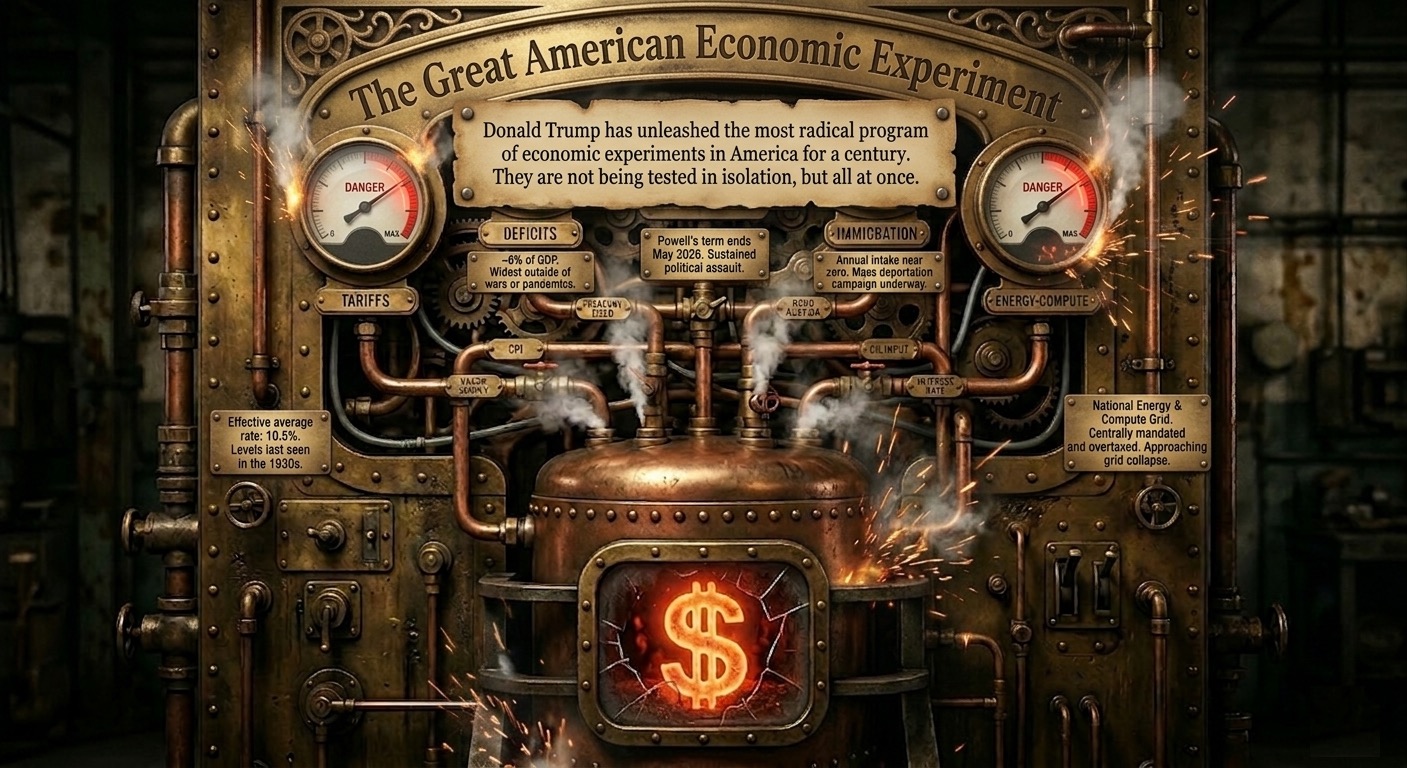
The connections are not metaphorical. They are arithmetic.
Hormuz connects to energy. The Iran strikes produced an 11 percent spike in oil prices within 48 hours. Energy price increases feed headline inflation with a three-to-six-month pass-through. Inflation constrains the Fed. Fed constraint means rates stay high. High rates increase the cost of servicing the federal deficit. The deficit is already $1.9 trillion. Interest payments on the debt will cross $1 trillion in fiscal 2026. Every basis point of yield increase raises the cost of rolling over $30.6 trillion in outstanding Treasury securities.
Immigration connects to labor markets. Social Physics traced the CBO's calculation: the immigration surge of 2021-2026 would have increased nominal GDP by $8.9 trillion over the decade and reduced federal deficits by $0.9 trillion. Immigration enforcement, this series' enforcement pipe, reversed that calculation. Farm employment dropped 155,000 workers. Agricultural wages spiked 12 percent. Construction employment declined in high-immigration states. The labor shortage that enforcement creates feeds the inflation that tariffs create, compounding inflationary pressure from both ends of the supply chain.
Tariff-driven inflation connects to the enforcement apparatus through cost-of-living pressures. When consumer prices rise on the tariffs and energy shocks that Social Physics documented, the economic pressure on working-class households intensifies. The political response to that pressure, scapegoating immigrants for economic conditions that tariff policy created, generates political capital for more enforcement. The enforcement generates more labor shortage. The labor shortage generates more inflation. The inflation generates more scapegoating. The loop runs through both machines simultaneously.
The Economist's 14 slides and these 6 articles are reading the same system through different gauges. Social Physics read the economic gauges: tariffs, deficits, Fed independence, immigration as labor data, energy-compute as infrastructure investment. The Domestic Machine reads the power gauges: immigration as enforcement authority, labor as exploitation architecture, sovereignty as executive prerogative, documents as control mechanism, war as system override. The gauges are different. The machine is the same.
The shared pipes are not incidental overlaps. They are the load-bearing connections between the economic and domestic dimensions of executive power. Immigration is the most visible shared pipe: Social Physics traced the CBO's calculation that immigration restriction would reduce GDP growth, widen the deficit, and eliminate $8.9 trillion in projected economic expansion. This series traced the same immigration restriction through the enforcement pipe, showing how it creates labor shortages that make trafficking profitable, detention revenue that incentivizes more enforcement, and political capital that justifies further restriction. The economic cost and the domestic power dynamic are produced by the same policy, enforced by the same apparatus, controlled by the same office. They are not parallel stories. They are one story told through two sets of gauges.
The Fed pipe is equally shared. Social Physics documented the administration's investigation of Fed Chair Powell as an assault on monetary policy independence, tracing the economic consequences through the bond market, the deficit, and the interest rate calculus. This series' document/loyalty pipe documented the same investigation as an exercise of executive control over institutional independence, tracing the loyalty dynamics through the DOJ, the classification system, and the personnel incentive structure. The investigation of the Fed Chair is simultaneously an economic event (Social Physics) and a power event (Domestic Machine). The two series read the same event through different codes, and neither series alone captures both dimensions.
The convergence matters because it explains why the machine is more resilient than any single analysis suggests. If the machine were purely economic, it could be constrained by economic countermeasures: market discipline, fiscal responsibility legislation, central bank independence protections. If the machine were purely domestic power, it could be constrained by political countermeasures: congressional oversight, judicial review, electoral accountability. But because the machine operates through both economic and power dimensions simultaneously, countermeasures in one dimension are undermined by the machine's operation in the other. Economic countermeasures (market discipline) are undermined by power dynamics (the war pipe's rally-round-the-flag effect makes market discipline politically untenable). Power countermeasures (congressional oversight) are undermined by economic dynamics (the deficit constraint makes Congress dependent on executive fiscal cooperation). The machine's two dimensions protect each other.
EXECUTIVE POWER
  │
  ├── ECONOMIC MACHINE (Social Physics)
  │   ├── Tariffs → import prices → inflation
  │   ├── Fed pressure → rate constraint → bond yields
  │   ├── Deficit → $1.9T → interest costs → $1T/year
  │   ├── Immigration restriction → labor shortage → wage inflation
  │   └── Energy-compute → AI infrastructure costs → tariff friction
  │
  ├── DOMESTIC MACHINE (This series)
  │   ├── Labor → H2A trafficking → exploitation architecture
  │   ├── Enforcement → tactical teams → citizen lethality
  │   ├── Sovereignty → capture + acquisition → international norms
  │   ├── Documents → classification → loyalty enforcement
  │   └── War → Iran → override all other codes
  │
  └── SHARED PIPES
      ├── Immigration: labor data (SP) ↔ enforcement authority (DM)
      ├── Energy: infrastructure costs (SP) ↔ Hormuz/war (DM)
      ├── Fed: independence (SP) ↔ DOJ investigation/loyalty (DM)
      └── Inflation: tariff-driven (SP) ↔ enforcement-driven shortages (DM)
V. The Honest Accounting
This is the series-level reckoning. Not a single article's self-audit, but an accounting of the entire analytical project, what we got right, what we got wrong, and where the line between rigorous structural analysis and pattern-seeking narrative remains uncomfortably blurry.
Where we were clear-eyed:
The Venezuela Strategic Analysis, published in January 2026, was the most rigorous of our earlier reports. It set a Bayesian posterior for diversionary intent at 25-45 percent, specified its priors, and engaged the steelman case for the operation's security justification. The assessment has held up. This series' structural analysis does not require the diversionary thesis; the institutional architecture produces its effects regardless of intent. The Venezuela analysis was asking the right question even though it was using the wrong framework.
The decision to apply a sociological framework, Blyth, Luhmann, Habermas, Lessig, was correct and overdue. The earlier dashboards tracked media coverage, which is a description of the conversation about power, not an analysis of power itself. The framework transition from "what are people saying about the crisis" to "how does institutional architecture produce and constrain the crisis" was the right move, and it produced the structural insights that the dashboards could not.
Where we were wrong:
The ICE Minneapolis dashboards tracked attention, not authority. They measured which cable news outlets covered the shootings, plotted the political positions of respondents, and visualized the media landscape. None of this answered the questions that mattered: Under what legal authority were the tactical teams deployed? Who issued the orders? Through what chain of command? What rules of engagement governed the operation? What institutional accountability mechanisms were activated? The dashboards were visually compelling and analytically safe. They described the conversation about the crisis without engaging the crisis itself.
The Crisis Hopping Q1 2026 report inflated the Bayesian posterior for diversionary intent from 25-45% to 55-65% without structured methodology. We did not specify updated priors. We did not document evidence weights. We did not apply the Analysis of Competing Hypotheses framework that our own critical-thinking curriculum teaches. The inflation was impressionistic: it felt like the crises were coordinated, and we updated our probability estimate based on feeling rather than method. In a report that claimed Bayesian reasoning, this was the core analytical failure. The structural analysis in this series does not require the diversionary thesis, which makes the earlier report's emphasis on it not merely methodologically wrong but strategically misguided: we were arguing the weaker case when the stronger case was available.
We wrote dashboards designed for visual impact. The Crisis Hopping report used gradient backgrounds, animated badges, and dramatic visual hierarchies. Some of this served clarity. Some of it served engagement at the expense of rigor. The difference between data visualization that illuminates and data visualization that performs is the difference between journalism and storytelling-as-analysis. We did not always stay on the right side of that line.
Where we remain uncertain:
The machine thesis is falsifiable, and we must state the conditions of its falsification clearly. If the pipes do not connect through the institutional architecture we describe, if enforcement does not feed labor shortages, if labor shortages do not increase trafficking profitability, if document control does not enable loyalty enforcement, if war does not override other institutional processes, the thesis fails. We have documented each connection with evidence. But documentation is not proof. The connections we trace are structural relationships, not causal chains established through controlled experiment. Structural analysis is inherently interpretive: we are reading an institutional architecture and asserting that its design produces specific effects. A differently trained analyst, reading the same architecture, might identify different connections or assign different weights.
Pattern-finding across crisis domains carries its own confirmation bias risk. When you have decided that the crises are connected, every new crisis looks like confirmation. Every new document release looks like evidence of the document pipe. Every new enforcement action looks like evidence of the enforcement pipe. The framework becomes a lens that selects for its own confirmation. We have tried to guard against this by specifying the institutional mechanisms through which each connection operates, not merely asserting connection but tracing the architecture through which the connection runs. But we cannot rule out the possibility that the architecture we describe is less connected than our analysis suggests, and that what looks like a machine is in part the product of our own pattern-seeking apparatus projected onto institutional complexity.
This is the honest accounting. The structural analysis is stronger than the diversionary analysis. The framework is more rigorous than the dashboards. The institutional connections are documented, not asserted. And the risk of seeing more machine than is there is real, acknowledged, and not resolved by acknowledging it.
VI. What the Machine Reveals
This series is not a prediction. It is a structural diagnosis.
Predictions are claims about the future made by actors who believe they can model the future's complexity. Predictions fail because the systems they model are more complex than the models. Structural diagnosis is different: it describes a configuration, a specific arrangement of institutional authority, legal architecture, enforcement capacity, financial incentives, information control, and military power, and asks what the configuration makes possible, what it makes probable, and what constraints it has dissolved.
The configuration is this: one executive controls the enforcement apparatus, the labor policy framework, the foreign policy and sovereignty projection capacity, the Department of Justice and its classification authority, and the military. Each of these authorities is constitutionally vested. Each was designed to be checked by institutional countermeasures, congressional oversight, judicial review, professional norms, market discipline. In the period documented by this series, each countermeasure either deferred, was bypassed, was captured, or was structurally inadequate.
The configuration does not predict what will happen. It identifies what the institutional architecture has enabled. It identifies the dissolved constraints that would have prevented specific actions. It identifies the feedback loops that compound pressure across pipes. It identifies the war code-switch that overrides all other institutional codes simultaneously. It identifies the cognitive and communicative bandwidth constraints that prevent democratic deliberation from processing the aggregate.
And it identifies the structural fact that connects this series to Social Physics: the domestic machine and the economic machine are the same machine. The same executive controls both. The same institutional specialization that prevents any single gauge-watching team from seeing the economic feedback loop prevents any single pipe-watching institution from seeing the domestic power machine. The blindness is the operating specification. The machine runs because the blindness enables it.
We began this series by auditing our own earlier reporting. The dashboards tracked attention. The compasses plotted positions. The Crisis Hopping report inferred intent from timing. None of them traced the institutional architecture through which power flows. This series traces the architecture. The architecture reveals the machine. The machine is one machine.
The question is not whether any individual pipe is running. Every article in this series documented a running pipe. The question is not whether the pipes are connected. The connections are documented in institutional authority chains, financial flows, legal frameworks, and public data. The question is not even whether one office controls all the pipes. The Constitution vests that control by design.
The question is what happens when all pipes are controlled by one office and no institutional architecture observes the aggregate. Not what will happen. What is happening. The aggregate is running now. No institution is watching the aggregate now. The machine is producing effects across every pipe now. And the institutional specialization that makes each pipe's experts sophisticated within their own domain is preventing anyone from describing the machine as a whole, because describing the machine requires a code that no institutional training provides, no professional incentive rewards, and no congressional committee is chartered to apply.
Social Physics began with a question: why can't the institutions that monitor each gauge see the machine? The answer was functional differentiation: each code-cage is staffed by experts who are right about their gauge and blind to the connections between gauges. This series began with the same question applied to domestic power: why can't the institutions that oversee each pipe see the machine? The answer is the same. The legal code processes enforcement. The diplomatic code processes sovereignty. The intelligence code processes threats. The media code processes coverage. Each code is right about its pipe. The machine runs between the pipes, in the connections that no code is designed to observe.
But there is a deeper answer that neither series fully explored until this final article. The reason no institutional code observes the aggregate is not merely structural. It is also political. Observing the aggregate would require naming the node at the top of the pipe diagram: one office, one executive, controlling all the pipes simultaneously. That naming is politically expensive in ways that are asymmetric with the naming of any individual pipe's problems. You can criticize an enforcement operation. You can question a military campaign. You can investigate document suppression. Each of these criticisms operates within an institutional code that provides professional standing, legal framework, and political legitimacy for the critic. Criticizing the aggregate, naming the machine, requires a meta-code that no profession provides, no institution charters, and no career path rewards. The critic of the aggregate is not an enforcement expert or a military analyst or a legal scholar. The critic of the aggregate is a systems thinker operating without institutional backing, professional standing, or the kind of evidentiary standards that any single code would recognize as authoritative.
This is why the machine persists. Not because it is hidden. Not because the evidence is unavailable. But because the institutional architecture of expertise, professionalism, and accountability is designed to process one pipe at a time, and the design is self-reinforcing: the more sophisticated each code becomes within its domain, the more costly it becomes to step outside that domain and observe the aggregate. The expert who names the machine forfeits their standing in every individual code simultaneously. The cost of seeing the whole is the loss of authority in any part.
We have tried, in this series and its companion, to pay that cost. The series may be wrong. The connections we trace may be less connected than our analysis suggests. The machine thesis is falsifiable: if the pipes do not connect through the institutional architecture we describe, the thesis fails. But the institutional architecture is documented. The connections are traced in legal authority, financial flows, personnel appointments, and public data. And the single node at the top of the diagram is constitutional fact.
The machine does not care whether you observe it. It runs.
Sources
Timeline Sources (Articles 1–5 Primary Sources)
- Article 1 (Labor): ProPublica/NPR. "Operation Blooming Onion" investigation series, 2024. U.S. DOL enforcement data. U.S. DOJ Southern District of Georgia, Case No. 2:21-cr-00024 (United States v. Patricio et al.).
- Article 2 (Enforcement): DHS operational records. Eighth Circuit Court filings. Minneapolis Police Department incident reports. Body camera footage (released under FOIA, February 2026).
- Article 3 (Sovereignty): Operation Absolute Resolve: CENTCOM operational summary. ICC Office of the Prosecutor, preliminary examination notice, January 2026. Danish Ministry of Foreign Affairs, ambassador recall notice, March 2026. Greenland Parliament (Inatsisartut), Resolution on Territorial Integrity, March 2026.
- Article 4 (Documents/Loyalty): U.S. District Court for the Southern District of New York, Epstein file release orders, Batches 1–4 (October 2025–March 2026). DHS NDA memorandum, February 14, 2026 (reported by Washington Post). Presidential pardon records, January 6, 2026.
- Article 5 (War): CENTCOM, "Operation Epic Fury: Initial Assessment," March 1, 2026. CBS News, Face the Nation, Badr al-Busaidi interview transcript, February 26–27, 2026. IAEA, GOV/2026/9. Lloyd's of London, JWC/2026/003. ICRC, "Iran: Situation Report — Hormozgan Province," March 3–5, 2026.
Institutional Architecture
- Hamilton, Alexander. The Federalist Papers, Nos. 70–77 (1788). On the unitary executive and its constitutional design.
- Calabresi, Steven G., and Yoo, Christopher S. The Unitary Executive: Presidential Power from Washington to Bush. Yale University Press, 2008.
- Posner, Eric A., and Vermeule, Adrian. The Executive Unbound: After the Madisonian Republic. Oxford University Press, 2011.
- Levinson, Daryl J., and Pildes, Richard H. "Separation of Parties, Not Powers." Harvard Law Review 119, no. 8 (2006): 2312–2386.
- Barron, David J., and Lederman, Martin S. "The Commander in Chief at the Lowest Ebb." Harvard Law Review 121, no. 4 (2008): 941–1112.
- Fisher, Louis. Presidential War Power. 3rd ed. University Press of Kansas, 2013.
Democratic Theory and Communicative Capacity
- Habermas, Jürgen. The Structural Transformation of the Public Sphere. MIT Press, 1991 (German original 1962).
- Habermas, Jürgen. The Theory of Communicative Action. 2 vols. Beacon Press, 1984–1987.
- Habermas, Jürgen. Between Facts and Norms: Contributions to a Discourse Theory of Law and Democracy. MIT Press, 1996.
- Verovšek, Peter J. "Habermas and the Colonization of the Lifeworld by the Market." Political Studies 71, no. 3 (2023).
- Sapolsky, Robert M. Behave: The Biology of Humans at Our Best and Worst. Penguin Press, 2017.
- Prior, Markus. Post-Broadcast Democracy: How Media Choice Increases Inequality in Political Involvement and Polarizes Elections. Cambridge University Press, 2007.
- Sunstein, Cass R. Republic.com 2.0. Princeton University Press, 2009. (Deliberative democracy and information overload.)
The Social Physics Connection
- Social Physics, Article 1: The Five Gauges Are One Machine. Tariff-inflation-Fed-deficit-immigration-energy feedback loop.
- Social Physics, Article 2: The Jetsons and the Flintstones. AI infrastructure costs and tariff friction.
- Social Physics, Article 3: You Know Where. Immigration as economic data.
- Social Physics, Article 4: Museums and Islands. Institutional architecture of the bond market.
- Social Physics, Article 5: The Bond Market. Fiscal dominance and sovereign debt dynamics.
- Social Physics, Article 6: The Odyssey. The five gauges synthesized.
- Congressional Budget Office. "The Budget and Economic Outlook: 2026 to 2036." February 2026. (Deficit, interest cost, and immigration GDP projections.)
- Penn Wharton Budget Model. "Effective Tariff Rates and Revenues." March 2026. (Tariff data.)
- Federal Reserve Board. "Energy Prices and Inflation Pass-Through." FEDS Notes, 2023. (Hormuz-to-CPI transmission mechanism.)
The Platform's Earlier Reports
- ICE Minneapolis Dashboard v1. January 2026. Media bias analysis of ICE shooting coverage.
- ICE Minneapolis Dashboard v2. January 2026. Expanded media tracking with Ground News-style bias spectrum.
- ICE Minneapolis Compass. January 2026. Political compass plotting of stakeholder positions.
- Venezuela Compass. January 2026. Political compass of intervention responses.
- Venezuela Maduro Dashboard. January 2026. Coverage tracking of Operation Absolute Resolve.
- Venezuela Strategic Analysis. January 2026. Bayesian posterior for diversionary intent at 25-45%.
- Crisis Hopping Q1 2026. March 2026. Comprehensive crisis timeline. Posterior inflated to 55-65% without structured methodology. Retracted.
- Iran Uprising 2026: Media Analysis Dashboard. January 2026.
Theoretical Frameworks (Full Bibliography)
- Mark Blyth:
- — Great Transformations: Economic Ideas and Institutional Change in the Twentieth Century. Cambridge University Press, 2002.
- — Austerity: The History of a Dangerous Idea. Oxford University Press, 2013.
- — "The Great Slump of 2025." Foreign Affairs, 2025.
- — With Matthias Matthijs. "The Future of the Euro." Oxford University Press, 2015. (On ideas as institutional weapons in European context.)
- Niklas Luhmann:
- — Social Systems. Stanford University Press, 1995.
- — Theory of Society. 2 vols. Stanford University Press, 2012–2013.
- — Law as a Social System. Oxford University Press, 2004.
- — "The World Society as a Social System." International Journal of General Systems 8, no. 3 (1982): 131–138.
- Jürgen Habermas:
- — The Theory of Communicative Action. 2 vols. Beacon Press, 1984–1987.
- — Between Facts and Norms. MIT Press, 1996.
- — The Structural Transformation of the Public Sphere. MIT Press, 1991.
- — Legitimation Crisis. Beacon Press, 1975.
- Lawrence Lessig:
- — Code and Other Laws of Cyberspace. Basic Books, 1999. (Code 2.0, 2006.)
- — Republic, Lost: How Money Corrupts Congress — and a Plan to Stop It. Twelve, 2011.
- — Free Culture: The Nature and Future of Creativity. Penguin, 2004. (On architectural regulation.)
For-Profit Detention and Market Data
- GEO Group, Inc. SEC Filing: Form 10-Q, Fiscal Quarter Ending March 31, 2026.
- CoreCivic, Inc. SEC Filing: Form 10-Q, Fiscal Quarter Ending March 31, 2026.
- Center for Responsive Politics (OpenSecrets). "Private Prisons: Lobbying, 2025." opensecrets.org
- Gotsch, Kara, and Basti, Vinay. "Capitalizing on Mass Incarceration: U.S. Growth in Private Prisons." The Sentencing Project, 2018 (updated 2025).
- RTX Corporation (formerly Raytheon Technologies). Stock price data: Yahoo Finance, March 1–7, 2026.
Constitutional Authority and Separation of Powers
- U.S. Constitution, Article II, Sections 1–4.
- War Powers Resolution, 50 U.S.C. §§ 1541–1548 (1973).
- Youngstown Sheet & Tube Co. v. Sawyer, 343 U.S. 579 (1952). Justice Jackson's concurrence on executive power zones.
- Hamdi v. Rumsfeld, 542 U.S. 507 (2004). On executive detention authority and judicial review during wartime.
- Boumediene v. Bush, 553 U.S. 723 (2008). On habeas corpus and the limits of executive classification authority.