Winning the War on Truth
Free in full, to every reader — because a democracy can only ever be as clear-eyed as its citizens. Where Think for Yourself teaches inoculation, this course names the machinery. Ten units following Samuel C. Spitale's How to Win the War on Truth chapter by chapter, anchored in case studies from the last three years and connected backward to where each propaganda technique was invented or perfected.
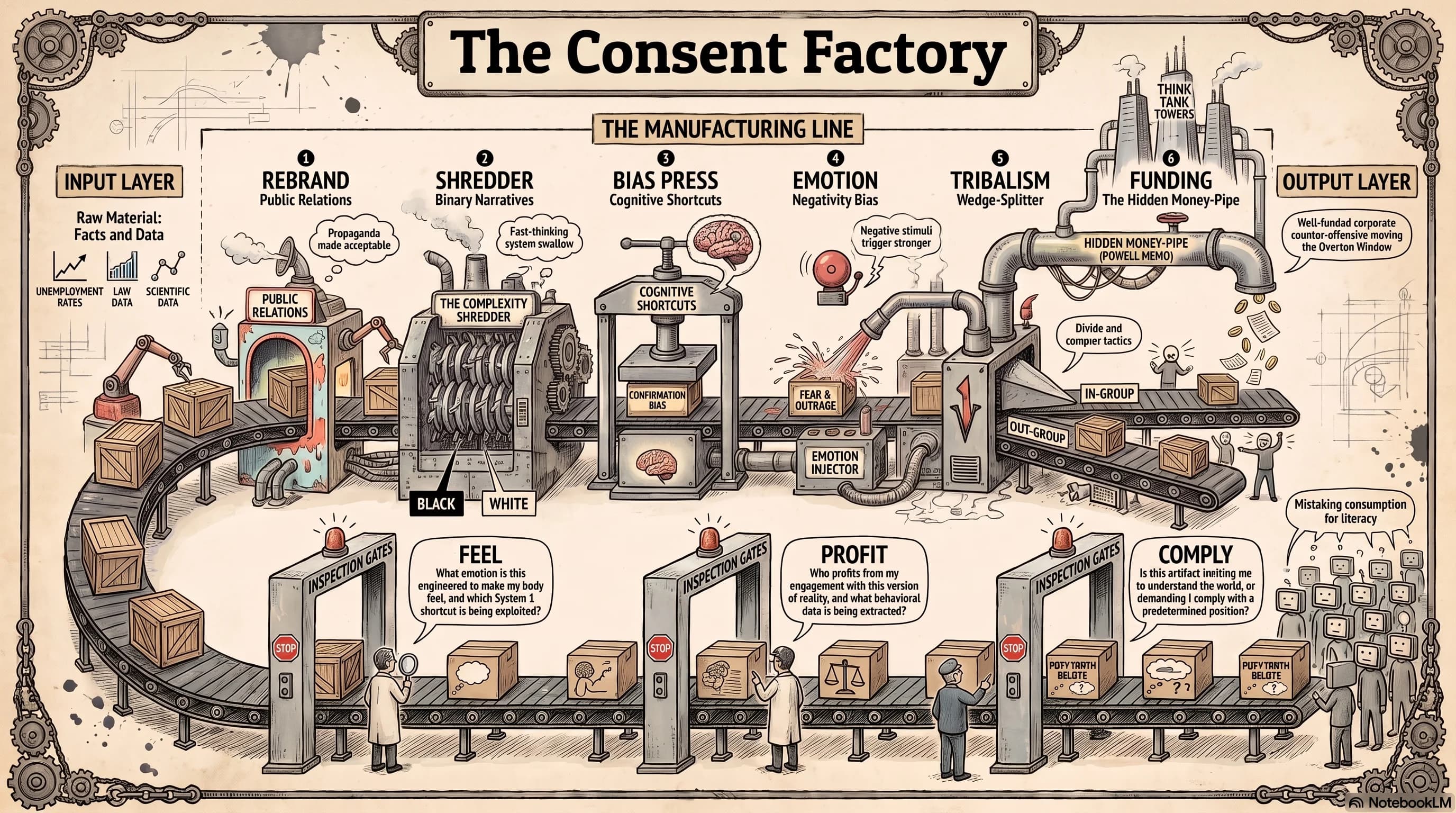
The Consent Factory: raw facts enter, six stations transform them into manufactured consent, and three inspection gates — FEEL, PROFIT, COMPLY — are the audit that can stop the line. The stations map to Units 2–7; the gates are the Source-Code Audit (Simon/Kahneman → Zuboff → Habermas).
Winning the War on Truth
Audio Overview
What You Will Learn
Present → Past, Not Past → Present
Every unit opens with a propaganda move happening now — the 2024 election vibes gap, the X transformation, the selling of the Iran war — then walks backward to where the technique was invented. Fractals grow from a seed in the present; mythology marches forward from a manufactured origin.
Spitale as Spine, Canon as Roundtable
Samuel C. Spitale's book is mandatory reading and every unit cites it by chapter. Adjacent voices — McIntyre, Pfeiffer, Bergstrom & West, Stanley, DiResta, Jeffries — provide the contemporary scholarly roundtable that extends Spitale's framework into specific arenas.
All units
The Source-Code Audit
A three-question protocol you use on every artifact: Simon/Kahneman audit (what emotion is this engineering?) → Zuboff audit (who profits from my engagement?) → Habermas audit (am I being asked to understand, or to comply?). The technique survives the course.
Recurring
Curated Video Library
9 curated videos to explore — plus 12 more matched to individual units inside the course

Start with the framing trick in the title itself: two economic labels, deployed as weapons rather than descriptions — exactly what Unit 8's field manual trains you to catch. Mr Global walks through how bailouts, subsidies, and regulatory capture socialize corporate losses while gains stay private, and why that asymmetry keeps disappearing from public debate: whoever controls the vocabulary controls what looks normal. This channel earned its place here twice over — our own No Kings series cites Mr Global's analysis in its sourcing, and this video lands squarely on the question that closes both The Stack and No Kings: when the downside is quietly moved onto people who were never in the room, who does the language work for? Watch it as a live exercise in Unit 7's core skill — following the money behind the message — then notice how rarely the phrase 'corporate socialism' survives contact with a cable-news panel. That absence is the lesson.

DarkMatter2525's animated allegories do something lectures can't: they let you watch a manipulation mechanism operate on characters before you're asked to recognize it in yourself. The thesis here is the course's central trap in miniature — the forces driving corruption and strife present themselves as the remedy for corruption and strife, and once people buy in, their moral reasoning gets conscripted rather than consulted. That's Unit 3's binary trap (the problem/solution frame forecloses every other option) fused with Unit 6's tribal pull (questioning the 'solution' reads as joining the enemy). Spitale's first trademark of propaganda is the black-and-white narrative; this video shows why that narrative is so hard to escape from the inside — the frame itself assigns you a role. The animation register matters too: it reaches viewers who would bounce off a FRONTLINE documentary, which is precisely the audience propaganda reaches first.

A former hedge-fund manager reads the largest IPO prospectus in history with dry precision and finds, in his words, a document that is part financial disclosure, part science fiction — everything he reports comes directly from the filing. Boyle walks through the governance structure a corporate law professor summarized as 'no votes, no sales, and no suits,' the products that don't yet exist, and the compensation package tied to a Mars colony the company itself calls improbable. Why does this belong in a propaganda course? Because our Computedollar series (Article 3, The Architecture) traces how exactly this structure was engineered so that index funds — meaning teachers' pensions and parents' 401(k)s — are forced to buy it regardless of objections. Unit 7 teaches that the deepest propaganda isn't a lie you're told; it's an architecture you're placed inside without being asked. Boyle's deadpan close-reading is the antidote the course trains: go to the primary document, and count who benefits.
Bremmer sits in the rooms where the news is made, so his answer to 'how do you stay informed?' carries unusual weight: mostly, you shouldn't — not the way your feed wants you to. In conversation with TED's Helen Walters he lays out how he grades sources, how he avoids getting spun by people whose job is to spin him, and why the volume of coverage on a story is nearly unrelated to its importance. This is Unit 10's reclaiming-reality toolkit spoken by a practitioner: attention is the scarce resource, and the feed's recency gradient — newest equals most important — is a design choice that serves the platform, not you. This course's own video library deliberately mirrors that gradient and then bends it toward history; Bremmer explains why the unbent version quietly wrecks your model of the world. Watch it early, then apply his sourcing discipline to everything else on this page, including us.
Set aside the provocative title and this is a rigorous exercise in Unit 4's hardest skill: evaluating testimony and authority claims from inside a belief community. DarkMatter2525's argument is structural — if believers were genuinely receiving guidance from an infallible source, you'd expect their beliefs and behavior to converge; instead they fracture along exactly the lines (culture, upbringing, tribe) that ordinary human bias predicts, and the video works through Pew's 2025 data on why people leave or stay. That's Festinger's dissonance research and the luxury-of-dismissal problem applied to the claims closest to people's identities, which is where Unit 4 says bias does its strongest work. The course takes no position on faith itself — but it insists that the machinery of belief maintenance (motivated reasoning, in-group confirmation, disconfirmation management) runs the same whether the object is a deity, a party, or a market narrative. This video is a case study in auditing that machinery where it's least comfortable.
FRONTLINE's account of the fight over Federal Reserve independence — from the campaign against Jerome Powell through Kevin Warsh's razor-thin confirmation — is the single best documentary companion to Unit 7, because it shows institutional capture happening through vocabulary before it happens through law. Notice the framing war the film documents: 'independence' recast as 'unaccountability,' emergency recast as mandate. Our Computedollar series (Article 2, The Rupture) picks up where the film ends, tracing how the bond market repriced within days of the confirmation vote — the moment when a rhetorical victory became a number everyone's mortgage now contains. Congress designed the Fed to be insulated from exactly this pressure so unpopular long-term decisions remained possible; the campaign to end that insulation is the Overton Window unit's textbook case, running in real time, with your grocery prices as the lab results. Pair with the Bremmer interview above: this is what a story that deserves your full attention looks like.
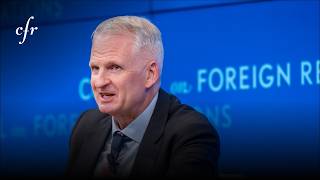
Snyder is the historian our No Kings series leans on for its sharpest frame — authoritarian consolidation as a sequence of institutional captures, each one 'failing at fascism' until it isn't — and this Council on Foreign Relations conversation catches him applying that lens to the American present: what he calls superpower suicide. The chapter on succession is the one to sit with: Snyder argues that what makes a state a state is the ability to transfer power without crisis, which reframes Unit 6's material on the authoritarian pull as a measurable institutional property, not a vibe. His section on technology's influence on modern power and on media access closes the loop back to Unit 1: information monopoly is not a side effect of authoritarian projects, it is the mechanism. An hour with a working historian thinking carefully in public — the exact opposite register of the content this course teaches you to defend against, which is itself part of the lesson.
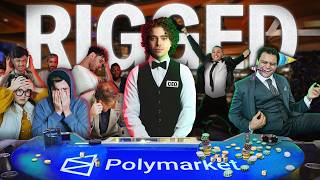
The setup is almost too perfect: a prediction-market platform approached an investigative newsroom seeking favorable coverage, and the newsroom investigated instead. More Perfect Union's receipt is one number — on Polymarket, 0.04% of traders capture 70% of the profits — set against the industry's own slogan, 'democratizing finance.' That's Bernays' engineering-of-consent playbook (Unit 2) wearing fintech clothes: rebrand an extraction mechanism as empowerment, and the mark volunteers. Our No Kings series (Article 2) documented the darker edge of the same machinery — suspiciously prescient trades landing minutes before market-moving government announcements — so this video sits at the junction of Unit 7's profit analysis and Unit 8's rebranding techniques. It's also a model of the course's method: the journalists didn't argue with the slogan, they counted. When a platform's marketing and its profit distribution point in opposite directions, believe the distribution.

Every current-events card above decays back to this one. Smedley Butler was a two-time Medal of Honor Marine general who spent his retirement saying the unsayable: 'War is a racket' — and naming the corporate beneficiaries of every intervention he'd led, from Cuba to China. Knowing Better covers the Banana Wars, Butler's 1935 pamphlet, and the Business Plot — the industrialists' scheme to recruit Butler for a coup against Roosevelt, which he instead exposed to Congress under oath (the McCormack–Dickstein hearing transcripts survive; the video links them). This is the deep prior for Units 2 and 9: the machinery of manufactured consent for profitable wars was documented, under oath, by its own most decorated instrument, ninety years before your feed existed. When the course argues that today's techniques are old inventions with better distribution, Butler is the receipt. If the 2026 cards on this page felt novel, watch this and recalibrate.
Explore These Channels
FRONTLINE is the primary documentary spine for this course. Long-form investigative reporting on information warfare, disinformation campaigns, electoral manipulation, and the institutional machinery that produces the propaganda Spitale's book anatomizes. Every unit references at least one Frontline documentary as case-study evidence, including The War Cabinet (2026), Caught in the Crackdown (2026), Lies Politics and Democracy (2022), Plot to Overturn the Election (2022 with ProPublica), The Facebook Dilemma (2018), and United States of Conspiracy (2020). Frontline's editorial discipline — sourcing, interview density, refusal to manufacture false balance — is itself a working model of the journalism/propaganda distinction Spitale draws in Chapter 1.
Dan Olson's long-form video essays do for video what Spitale's book does for prose: name the mechanics of media manipulation by walking through a concrete example with cinematic patience. Essays like Flat Earth, In Search of a Flat Earth, and Line Goes Up demonstrate the propaganda techniques Chapters 3, 4, and 7 catalogue without ever lecturing the viewer about cognitive bias. For students who want to see the analytical method applied at feature length, Olson's channel is the right depth. Particularly relevant for Unit 4 (Bias and the Brain) and Unit 7 (Power, Profit, and Propaganda).
Ian Danskin's The Alt-Right Playbook series is a frame-by-frame map of the contemporary tactics in Chapters 5 and 7 — dehumanization rhetoric, controlled-opposition framing, the Mermaid Problem, the gish gallop. The series is also a working demonstration of the present-back-to-past pedagogy this course uses: each video opens with a contemporary internet artifact and walks backward to where the technique was invented. Danskin's narration is calm and uncondescending, which models exactly the voice the course aims for.
Calling Bullshit (Bergstrom & West, University of Washington)
Carl Bergstrom and Jevin West teach the statistical and data-deception complement to Spitale's rhetorical inventory. Their UW course videos cover causality vs. correlation, base-rate fallacies, data visualization manipulation, and the specific propaganda moves Chapter 7 names. For students who will encounter manipulated charts and statistical sleights-of-hand in the live information environment, this is the operational toolkit. Particularly relevant for Unit 4 (Bias and the Brain) and Unit 8 (Propaganda Techniques).
Natalie Wynn's video essays are the production-design demonstration of how to land structural critique without sliding into either lecture or snark. Selected use only — particular essays (e.g., Cringe, Envy, J.K. Rowling) demonstrate the dehumanization-rhetoric and identity-construction patterns Chapter 5 anatomizes. Use for Unit 6 (Dividing and Conquering) and as advanced supplementary viewing for college-bound students ready for adversarial-presentation analysis. Not assigned wholesale; specific essays only.