Truth Decay and Reclaiming Reality
Spitale's Conclusion frames the analytical posture students should leave with: values over ideology, education over propaganda, and the discipline of reasoning slowly. This unit synthesizes the four intake-layer scholars and the RAND Truth Decay report into a sustainable practice, anchored in the 2026 information environment under the second Trump administration.
Learning Objectives
- 1Name RAND's four trends of Truth Decay and identify each operating in 2026
- 2Distinguish living by values from living by ideologies or beliefs (Spitale's closing distinction)
- 3Articulate the difference between education and propaganda (Max Wertheimer's distinction Spitale cites)
- 4Synthesize the four intake-layer scholars into a single sustainable analytical practice
- 5Run a final Source-Code Audit on the 2026 information environment as a whole
Hook: The 2026 Information Environment
The hook for this final unit is not an artifact. It is the air.
Open a phone in the spring of 2026 and what arrives is not a single piece of propaganda but a weather system. A cabinet meeting livestreamed and then immediately re-cut into nine competing versions across six platforms, each one of them claiming to be the unedited truth. Press briefings that flatly contradict the previous day's press briefings, delivered with the same confident cadence and tagged with the same official seal. Federal agencies pulling datasets from public-facing servers overnight and posting, the next morning, replacement datasets that say something different. Cable channels that used to disagree about interpretation now disagreeing about events. A regional newspaper that ran for one hundred and forty years closes on a Tuesday and by Friday a new website with a near-identical name and an opaque ownership trail is publishing in its place.
On May 26, 2026, PBS Frontline released The War Cabinet, a documentary that spent six months inside the operational core of the second Trump administration's information apparatus. It was followed within weeks by Caught in the Crackdown, which traced what happened to the reporters, civil servants, and academics who tried to keep the public record honest while the apparatus was being rebuilt around them. Speaking Truth to Power: Press Freedom in the Age of Disinformation arrived in the same window. These three films, taken together, are the contemporary evidence base for this unit. They do not document a single propaganda technique. They document an environment in which every technique inventoried across the previous nine units of this course is now operating simultaneously, at scale, with state backing, against a public whose attentional infrastructure was already exhausted before any of this began.
This is the condition Samuel Spitale's book exists to address. His Conclusion does not pretend the situation is recoverable through one more clever rebuttal or one more viral fact-check. He calls the condition by its name, truth decay, and asks what posture a person can hold when the ambient information environment is structured to disorient them. That is the question this unit takes up. The hook is not a single piece of propaganda this time. The hook is the room you are standing in.
Think About
Pick the most recent twenty-four hours of news you have consumed. Not a single story: the whole stream. What would you say is the dominant emotional state that twenty-four hours was engineered to leave you in? Now ask: who benefits from you being in that state?
Spitale's Framework: Truth Decay and What Comes After
Spitale opens his Conclusion with a single distinction that does almost all of the closing work of his book. It is not his distinction. It is Max Wertheimer's. Wertheimer was a Gestalt psychologist, one of the founders of the school of psychology that studied how the mind organizes raw perception into coherent wholes, and he made an observation that Spitale lifts directly into his final chapter.
"The psychologist Max Wertheimer once noted the distinction between education and propaganda: one changes minds, the other changes emotions. Propaganda replaces thinking with believing, facts with faith, and truth with myth." Spitale, How to Win the War on Truth, Conclusion
That is the conceptual hinge of the entire book. Education changes minds. Propaganda changes emotions. Education leaves you with a sharper question; propaganda leaves you with a stronger feeling. Education accepts that you might walk away from the encounter holding a different position than the educator does; propaganda is engineered specifically to prevent that outcome. Education is patient because thought is slow; propaganda is fast because emotion is fast. The same medium can serve either purpose. The same teacher can deliver either one. The same student can receive either one. What separates them is what each one is trying to do to you.
Spitale continues the passage, and he is precise about what propaganda does once the emotional substitution is complete:
"It overrides reason by invoking irrational fears and tribal anger, eroding empathy, silencing debate, and leaving a path of misinformation in its wake." Spitale, How to Win the War on Truth, Conclusion
Read that list slowly. Irrational fears. Tribal anger. Eroded empathy. Silenced debate. A path of misinformation behind it. That is a clinical inventory of what the previous nine units of this course have shown you, technique by technique. Spitale is not telling you something new in the Conclusion. He is telling you what you have already learned to recognize and asking you to name the collective effect.
The Four Trends
He gives the collective effect a name borrowed from the policy literature. Truth decay is the term coined by the RAND Corporation in 2018, and Spitale uses RAND's vocabulary because it is the most precise vocabulary the field has produced. He cites it directly in the Conclusion as the condition that must be reversed. RAND identifies truth decay as a cluster of four interlocking trends, not a single problem.
-
Increasing disagreement about facts and analytical interpretations of facts and data. Not disagreement about values or priorities, which is normal and healthy in a pluralistic society, but disagreement about what actually happened, what the numbers actually say, and what the data actually mean. When two informed citizens cannot agree on the basic factual record of a public event, deliberation about what to do next cannot get off the ground.
-
A blurring of the line between opinion and fact. Cable channels that present commentary in the visual grammar of news. Social platforms that flatten every post into the same rectangle whether it is a peer-reviewed study or a stranger's hunch. Headlines written as questions so the publisher can disavow the implied answer. The audience loses the ability to tell which kind of statement is in front of them.
-
The increasing relative volume, and resulting influence, of opinion and personal experience over fact. Anecdote crowds out aggregate evidence. The story of one person displaces the statistical reality of millions. This is what Spitale's Chapter 6 Application Exercises directly drill into the student under the heading story versus statistics: the human mind is built for narrative, not for distributions, and a propagandist who understands this will always feed the audience the story.
-
Declining trust in formerly respected sources of factual information. Once the first three trends have done their work, the fourth follows automatically. If facts are disputed, if opinion looks like fact, and if anecdote outweighs evidence, then the institutions that produce and adjudicate facts, universities, courts, agencies, the science press, the local newspaper, lose the social authority that allowed them to function. Trust does not collapse first; trust collapses last, after the cognitive ground beneath it has already been hollowed out.
These four trends do not describe a future risk. They describe the room. Each unit of this course has been a study of one mechanism by which one of these trends gets accelerated. Unit 1 named the toolkit. Units 2 through 9 traced specific techniques: censorship through noise, manufactured doubt, strategic denialism, framing, branding, algorithmic amplification, astroturfing, demagoguery, and each of those techniques is a contribution to one or more of RAND's four trends. The Conclusion is where those threads are pulled together into a single diagnosis.
Cross-Curricular Connection: Journalism's "When Truth Breaks" unit gives the structural treatment of conditions under which truth becomes unrecoverable from the public record: the journalistic-practice counterpart to RAND's truth-decay diagnosis. See When Truth Breaks in Journalism.
From Analysis to Posture
Here is where Spitale's Conclusion turns. He has spent the entire book teaching analysis. He spends the final pages on posture. The turn is not rhetorical decoration; it is the actual ethical work of the book. Analysis tells you what is happening. Posture tells you what to do while it is happening.
His core instruction is this: live by values, not by ideologies or beliefs. This is a sharper distinction than it sounds. Beliefs are claims about how the world is. Ideologies are organized systems of beliefs aligned to a political program. Values are commitments about how you want to act regardless of which beliefs turn out to be true. Honesty is a value. Courage is a value. Fairness is a value. Loyalty to your in-group's current talking points is not a value; it is an ideology disguised as one.
Spitale's closing point is that propaganda specifically targets people who have substituted ideology for values. If your operating commitment is "I believe what my side believes," then any new information that threatens your side becomes an emotional attack you must repel. The propagandist's job is easy: identify the side, weaponize the loyalty. If your operating commitment is "I want to act honestly and fairly regardless of which side benefits," then new information becomes data, not a threat. The propagandist's job becomes much harder, because there is nothing tribal in you to grab.
He closes the chapter with a paraphrase that returns directly to the first unit of this course:
"To paraphrase the father of propaganda, Edward Bernays, those who manipulate the opinions of the masses are the true ruling power in our society. It's time to return that power to the people." Spitale, How to Win the War on Truth, Conclusion
Bernays meant the line as a description of an accomplishment. Spitale repurposes it as a description of a debt. The first unit of this course opened with Bernays as the engineer who built the toolkit; the final unit closes with Bernays as the obligation he left behind. Returning the power to the people is not a slogan. It is the analytical and ethical practice this entire course has been training.
Cross-Curricular Connection: Think for Yourself's closing unit, Unit 5: Intellectual Self-Defense, is the personal-level analog of this unit's environmental audit. TFY teaches you how to defend a single mind from a single manipulation attempt. This course teaches you how to read a population-scale environment. The two practices are designed to be carried together: the environmental audit identifies the field you are operating in; the intellectual-self-defense practice protects the individual reasoning that has to operate inside that field.
Intake-Layer Overlay: All Four Synthesized
Every previous unit has foregrounded one of four intake-layer scholars whose work, together, describes the conditions under which propaganda operates on a modern mind. This unit foregrounds all four at once. The point of the synthesis is not to summarize them. The point is to show that the four are a single analytical practice when held in the correct order.
Simon Sets the Field
Herbert Simon, an economist and cognitive scientist who shared a Nobel Prize for his work on bounded rationality, observed in 1971 that the explosion of information would produce a corresponding scarcity of the resource that information consumes: human attention. A wealth of information creates a poverty of attention. That observation is the field on which everything else in this course takes place. Without Simon's diagnosis there is no environment in which propaganda is effective at industrial scale, because in a low-information environment a propagandist must defeat a focused audience. In a high-information environment they need only out-shout the other signals competing for the same exhausted faculty.
Simon does not name the propagandist. He names the condition that makes the propagandist's job easy. The 2026 information environment is the most extreme instance of the condition Simon described that has ever existed in human history. The number of inputs reaching an average phone in a given hour exceeds the total information available to a citizen of 1900 in a year. Attention is not just scarce now; it has been comprehensively colonized.
Kahneman Identifies the Gateway
Daniel Kahneman's Thinking, Fast and Slow describes two systems of cognition that share the same skull. System 1 is fast, automatic, emotional, intuitive, and almost always running. System 2 is slow, deliberate, analytical, expensive to operate, and almost always idle. The mind defaults to System 1 because System 1 is metabolically cheap and System 2 is metabolically costly. Most of the time this is adaptive. You do not want to deliberate about whether to flinch from a snake.
But it means that when information arrives faster than System 2 can process it, and in 2026 it always does, the response is being formed by System 1. System 1 does not check sources. System 1 does not weigh competing evidence. System 1 returns a feeling and a rough heuristic. Propaganda is content engineered specifically for the System 1 gateway. It is short, it is emotionally vivid, it is repeated, it uses pattern-matching cues the audience already trusts. Spitale's clinical inventory, fear, tribal anger, eroded empathy, is a System 1 inventory.
Kahneman is not the propagandist either. He is the anatomist of the gateway the propagandist walks through. Simon explains why the gate is always open. Kahneman explains what the gate is made of.
Zuboff Names the Engine
Shoshana Zuboff's The Age of Surveillance Capitalism identifies the economic engine that makes industrial-scale exploitation of the System 1 gateway profitable. Surveillance capitalism is the business model in which human experience is treated as a free raw material that is captured, processed into behavioral prediction products, and sold to actors who want to modify behavior at scale. The platforms that distribute most contemporary propaganda were not built to distribute propaganda. They were built to harvest behavior and sell prediction. Propaganda thrives there because emotionally extreme content produces more behavioral data than measured content does. The engagement metrics reward the System 1 hijack.
Zuboff's contribution is the question who profits. Simon explains the field. Kahneman explains the vulnerability. Zuboff explains who is making money from the vulnerability being exploited and why they have no structural incentive to stop. This is not a moral failing of individual engineers. It is the logic of the business model. A platform that lowered engagement to protect its users from manipulation would lose to a platform that did not.
Habermas Specifies the Discourse Pattern
Jürgen Habermas, the German social philosopher, distinguishes between two fundamentally different kinds of communication. Communicative action is communication oriented toward mutual understanding. Both parties enter willing to be persuaded if the other has the better argument. The currency is reasons. The test is whether you would still hold the position if your interlocutor produced a stronger argument. Strategic action is communication oriented toward producing a predetermined outcome in the other party. The currency is effect. The test is whether the audience does what you wanted them to do. Strategic action wearing the clothes of communicative action is what Habermas calls systematically distorted communication. That is the technical name for propaganda.
Habermas gives the course its ethical grammar. Simon, Kahneman, and Zuboff describe the conditions; Habermas describes what is being done to those conditions and why it matters. A society in which most public communication is strategic action masquerading as communicative action cannot self-govern, because self-government requires a public capable of reasoning together, and a public that has been trained to expect strategic action will eventually stop trying to reason at all. RAND's fourth trend, declining trust in formerly respected sources, is what that exhaustion looks like in aggregate.
The Four As One Practice
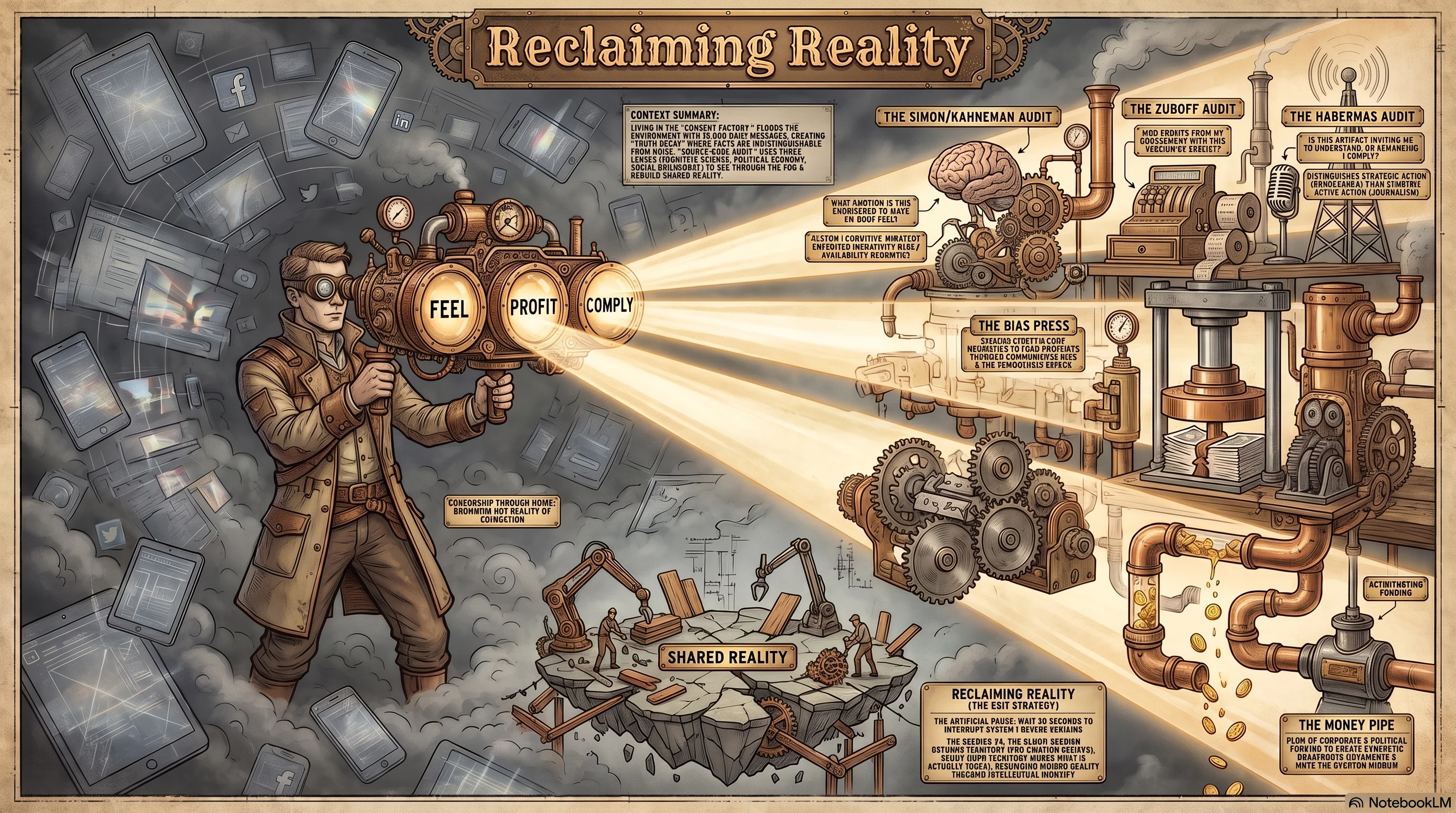
Read in sequence the four scholars are not four lenses on the same object. They are a single protocol for reading any piece of contemporary communication.
- Simon: What is competing for my attention right now, and why did this win?
- Kahneman: Which system in my own head is being addressed?
- Zuboff: Who is making money from my engagement with this?
- Habermas: Is this trying to help me think, or trying to get me to comply?
That sequence, field, gateway, engine, intent, is the Source-Code Audit in its mature form. Every unit of this course has rehearsed it on a single artifact. The final unit asks you to run it on an environment. Before that, hold the sequence in your hand for a moment. It is the equipment you leave the course carrying.
❓Concept Check
What is the difference between communicative action and strategic action in Habermas's framework, and why is the difference essential to Spitale's distinction between education and propaganda?
▸
Concept Check
What is the difference between communicative action and strategic action in Habermas's framework, and why is the difference essential to Spitale's distinction between education and propaganda?
Communicative action is communication oriented toward mutual understanding, where both parties are willing to revise their position based on the better argument. Strategic action is communication oriented toward producing a predetermined outcome in the other party, regardless of whether they understand or agree. Spitale's education/propaganda distinction is the same distinction in different vocabulary: education is communicative action because it tries to change minds through reasons, while propaganda is strategic action because it tries to change emotions to produce compliance.
Cross-Curricular Connection: The RAND four-trend framework formalizes what Critical Thinking has been training as the closing posture of its own curriculum: that thinking about thinking is the only durable defense against an environment in which thinking itself is under attack. See Critical Thinking Unit 13a: Thinking About Thinking for the metacognitive framework that the RAND diagnosis presupposes. The two closing units are best read together.
Scholar Roundtable
Jennifer Kavanagh and Michael D. Rich: The RAND Diagnosis
In January 2018, Jennifer Kavanagh and Michael D. Rich published Truth Decay: An Initial Exploration of the Diminishing Role of Facts and Analysis in American Public Life through the RAND Corporation. RAND is not an advocacy organization. It is one of the oldest defense-policy think tanks in the United States, founded in 1948 out of an Air Force research project, and its institutional disposition is sober, quantitative, and policy-oriented. The fact that this is the institution that produced the truth-decay framework matters. It is not a journalist's lament or a philosopher's complaint. It is a policy diagnosis written by analysts trained to evaluate threats.
Kavanagh and Rich's central methodological move is to compare the present moment to past episodes of American public-information turbulence, the yellow journalism era of the 1890s, the radio-driven populism of the 1930s, the television-news transformation of the 1960s, and ask whether the current period is qualitatively different or only superficially similar. Their conclusion is that the current period is genuinely different in degree if not in kind, because the four trends are interacting and reinforcing each other in ways they did not in previous episodes.
Spitale's book, published five years later for a general audience, lands on the same diagnosis from an entirely different starting point. Spitale is a former marketing-and-PR professional writing in the popular trade-book register. RAND is a defense think tank writing for a policy audience. Two independent paths, two different professional vocabularies, one architecture of crisis. When the marketers and the defense analysts converge on the same diagnosis, the diagnosis is worth taking seriously.
The original RAND report is freely available at rand.org. The Kavanagh/Rich framing has since become standard vocabulary in the field, and reading the first chapter of the report is a useful exercise for anyone who wants to see the analytical foundation Spitale's Conclusion rests on.
Renée DiResta: Invisible Rulers
Renée DiResta spent years as the research manager at the Stanford Internet Observatory, where she studied how influence operations spread through social platforms. Her 2024 book Invisible Rulers: The People Who Turn Lies into Reality is the most current contribution to the disinformation-resilience literature and is in direct conversation with the RAND framework.
DiResta's specific contribution is the diagnosis of what she calls bespoke realities. The contemporary information environment does not produce a single shared falsehood that competes with the truth, as Cold War propaganda did. It produces personalized falsehoods, customized to the individual user's prior engagement patterns and emotional triggers, delivered through algorithmic systems that are optimizing for engagement rather than coherence. The result is not that a population believes a single propaganda narrative. The result is that no two members of the population are looking at the same thing, and each of them has been served a version of reality calibrated to be maximally engaging for them.
This is the operational mechanism behind RAND's third trend: the increasing relative volume of opinion and personal experience over fact. When everyone's feed has been individually optimized, the only common ground left is what I personally saw on my phone today, and that is not common ground at all.
DiResta also identifies what she calls the influencer-as-infrastructure phenomenon. Public attention is now routed primarily through individuals whose follower counts function as broadcasting infrastructure, and many of these individuals have explicit financial incentives to produce strategically distorted communication. The traditional regulatory apparatus, built for a world of newspapers, broadcast networks, and licensed spectrum, has no purchase on this layer.
Alvin Toffler: The Twenty-First Century Illiteracy
Spitale cites the futurist Alvin Toffler directly in his Conclusion's Application Exercises. The Toffler quotation is the most useful single sentence in the popular literature on what truth decay demands of the citizen:
"The illiterate of the twenty-first century will not be those who cannot read and write, but those who cannot learn, unlearn, and relearn." Alvin Toffler, cited in Spitale, How to Win the War on Truth, Conclusion
The three verbs in that sentence are the whole curriculum. Learn is what schools have always taught. Unlearn is what schools rarely teach, because it requires the student to identify positions they currently hold that they may need to abandon, which is uncomfortable. Relearn is what no school teaches as a procedure, because it requires returning to a topic you thought you understood and rebuilding the understanding from new evidence. Together the three describe a citizen who treats their own beliefs as provisional, who is willing to discover they have been wrong, and who has the patience to rebuild rather than to defend.
This is the operating posture Spitale's Conclusion is asking you to adopt. It is not a posture of perpetual doubt. It is a posture of perpetual willingness to be corrected.
Max Wertheimer: The Conceptual Hinge
Max Wertheimer was one of the three founders of Gestalt psychology, working in Germany in the first decades of the twentieth century. The Gestalt school's central claim, that the mind organizes raw sensory input into perceptual wholes, and that the whole is not reducible to the sum of its parts, has direct relevance to propaganda analysis. A propaganda artifact is not built to deliver individual claims that can be evaluated atomistically. It is built to deliver a gestalt, a unified impression, that the audience receives as a single emotional event.
Spitale's choice to anchor his Conclusion on Wertheimer's education/propaganda distinction is not incidental. He is invoking a psychologist who understood that the mind perceives wholes, and pointing out that propagandists exploit exactly this feature of cognition. Education works at the level of components, evidence, argument, parts. Propaganda works at the level of the unified emotional whole. To resist propaganda is to learn to decompose the whole back into its parts, which is what every unit of this course has been training you to do.
That Wertheimer fled Nazi Germany in 1933 and finished his career in the United States is not irrelevant either. The first generation of psychologists who articulated how propaganda works were people who had watched a propaganda regime take their home country apart in real time. They wrote with urgency because they had reason to.
Historical Fractal: The RAND Report as Analytical Capstone
The historical fractal for this final unit is unusual. In previous units the fractal has looked backward across decades or centuries to find the seed of a contemporary technique. The seed of this unit's diagnosis is in the recent past, 2018, and the fractal that matters is not how the technique was invented but how the diagnosis converged.
The 2016 election surfaced something the policy establishment did not have a name for. The phrase fake news became a public-discourse fixture that year, and within months it had been weaponized by the politicians it was originally coined to describe. By 2017, every major Western democracy had launched some form of disinformation-response apparatus, and the field was producing analyses faster than anyone could catalog them. The RAND Corporation was not the first or the loudest voice in that space, but it was the most institutionally credible. When RAND publishes on a topic, defense and policy professionals read it.
Kavanagh and Rich began their work in late 2016 and published in early 2018. Their analytical move was to step back from the question how do we counter Russian information operations, which was the dominant framing in the policy community at the time, and ask a broader question: what is the underlying condition that makes any population vulnerable to operations like these. The answer they arrived at, the four-trend framework, reframed the conversation from one about external attack to one about internal degradation. The threat was not principally that hostile actors were inserting falsehoods into the American information environment. The threat was that the American information environment was no longer structurally capable of distinguishing falsehoods from truth, and external actors were exploiting that pre-existing condition.
This is the diagnosis Spitale arrives at independently from the marketing-and-PR side of the conversation. His book is not a response to RAND. It is a response to the same underlying reality from a different professional vantage point. The convergence is the fractal: two analytical traditions, looking at the same patient, arriving at the same diagnosis using different vocabularies.
"Over the past two decades, national political and civil discourse in the United States has been characterized by 'Truth Decay,' defined as a set of four related trends: increasing disagreement about facts and analytical interpretations of facts and data; a blurring of the line between opinion and fact; the increasing relative volume, and resulting influence, of opinion and personal experience over fact; and declining trust in formerly respected sources of factual information. These trends have many causes, but we focus on four: characteristics of human cognitive processing, such as cognitive bias; changes in the information system, including social media and the 24-hour news cycle; competing demands on the education system that diminish time spent on media literacy and critical thinking; and polarization, both political and demographic."
The opening framing of the RAND report that introduced the term 'truth decay' into policy vocabulary. The report was funded by RAND's internal venture-capital arm rather than by a government contract, which the authors note in the preface gave them latitude to define the problem in terms broader than any single agency's mandate.
Read the second sentence of that passage carefully. The authors identify four causes, and the four causes map almost perfectly onto the four intake-layer scholars this course has used as its analytical backbone. Cognitive bias is Kahneman. Changes in the information system, including social media is the Simon-and-Zuboff layer combined: attention scarcity plus the surveillance-capitalism business model that exploits it. Competing demands on the education system that diminish time spent on media literacy is the institutional half of what this course is trying to do. Polarization is the surface symptom of the strategic-action takeover that Habermas describes.
The RAND framework and the four-scholar intake layer are the same architecture seen from two different elevations. RAND describes it as a public-policy condition. The course describes it as a cognitive-environmental condition. Either description leads to the same conclusion: the recovery is not principally a matter of correcting individual falsehoods. The recovery is a matter of restoring the structural conditions under which the public can reason together at all.
The Sinclair Demonstration
Spitale's Conclusion contains one brief but important illustrative example: the Sinclair Broadcast Group incident of 2018. Sinclair owns one hundred and ninety-one local television stations in eighty-nine markets, reaching roughly forty percent of American households. In April 2018, Sinclair required its local news anchors across the entire chain to read an identical script warning viewers about fake news in language closely matching the Trump administration's contemporaneous rhetoric. Deadspin produced a side-by-side video showing dozens of trusted local anchors reading the same words in the same cadence, visible evidence of what concentrated ownership of supposedly local, supposedly independent news outlets actually means for the information environment.
The Sinclair incident is the historical fractal in operational form. RAND's first and fourth trends, disagreement about facts and declining trust in formerly respected sources, were operationalized in a single coordinated broadcast. The trusted local anchor is precisely the kind of "formerly respected source of factual information" RAND's fourth trend refers to. When a corporate parent can compel a hundred and ninety-one of them to deliver an identical script, the source is no longer producing local information. It is producing nationally directed messaging in local clothing. The trust that built up around the local-anchor relationship over decades becomes a vehicle for the very confusion the trust was once a defense against.
Cross-Curricular Connection: Local Ownership vs. Chain Ownership. Journalism's own business unit documents the print-side version of the mechanism Sinclair just demonstrated on television. A local owner's reputation depends on the community they serve, so their incentives track the audience's trust. A chain manages its papers as a portfolio, allocating resources, credibility included, to maximize returns somewhere else. Sinclair did not invent the move of treating trust as an extractable asset; it applied to one hundred and ninety-one broadcast affiliates a mechanism chain owners had already been running on thousands of newspapers. Different medium, same asset being liquidated: a relationship the audience thought was local.
The Final Source-Code Audit: Audit the Environment, Not Just an Artifact
Every previous unit has run the Source-Code Audit on a single artifact: a tweet, a campaign ad, a press conference, a manufactured controversy. The audit's three questions were always pointed at one piece of content. The final audit is different. The artifact is the environment itself.
Take the 2026 information environment as a whole. Not a single Frontline documentary, not a single press briefing, not a single platform: the ambient condition. The condition the hook of this unit asked you to feel. Now run the three-question protocol on the condition.
Cross-Curricular Connection: Systems Thinking's leverage-points unit is the operational answer to "what do you do once you see the system." When the system being analyzed is the public information environment, Meadows' leverage-points hierarchy becomes the toolkit for choosing where to push. See Leverage Points in Systems Thinking.
Question One: Simon + Kahneman. The Attentional Architecture
Which attentional architecture is the population trapped in?
The answer is not "people are distracted." That is the symptom. The architecture is the structural arrangement that produces the distraction. In 2026, the architecture has three features that lock together.
First, the average citizen carries a device that delivers between one hundred and three hundred discrete attentional interruptions per day. Each interruption is calibrated through years of behavioral testing to be maximally difficult to ignore. The device cannot be turned off without the user feeling that they have lost access to civic participation, professional standing, and social connection simultaneously. Simon's poverty of attention is no longer a metaphor. It is the engineered baseline.
Second, the content arriving through the device is sorted by algorithms that have been trained on engagement data, and engagement data overwhelmingly rewards content that triggers strong System 1 responses. The user does not see what is most informative. The user sees what is most emotionally vivid. Over years of exposure, the user's expectation of what an information environment feels like has been recalibrated to match the System 1 baseline. Slow, measured, complex content begins to feel boring not because it is, but because the substrate has been retrained.
Third, the institutions that historically organized public attention into coherent civic events, the front page of the morning paper, the evening news broadcast, the editorial board meeting, have largely been dismantled. The local newspaper that closes on a Tuesday is a microcosm. There is no replacement attentional architecture. The population has been left to assemble its own coherent picture out of the algorithmic feed, which is structurally incapable of producing coherence.
This is the population's attentional condition. It is not an accident. It is a designed environment producing the cognitive substrate on which everything else in this audit operates.
Question Two: Zuboff. The Extraction
Which extraction is sustained by that trap?
The 2026 information environment is profitable. That is the most important fact about it. The companies that operate the algorithmic infrastructure described in question one report quarterly earnings in the hundreds of billions of dollars. The political operations that operate inside that infrastructure raise comparable sums. The cable and broadcast networks that produce the content that feeds the infrastructure have higher operating margins than they have had at any point in the past two decades. The political action committees that propagate strategically distorted content have larger budgets than the news organizations attempting to correct it.
Zuboff's question is not is someone making money. The question is what is being extracted in exchange for the money. In 2026, the answer is at least three things.
The first extraction is behavioral prediction. The platforms harvest behavior, train models on it, sell prediction products to advertisers, political operations, and state actors. The user's attentional collapse is the input that produces the most reliable training data, because a fully attentive user is harder to predict than an exhausted one.
The second extraction is political compliance. The Frontline documentary The War Cabinet documents in detail how the current administration's communication strategy treats the information environment as a continuous extraction of compliance from public officials, civil servants, regulated industries, and individual citizens. The threats and rewards do not need to be explicit. The environment is structured such that anyone whose job depends on stable employment has been shown what happens to those who do not comply, and the rest is left to System 1.
The third extraction, the deepest, is the public's faith in its own perception. When the environment is structured so that no two citizens see the same picture, no shared object of conversation exists, and every shared object is immediately recontested, the long-term consequence is that the public stops trusting that it can collectively perceive anything at all. Spitale's RAND-citation fourth trend is this extraction's measurable signature. The collapse of trust is not principally a political opinion. It is the empirical readout of an extraction that has been running for years.
Who profits? The platforms. The political operations. The cable infrastructure. The legal and lobbying ecosystems that grew up around the post-truth condition. None of them have an incentive to stop. Each of them would lose competitive position if they unilaterally stopped first.
Question Three: Habermas. The Strategic Objective
Which strategic objectives are legitimated by the discursive pattern?
Habermas's distinction asks: when public discourse is dominated by strategic action wearing the clothes of communicative action, what is the dominant strategy for?
In the 2026 environment, the dominant strategic objective is the delegitimation of any public process that could produce binding accountability. Not the delegitimation of any one institution. The delegitimation of the category of institutions that could hold power accountable: courts, agencies, the inspectorate of the civil service, the press, the academic peer review system, the independent statistical agencies. Each of these institutions runs on communicative action: on the assumption that disagreement can be adjudicated through evidence and reasons. Each of these institutions is structurally vulnerable to a discursive environment that has been retrained to expect strategic action everywhere.
The strategic objective is not necessarily articulated by any single actor. It does not need to be. The environment is structured such that any institution that attempts to function through communicative action is portrayed, in the dominant attention-economy channels, as a partisan combatant engaged in strategic action against the speaker's tribe. The categorical accusation does the work. Once every accountability institution has been reframed as a hostile partisan force, no accountability process is socially legitimate, and the field is clear for political and economic actors to operate without restraint.
This is what the Frontline films document. Speaking Truth to Power shows the press operating under the categorical accusation. Caught in the Crackdown shows the civil service and the academic system operating under it. The War Cabinet shows the political apparatus weaponizing the categorical accusation continuously, across every news cycle, against every potential restraint. Habermas would recognize the pattern instantly. The strategic objective is to render communicative action publicly inaccessible, so that strategic action becomes the only available mode.
The Audit's Purpose
That is the audit, run once, on the environment as a whole. It is not the only correct answer. Run the same three questions on the environment tomorrow and the specifics will shift, but the structural shape will not.
The purpose of running the audit on the environment, rather than on a single artifact, is to leave you with a habit rather than a verdict. The artifact-level audit is a piece of analytical equipment. The environmental audit is a posture. Once you have run it once on the whole, you cannot un-run it. The next time you open your phone, some part of your mind will be asking the three questions automatically, about that piece of content, that platform, that piece of news, and the asking is itself the practice this course has been training.
Spitale's Conclusion is asking you to leave the book holding the asking, not holding a list of conclusions. The same is true of this course. The conclusions will date; the asking does not.
❓Concept Check
The Source-Code Audit run on a single artifact and the Source-Code Audit run on the environment as a whole use the same three questions. What changes between the two applications, and why does the environmental audit produce a posture rather than a verdict?
▸
Concept Check
The Source-Code Audit run on a single artifact and the Source-Code Audit run on the environment as a whole use the same three questions. What changes between the two applications, and why does the environmental audit produce a posture rather than a verdict?
In the artifact-level audit, the three questions point at a single piece of content and produce a specific reading of what that content was engineered to do. In the environmental audit, the three questions point at the ambient condition and produce a structural reading of what the environment is engineered to do. The artifact audit produces a verdict because the artifact is bounded; the environmental audit produces a posture because the environment is continuously regenerating itself, so what you are learning is the ongoing practice of reading it rather than a one-time conclusion. The posture is the takeaway.
Closing: What You Owe the Next Student
Spitale ends his book on a moral turn. He does not lecture. He simply notes that once the techniques are known to you, you cannot claim ignorance of them, and the position you take toward the public information environment is now a position you have chosen rather than inherited. That is the entire ethical content of his closing pages: you know what is being done, you know how it is being done, and the rest is on you.
This course extends the obligation by one step further out.
There is a next student. There always is. It will be a younger sibling who is starting to spend serious time on a phone. It will be a niece or a nephew arriving at the age when ideas become identity-shaped. It will be a student in your future classroom if you teach. It will be a younger colleague at the first job. It will be a child you have not yet had who will inherit whatever information environment your generation hands them. That next person is going to walk into the same room you just walked into, and the room will be louder than it was when you walked in.
The next student does not need you to be a martyr. They do not need you to win an argument with a relative at a holiday dinner. They do not need you to post a thread. They need something quieter and harder. They need you to have kept doing the practice, the slow reading, the Source-Code Audit, the willingness to unlearn, for long enough that when they show up confused, you are still able to think clearly and you have not burned out into either cynicism or partisan rage.
That is the harder ask. Cynicism is easy. Partisan rage is easy. Both of them are System 1 substitutes for the work this course has been trying to teach. Cynicism says everyone is lying so nothing matters. Partisan rage says my side is right so I do not have to check. Both of them remove the obligation to keep doing the slow work. Spitale's Conclusion is, finally, a refusal of both substitutes. Living by values rather than by ideologies or beliefs is exactly the refusal to slide into the easier options. It is the discipline of staying available to be wrong, for years, in an environment that punishes that discipline economically and socially.
What the Practice Looks Like
The practice has three parts and they are not complicated.
First, you keep reading slowly. Not everything, and not constantly. But every week, at least one piece of long-form work, a book chapter, a longform article, a primary-source document, read at a pace that allows System 2 to actually engage. The point is not the specific content. The point is to maintain the muscle that allows you to hold a complicated argument in your head for thirty minutes at a time. That muscle atrophies fast in the algorithmic environment, and once it is gone you cannot run any of the audits this course taught.
Second, you keep doing the Source-Code Audit. Not formally, not with the headings written out. But every time a piece of content provokes a strong emotional response in you, you ask the three questions. Which system is being addressed. Who profits. Education or compliance. The asking takes thirty seconds. The cumulative effect over years is a substantially different relationship to your own information diet.
Third, you keep the values explicit and the ideologies provisional. Write the values down. Honesty, fairness, the willingness to be corrected, the refusal to dehumanize an opponent, whatever yours are. Look at them periodically. When a political position you hold turns out to be in tension with one of your values, the value wins and the position changes. That is the practical content of Spitale's live by values, not by ideologies instruction.
The Toffler Promise
Toffler's sentence is the one worth ending on. The illiterate of the twenty-first century will not be those who cannot read and write, but those who cannot learn, unlearn, and relearn. The information environment you are walking back into is going to demand all three verbs from you continuously, for the rest of your life. There is no version of the next forty years in which this gets easier. The techniques will accelerate. The economic engines will sharpen. The strategic objectives will adapt. The four trends will keep operating until something structural changes.
What you owe the next student is not a guarantee that the environment will be better when they get to it. You may not be in a position to deliver that. What you owe them is a person, yourself, who is still doing the practice when they arrive. A person whose mind has not been hollowed out by the years of attempted hollowing-out. A person who can sit with them, name the moves operating on them in language they can understand, and point them at the analytical equipment that has kept you reasoning honestly through years of pressure to stop.
That is what reclaiming reality means in practice. It does not mean restoring some lost golden age in which everyone agreed on the facts. There was no such age, and pretending there was is its own form of propaganda. Reclaiming reality means refusing, in your individual case, to let the environment finish the work it has been engineered to do on your mind. Holding the line on your own thinking. Passing the equipment to the next person who needs it. Doing both for as long as you are able.
Spitale closes on Bernays. So does this course. Those who manipulate the opinions of the masses are the true ruling power in our society. It is time to return that power to the people. The people, in this sentence, are not a faceless aggregate. The people are you, specifically, and the next student you will eventually point this material at, and the long unbroken chain of careful readers who have, in every generation under every propaganda regime in modern history, refused to let the manipulators have the last word.
The chain continues through you now. Welcome to the end of the course. The work begins.
Think About
Name the next student. A specific person. A younger sibling, a cousin, a future student, a child you might one day have. Picture them at the age you were when you started this course. What is the one thing from these ten units you would most want them to walk away knowing, and what would you have to keep doing yourself, for the next several years, to be able to teach it to them when they arrive?
A live panel — journalists, influencers, political operatives from genuinely opposed camps — works through a fictional school-board controversy as social media distorts it in real time. Watch after finishing the course, as a final exam you grade yourself on: every technique in the field manual appears in the wild here, deployed by articulate people who believe themselves the reasonable ones. The panel includes voices the course's students will find sympathetic and infuriating in equal measure, which is the point — Unit 10's reclaiming-reality practice only counts if it survives contact with people you're inclined to dismiss.
Watch on YouTube