Post-Truth Nation: How the Information Age Became the Misinformation Age
Spitale's introduction frames the central problem: we live in an information age whose volume has produced cognitive scarcity. This unit names the architecture of that environment, anchors in the 2024 election's 'vibes' gap, and introduces the Source-Code Audit — the recurring three-question protocol students will use through every unit.
Learning Objectives
- 1Define the marketplace of ideas and explain why it has stopped functioning
- 2Distinguish truth (facts, data) from post-truth (feelings, beliefs)
- 3Name the five trademarks of successful propaganda and the chapters of Spitale's book that anatomize each
- 4Explain censorship through noise — how saturating an environment with contradictory information can be more effective than removing information
- 5Run a first-pass Source-Code Audit on a single piece of media
Thirteen minutes of Kurt Andersen compressing his book Fantasyland: the argument that America's break with shared reality isn't a social-media invention but a 500-year national trait — from utopian religious settlement through Civil War pamphlet media that published anything without fact-checking. Watch before the unit: it installs the historical prior that Unit 1 then sharpens, so that when the unit shows you the Information Age becoming the Misinformation Age, you already suspect the vulnerability was load-bearing in the culture long before the technology arrived to exploit it.
Watch on YouTubeHook: The 2024 "Vibes" Gap
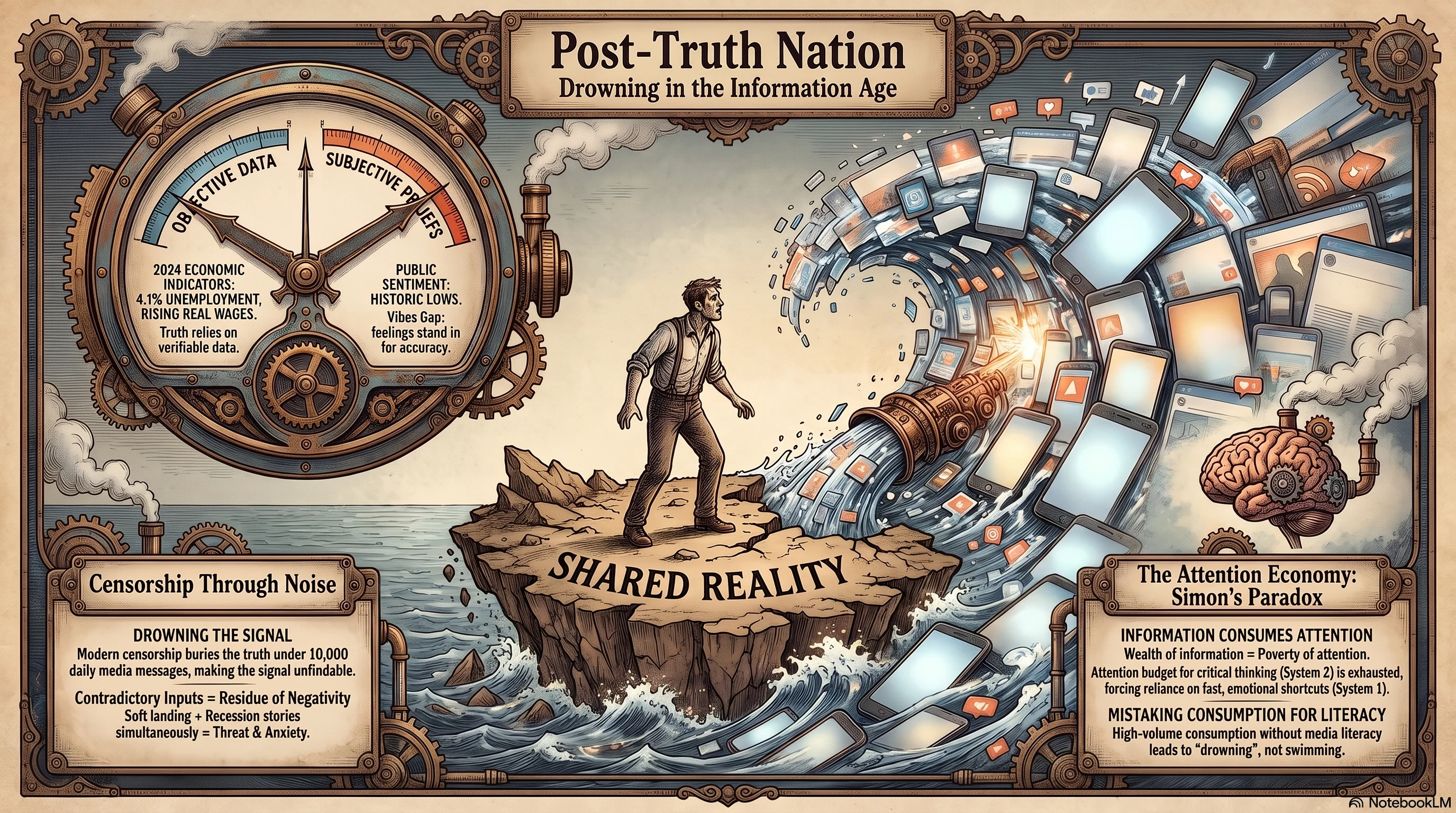
Through the back half of 2024, every major American polling outfit kept reporting the same strange split. YouGov's weekly economy tracker, Gallup's Economic Confidence Index, and Pew Research's pre-election surveys all showed a clear majority of Americans describing the economy as "poor" or "only fair." Roughly two-thirds said the country was on the wrong track. A plurality said inflation was still getting worse.
The objective indicators told a different story. By October 2024, the unemployment rate sat near 4.1 percent, historically low by any postwar standard. Real wages for the bottom half of earners had risen faster than for the top half for three years running, the first sustained reversal of the four-decade wage-stagnation pattern. Headline inflation, which had peaked at 9.1 percent in June 2022, was down to 2.4 percent, within the Federal Reserve's target band. The S&P 500 was up roughly 23 percent year over year. Gas prices were lower in real terms than they had been on Election Day 2020.
Two facts, sitting on top of each other and refusing to merge. The economy, by the measurements economists had used for a century, was in the strongest shape it had been in since 2019. The voters, asked how the economy felt, said it was bad. Many said it was the worst they could remember. A nontrivial number said it was the worst in their lifetime.
Reporters covering the gap settled on a word for it: "vibes." The vibes were bad. The Wall Street Journal ran a piece in August 2024 headlined "The Vibes-Based Economy." The Atlantic ran one in October called "The Great Vibe Shift." The word was a confession. It admitted that the explanation for what voters believed about the economy did not live inside the economy. It lived somewhere else.
The somewhere-else is the subject of this course.
If you take only one analytical move out of this opening unit, take this one. The 2024 vibes gap is not a story about voters being uninformed. The American voter in 2024 was, by every measure of information access, the most informed voter in human history. The median American consumed somewhere between 5,000 and 10,000 distinct media messages per day, by the estimates Spitale cites in his Overview. The problem was not a shortage of information. The problem was the shape and tilt of the information.
This is the structural condition Spitale names in his Introduction as censorship through noise: a strategy of drowning out reality not by suppressing the signal but by surrounding it with so much contradictory signal that no one can sort it. You cannot block out the truth at scale in a country with a First Amendment. You can, however, bury it. The economy, in 2024, was buried.
Consider what a voter saw between June and November 2024 on a mixed diet of cable, social, search, and short-form video. A recession warning on Tuesday and a soft-landing story on Wednesday. A "grocery prices have doubled" reel on TikTok and a "wages have outpaced prices" chart on Twitter, both engineered to feel like the definitive answer. Clips of empty shelves from 2020 recirculated as 2024. A CEO on cable saying the economy was great; a small-business owner on Instagram saying it was collapsing. Real footage, fake footage, and AI-generated footage, all sorted by an algorithm that rewards engagement. The highest engagement attaches to the negative version of any story.
The aggregate effect is not a balanced view. It is affective signal collapse: the inability to maintain a stable emotional read on a question because the inputs cancel out, leaving only the residue of negativity. Humans are negativity-biased by design, a 200,000-year-old inheritance from a world where missing one predator was fatal and missing one piece of good news was not. When the signals cancel, what is left is the threat.
That residue, in the case of the 2024 economy, was the vibes.
The voters were not wrong about what they felt. They were reporting accurately on the texture of their information environment. That environment was telling them, hour by hour, that the economy was a disaster even when the underlying numbers said otherwise. The disaster was real. It was just not in the economy. It was in the channel.
This unit's job is to teach you to see the channel.
Think About
When you formed your own opinion about the economy in 2024, what specific moments stand out: a video, a conversation, a headline, a price you saw on a shelf? Now ask yourself: if those moments had arrived in a different order, or surrounded by different other moments, would you have walked away with the same impression?
Spitale's Framework: Marketplace of Ideas to Marketplace of Mistruths
Samuel C. Spitale opens How to Win the War on Truth with a hard accounting of the gap between what Americans think we are doing when we consume media and what is actually happening to us. The Educator's Guide overview frames the scale of it bluntly: "The average American encounters up to 10,000 media messages a day. It's no wonder we struggle to separate news from all the noise — and there's a hell of a lot of noise!" That is the entry point. The country is awash.
But Spitale's Introduction makes a sharper move than just naming the volume. It identifies the specific category error most of us are making when we evaluate our own grasp of reality. In the opening paragraph of his Introduction, he writes: "Americans often mistake media consumption for media literacy. We think we understand media because we consume so much of it, but our media diet is awash in fake news, false claims, and outright fabrications."
Read that distinction twice, because the entire course depends on holding it steady.
Media consumption is the behavior. Watching cable news, scrolling TikTok, listening to a podcast on the commute, reading a magazine article, glancing at a push notification. These are acts of consumption. They take time. They feel like engagement with the world.
Media literacy is the capacity. It is, in Spitale's gloss, "the ability to identify and differentiate types of media messages, such as an infomercial versus a commercial versus a newscast." It is the trained skill of recognizing what category of artifact you are looking at, what its purposes are, who paid for it, and what it is asking of you.
The two are independent variables. You can spend ten hours a day consuming media and still have the media literacy of a child. In fact, and this is the move Spitale is making, the more time you spend in high-volume consumption without literacy, the more reliably the literacy degrades. The flood does not teach swimming. It teaches drowning.
The Marketplace of Ideas
The reason the American information environment is structured the way it is, the reason the flood exists at all, traces back to a foundational idea Spitale names directly in his Introduction. He calls it the marketplace of ideas, defining it in his key-terms list as "the belief that truth will inevitably prevail when competing with falsehoods, lies, and misinformation."
The marketplace-of-ideas inheritance runs deep in American law and political culture. John Stuart Mill argued a version of it in On Liberty in 1859. Oliver Wendell Holmes Jr. encoded a version of it into First Amendment jurisprudence in his 1919 dissent in Abrams v. United States: "the best test of truth is the power of the thought to get itself accepted in the competition of the market." The idea is that if you let all the speakers speak, the true claims will outcompete the false ones over time, and the citizenry will sort itself toward reality.
Spitale's Introduction does something disciplined with this inheritance. He does not throw it away. He observes that the marketplace metaphor has a structural assumption baked into it: the assumption that the market is unregulated and roughly fair. He then notes that America's marketplace of ideas is, in fact, unregulated, and that the result is not the equilibrium Mill imagined. The result, in Spitale's words, is a market "where corporate interests sell consumers their worldview just like any other product."
This is a different framing than the one most students arrive with. We tend to think of propaganda as something the state does: Soviet posters, Nazi rallies, North Korean broadcasts. Spitale's Introduction redirects the analytical lens. In a country with strong free-speech protections and weak regulation of corporate communication, the dominant producers of large-scale persuasion are not the government. They are the corporate, ideological, and political actors with budgets large enough to flood the market. The marketplace of ideas has been subsidized. The author Michael Goodwin, whom Spitale quotes, puts it concisely: "in the 'marketplace of ideas,' some ideas have been heavily subsidized."
Subsidized by whom? With what money? For what purpose? Those questions are the analytical engine of every unit that follows.
Truth and Post-Truth
The Introduction draws another pair of distinctions you will need to carry through the rest of the course. Spitale's key terms put it plainly: truth is "facts, data." Post-truth is "feelings, beliefs."
He quotes the journalist Charles P. Pierce, whose 2009 book Idiot America offered one of the earliest sharp definitions of the post-truth condition: "Fact is merely what enough people believe, and truth lies only in how fervently they believe it." Pierce was writing in the late-Bush, early-Obama window, before the 2016 election made "post-truth" the Oxford Dictionaries Word of the Year, and his formulation is still the cleanest one available. Post-truth does not mean "lies." It means a cultural condition in which the question "is this true?" has been replaced by the question "how strongly is this felt?" The intensity of conviction stands in for the accuracy of the claim.
You can see the substitution in real time in any contemporary political argument. "I feel that Trump could not have lost without massive voter fraud" is a post-truth statement. It does not predicate itself on evidence, and it does not invite evidence to refute it. It predicates itself on feeling and demands that the feeling be treated as fact-equivalent. Spitale's application exercise in the Introduction asks students to practice differentiating facts and feelings in this exact frame: "Trump lost the 2020 election" versus "I feel that Trump could not have lost without massive voter fraud," because the cultural muscle for the distinction has atrophied.
The pedagogical move here is not to mock the feeling. The feeling is real, and inside the information environment that produced it, it is even rational in a narrow sense. The move is to name the category error: the feeling is being treated as a substitute for the fact, rather than as a separate object that can also be examined.
Cross-Curricular Connection: Journalism's history-of-truth unit traces how the press has handled the conditions of truth and post-truth across the long arc, the historical context inside which Spitale's contemporary diagnosis sits. See The History of Truth in Journalism.
Censorship Through Noise
The marketplace of ideas in its captured form, the substitution of post-truth for truth, the 2024 vibes gap: all of it connects through a structural strategy Spitale names in his Introduction's key-terms list, censorship through noise.
His definition is exact: "the idea that there's so much misinformation that we can't tell what's true and what's propaganda."
This is the analytical center of the whole course. The mechanism is not new. Variants of it appear in every authoritarian playbook, from the Soviet "whataboutism" tactic to the contemporary Russian "firehose of falsehood" doctrine. Spitale's contribution is to name it as the dominant contemporary American mechanism. Not censorship by deletion. Censorship by saturation.
The traditional model of censorship is subtraction. A regime identifies a true claim and removes it from the information environment: the newspaper is shut down, the book is burned, the dissenter is silenced. This works in environments with low information volume and centralized distribution. It does not work in an environment with 10,000 daily messages and decentralized distribution. There is no central node to attack.
Censorship through noise inverts the strategy. Instead of removing the true claim, you flood the environment with contradictory claims of every quality, true, false, half-true, satirical, AI-generated, recycled from a decade ago, until the true claim becomes indistinguishable from the noise. The signal is still in the channel. It is just unfindable. From the receiver's standpoint, this is functionally identical to deletion. The truth is gone.
The Russian disinformation researcher Peter Pomerantsev, whose work informs much of the scholarly literature Spitale is drawing on, has called this "the censorship of doubt." The American information environment of the 2020s does not need to ban any claim. It only needs to ensure that for every true claim, there are fifty contradicting it, distributed faster, with more emotional weight, by accounts with no editorial responsibility.
Once you have that frame, the 2024 vibes gap stops being a mystery and becomes a textbook case. The economic data did not get suppressed. The Bureau of Labor Statistics releases were still public. The Federal Reserve's reports were still online. The information was there. It just could not be heard above the noise, and that noise, on closer inspection, was not random. It was tilted, consistently, toward outcomes that served specific economic and political interests.
The Five Trademarks of Successful Propaganda
Spitale's Introduction closes with the analytical spine of the entire book: the five trademarks of successful propaganda. They are listed verbatim in his Introduction, and they are the structural map of Chapters 2 through 6. The Educator's Guide states them as follows:
Successful propaganda has five trademarks: (1) It ignores the full picture in favor of simple black-and-white narratives (Chapter 2) (2) that appeal to our unconscious cognitive biases (Chapter 3) (3) to evoke negative emotions, like fear and outrage (Chapter 4) (4) that divide us into market segments of in-groups and out-groups (Chapter 5) (5) for the economic benefit of the power class (Chapter 6)
Read those five together as a sentence and you have the spine. Propaganda simplifies reality, exploits cognition, weaponizes emotion, segments the population, and enriches the architects. Each move requires the previous ones. You cannot exploit a cognitive bias on a population that has not first been handed a simple narrative to attach to. You cannot evoke an emotion at scale without a bias already in the channel. You cannot sort people into tribes without an emotional charge running through the categories. And you cannot harvest the economic benefit without the tribes. They are the market segments.
This course will spend one unit on each trademark, in the order Spitale presents them. Unit 2 covers black-and-white narratives. Unit 3 covers the cognitive biases. Unit 4 covers fear and outrage. Unit 5 covers in-group/out-group sorting. Unit 6 covers the power-class economic engine. Together, those five units are the anatomy of how a piece of propaganda is built. The remaining units handle the rhetorical inventory (Unit 7), the integrated case study (Unit 9), and the reclaim-reality posture Spitale closes his book with (Unit 10).
This is the map. Hold it. Every subsequent unit will reference back to it.
❓Concept Check
What is the difference between media consumption and media literacy, in Spitale's framing? Why does he insist on the distinction in the opening of his Introduction?
▸
Concept Check
What is the difference between media consumption and media literacy, in Spitale's framing? Why does he insist on the distinction in the opening of his Introduction?
Media consumption is the behavior of taking in media: watching, scrolling, reading. Media literacy is the trained capacity to recognize what kind of media artifact you are looking at, who produced it, what its purpose is, and what it is asking of you. Spitale insists on the distinction because Americans systematically confuse the two: we mistake the act of high-volume consumption for the skill of understanding, and the more time we spend consuming without literacy, the more reliably the literacy degrades. The flood does not teach swimming.
Intake-Layer Overlay: Herbert Simon and the Attention Economy
Spitale's Introduction names the volume of the contemporary information environment but does not, in the Introduction itself, give you the analytical apparatus for understanding why volume is the structural weapon. For that, the course imports a frame from outside Spitale's primary lineage. It belongs to the economist and cognitive scientist Herbert Simon.
In 1971, more than a half-century before any of this was current, Simon was invited to contribute to a volume titled Computers, Communications, and the Public Interest, edited by Martin Greenberger. In his contribution, Simon wrote one of the most-quoted sentences of the postwar social sciences:
"What information consumes is rather obvious: it consumes the attention of its recipients. Hence a wealth of information creates a poverty of attention, and a need to allocate that attention efficiently among the overabundance of information sources that might consume it."
Simon was writing at the moment computers were beginning to enter institutional life. He was already thinking about what happens to a society when information itself ceases to be the bottleneck.
Read the sentence carefully. Simon is not making a moral observation. He is making an economic one. Attention is a scarce resource. It is finite, it is bounded by the architecture of human cognition, and like any scarce resource it can be allocated, hoarded, traded, and extracted. The reason a wealth of information produces a poverty of attention is that the information is consuming the resource. Every message that crosses your field of awareness charges itself against a fixed budget.
In 19711971, when Simon wrote this, the average American adult was exposed to a small fraction of the daily media volume of the average American adult today. The thesis was, at the time, theoretical, a forecast of what would happen as the production cost of information continued to fall. It is now empirical. The forecast arrived.
The Meta-Filter
This course will treat Simon's insight as a meta-filter, the analytical move you run on every other analytical move. Before any propaganda technique in any unit can do its work on you, your attention has to be available to be captured. The first move in the propaganda game is not deception. It is exhaustion.
Hold the image. Imagine a person at the end of a long workday, scrolling a social feed with their thumb. They have absorbed thousands of micro-decisions, hundreds of interactions, a dozen meetings. Their executive function is depleted. Their working memory is taxed. Their negativity-bias detector is still on, it always is, but the part of their cognition that would normally weigh, sort, and skeptically evaluate is offline. Into this depleted state, the algorithm delivers an artifact engineered to evoke an emotion.
The artifact will work. Not because the person is stupid, they are not, but because the resource the skepticism would have used has already been spent. The attention is gone before the manipulation arrives.
This is the structural reason censorship through noise works. It is not that the audience is incapable of telling truth from falsehood. The audience is capable of it. The audience does not have the attention budget to do it ten thousand times a day. Sorting is cognitively expensive. The noise floor is engineered to be high enough that the cost of sorting exceeds the perceived benefit, and the rational response, the response any optimizing agent would make, is to stop sorting.
When you stop sorting, the negativity bias takes over the wheel. The negativity bias is cheap. It runs on no batteries. It just routes your attention toward the threat. So the vibes turn dark.
Cross-Curricular Connection: Systems Thinking has a full unit on the attention-economy lineage Simon began. There, attention scarcity is treated as the master variable of the contemporary information system; here, the same diagnosis becomes a war-zone field manual. See Attention Scarcity in Systems Thinking.
The Four Intake-Layer Scholars
Simon is the first of four scholars this course uses as the intake-layer overlay. Together they form the upstream filter stack, the lenses that apply before any specific propaganda technique starts working. The other three:
-
Daniel Kahneman, whose 2011 Thinking, Fast and Slow laid out the System 1 / System 2 architecture of cognition. System 1 is fast, automatic, intuitive; System 2 is slow, deliberate, effortful. Propaganda works on System 1 because System 1 is cheap and always on. Whenever the course names a cognitive bias being exploited, Kahneman's framework is the apparatus underneath.
-
Shoshana Zuboff, whose 2019 The Age of Surveillance Capitalism named the order in which behavioral data is the primary extracted resource. The user is not the customer; the user's predictable behavior is the product, and advertisers and political operators are the customers. Whenever the course asks "who profits from your engagement," Zuboff is the lens.
-
Jürgen Habermas, whose 1962 Structural Transformation of the Public Sphere established the distinction between communicative action (speech oriented toward mutual understanding) and strategic action (speech oriented toward producing a specific outcome in the listener). Whenever the course asks whether a piece of media is inviting you to understand or demanding you comply, Habermas is the lens.
The Source-Code Audit you are about to learn is built from three of them: Simon and Kahneman for the first question, Zuboff for the second, Habermas for the third. Spitale's specific techniques are the content run through the filter.
Cross-Curricular Connection: The four intake-layer scholars do similar epistemic work to what Critical Thinking's foundational unit calls the prior question: before you can evaluate a claim, you have to evaluate the conditions under which the claim is reaching you. See the Foundations unit in Critical Thinking for the parallel treatment. There, the analytical apparatus is built from the philosophy of knowledge; here, it is built from cognitive science and political economy. Same architecture, different scaffolding.
Scholar Roundtable
Every unit of this course brings two or three additional voices into conversation with Spitale. These are not decorative citations. They are scholars whose specific contributions extend, sharpen, or complicate the analytical move the unit is teaching. In Unit 1, the roundtable's job is to introduce the broader cast, the analytical neighbors whose work will recur across the rest of the course.
Lee McIntyre and the Philosophy of Post-Truth
Lee McIntyre is a research fellow at Boston University's Center for Philosophy and History of Science. His 2018 book Post-Truth, part of the MIT Press Essential Knowledge series, and his 2023 follow-up On Disinformation form one of the cleanest available philosophical treatments of the condition Spitale's Introduction names.
McIntyre's central claim is sharper than Spitale's, and the two are complementary rather than redundant. Spitale describes the condition of post-truth and names its mechanisms. McIntyre identifies the strategy that produces it and names the specific playbook. He calls it strategic denialism, and he traces a single recognizable pattern across multiple decades of American public-controversy manufacturing.
The pattern, in McIntyre's reconstruction, was first perfected by the tobacco industry in the 1950s. Confronted with mounting epidemiological evidence that smoking caused lung cancer, the major tobacco firms made a strategic choice in the mid-1950s not to dispute the science directly, a losing battle, but to manufacture doubt about whether the science was settled. The internal Brown & Williamson memo from 1969 stated the strategy verbatim: "Doubt is our product, since it is the best means of competing with the 'body of fact' that exists in the mind of the general public. It is also the means of establishing a controversy."
The playbook then ports. McIntyre's argument is that the tobacco template was studied, refined, and reused: first by petrochemical interests confronted with acid-rain science in the 1970s, then by the same firms (and frequently the same individual scientists for hire) confronted with climate science from the 1980s forward, then by vaccine-skeptic movements, then by election-denial movements after 2020. The denialist's job is not to prove the counter-claim. The denialist's job is to keep the public conversation in a permanent state of "controversy" so that no political action can be taken.
McIntyre will return as a primary voice in Unit 2, Spitale's chapter on simple black-and-white narratives, because strategic denialism's core move is the manufacture of a false binary where there is, in fact, a scientific consensus and a small dissenting fringe. The denialist is paid to make those look like equivalent sides of a debate. The trademark Spitale names in Chapter 2 is the mechanism McIntyre's playbook depends on.
Kavanagh, Rich, and the RAND "Truth Decay" Diagnosis
If McIntyre supplies the philosophical lens, Jennifer Kavanagh and Michael D. Rich supply the empirical one. In 20182018, the RAND Corporation published Truth Decay: An Initial Exploration of the Diminishing Role of Facts and Analysis in American Public Life, authored by Kavanagh and Rich. RAND is a federally chartered research organization whose work usually circulates inside the national security and policy establishments. The Truth Decay report broke out of that circuit because what it documented was a public-life crisis.
Kavanagh and Rich defined the phenomenon by four observable trends, and these four are worth committing to memory because they recur across every subsequent unit:
-
Increasing disagreement about facts and analytical interpretations of facts and data. Americans now disagree not just about what to do about a problem, but about whether the problem exists, what its magnitude is, and what counts as evidence.
-
A blurring of the line between opinion and fact. Cable news, talk radio, and social media have systematically eroded visible structural cues such as labeling, framing, and segmentation, the cues that once helped audiences tell the difference between a reporter, a commentator, and a partisan.
-
An increase in the relative volume, and resulting influence, of opinion and personal experience over fact. Op-eds, personal anecdotes, and influencer testimony now occupy more channel bandwidth than verified reporting. This is not a content-neutral shift; opinion is cheaper to produce and more engaging to consume.
-
Declining trust in formerly respected sources of factual information. Trust in mainstream news, government statistics, scientific institutions, and academic expertise has eroded across the political spectrum, though at different rates and for different reasons.
The RAND framing is useful because it does not editorialize. It just measures. When Spitale talks about post-truth as a cultural condition, Kavanagh and Rich give you the four empirical dials you can use to test whether the condition is intensifying or relaxing in any specific moment. All four dials, in 2024-25, were turned higher than at any point in the postwar series.
The RAND report will return in Unit 7, the rhetorical inventory unit, because the second and third trends (blurring opinion and fact; volume of opinion over fact) are the conditions under which specific rhetorical devices like the straw man, whataboutism, and the false equivalence become structurally rewarded.
The Roundtable Going Forward
Across the ten units, you will meet additional voices: Edward Bernays (Unit 2), Kahneman in his own right (Unit 3), the Brown & Williamson "Doubt is Our Product" team (Unit 4), Lee Atwater and the Southern Strategy architects (Unit 5), Lewis Powell and his 1971 Memo (Unit 6), the propaganda-analysis tradition from the Institute for Propaganda Analysis (Unit 7), and the Frontline investigative-journalism corpus (recurring). Spitale is the spine; each unit brings in the scholar whose work makes Spitale's specific move visible at the level of mechanism.
Historical Fractal
The information environment you were born into was not the default state of American life. It was built deliberately, in a single generation, by identifiable actors making identifiable decisions. The structural condition Spitale's Introduction names, and the 2024 vibes gap that condition produced, has a near-history. The near-history is the rise of the partisan broadcast environment between 1987 and the early 2000s.
The course's organizing principle is the present-back-to-past move: start with the contemporary case, then walk backward to the seed. The 2024 vibes gap is the present. Spitale's Introduction is the framework. The seed is in the late 1980s, specifically in a regulatory decision taken in 19871987 that almost no one alive at the time understood as a watershed.
The Fairness Doctrine
From 1949 to 1987, the United States operated under a Federal Communications Commission policy known as the Fairness Doctrine. The doctrine required broadcast license holders, the radio and television stations using the public's electromagnetic spectrum, to do two things when covering controversial matters of public importance: present the matter, and present opposing viewpoints fairly. The rationale was simple. The broadcast spectrum was a public good. Licenses were scarce. The public interest required that the small number of voices granted access to that spectrum could not use it to flood the channel with one-sided programming.
The doctrine was imperfect. It was selectively enforced, it generated litigation, and the broadcast industry resented it. But for nearly four decades it produced a recognizable American information environment. Network news divisions operated under a public-interest mandate. Local stations carried balanced opinion segments. The cost of being a partisan broadcaster, in regulatory terms, was high enough that the dominant model was the consensus-seeking generalist.
In 1987, the FCC under Chairman Mark Fowler, appointed by Ronald Reagan, repealed the doctrine. The stated rationale was First Amendment expansion: broadcasters, the argument ran, should not be subject to content rules the print press did not face. Congress passed a bill to restore the doctrine by statute. Reagan vetoed it. A subsequent attempt was prepared in 1991; the first President Bush threatened to veto, and the bill was not advanced.
The repeal sounded technical. In practice, it removed the regulatory cost of running an explicitly partisan broadcast operation in the United States. The market would now decide what kind of broadcasting was viable. Within eighteen months, the market answered.
The Cascade
The Construction of the Partisan Information Environment
FCC repeals the Fairness Doctrine
regulatoryThe forty-year regulatory requirement that broadcasters present balanced views on controversial matters is removed. The cost of explicitly partisan broadcasting falls to near zero.
Rush Limbaugh enters national syndication
mediaEFM Media Management syndicates The Rush Limbaugh Show nationally. By 1990 it is carried on more than 600 stations. Limbaugh's format, a single ideologically committed host running three hours a day with no opposing voices, would have been a Fairness Doctrine violation a year earlier.
Fox News Channel launches
mediaRupert Murdoch and Roger Ailes, the latter a former Republican campaign consultant, launch Fox News as a cable competitor to CNN. The explicit business model is to serve the audience underserved by the consensus-network model: viewers who experience mainstream coverage as ideologically opposed to them.
Telecommunications Act passes
regulatoryThe Telecommunications Act of 1996, the first major rewrite of communications law since 1934, eliminates national radio ownership caps and loosens television ownership rules. iHeartMedia (then Clear Channel) consolidates from 40 stations to more than 1,200 by 2001, standardizing right-leaning talk programming across the country.
Post-9/11 cable news consolidates
mediaAfter 9/11, cable news ratings explode. The 24-hour news cycle becomes the dominant national format. The structural pressure is toward continuous emotional engagement; there is no commercial reward for the slow, contextual segment.
Smartphone and social-media stack arrives
technologicalThe iPhone launches. Facebook opens to general public registration. Twitter scales. The information environment shifts again, this time toward algorithmic, personalized, friction-free distribution.
Post-truth becomes Word of the Year
culturalOxford Dictionaries names 'post-truth' the international Word of the Year, defining it as 'relating to or denoting circumstances in which objective facts are less influential in shaping public opinion than appeals to emotion and personal belief.'
The vibes gap arrives at full scale
culturalSurvey after survey shows a structural gap between subjective economic perception and objective economic indicators. Spitale's 'censorship through noise' is the operative explanation.
Read the timeline as a cascade. Each layer assumes and depends on the previous one. Limbaugh's national syndication depends on the regulatory removal of the Fairness Doctrine. Fox News depends on a national audience already trained by talk radio to expect single-perspective programming. The post-9/11 cable consolidation depends on Fox having already proven the audience exists. Social media depends on cable having already taught the country to expect personalized partisan reality. And the 2024 vibes gap depends on the entire stack: a population whose primary information channels have, for thirty years, been engineered for engagement rather than accuracy.
What the Fractal Shows
The point of the fractal is not to assign blame to any single moment. The point is to make visible that the information environment is constructed. You did not consent to live inside a 10,000-message-per-day cognitive landscape. No one did. The landscape was built, one regulatory decision and one technological deployment at a time, by actors who could not foresee, and in many cases did not care about, the cumulative effect.
The choices can be unmade. Spitale's closing chapters argue exactly this, and Unit 10 will work through what it would look like. But the unmaking begins with the seeing. You cannot dismantle what you cannot name.
Cross-Curricular Connection: Think for Yourself's Unit 5 on intellectual self-defense teaches the personal-level counterpart to what this unit teaches at the structural level. There, the move is to inoculate the individual mind against the techniques being run on it. Here, the move is to make the techniques themselves, and the historical conditions that built them, analytically visible. The two courses are designed to be taken together: Winning the War on Truth gives you the map of the territory; Think for Yourself gives you the field kit for walking through it.
The Source-Code Audit: A Protocol You Will Use in Every Unit
Spitale's Introduction names the condition. The intake-layer scholars name the upstream filters. The historical fractal names how we got here. Now you need a portable analytical tool, something you can run in your head, on any artifact, in real time, without needing a laptop or a citation.
The tool this course teaches is called the Source-Code Audit. The name is deliberate. Every piece of media has source code: the underlying instructions, mostly invisible to the consumer, that determine what the artifact does to the receiver. A consumer sees the rendered output. An auditor sees the source. The audit is the move you make, in three questions, to expose the source.
You will run this audit in every subsequent unit, on that unit's specific hook artifact. The unit's particular propaganda technique will show up differently inside each question. By Unit 10, you will run the audit automatically, the way a trained mechanic listens to a car engine and hears, immediately, what is wrong.
The audit has three questions. Each is the contribution of one of the intake-layer scholars.
Question One: The Simon/Kahneman Audit (The Hook)
What emotion is this artifact engineered to make my body feel? Which System 1 shortcut is being exploited?
The first question is about the hook. Every successful piece of propaganda has to capture the receiver's attention before it can do anything else. Simon tells you why this is the hard part: attention is the scarce resource, and the artifact has to win a competition against ten thousand other artifacts to get any of yours. Kahneman tells you how the winning artifacts win: they bypass System 2 (the slow, deliberate, expensive reasoning system) by speaking directly to System 1 (the fast, automatic, cheap pattern-matching system).
System 1 is moved by emotion. Fear, outrage, disgust, contempt, and tribal belonging are its fast lanes. An artifact that makes you feel one of those, within three seconds of contact, has won the attention auction. You will engage with it, you will share it, and, critically, you will form an opinion about its content before System 2 has had a chance to weigh in.
To run the question, slow the artifact down. Pause the video. Stop the scroll. Sit with what you just felt. Then ask: what specific emotion just arrived in my body? Was it fear? Outrage? A flash of moral superiority? A sense of belonging to the right team? An urge to defend? Whatever it is, name it precisely.
Then ask the harder follow-up: was that emotion the response to information, or was that emotion the delivery mechanism for the information? The distinction matters. A news report that informs you of a verifiable threat may legitimately produce fear; the fear is a rational response to a fact. A piece of propaganda manufactures the fear first and then tucks the claim inside the emotional payload, where it cannot be examined.
The Kahneman half of the question, which System 1 shortcut is being exploited, invites you to name the cognitive bias the artifact is riding. Is it confirmation bias (the artifact is telling you what you already believe, in a flattering way)? Negativity bias (the artifact is delivering a threat signal that overrides the parts of your cognition that would normally fact-check)? Availability heuristic (the artifact is supplying a vivid example that will dominate your future thinking on the topic, regardless of whether the example is representative)? Each of Spitale's Chapter 3 cognitive biases will show up as a specific answer to this half of the question in subsequent units.
Question Two: The Zuboff Audit (The Extraction)
Who profits from my engagement with this version of reality? What behavioral data is being collected?
The second question is about the economic engine. Shoshana Zuboff's contribution to the analytical apparatus is the relentless insistence that you ask, of any media artifact in the contemporary environment, who is making money off this exchange and how.
The naïve answer is "the platform, through ads." That is incomplete and misleading. The deeper answer is that the platform is harvesting your behavioral data: what you clicked, how long you lingered, what you scrolled past, what you shared, what you commented, who you replied to, what you searched immediately after. It sells predictive access to that data to advertisers, political operators, and ideological organizations who want to influence the behavior of people like you. The artifact you are looking at is not the product. You are not the product. Your predictable future behavior is the product.
Once you have that frame, the second question becomes concrete. Run it on the artifact: what behavioral data am I generating right now, and who is the customer for that data?
For the 2024 vibes-gap case, the answer is layered. Economic-anxiety content circulating on TikTok, YouTube Shorts, Instagram Reels, and Facebook in fall 2024 generated enormous behavioral data: watch time, share rates, comment volume, predictive signals about which messaging produced the strongest negative affect. That data was monetized in two directions: sold to commercial advertisers targeting an anxious audience, and accessed by political-operations firms running paid persuasion campaigns whose goal was to maximize the perceived economic crisis among targetable swing voters.
The platforms did not need to take a political side to produce this outcome. They just needed to monetize engagement; engagement maximized with negative economic affect; political operators were happy to pay for the resulting infrastructure. The structural extraction did the political work without any platform having to make a decision about it.
Zuboff's question forces you to see this. It is not enough to ask whether an artifact is propaganda. You have to ask whose economic engine the artifact is feeding. Sometimes that engine is direct (a paid political ad). Sometimes it is indirect (organic content whose engagement metrics generate behavioral data that gets sold downstream). Sometimes it is both. The Zuboff audit forces you to follow the money, not metaphorically but actually, through the data pipes.
Question Three: The Habermas Audit (The Strategy)
Is this artifact inviting me to understand the world, or demanding I comply with a predetermined position?
The third question is the most philosophical and, with practice, the most decisive. Jürgen Habermas, in his theory of communicative action, draws a distinction between two fundamentally different orientations of speech.
Communicative action is speech oriented toward mutual understanding. The speaker offers claims; the listener is invited to test them, agree, disagree, ask for evidence, modify, or refuse. The exchange treats the listener as a rational agent whose evaluation matters. Honest journalism, real scholarship, a sincere conversation, a teacher's explanation: these are communicative.
Strategic action is speech oriented toward producing a specific outcome in the listener regardless of whether the listener has rationally evaluated the claim. The speaker is not seeking the listener's agreement on the merits. The speaker is seeking the listener's behavioral compliance: a vote, a purchase, a share, a hatred, a fear, a loyalty. The exchange treats the listener as an object to be moved.
You can usually feel the difference if you are paying attention. A communicative artifact lets you stop, weigh, push back, and walk away. A strategic artifact wants you to take the action now, before you have time to weigh. The strategic artifact uses urgency, certainty, repetition, and emotional charge to short-circuit deliberation. It will often present itself as informational, "we're just telling you what's happening," but the structure is unmistakable: every element of the artifact is oriented toward producing one specific response in you.
Run the Habermas question on any piece of media: am I being treated as a thinking person whose evaluation the author respects, or am I being treated as a target whose behavioral compliance the author is engineering?
For the 2024 vibes-gap content, the answer is overwhelmingly the latter. The viral economic-anxiety clips on social platforms were not, with rare exceptions, communicative. They were not inviting you to understand the economy. They were demanding that you experience it a certain way and act on that experience. The structural giveaway is that no opposing data was presented as something to be weighed; opposing data, where it appeared at all, was presented as something to be dismissed.
Running the Audit on the 2024 Vibes Gap
Put the three questions together and run them, in sequence, on the hook artifact for this unit: a representative viral piece of fall-2024 economic-anxiety content. Picture the short-form video reel that shows a person at a grocery store, holding a receipt, looking into the camera and saying some version of "I cannot afford to live anymore."
Simon/Kahneman audit: The artifact is engineered to evoke fear and shame, fear that the economy is collapsing, shame at one's own inability to keep up. The System 1 shortcut being exploited is the availability heuristic: this one vivid grocery-receipt moment will dominate the viewer's mental representation of "the economy" for hours, displacing the aggregate statistics that would otherwise frame it. A further shortcut is the affect heuristic: how the viewer feels about the receipt becomes the viewer's judgment about the economy.
Zuboff audit: The platform monetizes the engagement directly through ad inventory. It monetizes indirectly by selling the behavioral signature, which demographics responded most strongly to the artifact, to advertisers and political operators. The political operators specifically purchased predictive access to "economically anxious voters in swing districts" throughout 2024. The viewer's emotional response to the receipt artifact was therefore monetized at least twice: once at the platform layer and once at the political-targeting layer.
Habermas audit: The artifact is not communicative. It does not present grocery price changes in context, link to BLS data, or invite the viewer to consider the broader picture. It is strategic. It is engineered to produce one specific response: a generalized affective conclusion that the economy is in crisis. The receipt in the artifact is real, but its function in the artifact is not informational; its function is to serve as the emotional payload for a predetermined position.
Now hold the three answers together. The artifact passed all three audit tests not as "informative content" but as "strategic propaganda inside the censorship-through-noise environment." It does not have to be false to perform the propaganda function. The receipt is real, the person's distress is real, the math at that one register on that one day is real. The artifact's propaganda function operates above the level of any individual factual claim. It operates at the level of which artifacts the channel selects for amplification, and why.
That is the analytical move. The audit does not require you to fact-check every claim. It requires you to recognize the category of artifact and the engine producing it.
❓Concept Check
Run the Source-Code Audit on a media artifact you encountered in the last 24 hours. Name the artifact. State the emotion it was engineered to produce in you. Name the System 1 shortcut it exploited. Identify who profits from your engagement. Decide whether it was inviting understanding or demanding compliance.
▸
Concept Check
Run the Source-Code Audit on a media artifact you encountered in the last 24 hours. Name the artifact. State the emotion it was engineered to produce in you. Name the System 1 shortcut it exploited. Identify who profits from your engagement. Decide whether it was inviting understanding or demanding compliance.
A complete answer names a specific artifact (not 'social media generally'), names a specific emotion (not 'I felt bad'), names a specific cognitive shortcut from Kahneman's catalog, identifies a specific economic beneficiary at the platform and at the secondary-customer layer, and reaches a defensible conclusion on the communicative-vs-strategic question. The audit is not a test of moral judgment about the artifact; it is a diagnostic. An artifact can pass the Habermas test even if you agree with its content, and fail it even if the content is factually accurate.
Cross-Curricular Connection: The Source-Code Audit is the structural-level counterpart to the analytical apparatus Critical Thinking on narrative fallacy and the Overton window builds for the analysis of narrative construction. Where Critical Thinking asks "how is this story being shaped, and by whom," this course asks "how is this entire information channel being structured, and to what end." Both moves are required. The story-level analysis tells you what an individual artifact is doing. The channel-level audit tells you why this category of artifact is even reaching you in the first place.
Closing: Reclaim Reality
This unit has been the longest piece of scaffolding the course will require. Subsequent units run shorter because the analytical apparatus is now in place: the framework (Spitale's Introduction), the meta-filter (Simon), the supporting roundtable (McIntyre, Kavanagh and Rich), the near-history (the partisan-broadcast cascade from 1987 forward), and the portable diagnostic tool (the Source-Code Audit).
The work, across the next nine units, walks through Spitale's five trademarks of successful propaganda, one trademark per unit, in the order he gives them, then integrates the apparatus in a case study and teaches the reclaim-reality posture his book closes with.
The road from here:
Unit 2: Propagating the Faith (Spitale Chapter 1): the construction of the modern public-relations industry from Edward Bernays forward, and why the industry had to rebrand from "propaganda" to "public relations" after WWII made the original term unusable.
Unit 3: Black-and-White Narratives (Chapter 2, first trademark): the propaganda move of collapsing complex reality into a binary. McIntyre's strategic denialism is the playbook; the fractal is cigarette-cancer denial.
Unit 4: Cognitive Biases (Chapter 3, second trademark): Kahneman becomes the foregrounded intake-layer scholar. You build a working catalog: confirmation, negativity, availability, anchoring.
Unit 5: Fear and Outrage (Chapter 4, third trademark): the historical fractal is the Brown & Williamson "Doubt is Our Product" lineage from cigarettes through climate to vaccines.
Unit 6: In-Groups and Out-Groups (Chapter 5, fourth trademark): tribal sorting. Lee Atwater's confession on the Southern Strategy is the primary source.
Unit 7: The Power Class (Chapter 6, fifth trademark): Lewis Powell's 1971 Memorandum as the founding document of the corporate-political alignment that funds large-scale propaganda. Zuboff foregrounded.
Unit 8: The Rhetorical Inventory (Chapter 7): naming specific devices on sight: whataboutism, straw man, ad hominem, red herring, false equivalence, the Gish gallop. The audit becomes the operating system you run the field guide inside.
Unit 9: Integrated Case Study (Chapter 8): a single sustained campaign analyzed across all five trademarks, the full rhetorical inventory, and all three audit questions.
Unit 10: Reclaim Reality (Conclusion): the course's closing posture. Personal practices, institutional reforms, and cultural moves the analysis points toward.
A Word About Posture
Spitale's title is How to Win the War on Truth. The word "war" is exact. The condition is adversarial. There are actors, identifiable, named, with budgets and strategies, whose interests are served by your epistemic incapacity. To win the war, in Spitale's framing, is to develop the literacy to refuse the terms the adversary is offering.
This course will not teach you that everything is propaganda, and it will not teach you to be cynical. Cynicism is the failure mode of half-finished media literacy, the response of someone who has noticed manipulation but has not yet developed the tools to discriminate between manipulation and honest speech. It is the disposition propagandists most prefer their targets to land in. A cynical citizen does not vote, does not engage, does not act, and has lost the discriminating capacity that would let them resist the next round.
The opposite of cynicism is not credulity. It is trained literacy: the capacity to look at any artifact, run the audit with calibrated confidence, and reach a defensible judgment about it. That capacity is what this course is for.
You will encounter, across the next nine units, specific factual claims about specific historical and contemporary events. Spitale's chapter content is the primary source for those claims. Where I extend Spitale or bring in supporting scholarship, I will cite it. Where the question is genuinely contested, I will say so. The ethical floor is stable: this is analytical work in the service of an informed citizenry. It is not a partisan polemic. It is not academic gatekeeping. It is the literacy a self-governing people require to remain self-governing.
You are, by the time you finish this course, going to know how propaganda is built. You will recognize the techniques on sight. You will be harder to manipulate than the average voter, the average consumer, the average citizen. The skill is portable across every domain you will encounter: commercial, political, religious, professional. The skill, ultimately, is the precondition for any other freedom you might want to exercise.
Welcome to the war.
Think About
Before you start Unit 2, do one thing: pick a piece of media, an article, a video, a post, that arrived in your awareness today and that produced a strong emotional response in you. Run the three-question Source-Code Audit on it, slowly, in writing. Notice where the audit was easy and where it was hard. The places where it was hard are the places where you have the most to learn.