The Southern Strategy — Every Chapter, One Historical Arc
Spitale Chapter 8 takes the framework of the previous seven chapters and applies it to one historical case — the Southern Strategy. This unit follows his architecture while extending the case forward through 2024-26, with January 6 multi-conspiracy framing as the contemporary hook and Spitale's own backward arc (1948 Dixiecrats → 1968 Nixon → 1980 Reagan → present) as the historical fractal.
Learning Objectives
- 1Apply the entire Spitale framework (Chs 1-7) to one historical case across multiple decades
- 2Identify dog whistles, coded racial language, and the makers/takers myth as live propaganda tactics
- 3Distinguish the original Southern Strategy (Nixon, 1968) from its successive iterations (Reagan, Bush, Trump)
- 4Recognize rejectionist voting and positive polarization as named electoral strategies
- 5Apply the Source-Code Audit to January 6 multi-conspiracy framing and trace it to Spitale's full inventory
Hook: January 6, 2021, Three Conspiracies at Once
On the morning of January 6, 2021, a crowd assembled on the Ellipse south of the White House to hear the sitting president of the United States tell them the election had been stolen. By mid-afternoon, members of that crowd had broken through police barricades, smashed windows of the U.S. Capitol, hunted for the vice president and the Speaker of the House, and forced a joint session of Congress to evacuate the chamber where the Electoral College count was underway. Five people died in connection with the events of that day. Roughly 140 police officers were injured. Cameras inside and outside the building recorded all of it.
The interesting question for this unit is not what happened. The interesting question is what happened next, in the framing.
Within seventy-two hours of the breach, three mutually contradictory accounts had stabilized in conservative media. The first account held that the Capitol rioters were not Trump supporters at all but Antifa infiltrators in costume, a false-flag operation engineered to discredit the right. The second account held that the people inside the building were peaceful tourists on a self-guided tour, waved through open doors by Capitol Police, and that any violence was the work of a tiny fringe. The third account held that the entire event was a federal entrapment operation, with FBI agents and confidential informants embedded in the crowd to provoke a breach that the Justice Department could then prosecute.
These three accounts cannot all be true. If the rioters were Antifa, they were not peaceful tourists. If they were peaceful tourists, they were not federal informants. If they were federal informants who provoked violence, they were not Antifa pretending to be Trump supporters. Each story directly contradicts the other two on basic facts of identity and motive.
That is the point. The contradictions are not a bug. They are the feature.
Spitale names this move directly in Chapter 7: when you cannot defend a position with evidence, you flood the space with so many alternative possibilities that the listener loses the energy to sort them. He calls this part of the toolkit of whataboutism and red herrings: distraction techniques whose purpose is to exhaust the audience rather than to win the argument on its merits (Spitale, Ch 7). The three January 6 conspiracies are a textbook live demonstration. A viewer who spends an hour debunking the Antifa claim has spent an hour not thinking about the actual rioters. A viewer who works through why the tourist-tour framing collapses on basic video evidence has not yet started on the FBI-informant claim. The cumulative effect, across millions of viewers, is doubt and fatigue. No single conspiracy needs to be believed. The strategy succeeds when the population stops trying to know what happened.
This is what Steve Bannon, paraphrasing a Russian propaganda technique, called flooding the zone. PBS Frontline's Lies, Politics and Democracy (2022) documents how this technique stabilized as a deliberate practice in the months between November 2020 and January 2021, with the Plot to Overturn the Election (Frontline, with ProPublica, 2022) tracing the operational coordination between media figures, party officials, and outside organizers. The documentaries are worth watching as primary evidence: they show participants, on camera, describing the strategy in roughly these terms.
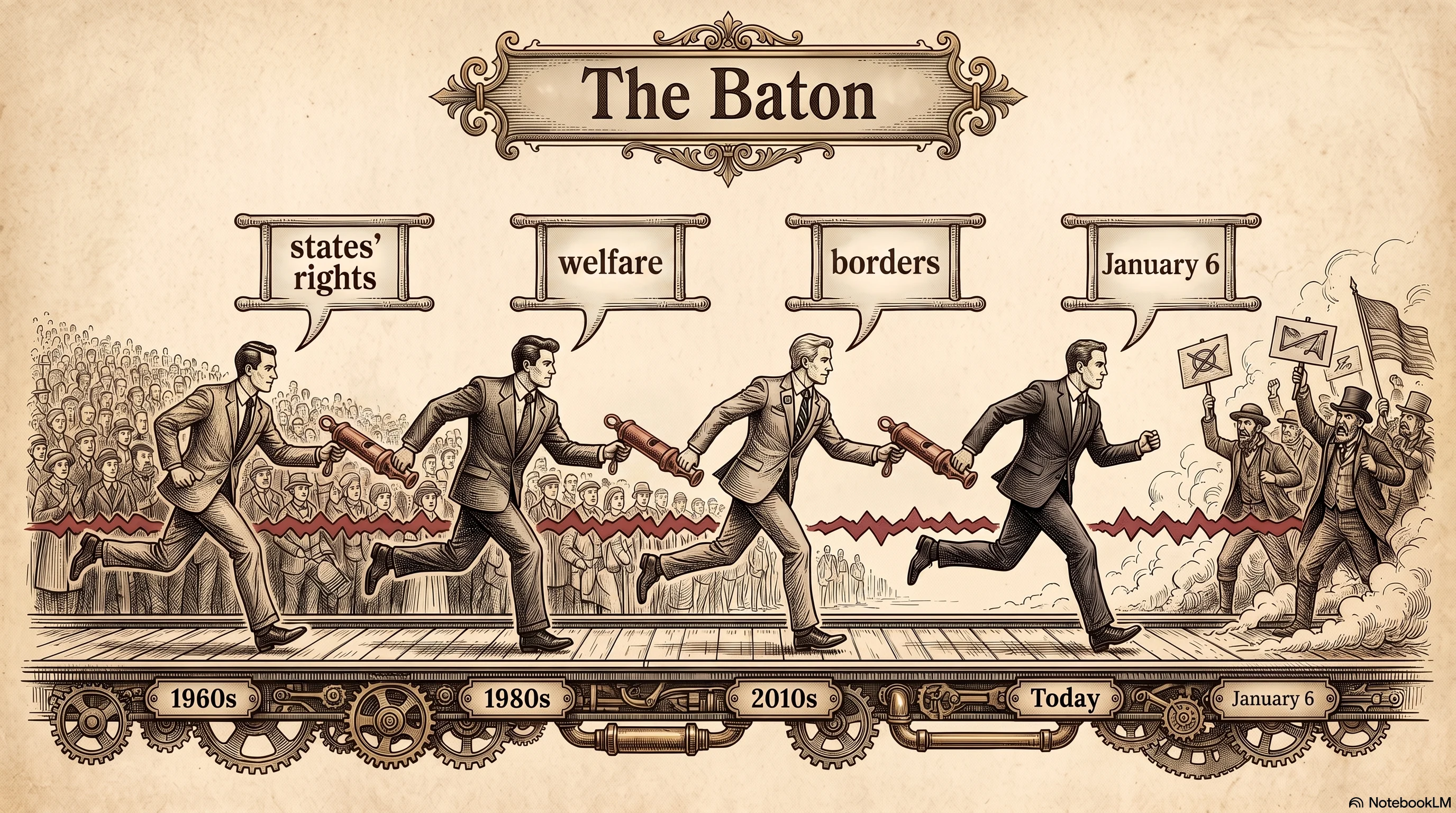
Spitale's Chapter 8 then provides the deeper diagnosis. The "flood the zone" tactic is not new. It is the latest version of a technique Republican strategist Lee Atwater described, on a 1981 audio recording first published by The Nation in 2012, as an escalator: each generation, the same coalition needs to say the same thing, but each generation needs to say it more abstractly than the last. Where in 1954 you could say the racial slur out loud, by 1968 you had to say "forced busing" and "states' rights," and by 1981 you had to talk about cutting taxes (Spitale, Ch 8, on the Atwater interview). The January 6 conspiracies are the same escalator running on a different topic. Where in 2008 the doubt about Barack Obama's legitimacy had to be encoded as questions about his birth certificate, by 2020 it could be expressed as the open claim that the entire electoral system was rigged, and the rioters who acted on that claim could then be re-described, contradictorily and simultaneously, as Antifa, tourists, and FBI plants.
This unit walks Spitale's Chapter 8 in full. It applies his framework, the full toolkit from Chapters 1 through 7, to one historical arc: the Southern Strategy. Then it extends that arc forward through 2026 and uses January 6 as the closing demonstration. Along the way it brings in three contemporary scholars who have done book-length work on the same material, and it foregrounds two intake-layer thinkers, Habermas and Zuboff, whose combined lens makes the modern stakes visible.
Think About
Before reading further: when you first heard the three competing explanations for what happened on January 6, what did you do? Did you try to sort them? Did you pick one? Did you stop trying? Hold onto your honest answer. Spitale will name what was being done to you.
Spitale's Framework Applied: The Full Toolkit on One Historical Arc
Spitale opens Chapter 8 with a thesis sentence worth quoting at length:
"This chapter uses the framework laid out in the previous chapters to explain how after the civil rights movement, political strategists exploited racial backlash for power in a campaign known as the Southern Strategy. The Southern Strategy was achieved by using coded narratives like the welfare queen (slogans), as well as appealing to the racial resentment of whites (heuristics) in order to evoke negative emotions (spite, anger) that divided voters along racial lines of makers and takers (us versus them) for the benefit of the corporate class (1 percent)."
Spitale opens his case-study chapter by stating the analytical move he is about to perform: applying every tool from the previous seven chapters to one historical arc.
That sentence is the entire chapter compressed into one breath. Read it twice. Each clause names a chapter:
- "coded narratives like the welfare queen (slogans)": Chapter 7, the loaded language of propaganda
- "appealing to the racial resentment of whites (heuristics)": Chapter 3, cognitive biases
- "evoke negative emotions (spite, anger)": Chapter 4, the negativity that hijacks attention
- "divided voters along racial lines": Chapter 5, the in-group / out-group sorting
- "makers and takers (us versus them)": Chapter 2, the simplified narrative
- "for the benefit of the corporate class (1 percent)": Chapter 6, the economic interest underneath
- "a campaign known as the Southern Strategy": Chapter 1, public relations dressed as politics
This is Spitale's method on display. He is not delivering a moral judgment about the Southern Strategy. He is demonstrating that a single historical event can be reverse-engineered into its constituent propaganda techniques, each of which has been catalogued earlier in the book. The chapter is, in effect, an answer key.
The coded language: dog whistles and the Atwater escalator
Spitale's Chapter 8 inventories the vocabulary the strategy ran on. The central technique is the dog whistle: coded racial language that sounds neutral to outsiders but transmits a specific racial signal to its intended audience. Spitale gives the canonical examples: welfare reform, inner city, states' rights (Spitale, Ch 8). Each phrase, on its surface, names a policy or geography. Each phrase, in the political context of the late twentieth century, also reliably triggered associations with Black Americans, and was designed to.
The primary-source evidence for the deliberateness of this technique is a 1981 interview with Republican strategist Lee Atwater, conducted by political scientist Alexander Lamis. Atwater was anonymized in the original publication; the audio, released by The Nation in 2012, removed any doubt about authorship. Atwater described the technique with chilling clarity:
"You start out in 1954 by saying, 'N-----, n-----, n-----.' By 1968 you can't say 'n-----' — that hurts you. Backfires. So you say stuff like forced busing, states' rights, and all that stuff. You're getting so abstract now you're talking about cutting taxes, and all these things you're talking about are totally economic things and a byproduct of them is blacks get hurt worse than whites."
Atwater, then a 30-year-old Republican strategist who would go on to manage George H. W. Bush's 1988 presidential campaign, explained the historical evolution of Republican racial appeals on the record. He believed at the time that the interview would be anonymous.
Atwater's quote is the escalator. It is the same coalition saying the same thing, encoded one rung higher each cycle, until by the early 1980s the racial content has migrated entirely into the policy vocabulary of taxes and economics. Spitale uses this interview as the documentary spine of his chapter. He is not inferring racial intent from outcomes; he is quoting the architect describing his own design.
Selection bias and the welfare queen
Spitale's second key term is selection bias: using a single anecdote to justify a generalization, even when the anecdote is unrepresentative (Spitale, Ch 8). His central example is the "welfare queen," a phrase Ronald Reagan used repeatedly on the 1976 presidential campaign trail, anchored to a real Chicago woman, Linda Taylor, who had committed welfare fraud on a scale that was genuinely unusual. Reagan inflated the numbers in his retelling. More importantly, he used one prosecutable case to characterize an entire population of welfare recipients, the majority of whom were not Black, were not committing fraud, and were not living the imaginary luxury Reagan's stump speech described.
This is selection bias as a propaganda technique. One vivid story, repeated, displaces all of the available statistics. Which leads to Spitale's third Chapter 8 term: statistics versus story. Dry data, that the average AFDC recipient in 1976 was a white woman supporting two children on roughly $300 a month, loses every time to a vivid narrative. The human brain is wired for narrative; propagandists exploit this wiring. Spitale's point is not that storytelling is inherently manipulative. His point is that propagandists know storytelling will outcompete statistics, and they choose their stories accordingly.
Makers versus takers: the simplified frame
From the welfare queen narrative falls out what Spitale's Chapter 8 calls the myth of makers and takers: the us-versus-them frame that divides hardworking taxpayers from supposedly lazy urban dwellers who mooch off the system. This is Chapter 2's territory: propaganda's preference for binary, oppositional simplifications over the complicated reality. Spitale's analytical move here is to show that the makers-vs-takers myth is not an organic folk belief that politicians happened to discover; it is a manufactured frame, deliberately constructed to convert economic resentment into racial resentment and then back into electoral support for policies that materially benefit the wealthy at the expense of both the "makers" and the "takers."
Spitale draws a direct contrast that is worth reproducing. Lyndon Johnson's 1964-65 War on Poverty named poverty itself as the enemy and proposed to spend public money attacking it. Richard Nixon's 1971 War on Drugs renamed the same urban populations as criminal and proposed to spend public money policing and incarcerating them (Spitale, Ch 8). Same neighborhoods, same demographics, opposite framings, opposite policy implications. The shift from "poverty" to "drugs" as the operative noun is the makers-vs-takers myth at work.
Altruistic punishment and rejectionist voting
Two of Spitale's Chapter 8 terms describe the emotional engine that powers the strategy. Altruistic punishment is the behavioral-economics term for impulsively punishing someone for perceived bad behavior even when doing so costs the punisher; Spitale notes that the colloquial English word for this is spite (Spitale, Ch 8). Voters who would themselves benefit from expanded health care, expanded unemployment insurance, or higher minimum wages can be reliably mobilized to vote against those policies if the policies are framed as also benefiting an out-group toward whom they feel resentment. Spite, weaponized at scale, becomes a voting bloc.
Rejectionist voting is the electoral expression of this dynamic. Spitale defines it as the strategy of winning elections by getting voters to vote against the opponent rather than for the candidate (Spitale, Ch 8). The corollary, positive polarization, is the candidate's side of the same coin: defining oneself entirely by opposition to the other candidate, with the result that the electorate sorts into two camps united more by what they hate than by what they want.
These two terms together describe what the modern American electorate has become. Pew Research and the American National Election Studies have tracked, since the late 1990s, a steady rise in what political scientists call "negative partisanship": the share of voters whose primary motivation is opposing the other party rather than supporting their own. Spitale's contribution in Chapter 8 is to show that this is not a natural drift; it is the direct, predictable consequence of a strategy whose architects chose it for its efficiency.
Cross-Curricular Connection: Think for Yourself's unit-04 on political manipulation covers the individual-level inoculation against the techniques this unit names at the population level. The dog whistle, the makers-vs-takers frame, and rejectionist voting all operate by recruiting individual cognitive shortcuts; the stealth course teaches you how to notice the recruitment in real time. This unit teaches you what is being built out of those millions of individual recruitments.
The corporate beneficiary and the permanent campaign
Spitale's final two Chapter 8 terms close the loop back to Chapter 6's economic analysis. Consolidation of corporate power, through monopoly, oligopoly, and the weakening of antitrust enforcement, is what the racial backlash strategy was, in his reading, ultimately in service of. The coalition that delivered the votes for Nixon, Reagan, and their successors was a coalition of working- and middle-class whites whose own economic interests were progressively eroded by the policies their votes enabled. The beneficiaries were a much smaller coalition of corporate and financial actors who funded the campaigns and the think tanks and the media infrastructure that ran the playbook.
The permanent campaign is the operational technique that keeps the machine running between elections: the year-round reliance on political consultants to maintain the candidate's brand image through news media, advertising, blogs, and now algorithmic social platforms (Spitale, Ch 8). The permanent campaign is what converts elections from periodic decisions into a continuous broadcast environment, which is, not coincidentally, exactly the environment surveillance-capitalism platforms are optimized to monetize.
That hand-off, from the permanent campaign to the platforms that now host it, is where the next section picks up.
Cross-Curricular Connection: US Politics' unit on weak parties and strong partisanship is the political-science complement to this unit: the structural diagnosis of the coalitional realignment that the Southern Strategy executed. Where this unit narrates the propaganda technique, US Politics describes the institutional shape it produced. See Weak Parties, Strong Partisanship in US Politics.
Intake-Layer Overlay: Habermas + Zuboff Together
The Southern Strategy is the cleanest historical demonstration of two diagnoses that this course has been building toward across all ten units. Jürgen Habermas's distinction between communicative action and strategic action describes what the strategy did to public discourse. Shoshana Zuboff's account of surveillance capitalism describes what the strategy became once it was ported onto the platforms that now host political life. The two scholars are usually read separately. The Southern Strategy is the case where they must be read together.
Habermas: strategic action displacing communicative action
Habermas, the German social theorist whose work on the public sphere has shaped political philosophy since the 1960s, draws a sharp distinction between two modes of speech. Communicative action is speech oriented toward mutual understanding: I say something to you because I want you to understand what I mean, and I am open to revising my position if your response shows me something I missed. Strategic action is speech oriented toward producing an outcome: I say something to you because I want you to do something, and the truth of what I say is instrumentally subordinate to whether it produces the behavior I want.
A healthy democracy, Habermas argued, depends on a public sphere in which communicative action predominates: spaces where citizens deliberate, reasons are exchanged on their merits, and minds can change. When strategic action colonizes those spaces, the form of deliberation persists but its function rots. The conversation looks the same. The conversation is not the same.
The Southern Strategy is strategic action at industrial scale. The point of saying "states' rights" was never to start a deliberative conversation about constitutional federalism. The point was to produce a specific voting behavior in a specific electorate. The point of the makers-vs-takers frame was never to invite the audience to examine income distribution data. The point was to produce a specific emotional reaction that translated into a specific vote. Spitale's chapter is, read through Habermas, a sustained documentation of strategic action wearing the costume of communicative action, for fifty years, on the largest stage available.
This is also why naming the move does not, on its own, defend against it. Communicative action requires both parties to be participating in good faith. When one party has decided in advance to use the conversation as a vehicle for behavior modification, the other party's good-faith engagement just makes the manipulation more efficient. Habermas's diagnosis is grim on this point: the colonization of public discourse by strategic action is not a problem that can be solved within the discourse itself. It requires changing the conditions under which the discourse operates.
Zuboff: the modern platform extracts behavioral data from the population the strategy sorted
Shoshana Zuboff's The Age of Surveillance Capitalism (2019) describes a particular twenty-first-century business model: platforms that produce free services in exchange for behavioral data, which they then sell to advertisers, including political advertisers, who use it to predict and modify future behavior. The platforms make money by knowing, in advance, what each user will respond to, and by selling that predictive accuracy to anyone willing to pay.
The Southern Strategy ran for fifty years before this infrastructure existed. It was already, by 2010, the most successful electoral coalition-building project of the postwar era. What the platforms then offered was not a new strategy. It was a thousand-fold efficiency gain on the existing strategy. The voters the Southern Strategy had sorted into in-groups and out-groups by the blunt instruments of television ads, talk radio, and direct mail could now be sorted at the level of the individual, with behavioral predictions accurate enough to deliver custom-tailored emotional triggers to each one. The makers-vs-takers frame did not need to be a national broadcast anymore. It could be a personalized message, generated algorithmically, optimized in real time for each user's individual resentment profile.
This is what makes the Habermas + Zuboff overlay essential for understanding the modern stakes. Habermas tells you what the Southern Strategy did to the public sphere. Zuboff tells you what happens when that already-degraded public sphere is then hosted on infrastructure whose business model is selling predictive control over behavior. The result is a feedback loop: the platforms profit from outrage, the strategy produces outrage at scale, the platforms learn which outrages each user is most susceptible to, the strategy refines its inputs to match what the platforms can deliver. After enough cycles, the line between "what voters believe" and "what voters have been profiled to be predictably triggered by" stops being meaningful.
Think About
If your daily social-media feed is a strategic-action environment optimized by a surveillance-capitalism business model, what would communicative action even look like there? What would you have to change about the environment, not yourself, to make genuine deliberation possible?
Scholar Roundtable
Spitale's Chapter 8 is compressed by design. To extend it, this unit brings in three contemporary scholars who have done book-length work on this exact material. Each one fills in dimensions Spitale's overview cannot.
Hasan Kwame Jeffries on the Lost Cause as proto-disinformation
Hasan Kwame Jeffries, professor of history at Ohio State and host of the Teaching Hard History podcast for Learning for Justice, has spent two decades documenting the cultural-memory project that preceded the electoral project. The Lost Cause, the post-Reconstruction historiographical movement that recast the Confederacy as a noble defense of states' rights against Northern aggression, minimized slavery as a cause of the Civil War, and venerated Confederate generals as tragic heroes, was, in Jeffries' analysis, a century-long disinformation campaign in everything but name.
Jeffries' contribution to this unit is mechanism analysis. The Lost Cause was not a spontaneous folk memory; it was constructed through specific institutional vehicles: the United Daughters of the Confederacy and its monument-building program, the Dunning School of academic historians at Columbia in the early 1900s, textbook adoption campaigns in Southern school boards, and a popular culture pipeline that ran from Thomas Dixon's novels through D. W. Griffith's The Birth of a Nation (1915) to Gone With the Wind (1939). Each generation of children, North and South, was taught a version of the Civil War in which slavery was peripheral and Reconstruction was the real atrocity.
That hundred-year cultural preparation is what made the Southern Strategy electorally possible. By 1968, when Nixon ran on "law and order," the voters being targeted had already been carrying a usable framework for racial resentment for several generations. The Lost Cause had pre-loaded the schema. The Southern Strategy was the political payoff. Jeffries' work, read alongside Spitale's Chapter 8, supplies the deeper time depth: the Atwater escalator is not just a sixty-year story, it is a phase of a much longer project.
Cross-Curricular Connection: Jeffries answers a question Spitale's chapter leaves implicit: how does a 1968 voter arrive already holding the framework? See how racial hierarchy was maintained for the cultural-memory infrastructure the electoral strategy ran on. Then take the coalition apart with a tool built for it. Steven Lukes' second dimension of power keeps a question off the agenda; his third shapes what people want in the first place, and is invisible to the people it works on. Pre-loading a schema across generations of schoolchildren is a third-dimension operation. Lukes' three dimensions in Intro to Sociology sets that claim beside Luhmann's objection that these are three ways of observing, not three kinds of power. Decide which one you are describing before you use the word.
Ian Haney López and the dog-whistle scholarship
Ian Haney López, professor of law at UC Berkeley, wrote Dog Whistle Politics: How Coded Racial Appeals Have Reinvented Racism and Wrecked the Middle Class (Oxford, 2014). The book is, in effect, the academic version of Spitale's Chapter 8, with the legal-historical apparatus Spitale's popular treatment leaves out.
Haney López's central analytical contribution is the three-level model of how a dog whistle works. The first level is the surface meaning: when a politician says "inner city," they are technically referring to dense urban neighborhoods. The second level is the encoded meaning: the specific racial group the phrase is understood, by the intended audience, to designate. The third level, and this is the move that makes the technique politically durable, is the deniability: when the politician is challenged on the racial content, they retreat to the surface meaning and accuse the challenger of being the one with race on their mind.
This three-level structure is why dog whistles are stable across the Atwater escalator. Each rung of the escalator preserves all three levels: surface neutrality, encoded racial signal, and structural deniability. The strategy survives generational succession because the technique itself is replicable and the deniability is built in. Haney López's second contribution, captured in his book's subtitle, is the economic argument: the white middle class voters mobilized by dog-whistle politics consistently vote for policies, tax cuts for high earners, deregulation, attacks on collective bargaining, that materially erode their own economic position. The dog whistle is the mechanism by which racial resentment is converted into votes for the upward redistribution of wealth. This is exactly the move Spitale names in Chapter 8 as the corporate-class beneficiary clause.
Rick Perlstein's narrative history
Where Jeffries supplies the deep cultural prehistory and Haney López supplies the legal-academic analysis, Rick Perlstein supplies the granular political narrative. His four-volume history, Before the Storm (2001), Nixonland (2008), The Invisible Bridge (2014), and Reaganland (2020), traces the American conservative movement from Goldwater's 1964 defeat through Reagan's 1980 victory, in roughly four thousand pages of immersive political journalism.
Perlstein's books are useful here for a specific reason: they make the strategy legible as strategy. Reading Spitale's compressed chapter, a student could be forgiven for thinking the Southern Strategy was a single decision made in a single room by a single set of operatives. Perlstein shows it was, instead, a slow assembly of techniques, coalitions, media properties, and operational personnel across two decades, with many failures and false starts. Nixonland in particular documents how the 1968 campaign deliberately, after internal debate, chose to make "law and order," a phrase already understood in 1968 as a racial signal in the context of the urban uprisings of 1967-68, the spine of its general-election messaging. Perlstein's contribution to this unit is texture: the strategy is real, was chosen, and was chosen by people whose internal deliberations have been documented.
Cross-Curricular Connection: The Partisan Sorting of America. US Politics tracks the identical timeline, 1964 through 2016, Nixon's Southern Strategy to Trump, but reads it as partisan sorting rather than propaganda technique: Southern whites migrating to the Republican Party, evangelicals consolidating under Reagan, the parties resorting along racial, religious, regional, and cultural lines until a voter's position on abortion predicts their position on guns and immigration. Same sequence of elections, two different instruments. This unit asks how the appeal worked on a listener; US Politics asks how it reshaped which voters ended up in which coalition. Neither account explains the vote totals alone.
Historical Fractal: Spitale's Own Backward Arc, Extended Forward
Spitale's Chapter 8 walks the strategy backward from the Reagan era through Nixon to its Dixiecrat origins. This unit reproduces that arc and then extends it forward through 2026. The Timeline below is the spine for the rest of the unit; each entry should be read as a single instance of the same underlying technique iterating on itself.
The Southern Strategy Escalator, 1948 to 2026
Dixiecrat split
politicalStrom Thurmond bolts the Democratic National Convention with the States' Rights Democratic Party after Hubert Humphrey's civil-rights plank is adopted. Thurmond carries four Deep South states in the November election. The party label is new; the underlying coalition is the same Solid South Democrats who had dominated the region since Reconstruction. The split signals that the racial-realignment dam has cracked.
Goldwater opposes the Civil Rights Act
politicalBarry Goldwater becomes the first Republican presidential nominee since Reconstruction to carry the Deep South, Mississippi, Alabama, Georgia, Louisiana, South Carolina, by opposing the 1964 Civil Rights Act on the floor of the Senate. Goldwater loses the national election in a landslide but proves the coalition is electorally viable.
Nixon's 'law and order'
politicalRichard Nixon's general-election campaign, after extensive internal strategy work documented later by Kevin Phillips in The Emerging Republican Majority (1969), runs explicitly on 'law and order' as a coded response to the 1967-68 urban uprisings and the civil rights movement. Nixon wins. The Southern Strategy is now operational doctrine.
Reagan's welfare-queen primary run
politicalRonald Reagan, running against incumbent Gerald Ford for the Republican nomination, introduces the 'welfare queen' anchored to Chicago fraudster Linda Taylor at primary campaign stops across the country. Reagan loses the nomination but the phrase enters the political vocabulary permanently.
Reagan opens his general-election campaign in Philadelphia, Mississippi
politicalReagan launches his post-convention campaign at the Neshoba County Fair, seven miles from the site where civil rights workers Andrew Goodman, James Chaney, and Michael Schwerner were murdered in 1964. He tells the crowd: 'I believe in states' rights.' The choice of location is not accidental.
The Atwater interview
primary-sourceLee Atwater explains the escalator on tape to political scientist Alexander Lamis. The audio will not be public for thirty-one years.
Willie Horton
politicalGeorge H. W. Bush's general-election campaign, with Atwater as campaign manager, runs the Willie Horton ad, a furloughed Massachusetts inmate's mugshot used to portray Democratic nominee Michael Dukakis as soft on crime. The ad is, by any reasonable reading, a dog whistle. Bush wins.
Birtherism and the Tea Party
politicalBarack Obama's election triggers two parallel responses: the Tea Party, ostensibly a fiscal-conservative movement that polling consistently shows is correlated more strongly with racial-resentment measures than with fiscal-policy preferences; and birtherism, the claim that Obama was not born in the United States. The 'inner city' rung of the escalator is now operating on the president himself.
Trump and the explicit version of the previously-coded
politicalDonald Trump's primary and general election campaigns abandon the Atwater escalator's upper rungs and return to nearly explicit racial messaging: the Mexican rapists announcement, the Muslim ban, the 'shithole countries' comment in 2018. The deniability the dog whistle was designed to preserve is no longer maintained. The strategy is no longer coded; it is broadcast.
January 6 and the flood-the-zone aftermath
politicalTrump's loss is met with the contradictory-conspiracy strategy described in this unit's hook. The Capitol breach is followed within seventy-two hours by three mutually incompatible accounts of who the rioters were and what they were doing. The strategy is now operating on direct evidence of the strategy itself.
AI-generated escalation
technologicalGenerative AI tools collapse the cost of producing dog-whistle content to near zero. Personalized political messaging optimized by surveillance-capitalism platforms can now be generated, A/B tested, and deployed at the level of the individual voter. The Atwater escalator's rate of iteration accelerates by orders of magnitude.
The arc is not a tidy line. It zigzags. It survives presidential losses, generational succession, and the public exposure of its own architects. Spitale's deeper observation in Chapter 8 is that the durability is itself diagnostic: a strategy that survives this many cycles of public exposure is not surviving by being secret. It is surviving by being structurally useful to the coalition that runs it.
In 19801980, when Reagan stood seven miles from where Chaney, Goodman, and Schwerner had been murdered and said "I believe in states' rights," he was not making a confession. He was performing a recognized political move whose intended audience understood it and whose challengers, when they raised the obvious objection, could be dismissed as the ones bringing race into a discussion ostensibly about federalism. That is the dog whistle's third level, the deniability, performed at the level of a presidential campaign launch. Haney López's three-level analysis applied to a single sentence.
Spitale's "further discussion": three backlashes converging
Spitale's Chapter 8 includes a "further discussion" section that broadens the case beyond race. The civil rights movement of the 1960s, he notes, was met with a backlash that produced the Southern Strategy. The women's rights movement of the 1970s, the Equal Rights Amendment, Roe v. Wade in 1973, second-wave feminism, was met with a parallel backlash organized by Phyllis Schlafly, Jerry Falwell's Moral Majority, and the religious right. The gay rights movement of the 1970s and 1980s, Stonewall in 1969, the AIDS crisis, the early marriage-equality movement, was met with a third parallel backlash that pulled the Christian right further into the Republican coalition (Spitale, Ch 8).
These three backlashes, Spitale argues, did not run on separate machinery. They converged into a single culture-war infrastructure that the party of business then exploited. The same media properties that ran the Willie Horton ad ran the segments on welfare queens, the segments on the ERA, and the segments on the "homosexual agenda." The same direct-mail operations sorted the same suburban voters into the same files. The same convention coalitions delivered the same nominees. By the late 1990s the three backlashes were no longer distinguishable as separate movements; they had merged into a generalized cultural reaction whose internal coherence was supplied not by any positive program but by what it was against.
This is positive polarization at the coalitional level. The right-leaning coalition was defined, increasingly, by its rejection of civil rights, women's rights, and gay rights, and that rejection, marketed by the party of business, delivered the votes that produced the policy program of upward wealth transfer. Spitale's chapter closes its further-discussion section with a question worth carrying forward: in what ways are Black Americans, gay Americans, and women in America still fighting the same battles of the 1960s and 1970s? The post-2022 Dobbs decision, the 2024 retrenchment on voting rights, and the legislative attacks on LGBTQ+ youth across multiple states in 2023-25 suggest the question is not rhetorical.
The Source-Code Audit Applied: Three Framings in Parallel
This unit's audit is unusual because the artifact under analysis is not one piece of media. It is three contradictory pieces of media addressing the same event. The audit's purpose here is not to determine which is true. It is to make visible what the contradictory ensemble accomplishes that no single piece could.
Recall the three-question protocol from Unit 1: the Simon/Kahneman audit on emotional engineering, the Zuboff audit on extraction, the Habermas audit on whether the artifact invites understanding or demands compliance.
Audit of Framing 1: "It was Antifa."
Simon/Kahneman: what emotion is engineered? Vindication. The viewer who has spent years being told their political opponents are violent extremists gets confirmation, in real time, that the violence they are seeing on television is actually their opponents' violence. The System 1 shortcut being exploited is what Kahneman calls substitution: the hard question ("did people who share my politics just attack the Capitol?") is replaced by the easier question ("are my opponents capable of staging this?"), and the easier question's answer is yes-of-course. The substitution feels like reasoning.
Zuboff: who profits? The media properties that ran the Antifa-false-flag story for the seventy-two hours it remained live profited from the engagement of viewers desperate for an exonerating explanation. Behavioral data: which viewers shared the claim, which viewers searched for confirming evidence, which viewers turned off when contrary evidence appeared. That data was sold to political advertisers preparing the 2022 cycle and was used to refine targeting for the next round of related claims.
Habermas: invitation or demand? Demand. The Antifa framing is not offered as a hypothesis to be tested; it is offered as a position to be adopted, and viewers who try to test it against evidence, who notice, for instance, that the rioters identifying themselves on camera by name and chapter were members of the Proud Boys and the Oath Keepers, not antifascist activists, are then accused of bias by the same outlets that ran the original framing.
Audit of Framing 2: "They were peaceful tourists."
Simon/Kahneman: what emotion is engineered? Minimization. The viewer who is uncomfortable with the violence but does not want to break with the political coalition that produced it gets permission to downgrade the severity. The shortcut being exploited is the availability heuristic: by anchoring the image of the day to specific video clips of people walking calmly through a hallway between velvet ropes, which exist, because the breach involved thousands of people and not all of them were violent at every moment, the violent moments are made cognitively less available. What you remember determines what you think happened.
Zuboff: who profits? This framing was particularly profitable for platforms because it generated extraordinarily long viewing sessions: the contested video clips invited frame-by-frame analysis, comment threads, and reaction videos. Each piece of contested footage was its own micro-attention market. The platforms learned which users would engage longest with which contested clips and refined the recommendation engines accordingly.
Habermas: invitation or demand? Demand. The tourist framing is not offered as one possible interpretation of an ambiguous event; it is offered as the correct interpretation, with the implicit instruction that disagreement is partisan. The form of the framing is conversational ("just look at the video"), but its function is the foreclosure of conversation: once you have accepted that what you are seeing is tourists, there is nothing left to deliberate about.
Audit of Framing 3: "It was a federal entrapment operation."
Simon/Kahneman: what emotion is engineered? Suspicion of institutions, recursively. The viewer is being trained not just to distrust the FBI but to distrust the act of trusting institutions in general. The shortcut being exploited is what Kahneman calls the affect heuristic: a prior emotional disposition toward "the deep state" determines the conclusion about a specific event without requiring any analysis of the specific event.
Zuboff: who profits? The deep-state framing was especially valuable for platform monetization because it has no endpoint. Each new piece of evidence, a confidential informant identified, a memo released, a transcript surfaced, can be interpreted as either confirming or contradicting the theory, depending on which the algorithm has learned the individual user prefers. The framing produces infinite engagement runway. There is always more to investigate.
Habermas: invitation or demand? Demand, but in a particularly insidious form. The deep-state framing presents itself as the maximally skeptical, maximally truth-seeking position: the framing for the viewer who has seen through all the other framings. In Habermas's terms it impersonates communicative action while functioning as strategic action: it borrows the form of critical inquiry to demand a predetermined conclusion. This is the most sophisticated rung of the escalator.
The cumulative analysis
Run the three audits side by side and the meta-pattern emerges. No single framing needs to convince anyone of anything specific. The Antifa framing absorbs the viewers who want the violence to be their opponents'. The tourist framing absorbs the viewers who want the violence to be minimal. The deep-state framing absorbs the viewers who want to feel they have seen through all the official stories. Three different emotional appetites, three different demographic profiles, three different audience segments: all served by a single ensemble whose contradictions do not matter because no individual viewer is exposed to all three with equal weight.
This is the strategy in its mature form. It is Spitale's Chapter 7 whataboutism scaled to the level of national-event interpretation, deployed across a population whose attention has been pre-sorted by Zuboff's platforms into the receptive segments for each framing, in a discourse environment that Habermas would recognize as fully colonized by strategic action. The Southern Strategy began in 1948 as a regional electoral maneuver. By 2021 it was the operating system of national political reality.
❓Concept Check
Why does the Source-Code Audit applied to the three January 6 framings produce a different conclusion than the audit applied to any single framing?
▸
Concept Check
Why does the Source-Code Audit applied to the three January 6 framings produce a different conclusion than the audit applied to any single framing?
Auditing a single framing identifies that framing's specific emotional engineering, extraction model, and strategic demand. Auditing all three in parallel makes visible what no single audit can show: that the strategy does not require any individual framing to be believed, only that the ensemble of contradictory framings absorbs every demographic segment with a preexisting receptivity, producing cumulative doubt and exhaustion. The contradictions are not failures of coordination; they are the coordination.
Closing: The Playbook Is Open-Source
The Southern Strategy has been documented in book-length detail for forty years. Kevin Phillips, who advised the 1968 Nixon campaign, published The Emerging Republican Majority in 1969, before the strategy's first reelection cycle was complete, and was openly explicit about the coalitional math. Rick Perlstein has published four volumes since 2001 totaling roughly four thousand pages. Ian Haney López's Dog Whistle Politics is in its second edition. Hasan Kwame Jeffries' podcast and curriculum project have been distributed free of charge to teachers across the country. Lee Atwater's interview has been public since 2012. Samuel Spitale wrote Chapter 8 of this book in 2023 specifically to compress the analysis into one teachable arc.
The strategy has been named, named again, and named by its own architects. And it has continued to work.
That is the deep insight of this unit, and it is the hinge to Unit 10. Spitale's central thesis, stated in his book's title, is that the war on truth requires reclaiming reality, not just naming the people who attack it. Naming is the prerequisite, not the solution. A propaganda technique whose existence is openly documented and which continues to succeed is a technique whose success does not depend on secrecy. It depends on the conditions that make the technique profitable to deploy and unprofitable to refuse.
Those conditions are what Unit 10 will turn to. They include: the campaign-finance environment that funds the permanent campaign; the platform business models that monetize outrage; the educational infrastructure that does or does not teach students to perform the source-code audit on their own information environment; the legal and regulatory environment that does or does not constrain the most extractive forms of behavior modification; and, perhaps most importantly, the local civic infrastructure (schools, congregations, libraries, public squares, family conversations) that does or does not give citizens places to practice communicative action in the Habermasian sense.
None of these conditions changes by being named. All of them change only by the slow, organized, expensive work of people who decide that the conditions are not acceptable and that altering them is worth the cost. Spitale's book ends in roughly that spirit. So does this unit.
The Southern Strategy is sixty years old. It is open-source. Its architects have explained how it works. Its scholars have documented every move. Its current operators have stopped pretending it is not what it is. The question that remains, the question Unit 10 will take up, is whether the population on the receiving end of it has the institutional infrastructure, the cognitive habits, and the collective will to make the strategy's continued use politically and economically more expensive than its abandonment.
That question does not have a guaranteed answer. It has only the answer the next generation of citizens decides to give it.
Think About
If the playbook is open-source and naming the move does not stop it, what concrete condition in your own information environment, your feeds, your school, your town, would have to change to make the move less profitable? Pick one. Be specific. Carry it into Unit 10.
FRONTLINE's two-hour 2022 documentary special by Michael Kirk is the primary documentary spine for Unit 9. It traces the years-long Republican Party realignment that culminated in the 2020 election denial and January 6 attack — exactly the historical arc Spitale's Chapter 8 case study walks. Watch with the unit's parallel three-question audit of the January 6 framings in mind; the documentary supplies the receipts.
Watch on YouTube