Bias and the Brain: Heuristics, Priming, and the Luxury of Dismissal
Spitale Chapter 3 takes the full inventory of cognitive shortcuts that make propaganda viable. This unit anchors in the 2024-26 polling vs. perception gap on the economy, deepens the Kahneman overlay introduced in Unit 3, and walks backward to the tobacco industry's 1969 'Doubt is Our Product' memo.
Learning Objectives
- 1Define heuristics, priming, confirmation bias, motivated reasoning, and cognitive dissonance
- 2Explain the availability heuristic and the Semmelweis reflex and recognize each in current discourse
- 3Understand privilege as Spitale defines it — the luxury of dismissing uncomfortable truths because one has not personally experienced them
- 4Run a confirmation-bias self-audit on one's own information diet
- 5Apply the Source-Code Audit to a piece of news content that triggers a strong personal reaction
Eleven minutes on Schacter's Seven Sins of Memory, aimed at the memories you're most sure of — flashbulb moments and childhood scenes. Watch before the unit as a humility primer: Unit 4's argument about heuristics and the luxury of dismissal only lands once you accept that the confident eyewitness in your head is a storyteller, not a recorder. The video's closing move — is it lying when your brain believes it? — is exactly the question the unit's priming material needs you already holding.
Watch on YouTubeHook: The 2024-26 Polling vs. Perception Gap
Begin with a puzzle that economists, journalists, and pollsters spent two solid years failing to resolve. From late 2023 through 2025, two sets of numbers told contradictory stories about the same country at the same time.
The first set, the objective indicators, pointed up. Unemployment held below four percent for the longest stretch in fifty years. Inflation, after the 2022 spike, decelerated steadily through 2024 toward the Federal Reserve's two-percent target. Real wages for the bottom half of earners grew faster than for the top half, the first such reversal in four decades. Gross domestic product expanded at a pace that confounded recession forecasters quarter after quarter. By any measure economists had used for the previous half-century, the United States was in a recovery.
The second set, the subjective indicators, pointed down. The University of Michigan's Consumer Sentiment Index sat near levels typically recorded during recessions. YouGov tracking polls through 2024 and 2025 found majorities consistently describing the economy as "poor" or "very poor." Pew Research surveys reported that a stable two-thirds of Americans rated economic conditions as bad, a share that barely budged as the objective indicators improved. Even among households whose own personal finances had improved, a clear majority reported believing the national economy was getting worse.
The gap was the story. And the gap is what this unit is about.
It is tempting to resolve the puzzle by picking a side. Either the indicators are wrong (the official statistics are missing something real), or the perceptions are wrong (people are misinformed and need better numbers). Both moves miss what is actually happening. The indicators measure one thing: the aggregate flow of dollars and jobs through the economy. The perceptions measure something else: what stories about the economy have become available to recall.
This is Samuel Spitale's territory. In Chapter 3 of How to Win the War on Truth, Spitale lays out the catalogue of mental shortcuts that propaganda exploits. The polling-vs.-perception gap is a near-perfect demonstration. Three of his terms do almost all the explanatory work.
The first is the availability heuristic. Spitale defines it in Chapter 3 as "our tendency to give greater weight to examples we can easily bring to mind, even if they are inaccurate or unlikely." If the stories about the economy that circulate most widely are stories about high grocery prices, layoffs at name-brand companies, and unaffordable housing, then those are the examples that come easily to mind. The aggregate fact that grocery inflation has cooled, that net hiring exceeds net firing, and that wage growth at the bottom of the distribution is outpacing the top: none of these appear as concrete recallable images. They appear as line items in a Federal Reserve report no one reads.
The second is negativity bias: the well-documented finding that negative information weights more heavily in memory and decision-making than positive information of equal magnitude. Negativity bias is not in Spitale's headline terms list, but it sits underneath his treatment of the availability heuristic. A news cycle in which one in ten economic stories is bad and nine in ten are neutral or good will, in the subjective record left in a viewer's memory, produce a roughly equal split. The negative stories stick. The neutral and good stories evaporate.
The third is the Semmelweis reflex. Spitale's Chapter 3 definition is "the tendency to reject new information that challenges old paradigms." Once the narrative "the economy is bad" has set into the public mind, contrary data does not simply update the narrative. It is rejected. Pollsters in 2024 and 2025 reported a recurring finding: respondents shown improving economic statistics responded not by updating their assessment but by questioning the statistics. The reflex is named after a nineteenth-century Viennese obstetrician whose own story we will return to in the Scholar Roundtable.
Think About
Think of one strong belief you hold about how the country is doing. Now ask yourself: what concrete examples come to mind when you think about it? Are those examples representative, or are they the ones that were most recently or most vividly served to you?
The gap is not an information problem. It is a problem of what the propaganda supply chain feeds people. The stories about the economy that have been most distributed, by partisan outlets, by social platforms ranking content for engagement, by short-form video built around outrage, are negative ones, because negative ones outperform on every engagement metric the distribution layer optimizes for. The availability heuristic does the rest. By the time a person tries to form an opinion about the economy, the recallable evidence is heavily skewed toward what their feed has fed them. The objective indicators never had a chance to compete on equal terms.
This unit walks the full catalogue of those shortcuts. Spitale's Chapter 3 is the spine. Daniel Kahneman supplies the experimental backbone. Leon Festinger and the team behind Mistakes Were Made (But Not By Me) extend the analysis into cognitive dissonance. Ignaz Semmelweis himself supplies the historical illustration. And the 1969 tobacco-industry memo from Brown & Williamson, a single sentence that should be taught in every civics classroom in the country, shows the playbook fifty-five years ago.
Spitale's Framework: The Brain Built for Other Problems
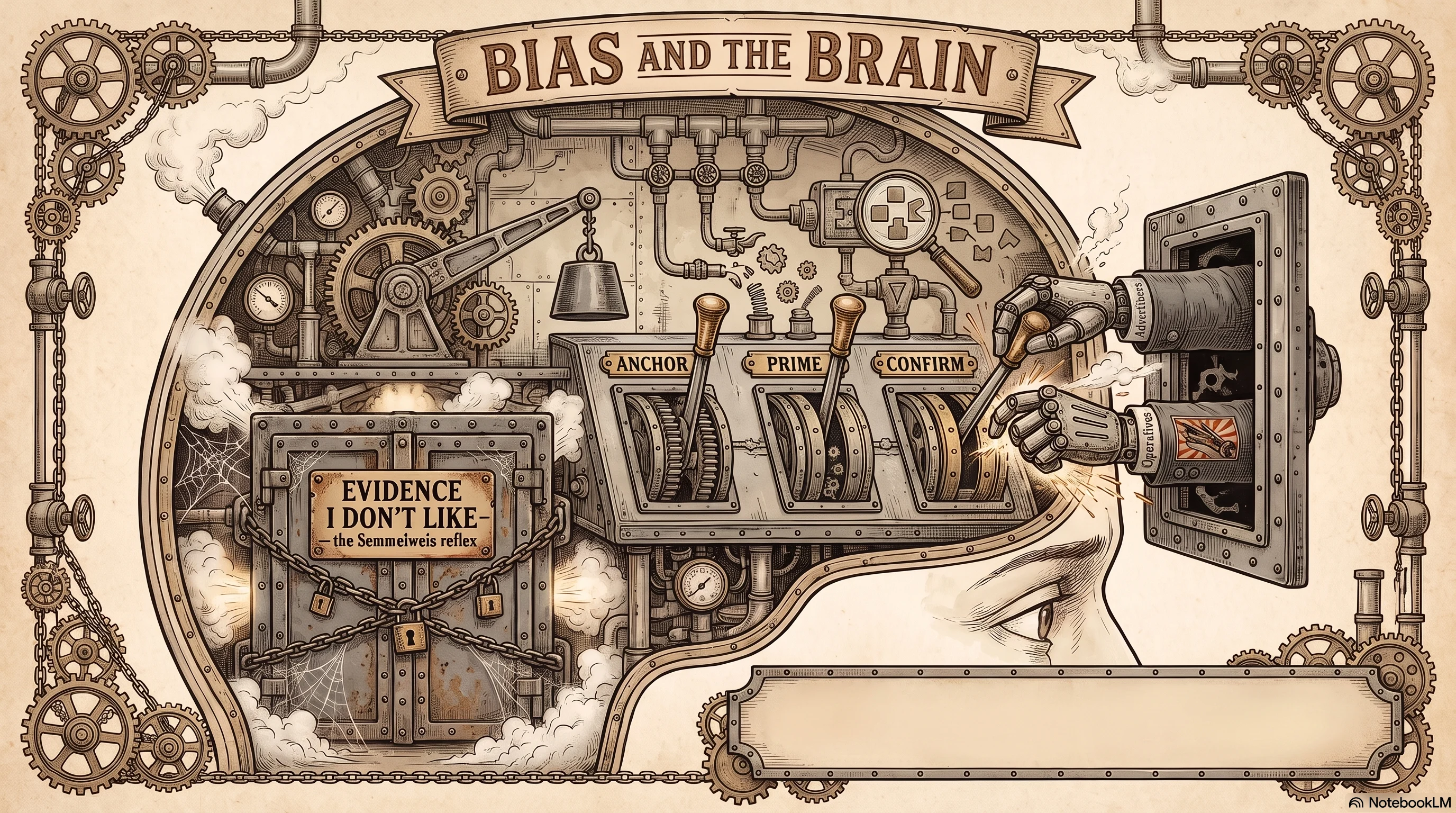
Spitale's Chapter 3 opens with a single sentence that compresses the entire pedagogical move of this course. He writes: "Propaganda appeals to our fast neural connections, or heuristics, which become our biases. Biases are introduced through priming and cemented through confirmation bias."
That sentence is the whole engine. Read it slowly. There are four nouns in motion, heuristics, biases, priming, confirmation bias, and the chapter's job is to define each one and show how they chain together into the apparatus propaganda uses.
The thesis sentence, unpacked
A heuristic is, in Spitale's Chapter 3 definition, a "mental shortcut that helps us simplify the decision-making process." Heuristics are not bugs. They are evolutionarily adaptive features of a brain that had to make survival decisions on incomplete information in short timeframes. The brain that survived to pass on its genes was the brain that did not deliberate at length about whether the rustle in the grass was a predator. It reacted. The cost of a false alarm was a wasted run; the cost of a missed alarm was death. The shortcut won.
Spitale's move is to point out that the same brain, ported into a twenty-first-century information environment, is now making consequential decisions, political, economic, social, using shortcuts engineered for short-term physical survival. Propaganda is the discovery, and then the industrialization, of the gap between what the brain is doing and what the brain thinks it is doing.
The heuristics, once activated, produce biases: durable patterns of judgment that systematically depart from what a deliberate analysis would produce. Priming, which Spitale defines in Chapter 3 as "exposing people to certain things so that they are influenced without realizing it," is the mechanism by which a propagandist (or a platform, or an advertiser) loads the brain's shortcut machinery with the inputs it wants. Confirmation bias, Spitale's Chapter 3 phrasing, "paying attention to information that confirms existing beliefs, while filtering out information that conflicts with them," then locks the bias in place by curating which subsequent inputs the brain will admit and which it will discard.
The chain is: shortcut → bias → priming loads the bias → confirmation seals the bias against future correction.
Cross-Curricular Connection: Bounded rationality, the cognitive-science finding that human decision-making is constrained by limited time, information, and computational capacity, is the foundation on which Spitale's Chapter 3 inventory sits. Systems Thinking's dedicated unit explains why the moves work at all. See Bounded Rationality in Systems Thinking.
Cross-Curricular Connection: Psychology's deep treatment of heuristics covers the same shortcuts that built civilization, and that propaganda hijacks. Read together with this unit, the two map the attack surface from both directions: where Psychology explains the adaptive function, this unit names the exploit. See Heuristics: The Shortcuts That Built Civilization in Psychology.
The full Chapter 3 inventory
Spitale gives us ten terms in his Chapter 3 key-terms list. The student should be able to define each, recognize each in the wild, and use each as a tool of analysis. Walk them in order.
Heuristics. Covered above. The umbrella term. Every other item on this list is either a particular heuristic, a particular bias produced by a heuristic, or a particular dynamic that protects a bias from correction.
Implicit bias. Spitale defines it in Chapter 3 as "an unconscious attitude that we apply to our understanding of the world, our actions, and our decisions, without realizing it. It often relies on stereotypes." The key word is unconscious. The person holding the implicit bias does not experience themselves as biased. They experience themselves as observing reality.
Priming. Covered above. The mechanism of installation.
Confirmation bias. Covered above. The mechanism of maintenance. Worth dwelling on: confirmation bias is not selective belief. It is selective attention. A person with strong confirmation bias may sincerely report being open to contrary evidence while functionally never noticing any.
Availability heuristic. Already introduced in the hook. Spitale's framing: we estimate how common, likely, or important something is by how easily we can recall examples. This is why a single vivid news story about a crime in a particular neighborhood can durably shift a person's estimate of how dangerous that neighborhood is, regardless of base-rate statistics.
Cognitive dissonance. Spitale's Chapter 3 wording: "an unpleasant mental state that arises when our thoughts about the world clash with reality. Seeking internal harmony, we make an unconscious decision to ignore new evidence in order to protect our existing beliefs, even if they're false." Note the structure of the move: the dissonance is the unpleasant feeling; the resolution can take several forms; the cheapest resolution is to dismiss the new evidence rather than restructure the prior belief.
Motivated reasoning. "Actively seeking out information that reinforces or confirms existing beliefs rather than information that challenges them." Where confirmation bias is passive, failing to notice contrary evidence, motivated reasoning is active. The person with strong motivated reasoning goes looking for the confirming evidence and brings it home.
Law of inertia. Spitale borrows a physics term: "a body at rest tends to stay at rest, as humans are conservative by nature and inclined to leave things well enough alone unless pushed by extraordinary circumstances to embrace change." The propaganda implication: existing beliefs are easier to keep than to change, and propagandists who want a population to stay where it is have inertia on their side.
Willful blindness. "The tendency to ignore new information and deny uncomfortable truths that we'd prefer not to acknowledge or deal with." This is dissonance plus complicity. The person is not merely failing to update; they are actively choosing not to look.
Privilege. Here Spitale makes the move that is the chapter's most distinctive contribution. He defines privilege in Chapter 3 as "the luxury of dismissing uncomfortable truths because we have not personally experienced them." This is not an identity-politics framing; it is a cognitive-dismissal framing. We will dwell on it shortly.
Semmelweis reflex. "The tendency to reject new information that challenges old paradigms." Named after a man whose own story is the cleanest possible illustration. The Scholar Roundtable will tell it.
Cross-Curricular Connection: Think for Yourself Unit 1 inventories the same set of brain traps from the personal-defense side. Where Winning the War on Truth names these traps in their propaganda-analysis register, what propagandists exploit at population scale, the stealth course names them as the cognitive vulnerabilities each student needs to defend against in their own daily cognition. Read alongside: Think for Yourself Unit 1: Pledges and Brain Traps. The vocabulary is shared; the strategic posture differs.
The thesis sentence again, now with weight
Re-read Spitale's Chapter 3 opening with the inventory in mind: propaganda appeals to fast neural connections (heuristics like availability), which become biases (like implicit bias and confirmation bias), introduced through priming (loaded by what the propagandist puts in front of the audience), cemented through confirmation bias (which then ensures contrary evidence does not penetrate). Layered on top of that core engine are the protective mechanisms, dissonance avoidance, motivated reasoning, inertia, willful blindness, the Semmelweis reflex, each of which fires when the bias is challenged and each of which makes the bias more durable.
That is the chapter. Every section that follows applies one or more of these terms to a specific contemporary or historical case.
A word on the privilege definition
Spitale's definition of privilege deserves its own paragraph because it is doing analytical work most undergraduate-level treatments of the concept never do. He is not defining privilege as an inherited social advantage to be acknowledged in introductions. He is defining privilege as a specific cognitive operation: the dismissal of uncomfortable truths grounded in non-experience of them. A person who has never been pulled over for a routine traffic stop that went badly does not need a complicated motivation to dismiss reports that such stops go badly with statistical regularity for other people. Non-experience is sufficient. The brain has no recallable instance to weigh against the report; the availability heuristic supplies nothing; the report carries no felt urgency; dismissal is cognitively cheap.
This framing connects privilege directly to the rest of the chapter's vocabulary. Privilege, in Spitale's sense, is the availability heuristic running on a thin local sample. It is willful blindness made effortless by the absence of any felt contradiction. It is the Semmelweis reflex with the additional protection of plausibly deniable indifference. The student should leave this section able to use Spitale's privilege definition as an analytical move, not a moral accusation. The point is not who is or is not privileged. The point is what cognitive work the dismissal of an uncomfortable truth is doing, in any direction, for anyone.
❓Concept Check
Spitale defines privilege in Chapter 3 as a specific cognitive operation, not as a social position. What is the cognitive operation he is naming?
▸
Concept Check
Spitale defines privilege in Chapter 3 as a specific cognitive operation, not as a social position. What is the cognitive operation he is naming?
Privilege, in Spitale's framing, is the luxury of dismissing uncomfortable truths because one has not personally experienced them. The non-experience makes dismissal cognitively cheap: there is no felt urgency from a recalled instance to weigh against the new information, so the availability heuristic supplies nothing and willful blindness becomes effortless.
Intake-Layer Overlay: Kahneman Deepened
Unit 3 introduced Daniel Kahneman's distinction between System 1, the fast, automatic, intuitive processing that runs almost everything we do, and System 2, the slow, deliberate, effortful processing we engage only when we have to. That distinction is the architecture. This unit walks the rooms.
Spitale's Chapter 3 opens by invoking Kahneman directly: "As the behavioral economist Daniel Kahneman noted, we process information in two ways: by thinking fast (automatic, emotional) or by thinking slow (deliberate, reflective)." Spitale's full inventory of biases is, with a few additions, a tour of the System 1 catalogue Kahneman spent his career mapping. To name the moves rigorously, the student needs a few of Kahneman's specific experiments in their working memory.
The Linda problem
In 1983, Kahneman and Amos Tversky published the result that became the textbook illustration of how System 1 substitutes one question for another. They described a fictional woman:
Linda is thirty-one years old, single, outspoken, and very bright. She majored in philosophy. As a student, she was deeply concerned with issues of discrimination and social justice, and also participated in antinuclear demonstrations.
They then asked subjects to rank the probability of various statements about Linda, including these two:
- Linda is a bank teller.
- Linda is a bank teller and is active in the feminist movement.
A consistent majority of subjects ranked statement 2 as more probable than statement 1. This is logically impossible. The probability of two conditions being true cannot exceed the probability of one of them being true on its own; the set of bank-teller feminists is a subset of the set of bank tellers. But System 1 was not computing probability. System 1 was computing representativeness, how well the description matched a stereotype, and substituting that answer for the question actually asked.
The Linda problem is the cleanest demonstration of what Spitale calls implicit bias in operation. The stereotype machinery runs automatically, without the subject's permission or awareness, and produces an answer that feels right. Slow, deliberate System 2 analysis, which would catch the logical error in about thirty seconds, is not engaged because nothing in the experience of answering the question signals to the brain that it ought to be.
The priming studies
Kahneman's Thinking, Fast and Slow devotes an extended discussion to a sequence of priming experiments that demonstrate Spitale's Chapter 3 definition of priming with experimental precision. In one famous study by John Bargh and colleagues, undergraduates were asked to assemble four-word sentences out of five-word sets. For one group, the word sets contained terms associated with the elderly: Florida, forgetful, bald, gray, wrinkle. The control group's word sets did not. After completing the sentence task, the subjects walked down a hallway to the next room. The subjects primed with elderly-associated words walked significantly more slowly than the controls.
Read that result again. The subjects were not asked to think about old age. They were not told the experiment had anything to do with old age. They simply assembled sentences. And then their bodies, without their awareness, behaved as though they had been thinking about old age the whole time.
This is Spitale's Chapter 3 definition of priming made physical: "exposing people to certain things so that they are influenced without realizing it." The subjects did not realize, because there was nothing to realize. The influence was below the level at which conscious experience operates.
Propaganda is the industrialization of this finding. Once a propagandist (or an advertising firm, or a campaign, or a recommendation algorithm) understands that priming works without the target's awareness, the entire information environment becomes a priming environment. Every image, every word choice, every story selection, every adjacency primes something. The question is not whether priming is happening. The question is who is choosing the primes and what bias they intend to install.
The anchoring experiments
A third Kahneman finding closes the loop. In an anchoring experiment, subjects are exposed to an arbitrary number, say, the last two digits of their Social Security number, and then asked an estimation question, like the maximum bid they would offer for a particular bottle of wine. Subjects with higher arbitrary numbers reliably produced higher estimates, even when the arbitrary number was clearly irrelevant to the question being asked.
Anchoring shows that System 1's shortcuts include using whatever number happens to be in working memory as a starting point for further estimation. The relevance of the starting point does not matter. The starting point is what is available, in the strict sense of the availability heuristic, and so it becomes the anchor. This is why a price tag of "marked down from $400 to $200" produces more buyers than a tag of "$200" alone. The first tag anchors the buyer's sense of fair value at $400 before asking them to evaluate $200.
Why this overlay matters for propaganda analysis
The Spitale vocabulary tells the student what is happening. The Kahneman experiments tell the student why it works and how confident we are that it works. The findings have been replicated. The mechanisms have been mapped. The student is not being asked to take Spitale's chapter on faith; the chapter rests on a half-century of carefully designed experimental psychology that converges on a single conclusion.
The conclusion is this: System 1 runs almost everything, including most political and consumer decisions. System 2 can override System 1, but only when System 1 notices something is wrong and signals for help, and System 1 has a strong bias toward not noticing. The bias is not symmetric. The brain's default is to coast on the shortcut and call it perception.
Propaganda's whole business is to keep the brain coasting.
Think About
Pick one consumer decision you made in the past forty-eight hours: a purchase, a click, a subscription, an opt-in. Walk it backward. What primes were in the environment when you made the decision? What anchor was set before you saw the number you accepted? What stereotype representation might System 1 have substituted for the actual question of whether the thing was worth it?
Scholar Roundtable
Three voices extend Spitale's Chapter 3 inventory into specific empirical territories: Leon Festinger on cognitive dissonance, Carol Tavris and Elliot Aronson on self-justification, and Ignaz Semmelweis as the historical illustration of the reflex named after him. Take them in order.
Leon Festinger: When Prophecy Fails (1956)
Cognitive dissonance is the workhorse term in Spitale's catalogue, and its empirical foundation is a single 1950s study so unusual it remains the most cited example in psychology textbooks seventy years later.
In the early 1950s, a Chicago-area housewife named Dorothy Martin began receiving what she described as messages from beings on a planet called Clarion. The messages warned that on December 21, 1954, a great flood would destroy the western hemisphere. A small group of believers, Martin called them the Seekers, gathered around her, quit their jobs, gave away their possessions, and prepared for the prophesied arrival of a flying saucer that would rescue them before the cataclysm.
Leon Festinger, then a social psychologist at the University of Minnesota, recognized what the group was about to become: a real-time test of what happens to a belief system when reality refuses to confirm it. He and two colleagues infiltrated the group as ostensible believers and observed what happened on the night of December 20, when the saucer was supposed to arrive at midnight, and the following morning, when neither the saucer nor the flood had materialized.
What happened next is the founding observation of dissonance theory. The believers did not abandon the belief. They intensified it. Within hours of the failed prophecy, Martin announced a new message from Clarion: the small group of believers, by their faith and devotion, had spread so much light that God had decided to spare the world from destruction. The group, which had previously shunned publicity, immediately began contacting newspapers to share the good news of the world's salvation.
Festinger published the study in 1957 as When Prophecy Fails, and in the same year published A Theory of Cognitive Dissonance. The theoretical move was this: when a strongly held belief is disconfirmed by reality, the person holding the belief experiences a painful psychological state, dissonance, that demands resolution. Resolution can take three forms. The believer can abandon the belief (rarely chosen, because the prior investment is too large). The believer can revise the belief (sometimes chosen, but only if the revision can be made small). Or the believer can reinterpret reality so that the belief was not actually disconfirmed (the most common path, because it preserves the prior investment intact).
Spitale's Chapter 3 definition of cognitive dissonance, "an unpleasant mental state that arises when our thoughts about the world clash with reality," is Festinger's term, used in its strict technical sense. The Seekers' move on December 21, 1954 is the canonical demonstration of the dynamic. The Seekers' move is also visible, in subtler form, every time a strongly held political or ideological belief encounters disconfirming evidence and emerges from the encounter strengthened rather than weakened.
Carol Tavris and Elliot Aronson: Mistakes Were Made (But Not By Me) (2007)
Half a century after Festinger, Carol Tavris and Elliot Aronson, Aronson having been one of Festinger's students at Stanford, published the contemporary popular treatment of dissonance theory as a working framework for understanding everyday self-justification. The book's title is borrowed from the passive-voice construction politicians and executives reach for when caught in error. The grammatical form is the whole point: an error happened; an agent did not.
Tavris and Aronson's contribution is to map dissonance theory onto adult moral and political life with the same precision Festinger applied to a doomsday cult. Their core observation: once a person has committed publicly to a course of action, voted for a candidate, signed a contract, married a partner, joined an institution, disconfirming evidence about that choice triggers dissonance. The dissonance is resolved, most often, not by acknowledging the error but by reweighting the evidence so the choice appears justified.
This produces a phenomenon they call the pyramid of choice. Two people start at the top of a pyramid, facing the same decision with the same evidence. One chooses A; the other chooses B. Each then experiences dissonance about their choice and resolves it by emphasizing the evidence that supports their decision and de-emphasizing the evidence against it. Each subsequent reinforcement moves them further down their respective sides of the pyramid. Within a year, the two people, who started with effectively identical priors, are at opposite corners of the pyramid base, each absolutely certain their choice was the obvious right one and the other's choice was obvious folly.
The implication for propaganda is direct. A propagandist does not need to win an argument; the propagandist only needs to get the target to make a public commitment. Once committed, the target's own dissonance-reduction machinery will do most of the subsequent work of cementing the belief. This is why political campaigns invest so heavily in early small commitments: a yard sign, a small donation, a public social-media share. The yard sign is not advertising. The yard sign is dissonance-resolution scaffolding.
Tavris and Aronson's book also names the dynamic that Spitale calls willful blindness with particular clarity. Once self-justification machinery is running, the person does not experience themselves as ignoring contrary evidence. They experience the contrary evidence as unworthy of consideration. The contrary evidence has been pre-filtered by the same machinery that pre-filtered everything else; by the time it reaches conscious attention, it has been tagged as bias, as bad faith, as not worth engaging. The willful blindness is, from the inside, indistinguishable from clear-sighted judgment.
Ignaz Semmelweis: the reflex named after him
The Chapter 3 term that most rewards a historical illustration is the Semmelweis reflex. The story is short and devastating.
In 1846, a Hungarian obstetrician named Ignaz Semmelweis took up a position at the Vienna General Hospital. The hospital operated two maternity wards. The First Clinic, where doctors and medical students delivered babies, had a maternal death rate from puerperal fever, a postpartum infection, of around ten percent. Some months it was higher. The Second Clinic, where midwives delivered babies, had a death rate around three percent. The disparity was so well known that women begged to be admitted to the Second Clinic. Some chose to give birth in the street rather than enter the First.
Semmelweis observed that the doctors in the First Clinic routinely came directly from the autopsy room, where they had been dissecting cadavers, often including women who had died of puerperal fever, to the delivery room, without washing their hands beyond what custom dictated. The midwives in the Second Clinic did no autopsy work. Semmelweis hypothesized that the doctors were carrying cadaverous particles from the corpses to the laboring women.
In May 1847, he instituted a mandatory protocol: physicians on the First Clinic had to wash their hands in a solution of chlorinated lime before entering the maternity ward. Within a month, the death rate in the First Clinic dropped from around eighteen percent to two percent.
"Most medical lecture halls continue to resound with lectures on epidemic childbed fever and with discourses against my theories. The publication of my theories has not had the desired result. My doctrine has been ignored, despite the unanswerable evidence of the mortality statistics."
Fourteen years after instituting hand-washing at the Vienna General Hospital and being rejected by the medical establishment for it, Semmelweis published a book-length defense of his findings. The tone is that of a man who has watched a profession refuse to look at data he is convinced will save lives.
The medical establishment of the 1850s and 1860s did not respond by adopting the protocol. They responded by rejecting Semmelweis. His findings, they argued, lacked a theoretical basis (germ theory was a generation away). His personality was difficult. His evidence was anecdotal. His methodology was suspect. By 1865, Semmelweis had been committed to an asylum, where he died within weeks, possibly from a beating by guards, possibly from the same kind of infection his protocol had been designed to prevent.
The Semmelweis reflex, as Spitale uses it in Chapter 3, is the tendency of an established paradigm to reject new information that would force the paradigm to reorganize itself. The paradigm does not reject the new information because the information is wrong. The paradigm rejects the new information because admitting the information would require admitting that the paradigm had been killing people for years. The dissonance is too large. The willful blindness is preferable.
It took twenty years and Louis Pasteur's work on germ theory before Semmelweis's protocol was vindicated. By then, several million women had died of preventable infections in hospitals across Europe and North America.
The lesson is not that doctors in 1850 were uniquely stubborn. The lesson is that the Semmelweis reflex is general. Any community of practice, political, religious, scientific, journalistic, has a paradigm, and the paradigm has defenses, and the defenses fire when new information threatens the paradigm. Recognizing the reflex in oneself is the beginning of resistance to propaganda. Refusing to recognize it is what makes propaganda durable.
❓Concept Check
Festinger's Seekers, when their flood prophecy failed, intensified their belief rather than abandoning it. What general principle from cognitive dissonance theory does this illustrate?
▸
Concept Check
Festinger's Seekers, when their flood prophecy failed, intensified their belief rather than abandoning it. What general principle from cognitive dissonance theory does this illustrate?
When a strongly held belief encounters disconfirming evidence, the resulting dissonance can be resolved by reinterpreting reality so that the belief appears not to have been disconfirmed, a path the brain prefers because it preserves the prior emotional and material investment intact. The Seekers reframed the non-arrival of the flood as proof their faith had saved the world, which converted disconfirming evidence into confirming evidence.
Historical Fractal
The polling-vs.-perception gap from the hook is not a new propaganda technique. It is the contemporary appearance of a playbook written down, in plain language, in 1969, and the playbook itself was a refinement of practices the tobacco industry had been running since the 1950s. The student should leave this section with one sentence committed to memory, because the sentence is the entire move, and the move continues to operate every day in 2026.
The 1969 Brown & Williamson memo
In 1953, Richard Doll and Austin Bradford Hill published in the British Medical Journal the results of a large prospective study showing a clear statistical link between cigarette smoking and lung cancer. By 1954 the tobacco industry had founded the Tobacco Industry Research Committee, soon renamed the Council for Tobacco Research, to fund counter-studies and seed scientific uncertainty. For the next fifteen years, the industry's public-facing strategy was to argue that the science was unsettled, that more research was needed, and that no firm conclusions about smoking and cancer could yet be drawn.
In 1969, an internal strategy memo at the cigarette manufacturer Brown & Williamson distilled this strategy into one sentence that should be taught in every civics classroom in the country.
"Doubt is our product since it is the best means of competing with the 'body of fact' that exists in the mind of the general public. It is also the means of establishing a controversy."
An internal memo, surfaced decades later in the legal discovery process that produced the 1998 tobacco Master Settlement Agreement, in which the cigarette industry stated plainly what the public-facing campaign was for.
Read it again. Doubt is the product. The company is not in the business of disproving the lung-cancer findings. The company is in the business of producing doubt: enough doubt, distributed widely enough, that any individual member of the public encountering the lung-cancer evidence will encounter, alongside it, a competing voice raising questions. The questions do not need to be persuasive. They only need to exist.
This is the Semmelweis reflex industrialized, and inverted. Where the Vienna medical establishment of 1850 spontaneously rejected new information that threatened its paradigm, the tobacco industry of 1969 deliberately manufactured material to feed the reflex in its customers. Where the establishment had ten percent maternal mortality to defend, the tobacco industry had eight billion dollars in annual revenue to defend. The mechanism was the same. The intentionality was different.
The memo also operationalizes every term in Spitale's Chapter 3 inventory. The availability heuristic is exploited by ensuring that whenever a person tries to recall the state of scientific knowledge on smoking and cancer, the easily available examples include "controversy" and "ongoing debate" alongside the actual scientific consensus. Confirmation bias is exploited by giving smokers, who have a powerful motivated reasoning to dismiss the lung-cancer evidence, a steady supply of confirming material. Cognitive dissonance is preempted: the smoker never has to face the dissonance of "I am doing something that may kill me" because the industry has supplied a ready-made resolution: "the scientists themselves don't agree." Willful blindness is made effortless, because the smoker is not refusing to look at evidence; the smoker is simply weighing one side against the other in what appears to be a fair debate.
Cross-Curricular Connection: Critical Thinking's unit on competing explanations works the same Brown & Williamson playbook from the analytical side: how the manufacture of doubt exploits the gap between what data shows and what individual readers can confidently conclude. Read alongside this unit's framing: Competing Explanations: ACH and Confidence Calibration. Where this unit names the cognitive shortcuts that make the doubt move work, that unit names the logical structure the doubt move attacks.
The arc forward: from tobacco to climate to AI
The playbook did not stay in the tobacco industry. In 2010, the historians Naomi Oreskes and Erik Conway published Merchants of Doubt, a meticulously documented account of how the same firms, often the same individual scientists for hire, ported the tobacco playbook to acid rain in the 1970s and 1980s, to ozone depletion, to secondhand smoke, and ultimately to climate change. The same lobbying firms ran the same campaigns. The same think tanks issued the same kind of doubt-generating reports. The talking points were structurally identical, often word-for-word identical, across topics that had no scientific relationship to one another.
Oreskes and Conway's contribution was to show that the doubt industry is an industry. It is staffed by a small number of repeat actors. It uses a small number of repeated rhetorical moves. And those moves all work because they exploit the cognitive shortcuts Spitale's Chapter 3 inventories.
The Doubt Playbook, 1953 to 2026
Doll and Hill publish lung-cancer findings
scienceThe British Medical Journal publishes prospective-study evidence linking cigarette smoking to lung cancer at large statistical confidence.
Tobacco Industry Research Committee founded
corporateThe cigarette industry establishes an in-house science-funding apparatus to seed counter-research and amplify uncertainty.
Brown & Williamson 'Doubt is Our Product' memo
corporateInternal strategy memo states the playbook plainly: doubt is the marketable product, not the cigarette.
Tobacco-trained scientists pivot to climate denial
corporateSame firms, often same individuals, port the playbook to early climate-science debates over carbon-dioxide forcing.
Tobacco Master Settlement Agreement
legalLegal discovery surfaces decades of internal industry documents, including the 1969 memo, into the public record.
Oreskes and Conway publish Merchants of Doubt
scholarshipHistorians document the playbook's migration across topics, firms, and decades, with the same actors recurring.
AI-authenticity doubt arrives at scale
technologicalBoth creators and skeptics now weaponize the existence of AI-generated content to dismiss inconvenient real evidence. 'Maybe the video is a deepfake' becomes the universal exit.
Why this fractal matters
The Brown & Williamson sentence is the fractal seed for almost every contemporary disinformation campaign the student will encounter. The 2024 AI-authenticity disputes are the same move with a new tool: a piece of inconvenient evidence emerges; rather than addressing the evidence, the response is to raise the possibility that the evidence is AI-generated. The possibility does not need to be proven. The possibility only needs to be raised loudly enough to plant the doubt that lets the audience's confirmation bias and willful blindness do the rest of the work.
The polling-vs.-perception gap from the hook is the same dynamic, applied to economic indicators rather than scientific ones. The objective data is the "body of fact." The doubt is the product. The cognitive shortcuts are the distribution channel. The 1969 memo could have been written about 2025 with no change other than the substitution of "the economy" for "smoking and cancer."
The Source-Code Audit Applied
The recurring exercise of this course is the three-question Source-Code Audit. Unit 1 introduced it. Every subsequent unit applies it to a specific propaganda artifact, with the unit's vocabulary used to make the audit concrete.
For this unit, bring one news headline from the past week that produced in you an immediate strong reaction, positive or negative. The reaction can be outrage, satisfaction, fear, vindication, disgust, or hope. The criterion is that the reaction arrived faster than thought. The headline did not invite you to consider it; the headline made you feel something before you finished reading it.
Write the headline down. Note your reaction. Then run the audit.
Question 1: Simon and Kahneman. What is this engineered to make me feel, and which System 1 shortcut is being exploited?
Begin by naming the feeling precisely. "I felt angry" is a start; "I felt a flash of anger directed at a specific group, accompanied by the satisfaction of having my prior beliefs about that group confirmed" is the actual data.
Now name the shortcut. Use Spitale's Chapter 3 inventory. Common patterns to look for:
- If the headline names an outlier event as though it were typical, the availability heuristic is the move. A single vivid example is being offered to overwrite a base-rate estimate.
- If the headline confirms something you already believed about a person or group, confirmation bias is the load and the lock. The headline was selected for distribution to you because the algorithm has profiled your priors. You are being shown what you would already nod at.
- If the headline involves a description of a person or group that activates a stereotype before any factual content arrives, implicit bias is being primed. Note the order of operations: the stereotype is loaded, then the claim is made, then your assessment of the claim is filtered through the stereotype you did not consciously consent to loading.
- If the headline asserts something is contested or controversial when the scientific or empirical consensus is in fact strong, the Brown & Williamson doubt move is in play. The headline is selling doubt as the product.
- If your reaction includes a strong sense of "of course they would do this," motivated reasoning is doing the work. You went looking for confirmation of a prior judgment, and the headline delivered it.
Be specific. Write down the shortcut by name, with a sentence on how the headline activated it.
Question 2: Zuboff. Who profits from my engagement with this version of reality, and what behavioral data is being collected?
The headline arrived through a distribution channel. The channel logged your engagement. Trace both.
What platform served the headline? What was on the page or in the feed around it? What did the platform learn from your engagement: that you clicked, that you stayed, that you scrolled to the next item, that you shared, that you commented, that you searched for a follow-up, that you blocked or muted the source?
Now think about what behavioral inference the platform can draw from that data. Engagement with this specific headline, combined with your prior engagement history, refines the platform's model of who you are politically, economically, and demographically. That refined model is the asset. The next headline you see will be served on the basis of that refined model. The model improves with every reaction you produce.
Spitale calls this surveillance capitalism, drawing on Shoshana Zuboff's framework that the course's later units will treat directly. For this audit, the operational question is: what part of my reaction was useful to the platform serving the headline, even if the headline itself was useful to me in no way at all?
Question 3: Habermas. Is this artifact inviting me to understand the world, or demanding I comply with a predetermined position?
A communication oriented toward understanding leaves space for the recipient to reach a different conclusion than the speaker. A communication oriented toward strategic action does not. The headline either treats you as a fellow citizen who might reasonably evaluate the evidence and decide, or it treats you as a target who must be brought into a predetermined emotional state.
Test the headline. Could a reasonable person, having read the underlying story, come to a different conclusion than the headline implies? If yes, the headline is at least nominally communicative. If no, if the headline is constructed so that the only valid response is to feel what the headline wants you to feel, the headline is strategic. It is propaganda in the technical sense Spitale's book uses throughout.
Most engagement-optimized headlines fail the test. They are constructed to produce one emotional response. The space for alternative reaction has been engineered out.
Walking the audit on a concrete case
Suppose the headline that triggered your reaction was something like "Crime Surges in [Major City] as Mayor Refuses to Act." The reaction is alarm, accompanied, depending on your priors, by satisfaction that the mayor's party is being exposed or by frustration that the city's reputation is being tarnished.
Question 1: The availability heuristic is the dominant move. "Crime surges" is a phrase that, in your memory, is anchored to vivid recallable instances: past stories, past images, past statistics. The phrase substitutes for actual statistical analysis. Confirmation bias is the load: you have prior beliefs about this mayor and this city, and the headline was distributed to you because the algorithm modeled those beliefs. If the underlying story shows year-over-year violent crime down twelve percent but a single high-profile incident occurred this week, the availability heuristic will let that single incident outweigh the trend.
Question 2: The platform serving the headline learns whether you click, share, comment, or rage. Your reaction is data; the model of you is the asset; the next headline is the product. If you stayed on the page long enough to read the comments, the platform learned that you are a high-engagement user for crime-and-politics content, and it will serve you more.
Question 3: The headline is constructed so that the only valid emotional response is alarm or anger. There is no "huh, I wonder what the underlying trends are" version of the headline. The space for a reasoning response has been removed.
The audit takes about three minutes. The first time you run it, the headline survives. By the tenth headline, you start to recognize the patterns before the audit finishes. By the hundredth, you begin to notice the patterns in headlines you have not yet been served. You can predict what the next outrage cycle will be by knowing which biases are currently being primed.
That is the goal. Not to never feel a strong reaction to a headline. To notice the reaction, name the move, and recover the few seconds of deliberation that propaganda is engineered to deny you.
Think About
Run the three-question audit on the most recent headline you reacted to today. Write the headline down, name the bias, name what the platform learned from your engagement, and decide whether the headline left you any room to think.
Closing: The Brain Will Not Save You
End on a brutal honesty that distinguishes this course from the self-help adjacent treatments of cognitive bias the student may have encountered. Knowing about a bias does not eliminate the bias. Reading a list of fallacies does not make a person less susceptible to them. The experimental literature on cognitive bias is unanimous on this point and rarely advertised: subjects who are taught about a bias before being tested for it show essentially the same susceptibility as subjects who are not taught.
Spitale acknowledges this in Chapter 3 when he writes that "becoming self-aware of our biases, and actively seeking to rewire them, is the foundation of the type of psychotherapy known as cognitive therapy." The phrasing is precise. Self-awareness is the foundation, not the cure. Active rewiring is the work. And the work is a continuous practice, not a completed achievement.
The reason is that the biases are not optional features of cognition that can be turned off once identified. They are the default mode of cognition. System 1 runs by default. System 2 has to be summoned, and the summoning is effortful, and the brain is biased against expending the effort. The Linda problem still trips experienced statisticians the first time they see it. The priming experiments still work on the researchers who designed them. The availability heuristic still skews the judgment of professional analysts whose careers depend on accurate base-rate estimation.
The defense, then, is not smarter cognition. It is slower cognition. Specifically, it is the disciplined interruption of one's own first reaction.
Cross-Curricular Connection: For the meta-cognitive layer, how to notice your own thinking in real time and slow it down before the shortcut completes, see Critical Thinking Unit 13a: Thinking About Thinking. That unit operationalizes the discipline this unit's closing argues is the only durable defense against propaganda: not smarter cognition, but slower cognition.
Three practices follow.
The first is the artificial pause. When a headline, post, image, or claim produces an immediate strong reaction, the practice is to do nothing for thirty seconds. Do not click. Do not share. Do not respond. Do not even continue reading. The pause is not for analysis. The pause is for the System 1 reaction to dissipate enough that System 2 has a chance to be summoned. The pause is small. Its effect is large.
The second is the audit-by-default. The three-question Source-Code Audit you have just practiced is meant to be a habit, not an occasional exercise. Run it on anything that produces a reaction. The first hundred runs are slow and conscious. By the thousandth run, the audit happens in the background, and the moves it surfaces become recognizable before they finish landing.
The third is the diet practice. The biases this unit has named are loaded by what enters the brain. The brain that consumes a diet of engagement-optimized outrage content will form bias patterns that engagement-optimized outrage content has shaped. The brain that consumes a more deliberately curated information diet, longer-form pieces, primary sources, work by people whose incentives are not metered in clicks, will form different patterns. The diet practice is the recognition that information environment is, in a strict cognitive sense, food.
None of these practices makes a person bias-free. The goal is not bias-free cognition. The goal is bias-aware cognition that buys the extra second of deliberation propaganda is engineered to deny.
Hand-off to Unit 5
This unit named the cognitive layer of propaganda's machinery: the shortcuts, the biases, the loads and locks that let a propagandist install and maintain a belief without the believer noticing. The cognitive layer is necessary. It is not sufficient.
Underneath the cognitive layer is the emotional layer. Most propaganda does not arrive at the brain as a proposition to be evaluated. It arrives as a feeling that bypasses evaluation entirely. The availability heuristic, the confirmation bias, the Semmelweis reflex: all of them are loaded and locked by emotional pressure that operates upstream of the reasoning machinery.
Unit 5 takes up that emotional layer. Spitale's Chapter 4 inventories how propaganda exploits the body's emotional architecture, fear, disgust, tribal belonging, the satisfactions of moral outrage, to install beliefs that the cognitive defenses this unit named would, in calmer states, catch. The hook will move from the 2024-26 polling-vs.-perception gap into the texture of an actively running disinformation cycle. The voice of the unit will shift accordingly: less Kahneman and the laboratory, more Antonio Damasio and the body that thinks before the cortex catches up.
Bring to Unit 5 the audit habit you began here. The emotional layer will not yield to cognitive analysis alone, but cognitive analysis with the audit running is the best apparatus the course has to offer for noticing what the emotional layer is doing before it has finished its work.
The brain will not save you. The discipline of slowing the brain down, run continuously across years of practice, might.