Propagating the Faith: Bernays, the PR Rebrand, and the Machinery of Persuasion
Spitale Chapter 1 traces the modern propaganda industry to Bernays' application of his uncle Sigmund Freud's psychology to mass marketing. This unit anchors in Musk's 2022-26 reshaping of X as a real-time PR overhaul of a public square, and walks backward to Bernays' 1929 'Torches of Freedom' campaign.
Learning Objectives
- 1Trace propaganda's twentieth-century rebrand into public relations through Edward Bernays' career
- 2Distinguish the four offspring of propaganda: marketing, advertising, publicity, and branding
- 3Identify the difference between journalism (uncovering truth) and the other forms of mass communication (selling something)
- 4Recognize the sleeper effect and illusory truth effect as cognitive mechanisms that let propaganda outlive its source
- 5Apply the Source-Code Audit to a contemporary branding example
Hook: The X Rebrand as Live Propaganda
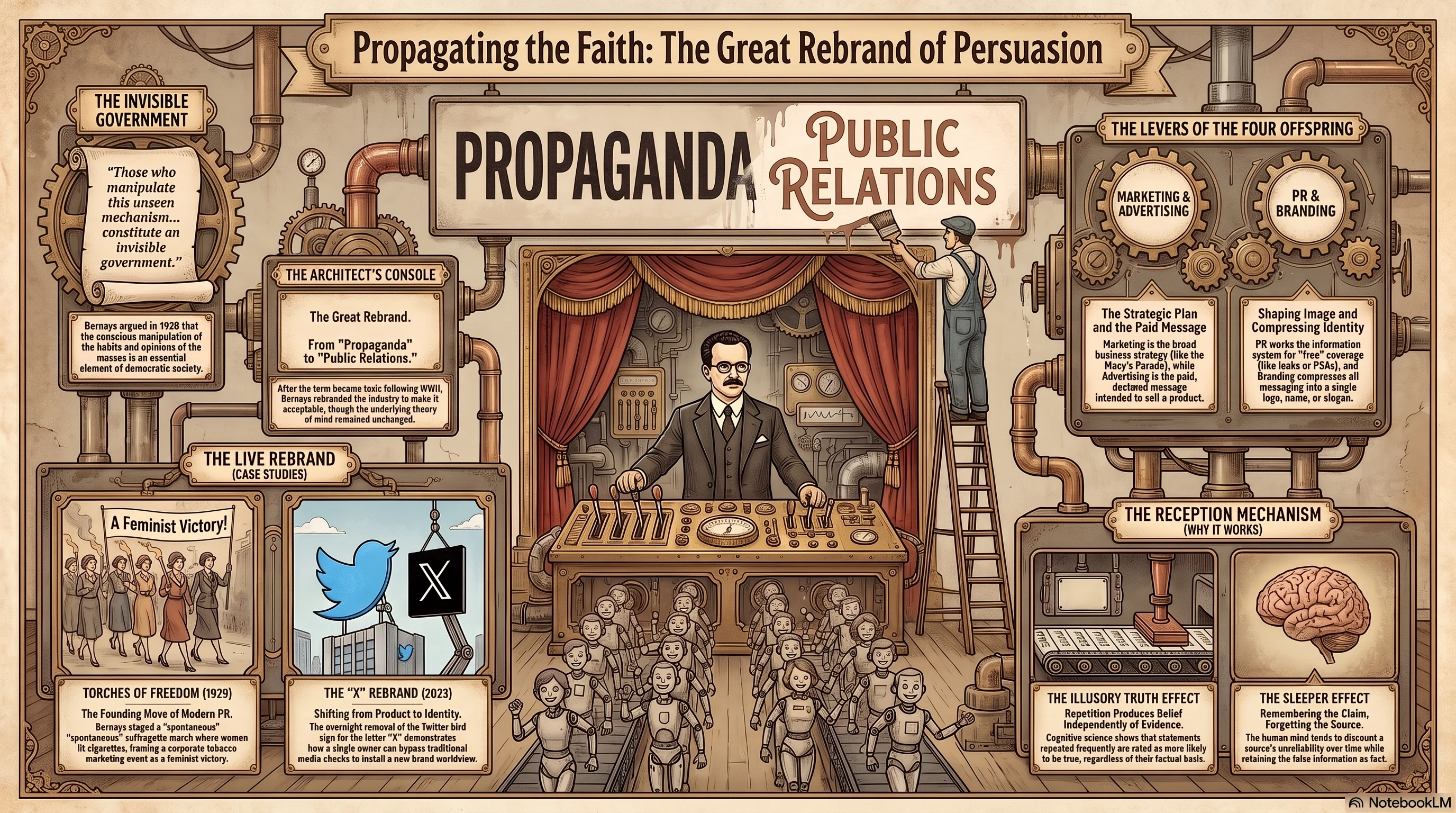
On July 23, 2023, the bird disappeared. Workers unbolted the Twitter sign from the side of the building at 1355 Market Street in San Francisco. The police stopped them mid-removal because they had not pulled a permit, which is a small detail with a large echo: the new owner did not appear to believe the rules about signage applied to him, and he did not appear to believe the rules about a public square applied to him either. By the next morning, the platform that for fifteen years had been called Twitter was called X. The verb "tweet," a word so embedded in journalistic and political vocabulary that the Oxford English Dictionary had formally added it, was retired by fiat. A logo was swapped. A name was changed. A worldview was installed.
This is the unit's opening artifact, and the reason is structural. What Elon Musk did to Twitter between October 2022 and the present is not primarily a story about one billionaire's mood swings. It is a textbook demonstration of the thesis Samuel Spitale lays out in Chapter 1 of How to Win the War on Truth: that the modern propaganda industry was renamed "public relations" not because it stopped being propaganda, but because the word had become unusable after Joseph Goebbels. Spitale's Chapter 1, "Propagating the Faith," makes the case that the renaming was a brand maneuver, executed by Edward Bernays himself, and that every subsequent corporate identity exercise, every Macy's Thanksgiving Day Parade, every "Just Do It," every "Don't be evil," every X, is downstream of that single rhetorical sleight of hand. Watch the rebrand from above and you see the move with unusual clarity, because Musk did not bother with the polite fiction.
Consider the sequence. October 27, 2022: the acquisition closes for $44 billion. Within forty-eight hours, half the staff is gone. Within a month, the trust-and-safety council is dissolved. On December 15, 2022, the accounts of nine journalists reporting on Musk, including reporters from CNN, The New York Times, and The Washington Post, are suspended under a newly invented rule against sharing the owner's "real-time location." The accounts are restored within days, but the message has landed: the new owner will use the platform's enforcement mechanisms against journalists covering him. PR, in Spitale's chapter-one sense, has fused with platform administration.
Then comes the algorithmic intervention. In February 2023, Platformer and The Verge report that Musk's engineering team has been ordered to boost the reach of his personal posts after a tweet of his received fewer impressions than President Biden's Super Bowl post. Engineers later confirm that a "power user multiplier" has been hardcoded for the owner. This is publicity in Spitale's taxonomy, the manufacturing of attention, but it is publicity that has eaten the editorial layer. The owner of the public square has placed his own voice on a structural amplifier and turned the dial on every other voice down.
Then comes the antisemitism episode of November 2023. Musk replies to a post asserting that Jewish communities promote "hatred against whites" with the words "You have said the actual truth." Within seventy-two hours, IBM, Apple, Disney, Comcast, and Warner Bros. Discovery suspend their X spending. On November 29, at The New York Times DealBook Summit, Musk publicly tells fleeing advertisers to "go fuck yourself." This is not PR collapsing. This is PR mutating. The owner has decided that hostility to the advertisers is itself a brand position. Spitale's chapter-one observation, that branding is "a carefully constructed image of a product that separates it from its competitors," is operating in real time. X is being branded against the legacy media ecosystem.
Then comes the 2024 election period. Musk endorses Donald Trump in July, campaigns with him in Pennsylvania in October, and personally funds a get-out-the-vote operation through America PAC. His personal posts, boosted by the owner-multiplier, direct hundreds of millions of impressions per week at narratives about election integrity and immigration. This is no longer simply branding. This is publicity, advertising, marketing, and PR, all four of Spitale's offspring of propaganda, converging on a single platform under a single owner with a single political objective.
The reason to begin Unit 2 here is that X makes the architecture visible. Most of the time, the four mechanisms Spitale catalogues in Chapter 1 operate behind the scenes of separate institutions: marketing departments in one company, ad agencies in another building, PR firms on retainer, brand consultants on quarterly contracts. The polite fiction of the twentieth century was that these were distinct trades, occasionally checked by a fifth function, journalism, operating from outside. What Musk demonstrated, with unusual candor, is that the polite fiction was always optional. Concentrate enough ownership in one place and the four mechanisms become one mechanism. The owner can punish journalists, boost his own voice, drive advertisers out and call it a feature, and hand the megaphone to a candidate.
Spitale writes in Chapter 1 that those who run the modern persuasion industries form what Bernays himself called an "invisible government." What X reveals, by making the invisible visible, is that the government was never that invisible. The mechanism was always describable. It just usually had the decency to wear a suit.
Think About
Before you read further, sit with this question. The Twitter-to-X transition involved a name change, a logo change, an algorithm change, a staffing change, and an editorial-policy change, all executed by a single owner without an external check. Which of those changes felt most like 'just a business decision' to you when you first heard about it? Why might Spitale argue that none of them are 'just' business decisions?
Spitale's Framework: Bernays, Public Relations, and the Four Offspring
Spitale opens Chapter 1 with a single sentence whose claim takes the rest of the book to unfold: "The modern advertising industry is traced to Edward Bernays, who applied his uncle Sigmund Freud's psychological insights to mass marketing." The sentence is doing two things at once. It identifies a person, Bernays, as the engineer of the modern persuasion industries. And it identifies a method: take what depth psychology learned about the unconscious mind and apply it not to therapy but to the manufacturing of consent. Persuasion before Bernays had been a craft. Persuasion after Bernays became a science with a research department.
Edward Bernays was born in Vienna in 1891 and raised in New York. His mother was Sigmund Freud's sister; his father's sister was Freud's wife. The Freud connection was not casual. Bernays read Freud's manuscripts, paid Freud royalties for the U.S. editions of his work, and self-consciously translated Freud's account of unconscious motivation into a working theory of public manipulation. During World War I, Bernays served on the Committee on Public Information, the propaganda body President Wilson stood up to manufacture American support for the war. When the war ended, Bernays carried the wartime techniques into peacetime commerce, and in 1923 he wrote Crystallizing Public Opinion, the founding text of the field. In 1928 he wrote a book called, with admirable candor, Propaganda. The opening passage is worth holding in your mind for the rest of this unit:
"The conscious and intelligent manipulation of the organized habits and opinions of the masses is an important element in democratic society. Those who manipulate this unseen mechanism of society constitute an invisible government which is the true ruling power of our country. We are governed, our minds are molded, our tastes formed, our ideas suggested, largely by men we have never heard of."
Bernays, then 36 years old, was articulating the working philosophy of the new public-relations profession he had personally invented. He was writing approvingly, not as a critic. He believed the techniques he was describing were the foundation of a stable, modern, democratic society.
That passage is the load-bearing wall of Spitale's Chapter 1. Spitale's argument is that Bernays was correct about the mechanism but catastrophically wrong about whether it was healthy. The "invisible government" Bernays describes, the small caste of professional persuaders who shape the public mind without the public's awareness, is a real thing. It exists. It has offices in Midtown and West London and the Persian Gulf. What Bernays did not anticipate, and what the 1930s made savagely obvious, was that the same techniques he was selling to soap companies could be sold to a regime engineering genocide.
Cross-Curricular Connection: Spitale's argument that "public relations" is rebranded propaganda is the population-scale analogue of the personal-scale move analyzed in Think for Yourself's Religion as Business unit. When an institution packages belief as an identity and sells the identity for ongoing extraction, financial, behavioral, emotional, the structural mechanism is the same whether the institution is a megachurch, a multilevel-marketing organization, or a corporate brand. The Think for Yourself course gives you the personal-defense toolkit for recognizing the move on an individual level. Spitale's framework, and this course, gives you the structural-analysis toolkit for recognizing it at population scale. Cialdini's six weapons of influence, taught in Think for Yourself, are the operating principles Bernays scaled into the modern PR industry.
The Rebrand
Here is the sentence in Spitale's Chapter 1 that students should memorize: "Bernays's methods were so successful in Nazi Germany that the term propaganda had to be rebranded as public relations after the war." That is a single sentence with two enormous implications.
The first implication: Joseph Goebbels, the architect of Nazi propaganda, was a student of Bernays. Bernays himself confirmed this. In his 1965 autobiography Biography of an Idea, he wrote, with what reads, decades later, as horrified self-justification, that Karl von Wiegand, a foreign correspondent for the Hearst newspapers, had told him in 1933 that Goebbels had been "using my book Crystallizing Public Opinion as a basis for his destructive campaign against the Jews of Germany." Bernays added that the news "shocked me," but he did not stop the work. He continued to consult for American corporations, the U.S. government, and the State Department for another fifty years.
The second implication is the one Spitale's Chapter 1 is built around. Once Goebbels was done with the word "propaganda," nobody in the West could use it anymore. The word now connoted gas chambers and choreographed rallies and burnt books. American advertisers and political consultants who had been using Bernays' techniques continuously since the 1920s now had a vocabulary problem. They needed a new name for the trade. Bernays, and this is the move, gave them one. He started calling himself a "public relations counsel." The trade press picked it up. The term spread. By 1947, the Public Relations Society of America had been founded, with Bernays as a founding figure. The same methods. The same theory of mind. The same invisible government. A different word on the business card.
This is the most important rhetorical move in twentieth-century commercial communication, and Spitale's Chapter 1 puts it at the center of the analysis: the modern PR industry is propaganda that has rebranded itself. Not propaganda's distant cousin. Not propaganda's reformed descendant. Propaganda, with a new name, executed by the same families of professionals, using the same techniques, refined for the same purpose. To understand any contemporary persuasion artifact, a Super Bowl ad, a CEO's tweet, a corporate statement during a crisis, a candidate's stump speech, you start by recognizing that the entire apparatus producing it was built by Bernays and renamed in the late 1940s to escape the residue of Nuremberg.
Cross-Curricular Connection: Japan faced the same problem in the same postwar moment and answered it the other way. From the late nineteenth century until 1945, State Shinto had mobilized shrine practice for emperor veneration and for the war, and when the occupation authorities disestablished it, Japanese practitioners and scholars were left holding a tradition with a compromised recent history. They did not rename it. They drew a line, State Shinto against shrine Shinto, naming which institutions the government had built and which had been running for centuries before it arrived. Hold the two responses next to each other. A rebrand keeps the thing and swaps the word, so the continuity goes invisible. A distinction keeps the word and splits the thing, so the continuity stays visible and stays arguable. The second option was available to Bernays in 1947. He took the first.
❓Concept Check
Why does Spitale insist that the post-1947 rebrand of 'propaganda' into 'public relations' was itself a propaganda move?
▸
Concept Check
Why does Spitale insist that the post-1947 rebrand of 'propaganda' into 'public relations' was itself a propaganda move?
Because the rebrand applied the same technique it was hiding: it took an unpopular product (propaganda, now associated with the Nazis) and gave it a new name and positive valence ('public relations') to make it acceptable to the public again. The methods, theorists, and underlying theory of mind did not change. Only the label changed. The rebrand is the strongest possible demonstration that the technique it concealed still worked.
The Four Offspring of Propaganda
Spitale's Chapter 1 lays out a taxonomy that you should commit to memory because the rest of the course depends on it. The single discipline Bernays built has, over the past century, divided into four working subdisciplines. They share a parent and they share a method, but they have specialized.
Marketing is the strategic envelope that contains the other three. Spitale defines it as "the broader business strategy behind all creative forms of communication used to promote a product, which includes advertising, public relations, publicity, branding, and any other means of promotion." If a company has decided that it wants to enter your life, marketing is the plan for how it will do so. Marketing is the chess game; the other three are the moves. The textbook origin story Spitale offers is the Macy's Thanksgiving Day Parade, which was conceived in 1924 not as a civic celebration of gratitude but as a marketing strategy: get families downtown the day before Black Friday, anchor the department store to the start of the Christmas shopping season, embed the brand into the family calendar. A century later you still hear the parade described as a "tradition," which is exactly the proof of marketing's success. The strategy disappeared into the culture.
A marketing variant worth flagging is undercover marketing, which Spitale defines as "marketing that may not be obvious, such as when an actor is paid to pass out samples of a new drink at a bar or when Sony hires people to pose as tourists to ask passersby to take their picture only to rave about their Sony camera." The 2002 Sony example Spitale references is the same move as the 2024 TikTok influencer who "discovers" a skincare brand without disclosing payment. The vocabulary has not changed.
Advertising is the paid, declared form of persuasion. Spitale's definition: "any paid message created with the intent to sell a product, such as a TV commercial, a magazine ad, or a billboard in Times Square." Advertising is the most honest of the four offspring because, in theory, you know it is happening. Print ads are supposed to be marked; broadcast ads must be identifiable. The "in theory" qualifier is necessary because advertising has been steadily blurring its edges through four sub-techniques Spitale catalogues. Product placement converted the entertainment industry into an advertising surface starting with E.T. and Reese's Pieces in 1982. Sponsorship converted the stadium, bowl game, and museum wing into advertising surfaces. Sponsored content, "advertising designed to look like other content in which it's placed," is the version of native advertising that now dominates Instagram and TikTok. Celebrity endorsement runs from Babe Ruth selling Pierce-Arrow automobiles in 1923 to Kim Kardashian paying a $1.26 million SEC fine in 2022 for promoting a cryptocurrency without disclosing payment.
Public relations, the direct heir of Bernays' rebrand, is the form of persuasion that does not pay for the message directly. Spitale's definition: "the act of shaping a person's image or a company's message so that they remain favorable in the eyes of the public. Whereas marketing and advertising involve spending money to promote a product, PR is about working the information system to promote a message for free, such as leaking information to the press, putting out a statement on Twitter, or getting a magazine to profile a celebrity's philanthropy." This is the form most directly aimed at journalism's territory. PR places its message inside the editorial product; PR earns coverage rather than buying space. A sub-form Spitale flags is the PSA, or public service announcement. The "Give a Hoot! Don't Pollute!" campaign was a PR product, paid for by the U.S. Forest Service to redirect environmental anxiety away from corporate polluters and toward individual litterers. The technique works precisely because the audience does not recognize it as a paid message.
Branding is the form that compresses all of the above into an identity. Spitale's definition: "a carefully constructed image of a product that separates it from its competitors. This includes its name, logo, positioning, core values, and promise to consumers." The sub-element Spitale specifically calls out is the slogan: "a memorable word or phrase used to positively characterize a brand." A slogan is propaganda in its most distilled form: three to five words designed to install a worldview through repetition. "Just Do It." "Think Different." "Don't Be Evil." "Make America Great Again." "Build Back Better." "Black Lives Matter." "Blue Lives Matter." Notice that the form is identical across commercial and political domains, because the technique is identical. The slogan is Bernays' rebrand of "propaganda" into "public relations" performed in three words. It compresses an argument into an identity, an identity into an image, and an image into a reflex.
The fourth offspring is publicity: "anything designed explicitly to attract public attention, like a press conference or photo opportunity." Publicity is the pure form of the Bernays method, because publicity does not even pretend to be communicating information. Publicity is engineered notice. The 2023 X rebrand itself, which we opened this unit with, was a publicity event: the sign being unbolted in front of news cameras was the point.
The taxonomy matters because it is also a defensive checklist. Spitale's Chapter 1 makes the case that every artifact of mass communication you encounter falls into one of these four offspring or into journalism. Identifying which one you are looking at is the first step of every Source-Code Audit in this course.
Think About
Look at the last five things on your phone that asked you for attention: a notification, a recommended video, a friend's repost, a sponsored post, a news headline. Which of Spitale's four offspring does each one belong to? Was any of them journalism? What does the distribution tell you about the information environment you actually inhabit?
Journalism: The Only Category That Is Not Selling You Something
Spitale draws a hard line in Chapter 1 that this entire course turns on: "Journalism is the only form of mass communication not trying to sell us something. Journalists seek only to inform and uncover truth. The other forms of mass communication, marketing, advertising, PR, publicity, branding, are intended to obscure truth. They are selling a product, a belief, a politician, or a policy."
The sentence is doing work that is easy to miss. Spitale is not claiming that every individual journalist is honest, or that every newsroom is well-run, or that every story produced under the journalism label clears the bar of disinterested truth-seeking. He is making a structural claim about the purpose of the activity. Journalism's purpose, when it is functioning, is to surface information that the powerful would prefer remain concealed. Every other form of mass communication has a purpose pointing in the opposite direction: to install information that the powerful want the public to internalize. The structural purposes are not "different versions of communication." They are inverses of each other.
This is the chapter's single most consequential teaching, and it is why the course's other CCC link, the one out to the Journalism curriculum, matters so much. The distinction Spitale draws is the structural premise of the Journalism course on this platform. When journalism is overwhelmed by the four offspring of propaganda, the population loses the capacity to "identify fact from fiction," in Spitale's phrase. Not because the facts have changed. Because the channels that were supposed to deliver facts have been captured by the channels that were built to obscure them.
Cross-Curricular Connection: The Wall Between Editorial and Business. Journalism's own business-of-news unit names the same seam Spitale is describing, in the same vocabulary. What that course calls "native advertising" breaching "the wall" between newsroom and business side is Spitale's sponsored content, one of advertising's four blurring sub-techniques, wearing journalism's clothes. The wall is the industry's attempt to keep journalism and the four offspring from collapsing into each other; native advertising is the mechanism by which they collapse anyway. Read the two accounts together and Spitale's structural distinction stops being philosophical: it becomes a line item eroding at specific newsrooms.
The Sleeper Effect and the Illusory Truth Effect
Chapter 1 closes with two cognitive mechanisms that explain why the four offspring work even on people who know better. Both effects are well-established in cognitive psychology, and both are exploited by every working PR firm.
The sleeper effect is, in Spitale's chapter-one definition, "forgetting the source of false information, as well as the fact that it's false, while remembering the information itself." Imagine you read a tabloid story in a checkout line about a celebrity affair. You roll your eyes. You know the tabloid is unreliable. You think you have discounted the claim. Six months later, somebody asks you about the celebrity, and you find yourself saying, "Oh, didn't they have that affair?" You have forgotten the source. You have forgotten that you discounted it. You have retained only the claim. Cognitive psychologists at Yale demonstrated this in the late 1940s, the original studies were conducted on World War II propaganda films, and it has been replicated continuously. The source of a claim decays from memory faster than the claim itself. This is why PR firms place stories in low-credibility outlets and wait. The discount fades. The claim remains.
The illusory truth effect is the second mechanism, and Spitale defines it as "believing something is true because we've heard it repeated so many times." This one is documented in a 1977 paper by Hasher, Goldstein, and Toppino, and it has been replicated across dozens of studies since. Statements that are repeated are rated as more likely to be true than statements presented once, even when the statements are false, even when participants are told in advance that the statements may be false, even when participants are subject-matter experts in the domain of the claim. Repetition produces belief independently of evidence. This is the single most important sentence in the cognitive science of propaganda, and you should make sure you can recite it: repetition produces belief independently of evidence.
Cross-Curricular Connection: Stated that way, the effect sounds like something that happens to other people about politics. The cleanest demonstration has no politics in it and no adversary at all. Students who re-read a passage report high confidence that they have learned it, and then recall roughly half of what students recall who closed the book and tested themselves instead. Nobody was manipulating them. There was a checkable right answer. The error happened anyway, because repetition made the text easy to process and the mind read the ease as a report on its own knowledge. That is the same machinery a slogan runs on, observed in the one setting where you can grade it. Treat it as the control condition. If familiarity can forge a verdict about material you chose yourself, with the answer key in front of you, it is worth asking what it forges about a claim you never went looking for.
Together the two effects are what make slogans work. "Build the wall," repeated thousands of times across rallies, broadcasts, social media, and merchandise, does not need to be true, defensible, or operationally specified. It needs only to be repeated. The repetition compounds. The source decays. The claim remains. The slogan installs a worldview not by argument but by frequency. Bernays did not have a name for these effects when he wrote Propaganda in 1928, but he was already exploiting them. He understood, before the cognitive science existed, that the mind rates the familiar as the true. The four offspring of propaganda are all, at the deepest level, machines for manufacturing familiarity.
Intake-Layer Overlay: Direct Introduction to the Bernays Lineage
This course's analytical apparatus rests on four intake-layer thinkers: Herbert Simon and Daniel Kahneman (on the bounded rationality of the human mind), Shoshana Zuboff (on the extractive economic logic of surveillance capitalism), and Jürgen Habermas (on the structural conditions for legitimate public discourse). Unit 1 introduced the protocol. Subsequent units will foreground each of the four in turn, applying their specific apparatus to Spitale's chapter content.
Unit 2 is different. There is no single intake-layer scholar foregrounded here, because Edward Bernays is the figure all four of them are responding to. Simon and Kahneman's research program on cognitive shortcuts is, in part, a scientific investigation of why Bernays' techniques work: why a Macy's parade installs an identity, why a slogan installs a worldview, why repetition produces belief. Zuboff's The Age of Surveillance Capitalism is, in part, an account of what happened when Bernays' insights about the manipulability of mass behavior met the data-collection infrastructure of the twenty-first-century internet. The result is no longer "an invisible government of educated persuaders shaping the public mind," Bernays' approving 1928 description, but a vertically integrated extraction industry that watches what you do, models what you want, and feeds you the version of reality most likely to produce the behavior its clients have paid for. Habermas, working in postwar Frankfurt with the rubble of the Nazi propaganda apparatus visible from his office window, built a forty-year theoretical project on the question Bernays' work raised but could not answer: under what conditions can a public actually deliberate, rather than be deliberated upon?
The point for Unit 2 is that Bernays is the conceptual root and the intake-layer scholars are the branches. When you read Zuboff in Unit 5, you will be reading a twenty-first-century update of the propaganda critique Bernays' own writings opened. When you read Habermas in Unit 7, you will be reading the most ambitious philosophical attempt to specify what an information environment immune to Bernays' techniques would look like. The reason Spitale opens his book with Bernays is the same reason this unit does: the family tree starts here.
Think About
Bernays believed the 'invisible government' of professional persuaders was a healthy feature of modern democracy: the masses were too irrational to govern themselves, so the educated few had to manage public opinion in the public's own interest. What is the strongest version of his argument? What is wrong with it? At what specific point does the case break down?
Scholar Roundtable
Three additional voices extend Spitale's chapter-one argument into the specific arenas where the four offspring did their twentieth-century work. Each scholar is responding, directly or indirectly, to Bernays. Each gives you analytical equipment that Spitale's chapter assumes but does not unpack.
Walter Lippmann, Public Opinion (1922)
The scaffolding Bernays drew from was largely the work of one man. Walter Lippmann, a journalist who had also served on Wilson's wartime Committee on Public Information alongside Bernays, published Public Opinion in 1922, six years before Bernays' Propaganda. Lippmann's argument is in some ways more sophisticated than Bernays'. Lippmann had observed the wartime propaganda machine from the inside and concluded that the modern public could not possibly form sound judgments about the world, because the world had become too complex and too distant to be apprehended directly. Citizens did not encounter "the war"; they encountered representations of the war filtered through telegraphs, newspapers, photographs, and official communiqués. The "pictures in our heads," in Lippmann's famous phrase, did not match the world outside; they were a stylized, manufactured substitute. Democracy as the founders had imagined it, citizens deliberating from direct knowledge, was therefore impossible. What would have to take its place, in Lippmann's account, was a managed system in which experts gathered and processed information, and journalists translated expert findings into shaped narratives the public could absorb.
Bernays read Lippmann carefully and took the next step. If the public is going to be governed by manufactured pictures regardless, Bernays reasoned, then the question is not whether to manufacture them but who gets to. Public Opinion described the problem; Propaganda sold the service. Reading them together is essential because Lippmann's diagnosis was sincere and partially correct, the modern world is too complex for unmediated apprehension, and Bernays' solution was the founding gesture of the industry Spitale's book is teaching you to resist. The intellectual honesty of Lippmann is what makes the move dangerous. He named a real problem. Bernays sold a counterfeit solution.
The contemporary relevance: the "epistemic management by experts" model Lippmann proposed has been the dominant operating assumption of American institutional life for a century, and it is fraying in real time across both the political left and right. The Bernays solution, the manufactured picture, is also fraying, because the manufacturing apparatus has been democratized to the point that anybody with a laptop can build their own. The course as a whole is, in a sense, a search for what an honest third path would look like.
Stuart Ewen, Captains of Consciousness: Advertising and the Social Roots of the Consumer Culture (1976)
Stuart Ewen's Captains of Consciousness is the most important historical account of how the advertising industry, in the 1920s and 1930s, deliberately set out to convert the American citizen into the American consumer. Ewen's archival research, he read decades of Printers' Ink and Advertising Age and the internal correspondence of the major early agencies, established that the conversion was not a side effect of industrial growth. It was an explicit project, articulated in industry trade publications, executed with conscious intent.
The 1920s industrial economy faced what its own theorists called the "crisis of overproduction." American factories, retooled and expanded during the war, could now produce more goods than American households had ever bought. The solution, as Edward Filene of the Boston department-store family wrote and as Calvin Coolidge's Commerce Secretary Herbert Hoover endorsed, was to teach Americans to want more, to make consumption itself a civic act, a marker of citizenship, a substitute for the older republican virtues of thrift and self-restraint. Ewen documents the explicit ideology behind the move. Bruce Barton, an ad executive who wrote a wildly successful 1925 book called The Man Nobody Knows recasting Jesus as the founder of modern business, was a member of the small cohort of industry figures consciously building the new identity. The figure of the housewife as efficient household-purchasing agent, the figure of the working man as deserving of leisure-consumption goods, the figure of the child as a junior consumer to whom toys could be marketed directly: all of these are 1920s inventions, manufactured by the advertising trade, distributed through the four offspring Spitale catalogues.
What Ewen adds to Spitale's chapter-one frame is the recognition that the rebrand of "propaganda" into "public relations" was only one of several rebrands the industry executed. The bigger rebrand was the conversion of "citizen" into "consumer." If the wartime propaganda apparatus repurposed itself in the 1920s for the marketing of commercial goods, the longer-term effect was to repurpose the public itself, to install consumption as the new ground of identity, the new theater of self-expression, the new substitute for political participation. Naomi Klein's argument, which we will turn to next, is what happens when that conversion completes.
Naomi Klein, No Logo (1999)
Naomi Klein's No Logo is the book that named what the world looked like after a century of Bernays. Published in January 2000, the year of the Battle of Seattle protests, the year before September 11, No Logo was the most-cited cultural critique of corporate branding of its decade. Klein's argument is that something fundamental shifted in the corporate economy in the late 1980s and 1990s. Companies stopped, increasingly, making things, and started making brands. The factories were offshored, the products commoditized, and the residual identity of the corporation became its brand: its logo, its slogan, its lifestyle, its meaning. Phil Knight's Nike is Klein's central case. By the late 1990s, Nike did not manufacture shoes. Nike commissioned shoes from Vietnamese and Indonesian contractors at production costs of $3 to $7 per pair, and sold them in U.S. malls for $120 to $180 per pair, with the differential capturable because the swoosh on the side had been invested with meaning. The swoosh was the product. The shoe was the delivery mechanism.
What this means for Spitale's framework is that branding, by the late 1990s, had eaten the other three offspring. Marketing, advertising, and PR all increasingly served the brand rather than the product. The product was a commodity that could be made anywhere; the brand was the only durable asset. This is why Spitale's Chapter 1 dwells on branding as the most compressed and most powerful of the four offspring. By the end of the twentieth century, the branding function had become the entire corporation's reason for existing in the consumer's mind.
Klein documents the move with case after case: Tommy Hilfiger from clothing line to "lifestyle," Starbucks from coffee shop to "third place," MTV from music channel to identity broadcast. Each conversion shifted the firm's value capture from the commodity to the meaning. Each required the four offspring to operate continuously, at full intensity, to maintain the meaning against decay.
The contemporary update is straightforward. What X looks like now, what every social platform looks like, is the Klein logic extended to the platform itself. When Musk renamed Twitter X, he was not changing the product. He was performing the move Klein documented: shifting value capture from the commodity to the brand identity. The product never had to improve. The brand had to install.
Cross-Curricular Connection: The Architecture of Belief unit in Critical Thinking traces how identities, ideologies, and worldviews are constructed and installed. Branding, as Spitale's Chapter 1 lays it out and as Naomi Klein's No Logo extends it, is the commercial version of the same construction. The brand is an identity that has been engineered, compressed, and broadcast to install belief in a product without the audience evaluating the product. See the Architecture of Belief unit for the deeper structural analysis of how this installation works at the level of worldview formation, and the Media and Narrative unit for how the four offspring of propaganda saturate the narrative environments in which contemporary citizens form their political identities.
What the Roundtable Adds
Three voices, three additions. Lippmann gives you the intellectual history: the sincere diagnostic problem Bernays exploited. Ewen gives you the social history: how the propaganda apparatus converted citizenship into consumption. Klein gives you the late-twentieth-century synthesis: how branding ate the commodity and the brand became the firm. Together they extend Spitale's Chapter 1 from a story about Bernays into a story about an entire century of professional persuasion saturating the environment in which contemporary Americans live, work, vote, and form identities.
Historical Fractal: The 1929 Torches of Freedom
The founding document of the modern PR industry is a parade. On Easter Sunday, March 31, 1929, ten young women walked up Fifth Avenue in New York City, ostensibly as part of the annual Easter Parade, and on cue, in front of carefully positioned press photographers, lit cigarettes. The cigarettes were Lucky Strikes. The women were paid models, recruited by Bernays through Vogue editor Bertha Hunt. The press release, distributed in advance to every major New York paper, described the women as "young suffragettes" striking a blow for sexual equality by smoking in public, at the time a social taboo for women that the cigarette industry desperately wanted to break. The press release coined the phrase Bernays wanted in the headlines: the cigarettes were "torches of freedom."
This is, in a precise sense, the founding move of the industry Spitale's chapter is teaching you to recognize. Bernays had been hired by George Washington Hill, the president of the American Tobacco Company, to expand the cigarette market by addressing the fact that, in 1929, the social convention against women smoking in public was costing American Tobacco roughly half its potential American customers. Bernays consulted a psychoanalyst named Abraham Brill, a colleague of his uncle Sigmund Freud's, who told him that cigarettes were "torches of freedom," symbols of male sexual power that women were being denied. Bernays took the diagnosis and built the campaign. He recruited the models. He hired the photographers. He drafted the press release. He placed the story in advance with friendly editors. And on the morning of the parade, he produced a "spontaneous" suffragette demonstration that was, in fact, a corporate marketing event from the first second to the last.
"Our parade of ten young women lighting 'torches of freedom' on Easter Sunday as they walked down Fifth Avenue, the smart street of America, got nationwide publicity. The next day pictures of the parade and stories about it appeared in papers throughout the country and the world. From then on the taboo was broken by one constructive act."
Bernays, then in his seventies, recounting the Torches of Freedom campaign with the candor of a man explaining the founding move of his profession. He believed the campaign was an honest piece of social engineering. He was describing one of the most influential public-relations operations of the twentieth century.
What is doing the work in that passage is the phrase "one constructive act." Bernays sincerely believed he was a social reformer, not a tobacco salesman. He believed breaking the taboo on women smoking was a feminist victory that the world owed him a thank-you for. The cigarette sales were, in his own mind, a downstream benefit of a humanitarian intervention. This is the self-image of every working PR professional since: that they are honest brokers facilitating useful social transitions, not paid manufacturers of consent on behalf of the highest bidder. The self-image survives because the alternative is unbearable. Bernays' 1929 campaign produced an immediate, measurable, and durable rise in female cigarette consumption. By 1935, a third of American women smoked. By 1965, roughly half of American women smoked. Roughly six million American women died of smoking-related illness over the following decades, lung cancer, heart disease, emphysema, stroke, and the parade in 1929 was a load-bearing component of the marketing apparatus that produced those deaths.
This is what the Historical Fractal is showing you. The contemporary case we opened the unit with, the X rebrand, the algorithmic boost, the advertiser hostility, the election interventions, is the 1929 move at higher resolution. Same technique. Same self-image of the operators. Same indifference to downstream cost.
From Public Opinion to the X Rebrand
Lippmann publishes *Public Opinion*
intellectualWalter Lippmann argues that the modern public is too poorly informed to govern itself directly. The world must be filtered through experts and presented as 'pictures in our heads.' The intellectual scaffolding for Bernays' move is in place.
Bernays publishes *Propaganda*
intellectualEdward Bernays articulates the working philosophy of the new persuasion industry: the conscious manipulation of mass opinion by an 'invisible government' of trained professionals is a healthy feature of modern democracy.
Torches of Freedom Easter Parade
corporateBernays stages a 'spontaneous' suffragette demonstration for the American Tobacco Company, breaking the social taboo on women smoking in public. The founding operation of the modern PR industry.
Goebbels adopts Bernays' methods
politicalJoseph Goebbels begins using Bernays' *Crystallizing Public Opinion* as a strategic basis for Nazi propaganda. Bernays is informed by foreign correspondent Karl von Wiegand. The word 'propaganda' is permanently contaminated.
Public Relations Society of America founded
corporateThe post-war rebrand is institutionalized. 'Propaganda' becomes 'public relations.' Bernays is a founding figure. The methods do not change.
Ewen publishes *Captains of Consciousness*
intellectualStuart Ewen documents the 1920s conversion of American citizenship into consumption, the deeper rebrand the propaganda industry executed beneath the surface rebrand of its own name.
Klein publishes *No Logo*
intellectualNaomi Klein names the late-twentieth-century synthesis: branding has eaten the other three offspring, and the brand has become the corporation's only durable asset.
Twitter is rebranded X
technologicalElon Musk performs the move at platform-ownership scale: one owner, one brand identity, one algorithmic instrument, one political objective. The polite fiction of separation between the four offspring is dropped.
The Timeline matters because it allows you to see the through-line. Each event is the same technique at a different scale, in a different domain. What unites them is the underlying theory of mind: the conviction that mass opinion can be engineered by professionals, that the engineering is best concealed, and that the operators can sincerely believe they are doing public-spirited work while their employers extract the profits.
A practical assignment. Identify the most recent "spontaneous" public moment you have seen: a viral video, a "candid" celebrity statement, a "leaked" corporate document, a "grassroots" protest. Apply the 1929 test: was there a paying client? Was there a press release? Was the optics planned? You will not be able to answer in every case, but the act of asking is the move. The Torches of Freedom parade was reported as suffragette news for decades before it was exposed as a marketing operation. The contemporary equivalents will be reported as whatever they want to be reported as. The defense is the question.
❓Concept Check
What is the structural similarity between Bernays' 1929 Torches of Freedom campaign and the 2023 X rebrand?
▸
Concept Check
What is the structural similarity between Bernays' 1929 Torches of Freedom campaign and the 2023 X rebrand?
Both are publicity events in which a corporate actor staged a public moment to install a new identity. Both used the media's appetite for 'spontaneous' significance to bypass the audience's defenses against advertising. Both treated the press as a delivery mechanism for the brand rather than as an independent check on it. Both relied on the audience forgetting that the event had a paying client and a strategic objective. The technique is identical; only the scale and platform have changed.
The Source-Code Audit Applied
You learned the three-question protocol in Unit 1. Every subsequent unit applies it to one specific contemporary artifact, so you build the muscle of running the audit on real material rather than abstract examples. The artifact for this unit is a single tweet, posted in June 2020, from the official account of a major American corporation. The corporation is Wendy's, the fast-food chain. The tweet read, in its entirety:
"Black Lives Matter."
Three words. No image. No link. No follow-up. The tweet went up at the peak of the protests that followed the murder of George Floyd in Minneapolis. Within forty-eight hours it had been retweeted 750,000 times and liked over two million times. Most of the engagement was praise: Wendy's was thanked for "taking a stand," for "being on the right side of history," for "showing other corporations how it's done." Some of the engagement was hostile, accusing Wendy's of empty corporate posturing. The hostile responses were themselves retweeted, generating further engagement. The post is, by every standard digital-marketing metric, one of the most successful corporate communications of 2020.
It is also, when you run the Source-Code Audit on it, a Bernays operation executed with textbook precision. Let's walk through it.
Question 1: Simon/Kahneman (The Hook)
What emotion is this artifact engineered to make you feel? Which System 1 shortcut is being exploited?
The tweet is exploiting identification. It is asking you to recognize the company as a member of your moral community, as someone who shares your values, your grief, your political alignment. The system-1 shortcut at work is what Kahneman calls "substitution": when faced with a hard question ("Is this company an ethical actor whose products and labor practices I should support?"), the mind substitutes an easier question ("Does this company say things that align with what I care about?"). The hard question requires research into supply chains, labor disputes, executive compensation, lobbying expenditures, and franchise practices. The easy question requires three words on a screen. Wendy's tweet hijacks the substitution by providing the easier answer with no friction.
The deeper hook is what behavioral economists call "moral licensing": when a person performs or witnesses a small moral act, they feel licensed to disengage from the larger moral question. Liking and retweeting "Black Lives Matter" feels like participation; participation feels like contribution; contribution feels like resolution. The consumer is then less likely to investigate whether Wendy's franchise locations are subject to wage-theft litigation, whether the corporation lobbies against minimum-wage increases through industry associations, or whether its board composition reflects its customer base. The substitution has worked.
This is what Spitale's Chapter 1 describes when he writes that the four offspring of propaganda "are intended to obscure truth." The tweet does not convey information about Wendy's. It conveys a feeling about Wendy's. The feeling stands in for the information.
Question 2: Zuboff (The Extraction)
Who profits from your engagement with this version of reality? What behavioral data is being collected?
The first-order beneficiary is Wendy's. Brand affinity, in the post-2010 social media economy, is convertible into immediate purchasing behavior. The Q3 2020 earnings call reported a same-store sales increase with leadership citing "brand resonance with younger consumers" as a contributing factor. The three-word tweet cost roughly a social-media manager's hour and generated brand affinity that corresponded to measurable revenue.
The second-order beneficiary is Twitter (now X). Every like, retweet, and reply was a data point. Engagement identified users as politically engaged, as receptive to corporate values messaging, as inclined to participate in cultural-political conversation in commercial venues. That data was sold to advertisers in real time and continues to be sold every time a user's behavioral profile is queried.
The third-order beneficiary, the level Zuboff's framework foregrounds, is the entire surveillance-capitalist infrastructure that uses moments like this to refine its behavioral models. The tweet was a sorting mechanism. It revealed which followers would amplify a values statement, which audiences would push back, what cross-platform discussion would spill onto Instagram and TikTok. All of that was harvested. None of it was anonymous. The data improved the models. The models improved the targeting. The tweet was a data-collection instrument disguised as a moral statement.
Question 3: Habermas (The Strategy)
Is this artifact inviting you to understand the world, or demanding you comply with a predetermined position?
Habermas distinguishes between two kinds of communicative acts. Communicative action aims at mutual understanding; the participants are oriented toward truth, sincerity, and rightness. Strategic action aims at success, at producing a specific behavior in the audience, regardless of whether the audience has been brought to genuine understanding. The Wendy's tweet is strategic action in the pure form. It is not inviting you to understand racism, to investigate police violence, to reflect on the structural conditions that produced the Floyd murder, to evaluate the moral character of the Wendy's corporation. It is asking you to perform an act of approval. The structure of the message, three words, no argument, no context, no commitment to any specific action, makes communicative response impossible. There is nothing in the tweet to engage with intellectually. There is only an identity to affirm.
The strategic character is what makes the tweet's success so striking. Wendy's communications team understood that the maximum brand benefit was achievable with the minimum commitment. A longer statement would have created surface area for criticism. A specific policy commitment (a donation, a hiring initiative, a wage increase for franchise workers) would have created accountability. A statement of values that named specific behaviors the company would change would have invited follow-up reporting. Three words created no surface, no accountability, no follow-up. The strategic value was in the compression. The audience could not engage; they could only approve.
This is what Spitale's chapter-one taxonomy means when it says branding is "a carefully constructed image of a product that separates it from its competitors" and that the slogan is "a memorable word or phrase used to positively characterize a brand." "Black Lives Matter," when posted by an activist organization, is a political claim and a movement demand. "Black Lives Matter," when posted by Wendy's, is a brand statement. It compresses the political moment into corporate identity. It positions the brand against competitors who did not tweet (or who tweeted later, or with weaker affect). It performs the move Spitale's chapter is teaching you to recognize: the conversion of political substance into propaganda artifact, executed at speed, at scale, and for measurable commercial benefit.
What the Audit Surfaces
Three questions, three findings. The tweet is engineered to substitute identification for evaluation (Simon/Kahneman). The tweet is engineered to convert political activation into monetizable engagement data (Zuboff). The tweet is engineered as strategic action against the possibility of communicative response (Habermas). All three findings point to the same underlying operation: the tweet is propaganda in Spitale's chapter-one sense, executed through the four offspring he catalogues. Marketing strategy positioned it. Branding compressed it. Publicity amplified it. PR managed the follow-up coverage. No advertising dollars were spent; none were needed. The infrastructure did the work.
You should run this audit on every corporate values statement you encounter for the rest of your life. The audit will not tell you what to think about the underlying political issue. It will tell you what to think about the artifact. Those are different acts. Spitale's whole book is the argument that confusing them is the precondition of being manipulated.
Think About
Pick a corporate brand statement from the past year on any politically charged topic. Run the three-question audit on it yourself. What emotion is being engineered? Who profits from your engagement? Is the artifact inviting understanding or demanding compliance? Write down what you find. Then ask yourself: what would the corporation have had to do differently for the statement to be a genuine communicative act rather than a strategic one?
Cross-Curricular Connections
Adam Curtis's The Century of the Self (Supplementary Viewing)
For a feature-length treatment of Bernays' biography and the propaganda-to-PR rebrand, Adam Curtis's 2002 BBC documentary The Century of the Self is the standard reference: four episodes, roughly an hour each. Episode 1, "Happiness Machines," covers Bernays directly: the Freud connection, the Torches of Freedom campaign, the post-war rebrand, the consulting work for the United Fruit Company that contributed to the 1954 CIA-backed coup in Guatemala. The remaining three episodes track the persuasion industry through the Cold War, the 1960s human-potential movement, focus-group politics under Reagan and Clinton, and the consultative refinement of brand identity through the 1990s. It pairs with this unit cleanly.
Closing: The Industry Hasn't Changed, Only the Scale
The point of this unit was not to make you suspicious of corporations. The point was to give you the structural vocabulary to describe what corporations, and political campaigns, and platforms, and any institution operating in the modern persuasion economy, are actually doing when they communicate with you. Spitale's Chapter 1 gives you that vocabulary. The four offspring of propaganda, marketing, advertising, publicity, branding, are not separate, neutral functions of commercial life. They are specializations of a single discipline, founded by one man in the 1920s, renamed in the 1940s to escape an association the founder himself had earned, and refined continuously for the century since. The discipline has a name. The name is propaganda. The polite name is public relations. The polite name does not change the function.
What has changed since Bernays' Torches of Freedom parade is the scale. The 1929 campaign required ten paid models, a press release, and a few cooperative editors; it produced a permanent shift in American smoking behavior. The 2020 Wendy's tweet required one social-media manager and produced a measurable quarterly revenue increase plus an enormous behavioral dataset. The 2022-26 X rebrand required one owner and produced, by November 2024, the structural amplification of a single political voice across the global information environment. The technique has not changed. The gating function, the journalistic check that in 1929 and even in 2020 sat between the propaganda apparatus and the audience, has been bypassed entirely.
You now have the historical framework, the taxonomy, the contemporary case, and the audit protocol. What you do not yet have is an account of why the technique works. Why does the human mind cooperate so willingly with its own manipulation? Why does repetition produce belief independently of evidence? These are cognitive-science questions, and the next chapter of Spitale's book turns to them directly.
Unit 3, "Cutting Out Complexity," takes up Spitale's Chapter 2 and his first trademark of successful propaganda: that it "ignores the full picture in favor of simple black-and-white narratives." We will introduce Herbert Simon's bounded rationality and Daniel Kahneman's two-system model of cognition as the intake-layer overlay, and use them to explain why the simplification move works: why your own brain is, architecturally, already complicit in the techniques the persuasion industry has refined to exploit it. The machinery of persuasion is the offensive apparatus. The cognitive architecture is the receiving apparatus. The two were built for each other.
A final point. Bernays lived to be 103. He died in 1995, having seen most of the twentieth century and shaped large portions of it. In his last decades he gave interviews acknowledging that the techniques had been misused, from the 1954 Guatemala coup to the marketing of cigarettes to children, but he did not retract the underlying philosophy. The methods, in his telling, were neutral instruments. The responsibility lay with the operators.
This is the central claim Spitale's book exists to refute. The methods are not neutral. They are designed to bypass evaluation, install belief, and convert population behavior into commercial benefit. Used at scale, they erode the capacity of the public to deliberate, the capacity of journalism to inform, and the capacity of individuals to form judgments grounded in evidence rather than repetition. There is no neutral use of the techniques. There is only the question of who is using them, against whom, and to what end. You now have the vocabulary to ask that question, on every artifact you encounter, for the rest of your reading life.
That is the bar. The next eight units are going to raise it.