Cutting Out Complexity: Fast Thinking, Narrative Fallacy, and the Binary Trap
Spitale Chapter 2 unpacks how nuance gets systematically stripped out of public discourse — turning complexity into binaries that pre-load the conclusion. This unit anchors in the 'Did you go to law school?' meme and the collapse of policy debate into team-identification, with Kahneman's System 1/2 as the cognitive scaffolding.
Learning Objectives
- 1Distinguish fast (System 1) from slow (System 2) thinking and recognize when each is engaged
- 2Explain the narrative fallacy and how compelling stories generate false certainty
- 3Differentiate journalism's job (telling us what to think about) from propaganda's job (telling us what to think)
- 4Identify a black-and-white narrative being substituted for a complex reality in current discourse
- 5Apply the Source-Code Audit to a viral binary meme
Hook: The "Did You Go to Law School?" Meme
Sometime in 2024, a phrase began appearing in legal and political arguments online whenever a non-lawyer offered an opinion about a court ruling, an indictment, or a constitutional question: "Did you go to law school?" The phrase was rarely a sincere question. It was a closer. It ended the conversation by reframing the other person's argument as presumption, as the wrong kind of person speaking the wrong kind of sentence, without ever engaging the substance of what they said.
By 2025 the move had become a meme template. Screenshots circulated of users wielding it in housing-policy threads, criminal-procedure threads, immigration-law threads, First Amendment threads. The structure was always the same. A complicated legal question, one that working lawyers themselves often disagree about, would arrive on the timeline. Someone non-credentialed would offer a take. A reply would appear: "Did you go to law school?" The thread would then split into two camps: people cheering the closer and people complaining about the closer. The actual legal question would vanish.
What happened in that maneuver is the move this unit is about. A complex domain, constitutional interpretation, statutory analysis, the actual relationship between credentialed expertise and democratic deliberation, was collapsed into a single binary: credentialed or not. The binary was loaded so that the speaker had already won. The complexity that the binary deleted included things that matter: that the Constitution is a public document; that the Supreme Court routinely splits 5–4 on questions where every justice attended an elite law school; that legal reasoning is a craft anyone can learn the basics of, the way they can learn the basics of medicine or finance; that in a self-governing republic, the basic competence of the citizenry to read its own founding documents is not optional.
None of that complexity is allowed back into the conversation once the binary has been deployed. The meme is doing the work of an argument without actually being one. This is exactly the move Samuel C. Spitale anatomizes in Chapter 2 of How to Win the War on Truth. He calls it cutting out complexity, and he is precise about what cutting out complexity is and why it works.
The "Did you go to law school?" meme is one local instance of a much broader pattern that swept public discourse from roughly 2022 onward. NIMBY housing debates collapsed into a binary of "build vs. don't build" that erased questions about where, for whom, and at what density. Debates about trans-rights legislation collapsed into culture-war yes-or-no battles that erased the actual content of the bills: who is regulated, how, by whom, with what enforcement mechanism. Debates about Israel and Palestine collapsed into team identifications that erased seventy years of competing land claims, governance failures, regional alliances, and international law. In each case the move was the same: take a topic with many real dimensions, strip it to a binary, load the binary so that one side is the side of decent people and the other side is the side of monsters, and post.
This unit teaches the analytical move that names what is happening when you see this on your feed. It also teaches the cognitive science that explains why the move keeps working on brains that, in their slower moments, know better.
Think About
Recall the last time you saw a complicated public argument collapse into a binary on your feed. What were the actual dimensions of the original issue, the ones you would have to name if you were teaching it from scratch? Which of those dimensions had to be deleted to produce the binary?
Cross-Curricular Connection: The personal-cognition side of this dynamic, the "us vs. them" brain trap and the pledges and identifications that lock you into a team before any argument starts, is the focus of Think for Yourself Unit 1. The same machinery Spitale describes at the population level operates inside the individual head, recruited by everything from sports allegiances to political party identification. Work through the pledges-and-brain-traps unit for the first-person version of what this unit just covered at the structural level.
Spitale's Framework: Fast vs. Slow, Story vs. Truth
Spitale opens Chapter 2, Cutting Out Complexity, with a sentence that does almost all the work of the unit if you sit with it. Read it slowly:
"Journalists (and storytellers) strive to tell us what to think about by depicting the full story of an issue, with all its complexity and shades of gray. Propagandists, however, tell us what to think by cherry-picking a single narrative and honing it into a simple black-and-white message. This message, or slogan, is repeated and reinforced until it becomes an ingrained belief, such as that marijuana is a gateway drug, or that more firearms make us safer. These beliefs are designed to appeal to our hidden biases so that they will stick."
Spitale's opening framing of the chapter, drawing the line between journalism and propaganda in a single move.
Notice what Spitale has done in those four sentences. He has named two distinct jobs and assigned them to two distinct professions. Journalism's job is to set the agenda for thought: here are the things worth thinking about, here is the full picture, here are the trade-offs. Propaganda's job is to deliver the conclusion: here is what to think, repeated until you believe it, designed to slot into a bias you already have. The first job respects the audience's reasoning. The second job substitutes for it.
This is the most important single distinction in the entire course. Hold it. Every other move propaganda makes, the bias exploitation in Unit 4, the emotional manipulation in Unit 5, the demagoguery in Unit 6, the censorship through noise in Unit 7, is downstream of this one. The propagandist has decided in advance what you should think. Everything afterward is engineering. The journalist has decided you are capable of thinking and is giving you the material.
The four moves of cutting out complexity
Spitale's Chapter 2 names four interlocking distinctions. You will recognize all four once they are on the table; the value of having them as named categories is that you can identify the move in the wild instead of just feeling that something is off.
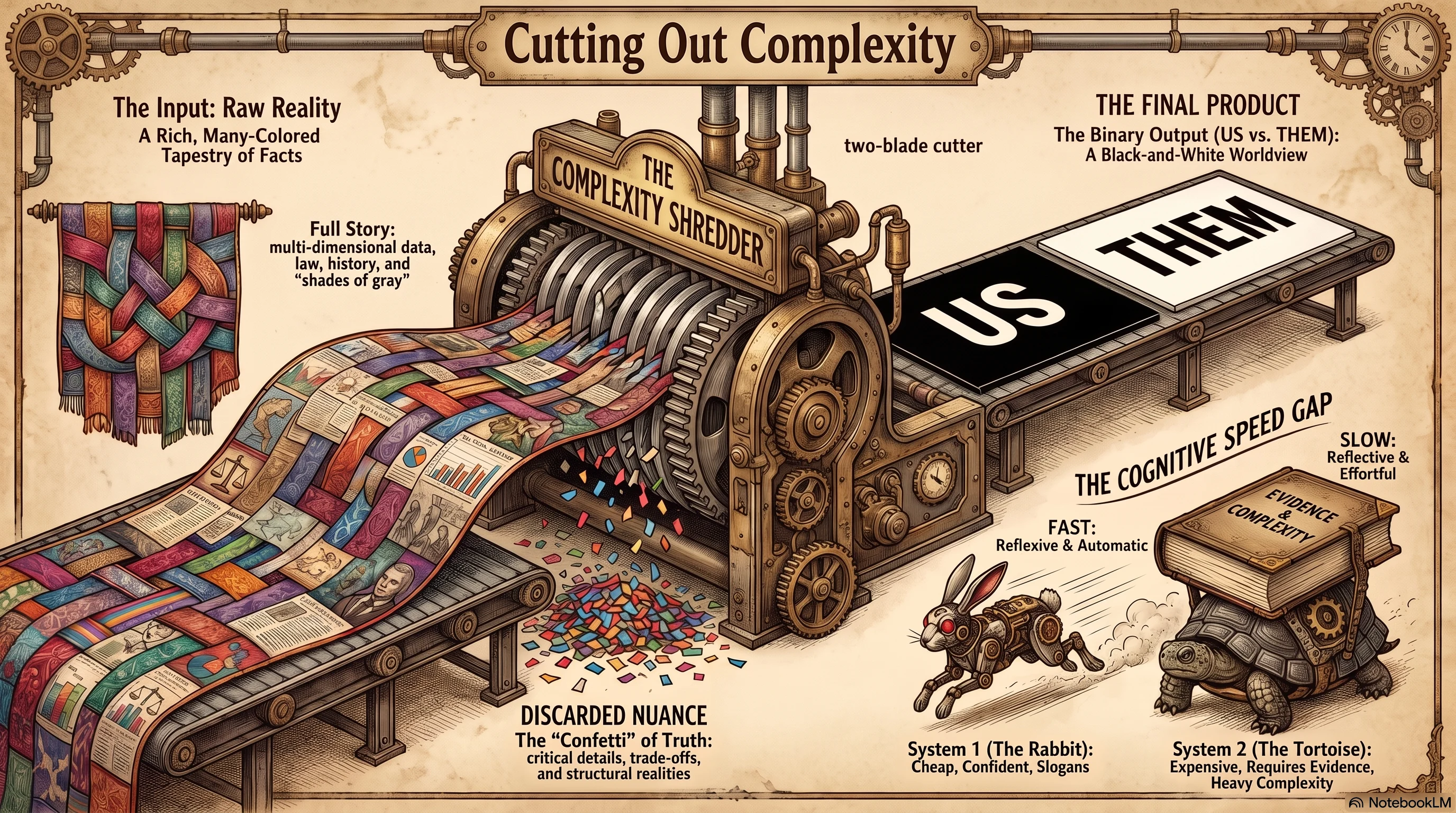
Fast thinking versus slow thinking. Spitale describes fast thinking as "reflexive, unconscious, automatic, routine, but prone to error." Slow thinking is "reflective, conscious, effortful, complex, and more reliable." Propaganda is designed for the fast lane. It arrives as a slogan, an image, a meme, a one-liner. It hits before the slow system can intervene. The slogan does not need to be true; it needs to be processed before the brain checks it.
Black-and-white thinking versus critical thinking. Spitale defines black-and-white thinking as "thinking in overly simplistic binary terms of positive or negative, right or wrong, good or bad." Critical thinking, by contrast, is "thinking that allows for complexity, nuance, and objective reasoning." Propaganda needs the first because the first is fast; the second is slow by design.
Narrative versus the full story. Spitale defines narrative as "a narrow perspective or singular point of view." The full story is everything the narrative had to leave out. A narrative is not necessarily a lie. A narrative might be made entirely of true facts. But it is narrow: it foregrounds one dimension and silences the others. Propaganda traffics in narratives because narratives feel complete from inside them.
Narrative fallacy. This is the deepest of the four. Spitale defines it as "constructing cause-and-effect relationships between events that may or may not be true, that provide a compelling story." The narrative fallacy is the brain reaching for a story that explains what happened, even when the available evidence does not support any specific story. A satisfying story feels like understanding. Most of the time, the feeling of understanding is upstream of the actual understanding, not downstream of it.
Cross-Curricular Connection: Historiography, the study of how history is written, has spent two centuries on a problem that turns out to be exactly the narrative-fallacy problem at scale. The past is always richer than any narrative about it; the historian's job is to compose a narrative knowing this and to flag the compression rather than hide it. This is the same ethical move Spitale assigns to journalism. The Philosophy of History course unpacks the move at length; see the historiography unit on narrative compression for the formal treatment of the problem this unit just walked at the propaganda scale.
Fact versus opinion as the same distinction restated
Spitale offers a clean way to test whether something is journalism or propaganda. He writes that "differentiating between what to think about and what to think is similar to distinguishing between fact and opinion. Journalism strives to tell us what to think about, while propaganda tries to tell us what to think."
This is not the high-school version of fact-versus-opinion, the one that teaches students that "the sky is blue" is a fact and "blue is the best color" is an opinion. Spitale is doing something more useful. He is asking: what is this sentence trying to do to me? A factual sentence describes a state of the world and invites the reader to weigh it. An opinion sentence delivers a conclusion and invites the reader to adopt it. Both are legitimate when they are labeled honestly. The propaganda move is to deliver opinion sentences in the clothing of factual ones: to phrase a conclusion so that it sounds like a description.
Try Spitale's own list. He pairs sentences deliberately to make the asymmetry visible:
- "The only thing that stops a bad guy with a gun is a good guy with a gun." That is a conclusion in the grammar of a fact. The sentence does not describe; it pre-decides.
- "The US has less than 5 percent of the world's population but owns half of the world's firearms." That is a factual claim. You can check it. It does not tell you what to do about it.
- "Raising the minimum wage will lead to higher unemployment." Conclusion in fact's grammar. Real economists genuinely disagree about this; the sentence pretends they don't.
- "Increasing the minimum wage means low-level employees will have more money to spend." Conclusion in fact's grammar going the other direction; same problem.
- "Anyone can improve their position in life if they work hard." Conclusion in the grammar of a maxim. The data on intergenerational mobility says otherwise; the sentence is doing identity work, not descriptive work.
The exercise is not "which side is right." The exercise is which sentences are journalism and which sentences are propaganda: which ones describe and invite you to weigh, and which ones conclude and invite you to repeat. Once the question is framed this way, the move becomes hard to unsee.
❓Concept Check
In Spitale's framing, what is the single most reliable test for distinguishing journalism from propaganda?
▸
Concept Check
In Spitale's framing, what is the single most reliable test for distinguishing journalism from propaganda?
Ask what the sentence is trying to do to you. Journalism describes a state of the world and invites you to weigh it: it tells you what to think about. Propaganda delivers a conclusion in the grammar of a description and invites you to repeat it: it tells you what to think. The same factual claim can do either job depending on whether the sentence concludes or describes.
Why the narrative wins
Spitale is clear about why the narrative beats the full story almost every time. A narrative is compact. It travels at the speed of a meme. It fits inside a chyron, a tweet, a chant. The full story does not. The full story requires patience, working memory, the willingness to hold a contradiction long enough to resolve it. The brain, left to its defaults, does not want to do that work. Spitale's analysis of marijuana as a "gateway drug" and of more guns as a path to safety are not arbitrary examples. They are slogans that survived decades of contradicting evidence because the slogans were tuned to the audience's pre-existing identity and the contradicting evidence was not.
This is the foundation Kahneman put under all of it. Time to move to the cognitive science.
Intake-Layer Overlay: Kahneman's Two Systems
In 20112011, the psychologist Daniel Kahneman published Thinking, Fast and Slow, the synthesis of forty years of joint research with Amos Tversky into how human judgment actually works. The book is the source of the vocabulary Spitale is using in Chapter 2. Spitale's "fast thinking" and "slow thinking" are Kahneman's terms, ported into media-criticism context. The audience for this course is capable of reading Kahneman directly, and should. The cliff notes here are not a substitute; they are an on-ramp.
System 1 and System 2
Kahneman's central claim is that the mind operates as if it contained two distinct systems, which he names, with full acknowledgment that this is a useful fiction rather than a neurological fact, System 1 and System 2.
System 1 is fast. It is always on. It runs without your permission. It tells you that the face in front of you is angry before you have consciously processed the eyebrows. It completes the phrase bread and ___ before you have decided to think about bread. It tells you that 2 + 2 is 4 without invoking arithmetic. It is intuitive, associative, emotional, and it is operating constantly in the background while you do other things. System 1 is also cheap. It uses very little of the brain's metabolic budget. It is also confident: it does not flag its own mistakes.
System 2 is slow. It is the system you experience as deliberate thought. It is the system that takes over when you are computing 17 × 24, when you are parking in a tight space, when you are reading a sentence in a language you are still learning. It is reflective, effortful, sequential. It is also expensive. Sustained System 2 thinking costs glucose, costs attention, costs you the ability to do other things at the same time. Because it is expensive, the brain rations it.
Kahneman's most important practical claim is the relationship between the two systems. System 1 proposes. System 2 disposes. System 1 generates an immediate impression, this person is trustworthy, this argument is correct, this stock will go up, and System 2 is supposed to review the impression before you commit to it. But System 2 is lazy. Most of the time, System 2 just signs off on whatever System 1 hands up. The only time System 2 actually engages is when System 1 produces a flag: when something feels off, when the answer is hard, when the cost of being wrong is salient. Propaganda is engineered to ensure that no flag is raised.
The bat and the ball
Kahneman's most famous demonstration of the System 1 / System 2 dynamic is a problem so short you can run it on yourself in three seconds.
A bat and a ball cost $1.10 together. The bat costs $1.00 more than the ball. How much does the ball cost?
Most people, including most students at Harvard, MIT, and Princeton, where Kahneman ran this exact problem, answer 10 cents. The answer is wrong. If the ball costs 10 cents and the bat costs $1.00 more than the ball, the bat costs $1.10, and the total is $1.20, not $1.10. The correct answer is 5 cents.
The 10-cent answer is the System 1 answer. The brain sees $1.10 and $1.00, subtracts, gets $0.10, and hands the result up to System 2. System 2, lazy, signs off. The 5-cent answer requires the brain to set up an equation: let x be the cost of the ball; then the bat costs x + 1; together they cost 2x + 1 = 1.10; therefore x = 0.05. That is System 2 work. It is slower, it is harder, and it is correct.
You can run a similar test on yourself with the riddles Spitale puts in his Application Exercises. They are doing the same psychological work as the bat-and-ball:
- "A boy has five piles of sand, and a girl has five piles of sand. They put them together. How many piles are there?" System 1 says ten. System 2 says one. (Piles combine.)
- "How many of each animal did Moses take on the ark?" System 1 says two. System 2 says Noah, not Moses, took the animals. The biblical names blur in System 1's associative cache.
- "A peppermint and a candy cane cost $1.10 total. The candy cane costs a dollar more than the peppermint. How much does the peppermint cost?" Spitale's direct port of Kahneman's bat-and-ball. The answer is $0.05; the System 1 answer is $0.10.
- "If a rooster lays an egg at the peak of a slanted roof, with one side at a 45-degree angle and the other at a 30-degree angle, which side will the egg roll off?" System 1 starts computing angles. System 2 notes that roosters don't lay eggs.
The same pattern recurs in every riddle. System 1 grabs the surface structure of the problem and produces an immediate answer. The answer is wrong because the problem is built to exploit exactly the surface feature System 1 latches onto. System 2 can fix the error, but only if it is invited in, and only if it accepts the invitation.
The Linda problem
Kahneman and Tversky's other most-cited demonstration is the Linda problem. Subjects are given a short description:
Linda is 31 years old, single, outspoken, and very bright. She majored in philosophy. As a student, she was deeply concerned with issues of discrimination and social justice, and also participated in anti-nuclear demonstrations.
Then they are asked which is more probable:
(a) Linda is a bank teller. (b) Linda is a bank teller and is active in the feminist movement.
The large majority of subjects pick (b). The large majority of subjects are wrong. The set of "bank tellers who are also active in the feminist movement" is a subset of the set of "bank tellers." It is mathematically impossible for the subset to be larger than the set it is contained in. The probability of (b) cannot exceed the probability of (a).
What is happening is that the description of Linda is engineered to make the feminist-bank-teller story more narratively coherent than the bare-bank-teller story. System 1 picks the answer that matches the story. System 2, if invited in, would catch the violation of the conjunction rule of probability. Most of the time, System 2 is not invited in.
Kahneman called this the conjunction fallacy. Spitale calls something very similar the narrative fallacy. They are pointing at the same machinery. The brain prefers a coherent story to an uncoherent set of facts, even when the coherent story violates basic logic.
Why this matters for propaganda
The whole architecture of modern propaganda, and the whole architecture of the present-tense attention economy that runs on it, is the deliberate engineering of artifacts that win in the System 1 lane before System 2 can intervene. A slogan. A meme. A chyron. A pull quote. A six-second clip. A thirty-second ad. A reaction GIF. Each of these formats is too short for sustained System 2 engagement. Each is calibrated to produce an immediate impression that the audience will then carry with them as if it had been thought through.
This is why Spitale's chapter title is cutting out complexity. The complexity is what System 2 would chew on. Cut the complexity, and System 2 has nothing to do. The artifact passes through the audience's mind on the System 1 highway, depositing its payload, the binary, the slogan, the team identification, without ever being inspected.
Propaganda's business model, stated as one sentence: the substitution of System 1 confidence for System 2 reasoning. Hold that sentence; the rest of the course is the elaboration of it.
Think About
The next time you are scrolling and you feel an immediate, confident reaction to a headline, agreement or rage, doesn't matter which, pause. Ask whether the reaction came from System 1 or System 2. If it arrived in under a second and feels obvious, it was System 1. What would invoking System 2 require you to actually check?
Scholar Roundtable
Spitale and Kahneman give you the spine. Three more voices extend the analysis into the places it needs to reach.
Nassim Nicholas Taleb: narrative fallacy as the brain's organizing principle
Nassim Nicholas Taleb's The Black Swan, published in 20072007, is where the term narrative fallacy enters the bloodstream of public discourse. Taleb borrowed the underlying psychology from Kahneman and Tversky and pushed it further. His claim is that the narrative fallacy is not an occasional cognitive glitch. It is the brain's default mode of organizing information. The brain is a story-machine. It cannot tolerate raw data. Confronted with a sequence of events, it will spontaneously generate a causal explanation, often within milliseconds, and then experience that explanation as if it had been deduced rather than confabulated.
Taleb's favorite illustration is the post-hoc market explanation. A stock falls 2 percent on a Tuesday. By Tuesday evening, every financial outlet has a reason: traders worried about inflation, the Fed signal was hawkish, the Mideast news spooked the market. On Wednesday the stock rises 2 percent, and every outlet has the opposite reason: traders shrugged off inflation, the Fed signal was softer than feared, Mideast tensions eased. The reasons are not deductions from evidence. They are stories spun retroactively to make the noise feel like signal. Taleb's point is that the demand for the story is the bug. The market does not require an explanation. The audience does. The narrative is supplied to satisfy the audience's narrative fallacy, not to track reality.
This is the precise mechanism Spitale identifies in propaganda. The propagandist supplies a narrative that the audience experiences as explanation. The narrative is engineered to be more satisfying than the actual evidence permits: welfare queens are why your taxes are high; immigrants are why your wages are flat; trans people are why your daughter's locker room feels unsafe. Each of those narratives is doing the job Taleb describes: substituting a clean causal story for messy structural reality. The narrative wins not because it is more accurate but because it is more narratively complete.
Taleb's gift to this course is the realization that the narrative fallacy is not a thing the manipulator does to the audience from outside. The manipulator is exploiting a fallacy the audience would have committed on its own. The propaganda is meeting the brain where the brain already is.
Cross-Curricular Connection: Taleb's diagnosis has a professional version that is harder to dismiss. Hayden White argued that historians working honestly from the sources still emplot the past, casting the same events as romance, tragedy, comedy, or satire, and that no external standard decides which casting the evidence supports. The French Revolution takes all four. If the plot shape is not read off the evidence even by people trained to read evidence, then "resist the narrative" is not a defense anyone can actually run. See White on emplotment in Philosophy of History. It leaves this unit with the question it has to answer for itself: if choosing a plot is unavoidable, what separates the historian's choice from the propagandist's?
Julia Galef: the scout mindset as a re-introduced discipline
Kahneman can be overwhelming for a student first encountering forty years of cognitive psychology in one chapter. Julia Galef is the friendly entry point. Her book The Scout Mindset, published in 20212021, takes the Kahneman-Tversky tradition and reframes it as a practice rather than a diagnosis.
Galef's core distinction is between the soldier mindset and the scout mindset. The soldier defends positions. The soldier's job is to know which side they are on, hold the line, and treat incoming counter-arguments as attacks to be repelled. The scout maps territory. The scout's job is to find out what is actually there, accurately, regardless of whether the map turns out to be flattering. The two mindsets are not personality types. Galef is clear that every person is capable of both. They are modes the brain can be invited into. The cultural question is which mode our institutions and our information environments invite us into by default.
Galef's contribution to this unit is a discipline rather than a diagnosis. She names a small set of habits that re-introduce doubt as a feature, not a bug:
- The outsider test: when you find yourself certain of something, ask whether you would believe it if it were being told to you by someone on the other team. If the answer is no, your certainty is coming from the source, not the argument.
- The counter-factual test: ask what evidence, if you encountered it tomorrow, would change your mind. If no such evidence exists, you are not holding an empirical belief; you are holding an identity.
- The equivalent-error test: when you are tempted to dismiss a mistake on your team as understandable and an identical mistake on the other team as damning, notice the asymmetry and correct it.
These are not abstract. They are exercises the student can run on their own beliefs starting today. Galef's framing also lets you describe what Spitale's chapter is asking of you without making it sound like an obligation. The scout mindset is the cognitive posture that survives Spitale's chapter. The soldier mindset is the one propaganda is built to recruit you into.
Amos Tversky: the silent co-author
A brief acknowledgment is owed here. Almost everything credited to Kahneman in the public imagination, System 1 and System 2, the conjunction fallacy, the availability heuristic, prospect theory, was produced in collaboration with Amos Tversky. Tversky died in 1996, six years before the Nobel Prize was awarded to Kahneman for the work they had done together. Kahneman has been clear throughout his subsequent career that the work was joint and that Tversky's name belongs on it. When you read Kahneman, you are reading Tversky too. When you cite the System 1 / System 2 framework, you are citing the Kahneman-Tversky research program. The fact that one half of that program did not live to receive the public credit it earned is a fact worth keeping in view.
The roundtable, taken together, is saying one thing: the narrative fallacy is the default, the soldier mindset is the path of least resistance, and the slow-thinking discipline that resists both is a practice you have to choose every time. It does not arrive automatically with adulthood, intelligence, or credentials. It has to be installed and maintained.
❓Concept Check
What does Julia Galef mean by the difference between the soldier mindset and the scout mindset, and why does she insist these are modes rather than personality types?
▸
Concept Check
What does Julia Galef mean by the difference between the soldier mindset and the scout mindset, and why does she insist these are modes rather than personality types?
The soldier mindset defends pre-existing positions; incoming arguments are threats to be repelled. The scout mindset maps territory; incoming arguments are data, regardless of whether they flatter what you already believed. Galef insists these are modes, not types, because every person can occupy either, and the relevant question is which mode the information environment is inviting you into by default. Propaganda is built to recruit the soldier; critical thinking is the deliberate practice of choosing the scout.
Historical Fractal
The "Did you go to law school?" meme is a 2024 instance of a much older move. To see the fractal, to see that the present is repeating something the past has already perfected, walk back fifty years to the canonical American example of cutting out complexity at a national-policy scale.
Reagan's welfare queen
In 19761976, Ronald Reagan was running an insurgent primary campaign against the incumbent Republican president, Gerald Ford. Reagan needed a way to fuse two concerns in his audience, concern about taxes and concern about race, without naming the second concern. He found his vehicle on the campaign trail in the form of a recurring stump-speech anecdote about a Chicago woman who was, in his telling, defrauding the welfare system on an industrial scale.
"She has eighty names, thirty addresses, twelve Social Security cards and is collecting veteran's benefits on four non-existing deceased husbands. And she is collecting Social Security on her cards. She's got Medicaid, getting food stamps, and she is collecting welfare under each of her names. Her tax-free cash income alone is over $150,000."
Reagan, campaigning in the South Carolina primary against incumbent Gerald Ford, repeated a version of this story dozens of times during the 1976 primary season. The figure was a composite that conflated several smaller fraud cases into one outsized character; the Cadillac detail in particular has never been substantiated.
The character was sometimes specified as Black, sometimes implied, sometimes left ambiguous; the audience's imagination did the work the speech declined to do explicitly. The Cadillac, which became attached to the character in later retellings, was the perfect prop: a luxury good consumed by someone the audience was being invited to imagine as undeserving. The figure of 80 names was an aggregate of several smaller fraud cases; the figure of $150,000 was not supported by any actual case. The story was, in Spitale's vocabulary, a narrative, a narrow perspective or singular point of view, being substituted for the full story of welfare in America, which was and is a story about a sprawling, imperfect, often inefficient, often racially structured system of programs designed to keep the bottom of the income distribution from falling through the floor.
What the narrative cut out
Spitale's framework gives you a clean way to see what Reagan's story did. It cut out:
- The scale. Welfare fraud existed and exists, at rates that researchers were already, in 1976, measuring at single-digit percentages of program disbursements. The marginal fraudster was nothing like the welfare queen character; the typical fraud case was small, individual, and embedded in cycles of administrative error as often as deliberate deceit.
- The structure. Welfare in 1976 was not one program. It was a federated patchwork of AFDC, food stamps, Medicaid, Social Security, and dozens of state-level supplements, each with its own eligibility rules and its own administrative apparatus. The compelling Cadillac character flattened that patchwork into a single grift.
- The recipient population. The actual modal welfare recipient in 1976 was a working-poor woman with children, often white, often rural, often cycling on and off benefits as low-wage employment came and went. The character on the stage was nothing like the population in the data.
- The policy alternative. If welfare fraud at the modeled scale were the actual problem, the policy solution would have been better administrative software and stricter eligibility verification. The political payoff Reagan was extracting from the story was not any specific reform; it was the binary itself, deserving Americans versus undeserving cheats, which justified cutting the programs without ever having to argue about the actual programs.
The story did what Spitale predicts a propaganda narrative will do. It collapsed a complex policy domain into a clean binary. It loaded the binary so that one side was the side of decent working people and the other side was the side of frauds. It hit System 1 with a vivid, memorable character, Cadillac, eighty names, $150,000, that traveled faster than any actual policy analysis could. And it lasted. By the 1990s, the welfare queen was a national archetype, deployed by politicians of both parties in the run-up to the 1996 welfare-reform bill that ended AFDC. The character survived four decades because the character was narratively complete in exactly the way the underlying policy reality was not.
The fractal repeats
Look at the move and the move repeats. Linda the bank teller from Kahneman's lab, a coherent biographical narrative that overrides the conjunction rule of probability, is the same machinery as the Chicago woman with eighty names from Reagan's stump speech. The "Did you go to law school?" meme is the same machinery deployed against a different complexity: the complexity of constitutional reasoning instead of the complexity of welfare administration. In each case, a vivid, compact, emotionally loaded artifact does the work that a careful analysis would otherwise have to do, and does it faster than the slow system can intervene.
The instructive part is not that Reagan invented the move. He did not. Edward Bernays was deploying it in the 1920s; the tobacco industry was deploying it in the 1950s; you can find versions of it in nineteenth-century yellow journalism. What Reagan did was demonstrate at full national scale that a single fabricated character could carry a multi-decade policy agenda because the character satisfied the narrative fallacy in the audience. Once you can name that as a move, you start seeing it everywhere: in campaign ads, in cable-news segments, in the meme economy of the present.
The Source-Code Audit Applied
Run the audit on the hook. The artifact is the "Did you go to law school?" reply meme as it has circulated on social platforms across 2024-26, used most prominently in threads about high-profile prosecutions, Supreme Court rulings, and First Amendment cases involving non-credentialed speakers offering legal interpretations.
1. The Simon/Kahneman audit: the hook
What emotion is the artifact engineered to make the body feel? Which System 1 shortcut is being exploited?
The emotion is vindication mixed with contempt. The meme is designed to land on a specific subset of the audience: the credentialed, the establishment-aligned, the people who have spent the last decade watching what they consider an unqualified online commentariat opine confidently on things the commentariat does not understand. To that audience, the meme arrives as catharsis. Finally, someone is calling out the presumption. That is the System 1 hit. It feels like a small victory landing without effort.
For the other side of the audience, the meme is engineered to produce a different System 1 response: resentment, the feeling of being talked down to by someone using a credential as a cudgel. That emotion produces engagement of a different kind: indignant replies, screenshots posted to the other team's timelines, the meme circulating as evidence of the establishment's contempt. The artifact is doing double duty. It is engineered to generate engagement from both sides of the binary it is creating.
The System 1 shortcut being exploited is the credentialism heuristic: the brain's fast-lane substitution of credential-checking for argument-checking. The shortcut is genuinely useful in some contexts. When your appendix bursts, you should defer to surgeons, not commentariat. But the shortcut also has the property of being applicable instantly without engagement with the substance. It produces a confident judgment, they don't know what they're talking about, that arrives faster than any actual assessment of what they said. System 1 supplies the verdict; System 2 is told to go back to sleep.
2. The Zuboff audit: the extraction
Who profits from my engagement with this version of reality? What behavioral data is being collected?
This is the part of the audit that the meme economy makes especially clean to see. The platforms hosting the meme, X, Threads, TikTok, Instagram, are not neutral pipes. They are advertising businesses whose revenue depends on the time you spend on the platform and on the precision with which they can predict and influence your next action. Every reply, every quote-post, every screenshot, every block, every follow that the meme triggers is data being captured and sold.
When the meme circulates, the platform learns several things about you specifically. It learns which side of the binary you are on. It learns how reliably you can be triggered into engagement. It learns whose content you reliably amplify and whose content you reliably argue with. It learns which adjacent topics light up the same engagement profile. The meme appears in a thread about, say, the Supreme Court, but you also engage with adjacent threads on housing policy and labor law. Over many such engagements, the platform builds a model of you that is precise enough to monetize: to sell to advertisers, to sell to political campaigns, and increasingly to sell to anyone who wants to model and predict a particular slice of the public.
The meme is not, in this analysis, primarily a political statement. It is primarily engagement bait that happens to wear a political costume. The political content is what makes you react; the reaction is what produces the data; the data is what gets sold. Shoshana Zuboff calls the underlying business model surveillance capitalism: the extraction of behavioral surplus from human activity, for the purpose of predicting and shaping future behavior. The meme is one tiny piece of input into that extraction machine.
Asked plainly: who profits from your engagement with the "Did you go to law school?" meme? The answer is not the credentialed lawyers winning the small daily fight. It is the platform whose advertising business depends on your continued presence, and the actors, advertisers, campaigns, foreign and domestic, who buy access to the audience profile your engagement helps build.
3. The Habermas audit: the strategy
Is this artifact inviting me to understand the world, or demanding I comply with a predetermined position?
This is the cleanest of the three audits for this particular meme, because the meme's structure makes the answer obvious once you ask the question. The artifact is not inviting understanding. The artifact is foreclosing understanding. The whole point of the meme is to terminate the conversation. It does not introduce a counter-argument; it disqualifies the speaker. It does not engage the substance; it questions the standing. The implicit demand is stop arguing this, defer to credentialed authority, the conversation is over.
Jürgen Habermas's analysis of communicative action, the kind of speech aimed at mutual understanding through reasoned exchange, versus strategic action, speech aimed at producing a predetermined behavioral outcome in the listener, gives you the vocabulary for what the meme is doing. The meme is strategic action wearing the costume of communicative action. It appears in a thread of discussion, where the operative norm is that participants are exchanging reasons. It does not exchange reasons. It pulls a credential card and ends the exchange. The form is conversation; the function is closure.
A version of this meme that would have been communicative action would have been: "I'm a lawyer; here's what's actually going on in this case, and here's why the take above misses it." That sentence engages. It cites. It teaches. It treats the other person as a participant in a shared attempt to understand. That is the journalist's job in Spitale's framing: telling us what to think about. The actual meme, "Did you go to law school?", does the propagandist's job. It tells us what to think (defer) without ever explaining what we are deferring to.
What the deleted complexity is
Running the three audits together, the question Spitale's chapter asks comes into focus: which complexity was deleted to produce this binary, and what would re-introducing the deleted nuance do to the meme's emotional payload?
The deleted complexity is the entire middle ground between credentialed lawyers know everything and non-credentialed citizens know nothing. That middle ground includes:
- The fact that constitutional interpretation is a public craft, conducted in opinions that are written in English specifically so that the public can read them. The Federalist Papers were newspaper essays. The Bill of Rights is a one-page document. The First Amendment is one sentence.
- The fact that working lawyers disagree with each other constantly, in legal briefs that quote the same statutes and reach opposite conclusions. Did you go to law school is not a tiebreaker among lawyers; lawyers wield it against each other in oral argument as a soft insult, not as a substantive move.
- The fact that elite-credentialed Supreme Court justices, all of whom attended Yale or Harvard or equivalent, split 5–4 on cases all the time, and have done so since the founding. The credential does not determine the conclusion.
- The fact that some of the most important legal arguments in American history, abolition, women's suffrage, civil rights, marriage equality, were carried in significant part by people who were not, at the time they made the arguments, credentialed lawyers.
- The fact that democratic self-government presupposes a citizenry capable of understanding its own foundational documents at least at a working level. A polity in which only lawyers may speak about law is not a democracy; it is a guild society.
Re-introducing any of those points punctures the meme. The binary requires that all of them stay deleted. The moment any one of them is back on the table, the meme stops working. The System 1 vindication evaporates, because the implicit premise (credentials track substance) collapses into the actual premise (credentials track training, sometimes correlate with substance, sometimes do not). That is what Spitale means when he says propaganda works by cutting out complexity. The slogan is doing the work of an argument; restoring the missing complexity exposes the argument the slogan was hiding.
Closing: Complexity as Intellectual Discipline
Spitale's Chapter 2 names the first move propaganda makes. Hold complexity, and the propagandist's slogan does not stick. Lose complexity, and you have already lost the argument before it begins.
The next two units of this course go deeper into the same problem from two different angles. Unit 4, Bias and the Brain, asks why the binary collapse succeeds against minds that, in calm moments, know better. The answer is that the brain ships with a set of biases, confirmation bias, availability bias, negativity bias, in-group bias, that pre-warm the System 1 channel for exactly the kind of narrative the propagandist supplies. The propagandist is not installing the bias; the bias is already there. The propagandist is matching to it.
Unit 5, Emotional Manipulation, asks how the artifact actually weaponizes the bias once the bias is identified. The answer is that emotion routes around the slow system entirely. Anger, fear, disgust, and vindication arrive in milliseconds. They tag the artifact as important before the brain has any chance to ask whether the artifact is accurate. The combination, bias to match, emotion to bypass, is what makes the binary collapse so consistently effective.
What this unit asks you to install, before moving on, is a disposition. Spitale's word for it is critical thinking; Galef's word for it is the scout mindset; Kahneman's word for it is engaging System 2. They are all describing the same posture. When a sentence arrives confident and binary and emotionally loaded, the posture is to slow down. To ask: what is being cut out to make this fit? To ask: whose narrative is this, and at whose expense is the missing complexity being held silent? To ask: am I responding because I have evaluated this, or am I responding because System 1 has already decided?
The discipline is not skepticism for its own sake. It is not contrarianism, and it is not the cultivated cynicism that treats every claim as suspect. The discipline is the willingness to hold complexity long enough to honor what is actually there. That is the difference Spitale draws between journalism and propaganda. Journalism, at its best, holds the complexity and gives it to you. Propaganda strips the complexity and gives you the conclusion. The audience's job, the citizen's job, the student's job, your job, is to know which one you are reading, and to refuse to be a vector for the second.
The next unit will tell you why this is harder than it sounds.
Dan Olson's 80-minute essay starts as a debunking of flat-earth claims and pivots, around the 30-minute mark, into a forensic walk through how conspiracy-binary thinking installs itself in cognition. The pivot is the lesson: Olson refuses the simple debunking that would treat flat-earthers as stupid, and instead shows the cognitive machinery that makes binary worldviews emotionally satisfying. This is exactly what Spitale's Chapter 2 anatomizes. Pair with Unit 3 because Olson demonstrates the cutting-out-complexity move in the same long-form analytical posture the course teaches.
Watch on YouTube