Power, Profit, and Propaganda: Think Tanks, Front Groups, and the Overton Window
Spitale Chapter 6 traces the corporate infrastructure of propaganda: think tanks, front groups, deregulated airwaves, the Overton window. This unit anchors in Musk's 2024-26 algorithmic reshaping of X and Zuboff's surveillance-capitalism overlay, with the historical fractal returning to the 1971 Powell Memo.
Learning Objectives
- 1Distinguish democracy (civil protections, non-profit-driven public services) from capitalism (production for profit) as Spitale defines them
- 2Identify think tanks, lobbying groups, and front groups (astroturf) as propaganda infrastructure
- 3Define the Overton window and explain how it gets moved deliberately
- 4Recognize the Powell Memo as the strategic blueprint of late-20th-century U.S. corporate political mobilization
- 5Apply Zuboff's surveillance-capitalism frame to a contemporary platform's algorithmic behavior
Hook: Musk, X, and the Algorithm as Propaganda Infrastructure
In October 2022, Elon Musk closed his $44 billion acquisition of Twitter. Within weeks, the platform's behavior began to change in ways that are now thoroughly documented and that map, almost line for line, onto Spitale's Chapter 6 thesis about corporate ownership of mass communication.
The first visible signal was personal. In February 2023, internal engineers were ordered to build a system that artificially boosted the reach of Musk's own posts. The engineering decision was a multiplier: his posts would be treated as roughly a thousand times more important than an ordinary user's post for the purposes of the ranking algorithm. This was not inferred from outside; it was reported from inside the company by employees who were ordered to ship the change after Musk noticed that a Super Bowl post by President Biden had outperformed his own. The owner of the platform had pushed a button and made himself, mechanically, louder than every other voice in the room.
That alone would matter. But the personal amplification sat on top of a more consequential reconfiguration. In late 2022, the platform suspended the accounts of several prominent journalists, reporters from the New York Times, the Washington Post, CNN, and others, who had been covering Musk's business and personal conduct. The suspensions were short-lived, but the signal was permanent: the platform's owner could remove a journalist from the largest real-time newswire in the world for the offense of covering him. Through 2023, advertisers left at a pace that turned a previously profitable business into a money-losing one: IBM, Apple, Disney, Sony, Comcast, Lionsgate, Paramount, Warner Bros., and others either paused or ended their spending. The exodus accelerated in November 2023 after Musk publicly endorsed an antisemitic conspiracy theory and told the departing advertisers, in a public conference interview, to "go fuck yourself." A man who had paid $44 billion for the platform was choosing to lose money to make a political point.
The 2024 U.S. election cycle revealed what the platform had been rebuilt for. Independent academic analyses of the algorithm between July 2024 and Election Day documented two patterns: accounts associated with one party were amplified at substantially higher rates than accounts associated with the other, and the owner's own posts, by then almost exclusively political, were the most-viewed content on the platform, repeatedly. Musk personally contributed roughly $250 million to political action committees supporting one candidate, held nightly livestreams, and repeated narratives that had originated in fringe accounts. The algorithm carried those narratives into the feeds of users who had never followed him.
Hold that picture: a single private owner, having bought the infrastructure of a quasi-public communications network, reconfigured the ranking system to amplify his preferences, defended the reconfiguration as free speech, and spent the resulting reach to influence the outcome of a presidential election in which he then accepted an administration appointment.
This is not a story about one billionaire's eccentricity. It is the precise scenario Spitale's Chapter 6 describes as the steady-state condition of corporate-owned mass communication. Spitale writes that the "true ruling power in society rests with those who wield influence through the media" (Ch 6). What X became in 2024 is not the corruption of a public square. It is the unmasking of an arrangement that was always private property, behaving the way private property behaves when its owner finds it more useful as a propaganda asset than as an advertising business.
This unit is the analytical apparatus for naming what just happened, and for naming what is happening, right now, on the other platforms whose owners have been quieter and whose architecture is the same.
Think About
Before you read further: write down, in one sentence, what you think the difference is between an advertising business and a propaganda business. Then write down whether you think the platform you spend the most time on is currently operating as one, the other, or both. You will revise this answer by the end of the unit.
Spitale's Framework: The Corporate Engine
Spitale opens Chapter 6 by quoting the Australian social psychologist Alex Carey, whose work on the political economy of propaganda is the scholarly bedrock of this entire analysis. Carey's thesis, paraphrased by Spitale: "the three greatest political developments of the 1900s were the growth of democracy, the growth of corporate power, and the growth of corporate propaganda (to protect an organization's power against democracy)" (Ch 6).
Read that sentence twice. The third development exists because of the first two. Democracy gives ordinary people a vote. Corporate power produces concentrations of wealth large enough that the votes of ordinary people threaten that wealth. Corporate propaganda is the engineered response: a steady manufacturing of public opinion designed to keep the wealth from being redistributed by the votes.
Spitale's analytical move in this chapter is to take that simple frame and walk it through its institutional forms. He names the mechanism: "By convincing consumers to think like corporations, these economic titans influence public opinion so that it becomes public policy" (Ch 6). The corporate-propaganda machine does not need to censor citizens or rig elections. It only needs the citizens to vote, freely and proudly, for the corporation's preferred outcome, to vote as if they were small shareholders of a system that owns no shares in them.
To make that maneuver work, the chapter argues, the propaganda must first install a vocabulary. So Spitale spends Chapter 6 inventorying the vocabulary. We will walk it.
Democracy versus capitalism
Spitale gives the student two precise, non-overlapping definitions that most American adults conflate:
Democracy is "a system of government in which every citizen has the ability to elect representatives to legislate and ensure the government provides civil protections and public services that don't have a profit incentive" (Ch 6). The operative phrase is the last one. Democracy, under Spitale's definition, is what produces the goods a profit motive cannot produce: clean air, libraries, a postal service that reaches every address regardless of yield, a public-health response that does not means-test the cure.
Capitalism is "an economic system in which businesses control the means of production in order to make money" (Ch 6). Capitalism is a tool for producing private wealth. It is good at producing private wealth. It is structurally indifferent to producing the goods democracy is responsible for, because those goods do not produce private wealth.
The two are not synonyms. They are not even partners. They are different categories. The reason American civic discourse keeps treating them as the same word is that decades of corporate propaganda have worked to fuse them. Spitale's first analytical demand is that the student un-fuse them.
❓Concept Check
Spitale defines democracy and capitalism as separate categories. State each definition in your own words, and then explain why he insists they are not interchangeable.
▸
Concept Check
Spitale defines democracy and capitalism as separate categories. State each definition in your own words, and then explain why he insists they are not interchangeable.
Democracy is a system of government in which citizens elect representatives who deliver civil protections and public services that do not have a profit incentive. Capitalism is an economic system in which businesses control the means of production for the purpose of making money. They are not interchangeable because they answer different questions: democracy answers how we make collective decisions and provide non-profit-driven goods; capitalism answers how private wealth gets produced. Conflating them lets capitalism's interests be marketed as democracy's interests, which is precisely the propaganda move Chapter 6 names.
Laissez-faire and neoliberalism
Once the categories are clear, the chapter introduces the ideological apparatus that has spent fifty years collapsing them. Laissez-faire economics is "an economic model in which the market is free to do what it wants without government oversight or interference" (Ch 6). The phrase is French, let it do, and it has been around since the eighteenth century. What is new is its rebranding.
Neoliberalism is "an ideology of laissez-faire market principles that includes deregulation, privatization, and small government" (Ch 6). The word "neoliberal" is one of the most contested terms in contemporary political economy, but Spitale uses it precisely: it is the modern ideological package that argues markets are the proper allocator of all goods, including the goods democracy was supposed to be responsible for. Schools should be markets. Prisons should be markets. Health care should be a market. Speech should be a market. The water should be a market. The argument, repeated long enough, makes the categorical confusion feel like common sense.
The student should pause here. Neoliberalism is not the same as conservatism. It is not the same as Republican Party platform. It is an ideology that has had bipartisan champions in the United States since roughly 1980, including Democratic administrations that pursued deregulation, financialization, and the privatization of public goods. Naming it is not partisan analysis. It is structural analysis.
Cross-Curricular Connection: Spitale treats the fusion of democracy and capitalism as a propaganda product, which makes it sound manufactured and therefore recent. Antonio Gramsci gives the same phenomenon a longer name and a harder claim. Cultural hegemony is rule that runs through schools, media, and the common sense of everyday life instead of through force, and its signature is that the people living under it do not experience the ruling worldview as anyone's ideology. They experience it as reality. See Gramsci on cultural hegemony in Intro to Sociology. The un-fusing this chapter asks of you is what Gramsci called a war of position, and he put its timescale in decades and institutions rather than definitions.
Lobbyists, think tanks, and pretense balancing
The chapter then names the three institutional forms through which neoliberal policy gets manufactured and delivered.
Lobbyists are "corporate representatives who seek to influence Congress, sometimes by directly drafting bills for representatives to sign" (Ch 6). The phrase directly drafting bills deserves attention. The American Legislative Exchange Council (ALEC), founded in 1973 and expanded aggressively after 1985, exists for precisely this purpose: corporate members write model legislation, state legislators introduce that model legislation in their statehouses, and the resulting laws, on everything from gun policy to voting access to environmental rules, bear the fingerprints of the corporate authorship. The mechanism is not hidden. It is just unfamiliar to most voters.
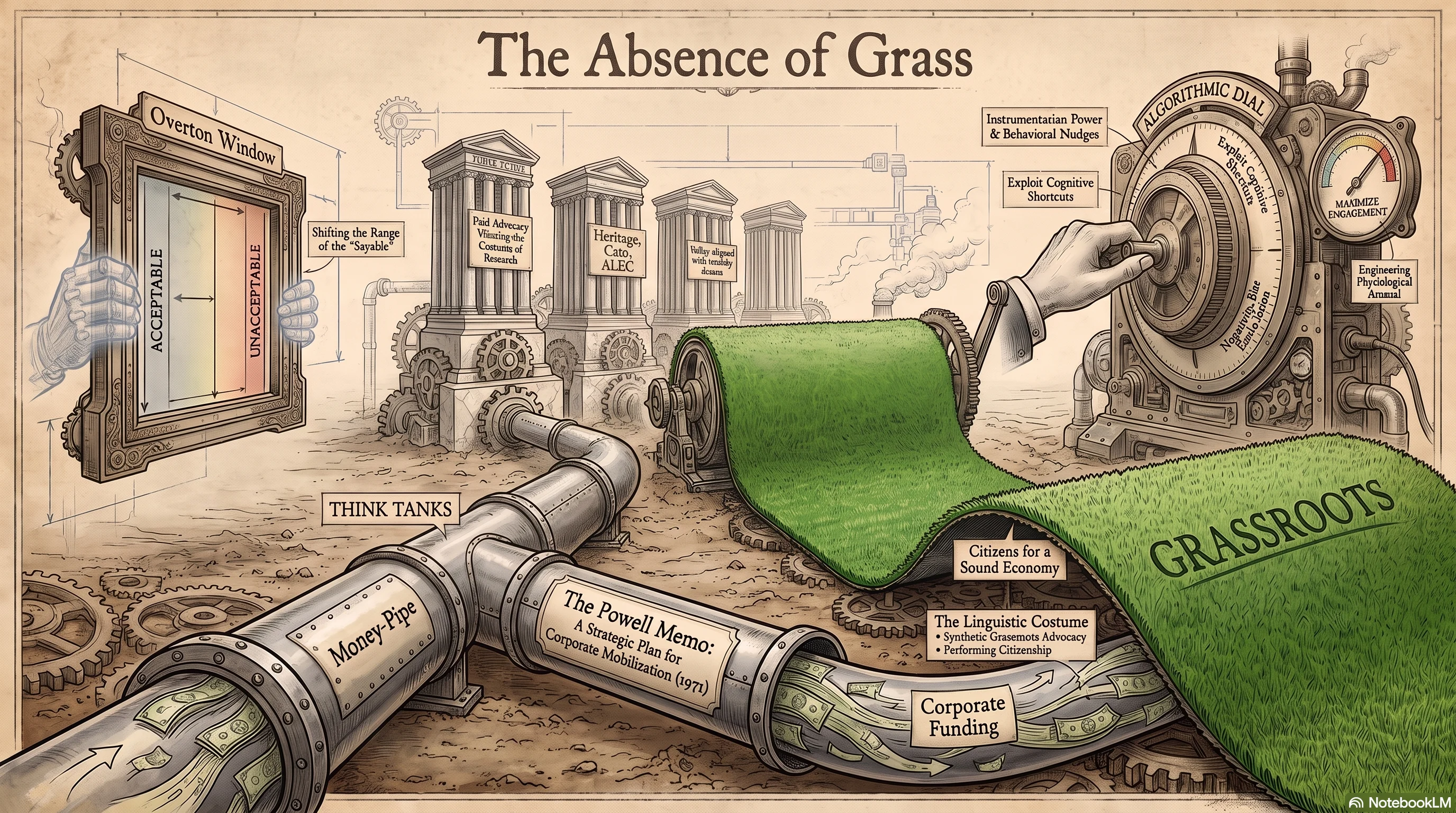
Think tanks are "politically motivated institutes that often advocate for industry and economic policies that benefit their wealthy backers" (Ch 6). This is one of the most important definitions in the entire course. The think tank presents itself as a research institution. It produces reports, hires fellows with academic titles, hosts panels, and feeds quotations to the press. What it does not do is produce findings that contradict the interests of the donors who fund it. The Heritage Foundation, the Cato Institute, the American Enterprise Institute, the Manhattan Institute, the Mercatus Center, the Mackinac Center, the State Policy Network: these are not universities. They are paid advocacy operations wearing the costume of universities. The costume is the propaganda.
Pretense balancing is the news media's complicity in laundering the think-tank product. Spitale defines it as "when news outlets appear to show both sides of a political debate but tilt heavily toward the side of a corporate think tank" (Ch 6). The journalist invites one university scientist and one think-tank fellow onto the segment, frames the exchange as a debate, and the audience walks away believing the science is contested. The science is not contested. The contest is the propaganda product.
Cross-Curricular Connection: US Politics' money-power-corruption unit is the political-science counterpart to Spitale's Chapter 6. Where this unit names the propaganda apparatus money buys, US Politics maps the institutional mechanisms by which the money enters the political process in the first place. See Money, Power, and Corruption in US Politics.
The Overton window and the Dunning-Kruger effect
The two cognitive concepts Spitale introduces here are the levers the institutional apparatus pulls.
The Overton window is "the range of social, political, or economic ideas accepted in the public sphere at a given time" (Ch 6). Named for the political theorist Joseph Overton, the window describes what is currently sayable in mainstream conversation without being dismissed as fringe. The window moves. It moves because somebody is pushing it. Think tanks push it by floating ideas that are initially considered unthinkable, repeating them until they become merely radical, then merely controversial, then merely a policy option, then law. The strategy is patient. It is also documented. Heritage Foundation strategists have written publicly about exactly this sequencing for decades.
The Dunning-Kruger effect is "an illusion of knowledge in which the more we think we know about something, the less we tend to actually know" (Ch 6). Spitale's reason for including it in Chapter 6 is structural, not just psychological. A population that has been propagandized into confidence about subjects it does not actually understand is the ideal audience for the next round of propaganda. Confidence is the precondition for manipulability. The humble student, the one who knows what she does not know, is harder to move. The corporate-propaganda apparatus prefers a confident voter who feels she has done her own research, because the research she has done is the research the apparatus prepared for her.
Freedom of the individual versus freedom of the market
Spitale closes the vocabulary list with the trade-off the entire chapter has been building toward. He writes that "every political decision (and all legislation) can serve only one group of constituents at a time (business or labor, corporation or consumer, etc.)" (Ch 6). The framing is austere on purpose. Most American political rhetoric pretends a policy can serve everyone. Spitale insists it cannot. A policy either protects the freedom of an individual person to live, work, breathe, and organize, or it protects the freedom of a market to operate without interference. It cannot, structurally, do both at the same scale on the same question.
The chapter then quotes the journalist George Monbiot's brutal compression of this trade-off, which Spitale carries into the application exercises: "Freedom from trade unions and collective bargaining means the freedom to suppress wages. Freedom from regulation means the freedom to poison rivers, endanger workers, charge iniquitous rates of interest and design exotic financial instruments. Freedom from tax means freedom from the distribution of wealth that lifts people out of poverty" (quoted in Ch 6). Every "freedom" the neoliberal vocabulary celebrates is, on closer inspection, a freedom-for somebody and a freedom-from-protection for somebody else. The propaganda hides the second clause.
Front groups and astroturf
The chapter ends its vocabulary survey with the most flamboyant of the corporate-propaganda inventions: the front group, or astroturf organization. Spitale describes front groups as "organizations that appear to be grassroots community coalitions but that are created and backed by industry and that usually seek to oppose government regulations" (Ch 6). The metaphor is exact. Real grass, actual citizens organizing from below, is replaced with synthetic turf. The product looks like a lawn. It is plastic.
Spitale provides a catalog. Some of the names are almost comically transparent once you know to look for them: Citizens for a Sound Economy, Committee to Protect Jobs, Tennessee Center for Policy Research, Center for Consumer Freedom, Citizens for Fire Safety, Freedom of Expression Foundation, Coalition for Americans at Risk, Freedom Task Force, Citizens for a Free Kuwait, American Energy Alliance, Global Climate Coalition, Trucking Information Service, Information Council for the Environment, Citizens Against Lawsuit Abuse, Lawsuit Abuse Watch, Greening Earth Society (Ch 6). The pattern is the linguistic fingerprint: the words "citizens," "freedom," "consumer," "coalition," "council," and "watch" doing the heavy lifting. A real citizens' group does not need to insist that it is a citizens' group in its name. Only an astroturf operation needs to perform the citizenship.
Two examples deserve naming. Citizens for Fire Safety lobbied to keep toxic flame retardants in furniture; it was funded by the three companies that manufactured the chemicals. Citizens for a Free Kuwait produced the 1990 testimony of "Nayirah," who claimed Iraqi soldiers had thrown Kuwaiti babies from incubators; it was funded by the Kuwaiti government and managed by the PR firm Hill & Knowlton. The testimony was false. Both fronts did the work they were paid to do: one delayed flame-retardant reform by decades, the other helped move U.S. public opinion toward the 1991 Gulf War.
❓Concept Check
A group calling itself the 'American Coalition for Clean Coal Electricity' runs television ads opposing new emissions regulations. What three questions does Spitale's framework prompt you to ask before you accept this group's claims?
▸
Concept Check
A group calling itself the 'American Coalition for Clean Coal Electricity' runs television ads opposing new emissions regulations. What three questions does Spitale's framework prompt you to ask before you accept this group's claims?
First: who funds it? If the donors are the coal companies whose emissions would be regulated, the 'coalition' is a front group, not a citizens' group. Second: what is the policy position, and who benefits from that position? If the position protects industry profits at the expense of public health, that asymmetry tells you which constituent the group actually serves. Third: what is the linguistic costume? The words 'American,' 'coalition,' and 'clean' are doing propaganda work: they are performing the citizenship and the environmentalism that the funding contradicts.
Intake-Layer Overlay: Zuboff and Surveillance Capitalism
Spitale wrote Chapter 6 in 2022. He names think tanks, lobbyists, front groups, and corporate-owned media. He is correct about all of them. But his frame predates a structural shift that the Harvard social psychologist Shoshana Zuboff has been documenting since the late 2000s, a shift that this unit needs to layer on top of Spitale's vocabulary, because without it the contemporary platform behavior in the hook is illegible.
Zuboff's 2019 book, The Age of Surveillance Capitalism: The Fight for a Human Future at the New Frontier of Power, is the most rigorous academic treatment we have of what platform companies actually do for a living. Her core claim, stated as plainly as she states it: human experience is now treated as a free raw material. It is extracted from us as we move through digital environments. It is translated into behavioral data. The behavioral data is processed into predictions about what we will do next: what we will click, buy, vote for, believe, fear. Those predictions are then sold, not to us, but about us, to clients in what Zuboff calls behavioral futures markets.
This is surveillance capitalism, and the word "surveillance" in Zuboff's hands is not metaphorical. She uses it the way a historian uses "feudalism": as the name of an economic order with its own logic, its own incentives, and its own characteristic injustices. Three of her terms need to enter your working vocabulary.
Behavioral surplus
When you use a digital service, it collects more data than the service requires. Your search query is what it needs to return a result. Your scroll velocity, hover patterns, cursor hesitations, typo corrections, location, battery level, accelerometer readings, your friends' behavior, your friends' friends' behavior: those are the behavioral surplus. Zuboff's argument is that the entire surveillance-capitalist business model was built on the discovery, around 2002 inside Google, that this surplus had commercial value. It could be processed into predictions. The predictions could be sold. The user did not need to be told.
The implication for Spitale's frame is severe. The "marketplace of ideas" metaphor that we inherited from John Stuart Mill assumes that participants in the marketplace are exchanging arguments. Zuboff shows that, on the platforms that now host most public discourse, the participants are not exchanging arguments. They are producing behavioral surplus while they exchange arguments. The platform is not the venue; the platform is the harvest.
Cross-Curricular Connection: Behavioral surplus was a discovery before it was a business model: the moment, around 2002 inside Google, when the exhaust data from search was found to have commercial value. History of Technology tells that origin story in full: see The Moment Google Discovered Gold. Reading how the extractive order was invented, alongside this unit's account of how it is now weaponized for propaganda, is the present-to-past move the course runs on.
Prediction products
The behavioral surplus, processed at scale by machine learning, becomes prediction products. A prediction product is not a guess about an individual person; it is a probabilistic claim about a population. Of the people who looked at this ad for 1.3 seconds and scrolled past, how many can be re-targeted three days later with a 12 percent higher probability of conversion? Of the people who watched this political video to completion, how many will donate to a candidate if shown a fundraising appeal in the next 48 hours? Of the people who clicked angry-react on this post, how many will click it again on a similar post about a different topic? The prediction products are the commodity. They are bought by advertisers, by political campaigns, by intelligence services, and, in the case Spitale's chapter is most worried about, by anyone who wants to influence the formation of public opinion at scale.
The key Zuboff insight is that prediction products get more valuable as they get more certain. The way to make them more certain is not to predict behavior more accurately. It is to modify behavior to make it more predictable. The incentive structure of surveillance capitalism, Zuboff argues, therefore drives the platform toward what she calls behavioral modification at scale. The platform learns to nudge you toward the outcomes it has sold predictions about. The nudges feel like recommendations. They are not recommendations. They are sales fulfillment.
Instrumentarian power
Zuboff's third term is the one that bridges most directly into Spitale's chapter. Instrumentarian power is the name she gives to the kind of power surveillance capitalism wields. It is not the totalitarian power of the twentieth-century state: that power demanded belief and punished dissent. Instrumentarian power does not care what you believe. It does not punish your dissent. It simply harvests your behavior, predicts your behavior, modifies your behavior, and renders your behavior into someone else's revenue. You can think whatever you want. The platform is doing something more efficient than thought control. It is renting your attention by the millisecond, in an auction you are not invited to.
This is the layer Spitale's Chapter 6 does not quite reach. When Musk reconfigures the X algorithm in February 2023, he is not just acting as a corporate owner influencing public opinion in the manner Spitale describes. He is exercising instrumentarian power over a behavioral-surplus harvest that was already extracting attention from hundreds of millions of users. The propaganda capacity is the byproduct. The harvest is the business.
Spitale × Zuboff
Stack the two frames. Spitale tells you that corporate propaganda exists to protect corporate power from democratic accountability. Zuboff tells you that the contemporary platform economy is structured so that every act of attention, including every act of democratic deliberation, is harvested as raw material for prediction products that are sold to whoever wants to influence what people do next.
Combine them and you get the picture: the "marketplace of ideas" on a modern platform is a behavioral-data market wearing the costume of public discourse. The arguments people exchange in the comments are not the product. The arguments are the bait. The product is the behavioral surplus generated while people exchange arguments. The platform's incentive is not for the arguments to be true. The platform's incentive is for the arguments to be engaging: sticky enough to extend the session, emotional enough to drive interactions, polarized enough to keep both sides scrolling. Truth, in this incentive structure, is a coincidence. Often an inconvenient one.
Cross-Curricular Connection: Habermas set three structural conditions for a public sphere: access, autonomy, and the force of the better argument rather than the force of money. Hold the Zuboff stack against that list. The platform supplies access better than any institution that preceded it and dissolves the third condition, because an engagement ranking is money arriving in the costume of interest. See the colonization of the public sphere in Architecture of Modernity, which complicates the timeline this unit implies. Habermas dated the damage to the commercialization of the press, decades before the feed existed. If the feed finished a transformation rather than starting one, breaking up the platforms restores less than it promises.
Think About
The platform you use most often makes its money by selling predictions about what you will do next. Sit with that sentence for a minute. Name three behaviors you have noticed in yourself in the last week that the platform almost certainly nudged you toward, not because someone told you to, but because the recommendation system found a more profitable next-action for you than the action you would have taken on your own.
Scholar Roundtable
Spitale's Chapter 6 cites a small set of writers and uses them as the load-bearing columns of his argument. This section pulls those writers out so the student can see the apparatus Spitale is standing on.
Alex Carey: Taking the Risk Out of Democracy (1995)
The Australian social psychologist Alex Carey (1922–1988) spent his career studying the political uses of propaganda in democratic societies. His essays were collected after his death by his colleague Andrew Lohrey and published in 1995 as Taking the Risk Out of Democracy: Corporate Propaganda Versus Freedom and Liberty. The book is the primary scholarly source for Spitale's chapter framing.
Carey's central thesis is the sentence Spitale paraphrases at the chapter's opening: the three greatest political developments of the twentieth century were the growth of democracy, the growth of corporate power, and the growth of corporate propaganda. The third item, in Carey's frame, is the deliberately engineered immune response that corporate power developed when democracy began to threaten it. The 1930s through the 1950s in the United States are Carey's primary case study. He documents how American business associations, the National Association of Manufacturers, the U.S. Chamber of Commerce, the Advertising Council, built a sustained, multi-decade propaganda campaign to identify the American way of life with private enterprise and to identify any expansion of public goods with foreign tyranny. Carey calls this the campaign to "take the risk out of democracy," meaning the risk that ordinary people, voting freely, might vote to redistribute wealth.
You will hear echoes of Carey's argument in everything that follows. He is the scholar whose work lets Spitale state, plainly, that the corporate-propaganda machinery is a designed response, not an accident of the media environment.
Lewis Powell: the 1971 Memo
Lewis F. Powell Jr. was a corporate lawyer in Richmond, Virginia, when in August 1971 he wrote a confidential memorandum to his friend Eugene B. Sydnor Jr., chair of the Education Committee of the U.S. Chamber of Commerce. The memo was titled "Attack on American Free Enterprise System." Two months later, President Richard Nixon nominated Powell to the Supreme Court. He was confirmed in December 1971 and served as a justice until 1987.
The memo is the historical fractal of this unit, and you will read it in detail in the next section. For the roundtable's purposes: Powell is the architect. Carey describes the propaganda strategy of mid-century corporate America. Powell, writing twenty years later, designs the institutional infrastructure, the think tanks, the litigation strategy, the media operation, the university interventions, that will execute the strategy through the next half-century. Spitale's Chapter 6 names the result. Powell wrote the blueprint.
Robert Reich on consolidation and the modern wealth distribution
Robert Reich, Secretary of Labor under President Clinton and a professor at UC Berkeley, has spent the last four decades documenting what happened to American wage growth, market concentration, and political power after the Powell-memo infrastructure matured. His 2015 book Saving Capitalism and his ongoing essays make a structural argument that complements Carey and Spitale: the wealth concentration we now see in the United States is not the outcome of a free market. It is the outcome of decades of rule-rewriting that consolidated market power into a small number of corporations and consolidated political power into the donors who fund those corporations' lobbying.
Reich's diagnostic numbers, repeated across his recent work: the share of national income going to the bottom 90 percent of American households has fallen substantially since 1980. The share going to the top 0.1 percent has risen to a level not seen since the late 1920s, the eve of the Depression, which is precisely the comparison Spitale invokes when he writes that the chapter's mechanisms have produced "a growing inequality that now rivals that of the Great Depression and threatens economic stability" (Ch 6).
Reich's contribution to the roundtable is to give the student a numerical floor for the argument. The propaganda system Spitale describes is not just morally objectionable. It is producing measurable distributional consequences at a scale that has, historically, preceded financial crises.
The Facebook Dilemma (PBS Frontline, 2018)
The fourth voice in the roundtable is the documentary record. PBS Frontline's two-part 2018 series The Facebook Dilemma, directed by James Jacoby, is the most thorough journalistic account we have of how a single platform's pursuit of engagement-driven advertising revenue produced, without anyone at the company explicitly intending it, the propaganda environment in which the 2016 U.S. election, the Brexit referendum, and the Myanmar genocide all unfolded.
The documentary's analytical move is the one this unit needs you to internalize. Frontline's reporters interview former Facebook executives, engineers, and trust-and-safety leads, and they show, in primary-source detail, how each ratcheting expansion of engagement optimization between 2008 and 2018 made the platform more profitable and more hospitable to hyper-partisan, high-emotion, low-truth content. The two outcomes were not in tension. They were the same outcome, viewed from two angles. This is exactly Zuboff's argument. Frontline delivers it in the form of named witnesses on camera, which is harder to dismiss than a theoretical claim.
Two segments are worth flagging for student viewing. The first is the documentary's account of how Facebook engineers, after the 2012 election, identified that posts evoking anger and moral outrage produced higher engagement metrics than posts evoking calm or curiosity, and how the ranking algorithm was then tuned, deliberately, toward the higher-engagement content. The second is the documentary's account of how the same platform's recommendation system in Myanmar amplified anti-Rohingya propaganda to genocide-enabling volume, with the company unable or unwilling to staff the moderation operation needed to slow it. Both segments are Spitale's Chapter 6 thesis in moving pictures: corporate ownership of mass communication, optimized for profit, produces propaganda at scale as a byproduct of the optimization.
Historical Fractal
The Musk story in the hook is the present tense of a process that was set in motion fifty-five years ago. The seed document is a confidential memorandum written in August 19711971 by a Richmond corporate lawyer named Lewis F. Powell Jr., addressed to Eugene B. Sydnor Jr., chair of the Education Committee of the U.S. Chamber of Commerce. Powell titled the memo "Attack on American Free Enterprise System." Two months later, Richard Nixon nominated Powell to the Supreme Court of the United States. He was confirmed in December and would serve as a justice until 1987.
The memo's existence was not publicly known until September 1972, when the columnist Jack Anderson reported on a leaked copy. The Chamber subsequently made it public, and it has been in the public domain ever since. The memo is short, about 6,500 words, and its prose is plain. What is remarkable about it, fifty-five years later, is that it reads as a strategic plan that was then executed, almost line by line, by the institutional infrastructure it called for.
The diagnosis
Powell opens with a diagnosis of the political situation as he saw it in 1971. American business, he argues, is under sustained intellectual and political attack from sources that include "perfectly respectable elements of society: from the college campus, the pulpit, the media, the intellectual and literary journals, the arts and sciences, and from politicians."
"No thoughtful person can question that the American economic system is under broad attack. This varies in scope, intensity, in the techniques employed, and in the level of visibility. There always have been some who opposed the American system, and preferred socialism or some form of statism (communism or fascism). Also, there always have been critics of the system, whose criticism has been wholesome and constructive so long as the objective was to improve rather than to subvert or destroy. But what now concerns us is quite new in the history of America. We are not dealing with sporadic or isolated attacks from a relatively few extremists or even from the minority socialist cadre. We are dealing with a sustained, well-financed effort to fundamentally alter the system, undertaken by perfectly respectable elements of society."
Powell, a corporate lawyer in private practice in Richmond, Virginia, wrote this memo two months before President Nixon nominated him to the Supreme Court. It was addressed to Eugene B. Sydnor Jr., chair of the Education Committee of the U.S. Chamber of Commerce, as a strategic call to arms. Its existence was not publicly known until 1972.
Hold the rhetorical structure for a moment. Powell is identifying mainstream American institutions, universities, churches, news media, working scientists, elected officials, as adversaries in what he frames as a "sustained, well-financed effort to fundamentally alter the system." The 1960s consumer, civil-rights, environmental, and labor movements that had produced the Civil Rights Act, the Voting Rights Act, the Clean Air Act, the Clean Water Act, the Occupational Safety and Health Act, the creation of the Environmental Protection Agency, the National Highway Traffic Safety Administration, and the Consumer Product Safety Commission, all signed into law between 1964 and 1972, most of them under Republican presidents, Powell reads as an existential threat to American free enterprise.
The accuracy of that reading is a question students of political history can argue about. What matters for this unit is what Powell proposes the U.S. Chamber of Commerce do about it.
The blueprint
Powell's proposals are organized by venue. He recommends a coordinated multi-decade counter-offensive on the following fronts.
The campus. Powell recommends that the Chamber hire its own faculty: scholars who can be retained as "speakers," published in academic journals, and used to counter-balance what he sees as the systematic anti-business bias of existing university faculties. He recommends the production of corporate-friendly textbooks. He recommends evaluating existing textbooks for ideological content and pressuring publishers to revise them.
"The Chamber should consider establishing a staff of highly qualified scholars in the social sciences who do believe in the system... The staff of scholars (or preferably a panel of independent scholars) should evaluate social science textbooks, especially in economics, political science and sociology. This should be a continuing program... The objective of such evaluation should be oriented toward restoring the balance essential to genuine learning. Political science, economics, sociology and many psychology texts need attention. To the extent the existing texts are biased or imbalanced, a program for incorporating sound economic theory should be undertaken."
Powell's section on universities, which he saw as the most important long-term battleground for the corporate counter-offensive.
The media. Powell recommends a corresponding operation on television, radio, and print journalism. He calls for monitoring of broadcast networks, formal complaints to the Federal Communications Commission, the production of corporate-sponsored programming, paid op-eds, the cultivation of friendly columnists, and the construction of an alternative media ecosystem. The corporate community, he writes, has been "too tolerant" of media criticism. The remedy is a sustained, organized response.
The courts. Powell makes a recommendation that, in retrospect, may be the memo's most consequential single passage. He observes that American business has neglected litigation as a political instrument, while organizations like the American Civil Liberties Union have used the courts effectively to advance their objectives. He recommends that the Chamber build a litigation operation modeled on the ACLU's, staffed by corporate-friendly attorneys and prepared to bring strategic cases.
"American business and the enterprise system have been affected as much by the courts as by the executive and legislative branches of government. Under our constitutional system, especially with an activist-minded Supreme Court, the judiciary may be the most important instrument for social, economic and political change... This is a vast area of opportunity for the Chamber, if it is willing to undertake the role of spokesman for American business and if, in turn, business is willing to provide the funds."
Powell's section on litigation strategy, which became the template for the conservative-legal-movement infrastructure built over the following decades.
The political process. Powell recommends sustained engagement with Congress, state legislatures, and regulatory agencies, with the Chamber serving as a permanent coordinating body for organized business interests across industries that had previously competed for political influence in isolation from each other.
Funding. Powell is explicit that the proposed counter-offensive will require resources at a scale the Chamber and the corporate community had not previously committed to political work. He calls for the program to be funded as a long-term investment in the survival of the system itself.
Execution
The memo became a blueprint. Within four years of its disclosure, the institutional infrastructure Powell called for began to appear.
The Powell-Memo Infrastructure
Powell Memo
corporateLewis F. Powell Jr. writes the confidential memorandum to the U.S. Chamber of Commerce calling for a coordinated corporate counter-offensive on campuses, in the media, in the courts, and in the political process.
Heritage Foundation founded
corporatePaul Weyrich, Edwin Feulner, and Joseph Coors establish the Heritage Foundation as a Washington-based think tank designed to produce policy research aligned with corporate and conservative donor interests. Funded initially by Coors brewing money.
ALEC founded
corporateThe American Legislative Exchange Council is founded to coordinate the drafting of model state legislation between corporate members and elected state legislators.
Cato Institute founded
corporateFunded principally by Charles Koch, Cato is established to advance libertarian and free-market policy positions through research and media operations.
Manhattan Institute founded
corporateAntony Fisher and William J. Casey establish the Manhattan Institute to influence urban and economic policy from a corporate-friendly position.
Federalist Society founded
corporateConservative law students at Yale and the University of Chicago, with Powell-memo-aligned funding, establish the Federalist Society to build a parallel legal infrastructure. By 2026 the Society's network produces the majority of federal-court conservative judicial nominees.
ALEC expansion
corporateALEC formalizes its model-legislation operation, with corporate members and elected state legislators co-drafting bills that are then introduced in dozens of state legislatures.
State Policy Network coordination
corporateA coordinating body for state-level think tanks aligned with the Heritage / ALEC infrastructure is established to scale the Powell-memo strategy across all fifty states.
Citizens United v. FEC
corporateThe Supreme Court, in a 5-4 decision, holds that political spending by corporations and unions is protected speech under the First Amendment. The decision unleashes the dark-money infrastructure the Powell-memo network had spent forty years building.
Musk acquires Twitter
corporateThe platform whose role in mass communication had been central since 2009 passes into private ownership of a single billionaire, who reconfigures its algorithmic ranking for political ends, the Powell-memo logic delivered through the surveillance-capitalism stack.
That sequence is not a coincidence. It is the execution of a strategic plan. The think-tank universe that now dominates American policy discourse, Heritage, Cato, Manhattan, AEI, Mercatus, Mackinac, the State Policy Network's affiliates in every state, was built, deliberately, between 1971 and the early 2000s, on the strategic model the Powell memo proposed. The litigation operation that produced Citizens United and the subsequent dismantling of campaign-finance limits was built on the model Powell proposed. The conservative legal movement that now produces a majority of federal-court judicial nominees was built on the model Powell proposed.
When Spitale writes in Chapter 6 that the modern propaganda movement "was propelled by the Powell Memo and flourishes under think tanks, lobbying groups, front groups, and deregulated airwaves" (Ch 6), he is naming the architecture of the past fifty years of American political economy. The infrastructure he names is not a conspiracy. It is the publicly documented institutional output of a strategy whose founding memo you can read online tonight.
❓Concept Check
The Powell Memo recommended a coordinated multi-decade corporate counter-offensive across campuses, media, courts, and politics. Name one institution founded after 1971 that executes each of those four prongs, and explain why the memo is the appropriate causal predecessor in each case.
▸
Concept Check
The Powell Memo recommended a coordinated multi-decade corporate counter-offensive across campuses, media, courts, and politics. Name one institution founded after 1971 that executes each of those four prongs, and explain why the memo is the appropriate causal predecessor in each case.
Campuses: the Mercatus Center at George Mason University, funded principally by the Koch network, produces academic-credentialed market-aligned research the way Powell recommended scholars-for-hire would. Media: the Heritage Foundation's media operation and the corporate-funded media ecosystem from the Cato Institute through to outlets like the Daily Caller execute the alternative-media strategy Powell called for. Courts: the Federalist Society, founded in 1982, executes the litigation-and-judicial-pipeline strategy Powell explicitly called for in his courts section. Politics: ALEC executes the legislative-influence strategy by drafting model bills for state legislators. In each case, the institution post-dates the memo, draws funding from the donor networks the memo addressed, and pursues the strategic objectives the memo articulated.
Cross-Curricular Connection: Think for Yourself's unit on political manipulation gives the individual-scale inoculation against the kinds of message the Powell-memo infrastructure delivers. This unit's job is to show you the structural source. Read the two units together and you will hold both halves of the analytical frame at once: the macro architecture that manufactures the messages, and the micro tactics those messages use on you personally.
The Source-Code Audit Applied
The recurring three-question protocol of this course is designed to be run on any artifact you encounter: a news segment, an advertisement, a campaign mailer, a viral post, a recommended video. For this unit's application, we will run it on a structural artifact rather than a single post: the X algorithm's boosting behavior as documented between 2023 and 2025. Walk the protocol with me.
Question 1: Simon / Kahneman. What emotion is this engineered to make the body feel, and which System 1 shortcut is being exploited?
The X algorithm, in its post-2022 configuration, demonstrably privileges three categories of content: posts by the owner, posts that contain expressions of outrage or contempt, and posts that engage with politically polarizing topics. The behavioral signature of a feed ranked this way is documented in user research: time-on-platform climbs, but self-reported mood after sessions declines, and the share of session time spent reading content the user actively disagrees with rises. This is not an accident. Outrage is the cheapest available driver of engagement. The System 1 shortcut being exploited is the negativity bias: the cognitive default by which threatening or contemptible information receives disproportionate attention. The algorithm has been tuned to feed that default because the default produces measurable session-extension.
The bodily experience this is engineered to produce: a low-grade, sustained physiological arousal, heart rate slightly elevated, jaw slightly tense, attention narrowed onto the next post. The state is the state of a person being mildly threatened, kept just below the threshold at which she would put the phone down. The platform has discovered that this state is the most reliable producer of behavioral surplus.
Name what you feel when you scroll the platform for fifteen minutes. If the answer is anything in the family of irritated, anxious, contemptuous, or restless, the algorithm is doing exactly what it was tuned to do.
Question 2: Zuboff. Who profits from my engagement, and what behavioral data is being extracted?
The first-order profit recipient on X is the platform itself, through advertising revenue and (since 2023) subscription revenue from the user-pays verification tier. But Zuboff's audit pushes deeper. The behavioral data being extracted from a single user's session includes: the specific posts viewed; the dwell time per post; the scroll velocity; the time of day; the device; the location; the network of accounts followed; the network of accounts followed by those accounts; the topics the user has clicked into; the topics the user has muted; the accounts the user has blocked; the comments the user has drafted but not posted; the videos the user has paused and rewound. All of this is processed into prediction products about the user's likely future behavior: what she will click, what she will buy, what she will donate to, what she will vote for, and above all, what she can be nudged toward.
The second-order profit recipients are the buyers of those prediction products: advertisers, political campaigns, the owner himself when he uses the platform as a political instrument, and any state or non-state actor who can purchase data-broker derivatives that recombine the behavioral surplus from multiple platforms.
The third-order profit recipient, in the X case specifically, is the platform's owner in his capacity as a political actor. When Musk reconfigures the algorithm to amplify his own posts, he is converting platform behavioral surplus directly into political influence, without paying for the influence at market rates, because he owns the market. This is the form of corruption Spitale's Chapter 6 names but for which the surveillance-capitalism vocabulary gives a more precise description: it is the exercise of instrumentarian power by an owner over a behavioral-data harvest that includes hundreds of millions of users who never consented to being inputs in his political strategy.
Question 3: Habermas. Is this artifact inviting me to understand the world, or demanding I comply with a predetermined position?
This is the strategic audit. Run it on the algorithm rather than on a specific post.
A platform configured to invite understanding would optimize for the surfacing of disagreements that can be productively engaged. It would privilege contributions that respond carefully to prior arguments. It would penalize bad-faith argumentation, demagogic compression, and pure assertion. It would surface expertise that is verifiable. It would not amplify the owner's own voice mechanically. Its incentive structure would treat truth-tracking as a feature, not a coincidence.
A platform configured to demand compliance would optimize for the production of emotional states that make sustained reflection difficult. It would privilege contributions that produce intense in-group / out-group reactions. It would reward demagogic compression. It would penalize careful disagreement as low-engagement. It would amplify content aligned with the owner's preferred political outcomes, mechanically. Its incentive structure would treat truth-tracking as a cost.
By every available external measurement of the X algorithm's behavior since 2023, the platform is operating in the second configuration. It is not inviting you to understand the world. It is demanding you take a side in a fight whose terms were chosen by the owner and whose engagement was monetized before you arrived. The compliance is not enforced. It does not need to be. Instrumentarian power does not need to enforce; it only needs to harvest.
What the audit returns
Running the three questions on the X algorithm returns a coherent diagnosis. The Simon/Kahneman layer tells you the algorithm is exploiting negativity bias for session extension. The Zuboff layer tells you the session extension is being converted into behavioral surplus, sold as prediction products, and reused as instrumentarian power by an owner with explicit political objectives. The Habermas layer tells you the resulting communicative environment is structurally hostile to the deliberation democracy is supposed to depend on.
Spitale's Chapter 6 thesis is then visible in the diagnosis. The corporate owner of mass-communication infrastructure is using that infrastructure to protect and extend his preferred political and economic arrangement against the deliberation a healthy democracy would produce. The mechanism is exactly the mechanism Carey described in 1995, Powell prescribed in 1971, Reich has measured the consequences of for forty years, The Facebook Dilemma documented in 2018, and Zuboff has named the operating logic of since 2019.
The audit does not need to be run on every post. It needs to be run on the architecture. Once you have run it on the architecture, you can read individual posts with the right priors about who paid for the room you are reading them in.
❓Concept Check
Apply the three-question Source-Code Audit to one feature you encounter in the next 24 hours on your most-used platform: the recommended video, the algorithmic feed, the trending topic, the notification. For each question, write one sentence.
▸
Concept Check
Apply the three-question Source-Code Audit to one feature you encounter in the next 24 hours on your most-used platform: the recommended video, the algorithmic feed, the trending topic, the notification. For each question, write one sentence.
There is no single correct answer; the point is fluency. A correct application names the specific System 1 shortcut the feature exploits (negativity, novelty, in-group signaling, scarcity), names the specific behavioral data the feature is harvesting and which party is the primary buyer of the resulting prediction product, and names whether the feature is structured to invite reflection or to demand compliance. If you can answer all three questions specifically about the feature, the audit is working. If you find yourself answering abstractly, run it again on a more concrete artifact.
Closing: The Public Square Was Always Privately Owned
The phrase "public square" gets used about platforms so often that it has stopped registering as a metaphor. It is a metaphor. And it is the wrong one.
A public square, historically, was a piece of land owned by a municipality. It was governed by the rules the municipality's residents had collectively set for it. The people speaking in it were subject to those rules, and the rules were subject to the residents' political process. When the rules were unjust, the residents could change them. When the speakers were ejected unfairly, the speakers could appeal to a body whose authority derived from the residents. The square was public because the residents collectively owned both the ground and the authority that governed the ground.
A platform is none of these things. The ground is privately owned. The rules are privately written. The authority that enforces the rules is the owner. The owner is not elected. The owner is not accountable to the users in any procedural sense: the users have no vote on the rules, no representation in their drafting, no appeal to anything other than the owner's discretion. When the owner changes the rules to amplify the owner's preferred political position, the users have no procedural recourse. They can leave. That is the entire extent of their power.
Spitale's Chapter 6 thesis lands here. The corporate ownership of mass communication is the structural condition of the propaganda environment. It is not a corruption of the platform. It is the platform. Every platform you have ever used to read political news, debate political questions, organize political action, or form political opinions has been, for the entire duration of your use of it, the private property of an owner whose incentives included none of the things a healthy democratic deliberation would require. The propaganda was not an accident. The propaganda was the operating logic.
The category error of "public square" matters because it suggests a class of remedies, reform the rules, restore the norms, hold the company accountable, that the underlying ownership structure cannot deliver. You cannot hold private property accountable to a public it does not serve. You can regulate it. You can break it up. You can replace it with something whose ownership and incentives are aligned with democratic deliberation. You cannot fix the metaphor.
This is not a counsel of despair. It is a counsel of clarity. The student who walks out of this unit knowing that the platform is private property, that the algorithm is the property's operating logic, that the behavioral surplus is the property's product, that the propaganda capacity is the property's natural use, is a student who can stop asking the wrong questions about how to make the platform "better" and can start asking the correct questions about what democratic infrastructure for mass communication would actually look like.
Some of those questions are old. The Communications Act of 1934 created the regulatory architecture that governed American broadcast for fifty years, on the explicit theory that the airwaves were a public resource that could be licensed to private operators only on the condition that the operators served the public interest. The Fairness Doctrine, repealed in 1987, required broadcasters to present multiple sides of controversial issues. Common-carrier obligations on telecommunications operators have prevented those operators from selectively amplifying or suppressing the speech that travels over their networks. The framework exists. It has been deliberately dismantled, piece by piece, over the past forty years, by exactly the corporate-propaganda infrastructure this unit has spent six thousand words inventorying. It can be rebuilt. The rebuilding is a political question, not a technical one.
Cross-Curricular Connection: Systems Thinking's live case study of institutional capture at the Pentagon is the same machinery Spitale's Chapter 6 anatomizes, operating on one specific institution in real time. Read together, the two show the long-run outcome of corporate-propaganda infrastructure when it succeeds. See Institutional Capture: Pentagon 2025 in Systems Thinking.
Some of the questions are new. What does it mean to have a digital public commons? What ownership structures could host mass communication on incentives other than behavioral-surplus extraction? What rights do users have in the behavioral data they generate by existing? What duties does a platform owe to a democracy that hosts the platform? These are questions that the engineers, the lawyers, the political theorists, and the journalists are all working on in real time. The version of this question your generation answers will determine whether the next two centuries of American political life occur inside a Powell-memo-infrastructure delivering Zuboff-style behavioral modification through Spitale's full propaganda inventory, or inside something the engineers, lawyers, theorists, and journalists are currently building that has not yet found its name.
The next unit, Unit 8, takes the propaganda toolkit you have just inventoried at the structural level and walks its rhetorical contents. You have spent this unit looking at the room the message arrives in. Unit 8 takes the message out of the envelope and reads it.
Think About
Pick one of Spitale's astroturf front-group names from the catalog earlier in this unit: Citizens for a Sound Economy, Citizens for Fire Safety, American Energy Alliance, any of them. Spend ten minutes online tonight finding out who funded the group, what specific policy outcome it lobbied for, and which corporate interests benefited from that outcome. Write down what you find. The exercise is the apparatus. Once you have run it once, you can run it on any group whose name performs the citizenship a little too loudly.
Part One of FRONTLINE's two-part 2018 investigation traces the company's growth from Harvard dorm to global empire and surfaces the warning signs that were buried because they would have cost ad revenue. Engineers describe, on camera, decisions to weight content that triggered the exact biases Spitale's Chapter 3 catalogs — but the unit-7 frame asks instead who profited from the exploitation. Pair with the Powell Memo material in the unit text.
Watch on YouTube