Propaganda Techniques: Doubt, Framing, and the Field Manual of Rhetorical Fallacies
Spitale Chapter 7 inventories the active rhetorical tactics: doubt-sowing, framing, Orwellian language, ad hominem, red herrings, straw men, whataboutism. This unit anchors in the 2024-26 AI-deepfake political content ecosystem and the broader 'doubt-as-a-product' market, with the historical fractal returning to Lee Atwater's 1981 interview.
Learning Objectives
- 1Distinguish corporate, political, and personal denial as three registers of sowing doubt
- 2Define framing and Orwellian language and recognize them in current discourse
- 3Identify ad hominem, red herring, straw man, and whataboutism as live rhetorical tactics
- 4Distinguish disinformation (intentional) from misinformation (accidental) and recognize when bad actors exploit the slippage
- 5Apply the Source-Code Audit to AI-generated political content
Hook: AI-Generated Political Content and the New Doubt Market
In the run-up to the 2024 U.S. election, a robocall went out to New Hampshire primary voters featuring what sounded like Joe Biden's voice telling Democrats not to bother voting. It was a cloned voice, generated for a few dollars by a magician in New Orleans who had been hired by a political consultant. Around the same time, a Trump campaign account posted an AI-generated image of Taylor Swift in a star-spangled Uncle Sam pose with the caption "Taylor Wants You to Vote for Donald Trump." She had not endorsed him. By late summer 2024 the public had absorbed the idea that any photograph of a politician could be fake, any audio clip could be cloned, any video could be a deepfake. That absorption was the point.
What happened next is the move this unit names. A real photograph of a Trump rally crowd was widely circulated. Trump himself claimed the crowd in the photo was AI-generated, that the image showing his rival's actual turnout had been faked. A real audio clip of a candidate saying something embarrassing? "AI." A real video of a senator caught on a hot mic? "Obviously generated." The political-science term of art for this is the Liar's Dividend: once the public knows fakes exist, every authentic but inconvenient piece of evidence can be dismissed as a possible fake, and the burden of proof shifts to the person showing you something real. Legal scholars Bobby Chesney and Danielle Citron predicted this dynamic in 2018 before deepfake technology was mature. By 2024 it was operational.
This is not a story about new technology. It is a story about an old technique finding a new market. The technique is what Samuel Spitale, in How to Win the War on Truth Chapter 7, calls doubt as a product, and he traces it directly to the tobacco industry's internal strategy memos from the 1950s and 60s. The cigarette companies did not need to prove that smoking was safe. They only needed to manufacture enough doubt that the question stayed open in the public mind, which kept regulators frozen and customers buying. Spitale Ch 7 walks the genealogy: tobacco, then asbestos, then lead in gasoline and paint, then climate change, then COVID-19 vaccines, then the 2020 election. Each iteration uses the same operational template: fund doubt-producing research, recruit credentialed mouthpieces, demand "more study," call any contrary expert biased. The product is not knowledge. The product is uncertainty.
Lee McIntyre, the philosopher of science whose 2023 book On Disinformation will sit in the scholar roundtable below, names the same template strategic denialism and shows that the personnel often literally overlap from one denial campaign to the next. The same physicists who took tobacco money in the 1980s took fossil-fuel money in the 1990s. The pattern is portable because the goal is portable: you do not have to convince anyone of anything, you only have to convince enough people that the truth is unknowable.
The 2024-26 AI-deepfake disputes are the most recent port. Two strategies now run in parallel. Strategy one: produce AI-generated content and let it circulate as real long enough to do its damage. Strategy two: when authentic content surfaces that hurts you, claim it is AI-generated and let the doubt do its damage. Both strategies require only that the audience hold a low-confidence prior about which is which, and a low-confidence prior is exactly what a saturated information environment produces. Spitale Ch 7's "doubt is the product" frame describes both moves with one sentence.
January 20242024 is a clean marker for when the technique entered general political practice in the United States. But the strategy is older than the technology by half a century. Before we walk into the catalog of tactics this chapter inventories, sit with this.
Think About
If a piece of evidence that hurts a powerful person can always be dismissed as 'AI-generated,' what kind of evidence still counts? Who decides what counts? What happens to accountability when the answer to both questions is 'nobody'?
Spitale's Framework: The Full Inventory
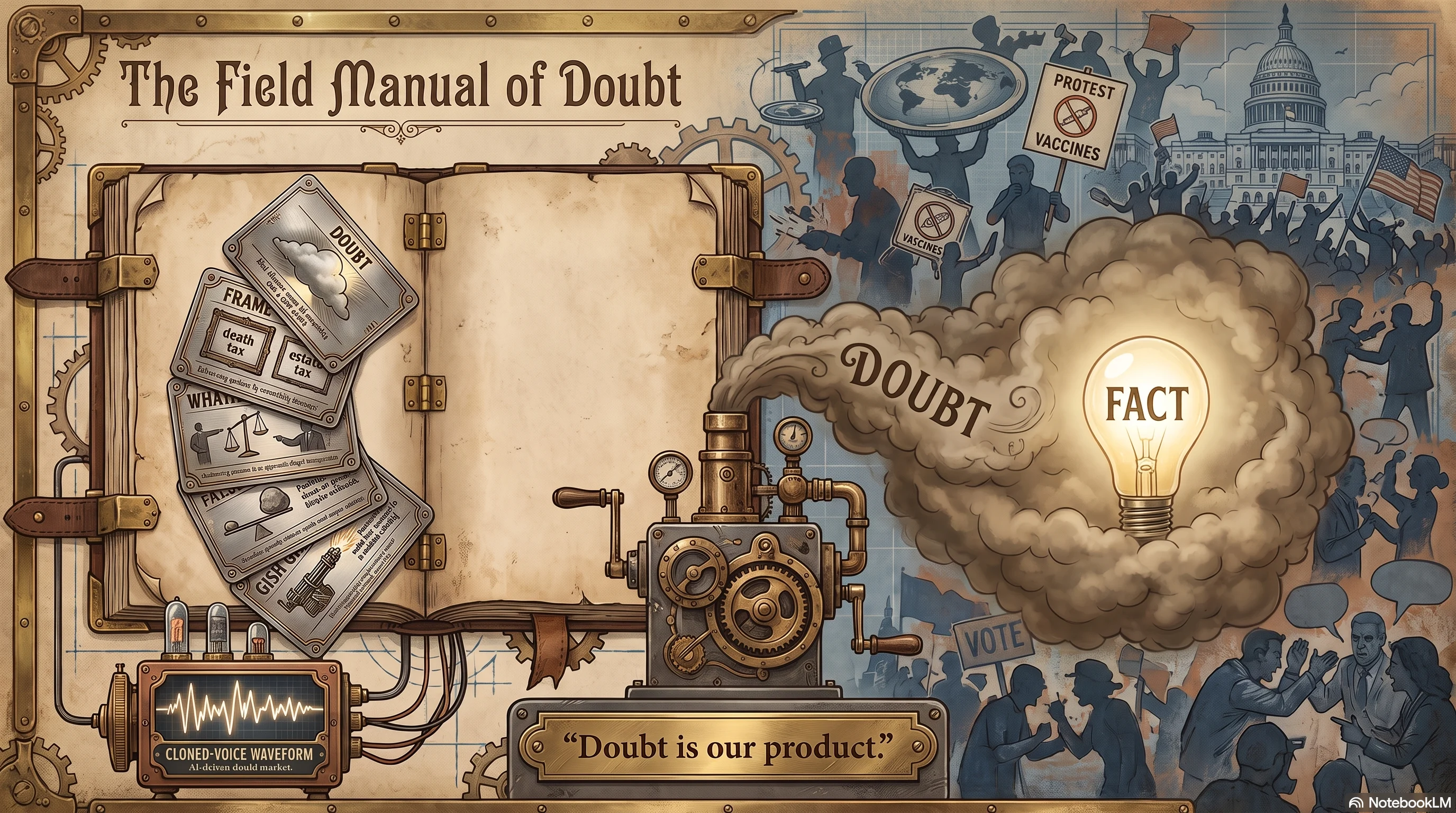
Spitale opens Chapter 7 by setting out the working catalog: "the most common propaganda tactics that corporate and political strategists use to derail debate, from framing (liberal media, entitlements, death tax, states' rights), to Orwellian language (fair and balanced, Clear Skies Act, political correctness, religious liberty laws), to sowing doubt (the tobacco playbook, global warming, asbestos and lead, low-fat diet), to logical fallacies like ad hominem attacks (fake news, feminazi, McCarthyism, crooked Hillary), red herrings (voter fraud, birtherism, War on Christmas, antifa), and straw man arguments (socialism, death panels, tort reform, critical race theory)." That single paragraph is the field manual. We are going to walk it tactic by tactic, because the goal of this unit is straightforward: when you see one of these moves, you should be able to name it.
Doubt: Three Registers
Spitale Ch 7 divides doubt-sowing into three registers, distinguished by who is sowing it and against what claim. The mechanism is the same in all three; the target differs.
Corporate denial. A company faces evidence that its product harms people. Rather than dispute the evidence directly, which would require winning a scientific argument, it manufactures doubt that the evidence is settled. Spitale's canonical examples are asbestos and lead. Asbestos manufacturers knew by the 1930s that breathing asbestos fibers caused mesothelioma. Lead-paint and leaded-gasoline manufacturers knew by the 1920s that lead caused neurological damage in children. In both cases the strategy was identical: fund counter-research, recruit credentialed defenders, demand "more study," portray plaintiffs' lawyers and regulators as opportunists. Decades of public exposure resulted. The 1969 Brown & Williamson internal memo from the tobacco industry put the strategy in writing in one sentence: "Doubt is our product, since it is the best means of competing with the body of fact that exists in the mind of the general public." That sentence is the operational charter of corporate denial.
Political denial. A political faction faces evidence that one of its actions is indefensible. Rather than defend the action, the faction manufactures doubt that the action occurred. Spitale Ch 7 gives the 2020 election loss and the January 6 Capitol insurrection as the clearest contemporary cases. The election results were certified by Republican and Democratic state officials, audited, recounted, and adjudicated in more than sixty court cases. The video footage of the Capitol breach is in the public record. Neither set of facts is in serious factual dispute. What was deployed against both was not counter-evidence but doubt: doubt about voting machines, doubt about mail-in ballots, doubt about whether the people on the video were really Trump supporters or whether they were "antifa in disguise" or "FBI plants." None of these doubts had to be true. They only had to circulate.
Personal denial. A powerful individual faces credible accusations of personal wrongdoing, typically sexual misconduct. Rather than rebut the specifics, the accused manufactures doubt that the accuser is credible, that the timeline is verifiable, that the "real story" is knowable. The targets shift but the operational template is the same as the tobacco template. Spitale Ch 7 places personal denial alongside corporate and political denial deliberately, because seeing them as the same move is the analytical step that lets a student recognize the strategy across contexts.
Cross-Curricular Connection: Intro to Sociology's unit on risk and the production of ignorance is the scholarly treatment of doubt as a manufactured product: the long-form sociological lineage behind Spitale's "doubt as the master technique." See Risk and the Production of Ignorance in Intro to Sociology.
Framing
Spitale Ch 7 defines framing as "a subtle way of influencing public opinion by controlling the language used and the parameters of the subject matter." Whoever picks the words has already shaped the debate. The technique has three sub-moves Spitale names.
Orwellian language. Spitale Ch 7's definition: "a framing tactic in which something is described as the exact opposite of what it claims to be." George Orwell's 1984 gave us the Ministry of Truth, which manufactures lies, and the Ministry of Love, which administers torture. The contemporary catalog runs long. The "Clear Skies Act" (2003) loosened air-pollution rules. "Right-to-Work" laws weaken unions' ability to collect dues from workers who benefit from union contracts. "Religious liberty" laws as written in the 2010s and 2020s frequently authorize discrimination against people the legislators consider religiously disfavored. The name of the platform "Truth Social" performs the technique in its branding. Each Orwellian label invites the listener to evaluate the policy on the label rather than on what the policy does.
Business frame versus labor frame. When restaurants and warehouses cannot find workers, the business press describes a "worker shortage" or "labor shortage," framing labor as the scarce input that ought to adjust. The same situation can be framed as a "livable wage shortage," framing capital as the scarce input that ought to adjust. Both descriptions are factually true. Whichever frame dominates the coverage shapes what reforms get debated. Spitale Ch 7 uses this exact contrast to show that framing operates not by lying but by choosing which factual description gets centered.
Glittering generalities. Spitale Ch 7's definition: "words that suggest positive connotations while being so generic they are basically meaningless ('new,' 'improved,' 'best')." Political glittering generalities include "common sense," "American values," "freedom," "family." None of these words is wrong. None of them is anchored to anything specific enough to be falsifiable. They function as warm fog: they make a position sound agreeable without committing to any content the listener could disagree with.
Logical Fallacies as Active Tactics
The next three moves are logical fallacies. They are also active rhetorical weapons. Spitale Ch 7 treats them not as abstract errors in reasoning but as deliberate moves to derail a debate the speaker is losing on the merits.
Straw man fallacy. Spitale Ch 7: "an argument that deliberately misrepresents an idea so that it's easier to attack or dismiss." His examples: characterizing critical race theory as "racist," characterizing universal healthcare as "socialist," characterizing modest gun-safety proposals as "they're coming for your guns." The original idea is replaced with a cartoon version of it; the cartoon is then attacked. The audience comes away believing the original idea was the cartoon.
Ad hominem attack. Spitale Ch 7: "barely a step above name-calling, this attack is directed at a person's character rather than their argument or position." His examples: calling someone insufficiently pro-capitalist a "commie"; calling unfavorable media "fake news"; "feminazi"; "crooked Hillary"; "Sleepy Joe." The character attack substitutes for the argument the speaker cannot win. Notice that the recipient of the label loses standing to make any argument until they have rebutted the label, which they cannot do without participating in the very frame that demeans them.
Red herring. Spitale Ch 7: "a distraction that makes a mountain out of a molehill to deliberately distract people from the issues at hand." His examples: Hunter Biden, George Soros, the "War on Christmas," Benghazi (as a permanent talking point rather than a specific 2012 incident). The red herring is the move where you respond to an argument by changing the subject to a more emotionally charged but topically adjacent one. The audience follows the new topic and forgets the original one.
Cross-Curricular Connection: The Critical Thinking course's Foundations unit teaches straw man, ad hominem, and red herring as formal logical fallacies: moves that fail as arguments by the standards of formal logic. Spitale's contribution is to show that these are not merely failures of reasoning; they are deliberate weapons. The formal-logic frame is necessary but not sufficient. A move can be a logical fallacy AND a deliberate strategic-action tactic, and recognizing both registers is the full analytical picture.
Disinformation, Misinformation, and the Strategic Slippage
Spitale Ch 7 draws a distinction that operates underneath every tactic above:
- Disinformation: "falsehoods or lies created and spread in order to deceive."
- Misinformation: "accidental errors, rumors, or false claims unintentionally spread without intent to deceive."
The categories sound clean. In practice they slip into each other constantly, and bad actors exploit the slippage. A coordinated political operation creates a false story; an unwitting cousin reshares it on Facebook believing it; a politician then says "look, even ordinary people are talking about this," laundering the disinformation through the misinformation it produced. Or in reverse: when a disinformation campaign is exposed, its operators retreat to the misinformation defense: "we honestly believed it." The categorical line lets the strategy hide.
Whataboutism is the specific red-herring variant Spitale Ch 7 names: "creating a false equivalency by misdirecting attention to someone else in order to distract from one's own transgressions." The classic Cold War example was the Soviet response to American criticism of human-rights abuses: "and you are lynching Negroes." The contemporary domestic version is structurally identical: any accusation against side A is answered with a counter-accusation against side B, on the implicit theory that both sides are equally bad and therefore neither needs to defend itself. The technique trades the original specific question for an unwinnable comparative one.
Cross-Curricular Connection: Journalism's unit on misinformation gives the operational treatment of the disinformation-vs-misinformation distinction Spitale's Chapter 7 names: the working vocabulary of newsroom practice for the same techniques inventoried here. See Misinformation in Journalism.
Whitewashing
Spitale Ch 7 closes the inventory with one further-discussion concept: whitewashing, which he defines as "intentionally downplaying some kind of wrongdoing so that it absolves one of blame or guilt." The chapter offers historical examples: the near-genocide of Native Americans, the brutality of chattel slavery, the structure of Jim Crow. Each can be, and across contemporary American textbook politics, frequently is, minimized through softer language ("settlers moved west," "the peculiar institution," "racial separation"). Whitewashing is the long-run consequence of letting framing, glittering generalities, and red herrings operate on a historical record. It is also the explicit content of much current political contestation about what children are taught.
❓Concept Check
A pundit defends migrant detention conditions by saying 'only six children have died in custody.' Name the move.
▸
Concept Check
A pundit defends migrant detention conditions by saying 'only six children have died in custody.' Name the move.
This is a red herring combined with whitewashing. It distracts from the question of whether any children should die in custody by reframing the question as a quantitative one ('only six'), and it minimizes the seriousness of what occurred by treating preventable deaths in state custody as a small, comparable number. It also implicitly compares to an unstated worse case.
Before we move on, sit with one piece of Spitale Ch 7's own teaching apparatus. The chapter ends with an eighteen-item identification exercise: real-world quotations and headlines, and the assignment is simply to name the technique each one is using. The list ranges from Trump calling Kim Jong-un "little rocket man" (ad hominem, also possibly red herring), to Kellyanne Conway's "alternative facts" (Orwellian language), to "homosexual agenda" (framing/Orwellian), to a coal company responding to a deadly mine collapse by holding a workplace-safety seminar that "promotes individual responsibility" (whitewashing, also framing, relocating responsibility from the corporate decision-maker to the worker). The exercise's pedagogical point is that the catalog is finite and you can learn to spot every member of it. The catalog being publicly available, and the techniques continuing to work anyway, is the puzzle this whole course exists to address.
Intake-Layer Overlay: Habermas on Strategic Action's Field Manual
Unit 6 introduced Jürgen Habermas's distinction between two postures a speaker can take when they open their mouth. Communicative action is speech oriented toward mutual understanding: you say what you believe to be true because you believe the other party is also trying to figure out what is true, and you both hold yourselves accountable to evidence and reason. Strategic action is speech oriented toward producing a predetermined outcome: you say whatever will move the listener to the conclusion you have already decided they should hold. The two postures use the same grammar. They are distinguishable only by the speaker's intent and the relationship the speaker assumes with the listener.
If Unit 6 named the distinction, Unit 8's job is to inventory its operating manual. Every tactic in Spitale Ch 7's catalog is a named move in strategic action. Each one is a way of producing a predetermined outcome in the listener while wearing the surface costume of an argument.
Walk through the catalog with Habermas's frame in mind.
Doubt-sowing is strategic action because the speaker's goal is not to determine whether the underlying claim is true. The speaker already knows. The 1969 Brown & Williamson memo writers knew tobacco caused cancer. The ExxonMobil internal scientists in the 1970s and 80s knew their products were warming the planet. The goal of the public-facing communication was never to settle the question. The goal was to prevent the question from being settled in a way that would force the speaker to change behavior.
Framing and Orwellian language are strategic action because the speaker is choosing the words not to describe reality more accurately but to produce a predetermined evaluative conclusion in the listener before any argument occurs. "Death tax" is not a more accurate description of the estate tax. It is a more effective one, and effectiveness here means producing the response the speaker has pre-decided the listener should have.
Straw man, ad hominem, and red herring are strategic action because none of them attempts to engage what the other party actually said. They attempt to produce a conclusion ("the other party is wrong / bad / changing the subject") without conducting the inquiry that would make the conclusion legitimate. They are the rhetorical equivalent of fixing the outcome and then performing the trial.
Whataboutism is the cleanest case. The strategic-action speaker is asked to defend a specific act. Instead of either defending it or conceding it, the speaker pivots to an unrelated accusation against the questioner. The strategic objective, avoid accountability, is met without engaging the question. Mutual understanding was never on the table.
Habermas's term for what these tactics collectively do is systematic distortion of communication. The communicative form is preserved, both parties are using sentences, both are using arguments-that-look-like-arguments, but the orientation toward mutual understanding is gone. What looks like a debate is a performance of debate, with the outcome scripted in advance. The audience watching is not being invited to think with the speakers. The audience is being managed.
Spitale's chapter is, in this sense, a Habermas reader. Every entry in the catalog is a named subspecies of strategic action. Knowing the name does not by itself restore communicative action: the speaker who is committed to strategic action will simply pick a different move from the catalog when the first one is named. What knowing the name does is allow the listener to refuse to participate in the strategic game. That refusal is the first move of intellectual self-defense, and it is the bridge into the Think for Yourself course.
Cross-Curricular Connection: When you watch a public exchange and ask yourself "is this speaker trying to understand something or trying to produce a conclusion in me," you are applying the Habermasian frame to live discourse. Think for Yourself's Intellectual Self-Defense unit develops the personal-level practice: the small set of questions you can ask in real time that make strategic-action moves visible the moment they happen. Spitale gives you the public catalog of the moves; Think for Yourself gives you the in-the-moment recognition apparatus.
Scholar Roundtable
Spitale Ch 7 catalogs the rhetorical surface of strategic action. Four other voices extend the catalog into specific domains and arm the student with deeper apparatus.
Carl T. Bergstrom and Jevin West: Calling Bullshit
In 2017 a biologist and an information scientist at the University of Washington taught a course called Calling Bullshit in the Age of Big Data. The lectures went viral on YouTube; the course became a 2020 book, Calling Bullshit: The Art of Skepticism in a Data-Driven World. Bergstrom and West make one extension to Spitale's framework that the contemporary student needs: the rhetorical tactics in Chapter 7 now travel inside numerical wrappers. A misleading frame is more powerful when it arrives as a chart. An ad hominem is more powerful when it arrives as a citation count. A red herring is more powerful when it arrives as a correlation coefficient.
Their core diagnostic is what they call the principle of charitable interpretation, then the bullshit test. First ask whether the numerical claim could be true under any reasonable interpretation. If it could, take it seriously. If it could not, if the implied data could not exist, if the chart's y-axis is doing concealed work, if the claimed correlation requires variables nobody measured, then call it. Their work is the quantitative complement to Spitale's rhetorical inventory: the same strategic-action moves dressed in numbers, which the public has been trained to find more authoritative than words.
The UW course videos remain freely available and are the best fifteen-minutes-at-a-time entry point. Watch the segments on data visualization, selection bias, and the prosecutor's fallacy. Each gives you a named move you can spot in the next chart you see.
Naomi Oreskes and Erik Conway: Merchants of Doubt
Oreskes is a Harvard historian of science; Conway is a science historian at the Jet Propulsion Laboratory. Their 2010 book Merchants of Doubt did the archival history of corporate denial. They went into the document collections that came out of tobacco litigation, then traced the same network of think tanks, public-relations firms, and credentialed scientists from tobacco into acid-rain denial, the ozone-hole denial campaigns, secondhand-smoke denial, and finally climate-change denial.
The book's central finding is the one McIntyre will later generalize: the personnel literally overlap. Fred Seitz, Fred Singer, Robert Jastrow, and other once-credentialed physicists moved from defending tobacco for industry money to defending CFCs for industry money to denying anthropogenic climate change for industry money. The strategic-denialism template is not metaphorically the same across cases. It is operationally the same, executed by some of the same people, funded through some of the same conduits.
For the student, the Oreskes-Conway contribution is this: when you see a new doubt-sowing campaign, the first question is not "is this claim true." The first question is "who is paying for the doubt, and have they paid for doubt before?" The historical record on the latter question is often more accessible than the scientific record on the former.
Whitney Phillips: On the Bad-Faith Ecosystem
Phillips is a media studies scholar at Syracuse and the author of This Is Why We Can't Have Nice Things (2015) on early internet trolling and, with Ryan Milner, You Are Here (2021) on the contemporary information ecosystem. Phillips's contribution is to name what changed when the strategic-denialism playbook moved online: the move scaled, and coordinated inauthentic behavior became the dominant mode of execution.
Coordinated inauthentic behavior is the technical term Meta and other platforms use for networks of accounts that pretend to be ordinary citizens but are actually operated by a campaign, a foreign service, or a paid firm. A doubt-sowing campaign no longer requires a TV ad. It requires a few hundred accounts that look like grandmothers, plumbers, and high school students, all asking the same skeptical questions in slightly different words. Phillips's argument is that the contemporary information environment is structurally hostile to the assumption Habermas made about communicative action, the assumption that the other party is a real person with sincere beliefs, because in any given thread, a meaningful percentage of the participants are not real and have no beliefs to be sincere about.
For the student, Phillips's frame produces one practical instruction: when you see a tactic from Spitale Ch 7's catalog executing at scale across many accounts in a short window, the right unit of analysis is not the individual account but the campaign. Treat the moves as plural-by-default.
Lee McIntyre: On Disinformation
McIntyre is a philosopher of science at Boston University whose 2023 book On Disinformation: How to Fight for Truth and Protect Democracy is the most useful single short volume on the strategic-denialism template as a generalizable playbook. McIntyre traces the same operational pattern from tobacco through climate through vaccines through the 2020 election denial through, by the book's final chapters, contemporary AI-content authenticity disputes.
His diagnostic move is to insist that strategic denialism is not science skepticism, not contrarianism, and not "asking questions." It is a specific six-step operational template that runs roughly: (1) identify the conclusion you need to prevent the public from accepting, (2) fund and amplify any contrary research no matter how marginal, (3) recruit credentialed defenders willing to claim more uncertainty than the evidence supports, (4) attack the motives and methods of mainstream researchers, (5) demand "more study" indefinitely, and (6) frame the resulting public confusion as legitimate scientific debate. Once a student can recognize the template, they can recognize it across domains. McIntyre's contribution is the explicit portability claim.
The contemporary application McIntyre draws out most sharply is the one this unit's hook depends on: the Liar's Dividend in AI-content disputes is strategic denialism's most recent product. The strategy did not invent itself for the AI moment. The AI moment was a new market the existing strategy moved into.
Think About
If the same operational template runs from tobacco in the 1950s to AI deepfakes in the 2020s, what does this tell you about whether the next ten years will produce a new strategy or simply a new market for the existing strategy?
Historical Fractal: Atwater Explains the Escalator
In 19811981, the Republican political consultant Lee Atwater gave an interview to political scientist Alexander P. Lamis. Atwater was 30 years old, working in the Reagan White House, and on the road to becoming the strategist behind George H. W. Bush's 1988 campaign and the chairman of the Republican National Committee. The interview was conducted on the condition that Atwater not be identified by name; Lamis published it that way in his 1984 book The Two-Party South. After Atwater's death from a brain tumor in 1991, Lamis revealed the speaker's identity. In 2012 The Nation released the audio recording.
The passage that follows is the cleanest single primary-source exposition we have of the dog-whistle escalator: a Republican operative, in his own words, explaining the move by which the racial coding of campaign messages evolved from explicit to coded to economic, with the underlying racial intent preserved at every step. It is also a direct working example of every tactic in Spitale Ch 7's framing inventory. Read it carefully. The slur is in the original and is preserved here because softening it would falsify what is being demonstrated.
"You start out in 1954 by saying, 'Nigger, nigger, nigger.' By 1968 you can't say 'nigger' — that hurts you. Backfires. So you say stuff like forced busing, states' rights and all that stuff. You're getting so abstract now you're talking about cutting taxes, and all these things you're talking about are totally economic things and a byproduct of them is blacks get hurt worse than whites. And subconsciously maybe that is part of it. I'm not saying that. But I'm saying that if it is getting that abstract, and that coded, that we're doing away with the racial problem one way or the other. You follow me — because obviously sitting around saying, 'We want to cut this,' is much more abstract than even the busing thing, and a hell of a lot more abstract than 'Nigger, nigger.'"
Atwater was a 30-year-old Republican consultant working in the Reagan White House when he gave Lamis this interview on condition of anonymity. He is explaining to a political scientist how Republican campaign messaging in the South evolved over a quarter century: from explicit racial appeals, to coded ones, to economic frames whose racial subtext stayed legible to the intended audience while becoming deniable to the general public. The passage is the most direct first-person admission on the historical record of how the technique works.
What Atwater is describing, in technical terms, is the operational evolution of racial framing under increasing public sanction against explicit racism. In 19541954, the year of Brown v. Board of Education, a Southern white candidate could still use the slur in public and pay no electoral price among the intended audience. By 19681968, Richard Nixon's first presidential election victory, won in significant part by Kevin Phillips' Southern Strategy, the slur had become electorally costly because the rest of the country had moved. The intended audience had not necessarily moved. So the operatives shifted to coded substitutes: "forced busing," "states' rights," "law and order," "welfare queens." Each phrase had a literal meaning that was racially neutral on its face and a contextual meaning that the intended audience read fluently.
Atwater's next move in the passage is the analytically critical one. By the time you reach the 1980s, he says, even the coded phrases are too on-the-nose. The new vocabulary is economic: "we want to cut this." Tax cuts. Welfare reform. Privatization. Each economic policy has substantive policy content that can be debated on the merits. Each also has, in Atwater's own description, a "byproduct": "blacks get hurt worse than whites." And the byproduct, in his telling, is part of what makes the message land with the intended audience while remaining deniable in mainstream discourse.
Read against Spitale Ch 7's catalog, this passage is a master class:
- Framing. Atwater is naming the technique of changing the words to shape what the debate is "about." The same policy can be sold as racial backlash, as fiscal responsibility, as freedom, and which frame dominates shapes who supports it.
- Orwellian language. "States' rights" was the framing under which Southern segregationists had defended Jim Crow since the 1870s. By 1968 the phrase had become detached from its segregationist content in mainstream coverage; it was sold as a principled constitutional argument about federalism. The same words, the same underlying constituency, the surface meaning inverted.
- Glittering generalities. "Cutting taxes," "smaller government," "freedom": each is a positively-coded phrase abstract enough to mean nearly anything to the listener.
- Plausible deniability as a feature, not a bug. "You're getting so abstract now... and a byproduct of them is blacks get hurt worse than whites. And subconsciously maybe that is part of it. I'm not saying that. But I'm saying that if it is getting that abstract, and that coded..." The very abstraction provides the cover. Atwater is showing how the move works while performing the move in the act of showing it. He refuses to claim the racial motive while simultaneously confirming it.
This is the cleanest single document we have for the propaganda-technique catalog operating across decades on a single political project. It is also the direct setup to Unit 9, where Spitale's culminating case study deals with the Southern Strategy as a whole and where you will see the toolkit Atwater inventories operating at the scale of an entire electoral realignment.
One historical footnote bears mention. In 19911991, dying of brain cancer at 40, Atwater wrote and published an apology for the conduct of his political career: the personal viciousness, the 1988 Willie Horton ad, the broader practice of racially coded campaigning. Whatever you make of the apology, do not let it neutralize the 1981 interview. The 1981 interview is the operational document. It tells you what the move was, who taught it, and why it kept working long after he was gone.
The Doubt-as-Product Genealogy (Backward from 2024)
Tobacco industry secret meeting at the Plaza Hotel
corporateMajor cigarette manufacturers meet with PR firm Hill & Knowlton; the strategic-denialism template that will run for seventy years is operationally established.
Brown & Williamson 'Doubt is our product' memo
corporateInternal cigarette-industry memo names doubt as the marketable product. The single sentence becomes the chartered operating principle.
Atwater interview with Alexander Lamis
politicalRepublican consultant explains the dog-whistle escalator from explicit to coded to economic framing: the template by which framing replaces forbidden content while preserving intent.
First major fossil-fuel-funded climate-doubt campaign
corporateSame network of think tanks, PR firms, and credentialed scientists that ran tobacco doubt migrates to climate. Personnel literally overlap.
Oreskes and Conway publish Merchants of Doubt
scholarshipHistorical archives produce the documented through-line from tobacco to acid rain to ozone to climate; the strategic-denialism template is named for the first time as one phenomenon.
Election-denial campaign deploys the full toolkit
politicalDoubt, framing, ad hominem, red herring, whataboutism, and Orwellian language run in parallel on the question of whether the certified election results occurred.
AI-deepfake and Liar's Dividend arrive at electoral scale
technologicalAI-generated political content circulates as real; authentic content is dismissed as AI-generated. Same doubt-as-product strategy, new market.
The Source-Code Audit Applied
Pick a specific artifact. The audit only works on specifics. We will walk one example here, then the application is yours.
The artifact: an image circulating widely on X and Facebook in the past 90 days, showing a prominent U.S. politician embracing a notorious figure at what is presented as a private event. The image is photorealistic. It carries a caption claiming it is "newly leaked." Within hours, three things happen in parallel: (1) the politician's opponents reshare it as evidence of corruption; (2) the politician's supporters denounce it as AI-generated; (3) a small number of journalists try to source-verify the image and either cannot conclusively establish provenance or quietly conclude it appears to be synthetic. By the next news cycle, the original image has been seen by tens of millions of people. The verification, when it lands at all, reaches a small fraction of that audience.
Run the audit.
Audit Question 1: Simon and Kahneman. What is this artifact engineered to make my body feel? Which System 1 shortcut is being exploited?
The image is engineered to produce one of two immediate body responses depending on which audience you are. For the opponents' audience: visceral confirmation that the politician is what they have always believed he is: corrupt, hypocritical, compromised. The emotional payload is righteous vindication. For the supporters' audience: visceral grievance that the opposition is "at it again": manufacturing evidence, smearing him, exploiting AI. The emotional payload is loyalty under attack.
Both responses are System 1: fast, automatic, pre-deliberative. Both are driven by Kahneman's representativeness heuristic: the image looks like the kind of evidence I would expect if my pre-existing belief about this politician were true, therefore I treat it as confirming that belief. Both audiences process the artifact before either has any information about its provenance. By the time slower, deliberative System 2 engagement is available, should I check whether this image is real?, the emotional commitment has already been booked.
The Spitale Ch 7 tactic the artifact performs in this register is framing. The image's framing, embrace, intimacy, private setting, is doing the argumentative work. The viewer is not being given an argument that the politician did something wrong; the viewer is being shown a frame in which "wrong" is the only available reading.
Audit Question 2: Zuboff. Who profits from my engagement with this version of reality? What behavioral data is being collected?
The platforms profit. Every share, like, angry-face react, repost, and comment is logged. The artifact's circulation produces a behavioral dataset that segments users with extraordinary precision: who reshares without checking; who reshares with a caveat; who reshares the "this is AI" rebuttal; who engages in the comment thread; who blocks accounts after engaging. Each of these signals refines the targeting model for the next artifact.
The politician's opponents profit from circulation of the image. They do not need it to be true. They need it to circulate widely enough to depress the politician's polling among soft supporters, raise small-dollar fundraising from their own base, and crowd out other coverage during a news cycle they want to dominate.
The politician's campaign also profits, and this is the unintuitive piece. The "AI-smear" framing gives the campaign a real-time fundraising email and a rallying narrative. "They are so afraid of us they are now fabricating evidence with artificial intelligence." The image is fundraised against. Donations come in. The campaign list grows. The campaign's behavioral data on its own base, who clicks the fundraising email, who donates after the AI-smear framing, also accumulates.
The artifact's creator, if they are an outside political operative or a foreign service, profits from chaos as such. The strategic objective is not necessarily to advance either candidate; it is to degrade public confidence in the underlying reality of political evidence. Every successful AI-deepfake dispute makes the next one easier to deploy.
Zuboff's frame surfaces the structural point. The advertising-funded platform architecture rewards artifacts that produce high-emotion engagement irrespective of factuality. Both the artifact and its rebuttal are equally profitable to the platform. The platform has no business reason to suppress either.
Audit Question 3: Habermas. Is this artifact inviting me to understand the world, or demanding I comply with a predetermined position?
Demanding compliance. The artifact is not arguing for a conclusion; it is producing a conclusion. There is no claim of evidence to weigh, no source to interrogate, no methodology to evaluate. There is an image and a caption. The viewer is positioned not as an inquirer but as a juror who has already heard closing arguments before the trial began.
The "this is AI" rebuttal performs the same demand in the opposite direction. It does not invite the viewer to investigate whether the image is real. It demands the conclusion that the image is fake and that anyone who treats it as real is participating in a smear. Both moves are strategic action in Habermas's sense; both refuse the communicative-action posture in which the participants would together try to determine the image's provenance.
This is what makes the Liar's Dividend such a clean instantiation of the doubt-as-product strategy Spitale Ch 7 names. The strategy does not depend on either side winning the authenticity argument. The strategy depends on the question of authenticity itself remaining unresolved in the public mind. Once authenticity is permanently unresolved, every actor can pick the frame that serves them. The truth of the artifact stops mattering because nobody has the standing to settle it.
What the Audit Surfaces
The three audit questions, applied to one artifact in parallel, surface what no single question would: that the same piece of content is simultaneously an engineered emotional payload (Simon/Kahneman), a behavioral-data extraction event (Zuboff), and an instance of doubt-as-product strategic action (Habermas/Spitale). Naming the artifact's authenticity is not the same as defeating its function. The artifact's function is to circulate; whether it is real is, for the strategic actor, beside the point.
❓Concept Check
In the AI-artifact case above, why does it not really help the strategic actor's opponents to prove the image is fake?
▸
Concept Check
In the AI-artifact case above, why does it not really help the strategic actor's opponents to prove the image is fake?
Because the strategic objective was never to convince anyone the image was true. The objective was for the image to circulate widely enough to produce emotional engagement, behavioral data, fundraising, and degraded confidence in evidence as such. Proving the image fake leaves all four payoffs in place: the image already circulated, the emotions already booked, the donations already cleared, the public confusion already added to the cumulative total. The 'doubt is the product' strategy wins by being deployed, not by being adjudicated.
Now your turn. Pick an artifact from the past 90 days, a viral image, a video clip, an audio snippet, a screenshot, that has been the subject of an AI-authenticity dispute or that you suspect of being AI-generated. Walk the three audit questions on paper. Write the answers in complete sentences. Do not skip the question of who profits if the audit makes you uncomfortable; that is where the audit is doing its most useful work.
Cross-Curricular Connection: The audit's third question, what evidence would settle this dispute, and why is no such evidence forthcoming, is the formal-logic move taught in Critical Thinking's unit on competing explanations. When a claim's truth value is structurally unverifiable in the time horizon during which the claim does its work, the claim is not functioning as a knowledge claim. It is functioning as a persuasion artifact. Critical Thinking gives you the formal frame for that distinction.
Closing: The Catalog Is Public; The Techniques Still Work
The catalog you have just walked is not secret. The 1969 Brown & Williamson memo has been a public document for thirty years. Atwater's 1981 interview has been in the public record for over forty. Oreskes and Conway published Merchants of Doubt in 2010; Bergstrom and West's lectures have been free on YouTube since 2017; Spitale's book has been on sale at every airport since 2023. The complete operating manual for late-twentieth and early-twenty-first century strategic action is public, indexed, and searchable.
The techniques still work.
Sit with that. It is the unit's central pedagogical fact. Naming a move is necessary but not sufficient to defend against it. The same straw man you can name on a slide will still land on your friend's mother on Facebook. The same Orwellian label you can deconstruct in a discussion section will still appear in tonight's evening news copy and shape tomorrow's polling. The same doubt-as-product strategy that ran tobacco for forty years and climate for thirty is running AI deepfakes right now, and the population that has read Spitale, Oreskes, and McIntyre is small.
There are three reasons the techniques continue to work that this course will keep returning to.
First, the techniques are designed to operate on System 1. Kahneman's frame from Unit 2: fast, automatic, emotionally driven cognition arrives at conclusions before deliberative cognition catches up. By the time you have System 2 engagement available, wait, is this a straw man?, the emotional commitment is already booked, the share has already been clicked, the donation has already cleared. Naming a move post hoc is real intellectual work but it does not undo the work the move already did inside your body.
Second, the techniques are deployed at industrial scale by actors with budgets, while the defense is improvised by individuals. Phillips's frame: a coordinated inauthentic behavior network does not need each individual account to convince you of anything; it only needs enough accounts saying enough things in enough places that the noise drowns out the signal. An individual reader with no budget cannot, on average, outpace an attention-economy production line. The catalog is in the books; the deployment is on the platforms.
Third, the techniques produce a profitable equilibrium for everyone except the public. Zuboff's frame: the artifact, its rebuttal, the dispute about authenticity, the meta-dispute about who is "really" lying: every layer of the controversy generates engagement, behavioral data, and revenue. The platforms profit. The campaigns profit. The strategic-denialism contractors profit. The honest journalists trying to source-verify do not profit. The structural incentives that the open web's economic architecture established in the early 2000s have not been corrected; they have been refined and extended.
What you can do, individually and within your own information practice, is real but modest. You can run the Source-Code Audit on the next artifact that produces a strong emotional response in you, before you share it. You can extend a Phillips-style assumption that coordinated networks are the default, not the exception. You can hold the disinformation/misinformation distinction in mind without letting it be exploited. You can refuse the strategic-action game in your own speech: you can choose, when you talk about politics, to speak as if mutual understanding is still on the table, even when you have no confidence the other party is doing the same. Habermas's communicative action is a practice, not a guarantee. Practicing it does not by itself fix the public sphere. Not practicing it guarantees nothing else will.
The catalog Spitale Ch 7 has now given you closes the inventory portion of this course. You have a vocabulary. You have a set of named moves. You have the historical genealogy of where they came from and the operational sense of how they are deployed now.
Unit 9 takes Spitale's own culminating case study, Chapter 8 of How to Win the War on Truth, his analysis of the Southern Strategy from the late 1960s through the present, and runs the full toolkit against a single historical project of strategic communication. The Atwater interview you just read is the seed of that case study. The Southern Strategy is where doubt-sowing, framing, Orwellian language, glittering generalities, straw man, ad hominem, red herring, and whataboutism operate not as separate techniques but as one coordinated decades-long campaign. You have the field manual. Now we walk a campaign that used every page of it.
Think About
What is one piece of content you have shared in the last six months that, in retrospect, you would not share again after running it through the Source-Code Audit? What did the move you fell for tell you about which System 1 shortcuts are most operative in you personally?
FRONTLINE and ProPublica's 2022 documentary is a forensic walkthrough of doubt-sowing as a coordinated tactic. Reporter A.C. Thompson traces how a small team of operatives manufactured the core 'stolen election' narratives from mundane administrative facts. Watch with Spitale's Chapter 7 inventory in mind — students should be able to name each propaganda technique as it appears on screen: framing, doubt-as-product, straw-manning of election officials, ad hominem attacks on poll workers.
Watch on YouTube