Dividing and Conquering: Stereotypes, Tribalism, and the Authoritarian Pull
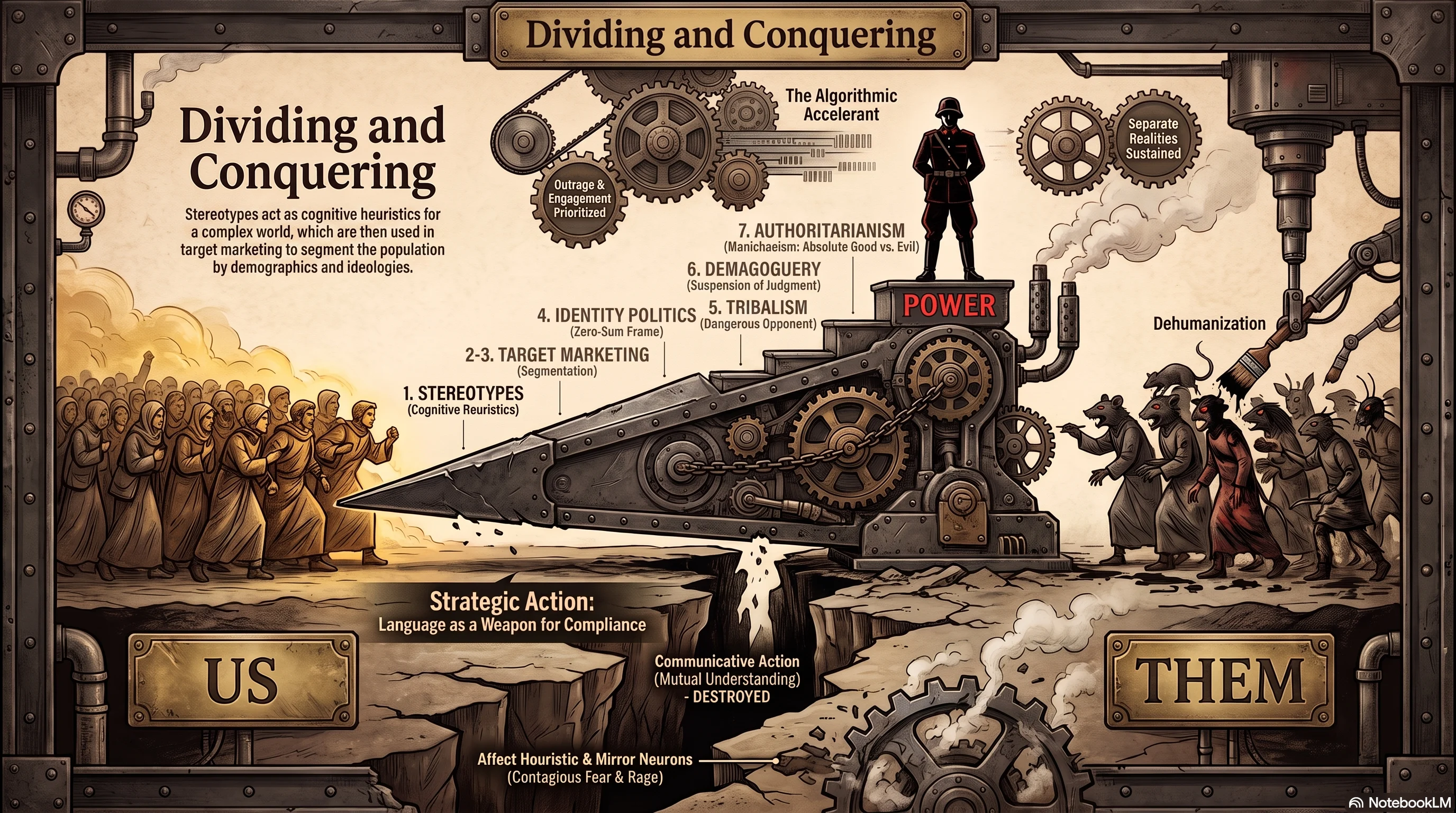
Spitale Chapter 5 traces the full chain from market-segmenting stereotypes to authoritarian Manichaeism. This unit anchors in 2024-26 immigration dehumanization rhetoric and the 'litter boxes in schools' moral panic, with Habermas's strategic-vs-communicative-action distinction as the analytical overlay.
Learning Objectives
- 1Trace the chain from stereotypes → target marketing → identity politics → tribalism → demagoguery → authoritarianism
- 2Define Manichaeism and recognize it in contemporary political rhetoric
- 3Distinguish Habermas's strategic action from communicative action
- 4Identify dehumanization language and explain why it is upstream of political violence
- 5Apply the Source-Code Audit to a piece of dehumanization rhetoric
Hook: Litter Boxes, Border Invasions, Dehumanization
Begin with a story that should have died on contact with reality and instead traveled across two years of school-board meetings, talk radio, and conservative cable. The claim: public schools are installing litter boxes in bathrooms to accommodate students who identify as cats. There are no litter boxes. There are no students who identify as cats. The Associated Press, NBC News, Reuters, and dozens of local reporters chased the rumor through specific named districts and found nothing in every case. And yet by 2024 the litter-box story had been repeated on the floor of state legislatures, by a sitting U.S. senator on a national debate stage, and by hundreds of candidates in down-ballot races.
The story does not survive because anyone believes it literally. It survives because it does a job. The job is to construct a particular kind of out-group, schools, teachers, gender-nonconforming kids, the parents who defend them, as so absurd and degraded that the people inside that group can no longer be reasoned with. You do not negotiate with people who think their children are cats. You remove them. The story is not an information artifact. It is a population-sorting tool.
Run the same machinery on a higher voltage and you get the immigration rhetoric of the 2024 campaign. The candidate at the top of the Republican ticket said, in a debate watched by sixty-seven million people, that Haitian immigrants in Springfield, Ohio were "eating the pets" of their neighbors. There was no evidence; the city manager, the police chief, and the Republican governor of Ohio all said publicly that the claim was false. It did not matter. Within seventy-two hours the story had been repeated thousands of times across right-wing media. Bomb threats closed Springfield's schools and city hall. The point of the story was never to convey information about Springfield. The point was to construct Haitian immigrants, and by extension all immigrants, as a category of being whose presence in a community is a form of invasion.
The same campaign, at rally after rally, named domestic political opponents as "vermin" and "the enemy from within" who must be "rooted out." PBS Frontline's Caught in the Crackdown (2026) traces what happened next: federal immigration sweeps that arrested U.S. citizens by mistake, raids that emptied workplaces and separated families, and deaths in detention that the agencies declined to investigate. The documentary is the visual record of the rhetoric's downstream arithmetic. Language that designates a population as illegitimate produces, with predictable speed, policy that treats that population as illegitimate.
Think About
Before reading further: pick one piece of dehumanizing political language you have heard repeated in the last twelve months. Not analyzed, just heard. Hold it in mind. By the end of this unit you should be able to name the specific mechanism it is running.
Samuel Spitale's Chapter 5, "Dividing and Conquering (an Audience)," is the part of the book that names this machinery in its full chain. He opens the chapter this way: "When propagandists reduce their stories to simple black-and-white narratives, the characters of their narratives are no longer real, complex people; instead they become what Walter Lippmann called stereotypes. These stereotypes are easily divided by biases, which propagandists turned into the strategy of target marketing. When these targeted groups are divided for political gain, it's known as identity politics, and when they are pitted against each other and dehumanized, it results in tribalism, the foundation for every war ever fought" (Spitale, Ch 5). The litter-box story, the Springfield slander, and the "vermin" speeches are not separate phenomena. They are the same chain, applied at different scales.
Spitale's Framework: The Full Chain
Spitale's chapter does something unusual in a popular book on propaganda: it lays the chain out as a single causal sequence rather than as a list of independent tactics. Read the chapter carefully and you find seven linked stages, each of which makes the next one possible. Walk them in order and you have the operating manual for how a population gets sorted into camps that no longer count each other as fully human.
Stage one: stereotypes as cognitive shortcut
Spitale begins where Walter Lippmann began a hundred years earlier: with the observation that no individual can take in the full complexity of the modern world directly. We rely on what Lippmann called stereotypes: pre-packaged mental pictures of categories of people and things. Spitale defines them precisely: "black-and-white narratives about people/things that we rely on as a cognitive shortcut, or heuristic, to more easily process the world" (Spitale, Ch 5).
The word heuristic matters here. A heuristic is a mental shortcut, a rule of thumb the brain uses when it cannot afford to do full computation. Heuristics are not pathologies. They are the only way a finite mind can act in an infinite world. The problem is not that we have stereotypes; the problem is what happens when someone with resources and intention learns to engineer them.
The student should resist the temptation to read Spitale's opening as a complaint about prejudice. Prejudice is a moral term; stereotyping in Lippmann's and Spitale's sense is a cognitive description. Every functioning human being uses stereotyped categories every day to navigate the world. You stereotype that the cup on the table will hold liquid; you stereotype that the person behind the counter wearing a name tag is an employee. The category is a hypothesis the brain runs in the absence of complete information. The propaganda question is not whether the categories exist, they always exist, but who is supplying them, with what intention, and what they were engineered to make you do.
Stage two: target marketing
Once you accept that human beings perceive the world through stereotyped categories, a commercial opportunity appears. Spitale defines target marketing as "the strategy of segmenting people by demographics in order to sell them stuff" (Spitale, Ch 5). The demographics, age, income, religion, gender, region, education, household composition, are the formal grid that mass-market industry uses to address us not as individuals but as segments. The mechanism is older than television; it is what made mid-20th-century consumer capitalism legible to itself. Procter & Gamble did not sell to people. It sold to the 35-to-49-year-old suburban mother of two with household income above the median.
What Spitale wants the student to see is that the same segmentation grid migrates, with almost no friction, from selling laundry detergent to selling political loyalties. The infrastructure that lets a brand find its "audience" is also the infrastructure that lets a political operation find its tribe. The agencies that pioneered demographic segmentation in the 1950s, J. Walter Thompson, McCann Erickson, BBDO, are the same agencies whose alumni populated the campaign consultancies of the 1970s and 1980s. The technology transfer was not metaphorical. It was personnel.
Spitale's own application exercise for this chapter asks the student to consider the target audience for a list of consumer products, lipstick, organic vegetables, soccer cleats, diet pills, baby formula, hearing aids, sugary cereal, hunting knives, honeymoon destinations, and to ask which television shows, magazines, and sponsorships would deliver each product to its segment. The exercise is not trivia. It is a finger exercise for seeing the segmentation grid that already organizes the student's media environment. Once the grid is visible for laundry detergent, the grid for political messaging is visible too.
Stage three: ideology
Between demographic segmentation and identity politics, Spitale inserts a connecting concept. Ideology, in his definition, is "a collection of shared beliefs that influence thinking and behavior" (Spitale, Ch 5). An ideology is what converts a demographic, a statistical slice, into a self-conscious group that thinks of itself as having a stake. Demographics are imposed from outside; ideologies are believed from inside. The conversion is what makes the next stage possible.
Stage four: identity politics
"Identity politics," in Spitale's clinical usage, is "when politicians target groups of people according to their demographics or ideologies" (Spitale, Ch 5). This is a more precise definition than the term usually carries in popular debate. Identity politics, in this analytical sense, is not the province of any one party. It is a category of political strategy: the explicit decision to mobilize voters by activating the identity grid rather than by appealing to shared interests across the grid.
The student should hold both sides of this carefully. There is a long history of disadvantaged groups organizing around shared identity precisely because nothing else worked; that is identity politics in a defensive register. There is also the deliberate engineering of resentment by a campaign that has no economic program to offer; that is identity politics in an offensive register. Spitale is not in this chapter making a moral verdict on the practice. He is naming it as the fourth link in a chain that, if left unchecked, runs all the way to authoritarianism.
What converts identity politics from a tool of organization into a tool of dehumanization is a specific further move: the framing of the in-group's interests as zero-sum against the out-group's existence. A union local that organizes its workforce around shared interests as workers is doing identity politics in the defensive register, and that politics remains compatible with the out-group's continued legitimate participation in the political community. A campaign that organizes a demographic around the claim that the out-group is taking what is rightfully theirs, jobs, country, future, has crossed the line into the tribal register. The grammatical signal is small but reliable: "we deserve" becomes "they are taking."
Cross-Curricular Connection: The architecture of categorical sorting that Spitale names abstractly is traced through one specific American instance in Critical Thinking's unit on race, whiteness, and constructed hierarchies. The CT unit walks through how the racial categories that now feel like natural facts were actively engineered over four centuries of American law and custom. Read together with this unit, the two show the same machinery from two angles: Spitale anatomizes the engineering move; CT shows what one historical instance of it produced.
Stage five: tribalism
Here the chain turns dangerous. Spitale defines tribalism as "viewing those with differing views as dangerous opponents" (Spitale, Ch 5). The word "dangerous" is doing all of the work. A political opponent who disagrees with you is someone you can argue with, vote against, and live next to. A dangerous opponent is someone whose continued presence in the polity is itself the threat. The shift from the first frame to the second is the shift from democratic disagreement to civil-war preparation.
Tribalism is downstream of identity politics, but it is not the same thing. Identity politics activates a demographic; tribalism dehumanizes the demographic on the other side. The litter-box story is a tribalism artifact. So is the Springfield slander. So is "vermin." Each of them performs the same conversion: a category of fellow citizens is rendered not as opponents but as threats.
The diagnostic question is whether the rhetoric makes room, in principle, for the out-group's continued existence as a legitimate political party in the polity. Disagreement is compatible with continued coexistence. Tribalism is not. When a piece of speech implies that the political contest will end when the other side has been removed, neutralized, or rendered unable to vote, when the goal is not victory in the next election but elimination from the political community, the speech is operating in the tribal register, regardless of which side of the partisan map it is coming from. The student should be careful to apply this test symmetrically; the analytical instrument is not partisan, even though the empirical record of its application in the current moment is asymmetric.
Cross-Curricular Connection: Psychology's tribal-belonging unit is the biological substrate under Spitale's tribalism stage. Together they show the same machinery from below and above: Psychology explains why the in-group/out-group response is so easy to trigger, this unit names what propagandists do with that triggerability. See The Tribe in Psychology.
Stage six: demagoguery
A population sorted into mutually-fearful tribes is a population available for capture. Spitale defines a demagogue as "any leader who amasses power through emotional manipulation, particularly by invoking anger and prejudice rather than by appealing to logic" (Spitale, Ch 5). Demagoguery is "exploiting hate and anger for political gain" (Spitale, Ch 5). The demagogue does not create the tribes; the demagogue arrives once the tribes exist and offers each one a leader who promises to protect them from the other. The arithmetic is straightforward. Once fifty-one percent of the population believes that the other forty-nine is an existential threat, you do not need a coalition. You need a champion.
Stage seven: authoritarianism and Manichaeism
The final two stages are what the demagogue installs. Authoritarianism is, in Spitale's definition, "the blind submission to an authority who promises to solve all our problems" (Spitale, Ch 5). The authoritarian personality, he adds, has "a binary worldview, an aversion to complexity, a strict obedience to authority, an intolerance of diversity, and a strong resistance to changing their beliefs." The binary worldview is the cognitive precondition; the strict obedience is the behavioral output.
The locking mechanism is Manichaeism: "a binary religious belief that everything is either absolutely good or absolutely evil, with no middle ground, no ambiguity, and no shades of gray" (Spitale, Ch 5). Manichaeism is what makes the system self-sealing. Once the world has been sorted into absolute good and absolute evil, no evidence can move it. Any data point that contradicts the binary becomes either fake or a trick from the other side. The student should recognize this immediately as the structural fingerprint of every conspiracy theory worth the name.
The physiological substrate: affect heuristic and mirror neurons
Two of Spitale's key terms describe the body-level mechanisms that make the chain work. The affect heuristic is "when our emotions influence our judgments and decisions" (Spitale, Ch 5). It names the well-documented finding that humans decide first at the emotional layer and rationalize afterward. Mirror neurons are "neurons that cause us to intuitively mimic the emotions and behavior we see in someone else" (Spitale, Ch 5). These are the cells in the brain that fire both when you perform an action and when you watch someone else perform it. They are the reason fear is contagious, why rallies work, why laughter on a sitcom track makes a joke feel funnier.
A demagogue who can broadcast fear and rage to a population is not making an argument. The demagogue is loading affect into bodies and letting the mirror-neuron substrate do the propagation. The student should hold this as the hardware-level fact that the rest of the chain runs on top of.
The algorithmic accelerant
Spitale's chapter names the modern accelerant explicitly: "how social media algorithms divide the populace." The algorithms that rank what you see on Facebook, X, TikTok, and YouTube are optimized for engagement, which in practice means optimized for the content most likely to provoke a strong emotional response. Outrage outperforms reflection by a factor of several. Content that activates the tribal sorter, that names a clear in-group hero and a clear out-group villain, wins the auction for attention.
The result is what Spitale calls the urban/rural divide on technological steroids. The same physical country, sorted by the same platforms into mutually-non-overlapping information environments, can sustain two completely separate working theories of reality. A 2026 Pew study found that the median Republican voter and the median Democratic voter share fewer than ten percent of their top-fifty most-viewed political video clips in a typical week. The algorithm is the strategic-action delivery system the demagogue inherits for free.
It is worth being precise about what the algorithmic accelerant adds to the chain that was not there before. Before optimized social feeds, a propagandist who wanted to load affect into a population had to buy access, to a printing press, to a broadcast slot, to a cable channel, and the gatekeepers at each access point added some friction, even when they were corrupt or partisan. Mass media in the broadcast era was tribal-sorted but not infinitely so; the same evening news played in the kitchen of the urban Democrat and the rural Republican alike, and even when the editorial line was sharply partisan, the factual base layer was largely shared. The post-2010 platform environment removed the gatekeepers and inverted the friction. The content most likely to circulate is now, by engineering, the content most likely to activate the tribal sorter, and the two halves of the population are sorted into feeds that have only marginal factual overlap.
A second thing the platform layer adds is real-time learning. A traditional broadcast had to commit to a message and live with it for the duration of the airing. A social-media campaign can A/B test thousands of variants of a dehumanizing claim against narrowly-targeted demographic segments, watch which variants produce the highest engagement inside which segments, and adjust within minutes. The chain Spitale describes used to be a craft. It is now an automated industrial process whose output is calibrated against live behavioral data on a continuous loop.
❓Concept Check
Name the seven stages of Spitale's chain, in order.
▸
Concept Check
Name the seven stages of Spitale's chain, in order.
Stereotypes, target marketing, ideology, identity politics, tribalism, demagoguery, authoritarianism. Manichaeism is the locking mechanism that holds the authoritarian frame in place.
Intake-Layer Overlay: Habermas, Strategic vs. Communicative Action
The German philosopher Jürgen Habermas spent the second half of the twentieth century working out a distinction that turns out to be the philosophical key to Spitale's chain. Habermas separated human communication into two fundamentally different kinds of activity, which he called communicative action and strategic action.
Communicative action is discourse aimed at mutual understanding. The parties to the conversation treat each other as legitimate interlocutors: beings whose reasoning matters, whose objections are real, whose agreement is the actual goal of the exchange. The conversation is open in the strong sense: either party can be moved by the better argument, and both know it. A scientist defending a paper at a conference, two neighbors working out a property-line dispute, a teacher and a student examining a proof: all of these, when they go well, are communicative action.
Strategic action is discourse aimed at producing a predetermined outcome regardless of the interlocutor's reasoning. The "conversation" is a delivery vehicle for a result the speaker has already decided on. The other party's objections are not data to be weighed; they are friction to be managed. A used-car salesman, a manipulative ex, a political ad: all of these are strategic action wearing the surface costume of conversation. The form looks like communication. The function is compliance.
Habermas's insight is that human social life depends, for its very intelligibility, on the possibility of communicative action. Democracy is communicative action at scale. Law is communicative action codified. Science is communicative action with rules of evidence. When the share of strategic action in a society's total discourse rises above a critical threshold, the institutions that depend on communicative action start to fail, not because they are attacked from outside but because the medium they run on has been replaced.
Cross-Curricular Connection: Intro to Sociology has a full unit on the Habermas-Luhmann debate that supplies this unit's intake-layer overlay. There, the debate is treated as a sociological-theoretical hinge; here, it becomes the diagnostic for how strategic action breaks the conditions of communicative action at population scale. See The Habermas-Luhmann Debate in Intro to Sociology.
Why tribalism makes communicative action impossible
This is the philosophical key to Spitale's chain. Stage five, tribalism, is the precise moment at which communicative action becomes structurally impossible. Once the out-group is reclassified as "dangerous opponents," it is no longer a legitimate interlocutor. Its arguments do not need to be answered; they need to be neutralized. Its members are not reasoners with whom one might reach mutual understanding; they are obstacles, threats, or marks. Every utterance directed at them becomes strategic by definition. Every utterance directed about them, broadcast to the in-group, becomes strategic by definition.
The dehumanizing move is not, in this analysis, a moral failure plus normal politics. It is the destruction of the conversational floor on which politics rests. When a leader says of fellow citizens that they are "vermin" or "the enemy from within," the leader is not making a hyperbolic claim that can be argued with. The leader is performing a categorical removal, moving those citizens out of the space of beings with whom communicative action is possible. After the removal, only strategic action remains.
The litter-box story does the same thing on a smaller scale. The story is not addressed to teachers and school boards as a claim they might answer. It is addressed past them, to the in-group, as a signal that teachers and school boards are no longer legitimate interlocutors. The school board meeting that follows is not a conversation. It is a strategic-action ritual whose outcome has been pre-decided by the in-group.
Cross-Curricular Connection: The Habermasian distinction is the philosophical engine room beneath the manipulation patterns named in Think for Yourself's Unit 4: Political Manipulation. Where TFY teaches a student to recognize the manipulation move at the personal level, this unit names the structural condition, strategic action installed as the default register of public discourse, that makes those moves a society-scale phenomenon rather than a parade of individual bad actors.
The Habermasian test, said plainly
The student can carry this test in pocket. For any piece of political speech: Is this utterance opening a conversation, or closing one? Communicative action opens: it invites the other party in, treats their reasoning as live, accepts that the speaker might be moved. Strategic action closes: it consolidates the in-group, names the out-group as illegitimate, and forecloses the possibility that anything the other side says could change the outcome.
The test is not a partisan instrument. Plenty of communication on every political surface is strategic. The point is to be able to see, in the moment, which kind of artifact one is holding.
Scholar Roundtable
Three thinkers extend Spitale's chain into the territories he most depends on but does not, in a single chapter, have room to develop in full.
Walter Lippmann: stereotypes as the precondition of mass communication
Lippmann's Public Opinion, published in 19221922, is the book Spitale's whole chapter rests on. Lippmann was a working journalist who had spent the First World War watching the U.S. government's Committee on Public Information manufacture support for American entry, and he came home convinced that the relationship between citizens and the world they were asked to govern was no longer direct. It was mediated, through newspapers, photographs, and wire services, by what he called "the pictures in our heads."
"For the most part we do not first see, and then define, we define first and then see. In the great blooming, buzzing confusion of the outer world we pick out what our culture has already defined for us, and we tend to perceive that which we have picked out in the form stereotyped for us by our culture... We are told about the world before we see it. We imagine most things before we experience them. And those preconceptions, unless education has made us acutely aware, govern deeply the whole process of perception."
Lippmann, an American journalist who had served in the Committee on Public Information during WWI and emerged disturbed by the ease with which mass democratic opinion could be engineered, opens his analysis of the relationship between citizen and reality.
This is the line Spitale builds his chapter on. The student should take Lippmann's claim as a description of the cognitive base case, not as a special pathology. Every human being perceives through inherited categories. The question Spitale's chain asks is what happens when someone with resources figures out which categories are vulnerable to deliberate engineering.
Jason Stanley: dehumanization as the upstream condition for political violence
Jason Stanley's How Fascism Works (2018) does the work Spitale's chapter gestures toward but does not have space to perform: the careful documentation of how fascist movements, across a century and three continents, use dehumanization language as the necessary precondition for the political violence they later commit. Stanley's argument, which he draws from the historical record of Italian, German, Hungarian, and contemporary American movements, is that the violence does not come first. The language comes first. The language constructs a population as sub-human, as vermin, as invader, as parasite, and the violence, when it arrives, has been pre-authorized by years of linguistic preparation.
Stanley's framework includes ten interlocking propaganda strategies, of which the relevant ones for this unit are: the mythic past (a fictional golden age the in-group must recover), the cult of the leader (the demagogue as savior), the construction of "us and them" (the explicit work of categorical sorting), and the appeal to "law and order" (the framing that authorizes coercion against the out-group). The "vermin" speeches and the "enemies from within" speeches that bracket the 2024 campaign are direct, unmistakable instances of strategies Stanley names as historically diagnostic. The student should hold this not as a partisan claim but as a pattern-match against a documented historical record.
Stanley is also careful about a point that matters for this unit's analytical seriousness. The label "fascism" carries enormous moral weight and is often deployed as an epithet rather than as a structural description. Stanley's contribution is to specify, with archival precision, what the structural conditions actually are, so that the analytical question becomes empirical rather than rhetorical. Does the rhetoric construct a mythic past? Does it elevate a leader as savior? Does it sort the population into us-and-them with dehumanizing language? Does it call for "law and order" enforcement against the named out-group? When the answers come up affirmative across the full set of strategies, the analytical case for pattern-match is strong, regardless of what one wishes the answer to be.
Hannah Arendt: loneliness as the precondition of totalitarianism
Hannah Arendt's The Origins of Totalitarianism, published in 19511951, is the book that sits underneath both Stanley's analysis and the final section of this unit. Arendt's central argument is structural and surprising. Totalitarian movements do not, she observed, succeed by capturing engaged, politically active populations. They succeed by capturing populations that have been atomized, stripped of the dense network of family, civic, religious, professional, and neighborhood relationships that, in a healthier society, give individual life its bearings.
"What prepares men for totalitarian domination in the non-totalitarian world is the fact that loneliness, once a borderline experience usually suffered in certain marginal social conditions like old age, has become an everyday experience of the ever-growing masses of our century. The merciless process into which totalitarianism drives and organizes the masses looks like a suicidal escape from this reality."
Arendt, a German-Jewish political theorist who had escaped Nazi Germany and watched totalitarianism take root in two of the most cultured societies in Europe, identifies the social precondition that, in her analysis, makes mass movements of this kind possible.
Arendt's word for this condition is loneliness, not solitude, which is the chosen state of the person who can be alone with their own thoughts, but loneliness, which is the experience of being unaccompanied even in a crowd. The lonely mass, in her diagnosis, reaches for the tribe because there is nothing else to reach for. The tribe offers belonging in exchange for thinking. The demagogue offers a place to stand in exchange for everything else.
This is the insight that closes this unit and opens the next one. Spitale's chain is real, but it does not act on a healthy social fabric. It acts on a population that has already been hollowed out: by economic precarity, by the decline of civic associations, by the displacement of physical community with mediated platforms, by the erosion of the institutions that used to give a non-tribal life its shape. Unit 7 takes up the economic engine that did the hollowing.
Historical Fractal
The American instance of the chain that most matters for the rest of this course is the 1968 Southern Strategy: Richard Nixon's deliberate conversion of the formerly-Democratic white South into the new electoral base of the Republican Party through coded racial appeals. Unit 9 is dedicated to walking that strategy in full. The point of mentioning it here is to establish the historical anchor and to make one analytical observation.
In 19681968, Nixon's campaign architects looked at the political map left behind by the Civil Rights Act of 1964 and the Voting Rights Act of 1965 and made a calculation. The white Southern Democrats who had been the bedrock of the New Deal coalition were available to be recruited, not on the question of economics, where their interests still aligned with the New Deal, but on the question of race. The campaign developed a vocabulary, "law and order," "states' rights," "the silent majority," "forced busing," that addressed white racial anxiety without ever using the explicit racial language that would have made the appeal unspeakable in public.
The deeper substrate is older. The dog-whistle techniques Nixon's team perfected were inherited, in lineage if not in personnel, from the Jim Crow politicians of the late nineteenth and early twentieth centuries who had constructed the elaborate machinery of legal segregation through language that often spoke of "public order" and "good government" rather than directly of race. The American practice of running Spitale's chain through coded vocabulary, saying the racial thing without saying the racial word, is at least one hundred and fifty years old.
For this unit, the analytical observation is simply this: the chain Spitale describes is not a 21st-century invention and it is not unique to the present administration. It is a recurring pattern in American political life, and the units to come, particularly Unit 9 on the Southern Strategy and Unit 8 on the Powell Memo and the corporate-funded propaganda infrastructure that grew up around it, will trace it forward to the contemporary case. The 2024 campaign's "vermin" and "Springfield" and "enemies from within" speeches are not a new species. They are an unusually unguarded instance of a strategy that has been running, with varying degrees of plausible deniability, for generations.
The historical fractal also runs further back than the American case. Spitale's chapter implicitly nods to the European twentieth century: the systematic dehumanization of Jews under National Socialism, the construction of class enemies under Stalinism, the Hutu Power radio broadcasts that called Tutsis "cockroaches" in the run-up to the 1994 Rwandan genocide, but he does not dwell on those cases, because his analytical concern is to make the chain legible inside an American present. The student should be aware that the deepest archive of the chain's application is the archive of mass political violence in the modern period. Stanley's book treats this in depth. So does Arendt's. The American thread Unit 9 will follow is one strand in a much wider braid, and the analytical apparatus the student is learning is general rather than parochial.
Cross-Curricular Connection: For the analytical apparatus that lets a student separate the political surface of a coded appeal from the operational targeting underneath, Critical Thinking's unit on narrative fallacy and the Overton window develops the close-reading skills required. A coded racial appeal is by design constructed to be deniable; recognizing it requires the same kind of disciplined attention that CT teaches for analyzing a news segment.
The Source-Code Audit Applied
Take a single sentence from a 2024 campaign rally, delivered to an arena audience and rebroadcast to roughly fifteen million viewers on cable and social platforms within twenty-four hours. The speaker, addressing political opponents domestically, called them "vermin" who must be "rooted out" because they "live like vermin within the confines of our country, that lie and steal and cheat on elections."
The student does not need to agree or disagree with anything about the speaker's politics to run the audit. The audit is a structural instrument. It examines what the artifact is doing, not what the speaker intends.
Question one: the Simon/Kahneman audit. Which emotion, which shortcut?
The sentence is engineered to produce fear and disgust, in that order. Fear because the named target is a threat that "lies and steals and cheats." Disgust because "vermin" activates the contamination heuristic: the deep human response to rats, lice, and parasites that drives sanitary withdrawal and, historically, sanitary violence. The System 1 shortcut being exploited is what behavioral scientists call the disgust-as-moral-judgment effect: when an artifact triggers physiological disgust, the brain transfers the disgust onto whatever moral category the artifact has attached the disgust to. This is the substrate Spitale's affect heuristic names. The sentence is loading affect, specifically the disgust register, onto a political category, and the mirror-neuron substrate broadcasts the affect to the arena audience and onward through the rebroadcast.
The student should notice that no argument has been offered. No policy claim has been made. Nothing in the sentence can be answered with evidence, because the sentence is not making an evidentiary claim. It is loading affect.
Question two: the Zuboff audit. Who profits from your engagement?
Several profit centers exist for this sentence. The campaign itself benefits from the small-dollar donations the rebroadcast will produce. Fear and grievance are the highest-converting emotional registers for online fundraising, by a wide margin. The cable networks that air the rally benefit from the ratings spike that a controversial sentence produces; their advertising rates are tied directly to those ratings. The social-media platforms benefit from the engagement the clip generates: every share, quote, and outraged reply is a unit of behavioral data the platform monetizes and a signal to the algorithm to surface similar content. The opposing campaign, paradoxically, benefits as well: the sentence becomes a fundraising email and a turnout argument inside the rival coalition.
The behavioral data being collected is unusually rich. Who shared the clip? Who commented? Who watched it without sharing? Who clicked through to the candidate's site? Who donated within an hour? Each of these signals refines the model the platforms hold of every user touched by the artifact, and that model is sold, through ad targeting, to whoever has the budget to buy access to the resulting segments. The artifact is, in Zuboff's vocabulary, a behavioral-surplus extraction event at scale. The political content is a delivery vehicle for the extraction.
Question three: the Habermas audit. Invitation or compliance?
This is the strictest reading. The sentence does not invite the targeted population to understand the speaker's position. The sentence forecloses understanding by declaring the targeted population sub-human. There is no possible response by the targeted population that the sentence is built to accept. The sentence is, in Habermas's precise sense, pure strategic action: discourse aimed at producing a predetermined outcome regardless of the interlocutor's reasoning.
What gets foreclosed, democratically, is the possibility that the targeted population's grievances, votes, or organized political demands can be received as legitimate inputs into the political system. Once a domestic opposition has been classified as vermin, any institutional check it operates, a court, a press outlet, a regulatory agency, can be characterized as illegitimate in the same move. The sentence is not, viewed structurally, about the targeted population at all. It is about delegitimizing in advance any institution that might constrain the speaker. The behavioral payload in the in-group is permission to disregard those institutions when they rule against the speaker's interests.
What the audit shows
Running all three questions on this single sentence surfaces the full architecture of Spitale's chain operating in compressed form. The Simon/Kahneman layer loads disgust. The Zuboff layer monetizes the resulting engagement. The Habermas layer destroys the communicative-action floor on which democratic checks depend. None of these operations requires that anyone in the in-group consciously consent to them. The chain runs through the body, through the platform, and through the political institution simultaneously, and the artifact at the front end is a single sentence twelve seconds long.
❓Concept Check
In the Habermas audit, what democratic capacity is foreclosed when a leader designates fellow citizens as 'vermin' or 'the enemy from within'?
▸
Concept Check
In the Habermas audit, what democratic capacity is foreclosed when a leader designates fellow citizens as 'vermin' or 'the enemy from within'?
The capacity of those citizens, and the institutions that represent or defend them, to be received as legitimate inputs into the political system. Once the out-group is categorically delegitimized, every institutional check it operates (courts, press, regulatory agencies, opposition parties) can be characterized as illegitimate in the same move. The behavioral payload in the in-group is permission to disregard those institutions whenever they rule against the leader's interests.
Closing: The Loneliness Underneath
Two pictures sit at the end of this unit, and the student should hold both at once.
The first picture is the machinery: the seven-stage chain that runs from stereotype to Manichaeism, with the affect heuristic and the mirror-neuron substrate as its physiological hardware and the engagement-optimized algorithm as its distribution layer. That picture is, in the strict sense, mechanical. It is the operating manual for how a population gets sorted into mutually-fearful tribes available for capture by a demagogue. The student should be able to name every stage, run the audit on any artifact, and recognize the chain on contact.
The second picture is harder, and it is Arendt's. The chain does not act on a healthy social fabric. It acts on a population that has already been hollowed out. The dense networks of family, neighborhood, congregation, union, lodge, and civic association that, two generations ago, gave a non-tribal life its shape have substantially thinned. The institutions that used to absorb working-age adults, the local newspaper, the central labor union, the rotary, the bowling league, the church basement, are smaller, fewer, or gone. The platforms that replaced them are engagement-optimized for the same outrage that Spitale's chain depends on, and they pay the cost of that optimization in the depth of the relationships they can sustain.
In Arendt's diagnosis, the lonely individual reaches for the tribe because there is nothing else to reach for. The tribe offers a place to stand. The demagogue offers a story. The Manichaean binary offers, finally, a kind of cognitive rest: a world in which the difficult work of weighing complexity is no longer required, because everything that matters has been pre-sorted into good and evil. This is why people accept the trade. It is not because they are stupid. It is because the trade is offering them something that nothing else in their environment is currently offering: belonging, meaning, and an end to ambiguity, in exchange for the suspension of independent judgment about a particular set of people.
The honest question this unit ends on is therefore not "how do we defeat the demagogues." It is the prior question: what would it take to rebuild the social conditions in which the demagogue's offer is no longer competitive? That is a question about the economic engine that produced the loneliness: about wages, hours, housing, geography, mobility, the shape of the working day, and the kind of leisure left at the end of it. It is the question Unit 7 takes up, with Shoshana Zuboff and the architecture of surveillance capitalism as the analytical overlay.
For now, the student should leave this unit with three things firmly in hand. First, Spitale's chain, in order, by name. Second, the Habermasian distinction between strategic and communicative action, with the test-in-pocket version: is this utterance opening a conversation or closing one? Third, Arendt's insight that the tribal solution is downstream of a social problem the tribal solution cannot fix, which means that everything the student is learning to recognize in this course is, in the deepest sense, a symptom of something larger.
Think About
Identity inventory, in Spitale's sense. List, privately, the in-groups to which you belong: by demographic, by ideology, by chosen community. For each one, name the corresponding out-group and the stereotype that out-group is assigned inside your in-group. Then ask: which of those stereotypes did you actively choose, and which did you inherit from the medium you spend the most time inside? You do not need to share any of this. You need to be able to see it.
The next unit is on the economic engine. The chain you have just learned to name is what the engine produces when it is allowed to run unchecked on a population without the relational ballast to absorb its outputs. Read on.
FRONTLINE and ProPublica's April 2026 documentary traces what happens after dehumanization rhetoric becomes federal enforcement policy. The film analyzes more than 300 arrests at anti-ICE protests, documents cases falling apart against video evidence, and shows the gap between the rhetoric of 'enemies from within' and the actual citizens arrested under that rhetoric. This is the downstream arithmetic Spitale's Chapter 5 chain produces — the in-group/out-group sort metastasizes into policy with real bodies.
Watch on YouTube