Emotional Manipulation: Fear, Outrage, and the Negativity Bias Highway
Spitale Chapter 4 anatomizes the emotional architecture of propaganda — the negativity bias highway, fear appeals, and Hitler's explicit directives. This unit anchors in the selling of the 2026 Iran war and the broader Israel-Gaza information environment, with the historical fractal returning to the WWI Committee on Public Information.
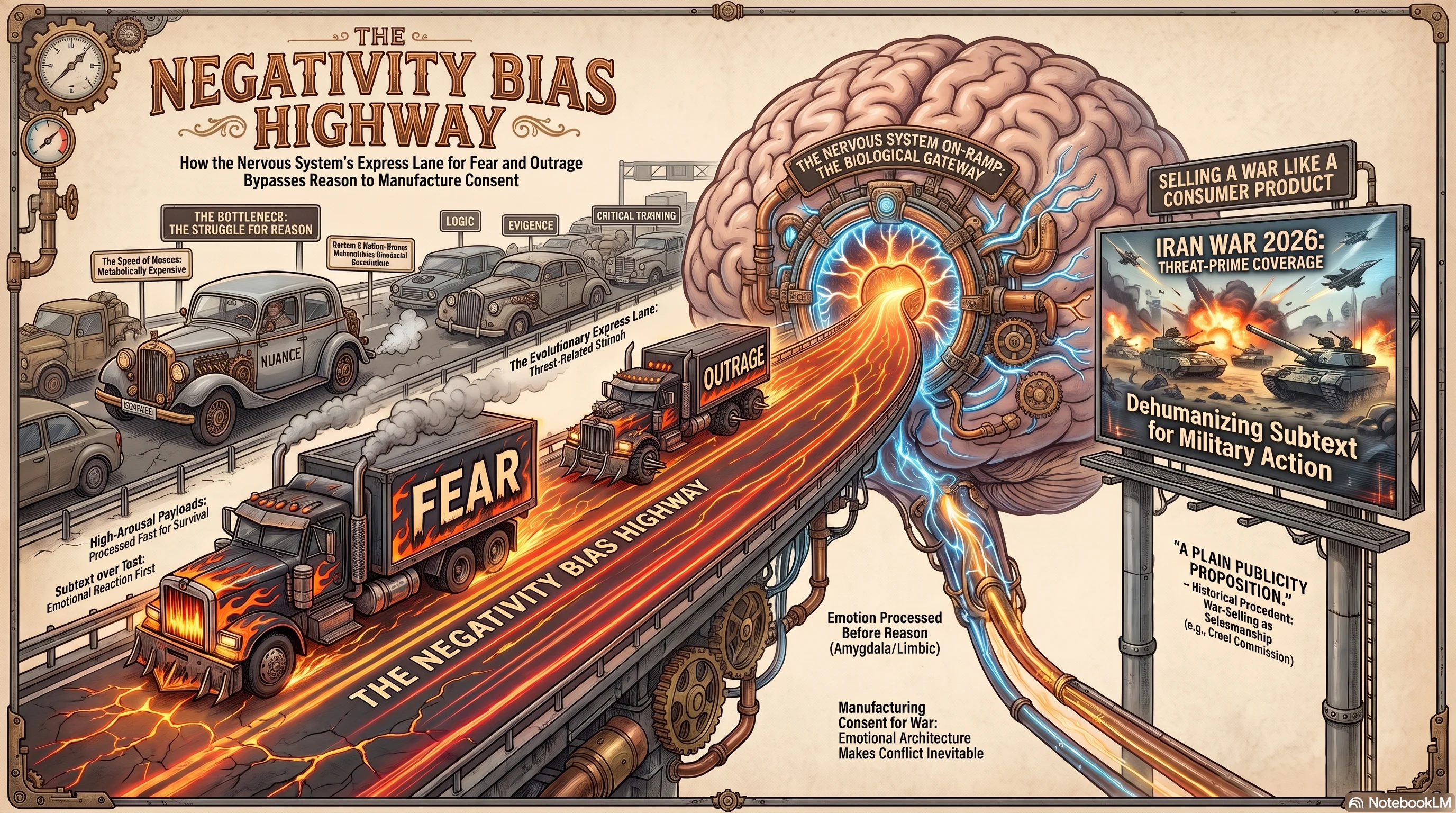
Learning Objectives
- 1Define negativity bias and explain why outrage spreads faster than calm
- 2Identify fear appeals and recognize when a raw appeal to fear is covering a lack of evidence
- 3Distinguish text (what is explicitly said) from subtext (what is emotionally implied)
- 4Name Hitler's three propaganda directives as Spitale catalogues them, and identify them operating in 2026 discourse
- 5Apply the Source-Code Audit to a piece of war-selling content
Hook: Selling the 2026 Iran War
On May 26, 2026, PBS Frontline premiered The War Cabinet, a documentary investigation of the rhetorical, diplomatic, and intelligence-shaping run-up to the United States' direct military engagement with Iran. By the time the documentary aired, the war was already underway. The film is therefore not a prediction. It is an autopsy of how the American public, and, more precisely, the American media ecosystem, was prepared to accept the war as not only necessary but morally inevitable.
The case is worth dwelling on because it is unfolding in front of you in real time. It is not a faded historical curiosity that you must trust a teacher's framing of. You can read the headlines that ran in the months before the first strike. You can watch the cable segments. You can scroll the social posts. The mechanism Spitale lays out in Chapter 4 of How to Win the War on Truth is not a museum piece; it is operating, at scale, on your feed, right now.
Here is the pattern, compressed. Over the eighteen months preceding the war, the dominant emotional register of coverage about Iran shifted from policy-debate (sanctions, the nuclear deal, regional diplomacy) to threat-prime (imminent danger, ticking-clock framings, the unique evil of a specific adversary). The shift was not announced. It did not arrive in a press release. It arrived in the subtext: in the choice of verbs, in the selection of images, in the recurring use of certain stock phrases ("regime," "rogue state," "existential threat") that carry their conclusions inside them. By the time the explicit argument for war was made, the emotional architecture to receive that argument had already been built.
This is what Spitale, citing the founders of FactCheck.org, calls the "If it's scary, be wary" principle. In Chapter 4, Spitale quotes Brooks Jackson and Kathleen Hall Jamieson's instruction directly: a raw appeal to fear is often used to cover a lack of evidence that a real threat exists. The corollary, which the unit will spend the next several thousand words unpacking, is this: when you notice your body responding to a piece of media before your mind has finished parsing the message, you have just been hit with a fear appeal. The appropriate next move is not to share. It is to slow down and ask what evidence is supposed to be carried by the feeling.
The War Cabinet is useful precisely because it documents this on both sides of the camera. Frontline interviews White House staff, intelligence officials, and journalists who covered the run-up. The film catalogues a tight feedback loop: anonymous official briefs reporter, reporter writes alarming story, alarming story is cited by anonymous official in the next brief as evidence of public concern, anonymous official briefs second reporter on the new "rising alarm," cable producers book the most hawkish guests because the hawkish framing now has the strongest news hook. The loop is self-sustaining because each turn raises the emotional temperature, and each rise in temperature makes the next turn easier to book, easier to publish, harder to interrupt with a calm question.
Notice what this loop does not require. It does not require a coordinated conspiracy. It does not require any single actor to lie. It requires only that the participating institutions all be tuned to the same signal, fear sells, attention follows alarm, the next show needs a hotter take, and that nobody in the chain stop to ask the slow question. The system runs on negativity bias the way a power grid runs on voltage. Spitale's Chapter 4 is the wiring diagram.
Think About
Before you continue: pick one piece of war-related content you have seen in the last week: a headline, a clip, a social post. What is the dominant emotion it produced in your body? Not what you thought; what you felt. Hold that emotion in mind as you read the rest of this unit.
The hook to this unit, then, is not a single moment. It is a documented eighteen-month emotional preparation, captured by working journalists in The War Cabinet, of which the war itself is the downstream consequence. The rest of this unit will give you the framework to take that documentation apart.
Spitale's Framework: The Emotional Subtext Under Every Message
Spitale opens Chapter 4 with a sentence that is doing more work than its plainness suggests. The opening claim of the chapter is this:
"Emotions are the hidden motivator (the subtext) behind our thoughts and actions (the text). Our emotional attachment is what makes propaganda stick, because people make decisions based not on reason but on feeling. Negative emotions like hate, fear, spite, and anger trump all others emotions because of our negativity bias."
Spitale opens the chapter by relocating the source of propaganda's power from the realm of argument to the realm of feeling. The reader is being told that the analysis to follow will not be about what political messages say but about what they make the body do.
Read that quote three times. Most of Spitale's Chapter 4 is in it. Three moves are happening at once.
Text versus subtext
The first move is the distinction between text and subtext. Text is what is explicitly said. Subtext is what is emotionally implied. A campaign ad that says "America's leadership is restoring stability" is a piece of text. The subtext, what your body absorbs before your mind has finished parsing the sentence, might be "we are surrounded by chaos and only this leader stands between you and it." The text describes a fact. The subtext sells fear. Spitale's Chapter 4 trains you to read both lines simultaneously, because most political communication is engineered so that the text gives you a deniable claim while the subtext does the actual selling.
The implication is uncomfortable but it is the foundation of the whole course: in mature propaganda, the literal content of the message is almost irrelevant. The point is the feeling the message leaves you carrying when you put your phone down. If you remember nothing else from Chapter 4, remember that the propagandist's product is not an idea; it is an emotional state.
Cross-Curricular Connection: That formulation assumes a propagandist picked the feeling. Sometimes nobody did. On September 16, 2001, George W. Bush called the coming war on terrorism "this crusade." In ordinary American speech the word means a vigorous campaign, as in a crusade against litter, and what follows in the record, a press-secretary walk-back within days and a presidential mosque visit in the same week, points away from the historical sense being the one intended. It landed anyway, because audiences across Muslim-majority countries supplied eight centuries of freight the speaker was not carrying. Set the reception of that one word against Spitale's model and the model needs a second case. A sender can write the subtext. A receiver can also install it out of memory the sender never consulted. Both leave the audience holding an emotional state. Only one of them has an author, and reading an author into the other is its own dependable way to get a message wrong.
Negativity bias
The second move is the identification of the specific psychological vulnerability that propaganda is engineered to exploit: negativity bias. Spitale defines this directly in the chapter's key-terms list as "our tendency to react more strongly to negative stimuli than to positive stimuli." This is not a moral failing. It is a feature of the nervous system that, in evolutionary terms, kept your ancestors alive. The branch breaking under your foot needs to be processed faster than the flower blooming next to it. The threat must register first.
The trouble is that the same hardware that helped your ancestors survive a sabertooth is now sitting in your pocket attached to a content-recommendation algorithm trained on engagement. Spitale puts it bluntly in Chapter 4: "This is why political smear campaigns are so successful and why partisan media specialize in outrage." The negativity bias is not a bug that propaganda exploits despite the system's design. It is the design. The architecture of the modern attention economy is built on top of it.
Notice the asymmetry. A calm explainer of a complex policy will, all else equal, generate less engagement than a furious thirty-second clip about the same policy. Not because the calm explainer is less true. Because the human nervous system spends more attentional energy on threat than on context. Propagandists, advertisers, and algorithm designers have known this for over a century. The negativity bias is the highway, and on that highway, fear and outrage drive faster than calm and curiosity.
"If it's scary, be wary"
The third move in Chapter 4 is the diagnostic Spitale borrows from Brooks Jackson and Kathleen Hall Jamieson, the founders of FactCheck.org. He quotes them directly:
"If it's scary, be wary. A raw appeal to fear is often used to cover a lack of evidence that a real threat exists."
Jackson and Jamieson founded FactCheck.org in 2003 at the Annenberg Public Policy Center. Their diagnostic for evaluating frightening claims has become a standard of media-literacy education.
Sit with the second sentence. The diagnostic is not that fear is always wrong. Sometimes the building is in fact on fire and someone has to scream. The diagnostic is about the substitution structure: when a communicator has weak evidence for a claim, the temptation to compensate with strong emotional intensity is enormous, because intense feeling is read by the audience as evidence. A frightened source feels credible. A frightened source feels like they know something you don't. The fear functions as a stand-in for the data the source does not have.
Spitale's chapter spends pages cataloguing this substitution structure as it shows up in advertising, in product marketing, in political smear campaigns. Bottled water sold on contamination fear. Home alarm systems sold on the imagery of strangers in your kitchen. Border-wall politics sold on imagery whose statistical premises do not survive examination. The pattern is consistent: when the evidence is thin, the affective intensity is cranked up to compensate.
Hitler's three propaganda directives
The most uncomfortable move in Chapter 4, and the move that requires the most analytical discipline from the reader, is Spitale's explicit citation of the three propaganda directives Adolf Hitler set down in Mein Kampf and operationalized through Joseph Goebbels' Reich Ministry of Public Enlightenment. Spitale lists them, in the chapter's key-terms section, as:
- Appeal to negative emotions.
- Repeat falsehoods.
- Direct anger at adversary.
A note on how to read this section before going further. Spitale cites these directives not because every contemporary use of them is morally equivalent to Nazi propaganda. He cites them because the directives are documented, they are openly stated, in primary sources, by the practitioners who refined them, and because the structural identity of the techniques is not in dispute. When a contemporary political operation deploys the three moves in sequence, what you are observing is not "like Nazi propaganda by analogy." You are observing the same engineering choices being made for the same reasons. The contemporary moral judgment is the reader's exercise. The mechanism is the curriculum.
Walk the three directives through the 2026 Iran case from the Hook.
Appeal to negative emotions. The dominant emotional register of the run-up was fear, specifically, fear of an imminent catastrophic act by a specific named adversary. Other emotional registers (curiosity about Iranian society, hope for diplomatic resolution, grief over the human cost of any war) were systematically underweighted in the cable-news booking patterns The War Cabinet documents.
Repeat falsehoods. Spitale's directive does not require that every claim be literally false. It requires that contested or weakly-supported claims be repeated until their unverified status drops out of audience memory. The Iran run-up featured several intelligence assertions that were treated as settled fact in repeat citation, despite remaining contested at the analytic level. The War Cabinet interviews working intelligence officers who watched assessments hardening in public discourse faster than the underlying evidence base was hardening internally.
Direct anger at adversary. This is the consolidation move. Once the body is afraid and the falsehoods have created a sense of confirmed threat, the audience needs a target. The target is supplied: a specific regime, a specific leader, a specific category of person. The fear becomes anger; the anger becomes permission for action that the audience would not have authorized from a position of calm.
The structural sequence, fear, repetition, target, is what makes the techniques work. Any one move alone is insufficient. Together, they manufacture consent for action the population had not previously authorized.
❓Concept Check
Spitale defines text as what is explicitly said and subtext as what is emotionally implied. Why does he argue that subtext is the more important layer to analyze in propaganda?
▸
Concept Check
Spitale defines text as what is explicitly said and subtext as what is emotionally implied. Why does he argue that subtext is the more important layer to analyze in propaganda?
Because mature propaganda is designed so that the literal claim of the message is deniable or innocuous while the emotional state the message produces in the audience does the actual work. People act on what they feel, not on what they read; the propagandist's real product is the feeling. Decoding the text without decoding the subtext leaves the manipulation intact.
Emotional awareness as the counter-move
Chapter 4 does not leave the reader in the diagnosis. Spitale's antidote is what he calls emotional awareness: the practice of pausing, before acting on a piece of media, long enough to name the emotion the media just produced in you. The chapter's "Further Discussion" section explicitly recommends that readers keep a journal for a week, periodically reflecting on what they are feeling and labeling the emotion ("bored," "anxious," "disappointed," "embarrassed," "excited") whenever they are highly aroused. The premise is that you cannot regulate what you cannot name. An unnamed emotion runs the show. A named emotion can be examined.
This is also why the chapter ends with an application exercise asking the student to identify the emotion behind eleven everyday actions: throwing a dish (anger), giving a sad friend a hug (comfort, empathy), bouncing your knee while waiting for blood-test results (worry). The exercise is deceptively simple. Its point is to build the reflex of seeing the emotion first, before the action, so that when the same reflex is run against a political message you can catch the feeling at the moment it is being deposited in you.
The corresponding political application exercise in Chapter 4, identifying the emotions evoked by a string of tweets responding to a hypothetical California cap-and-trade bill, is a good index of how granular Spitale wants you to get. Each tweet in the exercise leads with a different emotional payload (curiosity, disgust, fear, paranoia, doubt). The lesson is that a single news event can be wrapped in entirely different emotional packaging by entirely different communicators, and each package will produce a different behavior downstream in the audience. The event is the same. The propagandist's choice is the wrapper.
Cross-Curricular Connection: The personal-level recognition of emotional manipulation, the trained pause that catches the fear appeal before it produces the behavior, is the central skill of the Think for Yourself course's Political Manipulation unit. Where this unit gives you the population-level analysis of how the manipulation is engineered, that unit gives you the personal-level practice of refusing to be the product the manipulation is trying to produce.
Intake-Layer Overlay: Kahneman as the System 1 Emotion Gateway
The Kahneman overlay was introduced earlier in the course and will recur. Here it does specific load-bearing work, because emotion is not simply one of the inputs to System 1. Emotion is the primary input. It is the channel by which a message can be made to act on you before you have decided whether you agree with it.
The vocabulary, in case you have not seen it elsewhere: Daniel Kahneman, in Thinking, Fast and Slow (2011), draws a distinction between what he calls System 1 (fast, automatic, emotional, effortless, always running) and System 2 (slow, deliberative, analytical, effortful, lazy). System 1 is the autopilot. System 2 is the pilot who sometimes wakes up. The trouble is that System 2 is metabolically expensive and the brain is a thrifty organ; given the chance, it will let System 1 finish the task and move on. Most of what you experience as "thinking" is in fact System 1 running pattern-match on familiar inputs, with System 2 occasionally rubber-stamping the conclusion.
Emotion is System 1's native protocol. A frightening image does not need to be evaluated to produce a fear response; the response is the evaluation. By the time you consciously notice that the image frightened you, your heart rate has already changed, your attention has already narrowed, your readiness to act on threat-related information has already increased. The body responded before the mind parsed. The mind, parsing later, often finds itself constructing reasons that justify what the body already did.
This is the gap propaganda lives in. Consider the sequence:
- The message arrives via a visual or auditory channel (a video clip, a headline, an image).
- System 1 produces an emotional response within milliseconds: fear, disgust, anger, contempt. The physiological signature is already laid down.
- Several hundred milliseconds later, System 2 begins to parse the literal content.
- By the time System 2 reaches a verdict, the audience has already updated their priors on the underlying issue, because the emotional response itself was read as evidence ("if I'm this afraid, the threat must be real").
The propagandist does not need to defeat System 2. The propagandist only needs to ensure that System 1 has done the work before System 2 arrives. Once the emotional state is laid down, System 2's role degrades from evaluator to rationalizer. The mind constructs the case for what the body has already concluded.
This is why Spitale's emphasis on subtext, in Chapter 4, is not a literary nicety. Subtext is the System 1 payload. Text is what System 2 sees when it finally shows up. A piece of propaganda that has done its job well will leave System 2 with an entirely defensible literal text to point at, "I never said X, I only said Y," while the System 1 payload, which actually moved the audience, was X all along.
The implication for the student is precise. The defense against fast-channel emotional manipulation is not better arguments. Better arguments arrive too late; they are System 2 work, and the manipulation has already been completed by the time System 2 gets the file. The defense is a trained pause, Spitale's emotional awareness practice, that interrupts the System 1-to-behavior pipeline long enough for System 2 to actually do its work. The pause is unglamorous. It is a beat of stillness in which you ask: what just happened in my body, and is that response calibrated to the evidence? It is also the only intervention that works at the speed at which the manipulation operates.
Cross-Curricular Connection: Kahneman's two systems have an anatomy, and it is less flattering than the metaphor. Joseph LeDoux traced two routes a threatening signal takes at once: a fast one through the thalamus to the amygdala, which fires the response before you know what you are responding to, and a slower one up to the cortex that produces the accurate picture a fraction of a second later. That is the gap described above, measured. See the amygdala's two routes in Psychology, and notice what it costs you. The low road is the same circuit that makes you flinch at a stick in the dark before deciding it is not a snake. Spitale's trained pause cannot switch it off, because switching it off would be a worse deal than the propaganda.
Scholar Roundtable
Spitale gives you the spine. Three additional scholars sharpen specific edges of the analysis.
Jason Stanley on dehumanization as upstream preparation
Jason Stanley is a philosopher at Yale whose 2015 book How Propaganda Works is the most rigorous contemporary treatment of how propaganda functions inside ostensibly democratic societies. Stanley's central contribution to the framework you are building is the insight that emotional manipulation is rarely the first move. It is preceded, almost without exception, by a rhetorical preparation phase in which the language available to talk about a target population is gradually impoverished.
The preparation works like this. Before a population can be targeted with effective fear and anger appeals, the audience must first have its vocabulary shaped so that the target is no longer described in terms that activate fellow-feeling. The shift is usually subtle. A category of person is referred to by an abstract noun rather than a personal one. Pronouns shift from "people" to "they" to "them" to a pejorative shorthand. Verbs of agency are stripped away ("voted," "argued," "organized" become "swarmed," "flooded," "infested"). By the time the explicit fear appeal arrives, the target has been linguistically prepared so that the audience's normal empathy circuits are not triggered by hearing the target named.
Stanley calls this the demagogue's prerequisite. Spitale's three Hitler directives, fear, repetition, direct anger at adversary, assume that the audience can be made to feel anger at a specific category of person. Stanley's contribution is to point out that this assumption is itself manufactured, by a phase of language work that happens months or years before the explicit propaganda campaign. When you notice a contemporary discourse shifting its vocabulary about a category of person, when the descriptors are getting smaller, harder, less individuated, you are watching Stanley's preparation phase in real time. The fear appeal that follows will land harder because the linguistic ground has been prepared.
Robert Cialdini on the weapons of influence
Robert Cialdini's Influence: The Psychology of Persuasion (first published 1984, substantially revised in 2021) is the textbook of compliance professionals: salespeople, fundraisers, advertisers, political operatives. Cialdini catalogues what he calls the seven weapons of influence: reciprocity, commitment and consistency, social proof, liking, authority, scarcity, and unity. Each weapon exploits a different automatic response that, in ordinary social life, helps people coordinate efficiently. In the hands of a skilled manipulator, the same automatic responses become levers.
Two of Cialdini's weapons matter most for this unit. The first is scarcity: the principle that humans value things more when they are or appear to be in short supply. Scarcity is the engine of fear-based marketing. "Only three rooms left at this price." "Borders out of control." "America in decline." The implied loss does the work; the actual evidence base is secondary. Spitale's fear-appeal analysis in Chapter 4 is, in Cialdini's vocabulary, a special case of scarcity exploitation: scarcity of safety, of stability, of the imagined national past.
The second is social proof: the principle that humans look to the visible behavior of others to decide how to behave themselves. This is the engine of the cable-news feedback loop The War Cabinet documents. If three networks are running alarming coverage, viewers conclude the alarm is warranted because the alarm is widespread; the widespread alarm becomes evidence for the underlying claim, even though the alarm was generated by the networks responding to each other, not to the underlying evidence. Social proof, weaponized, manufactures the appearance of consensus, and the appearance of consensus is itself a fear-reducing signal that paradoxically licenses the fear.
The reason Cialdini matters for Spitale is that Cialdini gives you the transactional structure underneath the propaganda. Propaganda is not free-floating ideology. It is a sale. The weapons of influence are the sales techniques. Naming them in Cialdini's vocabulary, scarcity, social proof, authority, lets you see the move as a craft, not a mystery.
Whitney Phillips on rage-bait and coordinated harassment
Whitney Phillips, a media researcher whose work on the early-internet troll subculture and on contemporary mis- and disinformation has shaped the field, is the scholar who has done the most rigorous documentation of how Chapter 4's mechanisms operate inside platform-native communication. Her 2015 book This Is Why We Can't Have Nice Things and her later collaborative work on networked harassment supply the contemporary case material.
Phillips' key insight, for this unit, is that rage is the platform's preferred fuel. Not because the platforms are ideologically committed to rage, but because rage is what their engagement metrics reward. A furious post generates replies, quote-tweets, screen-shots, and follow-on furious posts. A calm post generates a like and is forgotten. The platforms did not design this; they discovered it. Having discovered it, they tuned their recommendation systems to prefer it. The recommendation systems then created an emergent incentive for communicators to package every message in the highest-arousal emotional wrapper available. The platform did not require anger. The platform's economics made anger the lowest-cost, highest-yield communication strategy.
Phillips also documents the coordinated harassment layer that operates on top of this incentive structure. Once anger has been engineered, it can be aimed. Networks of accounts, some human, some bot, some semi-automated, can be directed at a chosen target, producing a flood of hostile attention that functions as a punishment mechanism for speech the network's organizers want to suppress. The result is a chilling effect that the platforms officially deplore and that their economics quietly reward. Phillips' work makes clear that the contemporary "outrage economy" is not a moral failing of users. It is a structural property of systems designed to maximize engagement on top of nervous systems with a negativity bias.
Folding Ideas as the video-essay companion
For students who want to see what the analytical posture this course is teaching looks like in long-form video, Dan Olson's YouTube channel Folding Ideas is the recommended companion. Olson is not a credentialed academic, but his work, particularly his investigations of cryptocurrency, multi-level marketing, and the rhetoric of online financial scams, is a model of patient, evidence-grounded media analysis. His method is the one this course is trying to install: take a piece of contemporary communication, slow it down, name the moves, cite the primary sources, and refuse to be hurried by the urgency the artifact itself is trying to manufacture.
The Folding Ideas posture is also a useful counter-example to the dominant attention-economy register. Olson's videos are long. They are calm. They refuse cliffhangers. They are watched, by millions of people, precisely because they treat the audience as intellectual colleagues rather than emotional targets. The fact that such work has a large audience is evidence that the rage-bait equilibrium is not the only equilibrium available. It is, however, the easiest to reach. Choosing differently requires effort.
Historical Fractal
The contemporary case from the Hook, The War Cabinet's documentation of the run-up to the 2026 Iran war, is not unprecedented. It is one iteration of a pattern this country institutionalized over a century ago. The first explicit federal propaganda agency in American history was created to sell a war the public did not want, and the techniques it perfected are the techniques the modern media ecosystem now executes by default.
The Committee on Public Information
In April 19171917, one week after the United States entered the First World War, President Woodrow Wilson signed Executive Order 2594 creating the Committee on Public Information (CPI). The agency is also known as the Creel Commission, after its chairman, George Creel, a progressive journalist from Missouri. The CPI's mandate, in plain English, was to persuade a reluctant American public to support a war that the same public had recently re-elected Wilson on the promise of avoiding.
The political problem was acute. Wilson had won re-election in November 1916 on the slogan "He kept us out of war." Five months later, he was asking Congress to declare it. The gap between the campaign promise and the policy reversal had to be closed inside the population's emotional ledger, fast, or the war would be fought against domestic opposition that would make execution impossible. The CPI was the instrument designed to close that gap.
Creel staffed the agency with journalists, advertisers, academics, and artists. The CPI's output, over the next eighteen months, was vast: 75 million pamphlets in multiple languages, 6,000 press releases, an extensive program of war posters, films, and traveling exhibitions. It was the first time the federal government had operated, openly, as a national-scale persuasion machine. The vocabulary "propaganda" did not yet carry the negative valence it would carry by the 1930s; CPI staff used the word about themselves without apology.
The Four Minute Men
The most operationally instructive CPI program, for this unit, was the Four Minute Men. Beginning in summer 19171917, the CPI recruited 75,000 volunteer speakers across the country and trained them to deliver four-minute speeches, the length of a movie-reel changeover at a local cinema, on assigned topics provided by CPI headquarters. The speakers stood up in 7,500 communities, in cinemas, churches, schoolrooms, and fraternal halls, and delivered the same talking points, on the same week, with regional variations.
The genius of the program was that it solved the credibility problem that a centralized federal message would otherwise face. The speeches were delivered by trusted local figures, the dentist, the schoolteacher, the merchant, who carried social proof their audiences would not have given to a Washington pamphlet. The CPI provided the script. The community supplied the trust. The combination was the first deliberate exploitation of what Cialdini would later catalogue as the liking and authority weapons of influence operating in concert with social proof.
Spitale's three Hitler directives map cleanly onto the Four Minute Men script library, two decades before Hitler wrote Mein Kampf. Appeal to negative emotions: the standard speech topics included atrocity reports, threat of imminent German invasion, and the danger of internal enemies. Repeat falsehoods: the CPI's atrocity propaganda recycled British war-office claims about German conduct in Belgium that postwar investigation found to be substantially exaggerated. Direct anger at adversary: the standard rhetorical move was to convert generalized war anxiety into specific anger at "the Hun," a dehumanizing shorthand the CPI distributed across all its outputs.
This is not a casual parallel. The mechanism is the same because the target is the same, a population's nervous system, and the nervous system has not been redesigned in the intervening century.
The atrocity-propaganda campaign
The CPI's atrocity-propaganda campaign is the most documented piece of the operation. Reports of German soldiers bayoneting Belgian babies, raping nuns, and crucifying captured Allied soldiers were distributed through CPI channels and reprinted by virtually every American newspaper. Many of the most lurid stories were British in origin, drawn from the Bryce Report of 1915, whose methodology, depending heavily on uncorroborated witness statements collected under conditions that made falsification trivial, was substantially discredited in postwar academic review.
The pattern is exactly Spitale's Chapter 4 diagnostic: a raw appeal to fear used to cover a lack of evidence that a real threat exists. The evidence base for the most lurid atrocity claims was thin to nonexistent. The emotional intensity was maximal. The substitution structure operated as advertised, fear functioned as evidence, and the postwar reassessment, when it arrived, was carried by a small number of academic historians while the original images remained burned into the public memory of an entire generation. This is the durability problem of fear-based propaganda. The correction never reaches the audience the lie reached.
Cross-Curricular Connection: Ask why the correction failed and the answer is not that Americans were credulous. Maurice Halbwachs argued that memories are recalled externally, through the groups a person belongs to, and that collective memory keeps what holds the group together. The CPI's atrocity reports were rehearsed by 75,000 local speakers in the churches, cinemas, and schoolrooms where those groups actually met. The postwar reassessment was carried by a small number of academic historians. See Halbwachs on collective memory in Philosophy of History for why a story with that distribution behaves like a memory rather than a claim, and why a claim is the only one of the two that a correction can reach.
Creel's own memoir
In 19201920, two years after the war ended, Creel published a memoir titled How We Advertised America: The First Telling of the Amazing Story of the Committee on Public Information that Carried the Gospel of Americanism to Every Corner of the Globe. The title is not satirical. Creel was, in his own self-conception, proud of the achievement. The memoir is the closest thing in American history to a propaganda agency's own postmortem.
"In all things, from first to last, without halt or change, it was a plain publicity proposition, a vast enterprise in salesmanship, the world's greatest adventure in advertising... We did not call it propaganda, for that word, in German hands, had come to be associated with deceit and corruption. Our effort was educational and informative throughout, for we had such confidence in our case as to feel that no other argument was needed than the simple, straightforward presentation of facts."
Creel's postwar memoir is one of the most candid documents in the history of state-sponsored persuasion. He describes the CPI's work in the explicit vocabulary of advertising, without the embarrassment that the word 'propaganda' would acquire in the following decade. The book is best read as a confession written by someone who did not yet know it was a confession.
Read Creel's second sentence carefully. He claims the CPI's work was distinguishable from German propaganda because "our effort was educational and informative throughout." The atrocity reports were not, by the postwar evidence, factual. The threat of German invasion of the American mainland was not, by the postwar evidence, real. The CPI's "presentation of facts" was a presentation of a selected set of facts assembled to produce a specific emotional state in the audience. Creel does not appear to be lying in the memoir; he appears to genuinely not see that his definition of "the facts" was itself the product of the persuasion machine he was running. This is what makes the memoir useful. It is a primary source on how propagandists describe their own work to themselves.
The Bernays through-line
One CPI staffer's career deserves specific attention, because his post-CPI career is the bridge between the wartime persuasion apparatus and the peacetime public-relations industry this course will return to in later units. Edward Bernays, a young Vienna-born nephew of Sigmund Freud, joined the CPI's foreign-press section in 1917. He was twenty-five. The CPI taught him that mass emotional persuasion was an operational technology, not a theoretical possibility. He spent the rest of his life applying that lesson to commercial and political clients.
In 1928, Bernays published Propaganda, the foundational text of the public-relations profession. The book's opening sentences, the famous claim that "the conscious and intelligent manipulation of the organized habits and opinions of the masses is an important element in democratic society," are unintelligible without the CPI in the background. Bernays had watched the technique work, at national scale, on a population that had not wanted to be persuaded. The conclusion he drew was that the same technique, applied in peacetime by private clients rather than the federal government, would be the dominant communication mode of the twentieth century. He was substantially correct.
From the Creel Commission to the 2026 War Cabinet
Committee on Public Information founded
politicalWilson signs Executive Order 2594 creating the first explicit U.S. federal propaganda agency under journalist George Creel. Mandate: sell a war to a population that had voted against it.
Atrocity-propaganda campaign at peak
politicalCPI distributes Belgian atrocity reports, many drawn from the 1915 Bryce Report, through Four Minute Men speakers in 7,500 communities. The evidence base is thin; the emotional intensity is maximal.
Creel publishes 'How We Advertised America'
politicalCreel's postwar memoir, written in the proud vocabulary of advertising, becomes the closest thing in American history to a propaganda agency's own postmortem.
Bernays publishes 'Propaganda'
culturalEdward Bernays, a CPI alumnus, codifies what he learned at the Commission into the foundational text of the public-relations profession. The wartime technique becomes the peacetime industry.
Iraq WMD case constructed
politicalA more recent precedent for the 2026 case: intelligence assertions hardened in public discourse faster than the underlying evidence hardened internally. The postmortem arrived years after the war was launched.
The War Cabinet airs on Frontline
politicalPBS documents the eighteen-month emotional preparation that preceded the Iran war. The mechanism is one century old. The platforms are new.
The point of the fractal is not that 2026 is 1917. The point is that the engineering is the same, because the base it operates on, the human nervous system, with its negativity bias and its System 1 emotion gateway, has not been redesigned. The packaging changes. The cable booking patterns The War Cabinet documents are doing the work the Four Minute Men did in church basements. The mechanism is the inheritance.
The Source-Code Audit Applied
The Source-Code Audit is the recurring three-question protocol this course installs. The protocol was introduced in Unit 1. This is the fifth iteration. The artifact under audit is a representative sequence from The War Cabinet: a cable-news segment, replayed in the documentary, in which an anonymous administration source warns of an "imminent and catastrophic" Iranian capability, intercut with B-roll of military hardware and stock footage of Tehran street scenes shot from a low angle. The segment runs approximately ninety seconds. The chyron reads "BREAKING: NEW INTELLIGENCE."
Walk the three audit questions through it.
Question 1: Simon/Kahneman. What emotion is this artifact engineered to make the body feel? Which System 1 shortcut is being exploited?
The dominant emotional payload is fear, specifically the variant of fear that combines imminence ("immediate") with catastrophic-magnitude implication ("catastrophic"). The word imminent is doing System 1 work that the segment's literal claims could not do on their own; it activates the threat-response system, narrows attention, and elevates the audience's readiness to accept the next claim as evidence of the previous one.
The visual grammar reinforces this. Military hardware shots prime the audience for a context in which force is the natural response. Low-angle Tehran B-roll, a stock shot used because it is visually charged, not because it documents anything specific about the current claim, primes the audience for an interpretation of Iranian society in which threat is the salient feature. None of this is in the text of the segment. All of it is in the subtext.
The System 1 shortcut being exploited is the availability heuristic combined with the negativity bias. The availability heuristic is the mental shortcut by which the ease of imagining an event is mistaken for the probability of the event. The segment hands the audience an easy-to-imagine catastrophe and lets the imagining substitute for evidence. The negativity bias ensures the catastrophe is weighted more heavily than competing, calmer interpretations of the same intelligence.
Spitale's Chapter 4 diagnostic, "if it's scary, be wary; a raw appeal to fear is often used to cover a lack of evidence that a real threat exists," applies precisely here. The segment carries no specific evidentiary content the audience can evaluate. It carries an anonymous source's adjective ("imminent") and a visual mood. The intensity is doing the work the evidence is not doing.
Question 2: Zuboff. Who profits from your engagement with this version of reality? What behavioral data is being collected?
The question forces an inventory of beneficiaries. Run it.
The cable network running the segment profits from the engagement directly: the segment is high-arousal, which translates into longer viewer sessions, lower channel-change rates, and higher advertising rates. The network's economic interest is in more such segments, not in fewer. The fear is not a side effect of the network's work. It is the product.
The platforms that distribute the clip, the same segment will be uploaded to social platforms and shared by viewers within hours, profit similarly. The clip will generate replies, quote-shares, and follow-on engagement. The recommendation algorithms will surface the clip to users whose past engagement patterns predict that they will engage with high-fear content. Each engagement updates the platform's behavioral model of the user, refining the targeting of future content, including future advertising. The fear, in the Zuboff vocabulary, is being converted into behavioral data, which is being converted into prediction products, which are being sold to advertisers and political-targeting firms.
The political actors who supplied the anonymous source profit by having the public's emotional baseline shifted in the direction that licenses the policy they have already decided to pursue. The intelligence assessment, as The War Cabinet documents through interviews with working analysts, was contested internally. By moving the contested assessment into the public domain in maximum-arousal packaging, the political actors create a public-pressure context in which the contested status of the assessment becomes harder to maintain. The fear, in this respect, is being converted into political authorization.
The audience pays the cost. The audience pays in attentional bandwidth (the segment occupies cognitive real estate that could have been spent on the calmer, more evidence-laden coverage that exists but does not get distributed). The audience pays in nervous-system wear (chronic fear-arousal has documented health costs). The audience pays in behavioral-data surrender (every engagement updates the targeting model). The audience pays in political agency (the fear that licenses the war is not an authorization the audience would have given from a position of calm).
The asymmetry is the point. The fear flows down the pipeline; the value flows up.
Question 3: Habermas. Is this artifact inviting you to understand the world, or demanding you comply with a predetermined position?
This is the diagnostic question that names the manipulation, definitionally. Habermas distinguishes communicative action, speech that invites mutual understanding through the exchange of reasons, from strategic action, speech designed to produce a specific behavioral outcome regardless of the listener's reasoned consent.
Apply the diagnostic to the segment. Is the audience invited to weigh the evidence and reach a conclusion? No specific evidence is supplied that the audience could weigh. Is the audience invited to consider counterarguments? No counterposition is represented in the segment's ninety seconds; the structure is monological. Is the audience invited to update toward a particular conclusion through a specific chain of reasoning? The audience is invited to feel the conclusion through a specific chain of emotional priming.
The segment is strategic action. It is engineered to produce a specific downstream behavior, public support for military action against Iran, via a route that bypasses the audience's deliberative capacity. The fact that the audience experiences the resulting position as their own conclusion is the desired outcome, not evidence against the diagnosis. Strategic action that the listener experiences as their own opinion is strategic action that succeeded.
Spitale's emotional-awareness practice is the counter-move. The segment can only do its work if the audience does not name the emotion the segment just produced in them. A trained audience, pausing for the beat, noticing the imminent and the chyron and the low-angle B-roll, asking what evidence is supposed to be carried by the feeling, that audience has interrupted the strategic action and converted the segment, for themselves, back into the literal text it actually contains, which is one anonymous adjective and ninety seconds of mood.
❓Concept Check
In the Source-Code Audit, why is Habermas's question, 'is this inviting me to understand or demanding I comply?', the diagnostic that names the manipulation, definitionally?
▸
Concept Check
In the Source-Code Audit, why is Habermas's question, 'is this inviting me to understand or demanding I comply?', the diagnostic that names the manipulation, definitionally?
Because the distinction between communicative and strategic action is the distinction between speech that respects the listener as a rational agent and speech that treats the listener as a behavioral target. When the audit identifies an artifact as strategic action, it has named the artifact as a manipulation in the technical sense, not as a moral judgment but as a category description of what the artifact is doing.
Closing: Anger as a Renewable Resource
Most of what an industrial economy needs is finite. Oil runs out. Lithium runs out. Water, in any given place, runs out faster than the populations dependent on it have planned for. The attention economy discovered, over the course of the twentieth century, that one resource human beings produce in functionally unlimited quantities is anger. A population can be enraged today and re-enraged tomorrow and re-enraged the day after, on the same underlying issue, with diminishing but never quite exhausted returns. The grievance does not need to be settled. The grievance needs only to be renewed, kept warm in the public mind through a steady drip of fresh outrage, each item small enough to forget by next week but large enough to engage with this week.
This is what makes anger such an attractive commercial substrate. Unlike satisfaction, which terminates the transaction, anger seeks its next object. The audience that finishes a furious post does not feel resolved; they feel primed for the next furious post. The platforms are built to supply that next post within seconds. The supply chain runs from the propagandist's word choice through the algorithm's engagement-prediction model to the user's swipe, and at every node, the economic interest of the node is best served by keeping the audience angry rather than letting them rest.
Spitale's Chapter 4 names the substrate. Hitler's three directives, appeal to negative emotions, repeat falsehoods, direct anger at adversary, are not historical curiosities. They are an operations manual whose third step is the harvest. The first two steps prepare the field; the third step is where the value extraction happens. The audience that has been made afraid, and to whom contested claims have been repeated until they feel settled, is an audience whose anger is now available to be aimed.
That aiming is the next move. Once you can produce anger at scale, the question becomes what to do with it. The most common answer, the answer Spitale takes up in Chapter 5, and the answer Unit 6 of this course will take up next, is to use the manufactured anger to sort the population. Anger is the energy. Division is the use of the energy. A population sorted into in-groups and out-groups, makers and takers, us and them, is a population whose anger has been organized into a political instrument. The propagandist's product, in this respect, is not just the emotion. It is the direction of the emotion.
You will see, in Unit 6, that the sorting move follows the emotional-manipulation move with structural necessity. There is no point in producing anger if the anger has nowhere to go. There is no point in dividing the population if the division does not draw on a pre-existing emotional charge. The two units describe two halves of the same machine. This unit gave you the engine. The next unit will show you the steering.
Three closing instructions for the student before that handoff.
First, build the pause. Spitale's emotional-awareness practice is not a self-improvement exercise; it is a defense against the fastest manipulation channel in the system. Keep the journal for a week, as Chapter 4 recommends. Label the feelings as they arrive. The reflex you are training is the only one that operates at the speed at which the manipulation operates.
Second, expect the fear appeal to escalate. The 2026 Iran case is one iteration of a pattern that will iterate again, on different adversaries, in your lifetime. The War Cabinet is not the last documentary of its kind; it is the most recent. When you notice the next case beginning, when the vocabulary about a category of person starts contracting, when the cable-news temperature starts rising on a specific named threat, when the anonymous-source briefings start hardening contested intelligence into settled fact, you will not be surprised. You will have the framework to name what is happening as it happens.
Third, do not mistake the framework for a license to disengage. The point of this unit is not that you should stop caring. The point is that you should care under conditions you have chosen, on evidence you have examined, with emotions you have named. The propagandist's preferred audience is one that is either fully aroused or fully numb. The audience this course is trying to produce is one that is awake.
Onward to Unit 6, where the manufactured anger gets aimed at the manufactured enemy, and the population sorts itself into the categories the propagandist has prepared for it.
The May 2026 FRONTLINE documentary about the second Trump administration's war cabinet is the canonical contemporary evidence for the fear-appeal mechanics Spitale's Chapter 4 names. Walk students through the sequences on how Iran intelligence assessments were framed publicly versus what officials say privately. The emotional architecture of war-selling — negativity bias, the appeal to physiological threat, the substitution of subtext for evidence — operates in real time. Pair with the Creel Commission historical fractal in the unit text.
Watch on YouTube